ALoDLM:自适应循环扩散语言模型 ALoDLM: Adaptively Looped Diffusion Language Models
在去噪步内用token级自适应潜空间循环,让易预测词早提交、难预测词多迭代,质量速度兼得
前置知识
掩码扩散语言模型(Masked DLM)
一类通过「加噪—去噪」生成文本的语言模型:训练时随机把序列中部分 token 替换为 [MASK],模型学习在被破坏的上下文中并行恢复所有被掩码位置;推理时从含掩码的序列出发,每个去噪步同时预测多个掩码位置并填回,迭代若干步得到完整文本。与自回归模型逐 token 生成不同,DLM 天然支持并行解码,因而吞吐量潜力更高,但传统上质量落后于同规模 AR 模型。
ALoDLM 整个框架建立在 DLM 的去噪过程之上,「外循环」就是一次次去噪步;理解标准 DLM 对所有掩码位置施加均匀固定深度计算这一缺陷,是读懂本文动机与设计的前提。
循环深度 / Looped Transformer
把若干 Transformer 层打包成一个核心块并反复执行(权重共享),在不增加参数量的情况下提升有效深度。相当于用同一组权重迭代式地精炼隐状态,循环次数 $K$ 成为推理时可调的「虚拟深度」,已被证明能增强算法类与推理类任务表现,是参数量之外的一条新扩展轴。
ALoDLM 的 Recurrent Core 就是一个 looped Transformer(8B 模型重复中间 16 层),只有理解权重共享下的多次前向,才能明白「潜状态迭代精炼」和「计算按需分配」是如何实现的。
自适应计算与停机策略(ACT/PonderNet 一脉)
让网络对每个输入动态决定「算多少步」的机制。ACT 用累积加权决定停止时机;PonderNet 学习每步停机概率,并对所有可能退出深度求期望损失来训练。本文沿用「停机概率 + 截断几何先验」的思路,但因 token 提交会改变后续上下文,无法对所有联合退出方案精确求和,需要重新设计训练目标。
ALoDLM 的 ExitGate 与退出时刻表(exit schedule)正是这类机制;理解它才能分清本文与 PonderNet/Ouro 的本质差异——前者做序列级信用分配,后者只做逐深度期望求和。
变分下界(ELBO)与潜变量
当模型含不可直接观测的潜变量 $z$(本文中是每个 token 的退出深度)时,对数似然 $\log p_\theta(y|x)=\log\sum_z p_\theta(y,z|x)$ 难以直接优化。引入近似后验 $q_\phi(z|x,y)$,用 Jensen 不等式得到可优化下界:$\log p_\theta \ge \mathbb{E}_{q_\phi}[\log p_\theta(y|x,z)] - D_{\mathrm{KL}}(q_\phi\|\pi)$,从而同时优化生成模型与后验近似。
本文把 token 级计算分配建模为潜变量并推导出条件 NELBO(式 5),这是联合训练去噪器与停机策略的数学基础;不懂 ELBO 就无法理解其训练目标的来源与合理性。
score-function 梯度估计(REINFORCE)与控制变量
对离散决策(如采样出的退出深度 $z\sim q_\phi$)无法直接反向传播,REINFORCE 利用 $\nabla_\phi\,\mathbb{E}_{q_\phi}[f]=\mathbb{E}_{q_\phi}[f\,\nabla_\phi\log q_\phi]$ 估计梯度,但方差大。控制变量(baseline)技巧减去一个与决策无关的参考量(如首轮读出的损失),在不改变期望的情况下降低方差。
退出时刻表是离散潜变量,ALoDLM 训练停机策略依赖单轨迹 score-function 估计器(Proposition 1),并配上一阶控制变量与中间监督等方差缩减技巧,这是理解 §3.2 与附录 C 的必要背景。
KV 缓存与注意力上下文
Transformer 推理时把每个历史 token 在每层的 Key/Value 缓存下来,避免每生成一个 token 就重算整个前缀,是 AR 推理加速的基石。缓存与计算深度绑定:同一物理层在不同循环深度下接收不同隐状态,产生的 KV 并不相同。
ALoDLM 权重共享但各深度 KV 不同,需要「深度感知 KV 缓存」(每个前缀位置按匹配深度取用、以最深可用深度兜底),这直接决定了它的服务实现、显存开销与首 token 延迟等局限。
研究动机
扩散语言模型(DLM)通过在每个去噪步并行恢复多个被掩码 token 来实现快速生成,但与同等规模的自回归(AR)模型相比始终存在质量差距。作者把根因归结为「计算—难度失配」:在同一个去噪步内,不同被掩码位置的预测难度差异巨大——有些 token 只涉及局部续写、几乎一次前向即可确定,另一些则源于内在不确定性、多跳推理需求或对尚未解析 token 的依赖,需要多得多的计算。而标准 DLM 对所有未知位置施加完全相同、固定深度的去噪器:同一份计算既浪费在简单预测上,又让困难预测「吃不饱」。已有的置信度解码只是把低置信 token 推迟到后续去噪步,但被推迟的 token 在下一步会从 mask 嵌入重新计算,此前为它做的潜状态计算成果被整体丢弃。AR 模型因为每步只在完全已解析的前缀上预测单个 token,天然回避了这种步内分配问题。后果是实际的质量落差:8B 规模上最强 DLM 基线 WeDLM-8B 十一项基准平均 75.1,仍低于 Qwen3-8B-Instruct 的 78.5。
本文的目标是本文的目标是从根因上消除 DLM 的「计算—难度失配」,让去噪步内的计算量随 token 难度动态伸缩:简单 token 尽早提交为离散上下文,困难 token 保留并持续精炼其持久潜状态,通过额外循环轮次继续打磨。为此需要四件事:(1)一个支持 token 级自适应循环深度的架构(Prelude/Recurrent Core/Coda 三段式 + 双输出头);(2)一个能端到端联合学习「token 预测」与「计算分配策略」的原理性目标——把 token 级退出时刻表当作潜变量并推导条件 NELBO;(3)一个低方差、可稳定训练的梯度估计器(无偏单轨迹估计 + 方差缩减);(4)把方法扩展到 8B 参数并验证:在保持并行快速解码的同时,质量上超越所有被评估 DLM 乃至对应的 Qwen3 AR 基线,形成更强的质量—效率权衡。
与已有工作不同的是,既有弥合 DLM 质量差距的工作主要走两条路:一是重新引入 AR 结构(Block Diffusion、SDAR 的块扩散、WeDLM 的流式提交);二是把 DLM 降格为 AR 验证的起草器(TiDAR、DFlash 等)。已有的「循环 DLM」(Lee et al. 2026 等)虽在步内做循环,但循环深度对所有 token 位置全局统一,仍无步内 token 级自适应性;FReDA 虽支持 token 级提交,但迭代修改的是显式 token 草稿而非传播内部潜状态。ALoDLM 的独特切入点是「步内 token 级潜深度」:已提交 token 以离散嵌入反馈进循环状态、未提交 token 跨轮传递隐状态,二者并行推进;训练上用条件 NELBO 处理「提交改变上下文、联合退出方案指数爆炸」的难题,以单轨迹 score-function 估计器完成端到端学习。此外工程路线也不同——跳过昂贵的继续预训练(CPT),仅用 5B token 直接 SFT 从 Qwen3 转换出 8B 模型,是迄今最大的 looped DLM。
核心方法
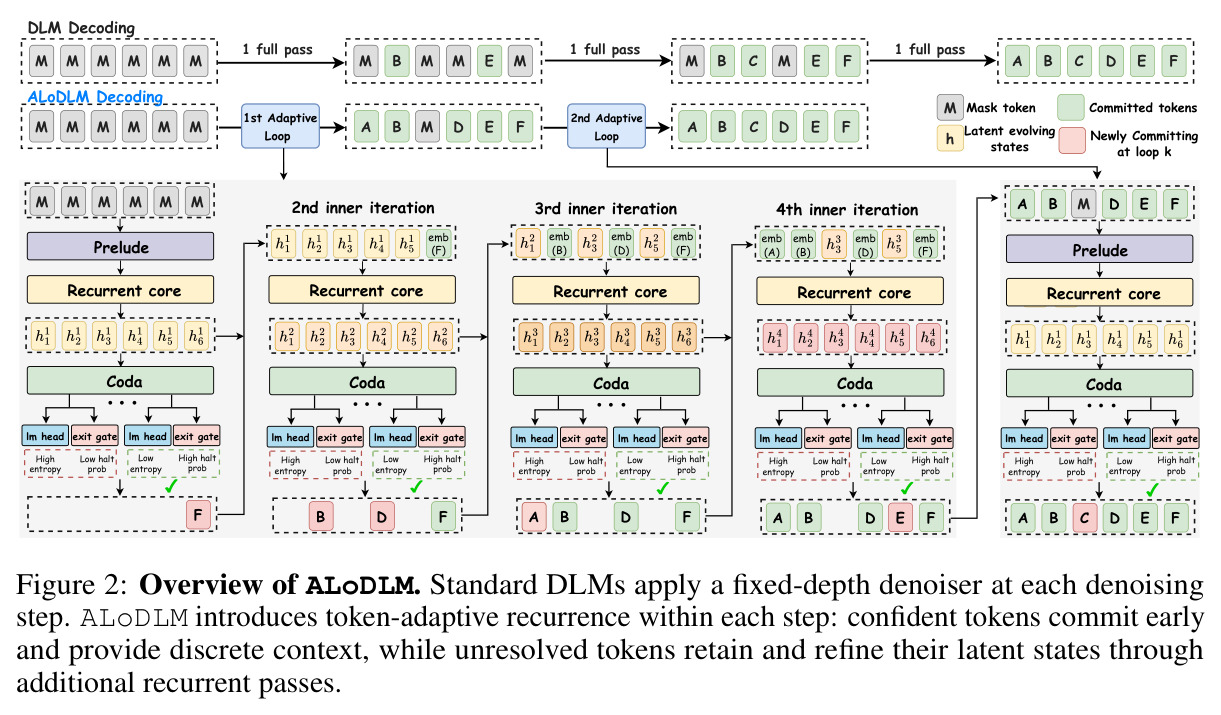
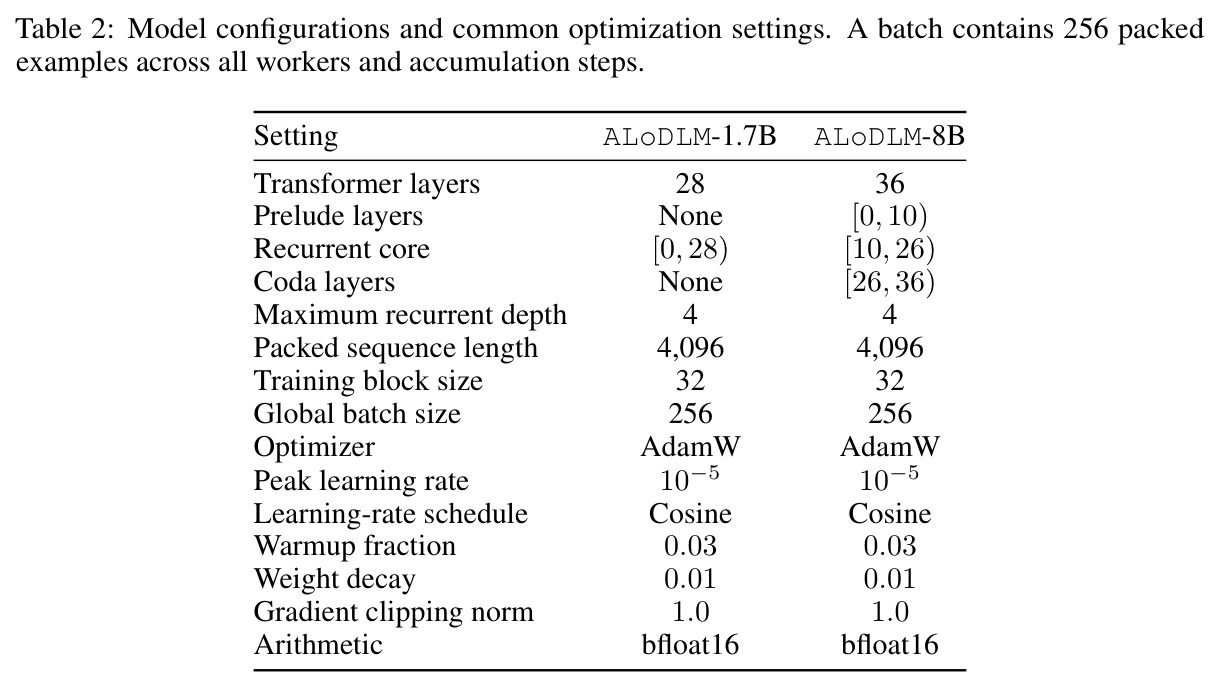
直觉上,ALoDLM 把「一个去噪步」从单次固定深度前向改造成一个内循环:模型每读一遍序列,就有一些被掩码位置变得足够自信、提前「落笔」,其离散 token 嵌入被写回作为新上下文;仍未解决的位置不重置,而是带着积累的隐状态继续下一遍精炼,直到整体足够自信或达到最大循环深度 $K=4$。技术路线上,模型沿用标准 Transformer(Qwen3)并切成三段:Prelude(嵌入层+前缀层,8B 为第 0-10 层)、Recurrent Core(中间共享层,8B 为第 10-26 层共 16 层;1.7B 则复用全部 28 层)、Coda(后缀层,8B 为第 26-36 层)。每轮循环中 Core 更新隐状态、Coda 读出,读出状态 $r^{(s)}$ 同时送入两个头:LMHead 给出词表分布,其预测熵决定哪些 token 提交(熵 $\le\tau$ 即提交);ExitGate 给出该轮停机概率 $\lambda_i^{(s)}=\sigma(\text{ExitGate}(\text{sg}[r_i^{(s)}]))$,决定整体是否继续(未解决位置的累积停机概率均值达到阈值 $q$ 即停,$s=K$ 时强制全部退出)。外层循环不断重复直至序列中再无 [MASK]。训练时通过把 token 级退出时刻表建模为潜变量、最大化条件 NELBO 来联合优化去噪器与停机策略,并用带方差缩减的无偏估计器回传梯度。
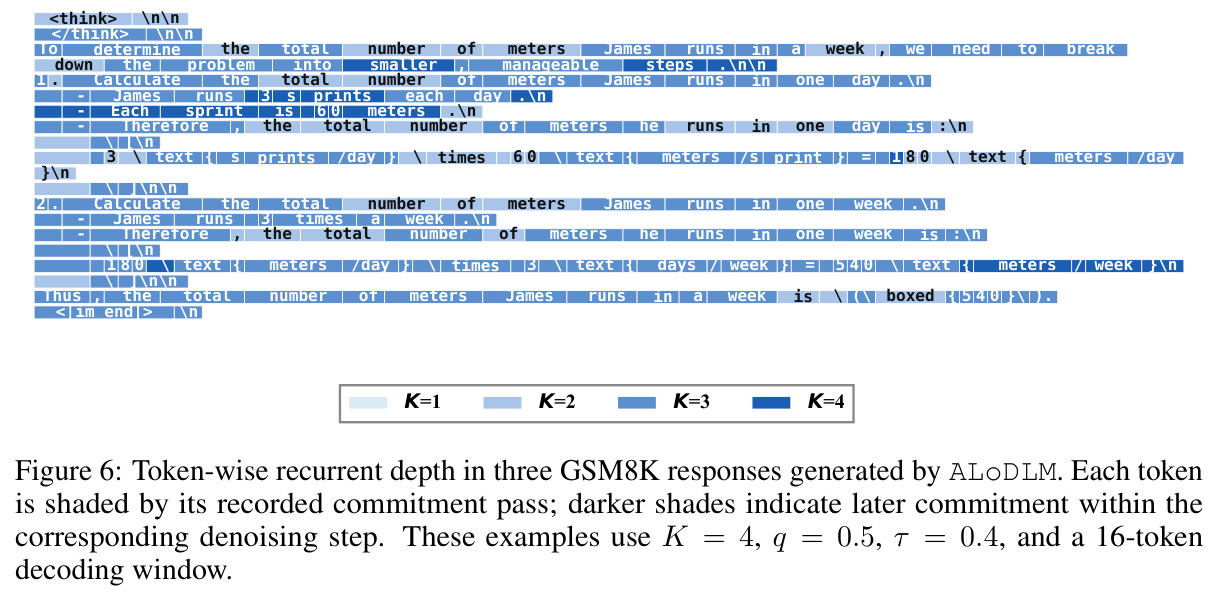
核心创新是「token 级自适应潜深度」与「持久潜状态跨循环传递」。与已有方法的本质区别有三。其一,标准 DLM 和已有 looped DLM 在每个去噪步对所有位置施加同一深度,而 ALoDLM 允许每个 token 在不同循环轮次退出:退出哪些 token 由 LMHead 的预测熵决定(提供并行提交能力),整体是否继续由学习出的 ExitGate 决定(提供深度自适应),两个头职责分离。其二,已提交 token 不是简单丢弃其计算,而是以离散嵌入反馈进循环状态(式 3):$h_i^{(s)}=\text{Emb}(\tilde{y}_i)$(已提交)或 $\tilde{h}_i^{(s)}$(未提交),为剩余位置提供逐渐完整化的上下文,同时未提交位置保留隐状态继续精炼——这修正了置信度解码「丢弃潜计算、从 mask 嵌入重算」的缺陷。其三,训练上把联合退出时刻表 $z$ 当作潜变量,推导条件 NELBO $\mathcal{J}=\mathbb{E}_{z\sim q_\phi}[\mathcal{L}_{\text{traj}}(z)]+D_{\mathrm{KL}}(q_\phi\|\pi)$,用序列级信用分配同时训练预测与计算分配;而非 PonderNet/Ouro 那样对所有候选退出深度精确求和——在本设定下,因为早期提交会改变其余 token 的上下文、联合方案呈指数级,精确求和不可行。
方法步骤详情
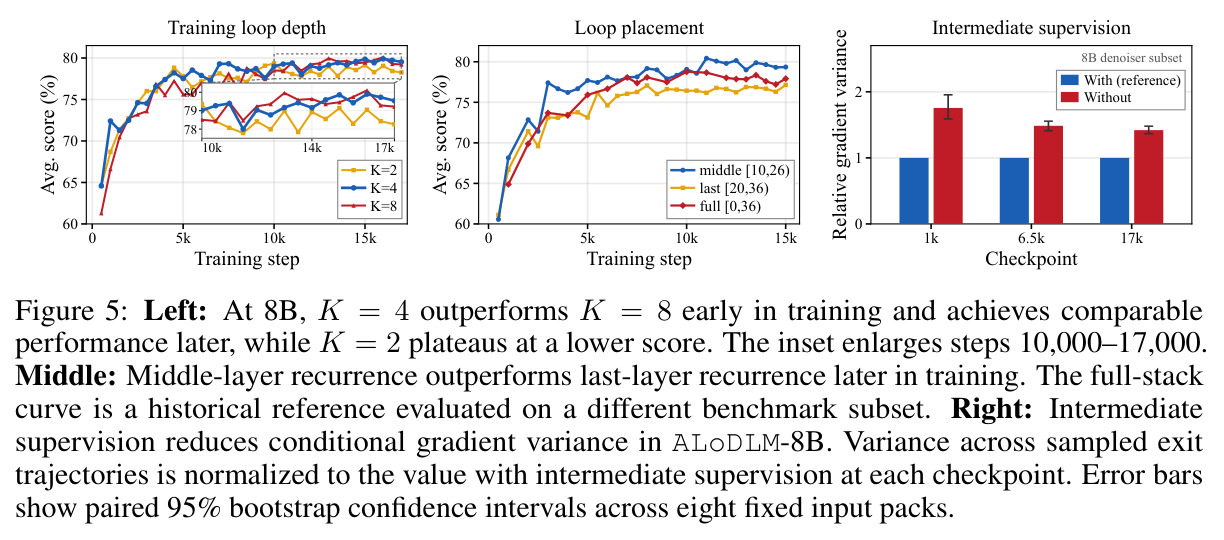
推理按 Algorithm 1 进行。(1) 外循环开始:找出当前序列全部掩码位置 $U$,Prelude 计算初始循环状态 $h^{(0)}=\text{Prelude}(x_t)$,累积停机量 $a$ 置零、已提交集合 $C$ 置空。(2) 内循环第 $s$ 轮:Core 更新 $\tilde{h}^{(s)}=\text{Core}(h^{(s-1)})$,Coda 读出 $r^{(s)}$;LMHead 给出各未解决位置的分布 $p_i^{(s)}$,ExitGate 给出 $\lambda_i^{(s)}$。(3) 提交:把预测熵 $\le\tau$ 的位置收进 $B^{(s)}$,逐位置采样 $\tilde{y}_i\sim p_i^{(s)}$,从 $U$ 移除并加入 $C^{(s)}$;这些位置的隐状态替换为 token 嵌入 $\text{Emb}(\tilde{y}_i)$,其余位置保持 $\tilde{h}_i^{(s)}$。(4) 停机判定:累积 $a_i^{(s)}=a_i^{(s-1)}+(1-a_i^{(s-1)})\lambda_i^{(s)}$;若 $U$ 为空或未解决位置的平均 $a$ 达到阈值 $q$ 则结束内循环,否则继续到最大深度 $K=4$。(5) 若本轮无任何提交,则强制提交熵最低的一个位置以保证进展;随后把所有提交 token 写入序列,进入下一个去噪步,直至无 [MASK]。训练上:以 WeDLM 的流式块扩散框架做直接 SFT(5B token,每 32-token 块独立采样掩码率 $t\in[0,1]$);以截断几何分布为先验 $\pi_{0,c}(d)\propto e^{-cd}$($K=4$、$c=0.4$,先验平均深度约 2.02);对单条采样轨迹计算轨迹损失 $\mathcal{L}_{\text{traj}}$,用式 (7) 的单轨迹 score-function 估计器(去噪器项 + 策略项 $(\mathcal{L}_{\text{traj}}+\log\frac{\pi(z)}{q_\phi(z)})\nabla_\phi\log q_\phi$)回传;再用首轮读出损失 $\ell_i^{(1)}$ 作控制变量、用权重 $\omega_i^{(s)}$ 对提交前每轮读出做中间监督来降低梯度方差(去除后方差升至 1.76×),配合松弛深度正则 $(\alpha,\beta)=(0.1,1)$ 与等权辅助 AR 损失,得到完整代理损失 $\hat{\mathcal{L}}_{\text{impl}}=\hat{\mathcal{L}}_{\text{den}}+\hat{\mathcal{L}}_{\text{gate}}+\hat{\mathcal{L}}_{\text{AR}}$。
技术新颖性
技术新颖性体现在四个层面。架构上:此前 looped DLM 的循环深度是步内全局统一的,FReDA 一类方法反馈的是显式 token 草稿;ALoDLM 首次在 DLM 去噪步内实现 token 级潜深度——各 token 退出时刻可以不同,且「早退出的离散嵌入反馈」与「未退出的潜状态保留」双通道并行,计算不再因推迟而作废。训练理论上:因为早期提交改变后续上下文,所有联合退出方案的精确边缘化(PonderNet/Ouro 路线)不可行,作者改用变分框架——以 ExitGate 为近似后验 $q_\phi$、截断几何分布为先验 $\pi$,推导出单条损坏样本上的条件 NELBO(Proposition 2),并证明单轨迹 score-function 估计器的无偏性(Proposition 1),把「算多少」变成了与「预测什么」联合优化的对象。优化技巧上:中间监督用 $\omega_i^{(s)}$ 权重复用提交前每轮读出,不需要任何额外前向就把去噪器梯度方差降低约 30%-43%(测量点上 1.76×/1.49×/1.42× 降至 1×);配合首轮控制变量与 $(\alpha,\beta)$ 分离的「个体多样性/聚合先验」正则,让 token 可以偏爱不同深度。系统工程上:为权重共享但深度各异的前向设计了深度感知 KV 缓存(匹配深度优先、最深可用兜底),8B 模型的执行路径为 $10+4\times(16+10)=114$ 层而非全栈 $4\times36=144$ 层,并直接以 vLLM 服务;8B 规模也使其成为目前最大的 looped DLM。
实验结果
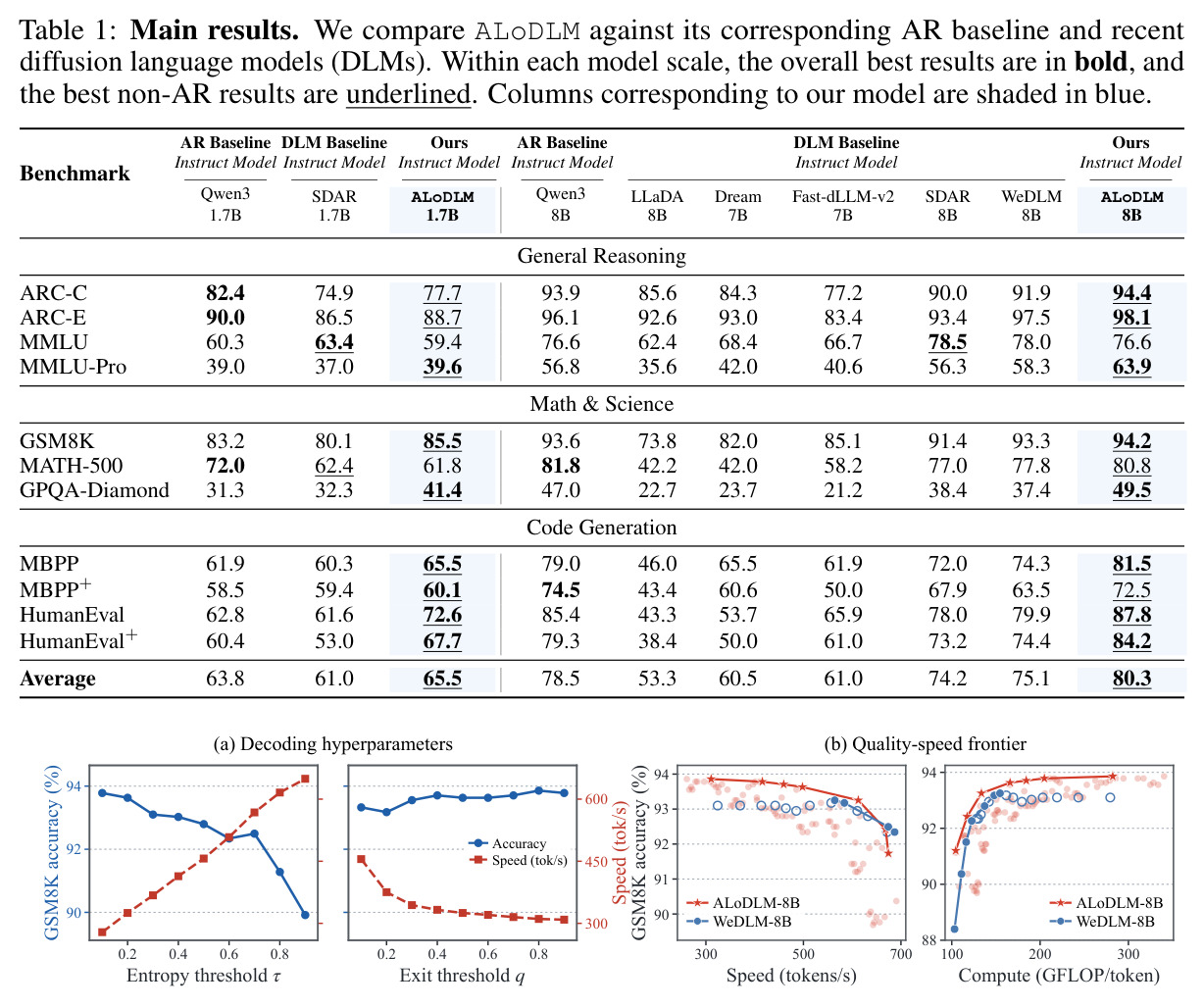
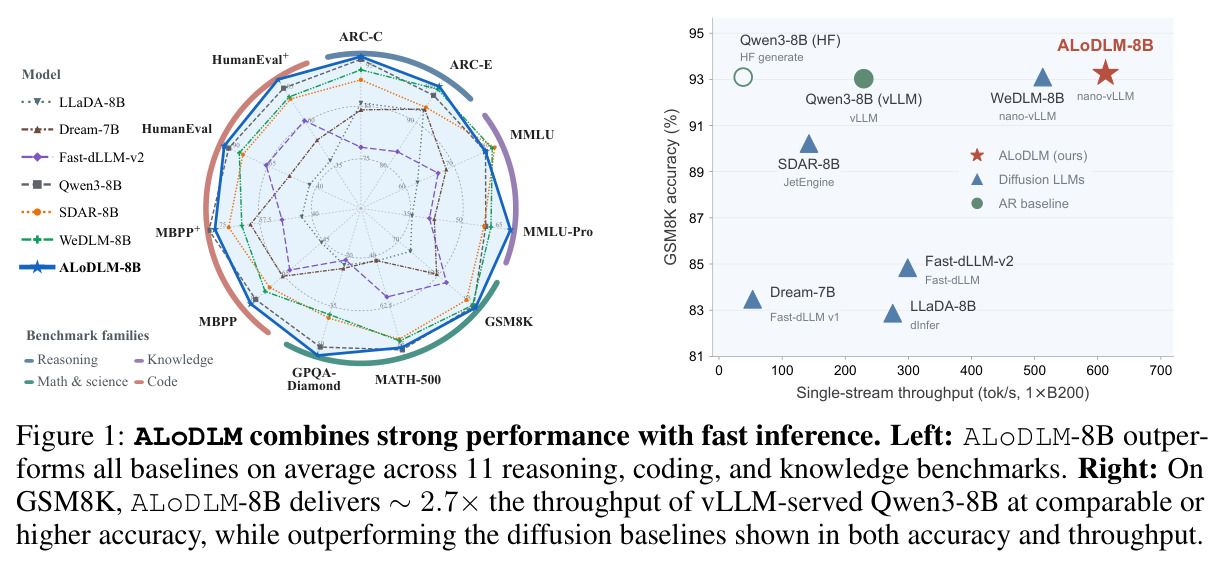
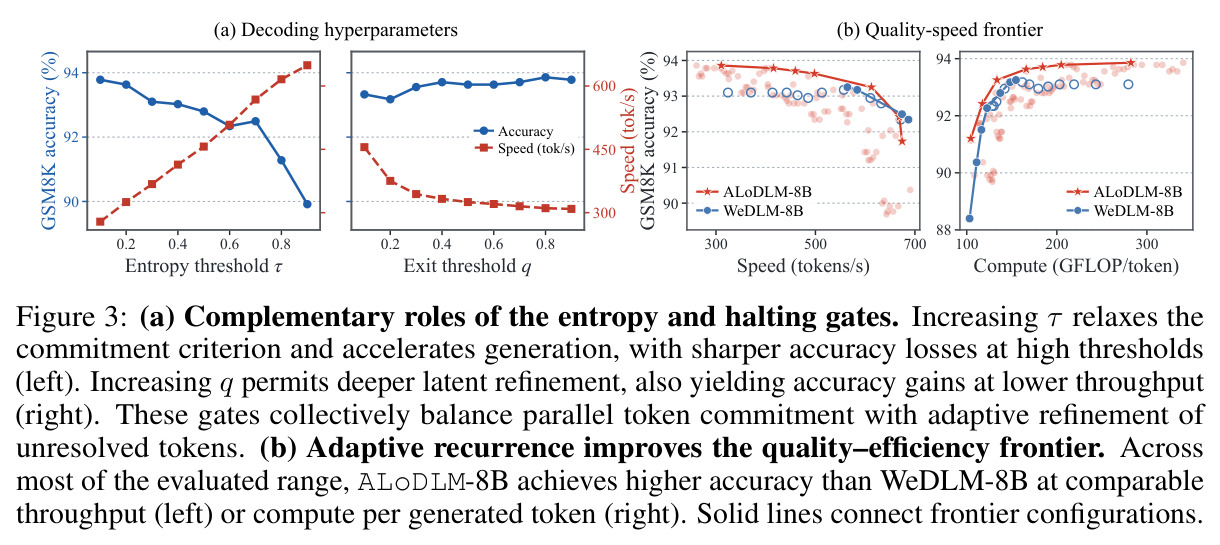
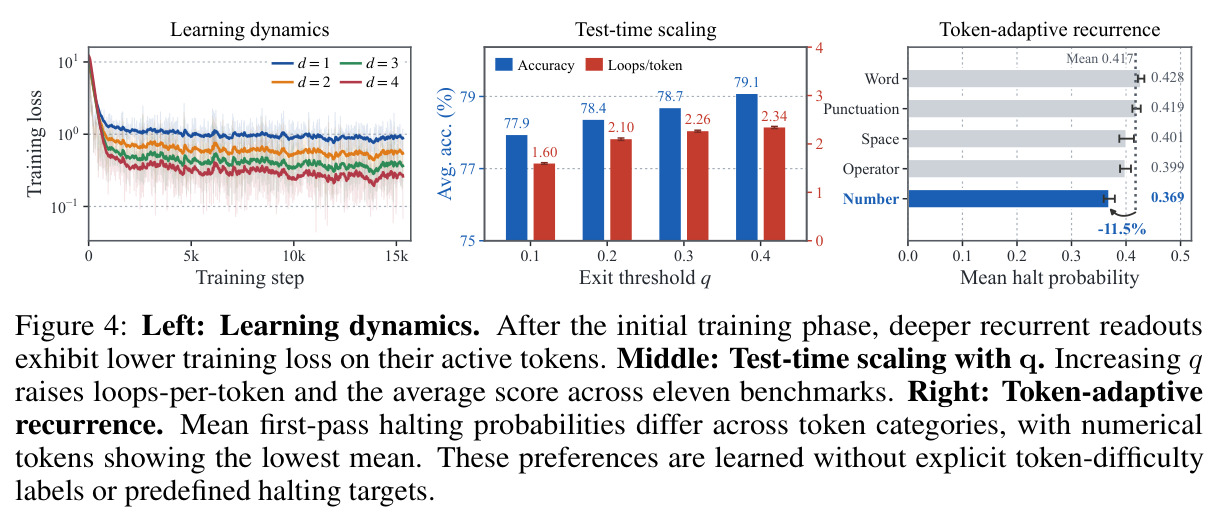
质量上(Table 1,OpenCompass 协议、贪心解码、4096 token 上限、每步提交一个 token 的保守模式):ALoDLM 在 1.7B 和 8B 分别取得 65.5 与 80.3 的十一项基准平均分,超过所有被评估 DLM 与对应 Qwen3 AR 基线——1.7B 对比:Qwen3-1.7B 63.8、SDAR-1.7B 61.0;8B 对比:Qwen3-8B 78.5、WeDLM-8B 75.1、SDAR-8B 74.2、Fast-dLLM-v2 61.0、Dream-7B 60.5、LLaDA-8B 53.3。ALoDLM-8B 比 WeDLM-8B 平均高 5.2 分、在 11 项中 10 项领先;代码生成横扫四项基准(HumanEval 87.8、HumanEval+ 84.2、MBPP 81.5、MBPP+ 72.5,仅 MBPP+ 以 72.5 略低于 AR 的 74.5);GPQA-Diamond 49.5 超 AR 的 47.0;MMLU-Pro 63.9 比 Qwen3-8B 的 56.8 高 7.1。且这只用了 5B token 的直接 SFT,跳过了 SDAR/WeDLM 必需的继续预训练。效率上(单流 B200、各自最优推理引擎):GSM8K 并行解码下 ALoDLM-8B 吞吐约为 vLLM 服务 Qwen3-8B 的 2.7 倍、精度持平或更高;与 WeDLM-8B 的精度—吞吐前沿在约 650 tok/s 处交叉,在 93.25% 匹配精度下 ALoDLM 达 612.4 tok/s(WeDLM 564.2,+8.5%),每 token 计算 133.5 GFLOPs(WeDLM 154.6,−13.6%),且在几乎整个计算区间精度更高。超参行为(Figure 3a,GSM8K):固定 $q=0.5$,把 $\tau$ 从 0.1 提到 0.6,吞吐从 278.7 升至 508.3 tok/s、精度从 93.8% 降至 92.3%,$\tau=0.9$ 时掉至 89.9%;固定 $\tau=0.2$,把 $q$ 从 0.1 提到 0.9,精度从 93.3% 升至 93.8%、吞吐从 455.3 降至 309.0 tok/s。分析与消融(Figure 4、5):提高 $q$ 使每 token 平均循环从 1.6 增至 2.34、平均分从 77.9% 升至 79.1%,验证潜循环是有效的测试时扩展轴;模型自发学到数值类 token 首轮停机概率最低(0.369,比跨数据集均值 0.417 低 11.5%)、词类最高(0.428),无需任何难度标注;$K=2$ 过早进入平台期,$K=4$ 后期追平 $K=8$,故取 $K=4$;中层循环 [10,26) 后期优于末层 [20,36);去掉中间监督后梯度方差在 1k/6.5k/17k 步分别升至 1.76×/1.49×/1.42×。
查看结构化数据
| 任务 | 指标 | 本文 | 基线 | 提升 |
|---|---|---|---|---|
| 8B 十一项基准平均(推理/数学/代码) | 平均分 | 80.3 | Qwen3-8B-Instruct(AR)78.5;WeDLM-8B 75.1;SDAR-8B 74.2 | +1.8 vs AR;+5.2 vs 最强 DLM |
| 1.7B 十一项基准平均 | 平均分 | 65.5 | Qwen3-1.7B-Instruct(AR)63.8;SDAR-1.7B 61.0 | +1.7 vs AR;+4.5 vs SDAR |
| GSM8K 并行解码吞吐(8B,单流 B200) | tokens/s 与 GFLOPs/token(匹配精度 93.25%) | 612.4 tok/s;133.5 GFLOPs/token | WeDLM-8B 564.2 tok/s;154.6 GFLOPs/token;vLLM Qwen3-8B 约 227 tok/s(2.7× 关系) | +8.5% 吞吐、−13.6% 计算量 vs WeDLM;约 2.7× vs vLLM Qwen3-8B |
| HumanEval+(8B) | pass@1 | 84.2 | Qwen3-8B 79.3;WeDLM-8B 74.4 | +4.9 vs AR;+9.8 vs WeDLM |
| GPQA-Diamond(8B) | accuracy | 49.5 | Qwen3-8B 47.0;SDAR-8B 38.4;WeDLM-8B 37.4 | +2.5 vs AR;最高领先 12.1 |
| MMLU-Pro(8B) | accuracy | 63.9 | Qwen3-8B 56.8;WeDLM-8B 58.3 | +7.1 vs AR;+5.6 vs WeDLM |
局限与改进
作者承认两点局限。其一,首 token 延迟(TTFT)可能比同级 AR 模型更长:prefill 阶段要为全部循环深度构建 KV 缓存(8B 模型按 $L+(K-1)m=36+3\times16=84$ 对逻辑 KV 缓冲,而 AR 只需 36 对),这会削弱并行解码对短回答或延迟敏感场景的收益。其二,生成速度本质上是输入依赖的:循环计算量与同时提交的 token 数取决于 token 置信度和自适应停机决策,吞吐在不同 prompt、数据集、领域间波动很大;在训练数据欠表示的领域,模型可能需要更多循环精炼、更少并行提交,速度优势会缩小甚至完全反转。我自己的补充观察:(1) 质量—效率前沿在约 650 tok/s 以上才占优,最快操作点上 WeDLM 反超,说明极限吞吐场景下自适应循环的调度开销并不划算;(2) Table 1 的质量数字来自每步只提交一个 token 的保守模式(此时 $\tau$ 失效),而高并行($\tau=0.9$)下 GSM8K 精度会掉到 89.9%,说明表中的质量与实际并行工作点之间存在落差;(3) 84 对深度 KV 缓冲的显存开销未被充分讨论,长上下文+大 batch 时可能成为瓶颈,且「最深可用兜底」的缓存近似与逐深度重算并不完全等价;(4) 停机策略依赖 REINFORCE 类估计,尽管做了方差缩减,训练对超参($c=0.4$、$(\alpha,\beta)$、$q$、$\tau$)的敏感性只有间接证据;(5) 对比基线几乎全是 Qwen3 转换而来的模型,方法在其他模型族上的普适性有待验证。
独立分析的弱点
弱点一:TTFT 惩罚。短回答、实时对话场景中 prefill 需为 4 个深度构建 KV(84 对缓冲),首 token 延迟上升,可能吞掉并行解码收益。改进方向:按需深度的 prefill(先只为深度 1 构建缓存,遇到深循环再增量补算),或蒸馏一个浅深度近似器供 prefill 使用。弱点二:领域偏移下的吞吐崩塌。在欠表示领域停机策略可能倾向多循环、少并行,速度优势反转。改进方向:利用 $q$、$\tau$ 这两个现成旋钮做领域级校准,或训练一个输入条件化的停机阈值预测器在线调节。弱点三:高并行模式下质量滑坡($\tau=0.9$ 时 GSM8K 89.9%)。改进方向:对提交质量做置信度校准(温度缩放、conformal 预测),或在序列级奖励上微调提交策略,让「敢于并行」与「提交正确」解耦。弱点四:训练管线复杂。REINFORCE + 首轮控制变量 + 中间监督 + 松弛正则的组合工程量大、超参多($c$、$\alpha$、$\beta$、$q$、$\tau$、辅助 AR 权重),复现门槛高。改进方向:探索 Gumbel-Softmax 类连续松弛或 straight-through 估计来简化目标;或冻结去噪器、单独对停机策略做 RL 后训练。弱点五:缓存近似与显存。深度感知 KV 缓存的兜底策略在理论上不等于逐深度重算,长上下文的精度损失未量化;84 对缓冲在高并发服务下是显著负担。改进方向:量化或驱逐低价值深度缓冲,给出近似误差上界,并报告不同上下文长度下的精度—显存曲线。弱点六:评测口径分裂。质量表用每步单 token 的保守模式,效率图用并行模式,两者最优配置不同,部署者需要自行摸索。改进方向:提供按延迟/吞吐 SLA 自动搜索 $(q,\tau)$ 的调度器,并在论文中报告中间工作点的质量数字。
未来方向
作者方向上:论文把 $q$ 明确定位为测试时扩展轴($q$ 从 0.1 调到 0.9,平均分从 77.9% 升到 79.1%),后续可研究「推理预算可控」的分配策略,例如按题目难度自动设定 $q$,把 loops/token 变成显式的推理深度旋钮;代码生成上的全面领先(引用 SMELT 的结论)也暗示可在更长 $K$、更深循环上探索推理任务的上限。基于成果可延伸的方向:(1) 与 AR 验证结合——用 ALoDLM 做起草器、AR 模型做验证器,吸收 Uno/TiDAR 的拒绝采样思想,构造无损加速管线;(2) 把 token 级自适应潜深度移植回纯 AR 模型(与 Mixture-of-Recurrences 交汇),检验「计算—难度匹配」原则是否与扩散框架解耦;(3) 理论侧:为自适应循环深度建立推理 scaling law(Parcae 一脉),给出 loops/token 与精度的解析关系;(4) 训练侧:用重要性采样、多轨迹平均或 offline RL 替代单轨迹 REINFORCE,进一步压低停机策略的梯度方差;(5) 系统侧:为深度感知 KV 缓存设计专用 attention kernel、驱逐策略与量化方案,压低 TTFT 和显存;(6) 架构侧:与 MoE 结合(SMELT 方向)或扩展到多模态扩散模型,检验自适应深度在稀疏与多模态设定中的收益。
复现评估
开源情况良好:代码在 github.com/amazon-science/ALoDLM,模型权重在 HuggingFace(amazon/ALoDLM-8B),另有项目主页。训练配置披露充分:基于 Qwen3-1.7B/8B 主干,用 WeDLM 的流式块扩散框架做直接 SFT(无 CPT),5B token 语料;AdamW、峰值学习率 $10^{-5}$、权重衰减 0.01、cosine 调度、3% warmup、梯度裁剪 1.0;全局 batch 为 256 条 4,096-token 打包序列、块大小 32、bf16、DeepSpeed ZeRO-2;8B 训练 8 个 epoch(34,512 步)并对每第二次循环层调用做激活检查点。关键超参($K=4$、$c=0.4$、$(\alpha,\beta)=(0.1,1)$、质量模式 $q=0.5$、并行模式的 $\tau$ 扫描与窗口 16、位置系数 $\gamma=0.02$)均已给出。难点在于:(1) 5B 语料的确切构成未在正文详述,完全对齐训练分布有不确定性;(2) 8B×8 epoch 的训练需要多卡集群(推测至少 8×A100/H100 级别),论文未报告卡时与总成本;(3) 深度感知 KV 缓存的 vLLM 集成是相当大的系统工程量,复现效率数字需要同代硬件(B200 单流);(4) 策略梯度部分对 stop-gradient 约定、损失归一化等实现细节敏感——附录 C/D 写得较细(含完整证明与 Eq. 34 的完整代理损失),属于「可复现但需精读附录」的中高难度。
论文图表
解码伪代码:外循环处理 [MASK] 直至清空;每步先用 Prelude 初始化状态,内循环最多 $K$ 轮——每轮过 Recurrent Core 与 Coda、算出 $p_i$ 与 $\lambda_i$、更新累积停机量 $a_i$,把熵 $\le\tau$ 的位置采样提交并从 $U$ 移除、其隐状态替换为 token 嵌入;若 $U$ 为空或平均 $a\ge q$ 则 break;若本轮无提交则强制提交熵最低位置;最后把提交 token 写回序列。
推理的每一步输入输出与分支条件都在这 19 行伪代码里,是理解 ALoDLM 与标准 DLM 解码差异、以及 $\tau$/$q$/$K$ 三个超参作用位置的最精确载体。