负向自蒸馏:通过规避缺陷学会推理 Negative Self-Distillation: Learning to Reason by Avoiding Flaws
让模型自演“粗心推理者”生成负向教师,推开缺陷token的概率分布,无标签提升数学推理
前置知识
On-Policy Self-Distillation (OPSD, 在策自蒸馏)
一种 LLM 自改进范式:模型把特权信息(如 ground-truth 标准答案)拼进提示,让同一模型充当“知道答案的教师”,对自己采样出的推理轨迹提供逐 token 的密集 KL 监督,从而绕开“找外部更强教师”的不现实要求。
本文的出发点正是 OPSD 的缺陷:知道答案的教师会产生人工过度自信、线性直给的轨迹,模仿它会压制探索与自我纠错。NSD 是 OPSD 的“反号”替代方案,不懂 OPSD 就无法理解其对比设计。
RLVR 与 GRPO
RLVR 用可验证奖励(如数学答案对错)做强化学习;GRPO 对每个问题采样一组(如 n=8)轨迹,用组内相对奖励做优势估计。其痛点是过易/过难问题上组内奖励全同导致优势坍缩、梯度消失,且结果级奖励无法做细粒度 credit assignment。
本文基线 Intuitor 和 TTRL 都是 GRPO 变体,且 NSD 的效率优势(每样本 1 条 rollout 对比 8 条、每步 68s 对比 187s)必须放在 GRPO 的 rollout 开销背景下才能理解。
Unlikelihood 训练
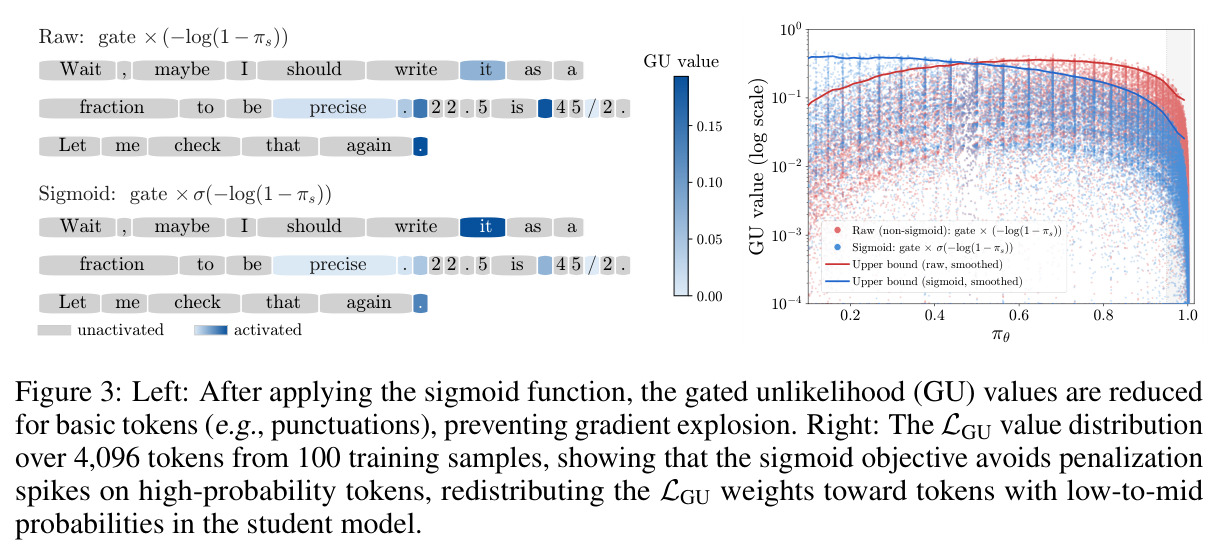
Welleck 等人提出的负向目标:最小化 $-\log(1-p_\theta(y_t))$,直接压低不希望出现的 token 的概率。缺陷是对学生本就高置信的 token,损失与梯度会爆炸($p\to1$ 时趋于无穷),破坏语言先验与训练稳定性。
NSD 的核心损失就是“门控 + Sigmoid 有界化”改造过的 unlikelihood,论文用整节推导其梯度性质,必须先懂原始目标才能看懂改造动机。
前向 KL 散度
$D_{KL}(p\|q)=\sum_v p(v)\log\frac{p(v)}{q(v)}$,衡量用 q 近似 p 的信息损失。本文在采样 token 上做单样本重要性加权估计:$L_{KL}=\pi_{ref}(y_t)\log\frac{\pi_{ref}(y_t)}{\pi_\theta(y_t)}$,避免昂贵的全词表计算。
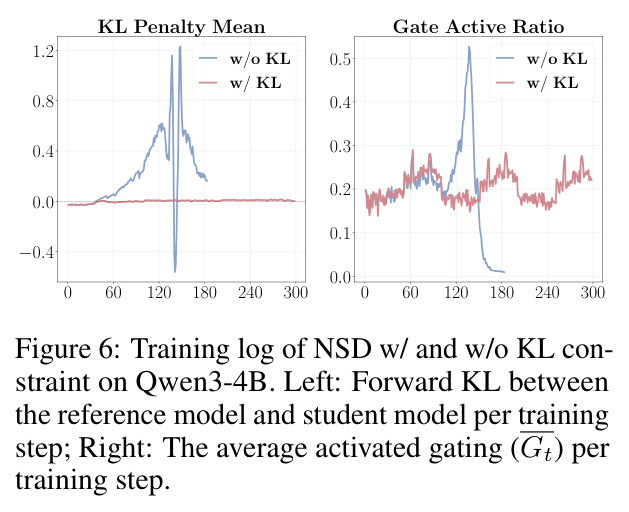
它是 NSD 总损失中的正则锚(权重 α=0.01),把学生拴在参考分布附近;消融实验显示去掉它后训练在约 120 步发生 KL 坍缩与振荡,是稳定性的关键组件。
风格 token 与任务 token
RLCSD 提出的 token 分类:style token 承载语言结构(标点、空格、连接词、停用词),task token 承载推理内容(数字、算符、LaTeX 命令)。已有研究表明蒸馏训练信号常被 style token 主导,学生学到的是文风而非推理。
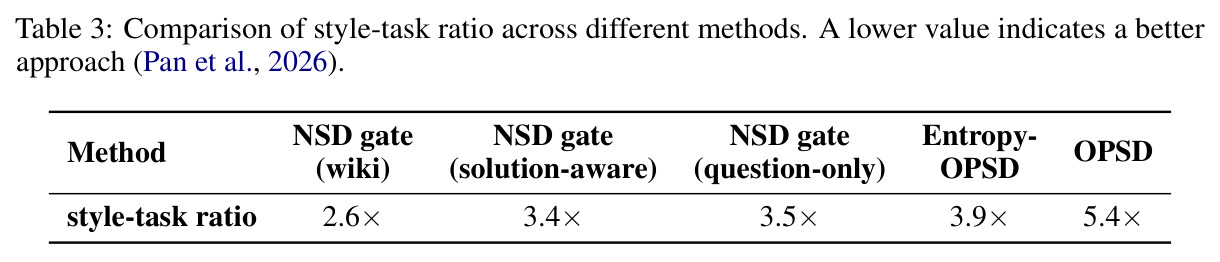
NSD 门控的有效性就用 style-task 比值来量化(NSD 门控 2.6×–3.5×,远低于 OPSD 的 5.4×,越低越好),这是理解“只罚缺陷、不伤语言先验”这一卖点的核心指标。
Avg@8 与 Pass@8
对每题独立采样 8 次:平均正确率叫 Avg@8,衡量平均性能与稳定性;至少一次答对的比率叫 Pass@8,衡量能力上限与输出多样性。
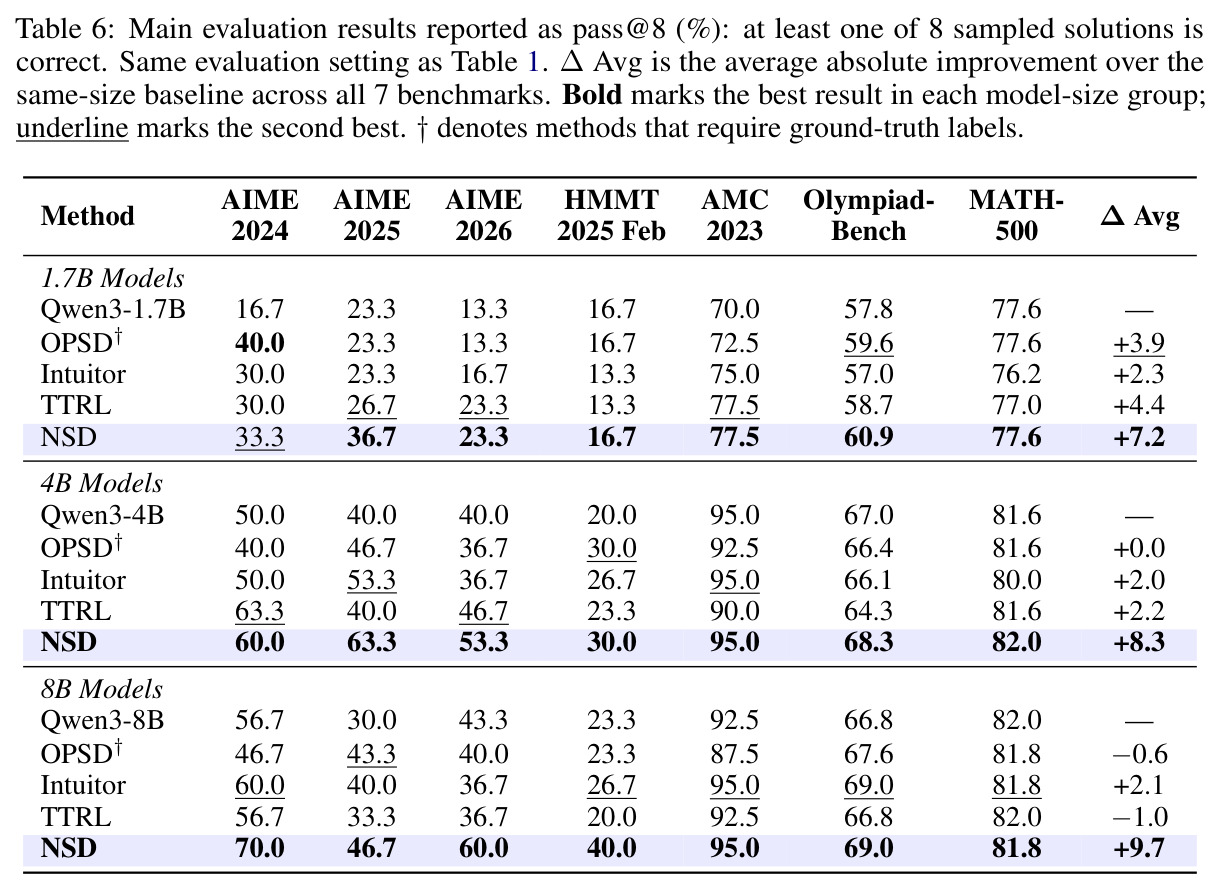
论文主表(Table 1)用 Avg@8,附录(Table 6)补 Pass@8:NSD 在两者上都领先(Pass@8 上 ΔAvg 高达 +9.7%),说明提升不是靠采样运气,两者结合才能完整评估。
研究动机
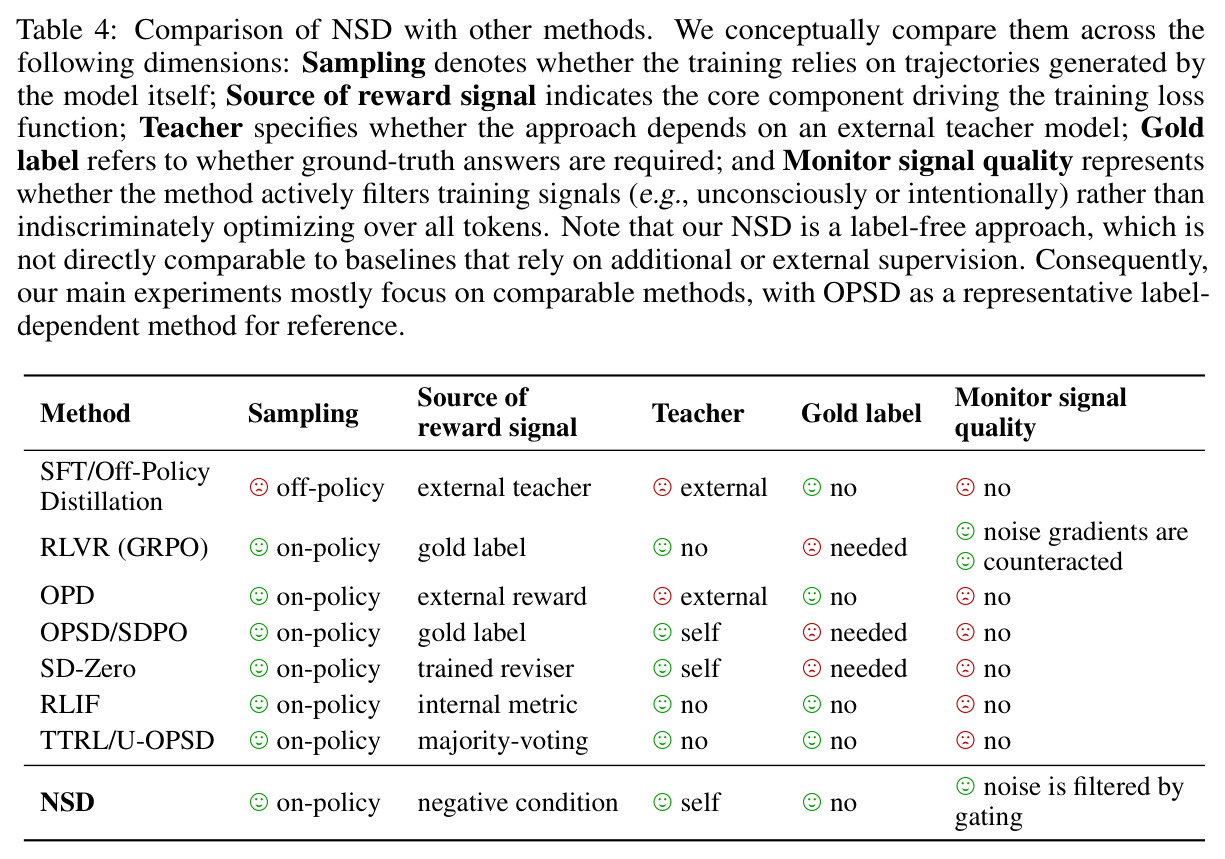
当前提升 LLM 推理的主流范式各有硬伤。RLVR(如 GRPO)存在两个结构性瓶颈:一是每题要采一整组 rollout(GRPO 类方法 n=8),在过易或过难的问题上组内奖励几乎全同,造成优势坍缩与梯度消失;二是结果级奖励均匀摊到整条序列上,掩盖了细粒度的 token 级 credit assignment。On-Policy Distillation 虽提供密集 token 级监督,但要求一个能力严格更强、且与学生 tokenizer 兼容的外部教师,实践中往往不可得。于是 OPSD 让模型自己当教师,把标准答案作为特权信息拼进提示来生成逐 token 监督。然而近期研究(Kim et al., 2026b 等)发现 OPSD 会严重损害复杂推理:知道答案的教师天然生成“人工自信、线性直给”的轨迹,强迫学生最小化与该分布的散度,等于系统性压制高熵探索、不确定性表达和自我纠错——而“等等,让我再验算一下”这类反思行为恰恰是攻克难题的关键。模仿一个开了上帝视角的完美教师,反而会教坏学生。另一类无标签方案(Intuitor 用自信度、TTRL 用多数投票)又依赖模型对答案对错的自我判断,弱模型自信不等于正确,Intuitor 在 Qwen3-1.7B 上甚至下降 0.5%。
本文的目标是本文要构造一个完全自举、无需标签的推理后训练框架:不使用 ground-truth 答案、不依赖外部教师、也不依赖多数投票或置信度这类基于模型自我判断的伪标签,却能提供稳定、密集、token 级的训练信号。验证目标有三层:其一,在 1.7B/4B/8B 三个规模、七个数学基准(AIME 2024/2025/2026、HMMT 2025、AMC 2023、OlympiadBench、MATH-500)上稳定超越 OPSD、Intuitor、TTRL;其二,不仅不牺牲模型的反思与自我纠错能力,还要显著增强它,避免 OPSD 式的过度自信;其三,保住模型的预训练语言先验(不被 unlikelihood 目标“误伤”语法与标点),同时训练效率要优于 GRPO 类基线——每样本只需 1 次 rollout、不做全词表 logit 对齐。
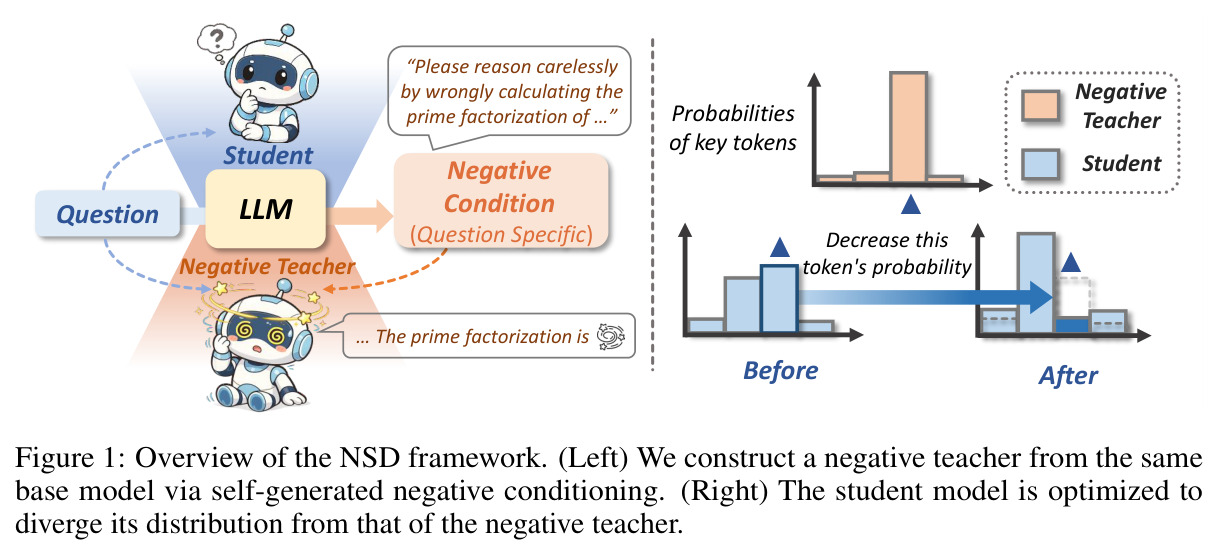
与已有工作不同的是,本文的独特切入是把自蒸馏的“符号”反过来:既然模仿特权教师会引入过度自信偏差,那就学“避开缺陷”而不是“模仿完美”。具体做法是让模型给自己生成一个题目专属的“负面人设”提示(如“你是一个粗心的学生,经常算错质因数分解,从不验算”),用同一份模型权重在不同上下文下实例化一个负向教师 $\pi_{\text{neg}}$,然后优化学生分布远离它。与 Intuitor、TTRL 不同,NSD 完全不需要模型判断“答案对不对”,只需要模型知道“坏习惯长什么样”——后者要容易得多。与朴素 unlikelihood 训练也不同,NSD 发现“负向教师认为概率高的 token”不都是缺陷(普通语法 token 在两种上下文下都高频),于是用负向教师与良性参考模型的逐 token 概率差做动态门控,只惩罚真正被负面条件抬升概率的 token,从机制上隔离了行为缺陷与语言基础。
核心方法
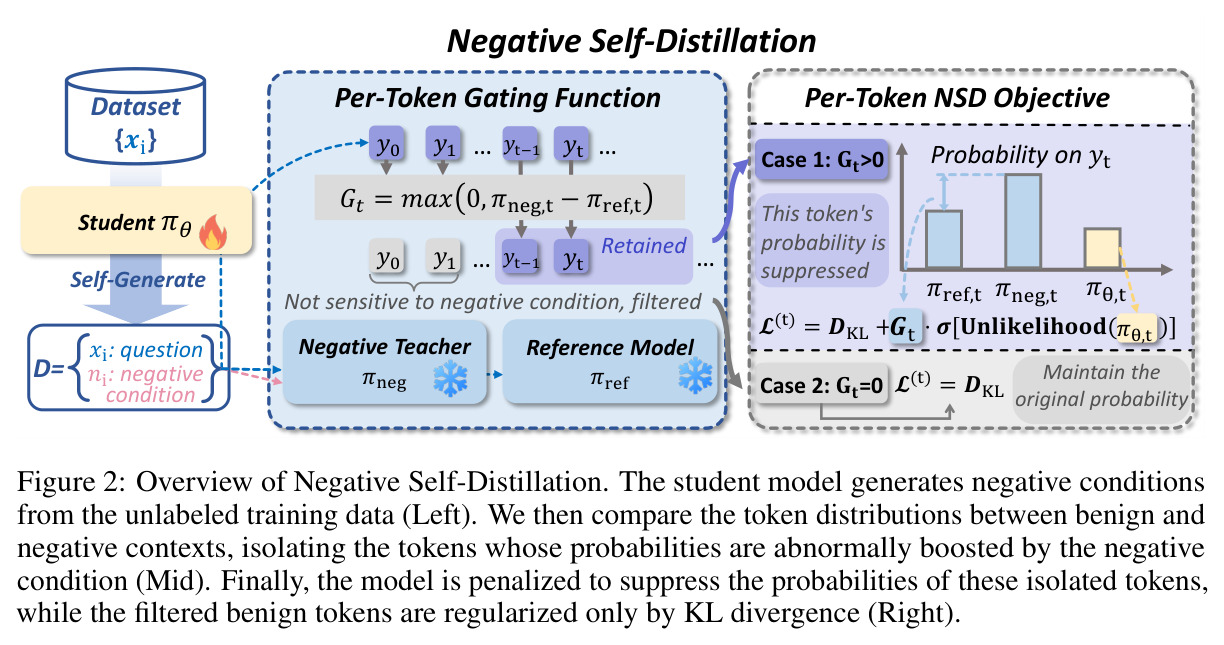
直觉:人的进步很大程度来自“见过错误、学会规避”——体会过粗心计算的代价,就会主动验算。NSD 把这个直觉工程化为三步流水线。第一步,负向条件生成:对每个无标签问题 $x$,先从学生模型采样初始解答 $y_{\text{init}}\sim\pi_\theta(\cdot|x)$,再用元提示(让模型扮演“数学教育专家+提示工程师”,构造含 persona、trigger、flawed execution、fatal omission 四要素的“定向攻击提示”,明令禁止验算步骤)生成题目专属的负向条件 $n\sim\pi_\theta(\cdot|x,y_{\text{init}})$。第二步,实例化两个冻结教师:参考模型 $\pi_{\text{ref}}$(只看原问题)和负向教师 $\pi_{\text{neg}}$(看问题+负面人设),二者共享完全相同的初始权重,唯一区别是上下文。第三步,NSD 训练:学生对每题只采一条轨迹,逐 token 计算门控 $G_t=\max(0,\pi_{\text{neg}}-\pi_{\text{ref}})$,用 Sigmoid 有界的 unlikelihood 惩罚压低被负面条件抬升的 token,再加权重 $\alpha=0.01$ 的逐点前向 KL 锚定。整个损失只需 3 个标量概率,无需全词表 logit 投影,两次教师前向可并行 prefill。
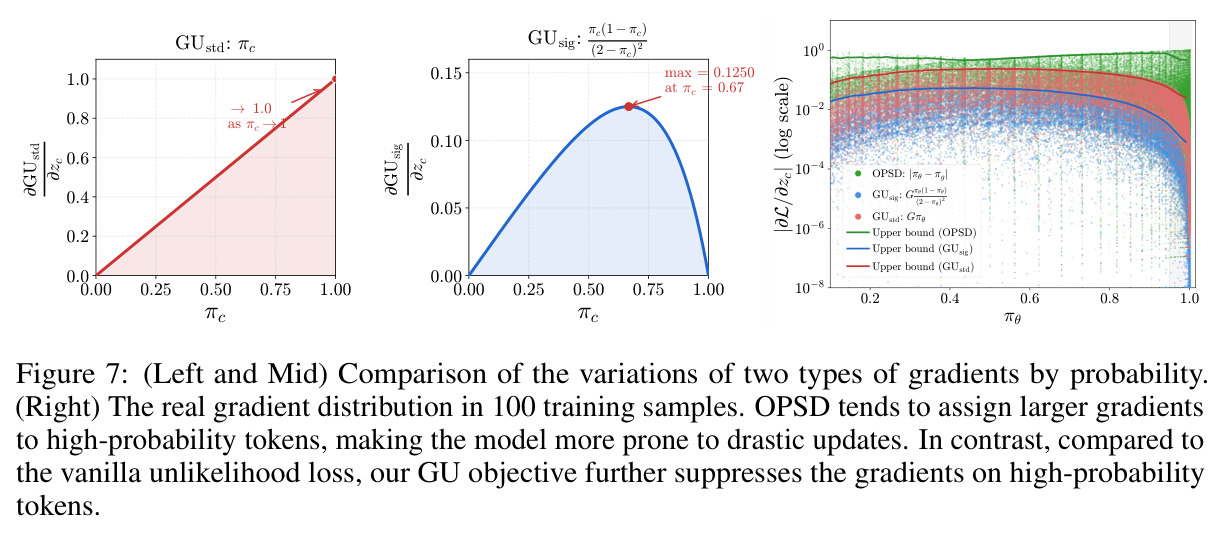
核心创新是“同权重、异上下文”的对比式负向监督。$\pi_{\text{neg}}$ 与 $\pi_{\text{ref}}$ 权重完全相同,差值 $G_t=\max(0,\pi_{\text{neg}}(y_t|x,n_i,y_{\pi_{\text{ref}}$,说明负面人设专门抬高了它——比如粗心人设会抬高“直接写答案”这类冒进 token——惩罚强度随差距成比例放大。这与 RLCSD 的 style/task token 理论吻合:NSD 门控的 style-task 比值最低(2.6×–3.5×),显著优于熵加权 OPSD(3.9×)与原始 OPSD(5.4×)。第二个关键设计是 Sigmoid 有界惩罚 $L_{\text{GU}}=G_t\cdot 2^{-\pi_\theta}$:对 logit 的梯度为 $G\cdot\frac{\pi_c(1-\pi_c)}{(2-\pi_c)^2}$,当 $\pi_c\to1$ 时梯度趋于 0,天然保护标点等高置信结构 token,把最强梯度留给 $\pi_c\approx0.6$ 的中置信、真正承载推理歧义的 token,从数学上解决了原始 unlikelihood 的梯度爆炸。
方法步骤详情
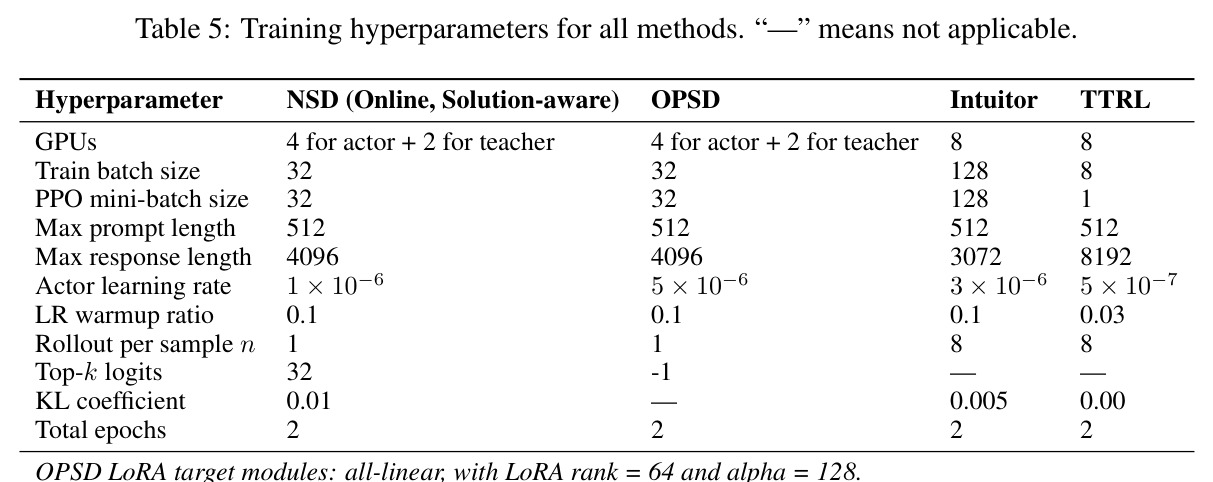
完整流程(Algorithm 1):输入无标签数据集 $\mathcal{D}_{\text{raw}}=\{x_i\}$、初始模型 $\pi_{\theta_0}$、KL 权重 $\alpha$。① 冻结两个教师 $\pi_{\text{ref}},\pi_{\text{neg}}\leftarrow\pi_{\theta_0}$。② 对每个问题 $x_i$:学生采样一条推理轨迹 $y=(y_1,\dots,y_T)\sim\pi_\theta(\cdot|x_i)$(Qwen3 非思考模式,最大 4096 token),再基于 $x_i$ 与 $y$ 生成负向提示 $n_i\sim\pi_\theta(\cdot|x_i,y)$(Solution-aware 元提示,输出 2–3 句“定向攻击提示”)。③ 逐 token 处理:取三个标量 $p_{\text{ref}}=\pi_{\text{ref}}(y_t|x_i,y_{<t})$、$p_{\text{neg}}=\pi_{\text{neg}}(y_t|x_i,n_i,y_{<t})$、$p_\theta=\pi_\theta(y_t|x_i,y_{<t})$;计算门控 $G_t=\max(0,p_{\text{neg}}-p_{\text{ref}})$;累加单 token 损失 $L^{(t)}_{\text{NSD}}=G_t\cdot 2^{-p_\theta}+\alpha\, p_{\text{ref}}\log\frac{p_{\text{ref}}}{p_\theta}$。④ 对序列求和得 $J_i$,梯度更新 $\theta$。训练配置:MATH 训练集(丢弃标签),Qwen3-1.7B/4B/8B,2 epochs,batch 32,学习率 $1\times10^{-6}$,$\alpha=0.01$,top-k=32,8×A100 80GB 单机。
技术新颖性
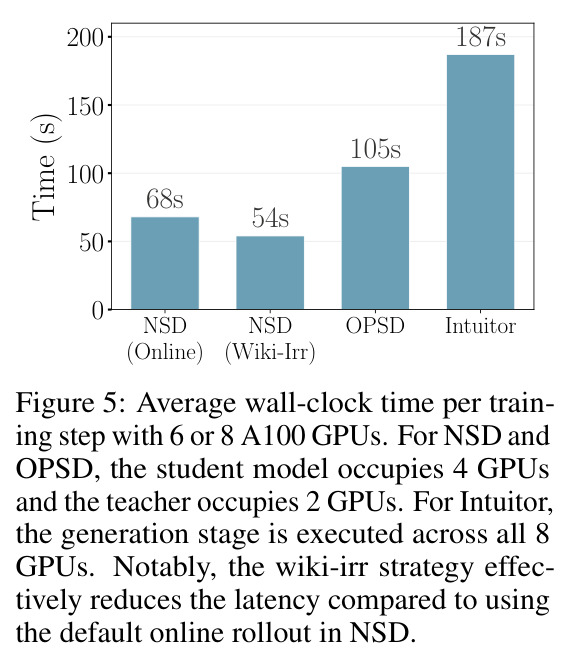
新颖性有四层。范式层面:首个把“自生成负向条件 + token 级门控散度”做成完整无标签自蒸馏框架的工作——与 NSR 等仅用负样本的结果级 RLVR 不同,NSD 在 token 粒度操作且显式隔离语言先验;与 Intuitor/TTRL 等依赖自我判断的方法不同,其信号源自上下文对比而非答案猜测。机制层面:用同权重模型的概率差作门控,本质是对负面条件的逐 token 点态互信息度量,把“缺陷在哪”转化为可计算的分布对比;消融证明其滤除 style token 的能力(2.6×–3.5×)优于熵加权(3.9×)与 OPSD 损失加权(5.4×)。数值层面:Sigmoid 有界 unlikelihood 带来参数免费的隐式梯度衰减——附录 A 证明标准 unlikelihood 梯度 $G\cdot\pi_c/(1-\pi_c)$ 随置信度线性放大并在 $\pi_c\to1$ 时爆炸,OPSD 梯度反而随概率上升(易过学 style token),而 Sigmoid 版峰值落在中置信区、高置信端归零,并在 100 个真实样本的梯度分布中得到验证。工程层面:每样本 1 条 rollout(较 GRPO 类省约 60% rollout 时间)、仅 3 个标量概率、无全词表投影、双教师并行 prefill,每步 68s(wiki-irr 版 54s)对比 OPSD 105s、Intuitor 187s。
实验结果
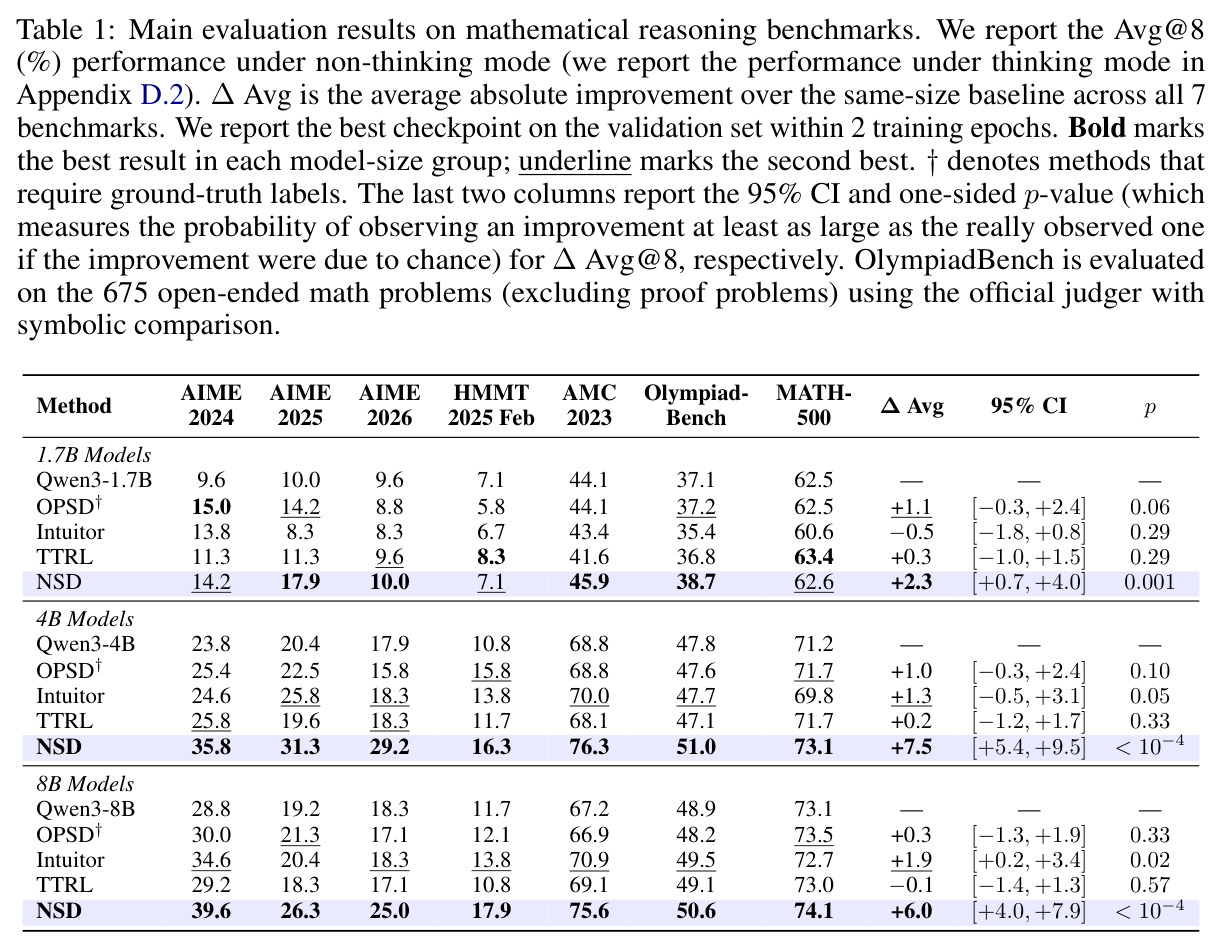
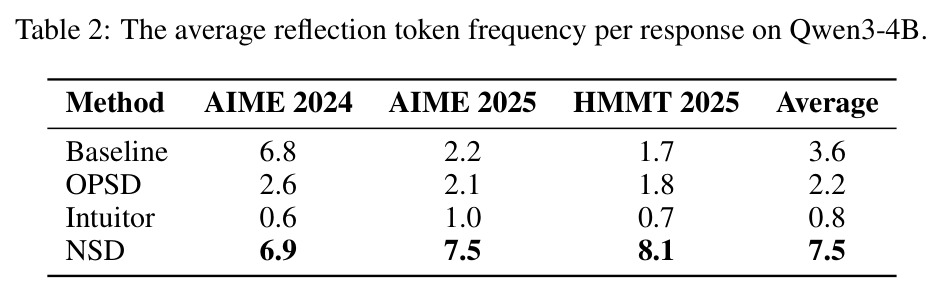
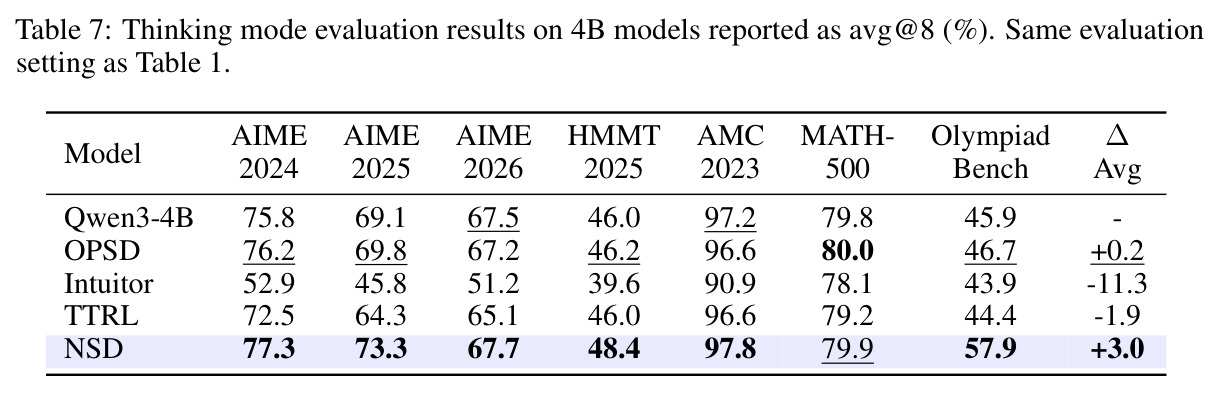
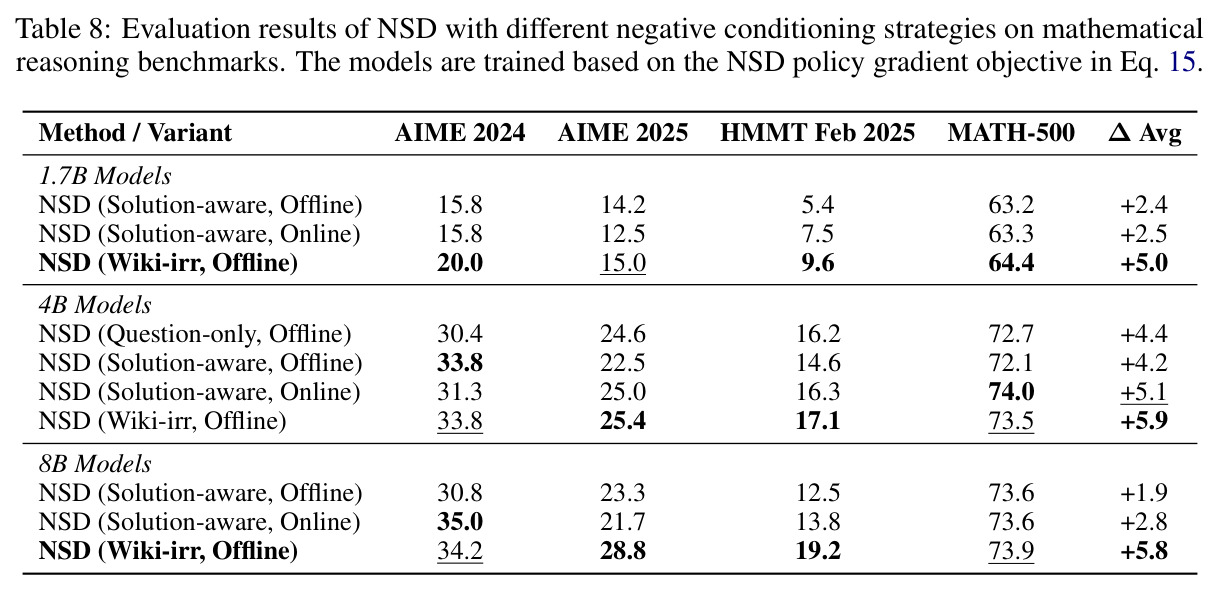
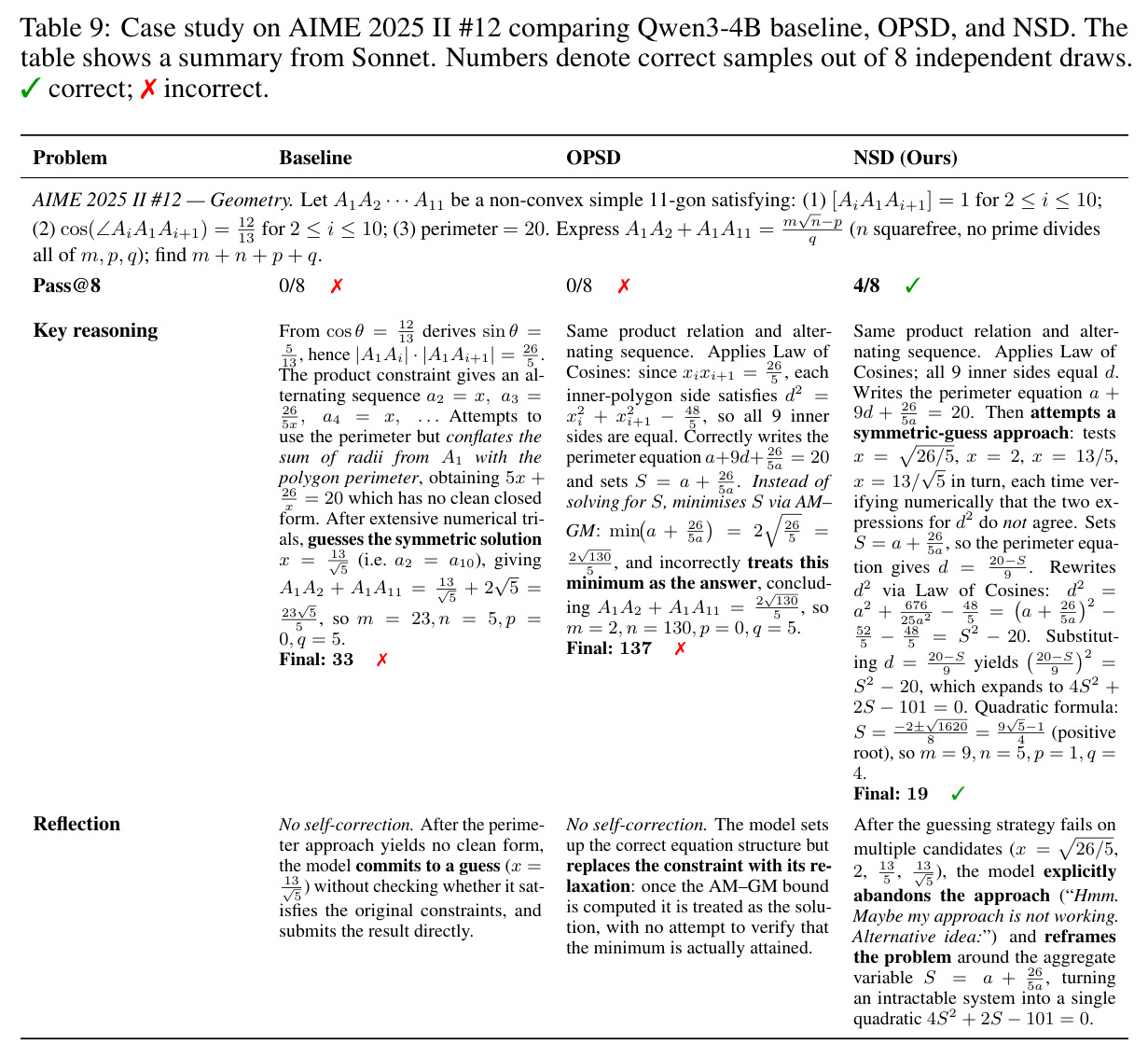
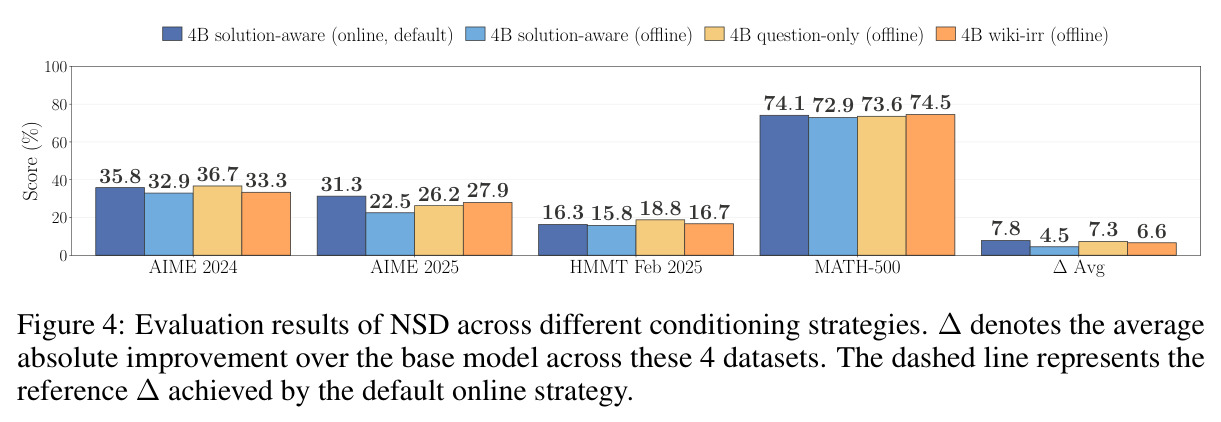
① 主结果(Table 1,Avg@8 非思考模式):NSD 在三个规模全部拿下七基准平均最佳:1.7B +2.3%(CI [+0.7,+4.0],p=0.001)、4B +7.5%(CI [+5.4,+9.5],p<10⁻⁴)、8B +6.0%(CI [+4.0,+7.9],p<10⁻⁴)。4B 上 AIME 2024 从 23.8→35.8、AIME 2025 从 20.4→31.3、AIME 2026 从 17.9→29.2、HMMT 从 10.8→16.3、AMC 从 68.8→76.3;8B 上 AIME 2024 从 28.8→39.6。对照基线:4B 最佳基线仅 Intuitor +1.3%,8B 的 OPSD 仅 +0.3%、TTRL −0.1%,1.7B 的 Intuitor 为 −0.5%。② 反思能力(Table 2):Qwen3-4B 每响应反思 token 均值 NSD 7.5,基座 3.6,OPSD 2.18,Intuitor 0.75——正向基线全面压缩反思,NSD 反而翻倍。③ 变体研究(Figure 4):question-only 离线策略 ΔAvg 7.3% 接近在线 solution-aware 的 7.8%,最轻量的 wiki-irr 也有 6.6%;离线 solution-aware 最弱(4.5%)。④ 效率(Figure 5):每步 68s(在线)/54s(wiki-irr)对比 OPSD 105s、Intuitor 187s;n=1 使 rollout 开销较 n=8 基线降约 60%。⑤ Pass@8(Table 6):ΔAvg +7.2%/+8.3%/+9.7%,8B 的 AIME 2026 从 43.3→60.0,多数基线 Δ≤2.2% 甚至为负。⑥ 思考模式(Table 7):NSD +3.0%(OlympiadBench 45.9→57.9),Intuitor 因过度思考崩至 −11.3%。⑦ 门控质量(Table 3):style-task 比 2.6×–3.5× 对比 OPSD 5.4×。⑧ KL 消融(Figure 6):去掉 KL 后约 120 步 KL 坍缩、门控失活、训练振荡。⑨ 案例(Table 9):AIME 2025 II #12 基座与 OPSD 均 0/8,NSD 4/8,能显式放弃失败路径改用聚合变量法。⑩ 策略梯度变体(Table 8):1.7B 下 PG 版更优(wiki-irr +5.0%),wiki-irr 在 PG 下全场最佳(+5.9%/+5.8%)。
查看结构化数据
| 任务 | 指标 | 本文 | 基线 | 提升 |
|---|---|---|---|---|
| 数学七基准平均 (Qwen3-4B) | Avg@8 平均绝对提升 ΔAvg | +7.5% (NSD, p<10⁻⁴) | +1.3% (Intuitor, 最佳基线);OPSD +1.0%,TTRL +0.2% | +6.2 个百分点 |
| 数学七基准平均 (Qwen3-8B) | Avg@8 ΔAvg | +6.0% (NSD, p<10⁻⁴) | +1.9% (Intuitor);OPSD +0.3%,TTRL −0.1% | +4.1 个百分点 |
| 数学七基准平均 (Qwen3-1.7B) | Avg@8 ΔAvg | +2.3% (NSD, p=0.001) | +1.1% (OPSD, 需 gold 标签);Intuitor −0.5% | +1.2 个百分点 |
| AIME 2024 (Qwen3-4B) | Avg@8 准确率 | 35.8% | 23.8% (基座模型) | +12.0 个百分点 |
| AIME 2024 (Qwen3-8B) | Avg@8 准确率 | 39.6% | 28.8% (基座模型) | +10.8 个百分点 |
| 数学七基准 (Qwen3-8B) | Pass@8 ΔAvg | +9.7% (NSD) | +2.1% (Intuitor);TTRL −1.0% | +7.6 个百分点 |
| 思考模式七基准 (Qwen3-4B) | Avg@8 ΔAvg | +3.0% (OlympiadBench 45.9→57.9) | +0.2% (OPSD);Intuitor −11.3% | +2.8 个百分点 (vs OPSD) |
| 反思行为 (Qwen3-4B, AIME+HMMT) | 每响应反思 token 频率 | 7.5 (NSD) | 3.6 (基座);OPSD 2.2;Intuitor 0.8 | 较基座翻倍,与基线方向相反 |
| 训练效率 (8×A100) | 每步墙钟时间 | 68s (在线) / 54s (wiki-irr) | 105s (OPSD) / 187s (Intuitor) | 比 OPSD 快约 35%,比 Intuitor 快约 64% |
| 门控信号质量 (100 训练样本) | style-task ratio (越低越好) | 2.6× (wiki 门控) 至 3.5× | 5.4× (OPSD) / 3.9× (Entropy-OPSD) | 接近 OPSD 的一半 |
局限与改进
作者承认两点:一是方法依赖学生自身生成有意义负向条件的能力,极小或极弱模型可能造不出有区分度的“负面人设”,1.7B 的增益(+2.3%)明显低于 4B(+7.5%)即是证据,不过作者预期随基座能力增强该瓶颈会自然缓解;二是在线策略需要额外的负向条件生成与两次教师前向,虽然可用 wiki-irr(54s/步)和并行 prefill 缓解。我的补充观察:其一,评估全部集中在 Qwen3 家族的数学推理任务,代码、科学问答、智能体等域未验证,外推性未知;其二,wiki-irr 仅用随机维基段落当“负向条件”就拿到 6.6% 增益、且在策略梯度变体下反而全场最佳(+5.0%/+5.9%/+5.8%),这暗示相当一部分收益可能来自“对上下文噪声的一般性鲁棒化”而非精确的缺陷定位,论文的因果机制解释还不完整;其三,反思能力只用反思 token 频率这一代理指标度量,未验证每次反思确有纠错收益,频率上升也可能是表面模仿;其四,训练只做 2 epochs 且只报验证集最佳 checkpoint,长期训练稳定性和超参(α=0.01)敏感性缺乏系统扫描。
独立分析的弱点
① 弱模型瓶颈:1.7B 增益仅 +2.3%,负面条件质量受限于模型自身能力。改进方向:用固定的更强模型离线批量生成负面人设库,或维护模板化的 persona+trigger 组合字典,把条件生成与被训模型解耦。② 域局限:只在 MATH 上训练、只在数学上评测。改进方向:把“负面人设”泛化到代码(如“你是一个不做边界检查的程序员”)、科学问答与智能体轨迹,检验门控机制的跨域迁移性。③ 机制归因不足:wiki-irr 的强势表现提示增益可能部分来自一般性抗噪而非针对性去缺陷。改进方向:设计严格对照——相同惩罚预算下比较“门控惩罚”“随机 token 惩罚”“最高熵 token 惩罚”,分离两种效应并给出定量归因。④ 反思度量粗糙:token 频率上升不等于反思质量提升。改进方向:引入 LLM 评委或人工标注的反思有效率、错误恢复率等更细的指标。⑤ 部署成本:需常驻两个教师分片(论文配置占用 2 张 GPU)。改进方向:教师量化、缓存高频 top-k 概率,或离线预计算门控信号。⑥ 报告方式:只报各基准最佳 checkpoint 的均值,缺少全程学习曲线与多次运行方差,难以评估训练过程的稳定性差异。⑦ 负面人设提示里“禁止验算”等攻击要素若意外泄漏到推理行为中,可能损害回答的有用性,需要安全性评估。
未来方向
作者提出的方向:随基座模型能力增强,自生成负面条件质量会提高,方法收益随规模放大(4B/8B 增益已印证这一趋势);wiki-irr 等免生成策略可作为低成本默认选项;框架可扩展到策略梯度范式(附录 D.3 已给出 $A_t=-L^{(t)}_{\text{NSD}}$ 的 PG 版本并验证可行)。基于其成果可延伸的方向:① 正负混合课程——RLVR 的正信号告诉模型“什么对”,NSD 的负信号告诉它“什么错”,二者互补,可能同时突破正信号稀疏与优势坍缩的瓶颈;② 把门控思想反哺正向 OPSD——Table 3 显示 NSD 门控滤除 style token 最有效,可直接用作正向蒸馏损失的 token 加权器;③ 自博弈式负向条件进化——让“攻击者”(生成更刁钻负面人设)与“防御者”(学生)交替优化,形成红蓝对抗式自改进;④ 跨域验证与安全应用——用“有害条件教师”做发散训练的对齐潜力值得探索;⑤ 理论工作——把门控 $G_t$ 与逐 token 点态互信息(PMI)建立形式化联系,解释“为何远离负面上下文能提升推理”;⑥ 与持续学习结合,研究 Sigmoid 有界 unlikelihood 是否天然抑制灾难性遗忘。
复现评估
复现条件较好。论文给出了 GitHub 代码与 Hugging Face 模型权重链接(开源);训练数据是公开的 MATH 数据集(按论文设定丢弃标签即可),基座是公开的 Qwen3-1.7B/4B/8B。算力需求:单节点 8×A100 80GB(NSD 配置为 4 卡跑学生 + 2 卡跑教师,另 2 卡空闲),训练 2 epochs,每步约 68s(在线)或 54s(wiki-irr)。超参在附录 Table 5 完整披露:batch 32、actor lr $1\times10^{-6}$、warmup 比例 0.1、$\alpha=0.01$、top-k=32、最大响应 4096、KL 系数 0.01;三类负向条件生成与教师提示模板在附录 C.3 全文给出(含 question-only 与 solution-aware 两版元提示)。评测协议详尽:Avg@8、temperature 0.6、top-p 0.95、32K 输出长度;OlympiadBench 用官方判题器做符号比较(675 道非证明题)。主表报告 95% CI 与单侧 p 值,统计严谨性高于多数同类工作。主要门槛是需要一套 RL/蒸馏训练基础设施与八卡级算力;建议从 wiki-irr 变体入手复现(无需在线生成,54s/步),再逐步过渡到在线 solution-aware。综合难度:中等。
论文图表