UniMate:单一统一模型驱动任意拓扑骨骼的动画生成 UniMate: One Unified Model to Animate Diverse Skeletons
输入任意拓扑的绑定3D资产与文本提示,单次前向直接合成骨骼动画
前置知识
骨骼动画与运动学树
3D角色由骨架驱动:骨架是带根节点的运动学树,关节按父子层级组织,前向运动学(FK)根据各关节局部旋转逐级推出全局位姿,网格经线性混合蒙皮(LBS)随骨架变形。静止姿态(rest pose)是未变形的参考构型。不同角色的关节数量与连接方式(拓扑)差异极大。
UniMate 的输入正是绑定资产的 rest-pose 骨架;BFS 规范排序、拓扑直径归一化、12 维关节特征等表示全部建立在这套概念上。
流匹配(Flow Matching)
生成建模范式:学习速度场 $v_\theta(x_\tau, \tau)$,把噪声 $x_0 \sim \mathcal{N}(0, I)$ 沿 ODE 连续输运到数据 $x_1$,目标是 $\mathbb{E}\|v_\theta - (x_1 - x_0)\|^2$。采样用少步 Euler 积分,常配合无分类器引导(CFG)提升条件遵循度。
UniMate 的 TADiT 就是条件流匹配模型,理解其训练损失与 50 步 Euler 推理都以此为框架。
RoPE 旋转位置编码
RoPE 用位置角生成分块对角旋转矩阵作用于 query/key,使注意力内积只依赖相对位置差:$\langle\text{RoPE}(s_i)q, \text{RoPE}(s_j)k\rangle = q^\top\text{RoPE}(s_j - s_i)k$,天然编码相对位置,广泛用于 1D 序列。本文的 Spec-RoPE 把『位置』换成图拉普拉斯谱坐标。
Spec-RoPE 是本文三大创新之一,先懂标准 RoPE 的相对位置性质,才能理解它如何推广到任意运动学树。
图拉普拉斯与谱嵌入
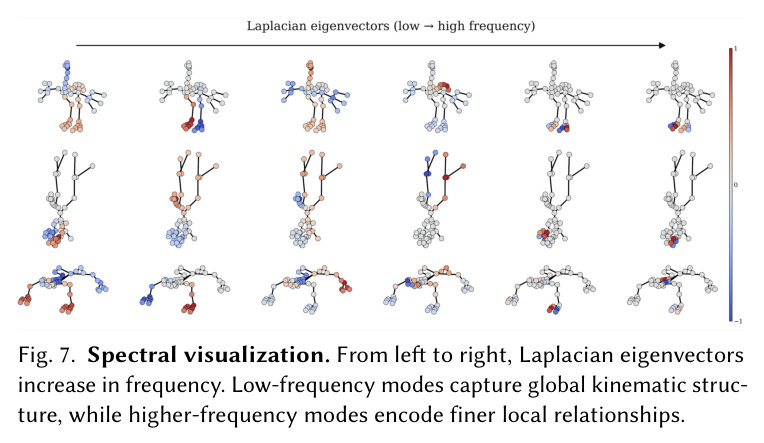
对图邻接矩阵 $A$,组合拉普拉斯 $L = \text{diag}(A\mathbf{1}) - A$ 半正定,可特征分解 $L = U\Lambda U^\top$。丢弃平凡常数向量 $u_0$ 后,前 $m$ 个非平凡特征向量构成每个节点的连续『谱坐标』:低频刻画全局结构、高频编码局部细节。特征向量有符号与基的歧义,SignNet 消除符号歧义。
UniMate 用运动学树的拉普拉斯谱坐标替代关节下标作为 RoPE 角度来源,其不变性与等变性都来自谱图理论。
AdaLN-Zero 与 DiT 条件注入
Diffusion Transformer 用自适应层归一化注入条件:$\alpha, \beta, \gamma$ 由条件线性生成,$h' = h + \alpha \odot f((1+\gamma)\odot\text{LN}(h) + \beta)$;Zero 初始化使 $\alpha=0$,每块初始为恒等映射,训练稳定。文本、时间步等全局条件常求和融合后统一注入。
理解全局拓扑条件器 $c_{\text{topo}}$ 如何与时间步、文本融合并调制每个 transformer 块,需要此机制。
FID(Fréchet Inception Distance)
生成质量指标:在真实与生成样本的深层特征上分别拟合高斯分布,计算两高斯的 Fréchet 距离,越低表示生成分布越接近真实;常与 Diversity(样本间平均成对距离)配合防止模式坍缩刷分。本文在骨架运动学特征上计算。
论文核心定量结论(0.757 vs 2.711)与全部消融都以 FID/Diversity 衡量,需知道其含义与方向。
研究动机
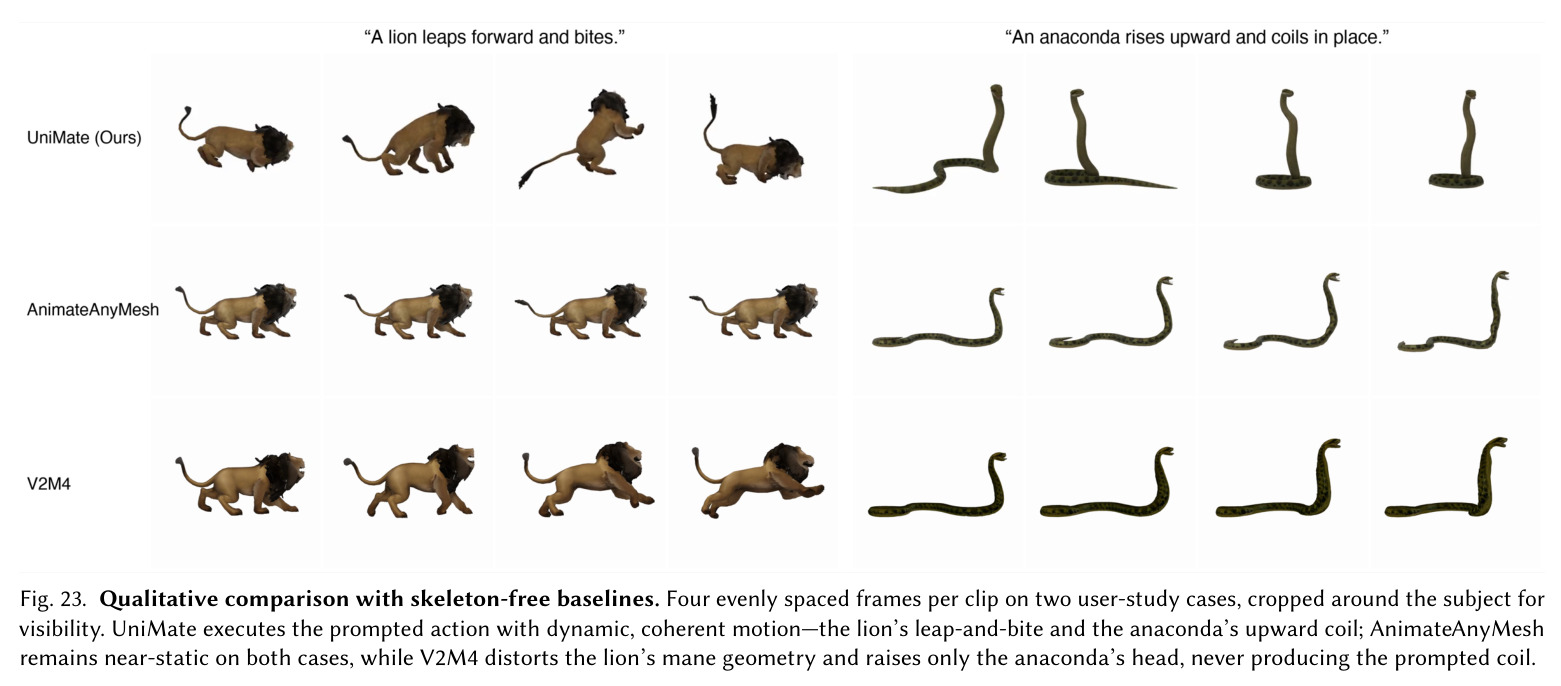
自动绑定(auto-rigging)已能大规模产出『可动画』的 3D 资产,但驱动它们的运动仍是内容管线中最费力的瓶颈。现有学习型动画器拓扑受限:主流文本到运动模型绑定单一模板骨架(人体 SMPL、动物 SMAL),无法处理偏离模板的角色;GANimator、SinMDM 等为每个骨架单独训练生成器,不能跨结构泛化;Motion2Motion 等重定向方法推理时必须提供目标骨架的示例动作;最接近的 AnyTop 只覆盖 Truebones 小型动物语料,推理时还需目标骨架的参考动作估计归一化统计,且不支持文本条件。另一类无骨架网格方法要么依赖昂贵的逐资产优化(V2M4 需先由视频扩散生成驱动视频,单资产耗时 1.641 小时),要么回归运动学不受约束的逐顶点变形(AnimateAnyMesh 动态度低、常近静态)。数据同样稀缺:文本-动作语料以人体为主,原始 4D 资产噪声大、关节命名混乱、坐标框架不一致,缺乏跨拓扑统一预处理与规范化监督。
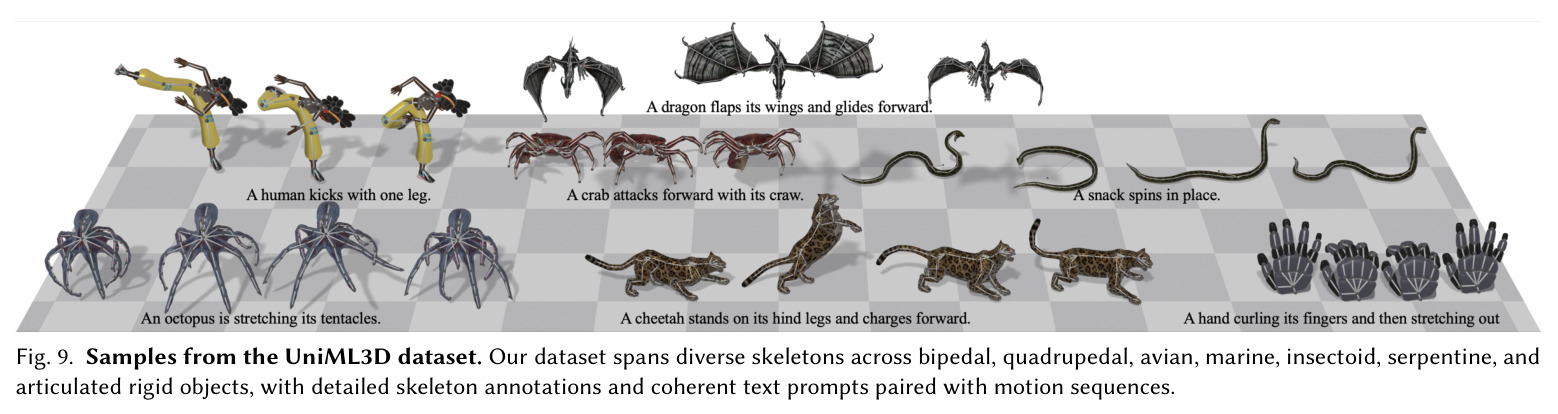
本文的目标是构建统一的动画基础模型:给定任意拓扑的 rest-pose 骨架与一条文本提示,单次前向传播合成时序连贯、符合语义的关节运动,无需测试时优化、逐骨架微调或参考动作。模型须把骨骼拓扑当作显式输入而非架构先验,在结构与运动的联合空间中推理,让运动先验跨拓扑共享,从而泛化到未见绑骨;同一预训练模型还要零样本支持跨拓扑动作迁移、补间、序列扩展与文本引导编辑。为支撑大规模训练,还需整理覆盖两足、四足、鸟类、海洋、昆虫、蛇形与铰接刚体、带统一规范化与文本配对的大规模异构运动数据集。
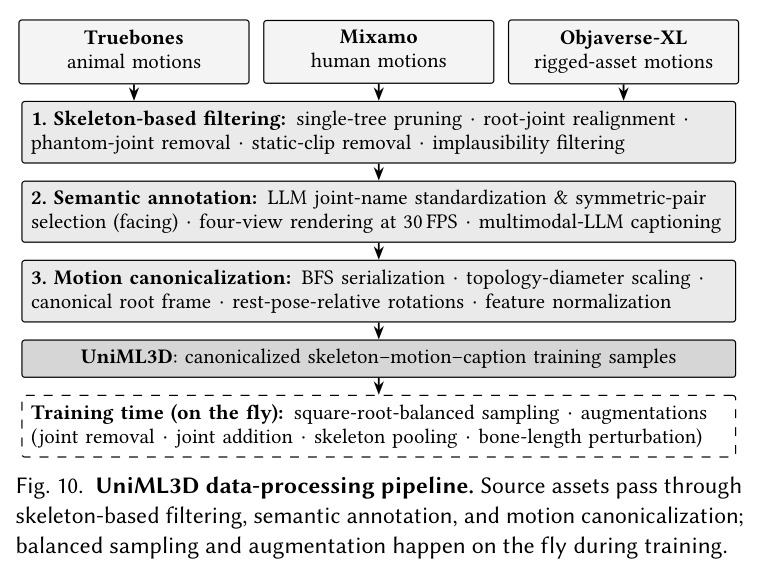
与已有工作不同的是,本文的独特切入是把『骨骼拓扑』提升为一等公民:不假设任何模板,而是把 rest-pose 运动学树的三层结构信息——成对关系与测地距离、谱坐标、全局摘要——通过三种互补机制注入注意力。与 AnyTop 相比,不只是数据规模扩大(13,006 条序列、数千骨架 vs 小型动物语料),关键是架构上用谱位置编码与结构感知注意力偏差替代『需要参考动作估计归一化统计』的设计,并原生支持文本条件;与无骨架网格方法相比,UniMate 保留紧凑、语义明确、可与 IK/物理引擎/动捕管线兼容的骨骼表示,一次生成即可驱动所有兼容蒙皮资产。数据侧贡献首个系统化跨拓扑规范化(LLM 关节名标准化、拓扑直径归一化、谱坐标)的大规模语料 UniML3D,填补『有骨架资产、无跨拓扑动作监督』的空白。
核心方法
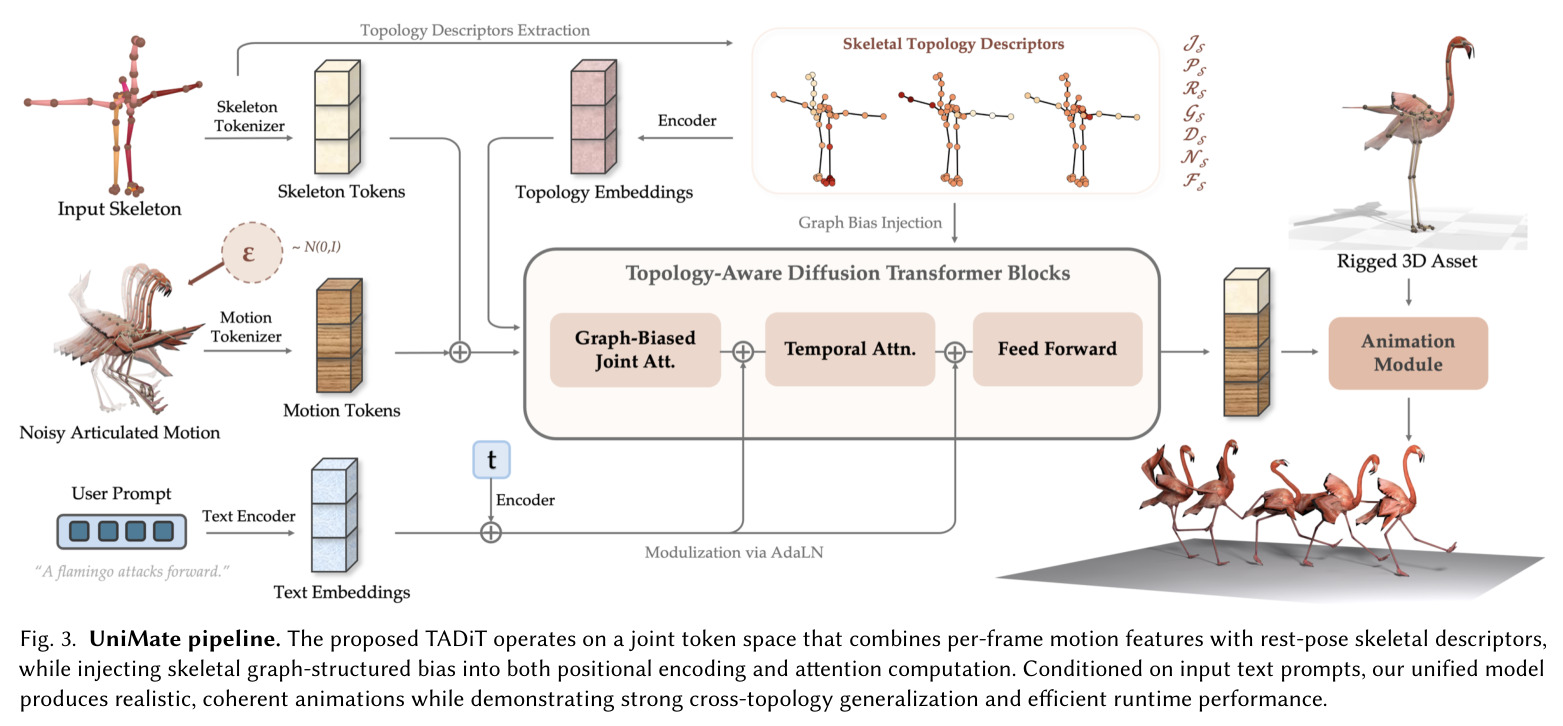
直觉是让 Transformer 在同一注意力空间同时『看到』骨架结构与逐帧运动:静态骨架 token 与运动 token 拼接共享注意力,由运动学图的结构信息引导注意力计算。UniMate 是条件流匹配模型,核心为拓扑感知扩散 Transformer(TADiT):8 个 Skeletal-Temporal 块,隐藏维 $d=512$、8 头注意力。每个骨架先从根节点 BFS 线性化获得规范关节顺序,按拓扑直径 $d_{\text{topo}}$ 缩放,表示为 $S = \{J_S, P_S, R_S, G_S, D_S, N_S, F_S\}$;每关节每帧运动特征 12 维 $m_t^j = [p_t^j, r_t^j, v_t^j]$(位置/6D 旋转/速度)。骨架 token 与运动 token 沿时间轴拼成 $Z \in \mathbb{R}^{(T+1)\times J\times d}$,每块做分解注意力:联合分支(帧内跨关节,注入图感知偏差与 Spec-RoPE)、时间分支(关节内跨帧,1D RoPE)与 FFN。条件 $c = c_\tau + c_{\text{text}} + c_{\text{topo}}$(冻结 FLAN-T5 编码文本)经 AdaLN-Zero 注入每个子层。推理 50 步 Euler 积分、CFG 尺度 3.0,60 帧约 1.2 秒、端到端 50 FPS。
核心创新是以三种互补机制把拓扑注入注意力。其一,图感知注意力偏差:把成对测地距离矩阵 $G_S$ 与关系类型矩阵 $R_S$(父/子/兄弟/祖先)经查找表嵌入、按头投影为标量偏差 $B^{(h)}_{ij}$,直接加到 joint-attention logits 上,使解剖邻近的关节相互关注更强,同时保留长程全身协调;偏差由关系类型而非绝对下标参数化,可迁移到未见拓扑。其二,Spec-RoPE:运动学树没有规范排序,1D RoPE 的下标对关节无意义(索引相邻的关节可能位于对侧肢体),于是旋转角改由谱坐标驱动:$\theta_j = f(F_S(j))$,$F_S(j) \in \mathbb{R}^8$ 取自拉普拉斯前 8 个非平凡特征向量,$f$ 用 SignNet 消除符号歧义。其三,全局拓扑条件器:4 个可学习 query 对骨架 token 做注意力池化,得到关节数与顺序无关的摘要 $c_{\text{topo}}$,为每块提供全局结构语境。与已有工作的本质区别:AnyTop 等把异构拓扑当作需归一化消除的『杂讯』,UniMate 把结构本身变成可学习的注意力先验,对『关节在骨架上的位置』而非『序列里的位置』做相对位置推理。
方法步骤详情
①骨架规范化:提取 rest-pose 骨架,根节点 BFS 序列化,按拓扑直径缩放,计算静止位置 $P_S$、关系/距离矩阵 $R_S, G_S$、深度 $D_S$、关节名索引 $N_S$ 及拉普拉斯前 8 个非平凡特征向量 $F_S$。②token 化:骨架 token 用融合 MLP 拼接关节与其父关节的静止位置;运动 token 为 $M_t^j = \text{MLP}(m_t^j)$ 加深度嵌入与关节名嵌入,二者拼成 $Z \in \mathbb{R}^{(T+1)\times J\times d}$。③8 层 Skeletal-Temporal 块:联合分支在 Spec-RoPE 旋转后的 query/key 内积上加图偏差 $B^{(h)}_{ij}$,时间分支用 1D RoPE,条件经 AdaLN-Zero 调制;输出头根/非根解耦,根 token 经零初始化交叉注意力聚合同帧全身信息。④训练:损失 $\mathcal{L} = \mathcal{L}_{\text{mse}} + 0.5\,\mathcal{L}_{\text{geo}} + 0.1\,\mathcal{L}_{\text{smooth}}$——掩码流匹配 MSE、单步去噪旋转的 $SO(3)$ 测地损失、速度平滑正则;UniML3D 上平方根平衡采样,并在线做删关节/加关节/骨架池化/骨长扰动四种保运动学增广,AdamW 学习率 $1\times 10^{-4}$,8×H100 十万步约一天。⑤推理:EMA 权重、50 步 Euler、每步 CFG($s=3.0$),最后 6D 旋转转 $SO(3)$、积分根速度、FK 得位姿、LBS 驱动网格。
技术新颖性
新颖性有四点。第一,Spec-RoPE 首次把 RoPE 推广到任意运动学树,附录 C 给出形式化性质:谱坐标平移不变 $\langle\text{RoPE}(s_i)q, \text{RoPE}(s_j)k\rangle = q^\top\text{RoPE}(s_j - s_i)k$;关节置换等变——谱在重标记下不变,SignNet 消除符号歧义后角度随关节一致置换;路径图上退化为标准 1D RoPE 的单调重参数化。且缩放谱坐标后的欧氏距离恰为树上有效电阻 $R_{\text{eff}}(i,j)$,旋转核随结构距离指数衰减。第二,把 GraphGPS 风格的图注意力偏差首次引入骨架运动生成,且以关系类型嵌入而非绝对索引参数化,实现跨拓扑迁移。第三,训练目标尊重旋转流形:对单步去噪旋转施加 $SO(3)$ 测地损失,而非在 6D 通道上做几何错位的各向同性 MSE。第四,数据工程深度罕见:用 DeepSeek-V4-Flash 把混乱关节名标准化到统一解剖学词表,LLM 选对称关节对定朝向,多模态 LLM 对四视角渲染写 caption 并辅以人工质检,管线与提示词全部公开。
实验结果
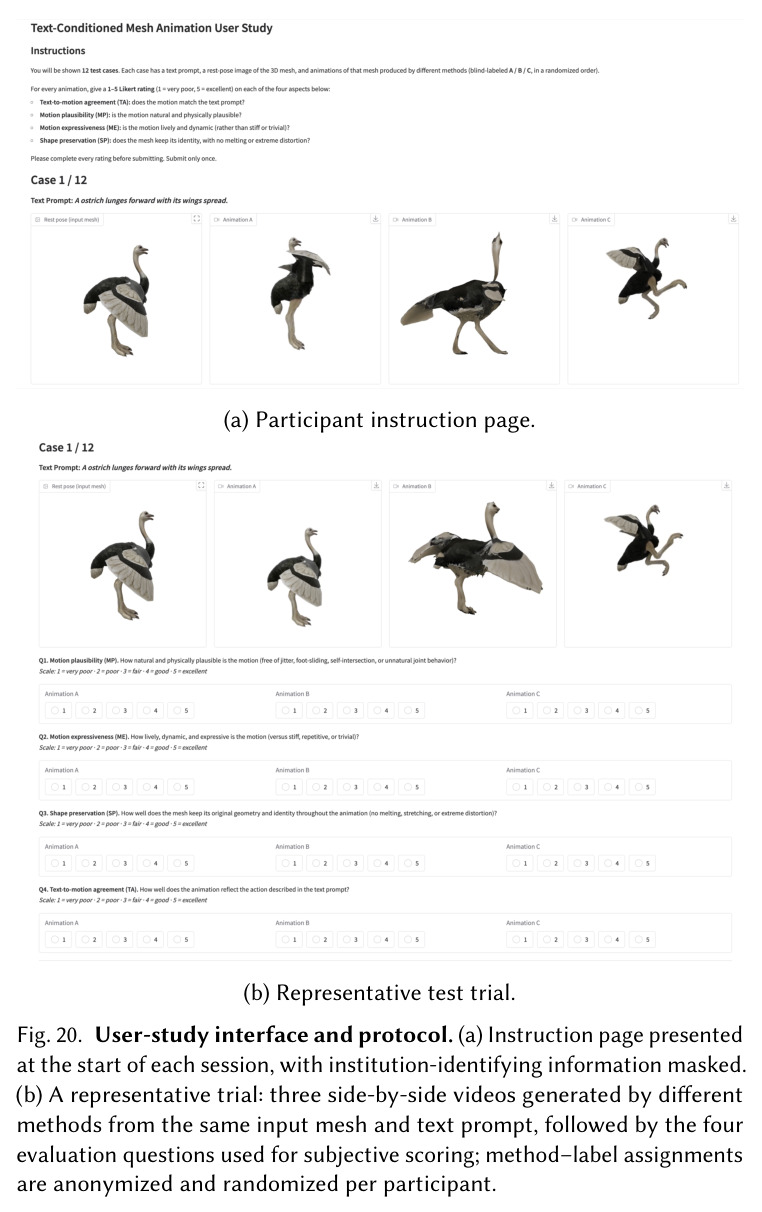
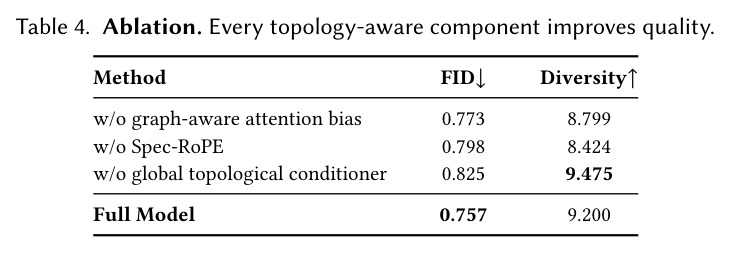
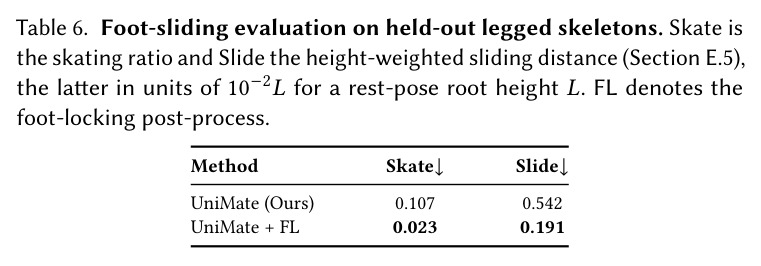
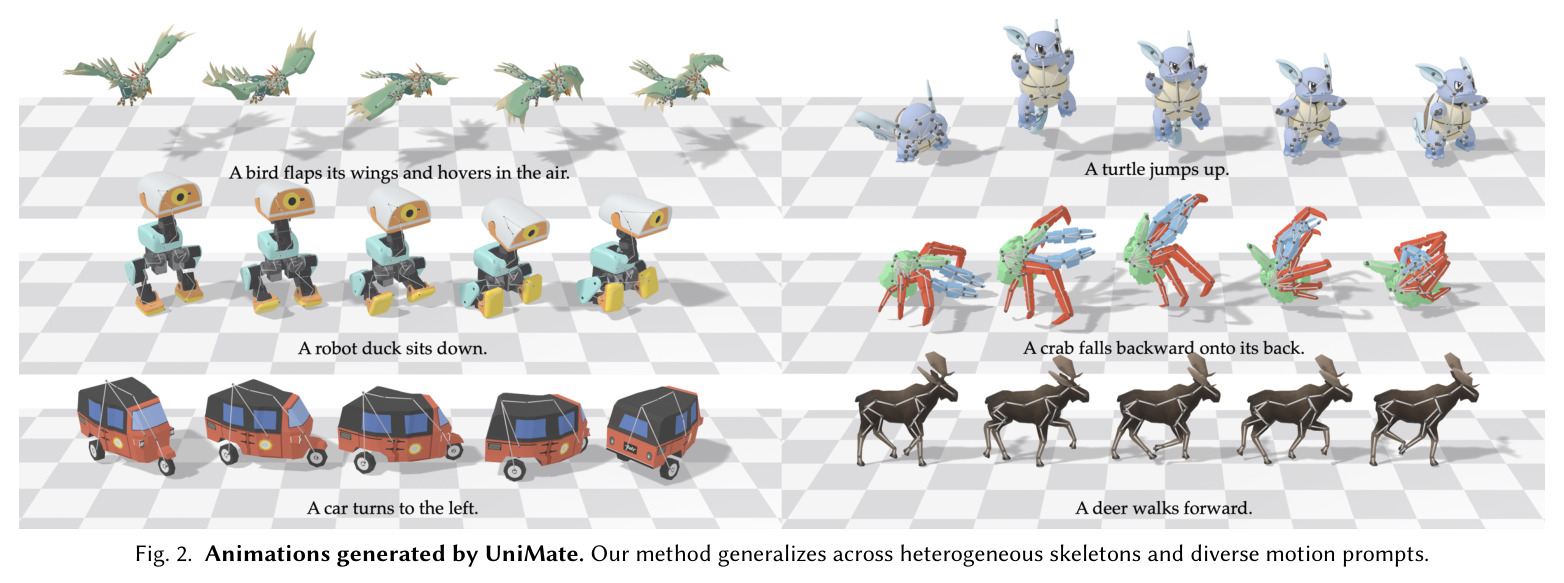
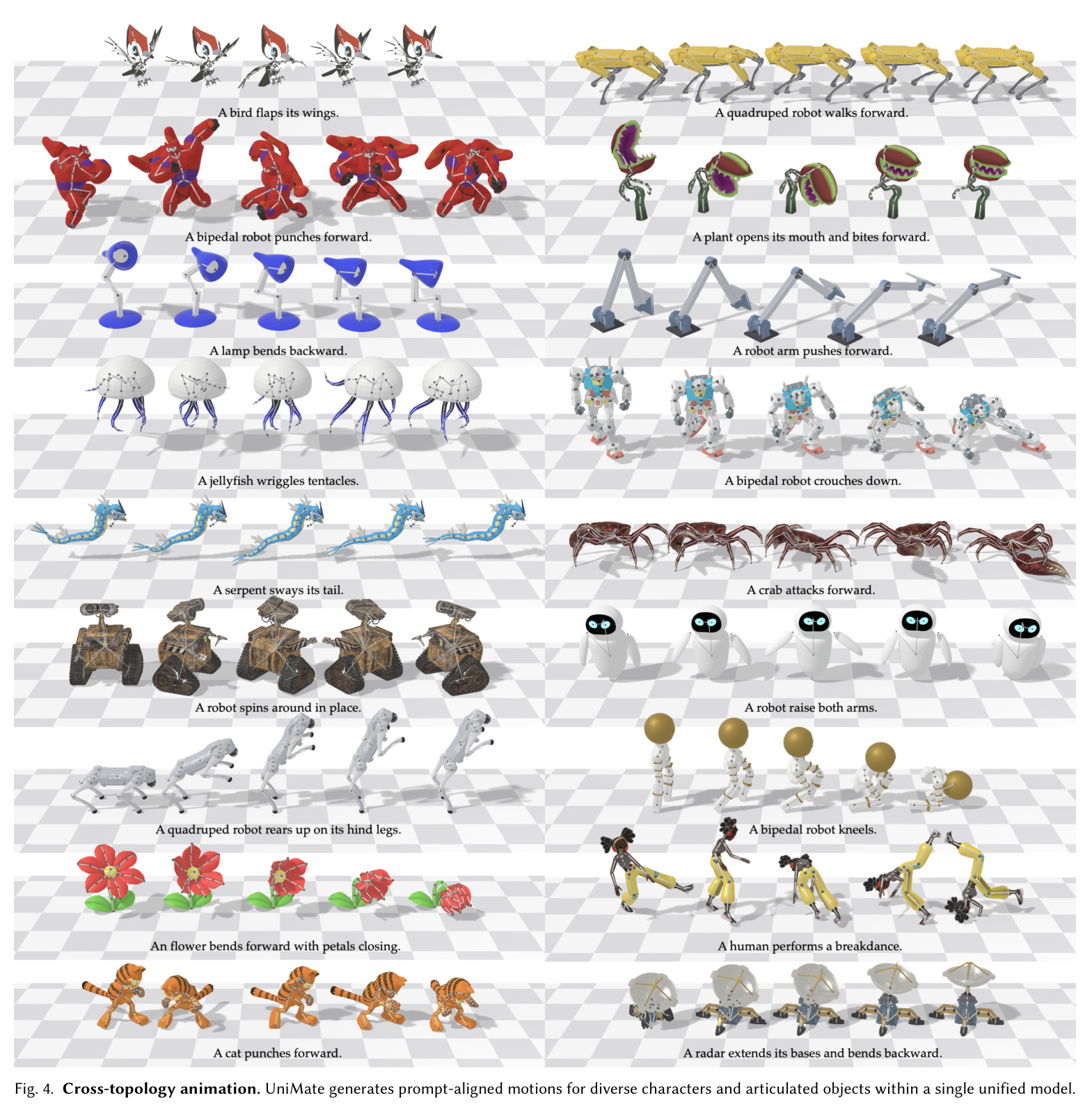
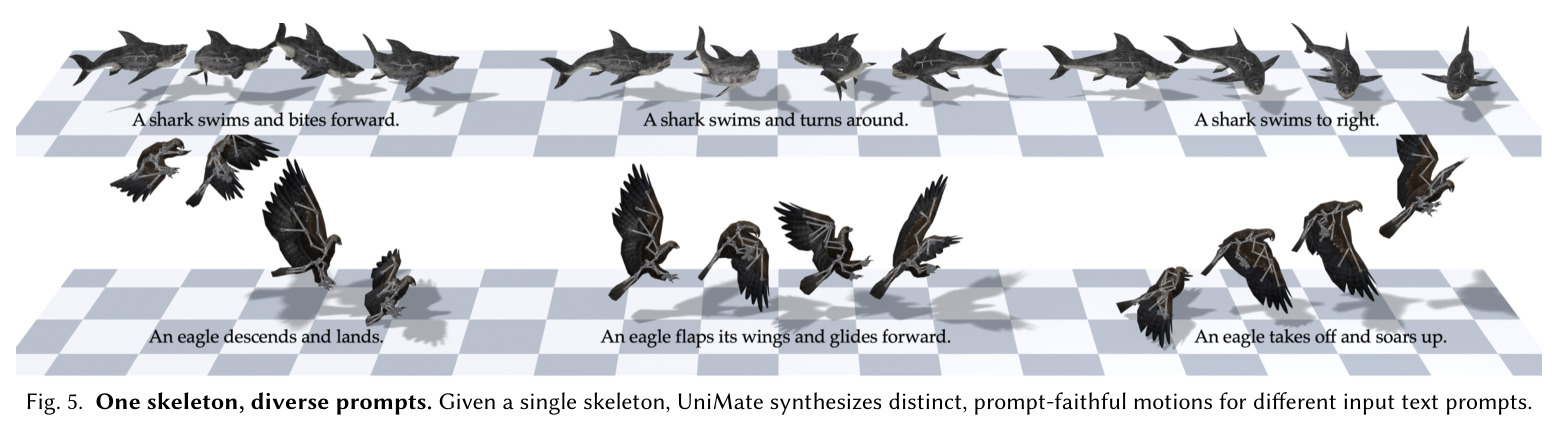
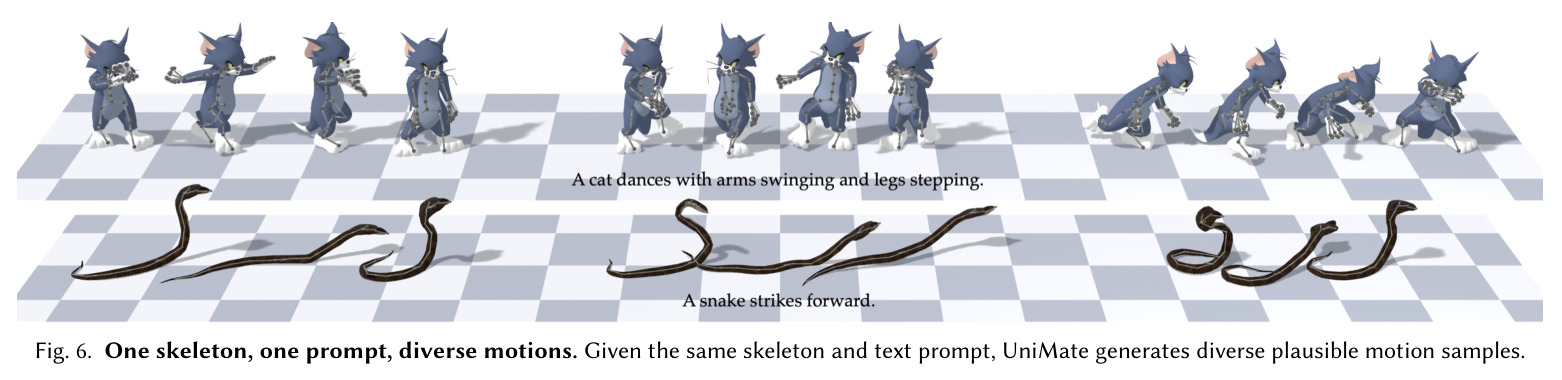
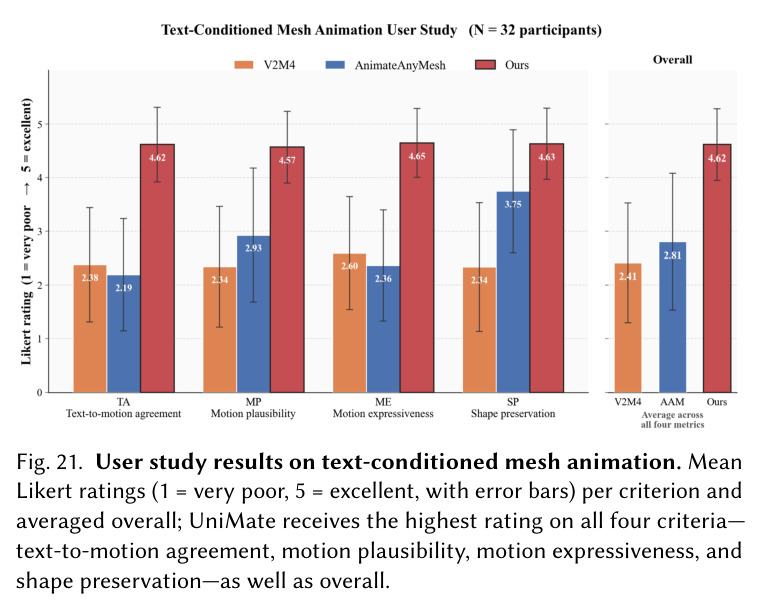
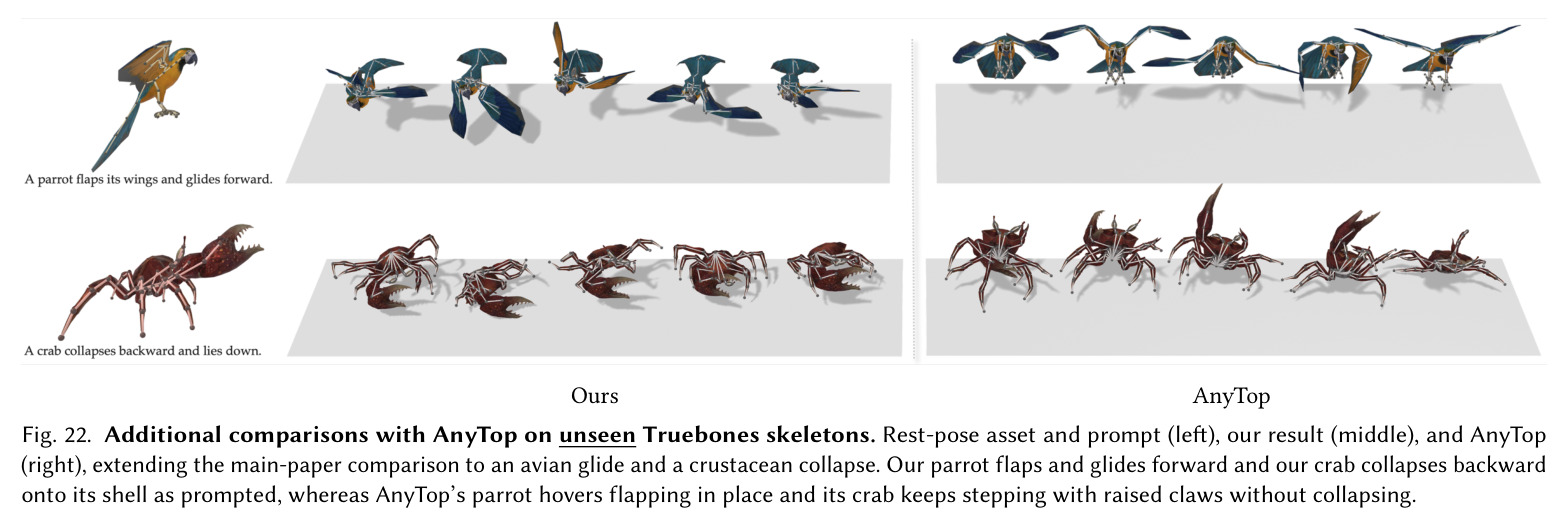
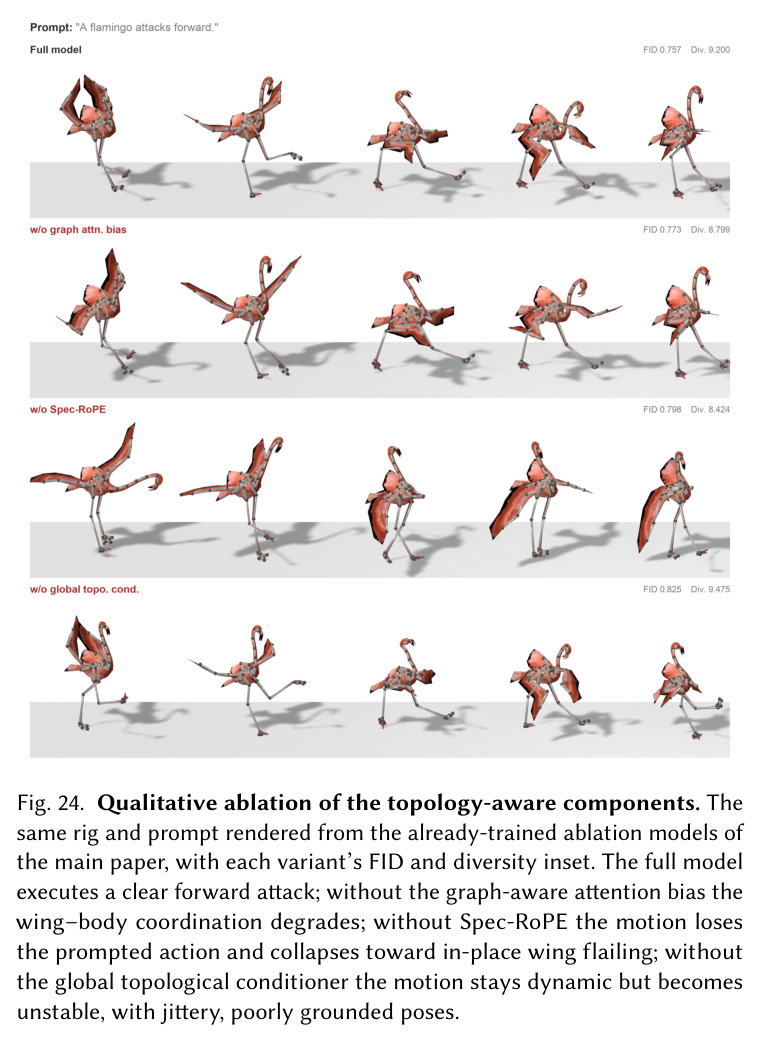
五个角度的验证。(1) 运动生成(Tab. 1):留出 7 个 Truebones 骨架共 58 条序列,对加文本交叉注意力的 AnyTop,FID 2.711→0.757(降 72%)、Diversity 8.139→9.200,非模式坍缩;定性上 AnyTop 在『摔倒』提示下鹿不倒、龙近静止,UniMate 均执行。(2) 网格动画(Tab. 2):18 网格 VBench,UniMate DD 0.833 对 V2M4 0.667、AnimateAnyMesh 0.352,AQ 0.544 最高,OC 0.186、MS 0.993 接近最优;每资产 1.214 秒,对 V2M4 的 1.641 小时约 4900 倍加速,AAM 平滑分高源于近静态输出。(3) 用户研究(Tab. 3):32 人×12 例,UniMate 四项全第一(一致 4.617、合理 4.568、表现力 4.646、形状保持 4.630),平均 4.615 对 2.808/2.413。(4) 消融(Tab. 4):去图偏差 FID 0.773;去 Spec-RoPE 0.798 且多样性 8.424;去全局条件器 0.825 且抖动。数据消融:去旋转重定基 FID 0.757→1.179,去在线增广多样性 9.200→8.265。(5) 零样本应用:跨拓扑迁移、补间、链式扩展、局部编辑均无需微调,180 帧变体无漂移。足滑(Tab. 6):Skate 0.107、Slide 0.542,脚锁后 0.023/0.191。

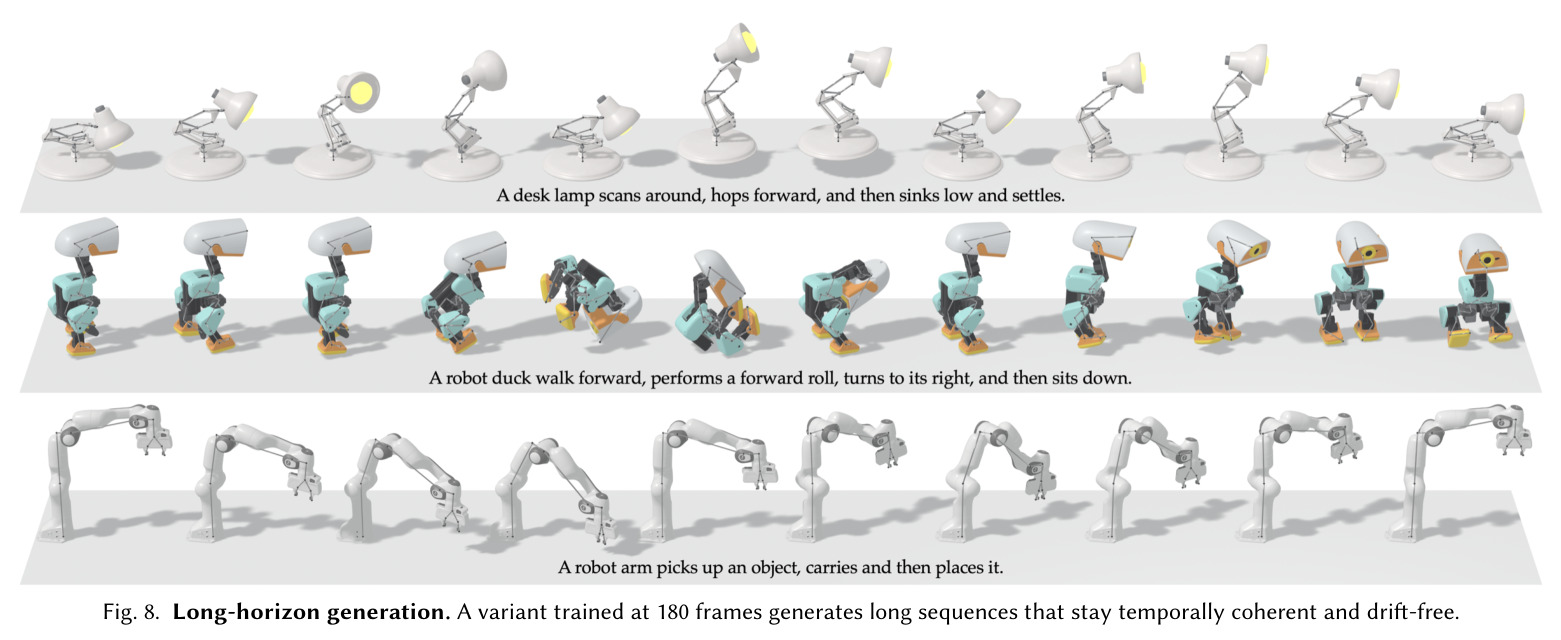
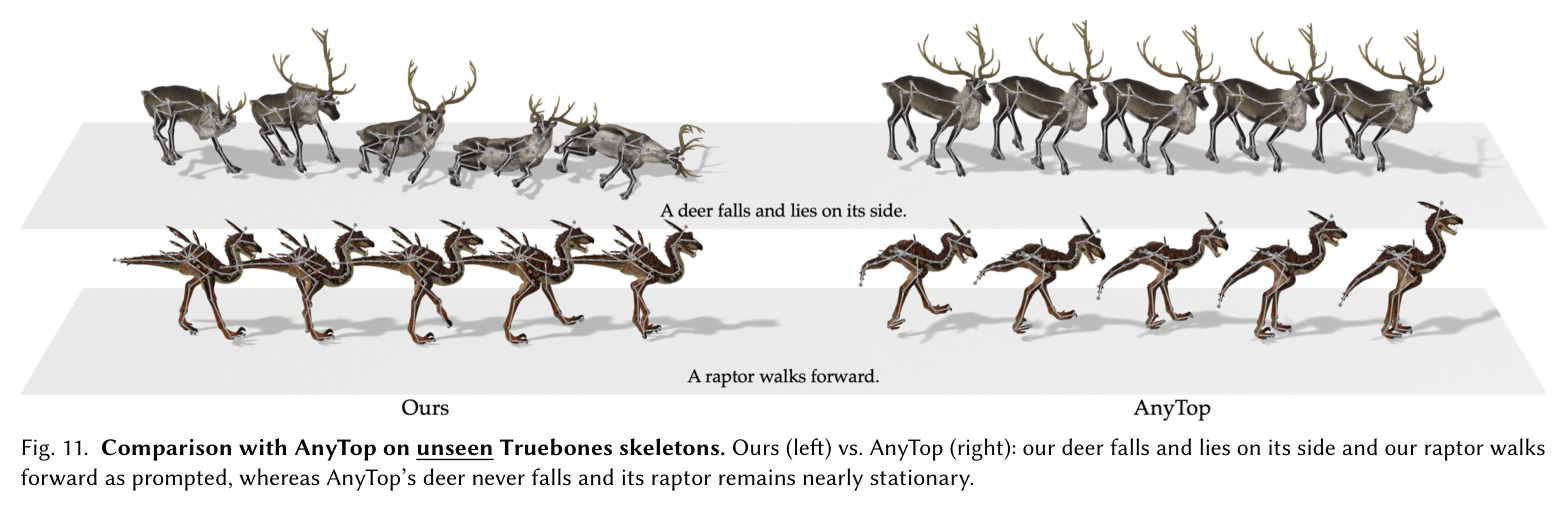
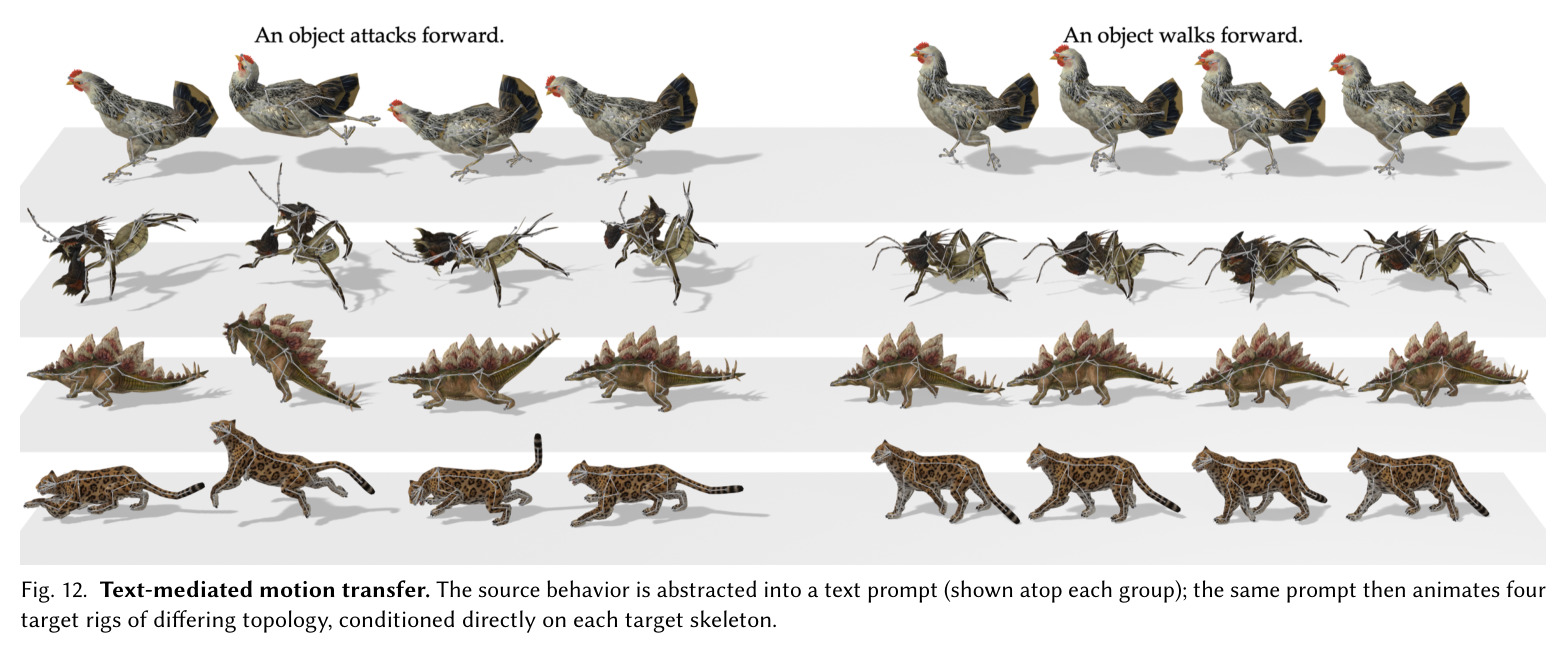
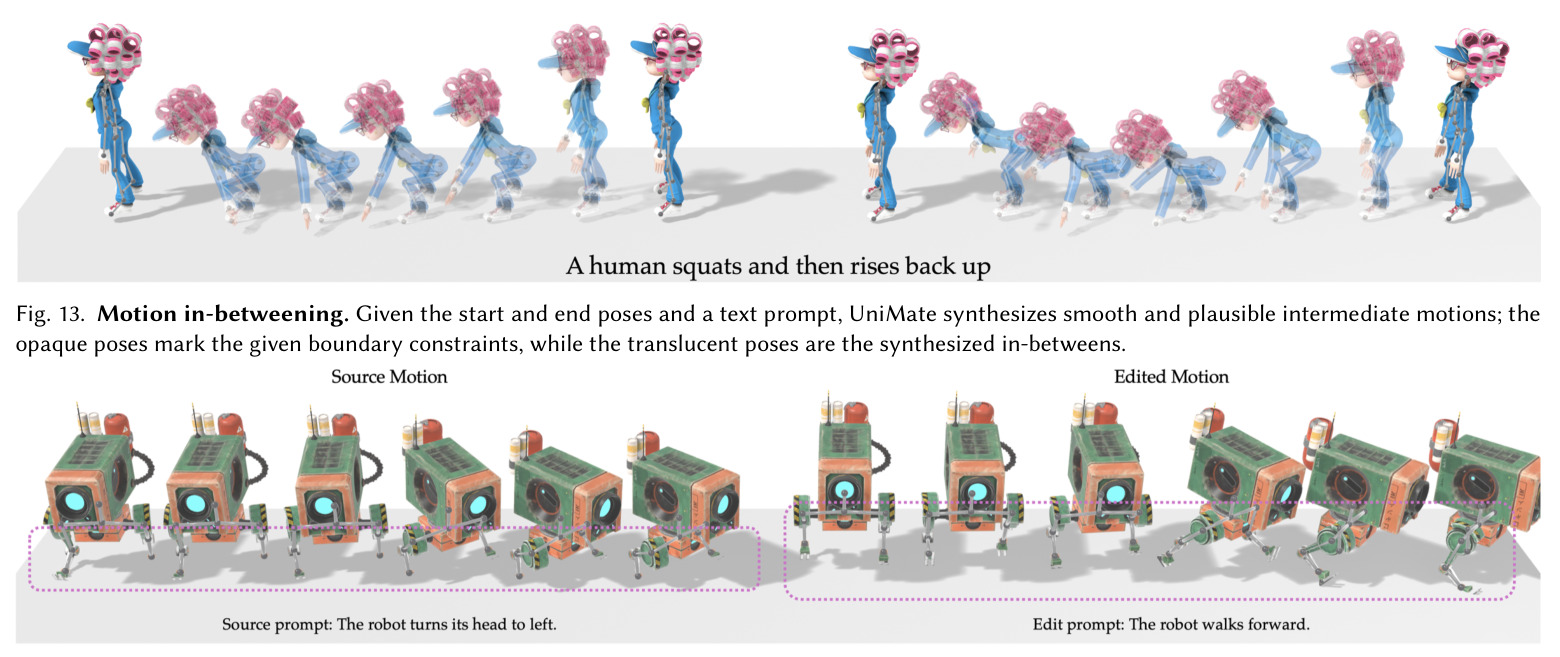

查看结构化数据
| 任务 | 指标 | 本文 | 基线 | 提升 |
|---|---|---|---|---|
| 跨拓扑文本条件运动生成(7 个未见 Truebones 骨架、58 条序列) | FID(骨架运动特征)↓ | 0.757 | AnyTop(加文本交叉注意力扩展)2.711 | 降低 72%(−1.954) |
| 跨拓扑文本条件运动生成(同上) | Diversity ↑ | 9.200 | AnyTop 8.139 | +13.0%,排除模式坍缩 |
| 文本条件网格动画(18 个网格) | VBench 动态度 DD ↑ | 0.833 | V2M4 0.667 / AnimateAnyMesh 0.352 | +24.9% / +136.9% |
| 文本条件网格动画(同上) | VBench 美学质量 AQ ↑ | 0.544 | V2M4 0.506 / AnimateAnyMesh 0.498 | +7.5% / +9.2% |
| 文本条件网格动画(同上) | 每资产生成时间 ↓ | 1.214 秒 | V2M4 1.641 小时 / AnimateAnyMesh 15.542 秒 | 快约 4870× / 12.8× |
| 网格动画用户研究(32 人 × 12 用例) | 平均 Likert(5 分制)↑ | 4.615 | AnimateAnyMesh 2.808 / V2M4 2.413 | +1.81 / +2.20 分,四项分项均第一 |
| 组件消融(同一留出评测集) | FID ↓ | 0.757(完整模型) | 去全局拓扑条件器 0.825 / 去 Spec-RoPE 0.798 / 去图感知偏差 0.773 | 三个组件各自贡献均为正 |
| 足部滑动(20 个留出腿类骨架) | Skate 滑动比 ↓ / Slide 滑动距离 ↓ | 0.107 / 0.542;加零样本脚锁后 0.023 / 0.191 | 无外部基线(自身前后处理对比) | 脚锁降低 78% 滑动比、65% 滑动距离 |
局限与改进
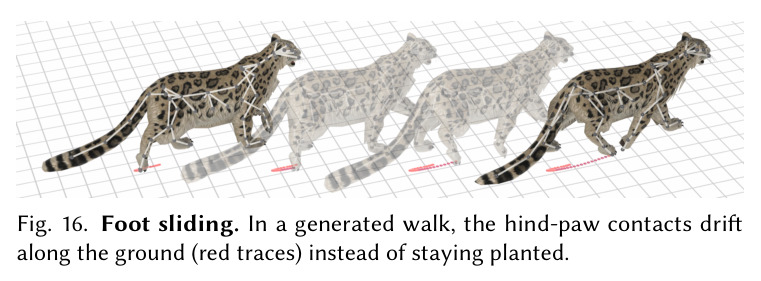
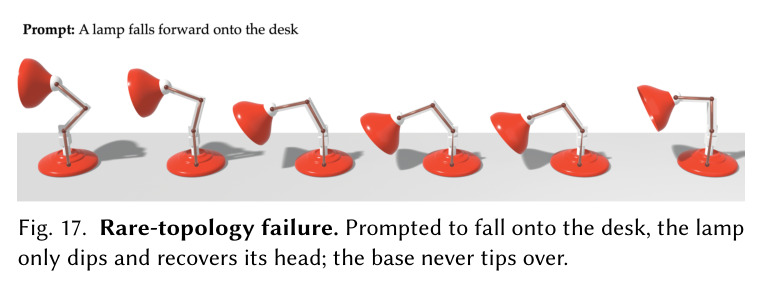
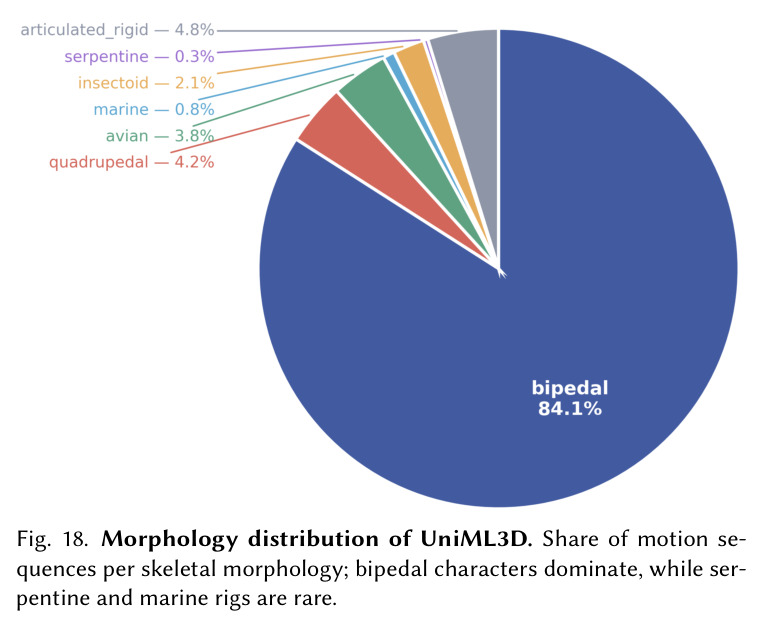
作者承认的局限:接触类动作有脚滑、漂移、悬空与穿地(Fig. 16),因为模型没有统一的接触模型——脚-地接触对双足/四足有意义,对蛇、游鱼、飞鸟和许多铰接物体定义不清;罕见拓扑与分布外动作不可靠(Fig. 17 中台灯被提示『倒在桌上』只低头又复位),根源是长尾 4D 数据(双足 84.1%,蛇形 0.3%、海洋 0.8%)。我的补充观察:其一,主评测集仅 58 条序列、18 个网格,FID 在小样本上方差大,且基于特征分布而非逐条轨迹误差,缺少接触精度、根轨迹误差等骨架空间硬指标;VBench 属视频感知代理指标,两套证据并不覆盖同一维度。其二,与 AnyTop 的对比是在自行加装文本交叉注意力后的版本上进行,扩展版未经独立验证;AnimaX、How to Move Your Dragon 因未开源或细节不足被排除,基线覆盖有限。其三,输出管线(6D 旋转 + Euler + LBS)无法表达骨架外非刚性细节(软组织、布料),作者承认骨架与无骨架范式互补但未实现残差混合。其四,数据管线深度绑定特定大模型(DeepSeek-V4-Flash、GPT-5、Qwen3.5-9B)与人工质检,模型版本更替可能引入分布漂移。
独立分析的弱点
弱点一:无显式接触与物理约束。生成的步行仍会滑步,需零样本脚锁后处理,且仅在支撑模式明确的形态有效。改进方向:按形态类别引入接触目标或可微物理投影,把脚锁从后处理改为采样时引导,学习形态感知的接触先验。弱点二:缺乏细粒度空间控制。文本能说『向前走』却无法规定『左脚踩在这里』或手部沿给定曲线运动,生产可用性受限。论文已证明采样时固定姿态 token 可做补间,可自然推广为逐关节轨迹引导(作者建议 ProjFlow 式投影采样或 UMO 式 in-context 学习)。弱点三:长尾覆盖不足。罕见物种与高技巧动作(体操、精细操作、社交互动)仍不可靠,平方根平衡采样只是缓解;可结合互联网视频蒸馏运动先验,或用 agent 系统批量合成『资产+脚本化动作』加密稀有区域。弱点四:时序长度受限。基础模型默认 60 帧短窗,长序列靠 180 帧变体或链式扩展,段间一致性靠边界帧硬约束,复杂长镜头易累积语义漂移;可引入时间维自回归或分层生成。弱点五:谱编码的理论盲区。论文自证 Spec-RoPE 在重复/近重复特征值上不保证基不变性,只能靠距离偏差、静止位置等线索兜底;可探索学习式基对齐或全谱不变特征。
未来方向
作者提出的方向:把互联网规模视频先验蒸馏进统一框架——用视频导出的运动场做辅助监督,或让 UniMate 的潜在动力学与预训练视频扩散模型对齐,使跨物种泛化随被动视频数据而非昂贵 4D 采集扩展;用 agentic 资产生成系统(如 Articraft)自动产出资产并配脚本化、仿真或蒸馏动作,填补稀有拓扑数据空洞;扩充条件通道——单目视频动捕、示例动作风格化、无绑定纯形状输入、部分骨骼演示(根轨迹、关键帧、步态时刻表),均可复用现有 AdaLN-Zero 注入路径;细粒度控制结合投影式流引导与轨迹 token 的 in-context 学习。基于本文成果可延伸的:把 UniML3D 规范化管线(LLM 关节名标准化、拓扑直径归一化、拉普拉斯谱特征)沉淀为社区标准与跨拓扑公开基准;TADiT 与物理仿真器或 RL 控制器串联生成物理可执行动作;谱位置编码思想迁移到其他树/图结构生成任务(场景图、分子构象、机器人 URDF);与 UniRig、MagicArticulate 等自动绑定进展首尾相接,构成『文本→网格→绑定→动画』的端到端流水线。
复现评估
复现条件在同类工作中属较好水平。代码仓库已公开(github.com/Friedrich-M/UniMate),论文承诺放出完整训练与数据预处理代码、预训练 checkpoint 与 UniML3D 数据集;项目页另有交互 demo 可直接检验生成质量。数据侧:Mixamo 免费公开、Objaverse-XL 可下载,Truebones 为付费资产,是复现数据集的主要外部障碍;管线依赖特定 LLM(DeepSeek-V4-Flash、GPT-5、Qwen3.5-9B)加人工质检,提示词虽全部公开但完整重跑成本不低,后来者也无法使用完全相同的模型版本。算力门槛友好:8×H100 训练约一天(10 万步、全局 batch 256、bf16),推理 50 FPS、60 帧约 1.2 秒,单卡 H100 即可复现推理与评测。技术难度:模型部分中等——图拉普拉斯特征分解、SignNet、AdaLN-Zero、流匹配均为标准组件,附录 B 给出全部超参与三个损失公式,附录 C 给出理论推导;数据部分较高——多阶段过滤、朝向推断、渲染字幕管线工程细节繁多,但研究性复现可直接使用官方发布的 UniML3D 绕过。总体属于可复现性较好的工作。
论文图表
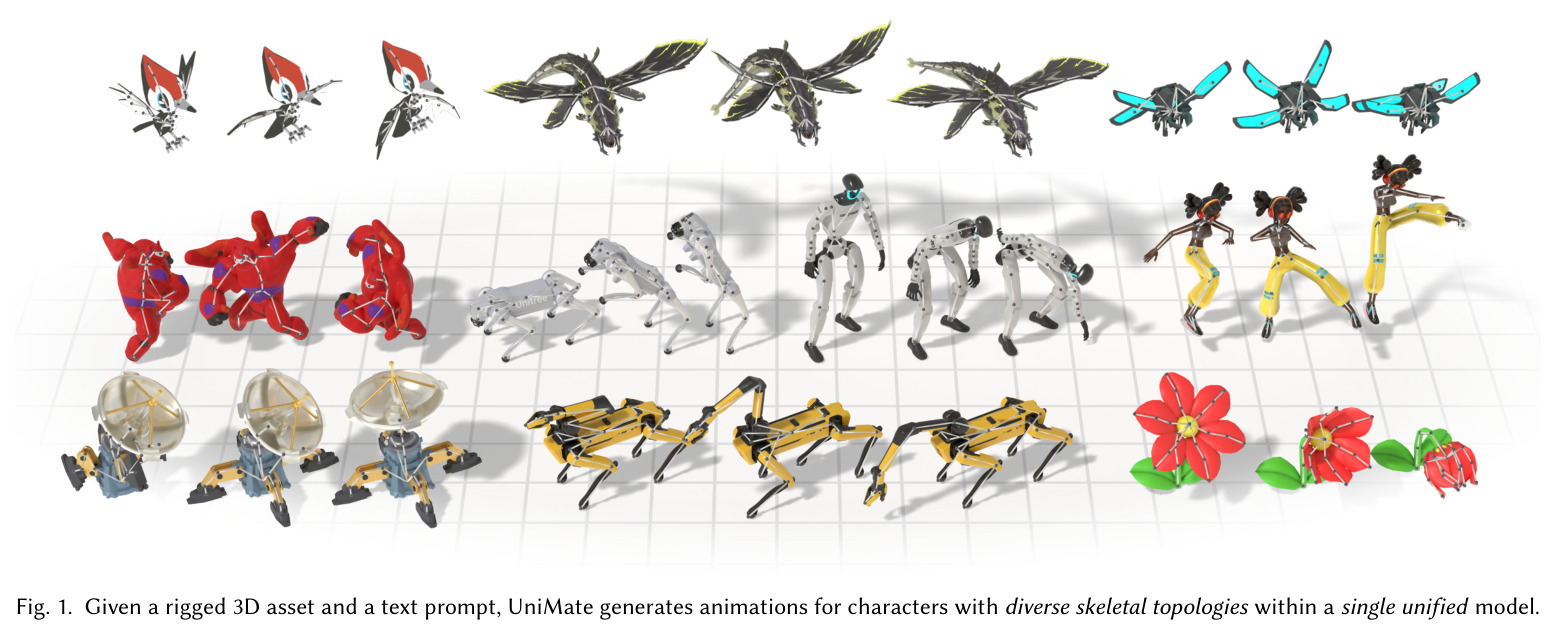
首页示意图:同一模型接收带绑定骨架的 3D 资产与文本提示,为两足、四足、鸟类等不同拓扑角色生成动画。
一图点题:单一统一模型 + 任意拓扑 + 文本条件,是全文核心命题的直观呈现。
失败案例:生成步行中后爪接触点沿地面漂移(红色轨迹)而非保持种植。
作者坦承的接触缺陷的直观证据,对应 Tab. 6 的量化分析。
失败案例:台灯被提示『倒在桌上』只低头又复位、底座永不倾倒——罕见拓扑与分布外动作的失效。
揭示长尾数据对模型能力边界的硬约束,是理解局限性的关键一图。
UniML3D 形态分布:两足占 84.1%,蛇形 0.3%、海洋 0.8% 极稀少,呈强长尾。
量化解释为何模型在稀有物种上不可靠,也说明平衡采样的必要性。
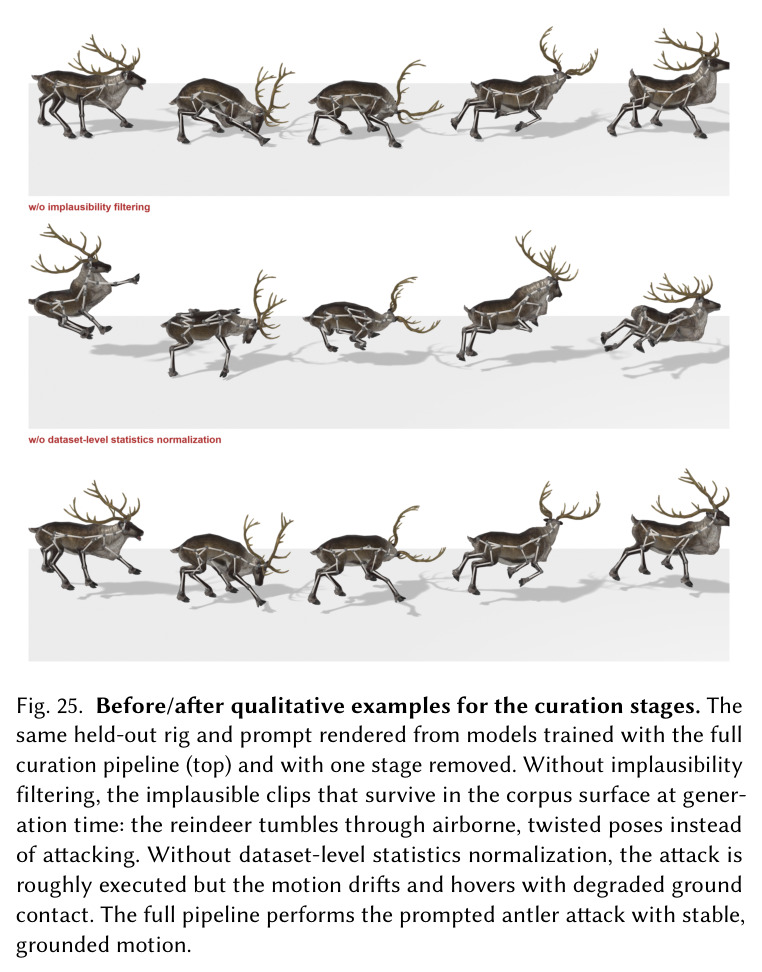
数据消融可视化:去不合理片段过滤则驯鹿出现空中翻滚等噪声动力学;去数据集级统计归一化则动作漂移悬空;完整管线执行稳定的鹿角攻击。
证明数据管线各阶段(含剔除 8.7% 片段的过滤)对最终质量的实际贡献。
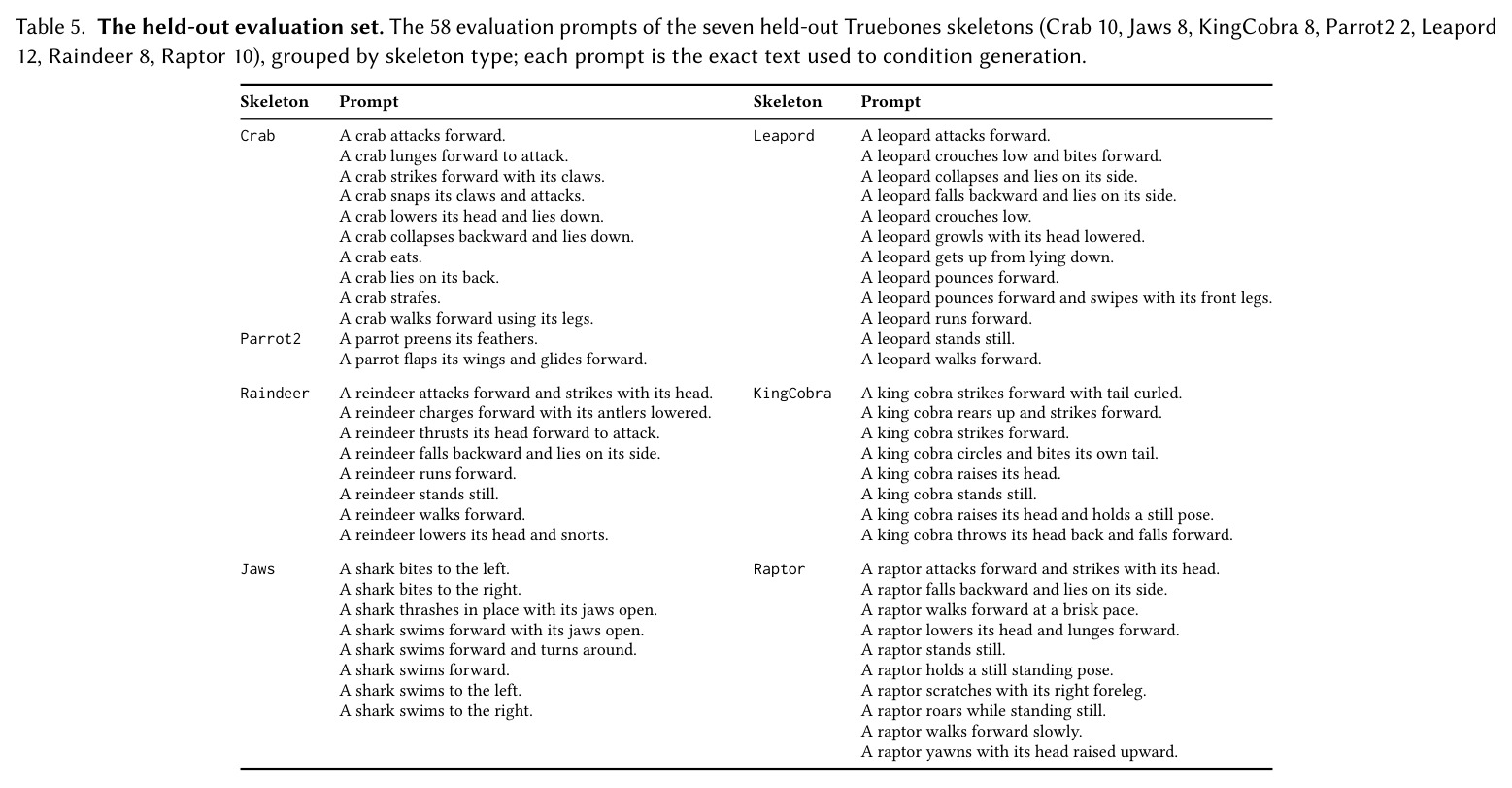
留出评测集明细:7 个骨架类型的全部 58 条文本提示原文及数量分布,随机种子 10。
保证评测可复现、可审计,是检验『未见』声明是否成立的依据。
20 个留出腿类骨架上的滑动量化:Skate 0.107 / Slide 0.542,加零样本脚锁后 0.023 / 0.191。
把局限章节的脚滑问题量化,并验证零样本后处理的有效性。