Avatar V:可扩展的视频参考化数字人视频生成框架 Avatar V: Scaling Video-Reference Avatar Video Generation
用视频参考+稀疏注意力+动作表征实现生产级1080p数字人视频生成
前置知识
Diffusion Transformer (DiT)
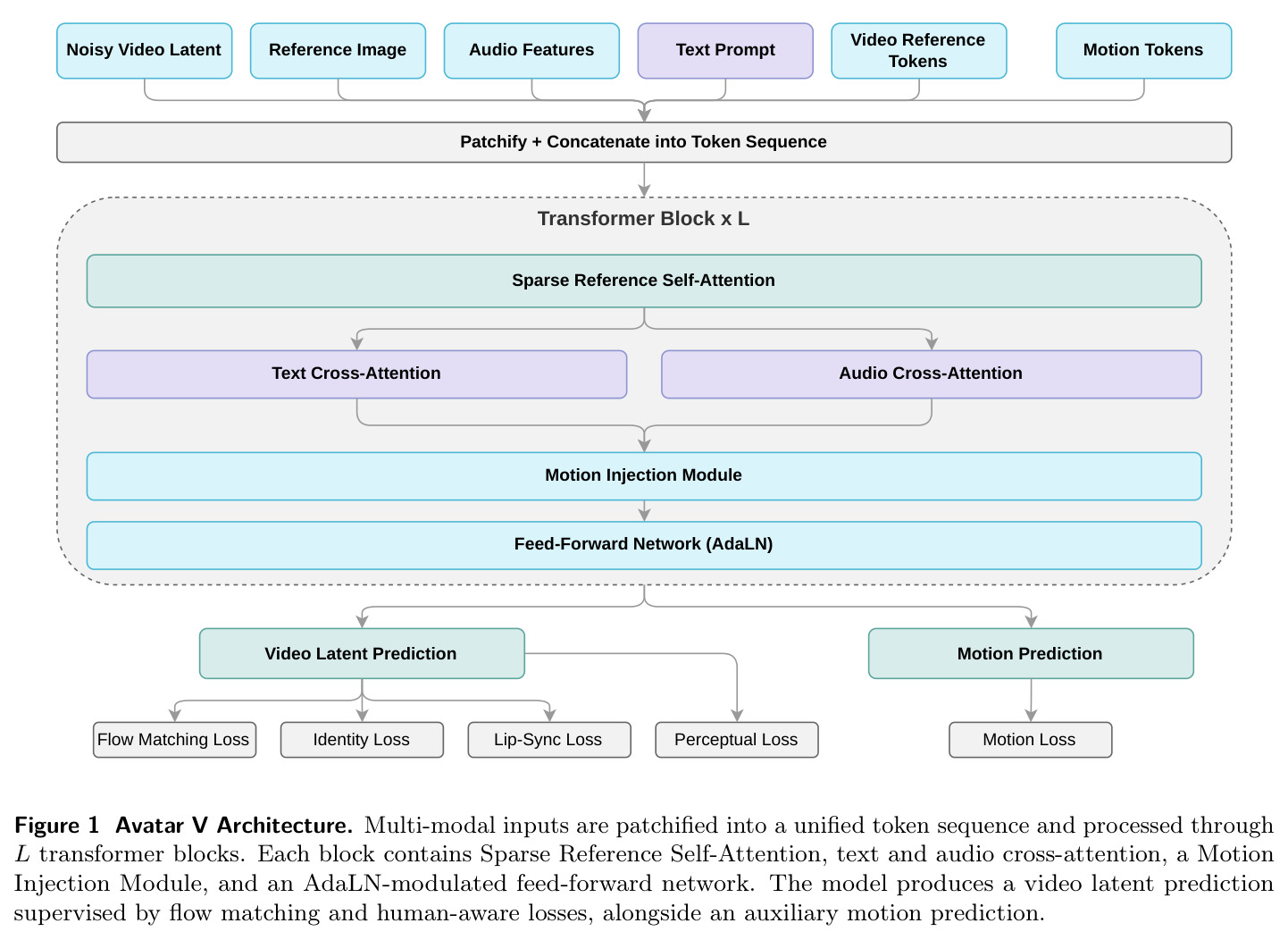
DiT 是一种将扩散模型的 U-Net 主干替换为 Transformer 的架构,核心思想是把图像/视频 patch 化后作为 token 输入,使用 AdaLN(自适应层归一化)将时间步和条件信息调制进每个 Transformer 块。本文整个 DiT 主干、Reference Attention、SR Refiner 都基于此架构。
Avatar V 在 DiT 之上加入非对称稀疏注意力,必须先理解 DiT 的 patchify、token 序列、AdaLN 调制,才能看懂 Sparse Reference Attention 是怎么嵌入标准 Transformer 块的。
Flow Matching(流匹配)
流匹配是一类将噪声沿直线轨迹传输到数据的训练目标,模型学习预测速度场 $v_\theta(x_t, t)$,相比 DDPM 在少步采样时表现更稳定,常配合 logit-normal 时间步分布使用。
本文 Stage 1 和 Stage 2 的扩散训练采用 rectified flow matching,且 DMD 蒸馏和 GRPO 强化学习都是针对流匹配形式化的,少步推理(24 步)依赖这套目标设计。
Sparse Attention / 稀疏注意力
稀疏注意力通过预定义或学习到的注意力掩码,让每个 query 只关注部分 key,而非全局的 $O(N^2)$ 计算。常见模式包括滑动窗口、块稀疏、跨序列非对称注意力。
Sparse Reference Attention 是本文最核心的创新,generation token 对 reference token 做 cross-attention、reference token 之间只 self-attend,将参考长度带来的复杂度从二次降为线性,是支撑「任意长参考视频」的关键。
DMD (Distribution Matching Distillation) 与 CFG 蒸馏
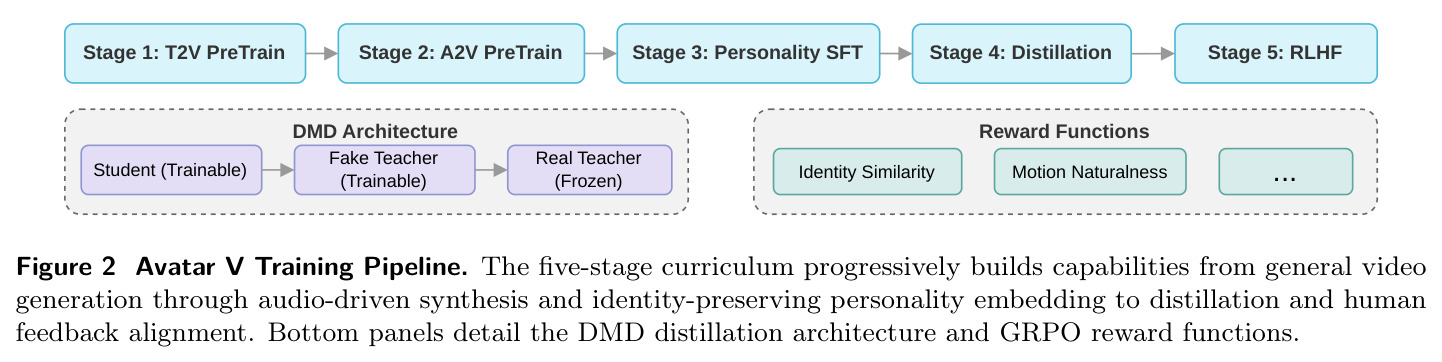
DMD 通过 trainable student、trainable fake teacher、frozen real teacher 三方模型,让 student 的单步输出分布对齐 multi-step teacher;CFG 蒸馏则把 conditional 与 unconditional 多次前向合并为单次前向。两者组合可把推理步数砍一个数量级。
本文 Stage 4 的 two-phase distillation 直接使用 DMD+CFG 蒸馏,把推理从大量 CFG forward 砍到 24 步单次前向,是生产部署低延迟的关键。
SyncNet / ArcFace / Q-Align
SyncNet 用 audio-visual embedding 衡量唇音同步;ArcFace 通过角度 margin 训练的人脸识别模型提取身份 embedding;Q-Align 是用 VLM 给出与人评 MOS 对齐的 IQA 分数。三者分别用于客观评测中的口型、身份、画质。
理解 Table 1 的指标含义(Sync-C/Sync-D、Face Sim、Q-Align)以及它们衡量的具体感知维度,是判断 Avatar V 真实能力的前提。
研究动机
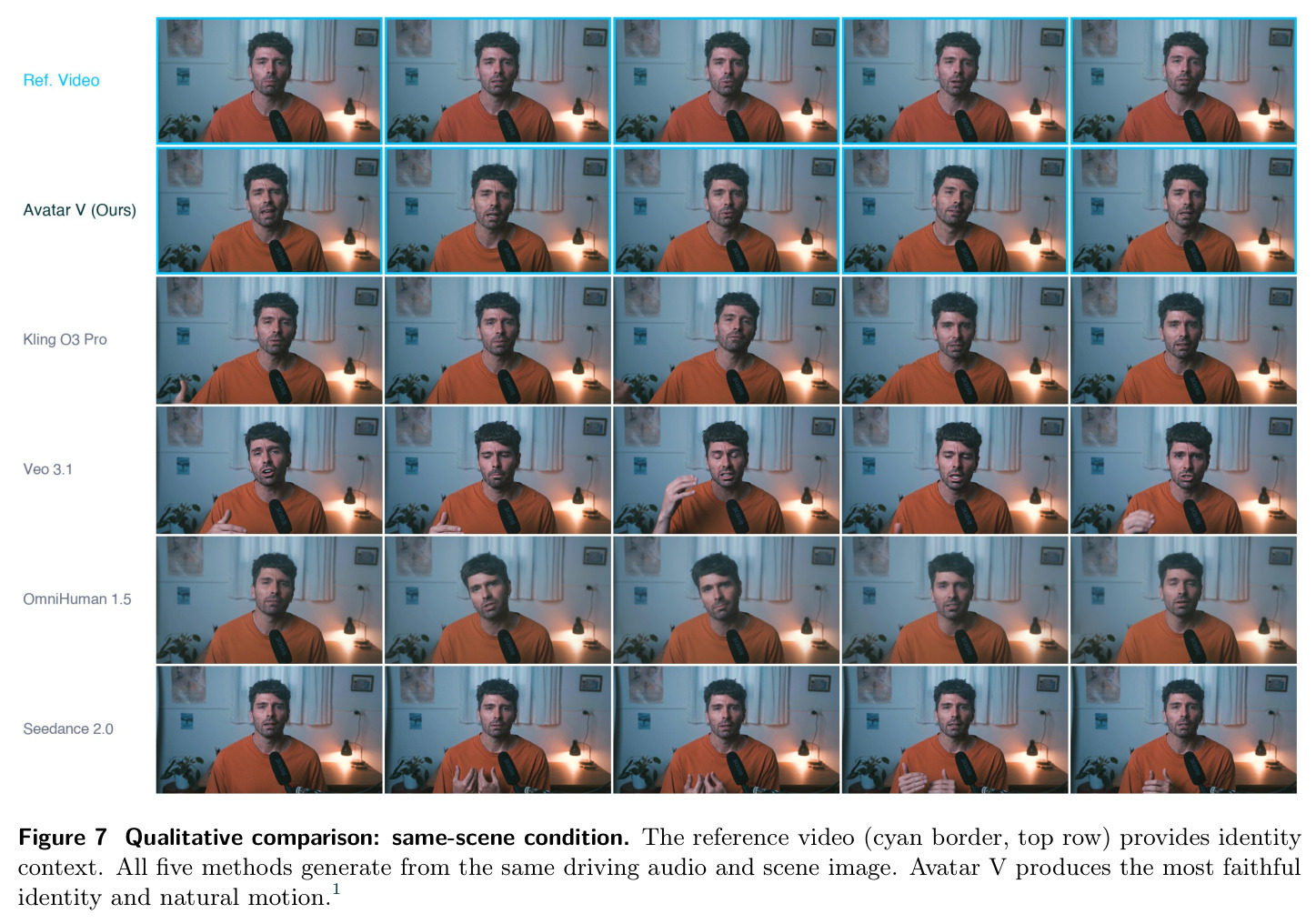
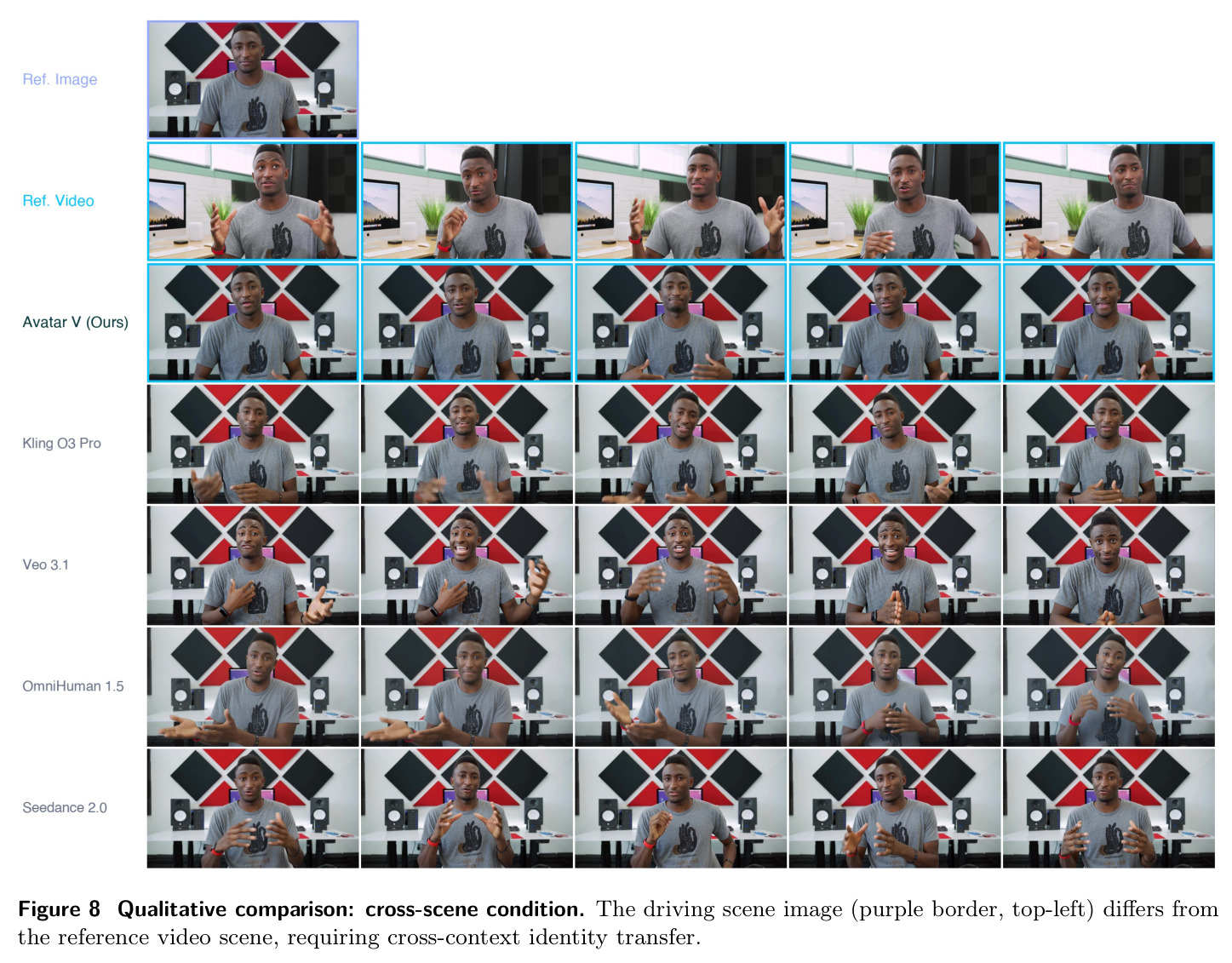
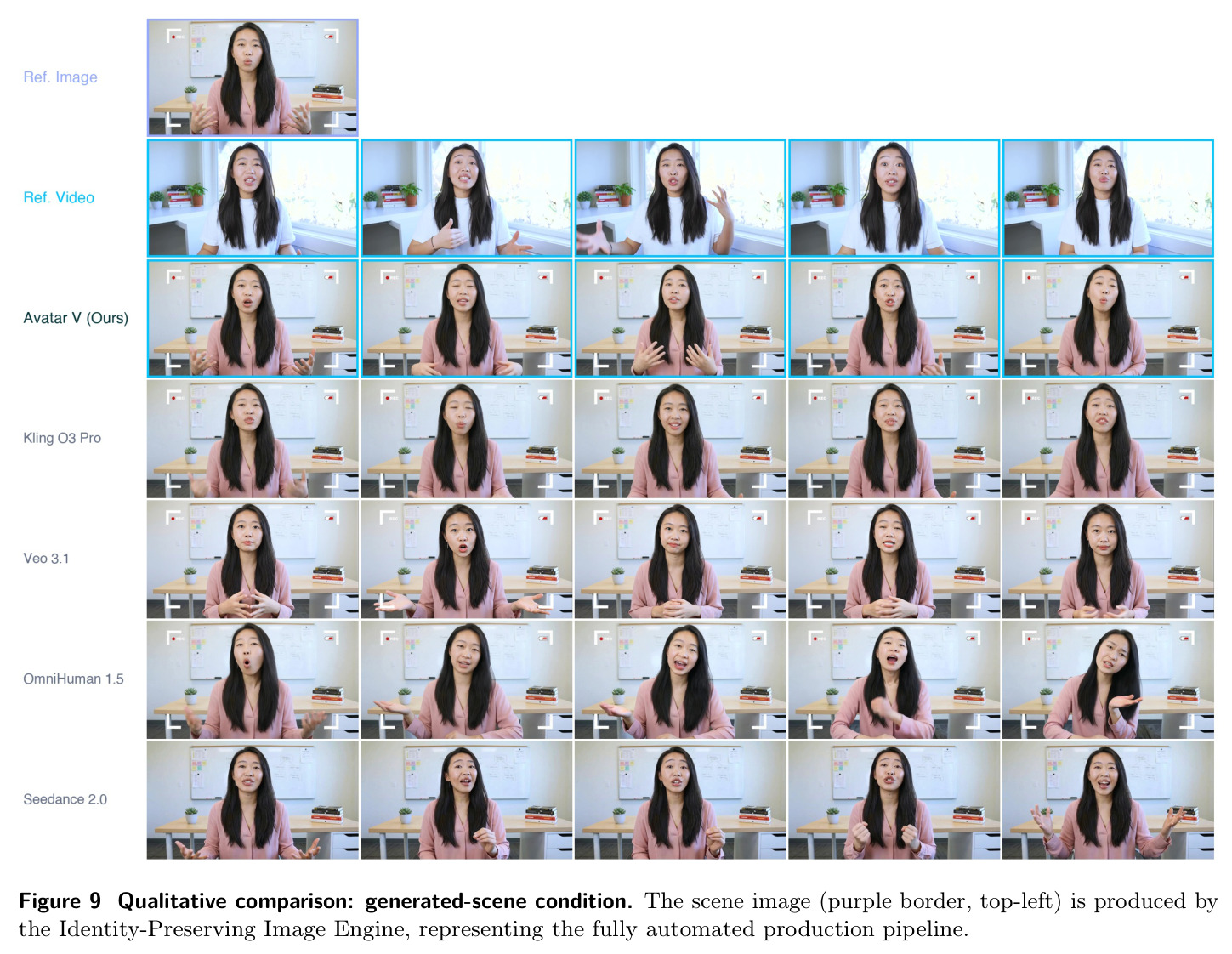
现有音频驱动的肖像/数字人生成方法普遍只接受单张静态参考图作为身份条件,身份信息被压缩到一个固定大小的 embedding。这种浅层身份表示存在三个根本缺陷:第一,单张图只能捕捉一个视角、一种光照、一种表情,模型必须「幻觉」出未见过的视角和发音模式,导致身份漂移、细节丢失;第二,身份与运动风格被解耦,模型把 identity 当作静态向量、把 motion 当作单独条件信号,导致无法复现目标人的说话节奏、习惯性微表情和手势倾向;第三,标准的像素级扩散损失把学习信号均匀分布在整张图上,但唇形、牙齿、微表情、眼神这些对数字人保真度最关键的区域只占像素总量的小部分,导致面部细节训练不足、口型同步差。在 70 个跨场景测试用例上,主流商用系统(Kling O3 Pro、Veo 3.1、OmniHuman 1.5、Seedance 2.0)的人脸相似度 ArcFace 得分仅有 0.714–0.838,远低于 Ground Truth 的 0.861,直观体现了身份保持能力的差距。
本文的目标是本文的目标是构建一个生产级的、可部署到真实业务中(已被部署服务上百万次生成请求)的端到端数字人生成系统 Avatar V:给定用户几秒到几分钟的短视频参考(任意长度)、目标音频、文本场景描述,生成无限时长、1080p 分辨率的数字人视频,既要在像素层面保真(高分辨率、无明显伪影),又要在身份层面行为层面像目标本人——五官/皮肤/牙齿/皱纹是 ta 的,讲话节奏、微表情、手势习惯也是 ta 的。论文强调的不是「看起来像」,而是「行为上能被识别为同一个人」。
与已有工作不同的是,本文的独特切入角度是把身份条件化重新定义为「视频参考条件化问题」,而不是「embedding 压缩问题」:模型不把参考视频压成固定大小向量,而是直接以完整 token 序列作为 context,通过 attention 从中抽取静态身份特征和动态行为模式。为了让这种条件化可扩展到任意长度的参考视频,作者进一步设计了 Sparse Reference Attention,把生成 token 对参考 token 的 cross-attention 与参考 token 之间的 self-attention 解耦,使参考长度带来的复杂度从二次降为线性。再叠加独立的运动表征流(既作训练目标又作条件信号,形成闭环)以及继承完整身份条件装置的超分精修器,构成了对「身份+行为+高分辨率」三位一体的差异化方案。
核心方法
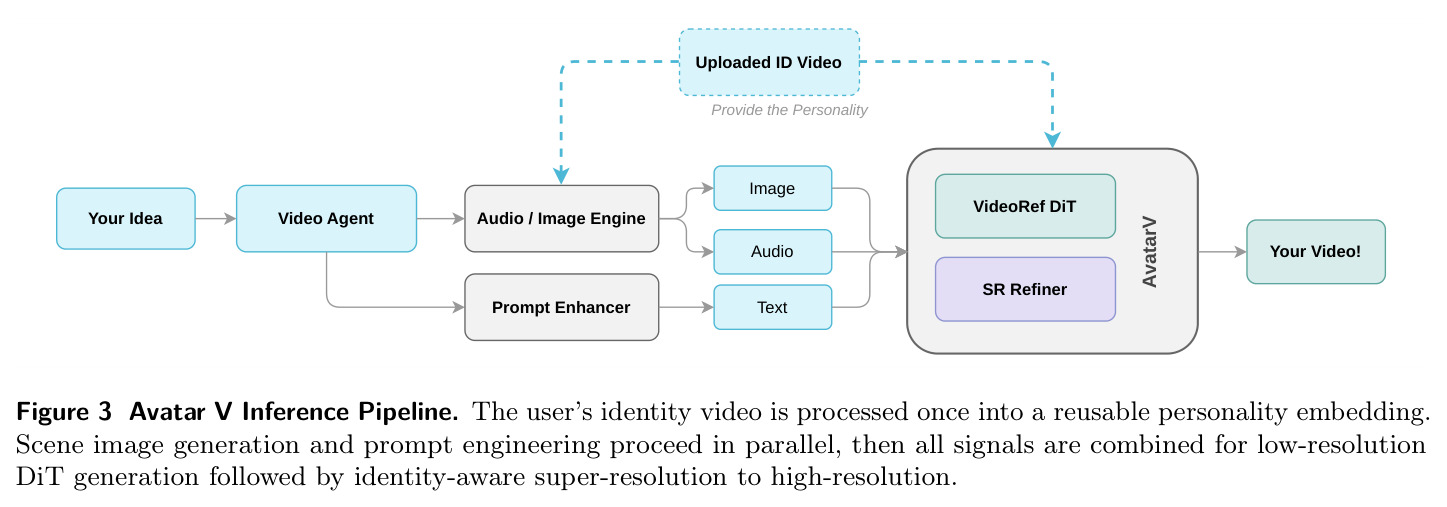
Avatar V 整体由四大模块串成:Identity-Preserving Image Engine 负责根据参考视频生成目标场景的图像;VideoRef DiT 是核心,基于 DiT + Flow Matching,用 Sparse Reference Attention 把视频参考 token、音频特征、文本 prompt、动作 token 全部 patchify 后拼成统一序列,过 $L$ 层 Transformer 块,输出低分辨率视频 latent;Audio Engine 是基于 LLM 的声音克隆模块,从 10 秒音频里提取声纹并按文本生成目标语音;Super-Resolution Refiner 沿用同一套 DiT 主干,把低分辨率 latent 配合高斯噪声、单步去噪到 1080p,并继承视频参考和音频条件以保持身份。整个系统通过 5 阶段训练管线(T2V 预训练 → A2V 预训练 → Personality SFT → 两阶段蒸馏 → RLHF)在 5000+ GPU 上训练,推理时 24 步出图,并配合 NVSHMEM 序列并行、agentic 编译、KV cache、流式 VAE 解码等优化上线。
核心创新是把「身份 embedding 提取」这件事从 encoder 端彻底搬到 decoder 端的全注意力机制里:模型不学习一个固定维度的身份向量,而是在每一层 Transformer 块中都通过 attention 看到参考视频的完整 token 序列,从中按需抽取静态特征(facial geometry、skin texture、dental structure、accessories)和动态特征(talking rhythm、micro-expression、gestural tendency)。与之配套的 Sparse Reference Attention 是一个非对称的稀疏模式——生成 token 对所有参考 token 做 attention 以充分提取身份信息,参考 token 之间只做 self-attend 而不与生成 token 互相 attend,这就把参考长度相关的注意力复杂度从 $O((L_r+L_g)^2)$ 降为近似 $O(L_r^2 + L_r L_g)$,其中 $L_r$ 是参考 token 数、$L_g$ 是生成 token 数;由于 $L_r$ 远大于 $L_g$ 且 $L_g$ 较小,参考长度方向上呈线性可扩展。这与已有「参考视频条件化」工作(WanAnimate、SlotID、Seedance 2.0)形成本质差异:它们要么用 bottleneck 编码器压缩参考(信息损失),要么朴素地把所有 token 拼接(计算量爆炸),Avatar V 选择了「不压缩、全连接、稀疏化」的中间路线。第二个核心创新是动作表征的「双角色」设计:动作流既是预测目标(motion loss 监督)又是 conditioning signal(motion injection module 注入),通过联合优化把目标人的动作模式内化到模型里,实现闭环 talking style 迁移。第三是超分精修器继承全部参考条件装置,避免传统 SR 在高分辨率下产生身份不一致伪影。
方法步骤详情
训练流程五步走。第一步 T2V 预训练:在大规模文本-视频对上做 rectified flow matching 预训练,logit-normal 时间步分布,分布式 Muon 优化器优化 2D+ 权重、AdamW 优化 1D 参数,余弦退火 + 线性 warmup;联合训练 T2V 和 I2V 任务,从低分辨率短 clip 渐进到高分辨率长序列。第二步 A2V 预训练:在 T2V 基础上引入音频 cross-attention 模块,对齐音素级唇动;同样做渐进分辨率和动态序列长度训练。第三步 Personality SFT:开启 Sparse Reference Attention 和 Motion Injection Module,训练数据是同身份跨场景配对 clip(cross-clip identity connectivity),强制模型学习身份不变特征;human-aware 辅助损失(identity / motion / lip-sync / perceptual)逐步激活,每个损失都在对应 learned representation space 中计算而非像素空间。第四步两阶段蒸馏:先做 CFG 蒸馏,把多路 classifier-free guidance 合并为单次前向;再做 DMD 蒸馏,三模型架构(trainable student、trainable fake teacher、frozen real teacher),配合 distribution matching loss、可选 adversarial loss、稳定性改进项,将去噪步数大幅压缩。第五步 RLHF:用 GRPO 作为主要 RL 算法(flow-matching 兼容形式化),reward 涵盖 identity fidelity、motion naturalness、visual quality,配合 KL 正则;备选用 DPO 学习人类偏好对。推理时用户上传的 ID 视频只预处理一次:编码成 video reference tokens、identity embeddings、expression embeddings,与音频特征、文本 prompt、Image Engine 生成的场景图并行准备;DiT 按 chunk 自回归(首块 ref2v,后续块 prefix2v,块间 2 帧 overlap),24 步采样使用改进的 stochastic Euler(overshoot + renoise 注入受控随机性恢复高频细节);SR refiner 单步对抗式上采样,$\sigma=0.6$ 加噪;最后流式 VAE 解码一边生成一边输出。Sparse Reference Attention 在推理时配合两层 cache:context-level(首步算一次 reference context 后续复用)+ attention-level KV cache(每个 transformer block 的 reference self-attention KV 首步算一次后续拼接),再叠稀疏 validity mask 跳过无效参考 token。
技术新颖性
技术新颖性体现在三个层面。架构层:Sparse Reference Attention 的非对称稀疏模式在视频参考条件化场景中是新颖设计——以往要么用 encoder 压缩(OmniHuman、IP-Adapter 类)、要么全连接(计算量爆炸),本文既保留参考全信息又把复杂度压到近线性。同一思路下,把动作表征流设计为「双角色」(同时作 loss 目标和 conditioning signal)形成的闭环监督在肖像动画文献中较为少见。训练目标层:把 identity / motion / lip-sync / perceptual 等多种 human-aware 辅助损失统一在 learned representation space 中计算,避免像素级 loss 在面部关键区域的信号稀疏;flow-matching 兼容的 GRPO 形式化是工程上较新的适配。系统层:从 agentic kernel synthesis(LLM 自动生成融合 CUDA/Triton kernel,配合 evolution island 策略避免噪声过拟合)到 NVSHMEM-based sequence parallelism(用 NVLink 做 sub-tensor pipelining,让 all-to-all scatter / cuBLAS GEMM / gather 细粒度重叠),再到 NUMA-aware process placement 和 GPU 时钟锁定,每一项都是为大规模视频 DiT 推理量身定制的工程方案。把这些组件组合为可服务百万请求的生产系统,比单纯模型设计更有工程参考价值。
实验结果
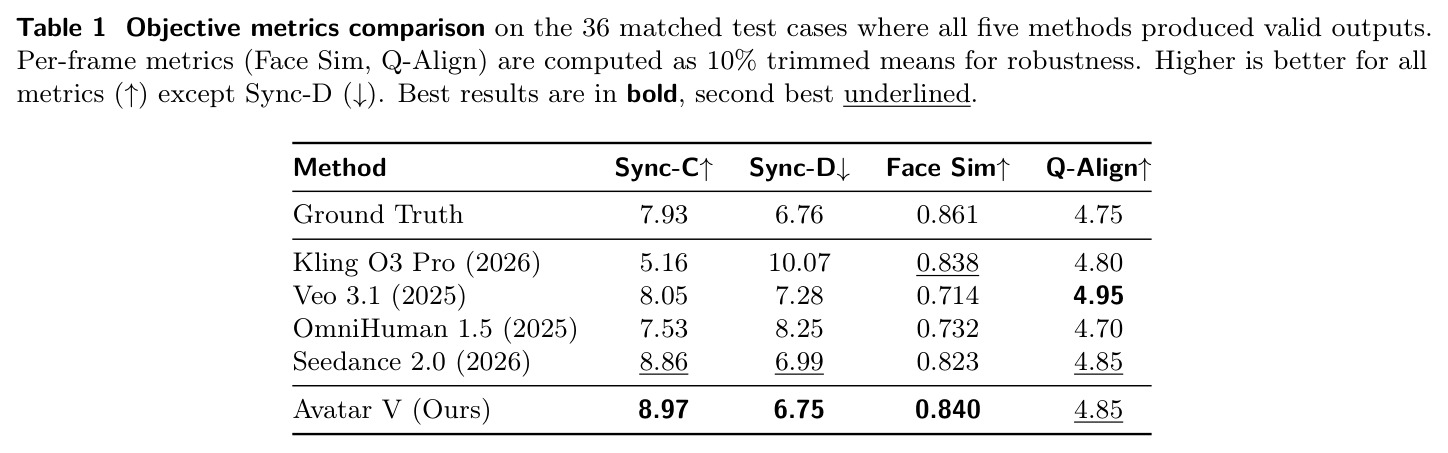
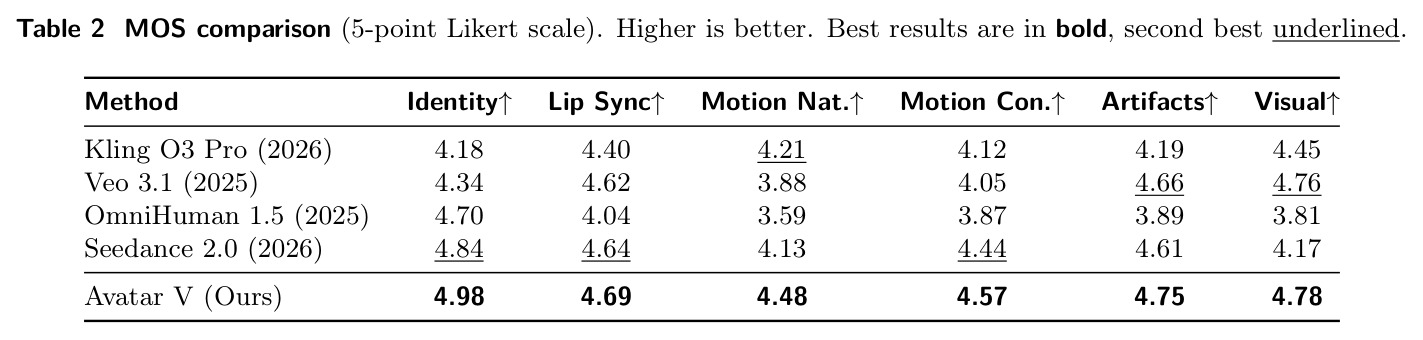
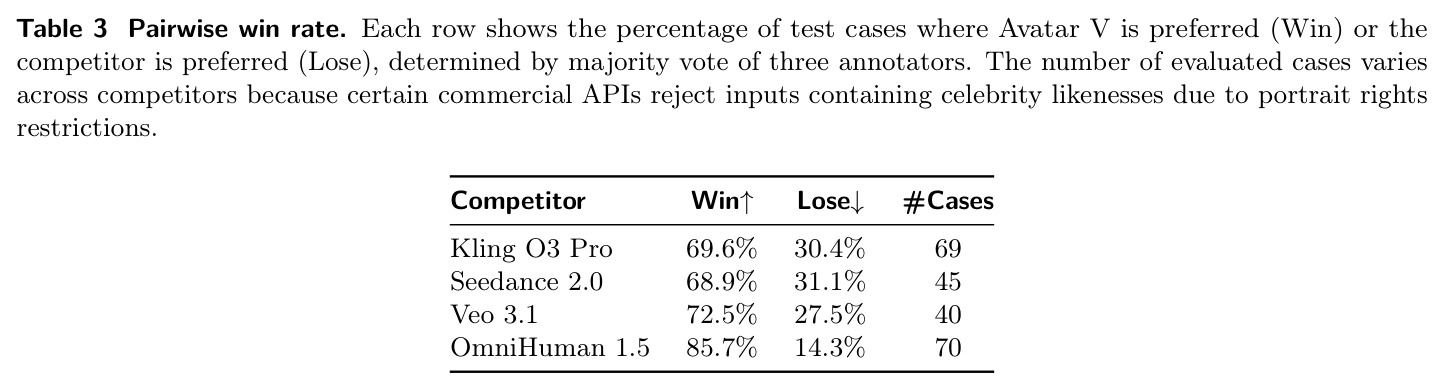
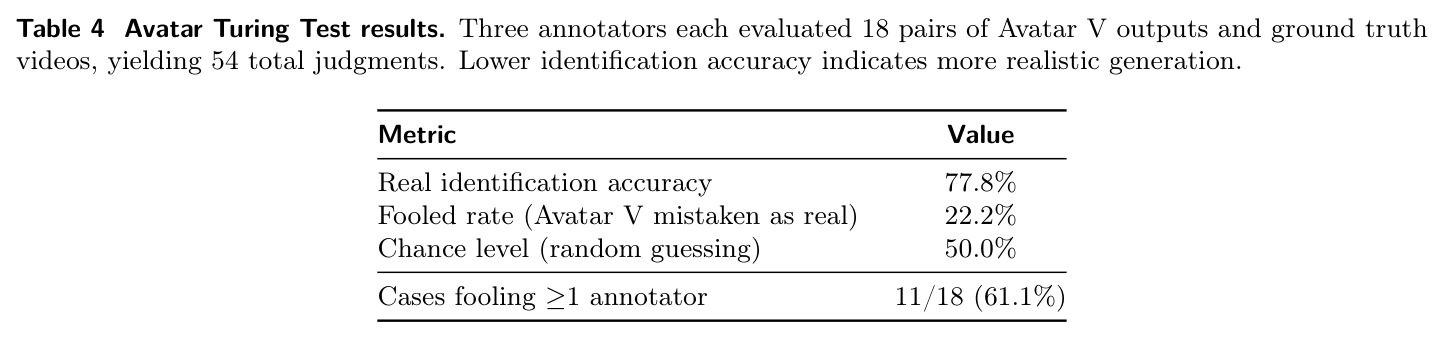
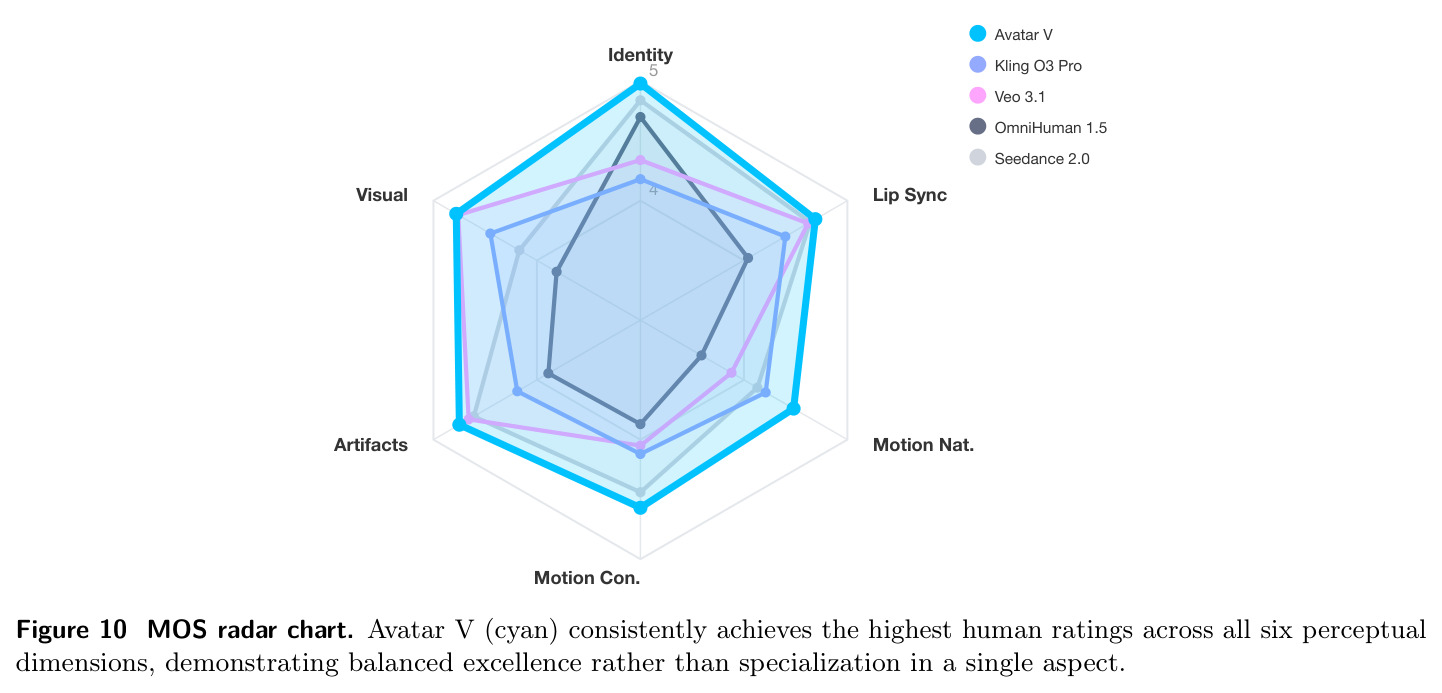
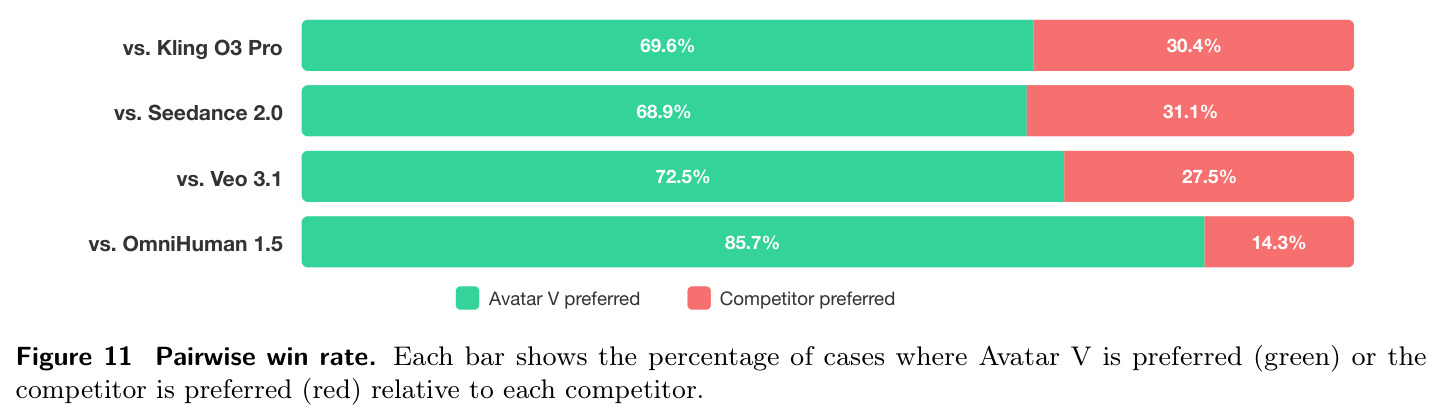
在 70 个跨场景测试用例(含 same-scene、cross-scene、generated-scene 三种条件)的客观指标评测(Table 1,36 个所有方法都产出有效结果的 matched cases)上,Avatar V 在 4 个指标中拿下 3 项第一、1 项第二。唇音同步方面 Sync-C 8.97 / Sync-D 6.75,超过 Ground Truth 的 7.93 / 6.76(这通常被认为是不可能的,因为 GT 的 Sync-C 通常就是上限),说明模型生成的视频在音画同步上甚至比真实录制略稳,可能是 GT 本身存在偶发口型错位。身份保持方面 Face Sim 达到 0.840,仅次于 Ground Truth 的 0.861,明显高于 Veo 3.1 的 0.714 和 OmniHuman 1.5 的 0.732,相比 Seedance 2.0 的 0.823 也有约 2% 的提升。Q-Align 画质上以 4.85 与 Seedance 2.0 并列第二,第一名 Veo 3.1(4.95)作者认为存在「过度锐化」导致指标虚高的问题——这是一个有趣的「指标与主观不一致」的观察。主观评测(Table 2,5 分制 MOS)Avatar V 在 6 个维度全部第一:身份一致性 4.98(接近满分)、唇音同步 4.69、运动自然度 4.48(领先第二名 Kling 0.27)、运动一致性 4.57、伪影控制 4.75、视觉质量 4.78。Pairwise Win Rate(Table 3)显示 Avatar V 相对四个基线都获得大幅偏好:vs Kling O3 Pro 69.6%、vs Seedance 2.0 68.9%、vs Veo 3.1 72.5%、vs OmniHuman 1.5 85.7%。最值得关注的是 Avatar Turing Test(Table 4):三名标注者看 18 对 Avatar V 输出与真人对,每对三人独立判断哪段是真的,结果真视频被正确识别的准确率为 77.8%(即生成视频被误判为真人的 fool rate 为 22.2%,低于 50% 的随机猜底线),但有 61.1% 的 case 中至少一名标注者被成功欺骗——说明在 case-by-case 层面,Avatar V 已经能生成「以假乱真」的片段,但成对比较时整体仍可被有经验标注者区分。系统层面推理优化实现 3× 延迟降低(相对未优化基线)、33% 相对 torch.compile Inductor 优化版本的提升;数据引擎 GPU 利用率 >95%,节点故障检测 <30 秒(从原 5–10 分钟),可线性扩展到 5000+ GPU 节点和 200K+ 并发任务。
查看结构化数据
| 任务 | 指标 | 本文 | 基线 | 提升 |
|---|---|---|---|---|
| Audio-Visual Lip Synchronization | SyncNet Sync-C (↑) | 8.97 | Kling O3 Pro 5.16 / Veo 3.1 8.05 / OmniHuman 1.5 7.53 / Seedance 2.0 8.86 / GT 7.93 | 较最强基线 Seedance 2.0 提升 0.11,超过 Ground Truth 1.04 |
| Audio-Visual Lip Synchronization | SyncNet Sync-D (↓) | 6.75 | Kling 10.07 / Veo 3.1 7.28 / OmniHuman 1.5 8.25 / Seedance 2.0 6.99 / GT 6.76 | 较最佳基线 Seedance 2.0 降低 0.24,逼近 GT 6.76 |
| Identity Preservation | ArcFace Cosine Similarity (↑) | 0.840 | Kling 0.838 / Veo 3.1 0.714 / OmniHuman 1.5 0.732 / Seedance 2.0 0.823 / GT 0.861 | 较最佳基线 Kling 提升 0.002、较 Seedance 2.0 提升 0.017,缩小与 GT 差距至 0.021 |
| Perceptual Image Quality | Q-Align IQA (↑) | 4.85 | Kling 4.80 / Veo 3.1 4.95 / OmniHuman 1.5 4.70 / Seedance 2.0 4.85 / GT 4.75 | 与 Seedance 2.0 并列第二,低于 Veo 3.1 0.10(作者指出 Veo 存在过度锐化) |
| Subjective Identity Consistency (MOS 5分制) | MOS (↑) | 4.98 | Kling 4.18 / Veo 3.1 4.34 / OmniHuman 1.5 4.70 / Seedance 2.0 4.84 | 较第二名 Seedance 2.0 提升 0.14,几近满分 |
| Subjective Motion Naturalness (MOS) | MOS (↑) | 4.48 | Kling 4.21 / Veo 3.1 3.88 / OmniHuman 1.5 3.59 / Seedance 2.0 4.13 | 较第二名 Kling 提升 0.27,显著优势 |
| Pairwise Preference vs OmniHuman 1.5 | Win Rate (↑) | 85.7% | OmniHuman 1.5: 14.3% | 净胜 71.4 个百分点 |
| Pairwise Preference vs Veo 3.1 | Win Rate (↑) | 72.5% | Veo 3.1: 27.5% | 净胜 45.0 个百分点 |
| Inference Speedup (Two-Phase Distillation) | Step Count / Latency | 24 steps, 3× latency reduction vs unoptimized, 33% reduction vs torch.compile Inductor | Multi-CFG multi-step baseline | >10× 端到端加速 |
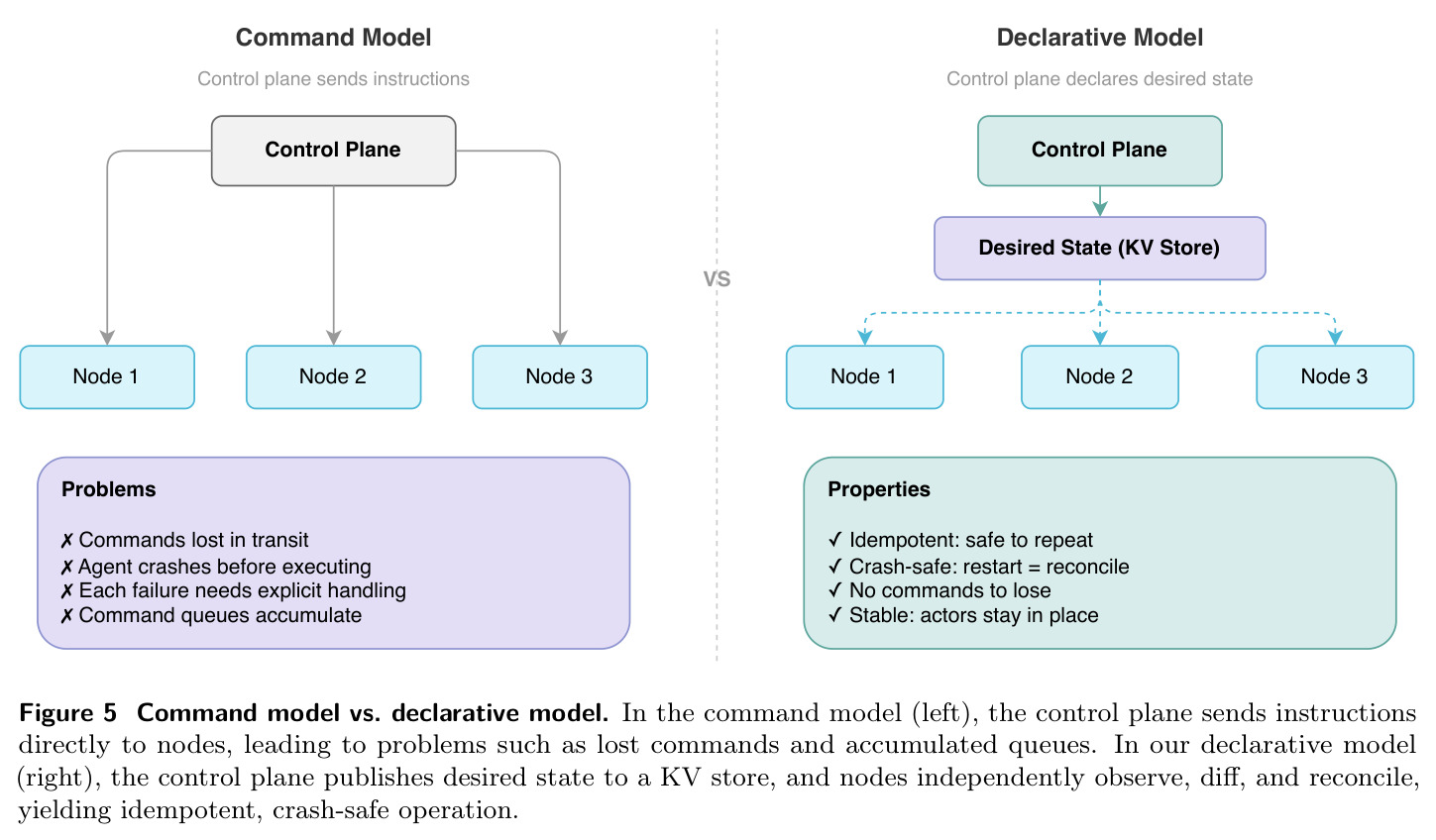
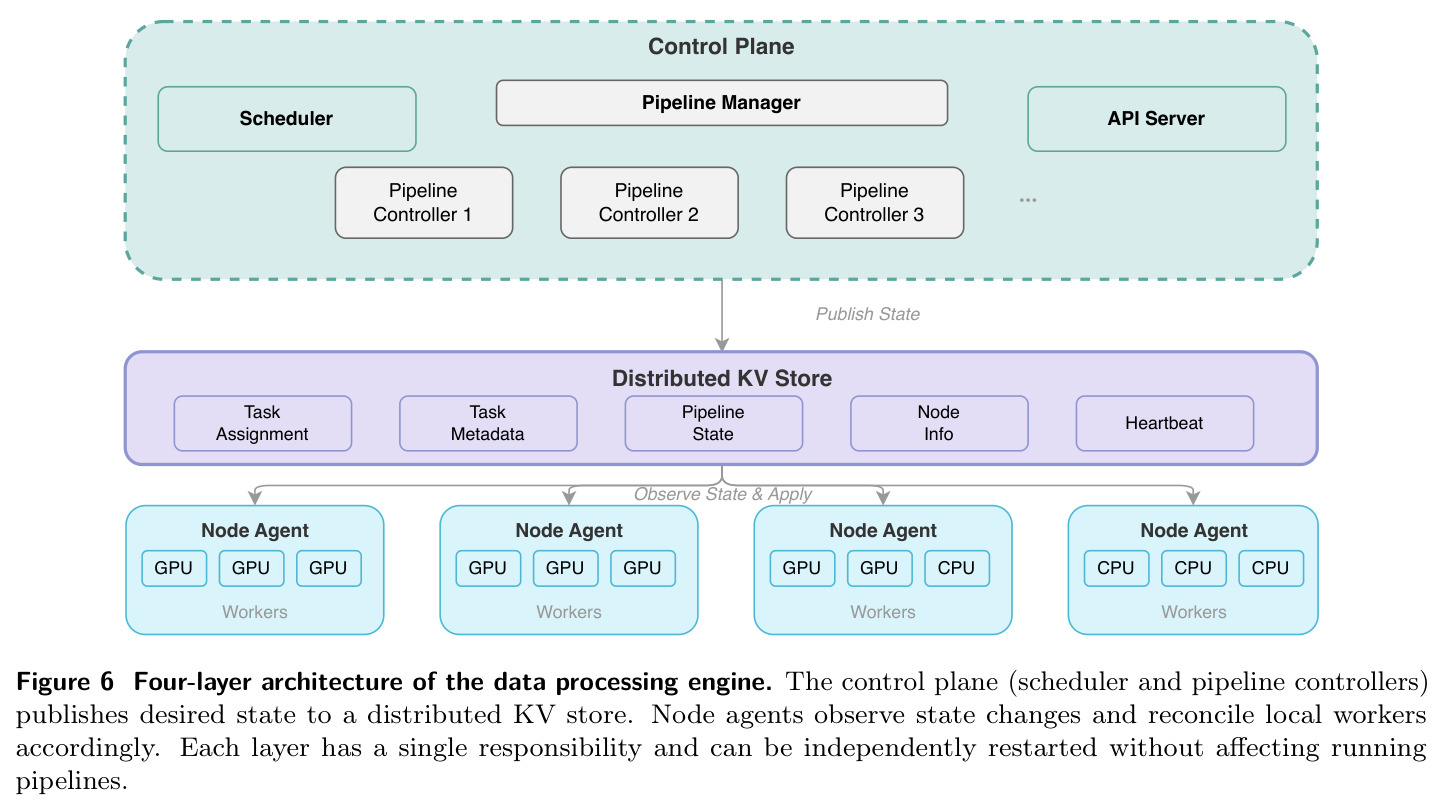
| Data Engine GPU Utilization | Utilization (↑) | >95%, <30s 故障检测, 5,000+ GPU 线性扩展 | 原 Ray 架构 GCS 瓶颈(>100GB RSS、400% CPU、随集群二次增长) | GPU 利用率提升、整体非生产 GPU 时间减少约 20% |
局限与改进
作者在论文中明确指出了几个可观察的局限。第一,Turing Test 揭示真伪可分:77.8% 的真视频识别准确率显著高于 50% 随机底线,说明 Avatar V 虽在 case 层面 61.1% 能骗过至少一名标注者,但整体上仍可被有经验人类识别——主要差别在极细微的生理细节、眼神微动、随机眨眼节律等。第二,Q-Align 上 Veo 3.1 超过 Avatar V 0.10,作者虽然指出 Veo 存在过度锐化问题,但这也说明在「视觉锐度/清晰度」这一感知维度 Avatar V 仍有改进空间,可能与 SR refiner 单步去噪的精细度受限有关。第三,本文没有公开模型权重、训练代码或推理代码,是一个纯技术报告;从复现性角度,没有具体架构超参(如 transformer 层数 $L$、head 维、reference 序列长度的上限与分布)、没有公开数据集、没有公开训练 schedule 的具体数值,可重复性较差。第四,「任意长度参考视频」的宣称在工程上依赖 inference 时的两层 cache,但若用户上传极长参考(如数小时),缓存本身对 GPU 显存的压力以及有效性 mask 的精度问题论文未深入讨论。第五,Cross-clip identity connectivity 依赖人脸相似度判定「同身份」,对家族成员、双胞胎、整过容前后等情况可能产生误连;训练数据的种族、年龄、性别、光照、语种平衡也未给出明确统计。第六,跨语种表现(论文提到 LLM Audio Engine 支持 multilingual)未给出专门评测。第七,系统对算力要求高(5000+ GPU 的训练规模、DMD 蒸馏三模型同驻),对中小团队而言几乎不可复现,方法论的价值大于可立即复现的价值。第八,伦理风险虽在 Section 9 提到了 consent 验证和双重审核,但对 deepfake 滥用的防御能力、对未授权参考视频的检测能力都未做技术评测。
独立分析的弱点
独立分析可识别的弱点与改进方向:(1)动作表征流虽然新颖,但论文未给出 motion loss 与最终 motion naturalness 之间的消融数据(无 ablation table),其贡献难以量化——可通过消融「仅作 conditioning / 仅作 loss / 关闭 motion 流」三个变体衡量。改进方向:补充完整 ablation。(2)Sparse Reference Attention 的稀疏模式是非对称的(generation→reference 与 reference→self),但未讨论 generation token 之间是否仍用全 attention,是否存在 O($L_g^2$) 内的退化;若 reference 极长,generation token 之间仍需 temporal attention 才能保持长时一致性,建议明确 generation 间的 attention 模式并提供复杂度证明。(3)auxiliary loss(identity / motion / lip-sync / perceptual)的权重调度未给出,且不同 representation space 的梯度尺度差异可能引起训练不稳定;建议采用 stop-gradient、loss 平衡策略或分阶段激活曲线来稳定训练,并在附录给出超参搜索过程。(4)Turing Test 77.8% 准确率说明仍有可识别的伪影,最可能的来源是:眼神微动节律过于规则、随机眨眼模式不自然、牙齿高频细节在 24 步采样下丢失。改进方向:在 loss 中加入眼神/眨眼节律统计约束,或针对牙齿/眼睛做专用局部 refinement。(5)5000+ GPU 训练规模对小团队遥不可及,建议作者开源 small-scale 训练 recipe(论文中提到的 flow matching + logit-normal + Muon 组合在 1.3B 量级下可复现),让方法论可被独立验证。(6)数据引擎虽声称 GPU 利用率 >95%,但具体 tail latency、failure recovery time、cost per generated minute 等运营指标未给出,难以判断其工程优势是否普适。
未来方向
作者在 Section 10 给出的未来方向主要是工程化和安全化,可补充的研究方向包括:(1)端到端「长上下文+长时序」数字人:当前 chunk-based 自回归仍有 prefix 边界伪影风险,未来可探索 full attention over reference + 滑窗 attention over generation 的统一机制,或基于状态空间模型(SSM/Mamba)的长时序方案。(2)多模态身份条件化:本文仅用视频+音频,未来可加入手势参考图、姿态骨架、文本化的性格描述(personality prompt),构建多模态人格建模。(3)实时/流式生成:当前是 24 步 + SR 单步 + 流式 VAE decode,已经朝 streaming 走了一步,但 DiT 块仍较重;结合 causal DiT 与 sliding window attention 可实现 sub-second latency 的实时数字人。(4)跨语种 / 跨文化 talking style 迁移:本文 LLM Audio Engine 支持 multilingual,但 motion 流对不同语言的微表情系统(如 tonal vs non-tonal languages 的口型习惯)未专门研究,是可扩展点。(5)few-shot / zero-shot 个性化强化:当前 SFT 阶段已用 cross-clip identity connectivity,但未明确「用户上传 1 段 3 秒视频」和「1 段 30 秒视频」对生成质量的影响曲线;可做 controlled study 给出「最少参考时长 vs 质量」曲线。(6)安全与检测:除了 consent 验证,可研究被动 deepfake 检测(针对 Avatar V 类模型的频域/时序伪影签名),构建可解释的检测器与生成器协同迭代。(7)模型压缩与端侧部署:DMD 已经大幅压缩,但仍然是大模型;未来可探索 4-bit/8-bit 量化、专家稀疏化、模型合并(model merging),把数字人模型推到消费级 GPU 上。
复现评估
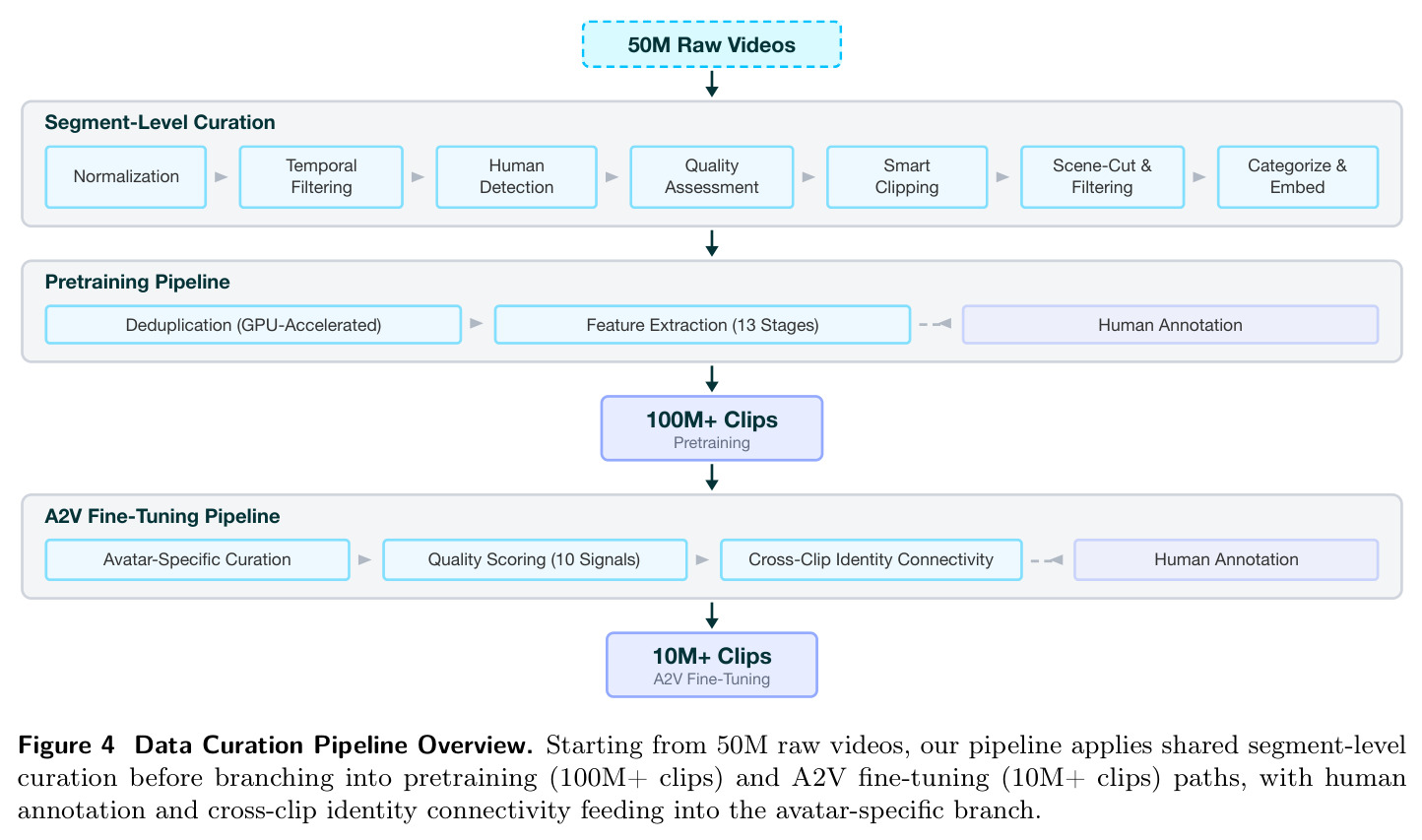
复现评估:本文明确说明是技术报告,没有开源任何代码、模型权重、数据、训练超参。从可复现性维度逐项评估:代码与权重——未公开,仅在 heygen.com/research 提供 project page 和 demo 视频,对研究者而言是「黑盒」。数据——50M 原始视频、100M+ 预训练 clip、10M+ 头像微调 clip 的具体来源、版权构成、地域分布未披露;cross-clip identity connectivity 的实现细节(人脸相似度阈值、场景差异度量、构图规则)仅在文字中简略描述;human annotation system 的 100+ 标注者规模、guidelines、inter-annotator agreement >85% 的计算方法也未公开。算力——5000+ GPU 训练、跨多云 5+ 提供商和 15+ 标准 cell 的 HELIOS 平台是个工程壁垒,第三方团队几乎不可能在合理时间内复现完整训练。难度——架构层面 Sparse Reference Attention 本身不算难实现(基于已有的 flash attention 加 mask 即可),但要把配套的两层 cache、motion stream、auxiliary losses、5 阶段训练 schedule、GRPO RLHF 全部跑起来需要数月工程量。综合判断:思想可复现、效果难复现、训练不可复现;研究者可在小规模(如 1.3B 模型、10K 视频样本、单机 8 GPU)上验证核心 idea(「非对称稀疏注意力 + 视频参考条件化」对身份保持的提升),但要复现论文中 SOTA 数字需要完整的 HeyGen 工业级 pipeline。
论文图表