Solvita:通过智能体进化增强大语言模型的竞赛编程能力 Solvita: Enhancing Large Language Models for Competitive Programming via Agentic Evolution
冻结LLM权重,用四智能体+可训练知识图谱的闭环系统让代码生成越用越强。
前置知识
上下文赌博机(Contextual Bandit)
一种序列决策框架:在每一轮,智能体根据当前上下文 $x$ 从候选动作集合中选择一个动作 $a$,获得奖励 $r$ 后更新策略。区别于完整 RL,它只关心当前收益、不考虑未来状态转移。Solvita 用它来为每个智能体挑选最佳的「策略家族」「攻击路线」或「解题范式」。
Solvita 把四个知识网络都形式化为 contextual bandit,正是这套机制让「不微调 LLM、只更新路由权重」成为可能。
REINFORCE 策略梯度
经典策略梯度算法 $\nabla_w J=\mathbb{E}[R\cdot\nabla_w\log\pi(a|x)]$。Solvita 用对比式 REINFORCE,同一 backbone 在有/无网络辅助下各跑一次,取差值 $\Delta R$ 作反事实奖励更新图边权重。
这是 Solver 知识图谱权重更新所用算法,决定了它如何从解题成败中学习。
testlib 验证框架
Codeforces 等平台用的 C++ 测试库,提供 `registerGen/Validation/TestlibCmd` 等接口,用来生成合法输入、校验输入、做独立判定。Oracle 用它三件套构建「经认证」的内部测试。
Oracle 是 Solvita 的「内审」,其可信度完全建立在 testlib 这种工业级合约上。
对抗样本与 Hack 思想
在竞赛圈,「hack」指对他人代码构造反例使其失败。Solvita 的 Hacker 智能体把这一人类行为自动化:先用 Code Analyst 检查代码、形成漏洞报告,再走「语义攻击 / 压力测试 / 反哈希碰撞」三路 cascade,目标是找出会让提交者拿 WA/TLE/RE 的对抗输入。
Hacker 是 Solvita 区别于 AlphaCodium/MapCoder 等流水线最关键的一环,直接决定了它在 Codeforces 上的真实对抗表现。
pass@1 与 Codeforces 评分
pass@1 是「单次生成即通过全部测试」的比例,是代码生成的金标准。Codeforces 评分基于 Elo 期望胜率 $p=1/(1+10^{(r_1-r_2)/400})$ 反推,≥2400 为 Grandmaster,≥3000 为 Legendary Grandmaster。
本文所有主要指标都用 pass@1 报告,并辅以 Codeforces 评分展示真实竞赛水平。
研究动机
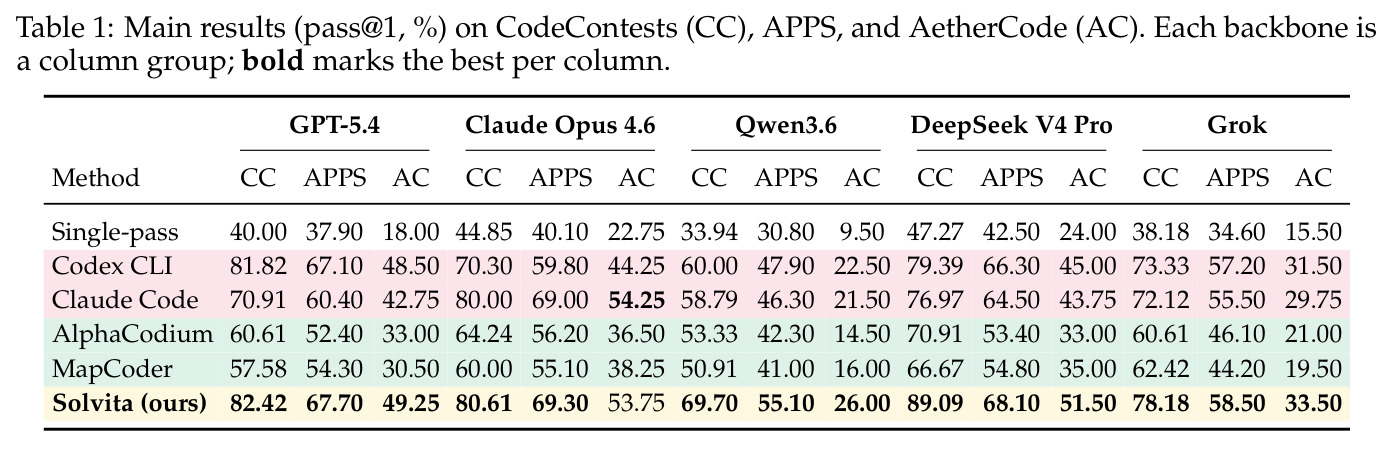
当前 LLM 做竞赛编程的主流范式(单次生成或 AlphaCodium/MapCoder 这类多步骤流水线)本质上都是「无状态」的:每个新题目从零开始,过去积累的解题、调试经验全部丢弃。即使引入 RAG,把过往题解文本塞回 prompt 也不改变底层推理过程。实验中可观察到这一硬伤:以 GPT-5.4 为底座、165 道 CodeContests 题为基准,单次生成的 pass@1 只有 40.00%,即便用上 Codex CLI 这种商业代理也只有 81.82%,在 AetherCode 这种高难度集上更跌到 18.00%。人类选手之所以能稳定进步,是因为他们会沉淀「哪些策略适配哪类题」「哪类实现容易踩坑」「赛前要主动攻击自己的解法」这类元经验,而 LLM 智能体缺少这种持续积累的机制。
本文的目标是Solvita 想要在不改动 LLM 权重的前提下,让代码生成系统具备「越用越强」的持续学习能力。具体可量化的目标:在 CodeContests/APPS/AetherCode 三个 benchmark、五个前沿 LLM 底座(GPT-5.4、Claude Opus 4.6、Qwen3.6、DeepSeek V4 Pro、Grok)的 15 组 backbone×benchmark 组合中拿下 SOTA;让 GPT-5.4 底座在 CodeContests 上的 pass@1 从 40.0% 提升到接近翻倍;在 12 场赛后真实 Codeforces 对抗中三个底座都达到 Legendary Grandmaster(≥3000)水平。
与已有工作不同的是,已有工作要么只改 LLM 权重(成本高、灾难性遗忘),要么只做静态检索(RAG,没改变推理过程),要么只在通信层面做多智能体(debate/self-consistency,不沉淀经验)。Solvita 切入了此前被忽视的中间地带——把记忆做成「图结构 + 边权重」,用强化学习把每一次 pass/fail 转化为图边权重的更新,使记忆本身变成可学习的路由机制;并且把「出题—写题—审题—攻题」组成闭环,让 Hacker 发现的 bug 能通过事件总线一次性写入四个知识网络,形成持续叠加的复利效应。
核心方法
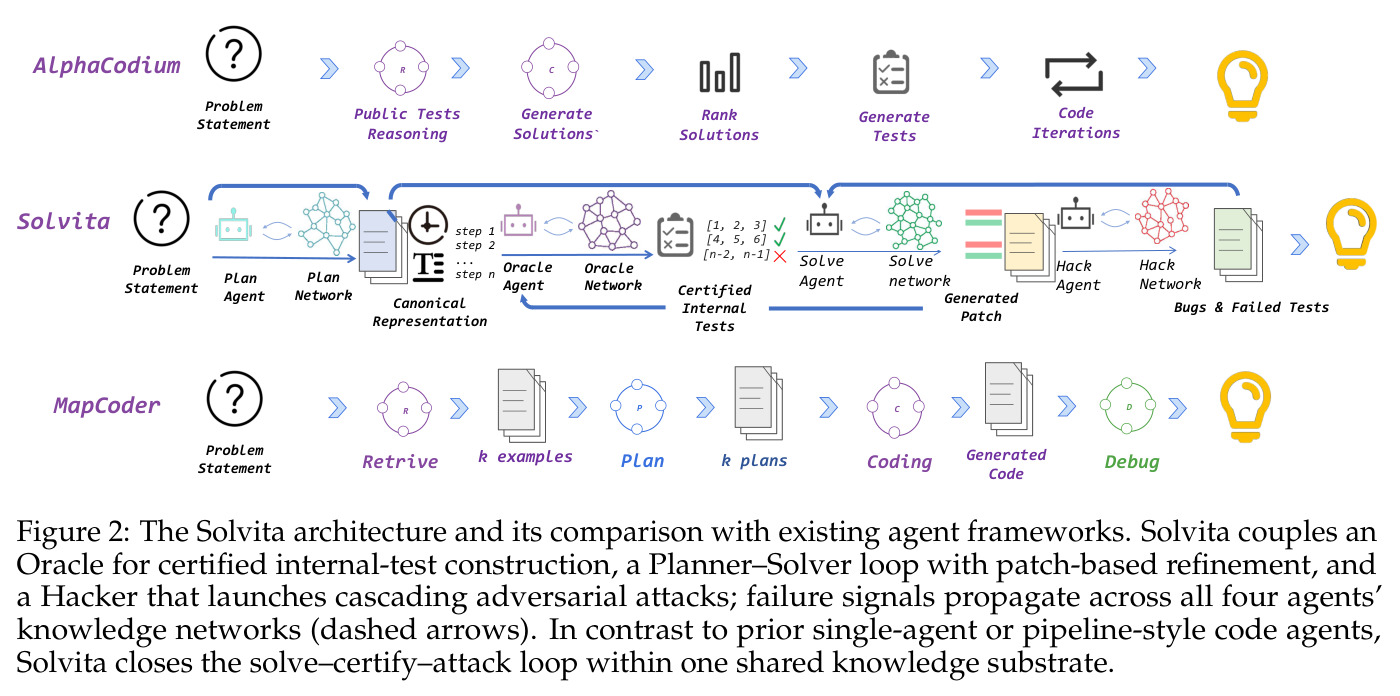
Solvita 可以类比为一家永远在开「内部训练赛」的软件公司:四名员工(Planner/Solver/Oracle/Hacker)各管一摊,但所有人共用一套「可学习的记忆本」(图结构知识网络 + 上下文赌博机)。每来一道新题,Planner 先把它翻译成形式化描述并预测算法范式;Solver 据此写 C++ 代码、写错了就用 SEARCH/REPLACE 补丁最小化修复;Oracle 平行地构造一份带 testlib 的认证测试套件作为「内部裁判」;Hacker 则扮演恶意攻击者,从语义/压力/反哈希三路 cascade 出对抗输入。任何一次失败信号——bad case、certification ratio 不达标、Hacker 抓到的 bug——都通过一个 contextual bandit 策略转化为对应知识网络边权重的 REINFORCE 更新。整个 LLM 权重保持冻结,但推理能力随着使用单调提升。直觉上,这套设计把「人脑靠经验变强」的机制移植到 LLM 智能体上,只不过用图边权重代替了突触权重。
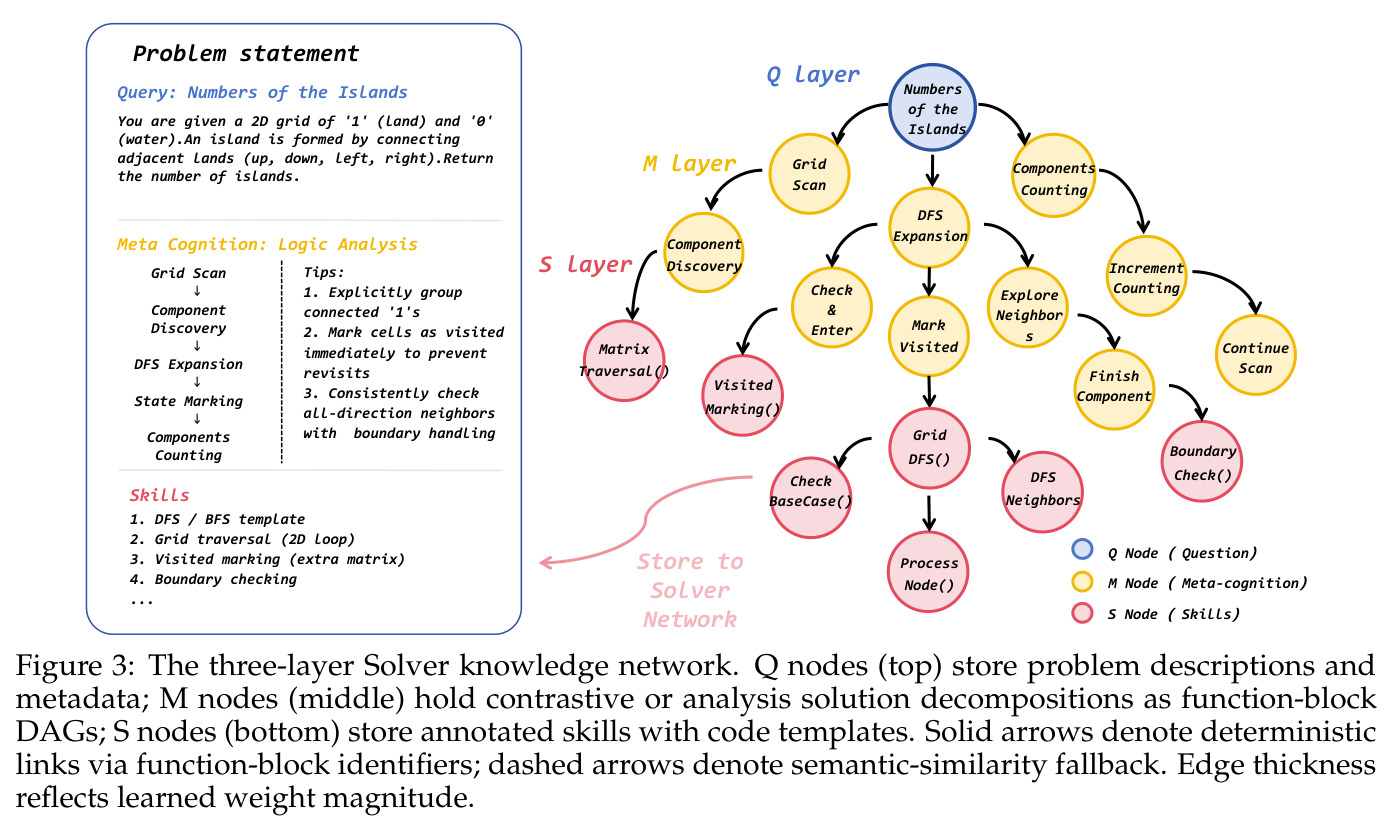
与已有方法最本质的区别在于「记忆是可学习的路由,而非静态的检索表」。AlphaCodium、MapCoder、AgentCoder 等流水线虽然引入了多步骤迭代,但都把每道题当作独立事件处理;RAG 类方法虽然引入了记忆,但只做相似度匹配,并未改变推理过程。Solvita 的关键创新有三层叠加:(1) 每个智能体单独拥有一张异构图(如 Solver 的 QMS 三层图:问题 Q-元认知 M-技能 S,边权重 $w_{qm}, w_{ms}$ 通过 REINFORCE 学习),把「该用哪种策略」转化为可学习选择;(2) 用反事实对比奖励 $\Delta R = R_{\text{with}} - R_{\text{without}}$(同一 backbone 在有/无网络下各跑一次)作为低方差强化信号,专门训练路由;(3) 四个网络通过事件总线互联——Hacker 抓到一个 bug,会同时在 Planner/Solver/Oracle 写入对比样本和规避策略,使经验沿闭环传播而不是孤立地被消化。
方法步骤详情
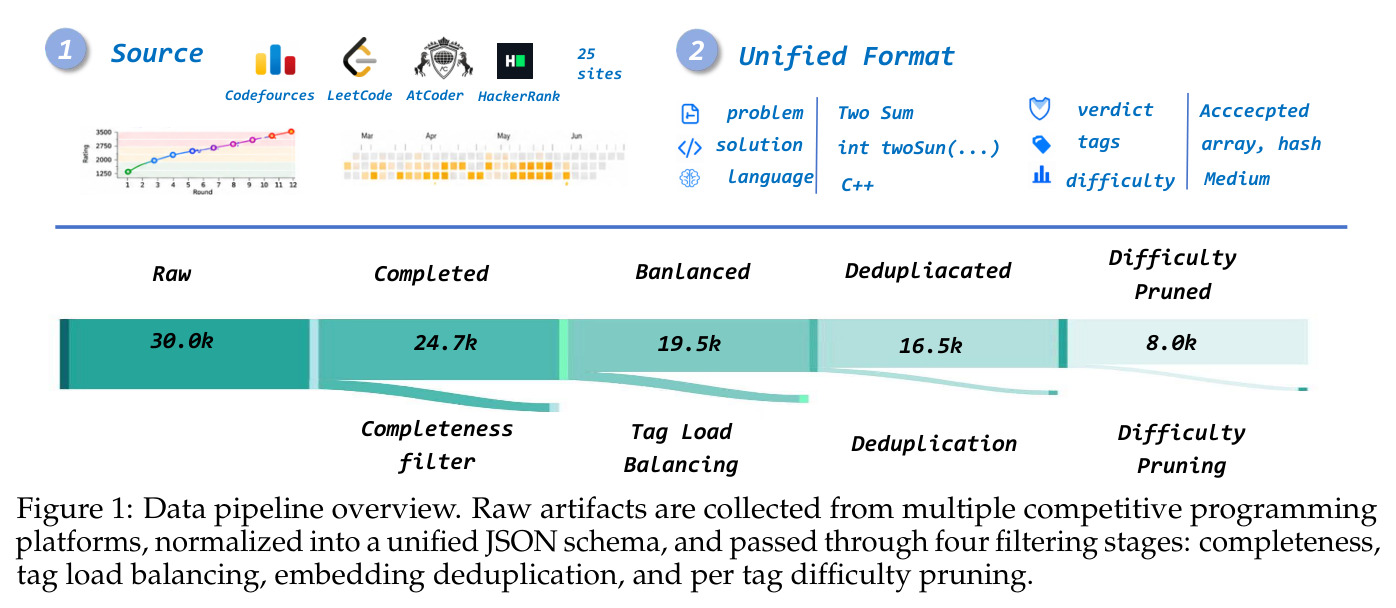
离线从多源爬 30,018 题,经完整性→标签均衡($C_{\max}=2300$)→embedding 去重($\delta=0.93$)→难度剪枝四道过滤得 8,017 题冷启动语料。在线四步:①Planner 改写 canonical_problem 并预测标签,命中真标签给 +1 否则 −1 的 bandit 奖励;②Solver 从 QMS 图检索 top-4 Q 节点两跳扩展到 S 技能,按 $\rho(s|q_{\text{new}})=\sum\text{Sim}\cdot w^q_m\cdot w^m_s$ 打分 softmax 采样 $1\sim5$ 个技能;初始全程序生成后最多 8 轮走 SEARCH/REPLACE 补丁(仅 patch_decision 判全局缺陷才退 full_regen),补丁须保留回归通过;③Oracle 并行产出 testlib 三件套,按 custom checker > 正确解 runner > exact match 验证,得 $\rho$,过门 $\rho\geq\tau=0.9$ 才被接受;④Hacker 从 $\mathcal{U}=\{\text{semantic, stress, anti\_hash}\}$ 选一路生成对抗输入,最多 3 轮 cascade,命中 bug 时通过事件总线写入其它三网络。
技术新颖性
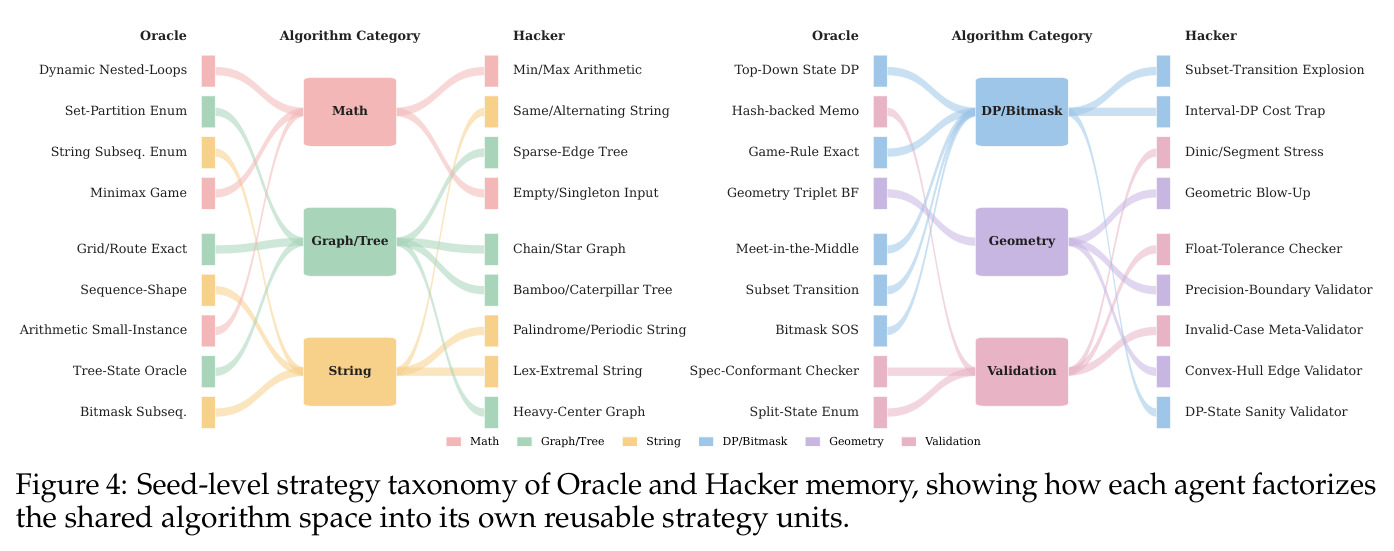
技术新颖性体现在三个不易复制的组合:(1) 角色专属 + 可训练知识网络。每个智能体有独立的 contextual bandit 学习率 $\alpha=0.01$、独立的标签-键控特征空间 $\Phi(x)$(FSM 位置 + 失败类型 + 题目标签),运行平均奖励低于 −0.3 且使用 ≥20 次的条目会自动退役,这避免了静态 RAG 的「召回不准」问题。(2) 对比式 REINFORCE。Solver 同一 backbone 跑两次取 $\Delta R$,大幅降低方差;且当两次输出有差异时把正确答案和错误答案配成新的 contrastive M 节点挂进图,让图在「智能体最挣扎」的地方自动膨胀。(3) Hacker-Oracle 互补策略空间。Figure 4 显示 Oracle 集中在「DP/Search/Enumeration」等可靠监督路径,Hacker 集中在「Complexity/Structural/Boundary」等暴露 bug 路径,二者共享分类轴但分解方式相反,这使二者联合时能比单独任何一方多检出 5–10 个百分点的错误解。
实验结果
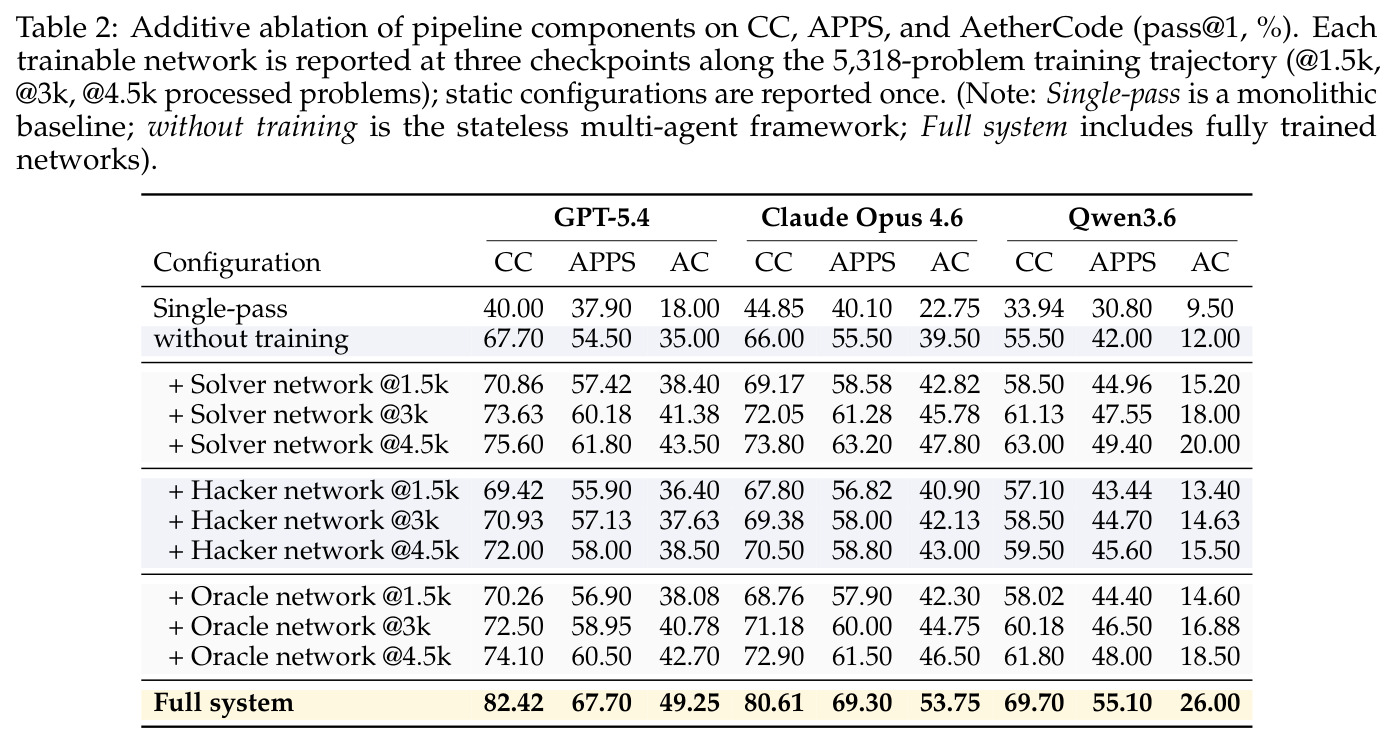
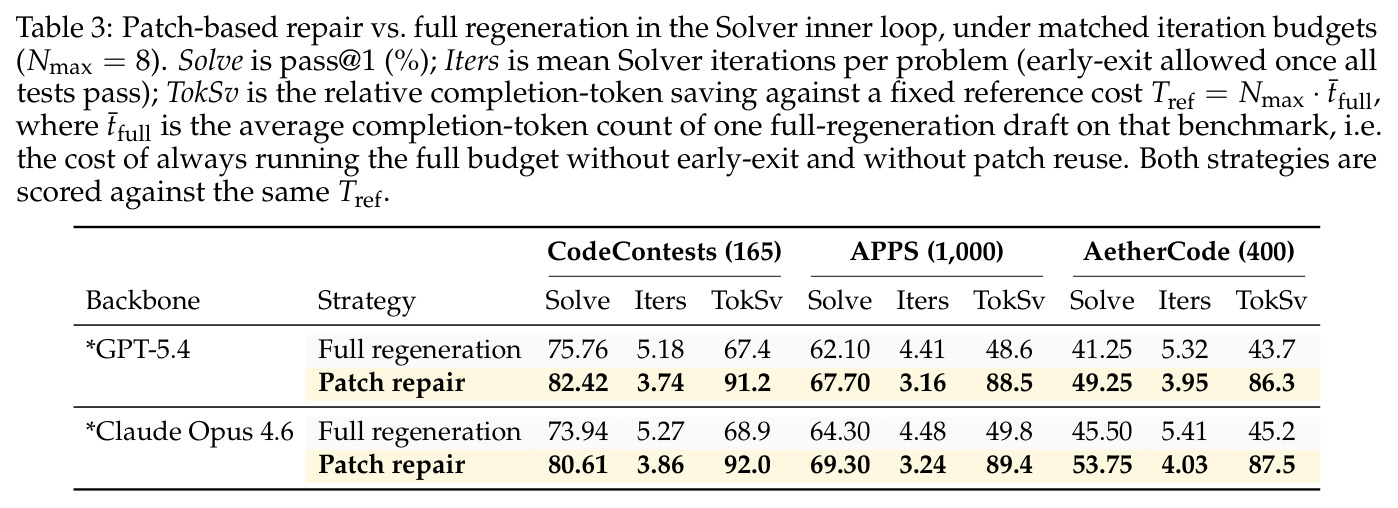
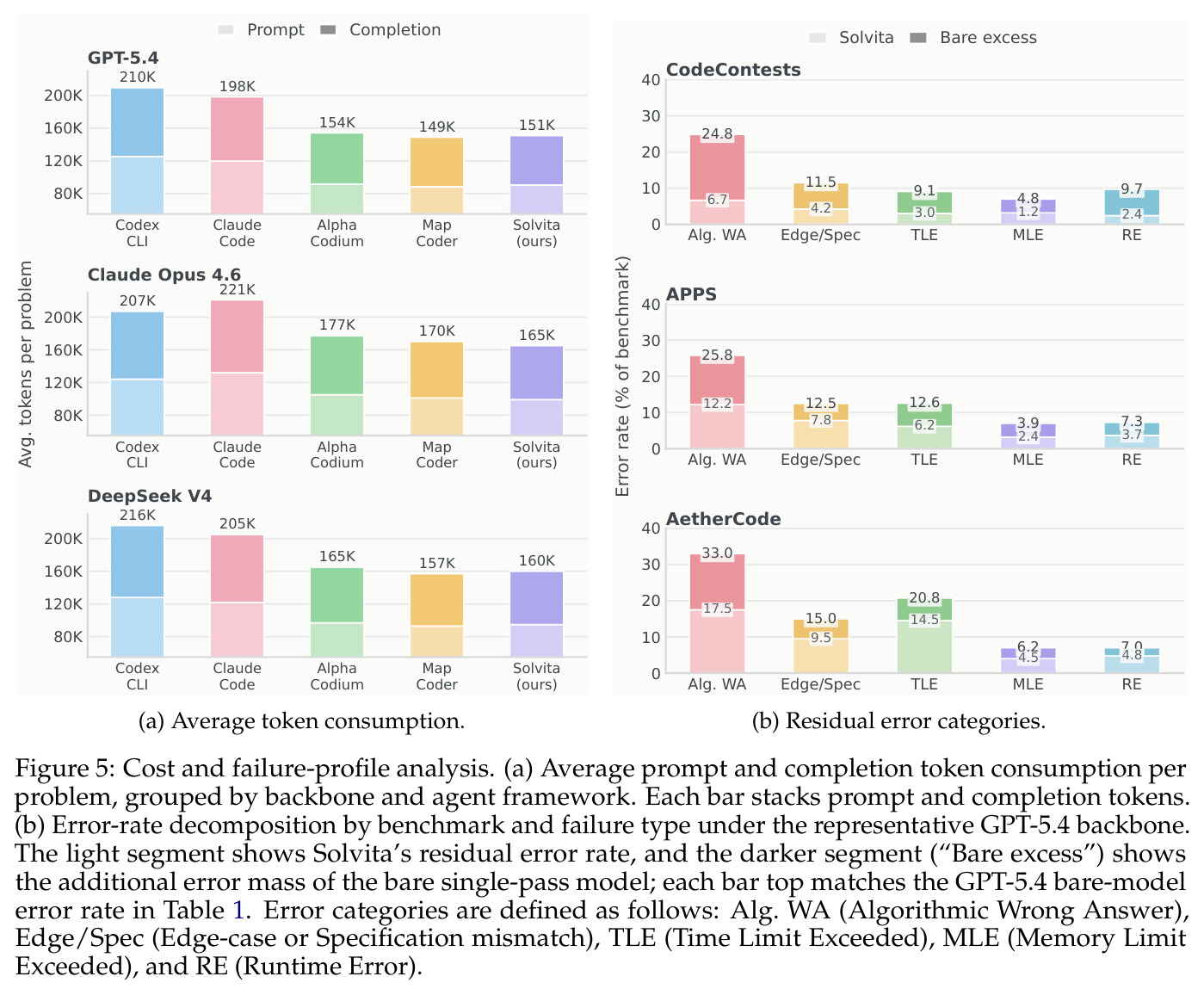
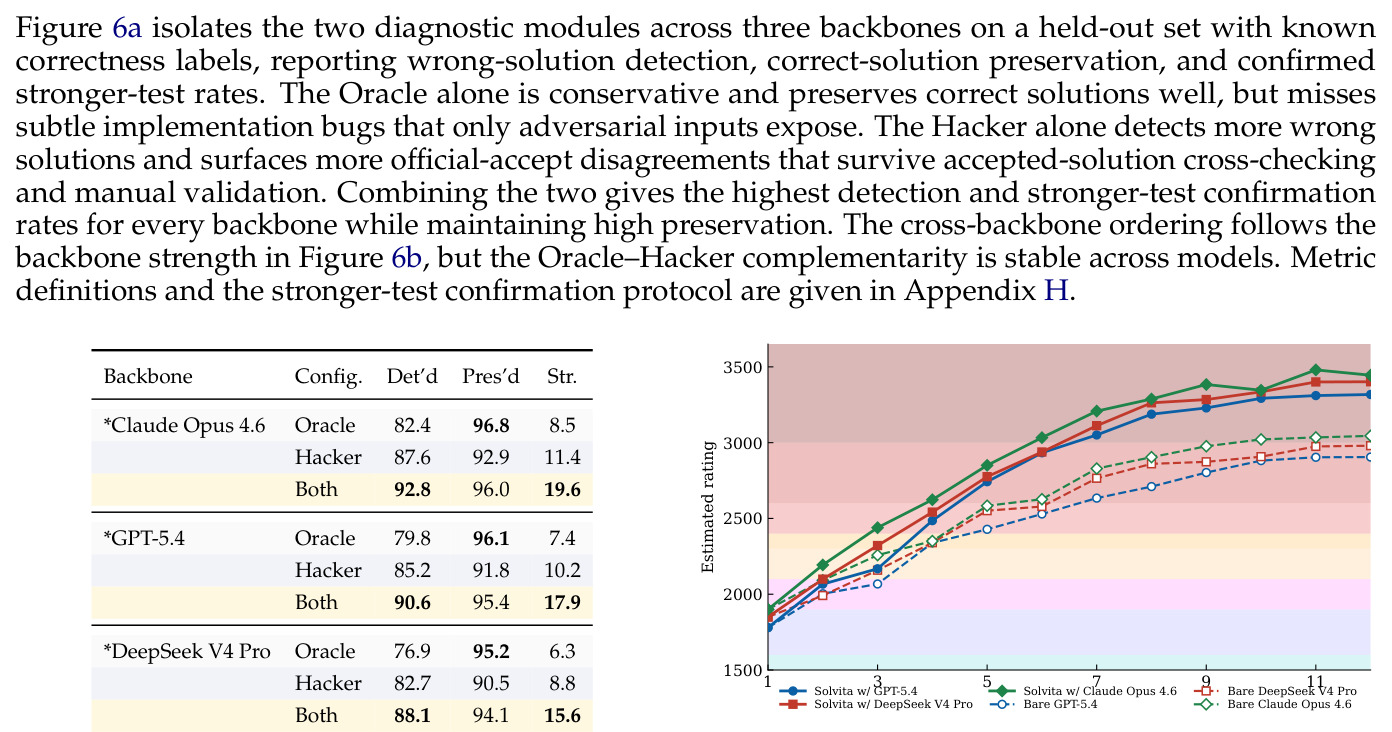
Table 1:Solvita 在 5 底座 × 3 benchmark 共 15 组中拿下 14 组第一,仅 Claude Opus 4.6 × AetherCode 输 0.5pp。最亮眼 GPT-5.4 × CodeContests:pass@1 从 40.00% 提到 82.42%(+42.42pp);DeepSeek V4 Pro × CC 推到 89.09%(绝对最高);AetherCode 上 GPT-5.4 从 18.00% 提到 49.25%(+31.25pp)。Figure 5b 失败分解全谱下降:GPT-5.4 上 Alg.WA 24.8%→6.7%、Edge/Spec 11.5%→4.2%、TLE 9.1%→3.0%、MLE 4.8%→1.2%、RE 9.7%→2.4%。Figure 6b:K=12 场真实 Codeforces 后三条 Solvita 曲线都跨过 3000 进入 Legendary Grandmaster,裸底座停留在 2700–2850 high GM。Table 2 消融:闭环本身 40.00%→67.70%,+Solver@4.5k 再涨 7.90pp,Full 叠加到 82.42%,三网络互补非替代。Table 3:patch 修复同时更准更省(GPT-5.4 × CC:82.42/3.74 轮/省 91.2% token vs regen 75.76/5.18 轮/67.4%)。Figure 6a:Oracle+Hacker 联合在 Claude 上 92.8/96.0/19.6,强测试发现率提升 8.2pp。
查看结构化数据
| 任务 | 指标 | 本文 | 基线 | 提升 |
|---|---|---|---|---|
| CodeContests pass@1 (GPT-5.4) | pass@1 (%) | 82.42 | 40.00 (单次生成) / 81.82 (Codex CLI) / 60.61 (AlphaCodium) / 57.58 (MapCoder) | +42.42 vs 单次生成 / +0.6 vs 最佳商业代理 |
| APPS pass@1 (GPT-5.4) | pass@1 (%) | 67.70 | 37.90 (单次生成) / 67.10 (Codex CLI) | +29.80 vs 单次生成 / +0.60 vs Codex CLI |
| AetherCode pass@1 (GPT-5.4) | pass@1 (%) | 49.25 | 18.00 (单次生成) / 48.50 (Codex CLI) / 33.00 (AlphaCodium) | +31.25 vs 单次生成 / +0.75 vs Codex CLI |
| CodeContests pass@1 (DeepSeek V4 Pro) | pass@1 (%) | 89.09 | 47.27 (单次生成) / 79.39 (Codex CLI) / 70.91 (AlphaCodium) / 66.67 (MapCoder) | +41.82 vs 单次生成(绝对最高) |
| AetherCode pass@1 (DeepSeek V4 Pro) | pass@1 (%) | 51.50 | 24.00 (单次生成) / 45.00 (Codex CLI) | +27.50 vs 单次生成 |
| Solver patch repair vs full regen (GPT-5.4 / CC) | pass@1 (%) & 平均迭代数 & token节省率 | 82.42 / 3.74 轮 / 91.2% | 75.76 / 5.18 轮 / 67.4% | +6.66 pp / -1.44 轮 / +23.8 pp 节省 |
| Oracle+Hacker 联合诊断 (Claude Opus 4.6) | Det'd / Pres'd / Str (%) | 92.8 / 96.0 / 19.6 | Oracle 单 82.4/96.8/8.5;Hacker 单 87.6/92.9/11.4 | 检测+5.2pp、保留稳定、强测试发现+8.2pp |
| Codeforces 实战 rating (K=12 rounds) | Codeforces 反演评分 | ≥3000(LGM 区间,三底座均达到) | 2700–2850(high GM,裸底座) | 约 +200–250 rating |
| 全量训练 vs 无训练 (GPT-5.4 / CC) | pass@1 (%) | 82.42 | without training 67.70 / single-pass 40.00 | 训练闭环 +14.72 pp;闭环本身 +27.70 pp |
局限与改进
作者承认三个 trade-off:①冷启动成本高——多智能体循环本身比直接生成贵,知识网络需 ~5,000 训练题才能摊薄成本(Table 2 显示 @1.5k 几乎无增益);②Hacker 覆盖范围有限——anti-hash 和 lattice 攻击受底座推理能力制约,number-theoretic/几何类数学题 break-ratio 接近 0,呈 bimodal 失效;③Patch repair drift——全局缺陷被误判为局部问题时,Solver 会打出一连串累积不一致的小补丁直到预算耗尽,目前只能靠 Section 4.3 的回归率事后识别。我自己的观察:评测集中在 5 个封闭商用底座,缺少 7B/13B 开源小模型数据,外推未知;Solver QMS 图随训练增长但论文未报告检索延迟;AetherCode 400 题偏少,跨域稳定性待更大公开集验证。
独立分析的弱点
独立可改进点:①冷启动前 1500 题几乎无收益(Table 2 中 +Solver@1.5k 在 CC 上仅 67.70→70.86),新部署需大量在线算力;应设计难度阶梯预热或先用人类 editorial 做离线 warm-start。②Hacker 在数学题上 bimodal 失效——Code Analyst 推理能力不足,建议为数学题单独加一个符号化反例构造子模块(接 SymPy/SMT solver)补盲。③Patch repair drift 仅事后识别,应把 Section 4.3 回归率信号前置为 `FAIL:REGRESSION` 特征键,让路由器自动倾向 full_regen。④Hacker 失败事件是单向广播,误判好解为坏解时会污染 Solver 图;可加事后验证环节,对「Hacker 攻击但官方 AC」做负权重回写。⑤token 绝对值不低(GPT-5.4 上 ~150K tokens/题),可通过子任务路由(仅 Hacker 启用深度推理)降低平均开销。
未来方向
作者列出了三个方向:(a) 用开源经验语料(editorial、accepted 提交、调试轨迹)做 warm-start 缩小冷启动窗口;(b) 把四智能体闭环迁移到形式化定理证明(Oracle 变 proof checker,Hacker 找反模型)、数学奥赛(用符号验证代替测试案例)、科学推理(接可执行模拟器)等其他可验证奖励域;(c) 探讨把 Hacker 的逐步对抗信号从 prompt-level 升级为模型权重的 fine-tuning 信号,同时不丢失角色化信用分配。我个人补充的方向:(d) 把 Solvita 接到 Multi-Modal LLM 上扩展到几何/可视化题目;(e) 研究知识网络的「蒸馏/合并」协议,使不同底座训练出的图能彼此迁移,避免每个团队重复训练;(f) 把训练轨迹作为数据集发布,供后续 offline RL 研究复现。
复现评估
复现透明度较高:数据管线、prompt 模板、bandit 超参、token 预算全部附录化(附录 A-H)。冷启动语料可自行从 Codeforces/AtCoder/Aizu 公开抓取,8,017 题过滤管线参数($C_{\max}=2300$, $\delta=0.93$, 107 标签)完整。算力门槛:每题 ~150K tokens,5 底座 × 3 benchmark × 5,318 训练题 ≈ 数十亿 tokens,按 GPT-5.4 公开价估算需 5–10 万美元等价 API 额度;用 Qwen3.6 等本地底座可显著降本。作者声明随论文发布 prompt YAML(`config/prompt_template.yaml`)与沙箱(`src/sandbox/`),但未明确承诺开源全部知识网络权重,第三方必须从 5,318 题冷启动重训,耗时几天到一周。最可能失败的复现环节是 Hacker 反哈希攻击(依赖底座能否写出 Thue-Morse 类碰撞)和 patch_decision 的 LLM skill 选择(提示词略改一行即偏移行为)。
论文图表
横轴是 K=12 场 Codeforces round(952–963,混合 Div. 2 / Div. 1+2),纵轴是按 CodeElo 反演得到的评分;三条实线是 GPT-5.4 / Claude Opus 4.6 / DeepSeek V4 Pro 三个 Solvita 变体,三条虚线是同一批裸底座;约 6 场后三条 Solvita 曲线都跨过 3000 进入 Legendary Grandmaster 区间并收敛,裸底座停留在 2700–2850。
这张图把整套方法从「离线 benchmark」搬到「真实对抗环境」,是论文最有说服力的实战证据。