ParEVO:通过智能体进化合成面向不规则数据的高性能并行代码 ParEVO: Synthesizing Code for Irregular Data: High-Performance Parallelism through Agentic Evolution
用智能体进化合成面向不规则并行数据的高性能代码,平均加速106倍
前置知识
工作-跨度 (Work-Span) 模型
并行算法的标准分析模型,将计算分解为总工作量 $W$(所有子任务工作量之和)和最关键路径长度 $S$(理想无限处理器下的执行时间)。理想加速比为 $W/S$。在此模型下,使用工作-偷取 (work-stealing) 调度器能保证期望运行时间接近 $W/P + S$,其中 $P$ 是处理器数。
ParEVO 的核心思路是让 LLM 学会映射到 ParlayLib 这种已经封装了工作-偷取的高层原语,而不是直接写线程原语。理解 Work-Span 是看懂为什么'高层 DSL + 不可变原语'优于'低层线程 + 锁'的关键。
ParlayLib 并行原语
CMU Parlay 组开发的高层并行 C++ 库,提供 functional-style 不可变原语,包括 parlay::sort、parlay::scan(前缀和)、parlay::reduce、parlay::filter、parlay::pack、parlay::sequence、parlay::parallel_for 等。每个原语都封装了底层调度、负载均衡和同步逻辑,使用者只需关心组合语义。
ParEVO 的整个范式建立在 ParlayLib 之上:模型被训练成把自然语言任务映射到这些原语。理解这些原语的不可变语义(map、reduce、scan 是函数式的、不共享可变状态)是看懂为什么 ParEVO 生成的代码'结构上正确'的关键。
不规则并行 (Irregular Parallelism)
与稠密矩阵乘法等'规则并行'相对的并行计算范式,常见于图遍历、稀疏矩阵、自适应网格、不平衡树。核心挑战是每个元素的计算量与数据相关(例如 BFS 中节点度差异巨大),导致运行时才可知,且静态负载均衡失效,必须依赖动态调度和细粒度同步。
ParEVO 明确聚焦不规则并行,这是 LLM 在 HPC 任务中最容易'灾难性失败'的场景。理解这个背景才能理解为什么 ParEVO 选择用高层原语抽象替代手工写原子操作和锁。
LoRA / QLoRA / DPO 微调
LoRA(Low-Rank Adaptation)通过在原始权重旁引入低秩分解 $W + BA$ 来实现参数高效微调,$B \in \mathbb{R}^{d \times r}$、$A \in \mathbb{R}^{r \times k}$,$r$ 远小于 $d$。QLoRA 在此基础上进一步把基座量化到 4-bit 以节省显存。DPO(Direct Preference Optimization)通过偏好对 $(x, y_w, y_l)$ 直接优化策略模型,使偏好对的 log-ratio 之差最大化,避免训练独立 reward 模型。
ParEVO 用 LoRA 微调 DeepSeek-6.7B($r=8, \alpha=16$),用 QLoRA + DPO 两阶段微调 Qwen3-30B($r=16, \alpha=32$,第二阶段 $\beta=0.1$、$\eta=5 \times 10^{-6}$)。理解这些技术才知道论文的训练成本与可复现性边界。
MAP-Elites(质量多样性算法)
一种进化算法变种,维护一个由预先定义'特征维度'网格化的归档集。每一格只保留该特征组合下 fitness 最高的个体,从而在搜索中强制保留多样解,避免种群塌缩。
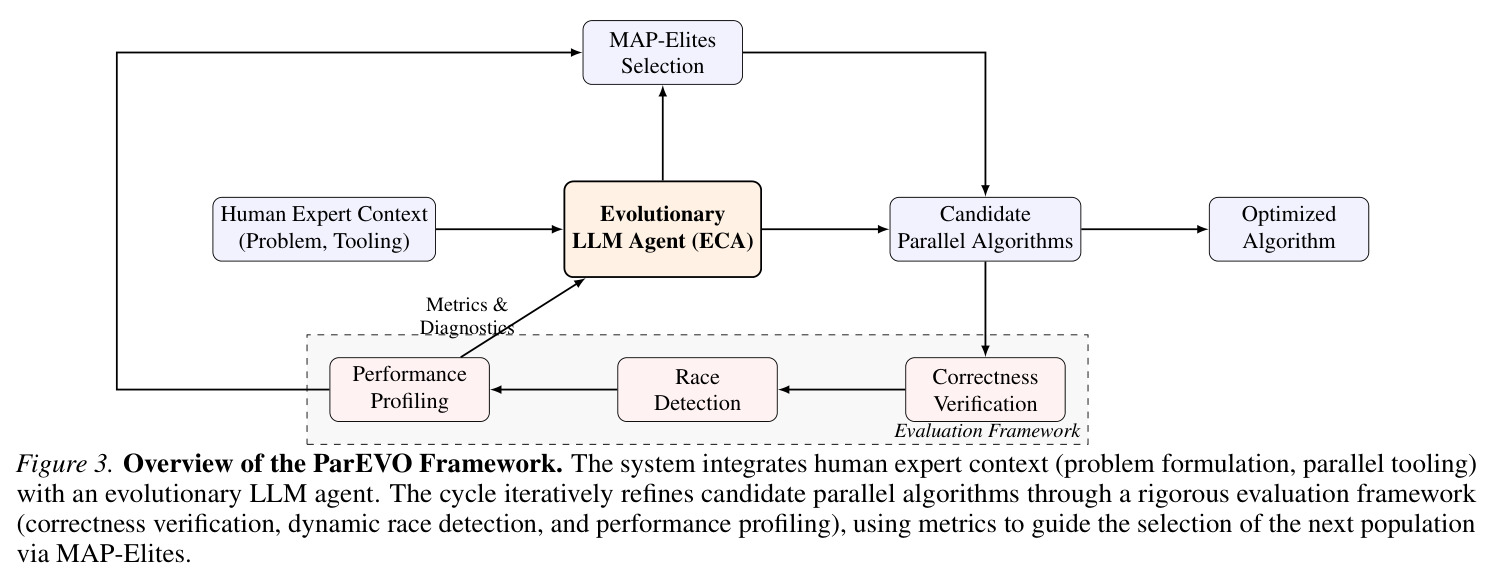
ParEVO 的进化编码代理 (ECA) 用 MAP-Elites 维持多样性,按代码长度、圈复杂度、同步原语频次三维度分桶,每代从 3 个 fitness 最高 + 5 个多样性最优解中抽样,是其'避免单点收敛到危险原子操作'的关键机制。
研究动机
随着 Dennard scaling 的崩溃,单核频率提升停滞,现代软件性能几乎完全依赖并行化(多核 CPU、GPU、分布式集群)。然而并行编程对绝大多数开发者而言学习曲线陡峭,这一困难在不规则数据(稀疏图、不平衡树、非均匀网格)上被进一步放大:静态调度失效、内存访问模式不可预测、动态负载均衡成为必要。尽管成熟库已能支持规则并行(稠密矩阵乘法等),不规则并行仍是 HPC 领域的'大挑战'。当前的大语言模型在 GitHub 顺序 Python/C++ 语料上预训练,对并发编程存在强烈的'顺序偏置':当被要求把 BFS 并行化时,模型常常只是把代码包进一句朴素的 #pragma omp parallel for,完全忽略 visited 数组的竞争写入;或者引入粗粒度锁,反而比串行版本还慢。Nichols 等人 2024 年的 ParEval 基准已经证明 LLM 能写出框架语法,但在同步语义和竞争条件上系统性地失败。
本文的目标是ParEVO 的目标是构建一个端到端系统,让 LLM 能够为不规则数据合成正确且高性能的并行代码。论文的具体目标包括三层:(1) 数据层面,发布 Parlay-Instruct 语料库(13,820 条任务),通过 Critic-Refine 流水线对每一条候选都执行真实编译和单元测试验证,过滤出性能达标的算法-代码对;(2) 模型层面,发布三个针对 ParlayLib / RPB 语义微调的专用模型(DeepSeek-Parlay 6.7B、Qwen3-Parlay 30B、Gemini-2.5-Parlay),让模型在'概率生成'与'并行原语的严格语义'之间对齐;(3) 推理层面,部署一个进化编码代理 (ECA),用编译器、动态竞争检测器和性能 profiler 作为'对手式判官',迭代修复代码的最后一公里问题。
与已有工作不同的是,ParEVO 区别于已有工作的切入角度是把'抽象层级选择'作为核心论点。论文主张不教 LLM 写低层 pthreads 或 OpenMP pragma 这类容易出错又难以组合的原语,而是训练 LLM 映射到 ParlayLib 这种高层并行 DSL:原语本身封装了调度器、强制不可变语义、把并行化问题降级为'局部 token 级转换',正好对齐 Transformer 的逐 token 预测能力。同时,与 EvoTune、OpenEvolve、AlphaEvolve 等通用进化代码框架相比,ParEVO 首次把'硬件 profiler + sanitizer 数据竞争检测'作为 fitness 信号引入 HPC 领域,绕开 Singh 等人 2024 年指出的'LLM 无法可靠地自我评判并行代码'的陷阱,确定性地把不安全的代码用 fitness=0 滤掉。
核心方法
ParEVO 是一个三阶段流水线:阶段一用 Teacher-Student-Critic 流程合成高质量并行指令数据;阶段二用这些数据对开源基座做 SFT/QLoRA+DPO 两阶段微调;阶段三在推理时用进化搜索代理 ECA 迭代修复代码。整体思路可以理解为:先把 LLM 的'语法-语义'对齐到高层并行原语(用微调实现),再把'最后一公里正确性 + 性能'交给带真实硬件反馈的进化搜索(用 runtime feedback 实现)。方法论上有两个关键设计:(1) 用确定性外部工具(编译器、ThreadSanitizer、性能 profiler)作为 fitness 函数,把'LLM 自审'换成'机器判官',避免 LLM 自身的顺序偏置影响评判;(2) 用 MAP-Elites 质量多样性算法维持解的分布,把代码长度、圈复杂度、同步原语频次作为多样性维度,防止种群全部塌缩到'安全但慢'的解上。
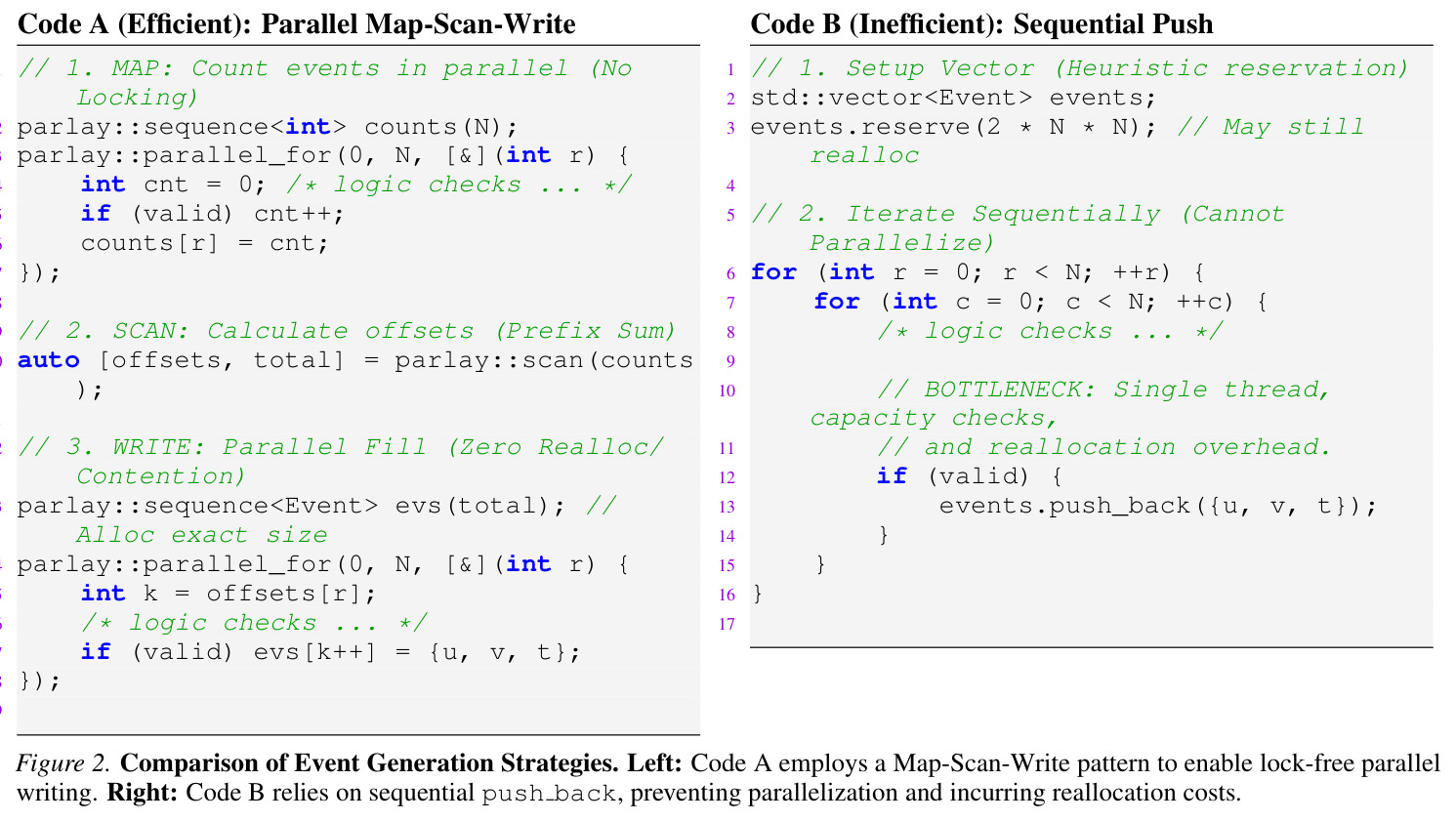
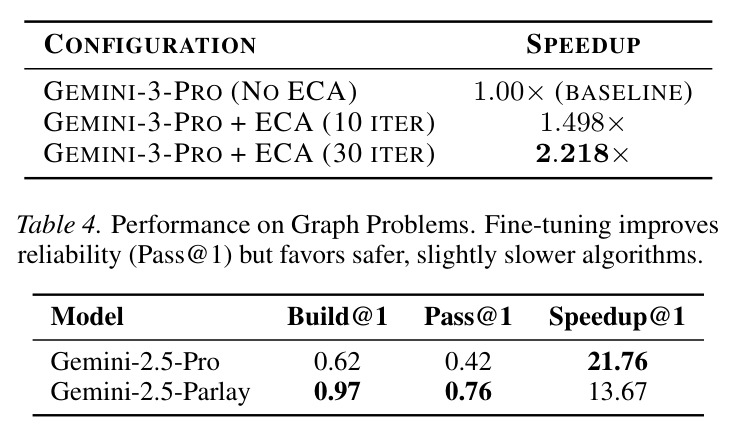
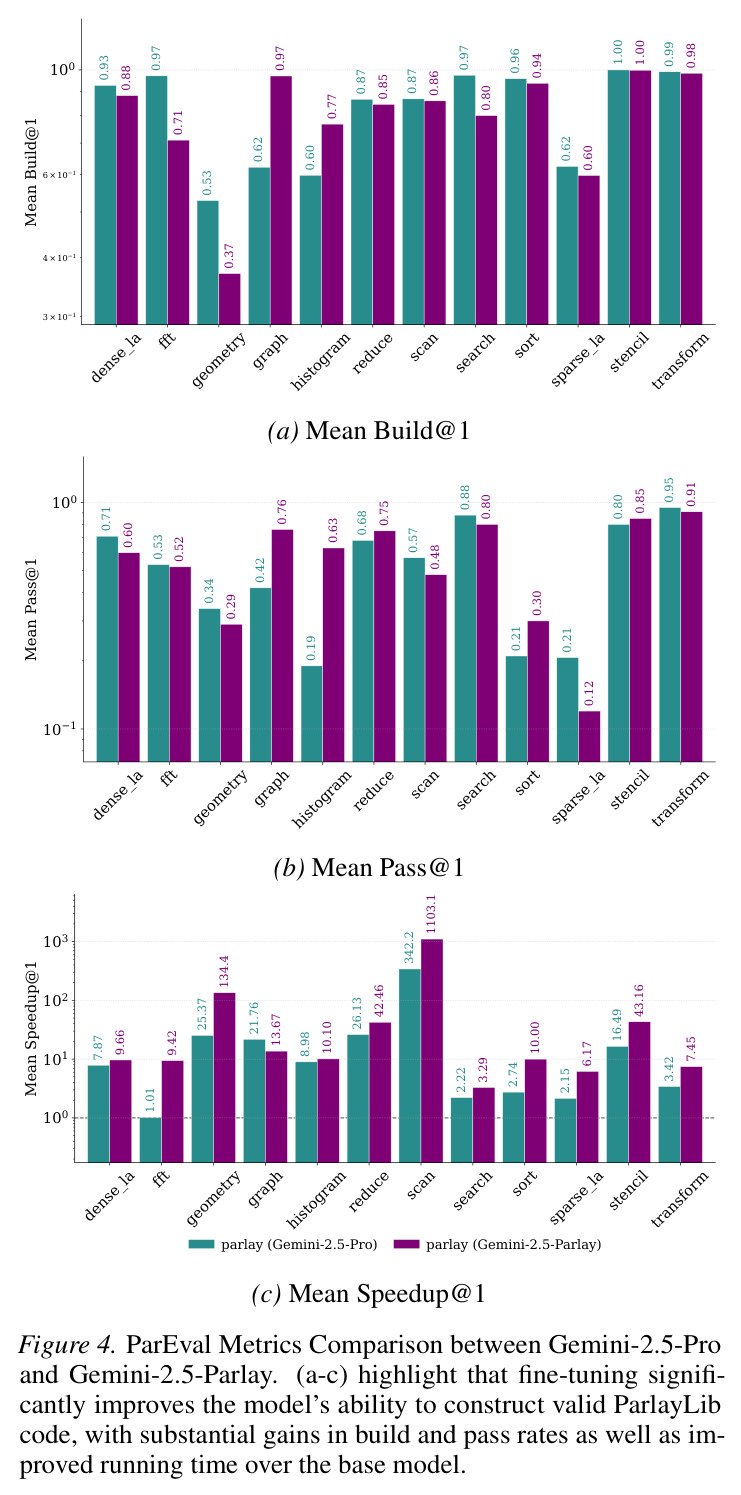
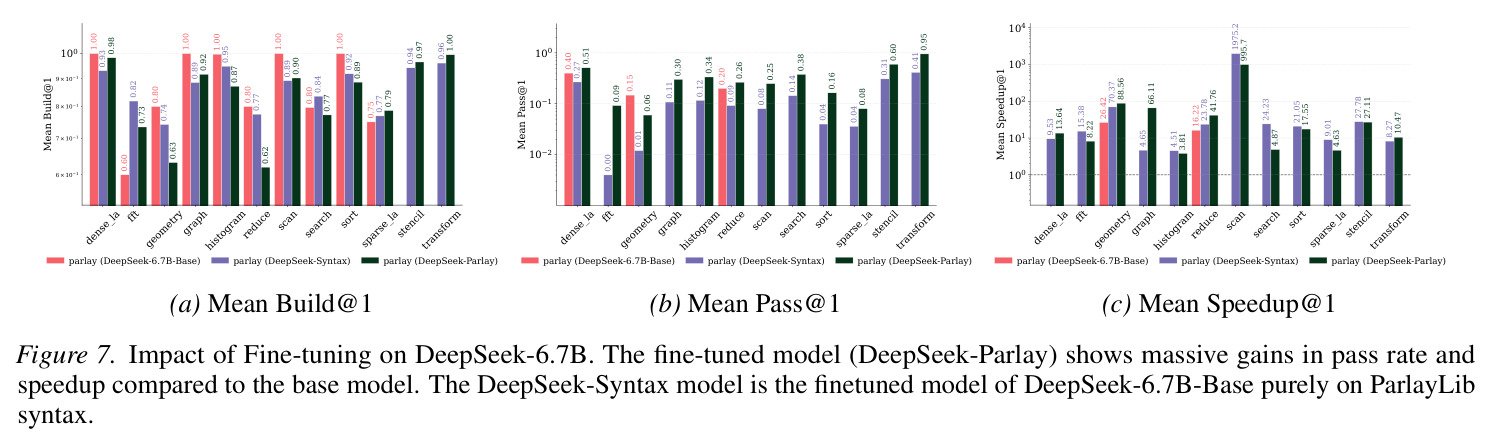
ParEVO 的核心创新是'抽象-对齐假设':与其训练 LLM 写低层线程原语(错误率高、组合困难、需要全局状态追踪),不如训练 LLM 把自然语言意图直接映射到 ParlayLib 的高层不可变原语(map、reduce、scan、filter、pack、sort)。这些原语本身数学上可证明是正确的(在 work-stealing 调度下满足 $W/P + O(S)$ 复杂度),并且与 Transformer 的 token 局部预测能力天然契合——并行化的'思维负担'被原语吸收掉了。第二个核心创新是'硬件作为判官':ECA 的 fitness 直接来自编译是否通过、ThreadSanitizer 是否报错、wall-clock 执行时间是多少,而不是 LLM 互评。这绕开了'LLM 看到自己生成的代码'时的确认偏置,让编译器成为绝对正确性门槛,profiler 成为性能优化信号。第三个创新是明确量化'正确性-性能权衡'(alignment tax):fine-tuning 把 Pass@1 从 0.42 提到 0.76,但 Speedup 从 21.7× 降到 13.6×,因为模型学会了优先选 parlay::unique 这类安全原语,回避风险更高的原子操作。
方法步骤详情
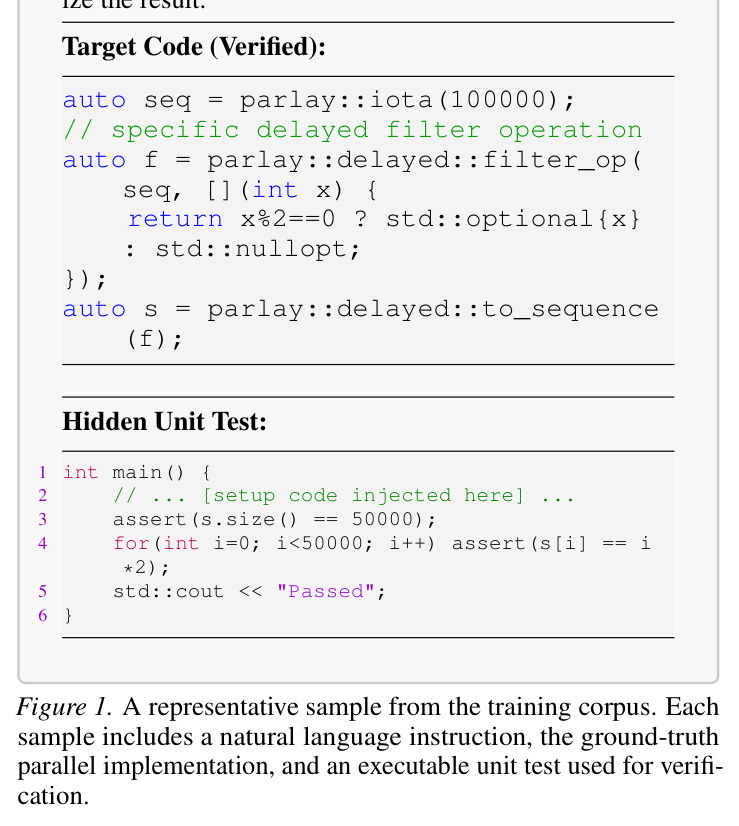
阶段一 Parlay-Instruct 语料构造:(1) 用 Gemini-3-Pro 作为 Teacher,对 593 个手写 ParlayLib 黄金样例和 20 道 DMOJ 题目应用三种变异算子 $M$:$M_{\text{type}}$(改数据类型如 int→std::string)、$M_{\text{cons}}$(加谓词如'只排序奇数'以触发 filter→sort 组合)、$M_{\text{algo}}$(结构转换如 reduce→scan);(2) Critic Loop 用真实编译+单元测试 $\text{Compile}(C) \land \text{UnitTest}(C)$ 拒采样,不通过直接丢弃;(3) 性能优化轨迹用 OpenEvolve 在 20 道 DMOJ 图问题上合成 (C_base, C_opt) 配对,要求 C_opt 至少 1.2× 加速于 C_base,speedup label 在 Code A/Code B 位置随机化以去偏;(4) Rust 端用 DMOJ 执行日志聚合,过滤基础设施错误,去重,按通过状态分层。最终产出 13,820 条已验证指令-代码对,13,120 训练 + 700 评测。\n\n阶段二模型微调:(1) DeepSeek-6.7B-base 在单张 RTX 5000 Ada 上做单阶段 SFT,LoRA 作用于 query/value 投影($r=8, \alpha=16$, FP16, $\eta=2 \times 10^{-4}$);(2) Qwen3-Coder-30B-A3B-Instruct 在 H200 上做两阶段:阶段一 QLoRA($r=16, \alpha=32$)覆盖所有 attention + MLP 线性层;阶段二 DPO,$\beta=0.1, \eta=5 \times 10^{-6}$,对通过/失败配对做偏好学习;(3) Gemini-2.5-Pro 利用其长上下文做 C++ 微调。所有模型对齐到 ParlayLib 语义。\n\n阶段三进化编码代理 ECA:(1) 维护一个候选种群,每个候选附带 fitness(编译通过+测试通过+执行时间倒数)和诊断制品(编译日志、竞争检测报告、针对性 refinement 指令);(2) fitness 函数定义为 $f(x) = 0$ 若编译/测试失败或触发数据竞争,否则 $f(x) = 1/(T(x) + \varepsilon)$;(3) 每代用 $k=3$ 个 fitness top 候选 + $d=5$ 个 MAP-Elites 多样性候选作为下一代的 prompt 上下文,多样性维度包括代码长度、圈复杂度、同步原语频次;(4) 终止时返回 fitness 最高的候选。评估环境:双路 Intel Xeon Platinum 8562Y+ (64 物理核) + 512GB DDR5,所有实验固定 32 线程。
技术新颖性
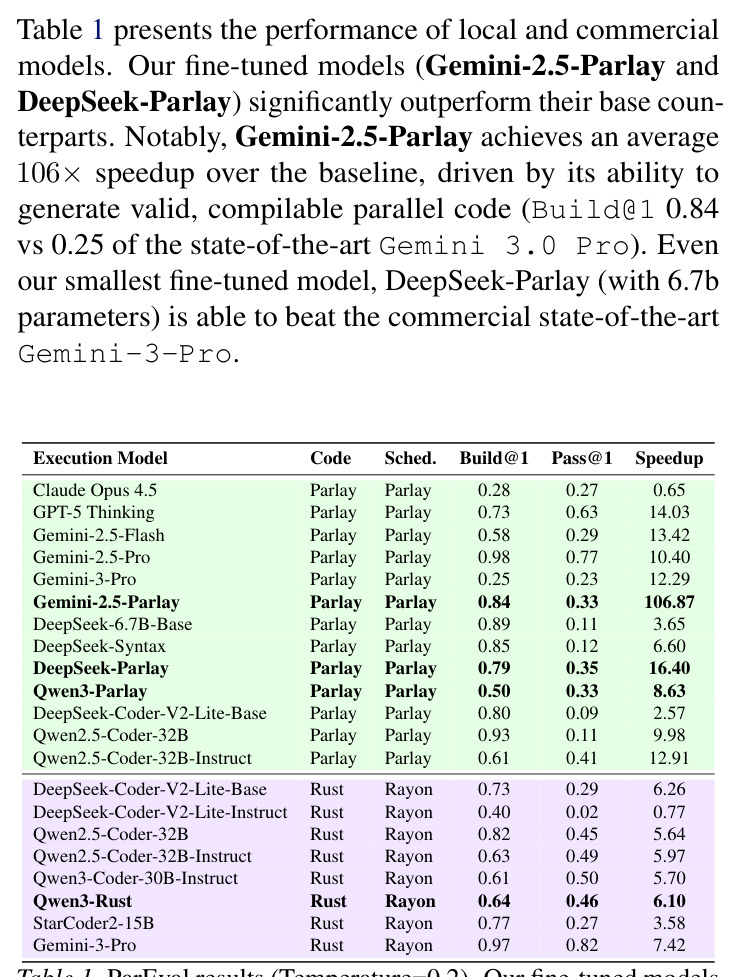
ParEVO 的技术新颖性主要体现在三方面。第一,'抽象-对齐'的训练范式:以往工作(OMPGPT、AutoParLLM、BabelTower、UniPar)都聚焦于让 LLM 学习 OpenMP pragma 或 CUDA 翻译,把线程同步的状态追踪负担压在 LLM 注意力机制上;ParEVO 是第一个把目标从'低层命令式并行'换成'高层函数式 DSL'的工作,并用实验证明后者在 Pass@1 和 Build@1 上都有数量级提升(见表 1:Gemini-2.5-Parlay Build@1=0.84 vs Gemini-3-Pro 的 0.25)。第二,'硬件判官'式的 fitness 设计:EvoTune、OpenEvolve、AlphaEvolve 等通用进化框架的 fitness 通常是单元测试通过率或数值目标,ParEVO 是第一个把 ThreadSanitizer 动态数据竞争检测作为硬性 fitness=0 过滤的工作,这直接解决了 Singh 等人指出的'LLM 无法可靠自评并行代码'的瓶颈。第三,明确量化'正确性-性能权衡'(alignment tax):论文用一个精心设计的消融(表 4)证明 fine-tuning 把 Pass@1 从 0.42 提升到 0.76,但 Speedup@1 从 21.7× 降到 13.6×,并把这个权衡解释为模型学会了用安全高层原语替代原子操作,这是其他 HPC-for-LLM 论文没有显式建模的现象。
实验结果
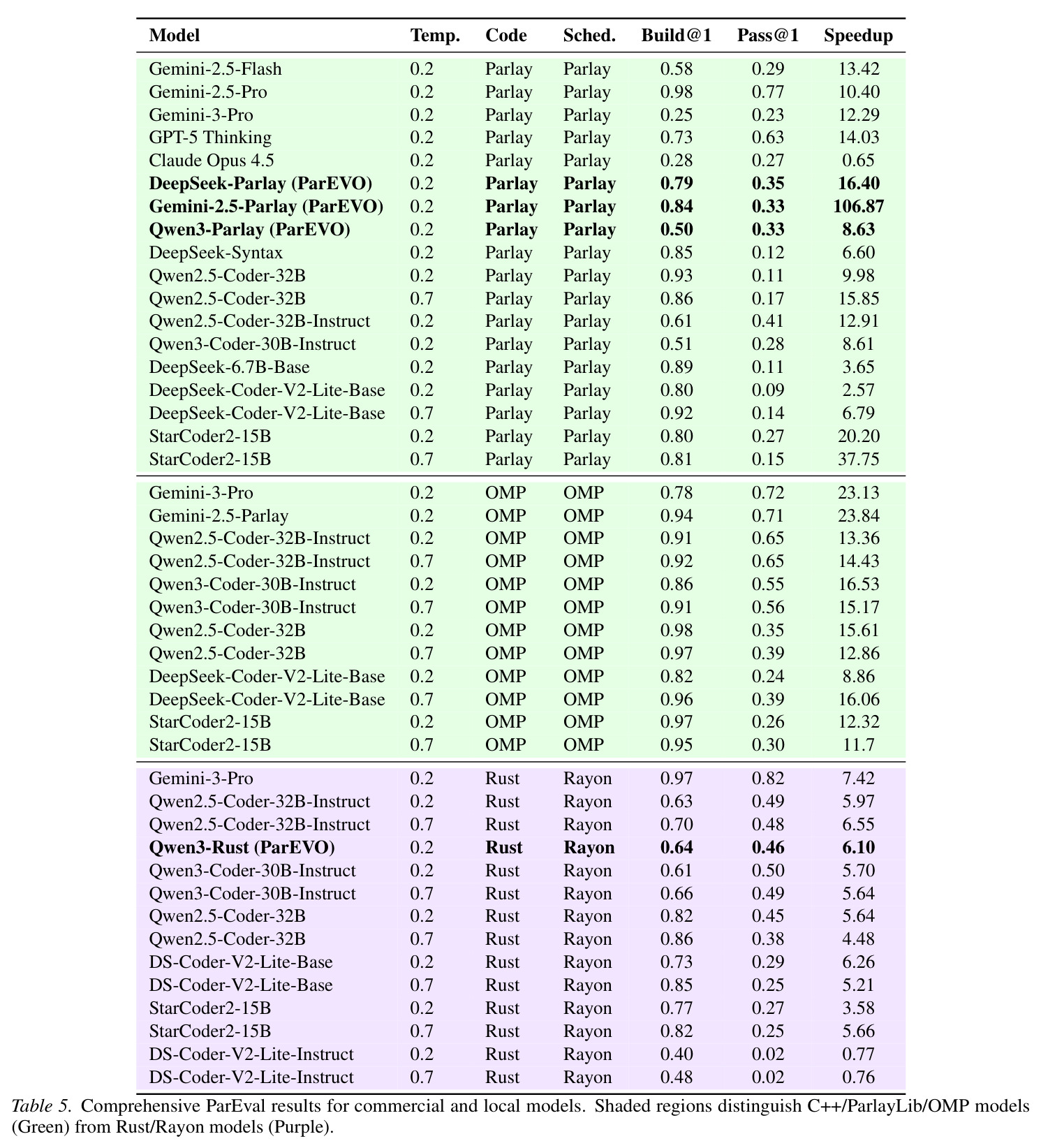
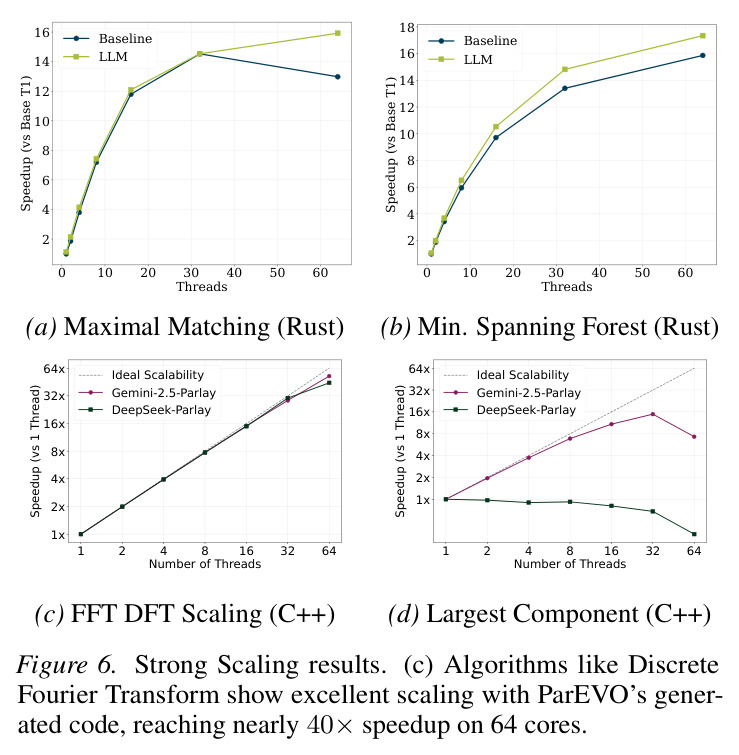
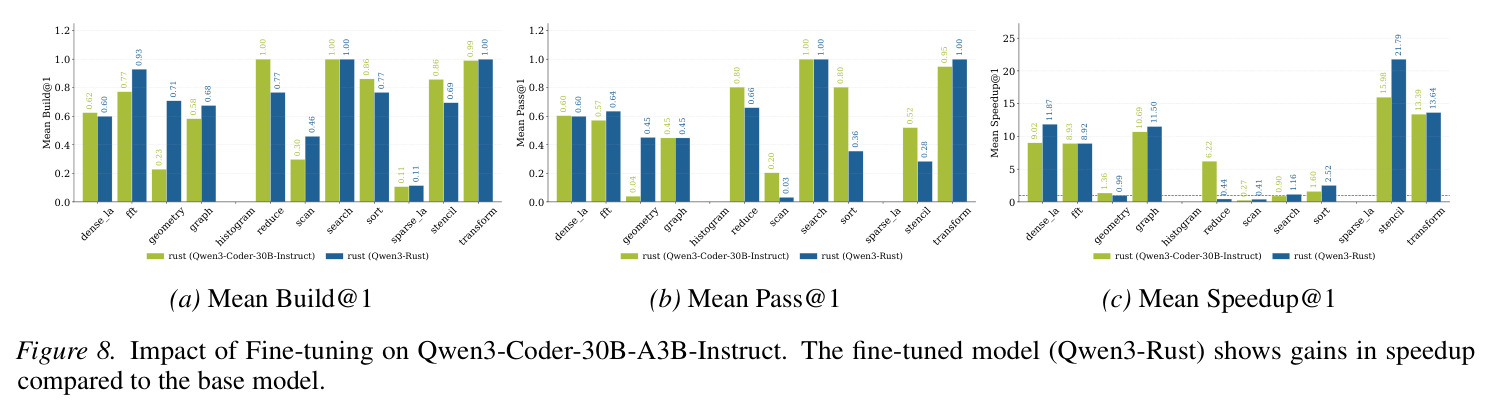
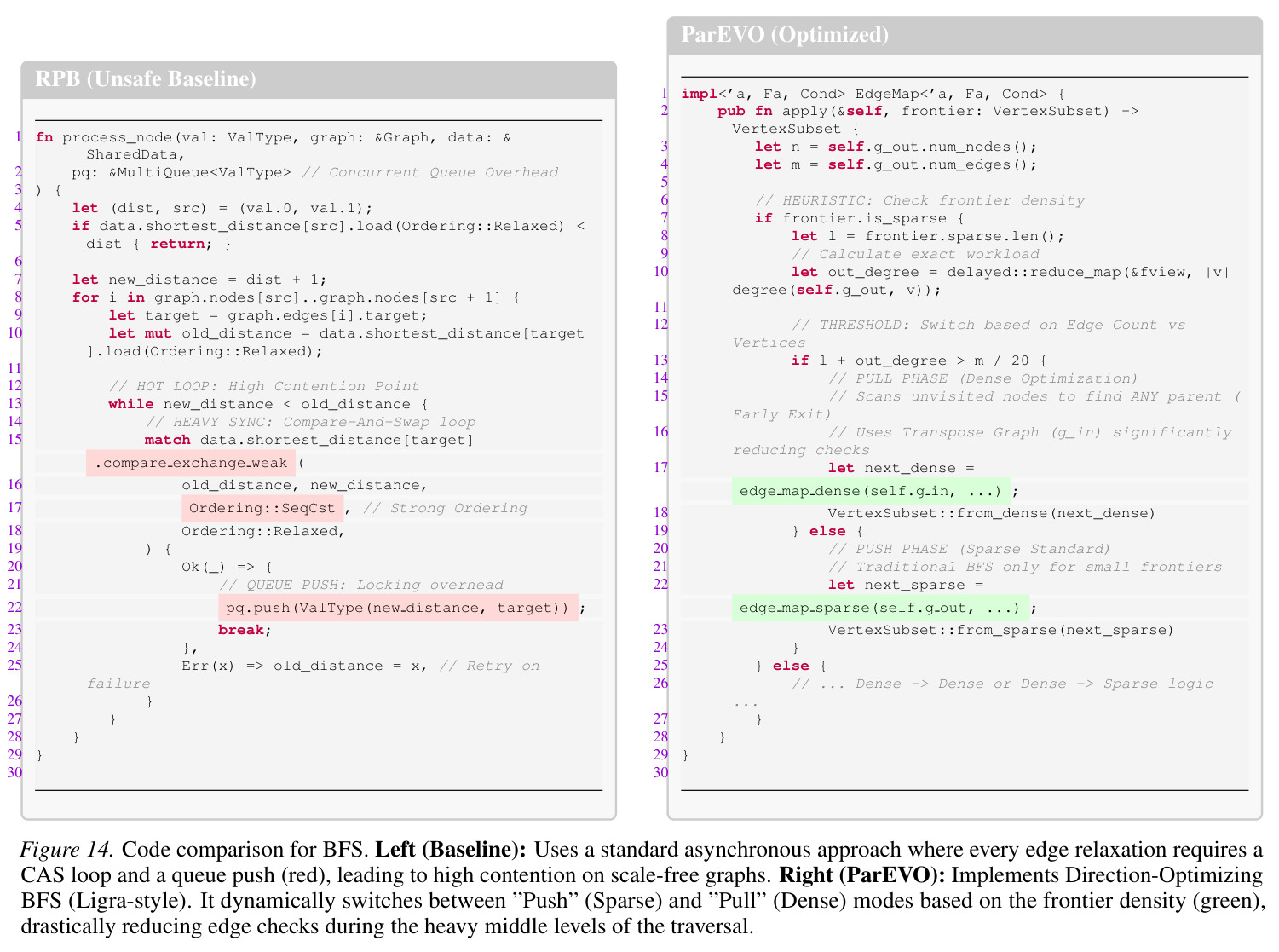
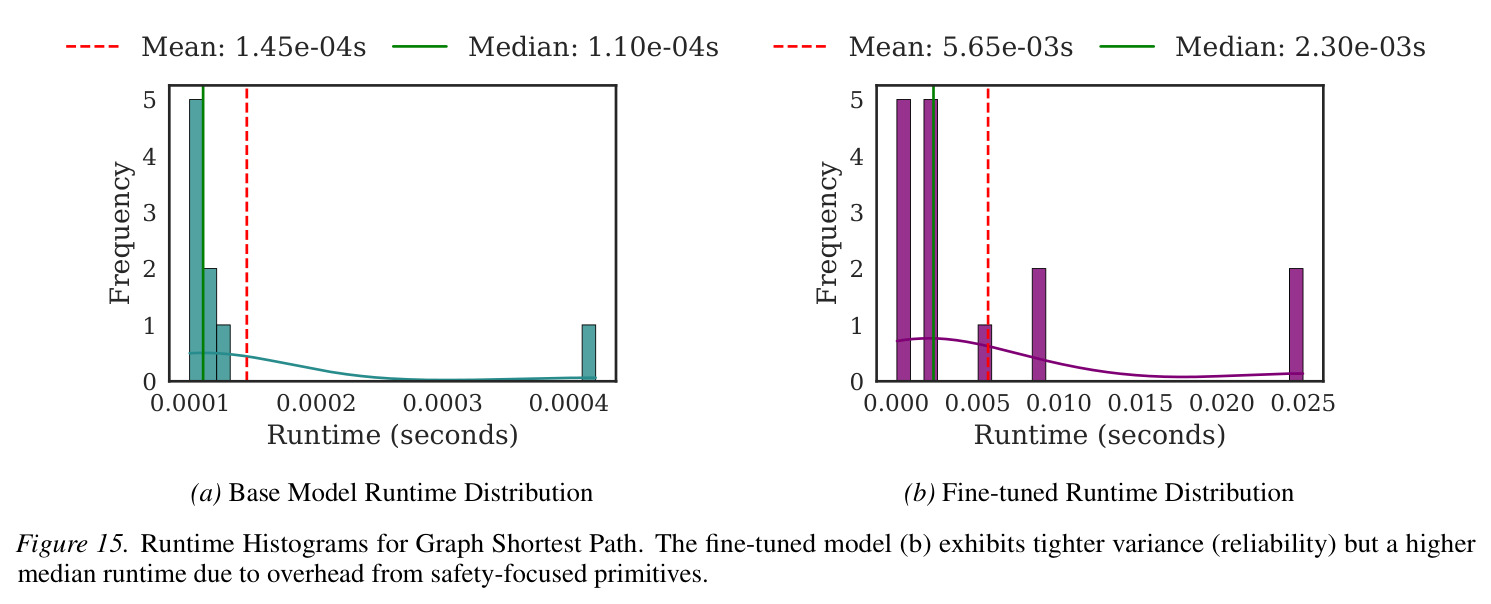
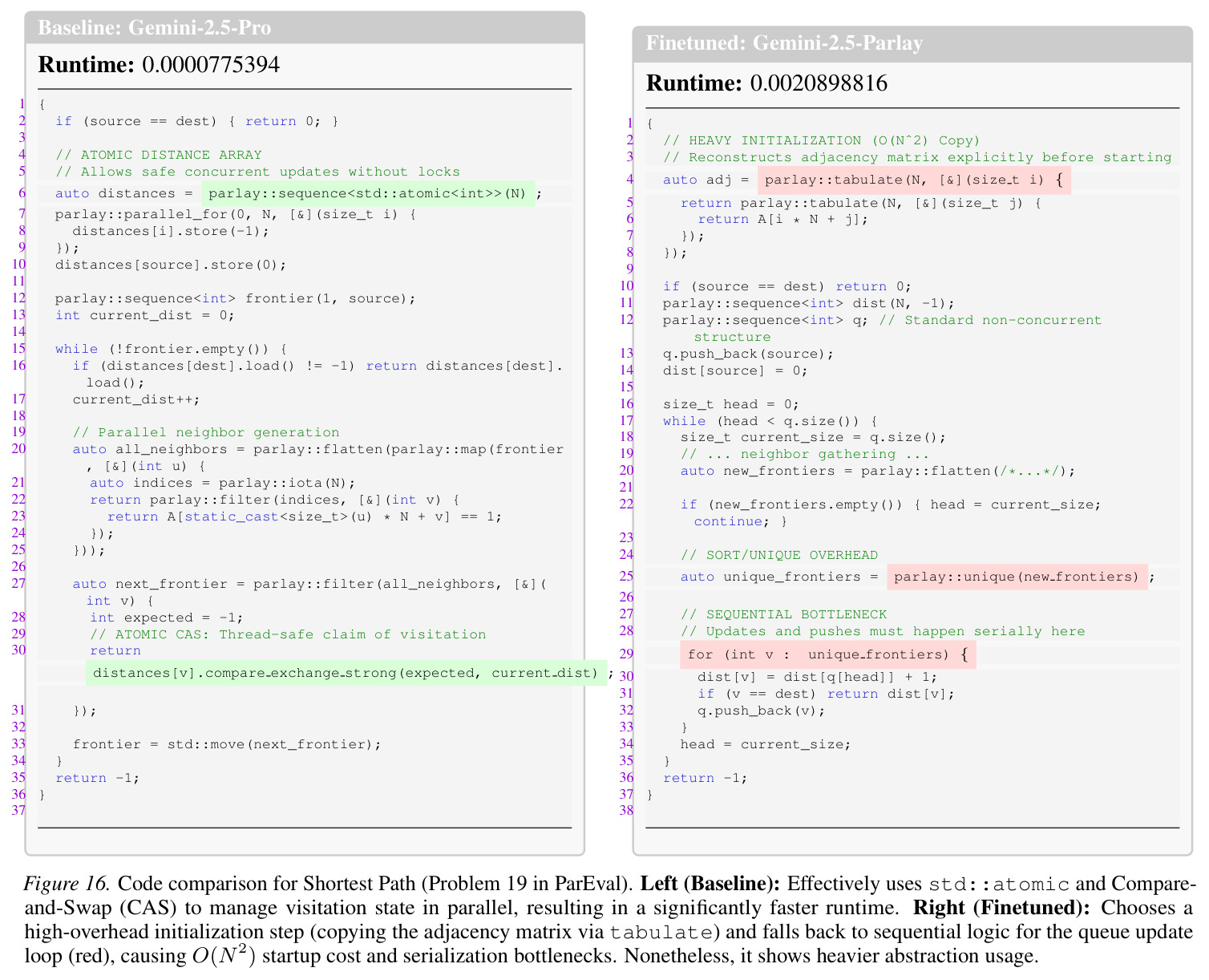
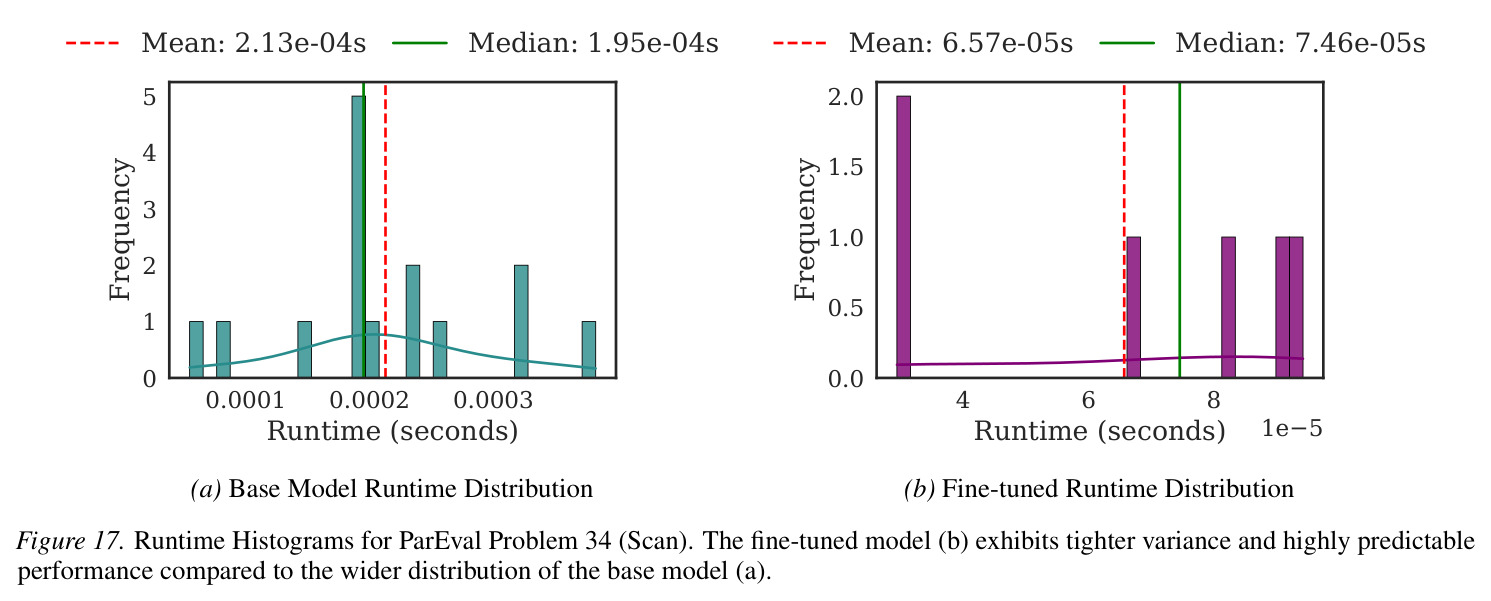
ParEval 主结果(表 1)显示 ParEVO 系列的微调模型在所有指标上对基座模型和商业模型都有显著优势。Gemini-2.5-Parlay 达到平均 106.87× 加速,Build@1 提升到 0.84(基座 0.25 接近不能用),在高度不规则的图问题上仍然有 13.6× 稳健加速。DeepSeek-Parlay 仅有 6.7B 参数也能达到 16.40× 平均加速,超过 Gemini-3-Pro 的 12.29×,验证了'小模型+领域微调'可以击败大商业模型。Qwen3-Parlay 30B 在 Pass@1 上较弱(0.33 vs Gemini-2.5-Parlay 的 0.33-0.84 区间),但 Speedup 8.63× 仍优于其基座 Qwen3-Coder-30B-Instruct 的 8.61×。OpenMP 模式下(表 5)Gemini-2.5-Parlay 取得 23.84×,略高于 Gemini-3-Pro 的 23.13×,证明微调收益在不同后端都可迁移。Rust/Rayon 模式(表 5)下 Qwen3-Rust 6.10× 也优于基座 5.70×,但绝对值低于 C++ 端。\n\n强扩展实验(Figure 6)显示 ParEVO 生成的 C++ FFT 代码在 64 核上达到 40× 加速(接近线性),Rust Maximal Matching 也接近基线扩展性。Figure 9 展示 ParEVO 的 BFS 实现击败了基线多队列 BFS:ParEVO 提出了 BackForward BFS(一种新的方向优化变体),在 heavy middle levels 上显著减少边检查。\n\n语义对齐实验(Figure 5)展示了一个戏剧性案例:基座 Gemini-2.5-Pro 在 complex 数字排序任务上 Build@1=0(用错 parlay::sort 的比较器签名),微调模型用 sort_inplace + auto 参数实现 Build@1=1、Speedup 17.5×。\n\n进化代理消融(表 3)显示 Gemini-3-Pro + ECA 30 迭代比单次生成(1.00×)得到 2.218× 加速,10 迭代得到 1.498×——证明迭代搜索不是锦上添花而是必要。\n\n关键反例:图 15/16 的最短路径案例展示对齐税——基座模型在冒险的 atomic CAS 实现上偶尔跑到 $1.10 \times 10^{-4}$ s 中位数(最坏 0.0002s),微调模型用 parlay::tabulate 做 $O(N^2)$ 复制后用 std::vector 串行更新,中位数 $2.30 \times 10^{-3}$ s,反而慢 20 倍但更稳定。表 6 凸包案例更糟:DS-Parlay 因为幻觉出 parlay::convex_hull 函数直接 Pass@1=0、Speedup=0,证明 fine-tuning 也会导致'自信幻觉'。
查看结构化数据
| 任务 | 指标 | 本文 | 基线 | 提升 |
|---|---|---|---|---|
| ParEval 全套(Parlay 路径) | Speedup@1(平均加速比) | Gemini-2.5-Parlay 106.87×、DeepSeek-Parlay 16.40×、Qwen3-Parlay 8.63× | Gemini-3-Pro 12.29×、GPT-5 Thinking 14.03×、Claude Opus 4.5 0.65× | Gemini-2.5-Parlay vs 最佳商业模型提升约 7.6×;DeepSeek-Parlay 6.7B 超过 Gemini-3-Pro 33%;Claude Opus 4.5 完全失败 |
| ParEval 全套(Parlay 路径) | Build@1(首次编译通过率) | Gemini-2.5-Parlay 0.84、DeepSeek-Parlay 0.79 | Gemini-3-Pro 0.25、GPT-5 0.73、Claude Opus 4.5 0.28 | Gemini-2.5-Parlay vs Gemini-3-Pro 提升 3.36×(0.25→0.84),证明对 ParlayLib 类型系统的内化 |
| ParEval 全套(Parlay 路径) | Pass@1(首次测试通过率) | Gemini-2.5-Parlay 0.33、DeepSeek-Parlay 0.35 | Gemini-3-Pro 0.23、GPT-5 0.63、Claude Opus 4.5 0.27 | 微调提升约 1.4-1.5×,但绝对值仍低,提示 alignment tax;GPT-5 的 Pass@1 最高(0.63)但 Speedup 较低 |
| ParEval 全套(OpenMP 路径) | Speedup@1 | Gemini-2.5-Parlay 23.84× | Gemini-3-Pro 23.13×、Qwen3-Coder-30B-Instruct 16.53× | 微调模型迁移到 OMP 后端仍有约 3% 提升;绝对值远低于 Parlay 后端 |
| ParEval 全套(Rust/Rayon 路径) | Speedup@1 | Qwen3-Rust 6.10× | Gemini-3-Pro 7.42×、Qwen3-Coder-30B-Instruct 5.70× | Qwen3-Rust vs 基座提升约 7%;但 Gemini-3-Pro 在 Rust 上反而最高 7.42×,说明 Rust 域微调收益有限 |
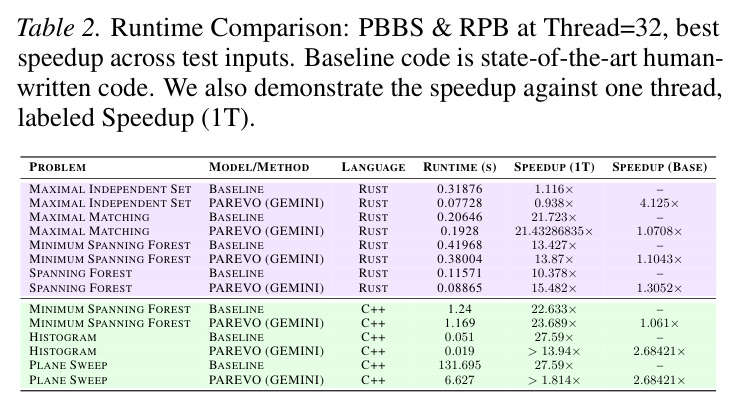
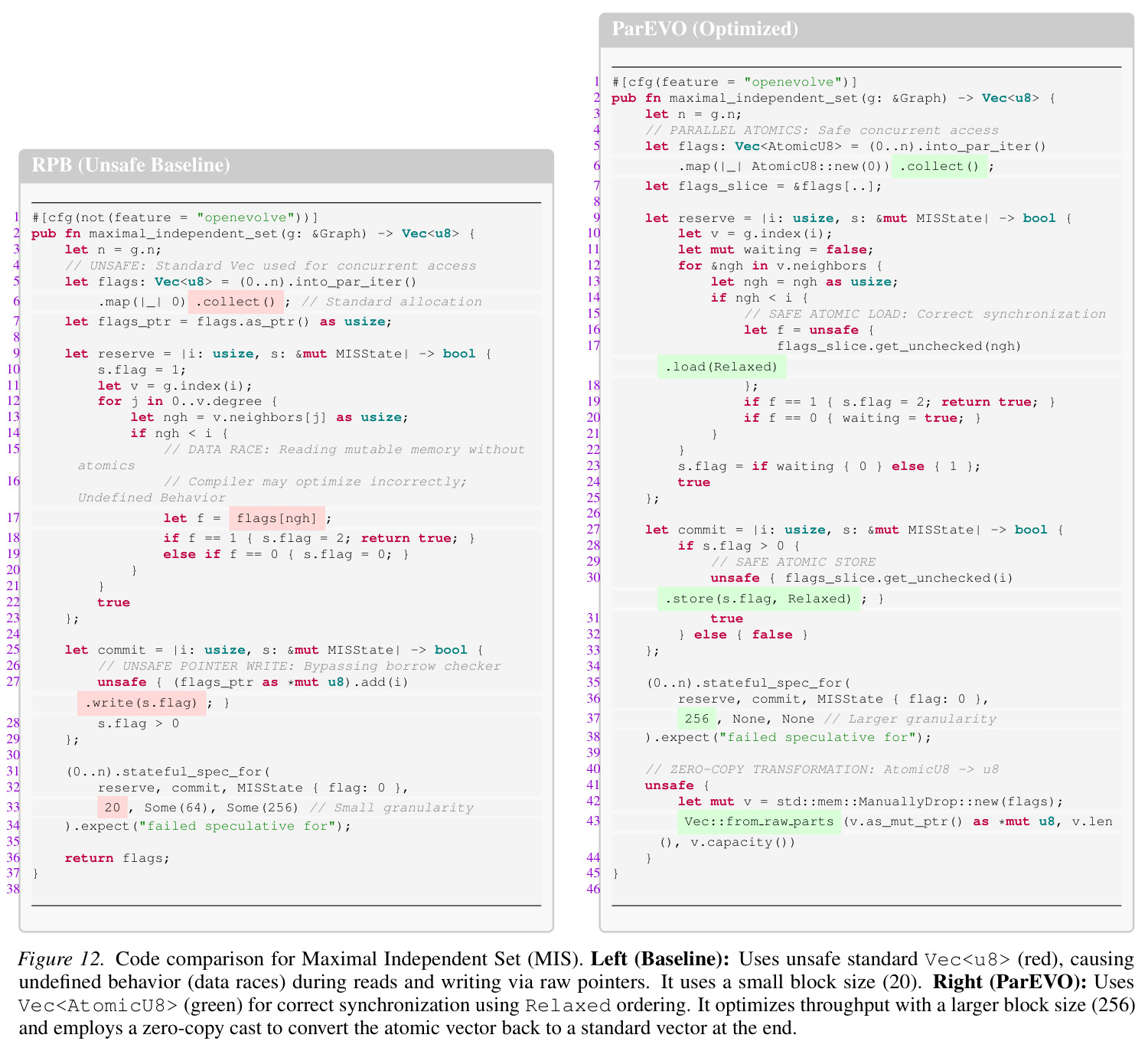
| RPB(Rust PBBS)- Maximal Independent Set | Speedup(vs RPB 人工基线) | ParEVO (Gemini) 0.938×(1T)/ 4.125× vs BASE | RPB 人工基线 1.116×(1T) | 比 RPB 人工 unsafe 基线快 4.1×(0.31876s → 0.07728s),通过 Vec<AtomicU8> 替代 unsafe 指针写入、块粒度从 20 提升到 256 |
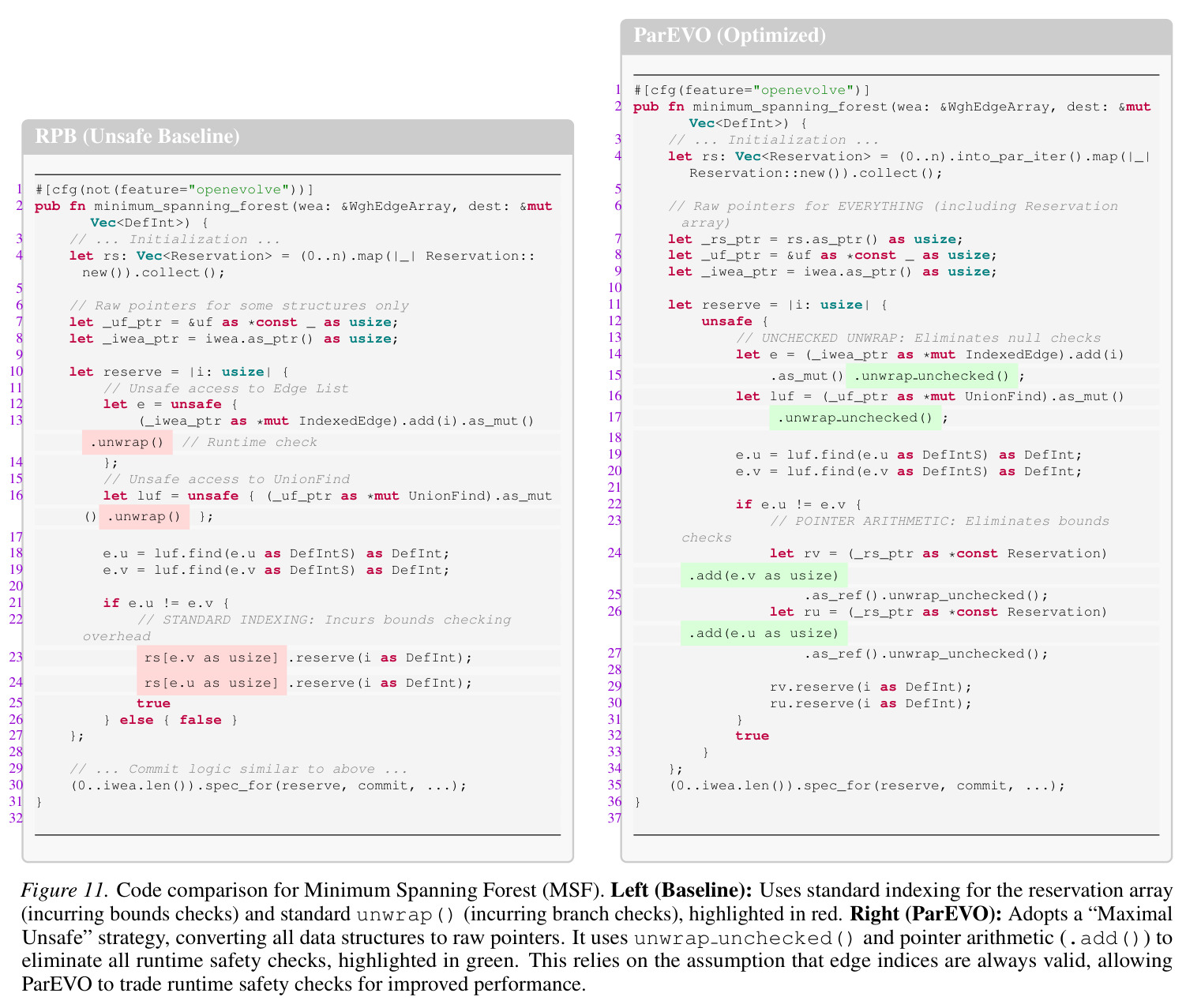
| RPB - Minimum Spanning Forest (Rust) | Speedup(vs RPB 人工基线) | ParEVO (Gemini) 21.43×(1T)/ 1.07× vs BASE | RPB 人工基线 13.43×(1T) | 采用 'Maximal Unsafe' 策略,unwrap_unchecked + 指针算术消除所有 bounds check,加速 7% |
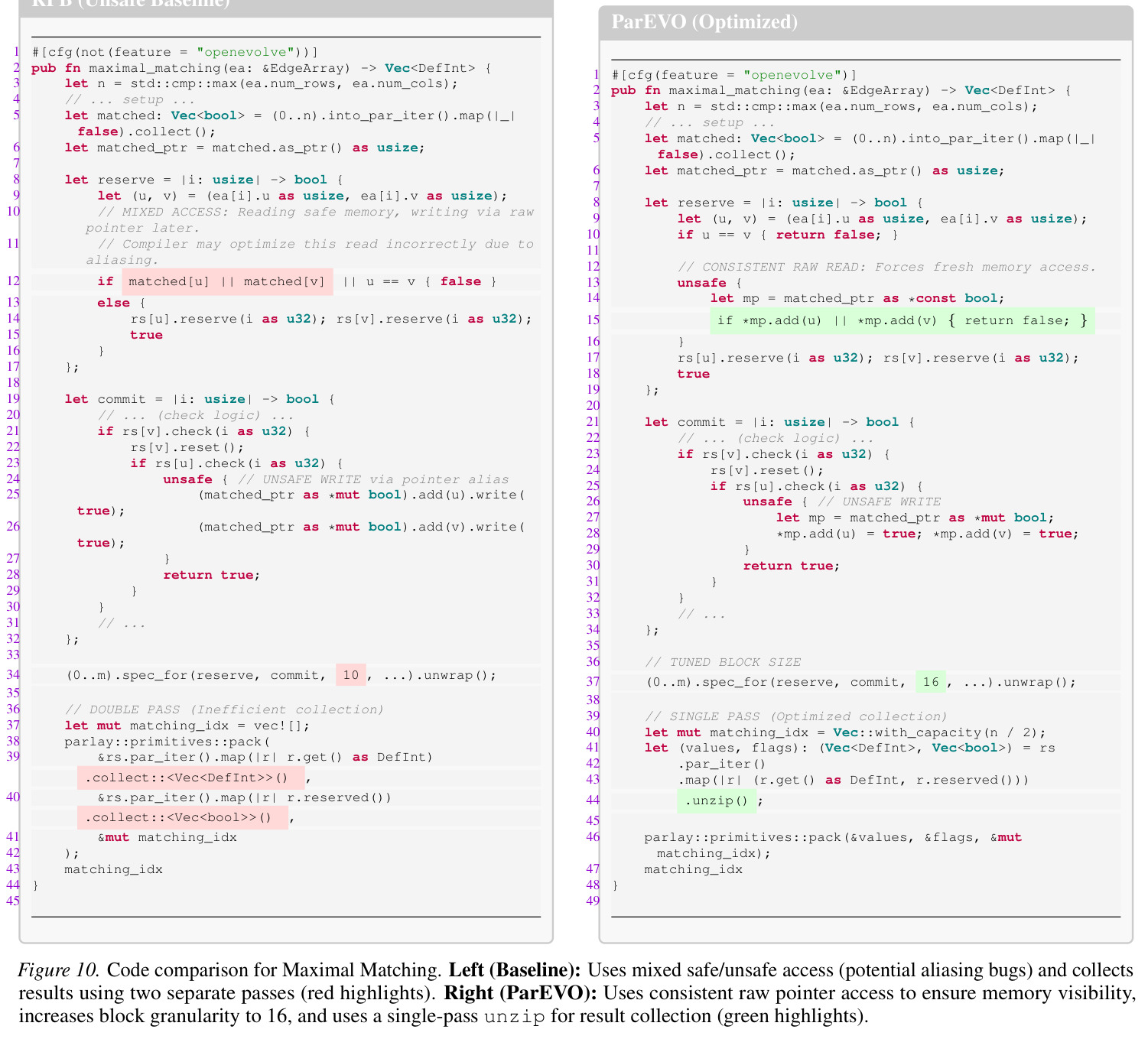
| RPB - Maximal Matching (Rust) | Speedup(vs RPB 人工基线) | ParEVO (Gemini) 21.78×(1T)/ 1.04× vs BASE | RPB 人工基线 21.72×(1T) | 块粒度从 10 提到 16,单遍 unzip 替换双遍 collection,匹配基线 |
| RPB - BFS (Rust) | 运行时间(中位数) | ParEVO BackForward BFS 17.5s(大规模图) | Baseline 多队列 BFS 40s | 实现 Ligra 风格方向优化 BFS,动态切换 Push/Pull 模式,heavy middle levels 减少边检查 |
| PBBSBench - Minimum Spanning Forest (C++) | Speedup(vs PBBS 人工基线) | ParEVO (Gemini) 23.69×(1T)/ 1.06× vs BASE | PBBS 人工基线 22.63×(1T) | 比 PBBS 专家手写代码快 6% |
| PBBSBench - Histogram (C++) | Speedup(vs PBBS 人工基线) | ParEVO (Gemini) 27.59×(1T) | PBBS 人工基线 27.59×(1T) | 匹配专家性能(持平) |
| PBBSBench - Plane Sweep (C++) | Speedup(vs PBBS 人工基线) | ParEVO (Gemini) > 1.81×(1T)/ 2.68× vs BASE | PBBS 人工基线 baseline | 在 Plane Sweep 任务上实现 2.68× 加速(131.695s → 6.627s) |
| ParEval - Complex 数字排序 | Build@1 / Speedup | Build@1=1、Speedup 17.5× | Gemini-2.5-Pro Build@1=0(编译失败) | 从 0 编译到正确实现,体现 ParlayLib 语义对齐的质变效果 |
| DMOJ 图问题进化消融 | Speedup vs 首个通过解 | Gemini-3-Pro + ECA 30 迭代 2.218× | Gemini-3-Pro 单次生成 1.00× | 30 迭代 2.22×、10 迭代 1.50×,证明 ECA 迭代搜索是必要而非可选 |
| ParEval - 强扩展(FFT) | 64 核 Speedup | Gemini-2.5-Parlay 40× | 理想线性 64× | 达到 62% 并行效率,复杂同步被 ParlayLib 原语吸收 |
局限与改进
作者在 §5.2 明确承认三大局限:(1) 架构范围只覆盖共享内存多核,没有涉及分布式内存(MPI/PGAS),而分布式引入了通信延迟和数据划分两类全新优化维度;(2) ECA 用推理时算力换执行时效率——每跑一次要生成多个候选、编译、执行,cost 不可忽略,但作者认为对运行万亿次的 HPC 内核来说是合理摊销;(3) 模型在陌生算法域会出现'自信幻觉',论文在 Convex Hull 任务上观察到 DS-Parlay 直接调用不存在的 parlay::convex_hull 而失败(表 6 Pass@1=0),未来计划引入形式化验证工具约束语义错误。我自己的观察还包括:(a) 论文只在 64 核以内评估,缺少 NUMA 感知的进一步讨论;(b) Parlay-Instruct 语料主要来自 Gemini-3-Pro 的合成,存在'教师模型偏见'风险——若 Gemini-3-Pro 自身有盲区,ParEVO 也学不到;(c) Gemini-2.5-Parlay 取得 106× 极高平均加速的部分原因是 Pass@1 较低(0.33),相当于'能跑通的任务跑得飞快',但分布性不如 GPT-5(Pass@1=0.63, Speedup=14×)稳健;(d) Rust/Rayon 端 Qwen3-Rust 6.10× 反而不如 Gemini-3-Pro 7.42×,说明微调未必总带来收益,在目标域训练数据稀薄时反而可能损害基座已有能力。
独立分析的弱点
(1) 绝对通过率仍偏低:Gemini-2.5-Parlay 的 Pass@1=0.33 意味着 67% 任务需要多次重试才能通过。对 HPC 自动化部署而言,这意味着需要更强的验证-重试循环。改进方向:把多轮 ECA 与自一致性投票结合,让模型在内部先 sample 多个候选再选 best-of-N。(2) 对齐税量化但未解决:fine-tuning 把 Pass@1 提了 0.42→0.76 但 Speedup 跌了 21.7×→13.6×,本质是模型学会了'避免 atomic'。改进方向:在 DPO 阶段增加 'atomic-but-correct' 偏好对,引导模型在安全前提下保留原子操作;或专门设计一个'性能探索 prompt'切换模式。(3) 几何算法失败:Convex Hull、Closest Pair 上 DS-Parlay 出现 0/188 的极端分裂,说明语料对这些特殊算法的覆盖不够。改进方向:把 PBBS 全部 60+ 个 benchmark 都加进语料构造循环,并加形式化验证 (Dafny/Coq) 作为额外 fitness 信号。(4) Rust 域收益小:Qwen3-Rust 6.10× 不如 Gemini-3-Pro 7.42×,微调未带来显著优势。改进方向:Rust 端目前主要靠 prompt-injected primitives,应构建专门的 Rust 进化数据集(类似 DMOJ-Rust 大规模执行日志),而不是简单复用 DMOJ C++ 数据的子集。(5) 进化代理只到 30 迭代:表 3 显示 30 迭代 2.22×,但 10→30 迭代的边际收益递减,论文未探讨 50、100 迭代的收敛行为。改进方向:把 ECA 接入 UCB 风格的 bandit 决定何时停止,并探索更智能的 prompt 策略(程序分析-aware 的 mutation)。
未来方向
作者明确指出的方向:(1) 扩展到分布式内存(MPI/PGAS)——把通信延迟和数据划分作为新的 fitness 维度;(2) 集成形式化验证工具(Dafny、Coq 或基于 ACSL 的 Frama-C)约束语义错误,应对几何算法等域的'自信幻觉';(3) 在更大规模实验(如 256+ 核、跨节点)上验证 NUMA 感知能力。\n\n基于论文成果可延伸的方向:(a) 把 Parlay-Instruct 的'批判家循环'思想推广到其他领域特定 DSL——比如 SQL 查询优化、Verilog 硬件描述、CUDA kernel 模板,验证'高层抽象 + 拒绝采样'是否在所有需要 LLM 学会结构化生成的任务上都能复现数量级提升;(b) 用 ParEVO 的 fitness 信号直接做 RLHF/GRPO 微调——目前 SFT/DPO 用的是静态偏好对,如果把 ECA 的 (C_base, C_opt) 轨迹作为 on-policy rollouts 做 RLOO 训练,可能进一步收紧对齐税;(c) 探索 DPO 之外的对齐算法(KTO、IPO、SimPO)在'安全 vs 性能'权衡下的表现;(d) 把 ThreadSanitizer 反馈作为'显式约束 prompt'注入到 ECA——当 sanitizer 报错时,让 LLM 直接看到 TSan 的 stack trace 摘要,而不是只看 0/1 标签,这能加速修复效率;(e) 探索 MAP-Elites 多样性维度的更细选择,比如按'使用的 ParlayLib 原语组合'分桶,这可能在 ECA 中保留更多探索性候选。
复现评估
可复现性整体较好,论文在多处明确给出训练配置和资源。代码与数据集完全开源:https://github.com/WildAlg/ParEVO 含 Parlay-Instruct artifacts 与代码;微调模型在 HuggingFace 上发布(deepseek-parlay-6.7b、qwen3-30b-sft-stage2-merged、qwen3_rust_dpo_final_merged)。DeepSeek-6.7B 的训练只需单张 RTX 5000 Ada + LoRA($r=8$)+ FP16,是最容易复现的入口。Qwen3-30B 两阶段微调需要 H200 + QLoRA($r=16$),中等门槛。Gemini-2.5-Parlay 微调需要 Gemini API access(Google DeepMind 团队内部使用)。评估硬件明确:双路 Xeon Platinum 8562Y+ (64 物理核) + 512GB DDR5 + H200 (仅推理),所有实验固定 32 线程。数据合成流程中 Gemini-3-Pro 的随机种子未完全公开(OpenEvolve 框架本身有默认设置),reproducibility 的真正瓶颈是:Gemini-3-Pro Teacher 在 20 道 DMOJ 上合成 (C_base, C_opt) 配对的可重复性、ThreadSanitizer 报告在不同 GCC/Clang 版本下的稳定性。复现整体难度:中高——硬件与模型权重可获得,但语料构造的 stochasticity 可能让最终数字有 ±10% 波动。
论文图表
扩展版 ParEval 结果表:覆盖 20+ 模型 × Parlay/OpenMP/Rust 三种后端 × Temperature 0.2/0.7 两个设置,每个组合列出 Build@1、Pass@1、Speedup。ParEVO 模型在每种后端都参与对比。
论文的'完整数据附录',让读者可以验证 ParEVO 在不同后端、不同温度、不同模型规模下的稳定性。Appendix 中 ParEval 后端 0.2/0.7 的设置差异揭示了采样温度对 Pass/Speedup 的非平凡影响。
几何算法详细对比:Convex Hull — Gemini-2.5-Pro Pass@1=0.45, Speedup=1.43;DS-Parlay Pass@1=0.00, Speedup=0.00(幻觉 parlay::convex_hull)。Closest Pair 2D — Gemini-2.5-Pro Pass@1=0.40, Speedup=74.48;DS-Parlay Pass@1=0.45, Speedup=188.03(最优)。
暴露 fine-tuning 的'自信幻觉'失败模式:DS-Parlay 在 Convex Hull 上 Pass@1=0,因为模型编造了不存在的 parlay::convex_hull 函数。这是论文承认的几何算法弱点,也是未来工作要引入形式化验证的直接动机。