BaRe-Mem:面向鲁棒自适应智能体咨询的贝叶斯可靠性记忆 BaRe-Mem: Bayesian Reliability Memory for Robust and Adaptive Agent Consultation
在线贝叶斯记忆为顾问可靠性建模,动态决定中心模型“信谁”与“要不要问人”。
前置知识
贝叶斯线性回归
一种概率化回归:假设观测 $z=w^\top x+\epsilon$、$\epsilon\sim\mathcal{N}(0,1)$,并对权重施加高斯先验 $w\sim\mathcal{N}(0,\lambda^{-1}I)$;结合数据后得到权重的后验 $\mathcal{N}(m,\Lambda^{-1})$,其中 $\Lambda=\lambda I+\sum xx^\top$、$m=\Lambda^{-1}b$。后验同时给出预测均值与不确定度,证据越多后验越集中。
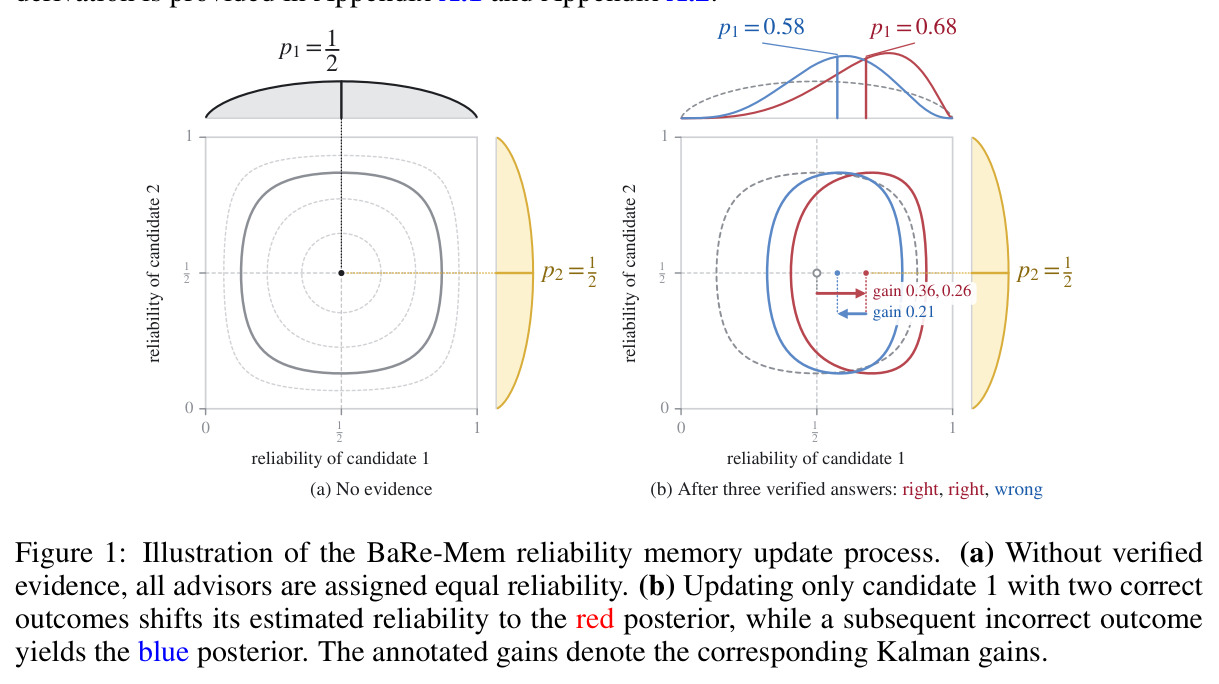
BaRe-Mem 的整个“记忆”就是一个贝叶斯线性回归:正确性信号 $s=2y-1$ 被建模为特征的线性高斯观测,所有可靠性与自主能力估计都从该后验导出,不懂这套框架就无法理解论文式(3)–(6)。
Kalman gain 与精确在线更新
贝叶斯后验可用秩一更新增量维护:新观测 $(x,s)$ 到来时,增益 $g=\Lambda^{-1}x/(1+x^\top\Lambda^{-1}x)$ 决定残差 $s-x^\top m$ 对均值与协方差的修正幅度。当前后验在 $x$ 方向越不确定,$g$ 越大、新证据影响越强;可证明更新结果与一次性批处理完全一致,且与观测到达顺序无关。
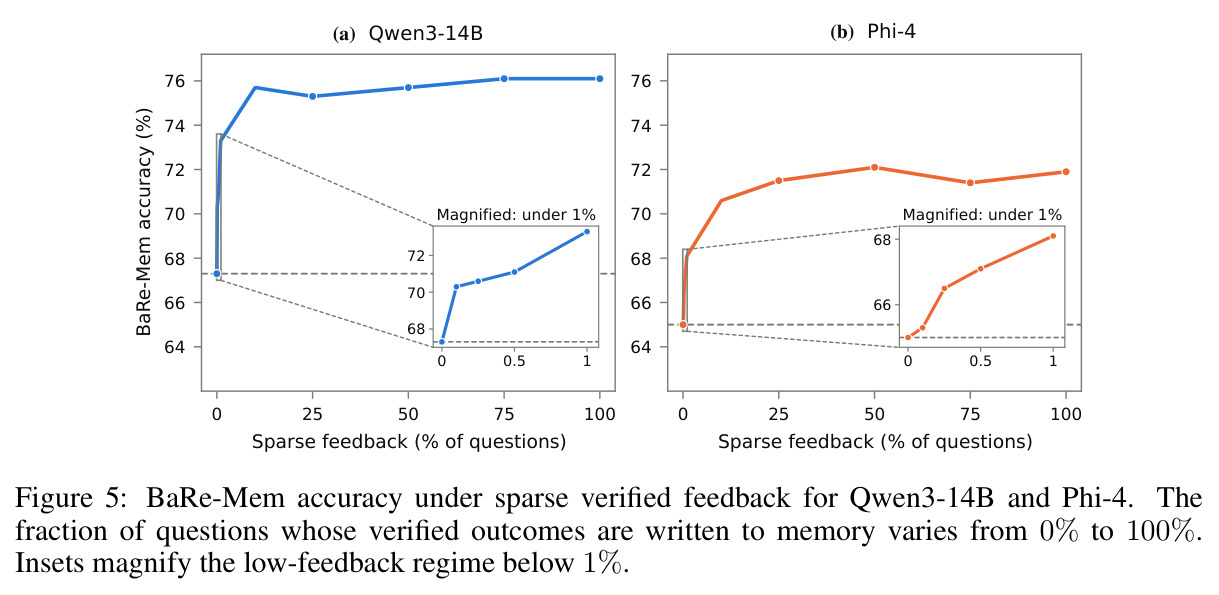
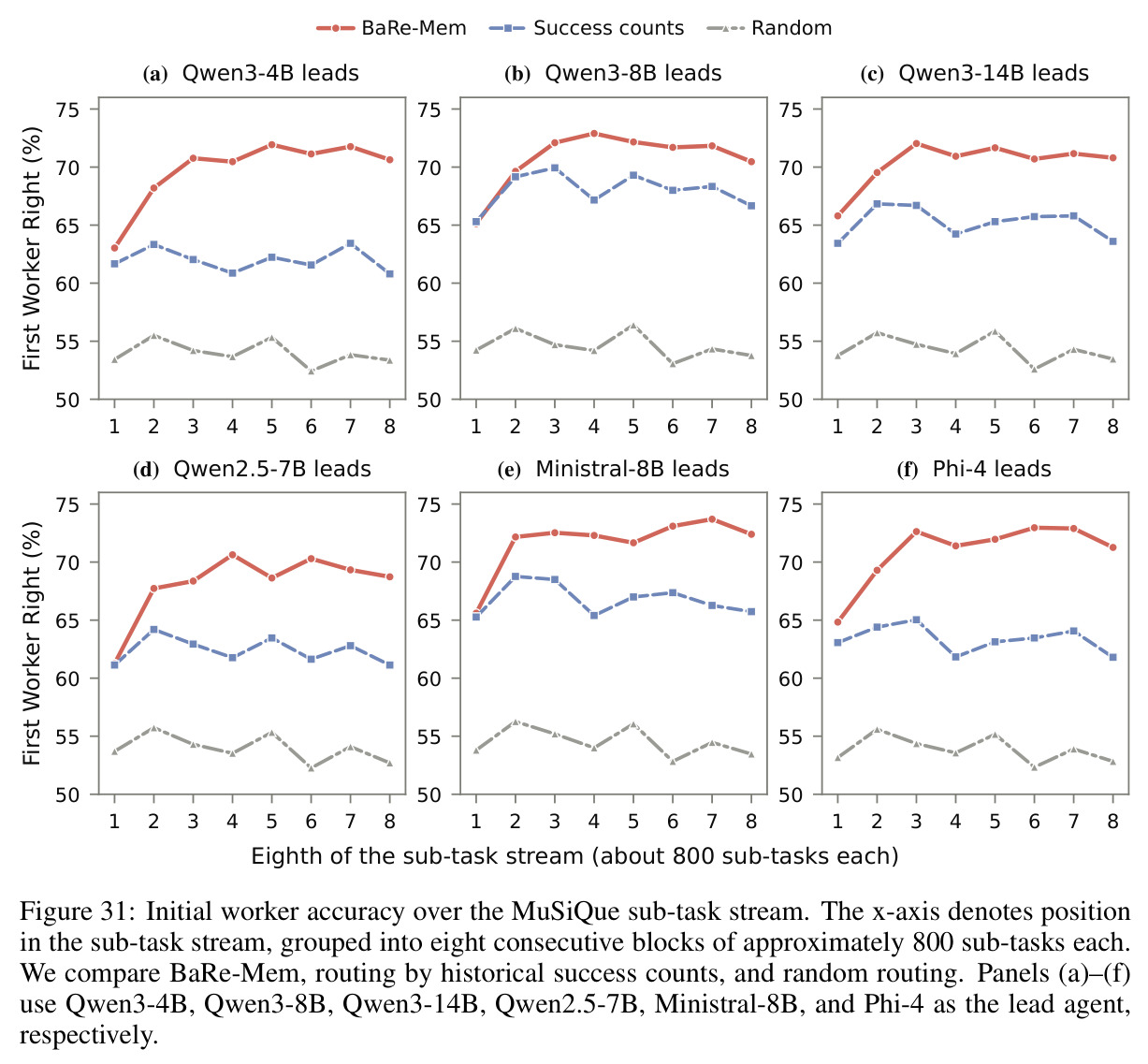
这是 BaRe-Mem 免训练、可在线扩展的数学核心;附录 A.2–A.4 专门推导它,Figure 5 的稀疏反馈效率与 Figure 31 的快速适应现象都由“早期增益大、后期增益小”这一性质解释。
注意力机制与 logit 修改
Transformer 注意力先算未归一化分数 $\langle Q,K_j\rangle/\sqrt{d}$,再经 softmax 归一化成权重。“logit 修改”指在 softmax 之前给某些 token 的分数加偏置,等效于按 $e^{\beta}$ 缩放其未归一化注意力,直接控制这些 token 对下游表征与输出影响的强弱。
BaRe-Mem 把可靠性落到模型行为上的接口正是式(7)的偏置 $\beta_{t,k}=\gamma\log(p_{t,k}/\max_{k'}p_{t,k'})$:理解这一接口才能明白“可靠性估计如何变成模型决策”,以及为何整个过程无需任何训练。
多智能体咨询范式
让一个中心 LLM 借助外部模型、工具或人类完成任务的组织方式。常见基线:Question+Peers(把顾问回答放进上下文)、Majority voting(候选答案投票)、Debate(多轮辩论后裁决)。这些方法默认外部信息总体有益,以等权或聚合方式融合意见。
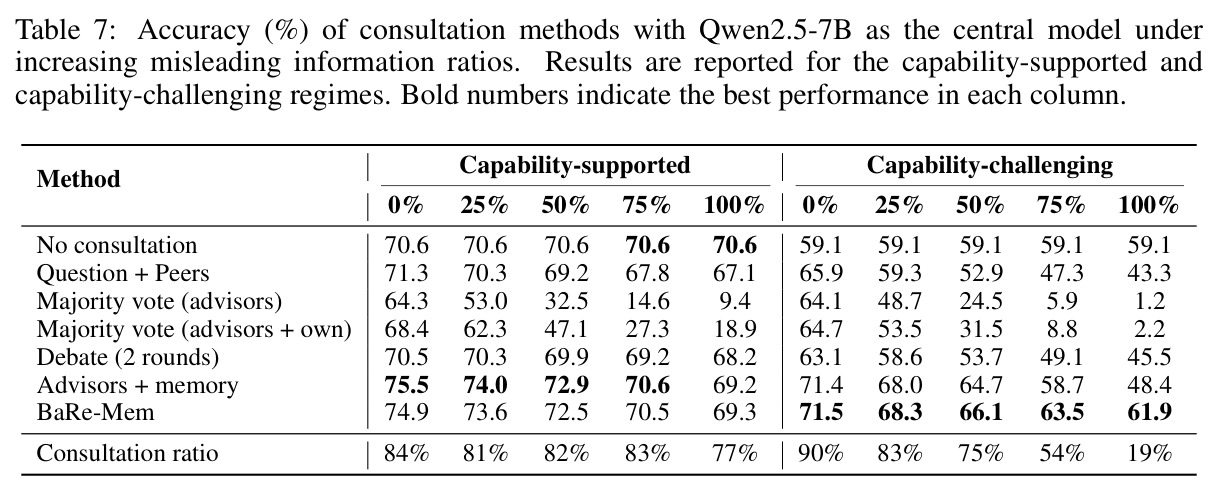
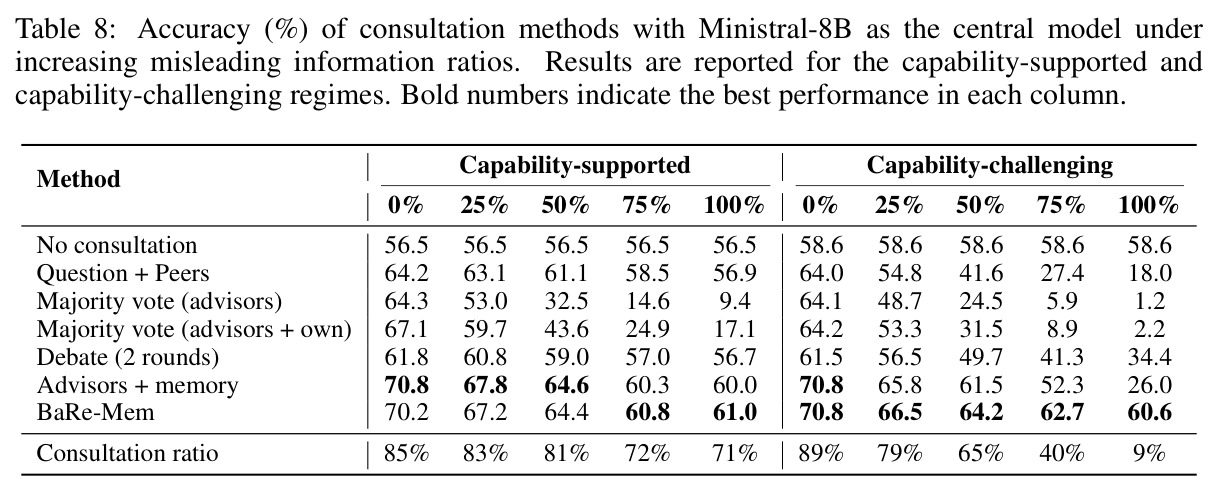
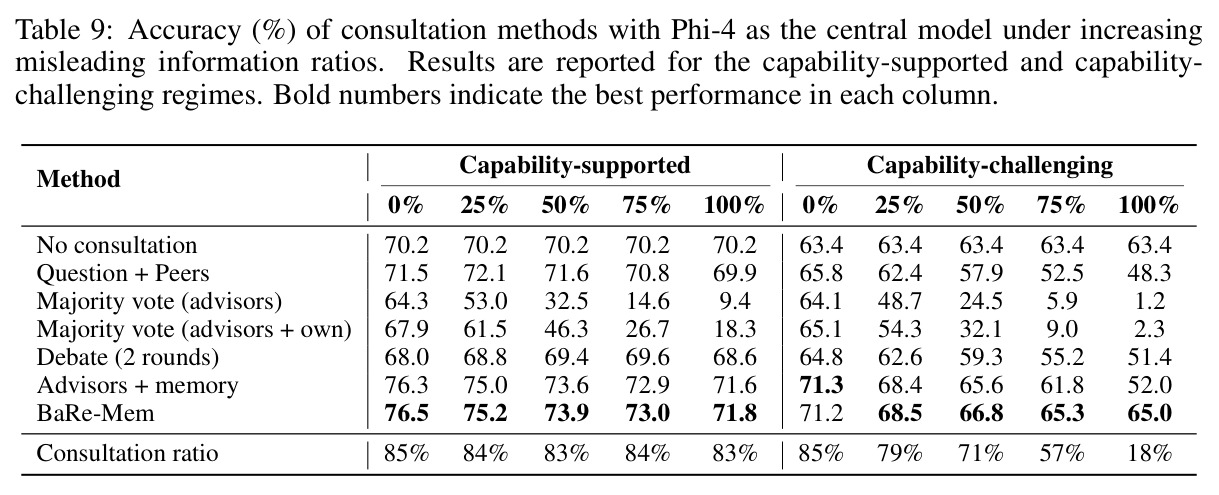
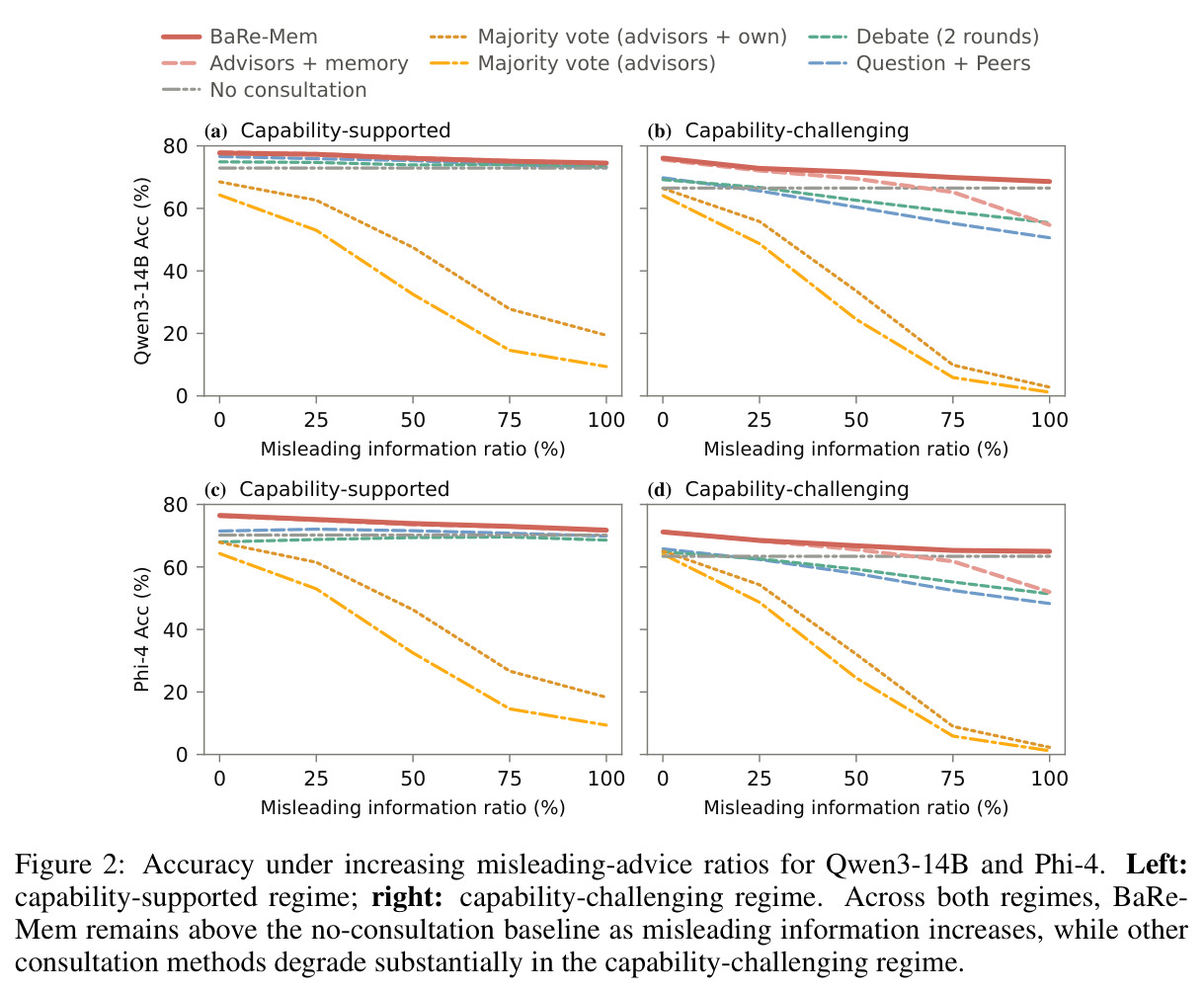
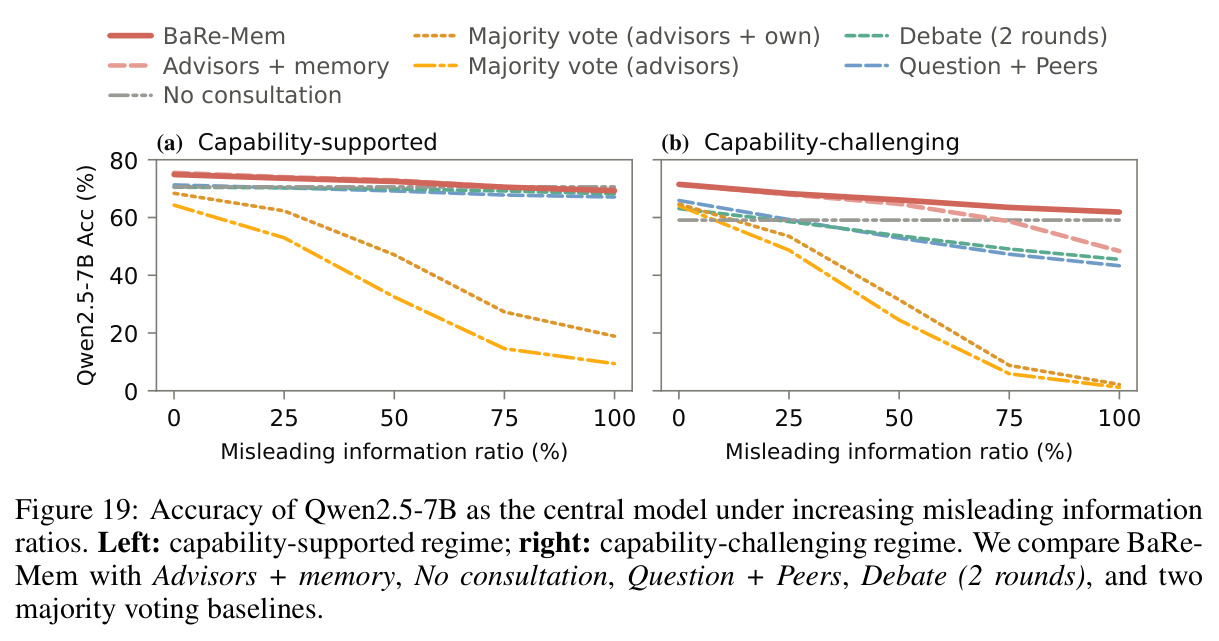
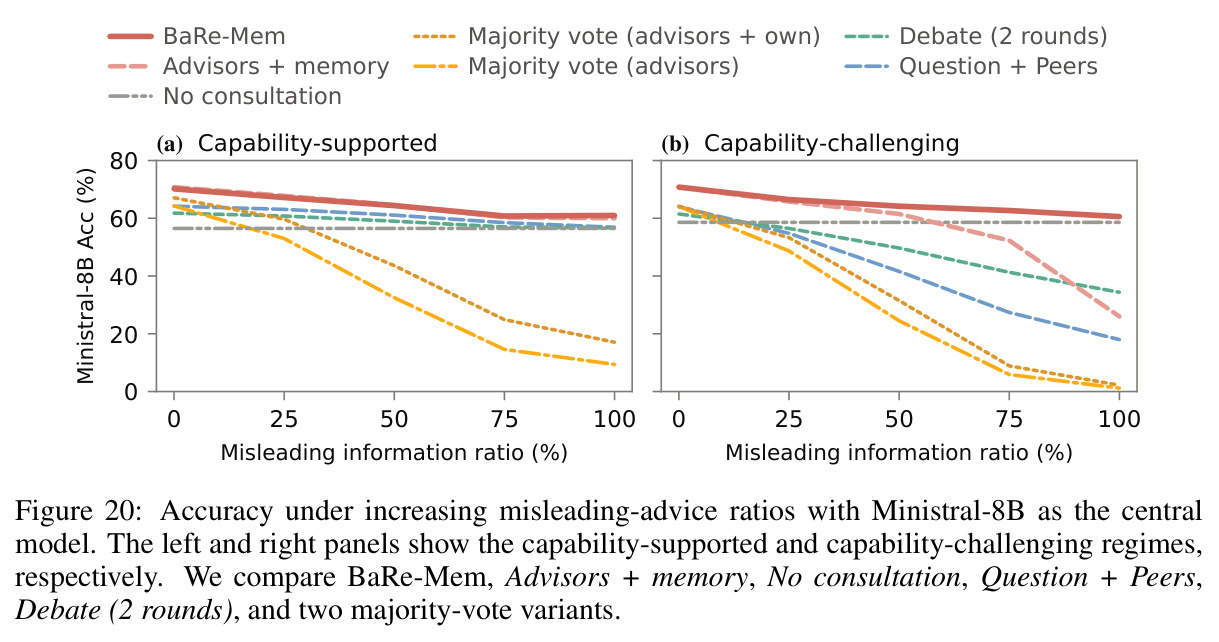
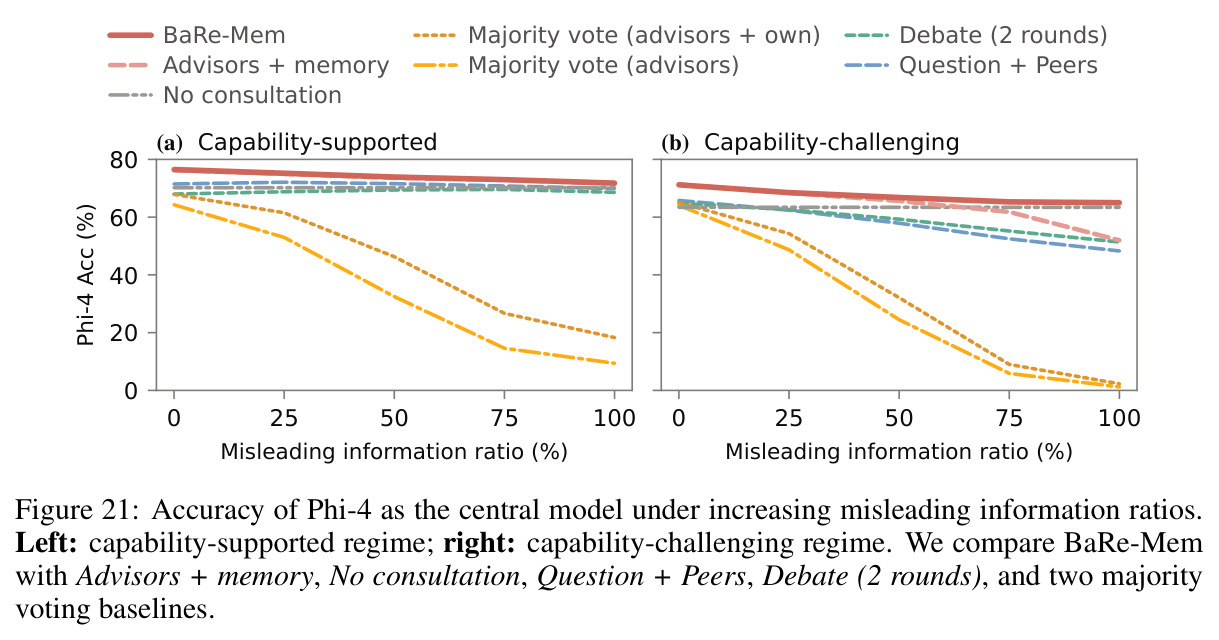
论文全部对照实验围绕这些基线展开,其核心卖点正是基线在误导信息下崩溃(多数投票在 100% 误导率下仅剩 9.4%/1.2%)而 BaRe-Mem 不崩;理解基线的失败模式才能读懂 Table 1 与 Figure 2。
校准(calibration)
指模型置信度与真实正确概率的一致程度:把置信约 0.8 的预测放在一起,若经验正确率也接近 0.8 则校准良好。常用“分组—实测”曲线检验,LLM 普遍存在过度自信问题。
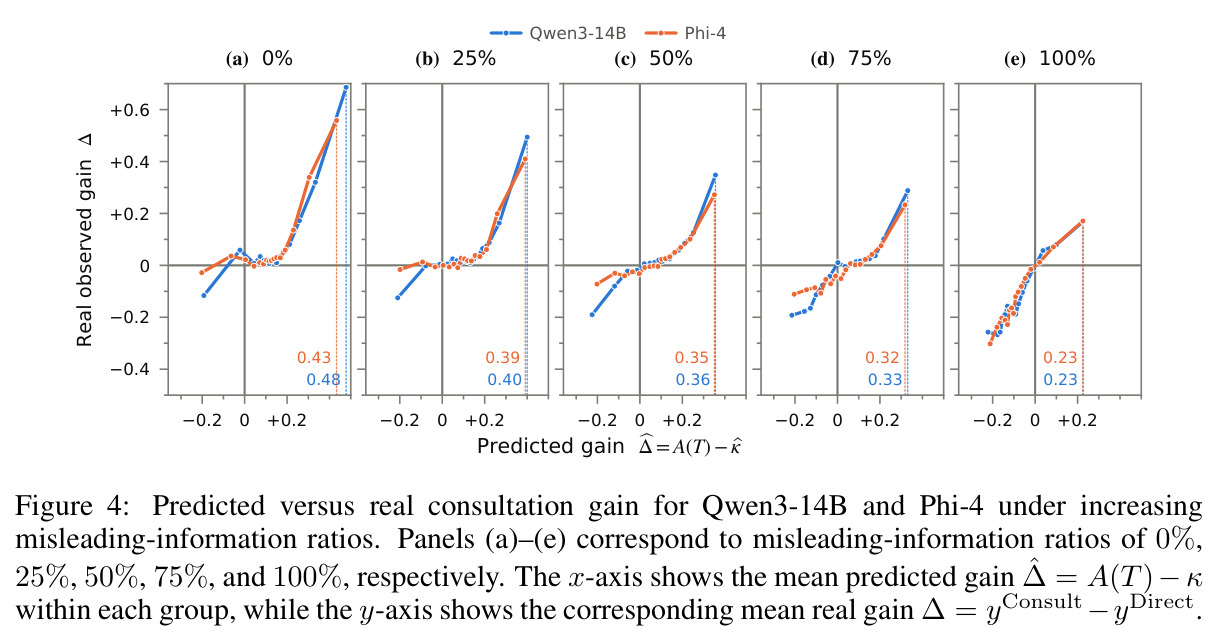
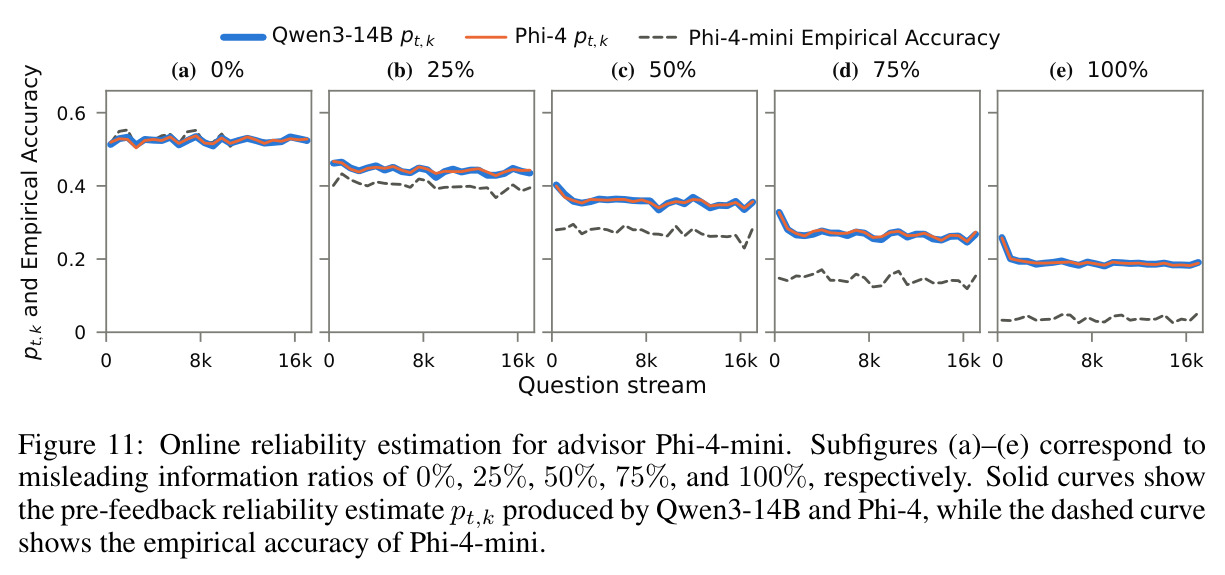
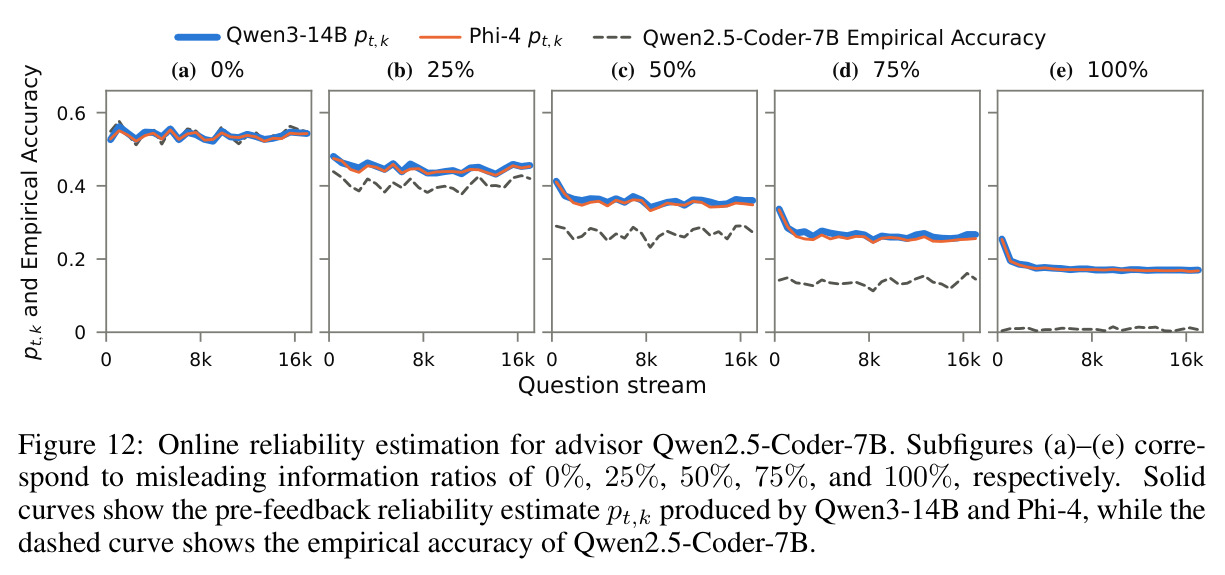
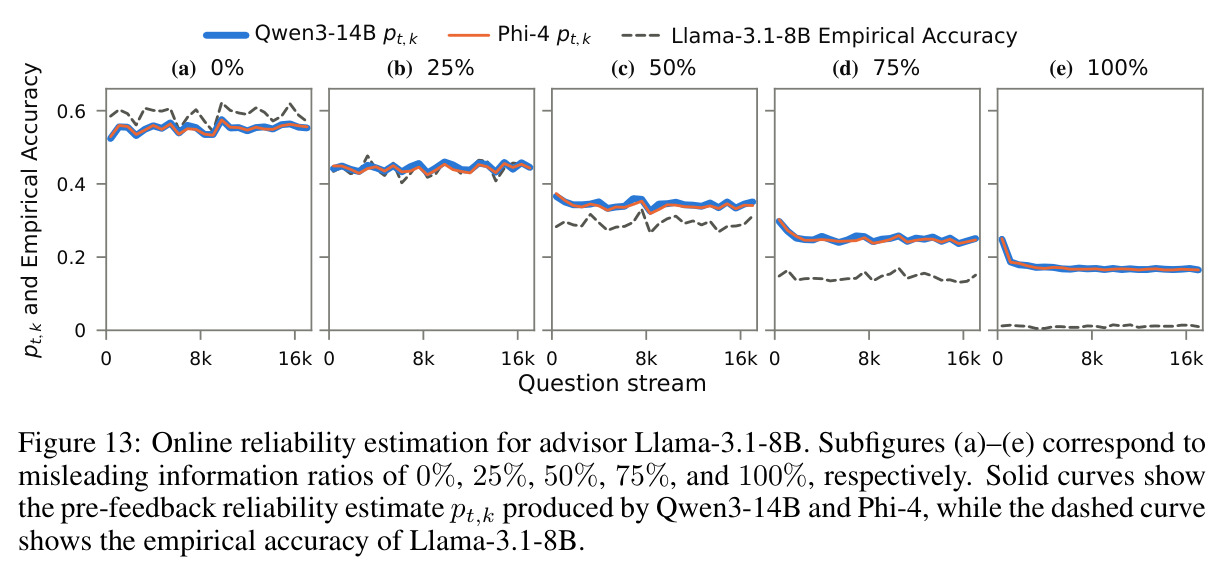
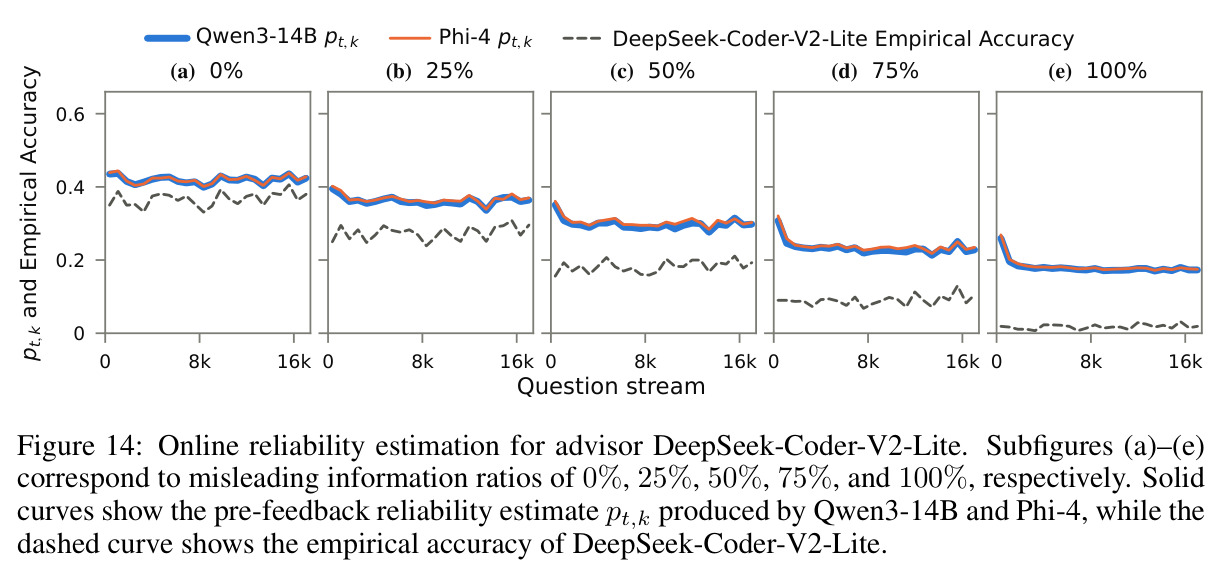
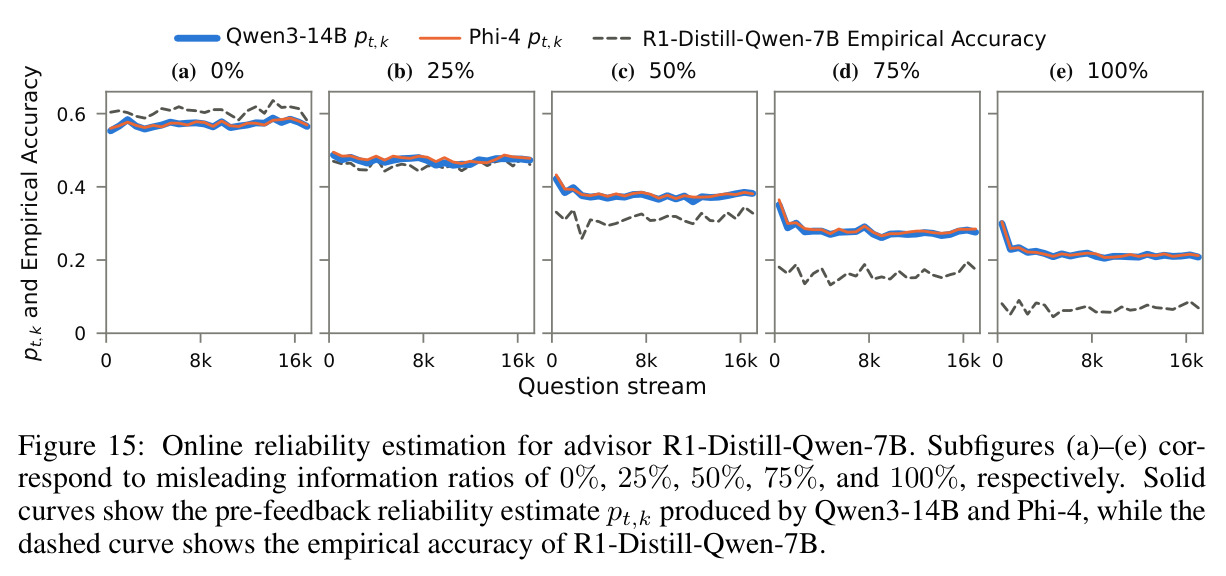
第 4.3 节两项诊断本质是校准分析:$\kappa$ 是否随经验自主准确率单调变化(Figure 3)、预测增益 $\hat{\Delta}=A(T)-\kappa$ 是否与实测增益过零对齐(Figure 4);附录 B.4 还指出高误导率下可靠性估计系统性偏高的校准缺口。
研究动机
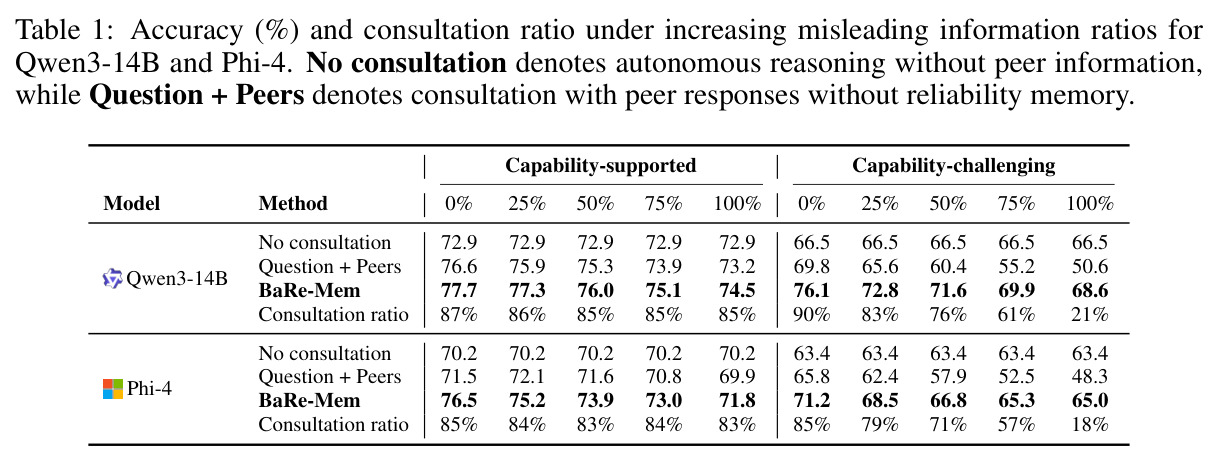
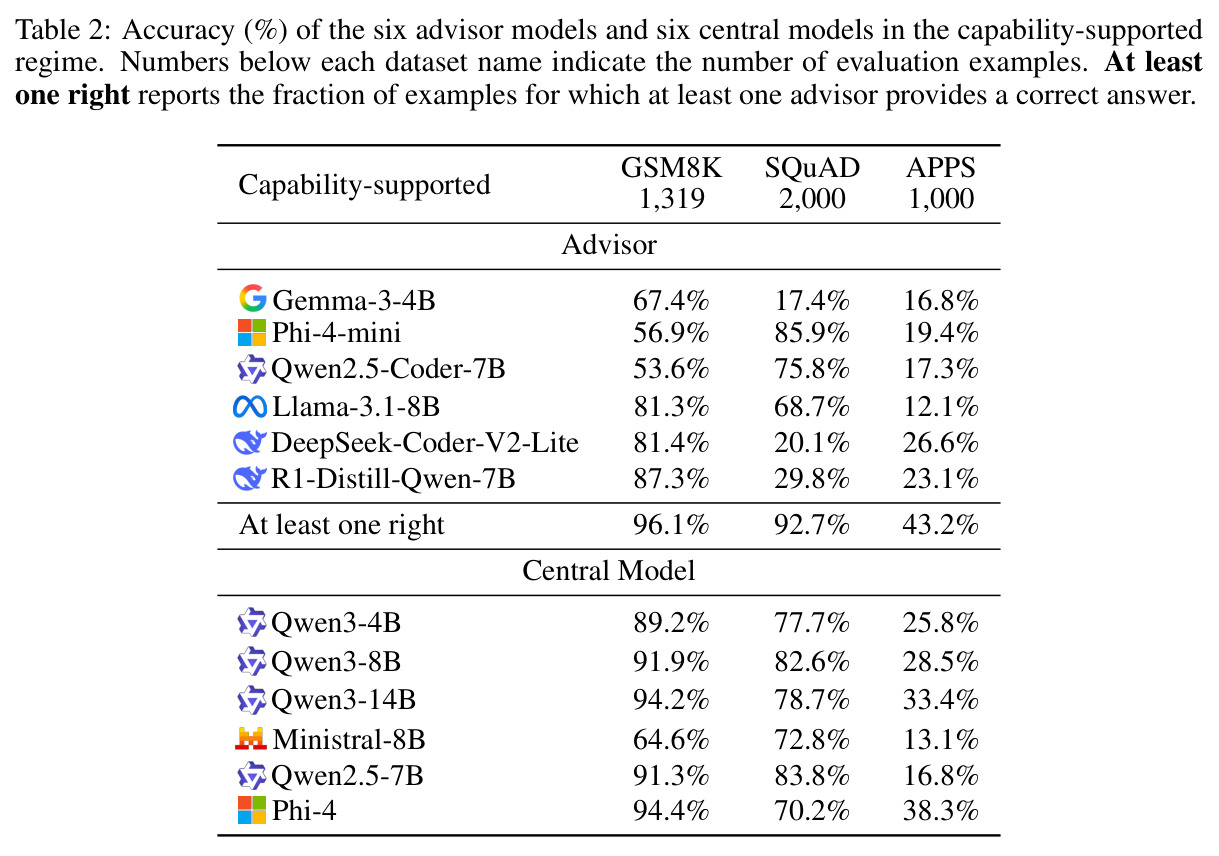
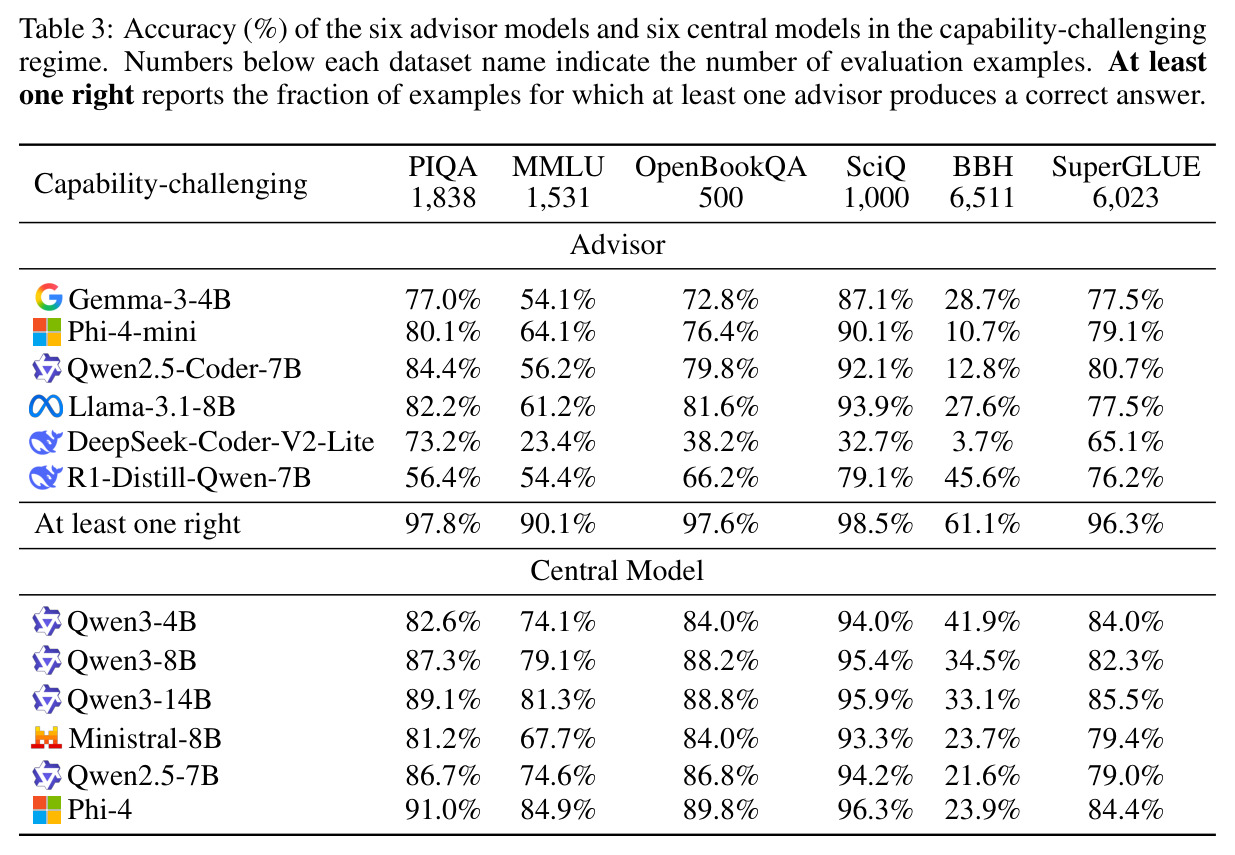
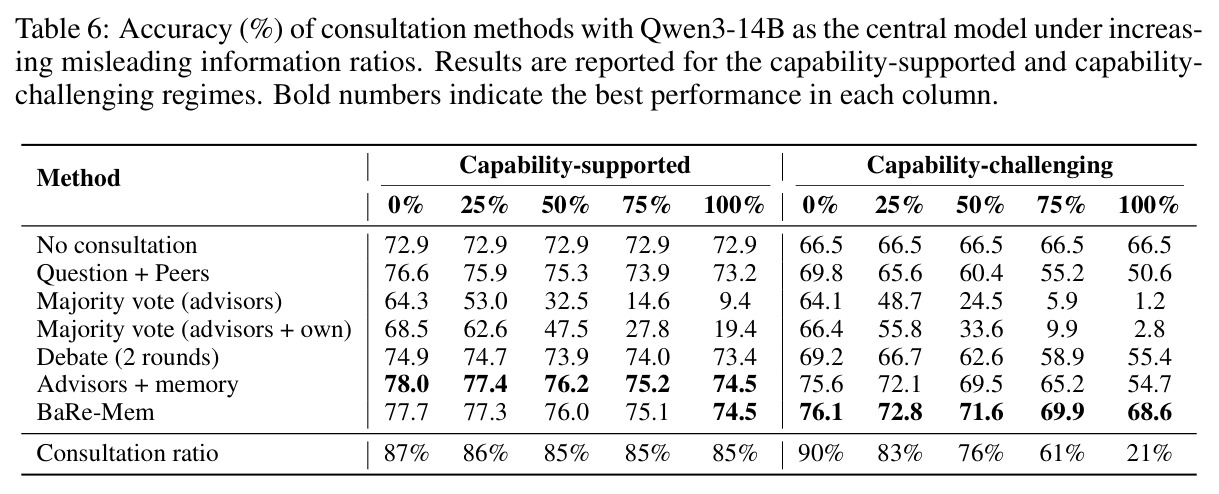
多智能体系统中,中心模型经常要“咨询”其他模型或服务,但咨询是双刃剑:已有研究表明模型暴露在误导性咨询下会放弃自己原本正确的答案,使咨询反而不如独立推理。论文用受控实验量化了问题:把一部分顾问回答替换成“流畅、切题但已验证错误”的误导回答后,在能力挑战型套件(PIQA/MMLU/OpenBookQA/SciQ/BBH/SuperGLUE)上,Question+Peers 与两轮 Debate 在误导率超过 50% 后双双跌破不咨询基线(Qwen3-14B:Question+Peers 从 69.8% 跌到 50.6%),只对顾问答案做多数投票更是从 64.1% 崩到 1.2%。根源在于顾问能力高度任务异质:DeepSeek-Coder-V2-Lite 在 PIQA 上有 73.2% 但 SciQ 只有 32.7%、BBH 仅 3.7%;R1-Distill-Qwen-7B 在 BBH 上 45.6% 却在 PIQA 上仅 56.4%。而现有记忆方法(文本轨迹、反思技能、隐状态记忆如 Titans/MemoryLLM)只会“存历史”,不会把历史转化为对当前问题上每个信息源可靠性的量化估计,更不会判断“该不该咨询”。
本文的目标是目标是构建一个在线贝叶斯可靠性记忆 BaRe-Mem,让中心模型在长期交互流中学会三件事:(1) 对当前问题上的每个顾问候选回答,估计“它有多大概率正确”的情境化可靠性;(2) 用该估计直接调制注意力,决定每个顾问回答对最终决策的影响强度;(3) 进一步比较“估计的咨询能力”与“估计的自主推理能力”,逐题决定到底要不要咨询。约束条件是:不引入任何可训练参数与梯度更新、记忆随任务流在线扩展、对误导信息鲁棒、能从稀疏的验证反馈中学习。作者还要求同一机制能迁移到智能体团队的 worker 分配(MuSiQue 路由),以验证“回答级咨询”之外的通用性,并希望可靠性估计(如 $\kappa$、预测增益)与真实统计量可校准、可解释。
与已有工作不同的是,切入角度有三点新意。第一,以往记忆工作保存的是“经验本身”——文本式如 Reflexion、ExpeL、Mem0、G-Memory,连续态式如 Titans、MemoryLLM、Memory Decoder、$\delta$-mem;BaRe-Mem 保存的是“对信息源可靠性的后验信念”,且该信念以中心模型对当前问题与候选回答的内部表征(question belief 与 answer content belief)为条件,即“在这个问题上、针对这个回答”的可靠性,而非全局平均成功率。第二,记忆落地接口选择直接修改注意力 logit(介于 prompt 条件化与参数适配之间的第三条路),因为逐顾问的可靠性估计天然对应“每个顾问回答该施加多大影响”,无需训练即可注入冻结模型。第三,多数工作只回答“信谁更多”,本文额外建模中心模型自身能力 $\kappa$ 与咨询能力 $A(T)$ 的比较,回答“要不要信外部”——在强模型协作收益递减甚至为负的背景下(Kim et al., 2026)这一点尤为关键。
核心方法
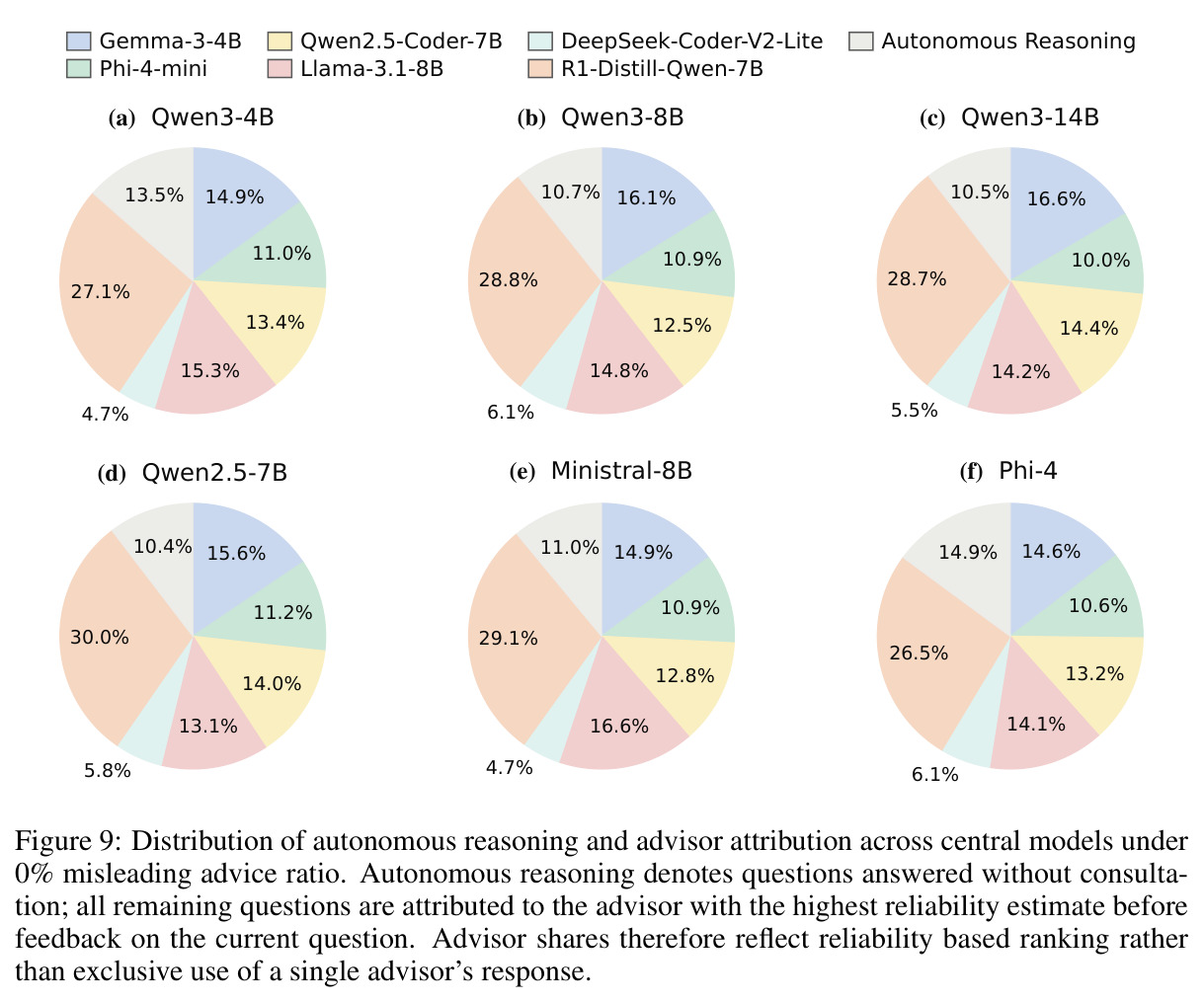
直觉上,BaRe-Mem 像一本“带不确定度的信任台账”:每当事后核实某个候选回答的对错就记一笔;对不熟悉的顾问或问题类型,早期证据影响大,随累积更新越来越保守。技术上分四步。首先,冻结的中心模型 $M$ 对问题 $q_t$ 编码 $K+1$ 个候选($K$ 个顾问回答加自主回答 $a_{t,0}$),导出共享的问题信念 $\psi_q^{(t)}$ 与每个候选的内容信念 $\psi_c^{(t,k)}$,拼上来源 one-hot 构成特征 $x_{t,k}$。其次,把验证得到的符号正确性 $s_{t,k}=2y_{t,k}-1$ 建模为 $s_{t,k}\sim\mathcal{N}(w^\top x_{t,k},1)$、先验 $w\sim\mathcal{N}(0,\lambda^{-1}I)$,用贝叶斯线性回归维护后验 $\mathcal{N}(m,\Lambda^{-1})$,并以 Kalman gain 做精确的秩一在线更新。第三,由后验算出候选正确概率 $p_{t,k}=\Phi(\mu_{t,k}/\sqrt{1+v_{t,k}})$ 并注入注意力 logit,按相对可靠性降权不可靠顾问。第四,另用一个二维贝叶斯回归在线学习 $\hat{\rho},\hat{\delta}$,比较 $A(T_t)$ 与 $\kappa_t$ 决定“咨询还是自主推理”。
核心创新是“以中心模型内部信念为条件的情境化可靠性 + 决策级咨询门控”。与历史成功计数这类全局统计不同,打分函数 $w^\top x_{t,k}=w_k^\top\psi_q^{(t)}+w_c^\top\psi_c^{(t,k)}+w_0$ 把可靠性分解为“该来源在此类问题上的可靠性”与“这个回答内容本身透露的可靠性”两项,使记忆能同时表达“顾问 A 擅长数学、顾问 B 擅长代码”与“这个回答内容就有问题”两类信号。与已有注意力调控(post-hoc attention steering、CRAM 等)的本质区别在于,偏置量完全由免训练的贝叶斯后验给出:最可靠顾问不动,其余按相对可靠性的对数比例缩放。与“总是咨询”的方法本质区别在于决策模型 $A(T)=T\rho+(1-T)(\kappa-\delta)$:信任度 $T_t=\max_k p_{t,k}$ 高时按可靠证据利用率 $\rho$ 计,低时按受损自主能力 $\kappa-\delta$ 计;由此导出闭式阈值 $T^*=\hat{\delta}/(\hat{\rho}+\hat{\delta}-\kappa_t)$——自主模型越强、误导伤害越大,所需信任门槛越高,行为可解释、可调控。
方法步骤详情
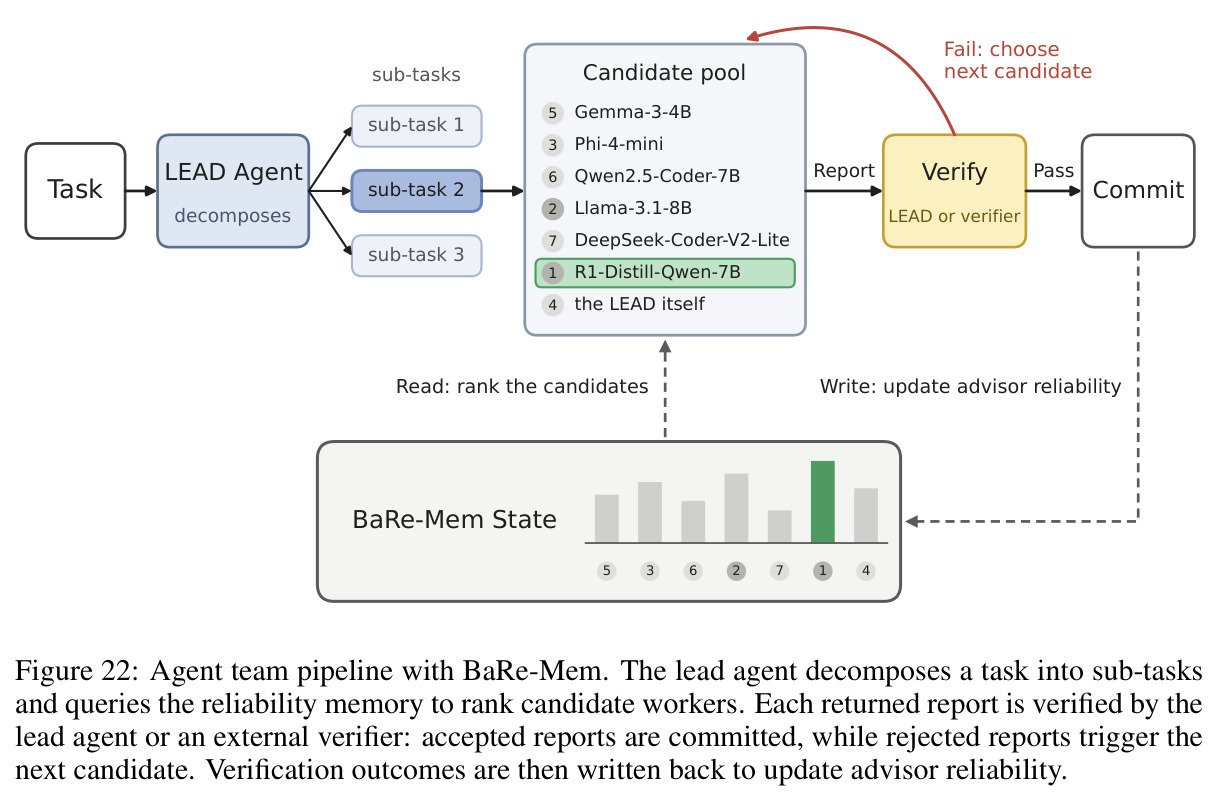
完整流程六步。第一步(表征):冻结中心模型 $M$ 在 $q_t$ 上下文中编码每个候选,取问题信念 $\psi_q^{(t)}$ 与候选内容信念 $\psi_c^{(t,k)}$,拼成 $x_{t,k}=[e_k\otimes\psi_q^{(t)};\,\psi_c^{(t,k)};\,1]$,$e_k$ 为来源 one-hot。第二步(可靠性读取):由后验计算 $\mu_{t,k}=x_{t,k}^\top m$、$v_{t,k}=x_{t,k}^\top\Lambda^{-1}x_{t,k}$,得 $p_{t,k}=\Phi(\mu_{t,k}/\sqrt{1+v_{t,k}})$;无证据时一切 $p=1/2$。第三步(注意力调制):在 softmax 全注意力层上对顾问 token 加 $\beta_{t,c(j)}=\gamma\log(p_{t,k}/\max_{k'}p_{t,k'})$,等效把该顾问的未归一化注意力按相对可靠性缩放。第四步(生成与验证):中心模型产出回答,事后核实各候选正确性 $y_{t,k}$。第五步(记忆写入):用 Kalman gain 秩一更新 $m$ 与 $\Lambda^{-1}$,与批后验完全一致、顺序无关。第六步(咨询决策):取 $\kappa_t=p_{t,0}$、$T_t=\max_k p_{t,k}$,用二维贝叶斯回归从历史 $(T_s,\kappa_s,y_s)$ 学 $\hat{\rho},\hat{\delta}$,若 $A(T_t)\ge\kappa_t$ 则咨询否则自主推理。MuSiQue 团队场景中,同一记忆改为给候选 worker 排序并决定验证失败后的重试顺序。
技术新颖性
新颖性有五点。(1) 记忆对象是“可靠性后验”而非经验文本或隐状态,且明确以中心模型的内部信念表征为条件,这在相关工作中是首次出现。(2) 数学上保证“在线=批量”:秩一更新加 Kalman gain(附录 A.2 证明它是条件均方误差最小意义下的最优增益)使后验与一次性批处理完全相同,且对固定证据集顺序不变(A.4 的次序无关性),这是多数启发式经验记忆不具备的性质。(3) 零训练成本:注意力调制只是在 logit 上加一个标量偏置,无可学习参数、无需反传,可直接套在冻结模型上,工程上即插即用。(4) 把“是否咨询”形式化为两个可在线估计量 $A(T_t)$ 与 $\kappa_t$ 的比较,给出闭式阈值及单调性($\partial T^*/\partial\kappa>0$、$\partial T^*/\partial\hat{\delta}>0$、$\partial T^*/\partial\hat{\rho}<0$,A.7),并配套错误侧决策的代价刻画(A.8)。(5) 机制可迁移:同一记忆从“回答重加权”平移到“worker 路由”,只需把候选从回答换成工人,说明这是原理层面的通用机制而非任务特定技巧。
实验结果
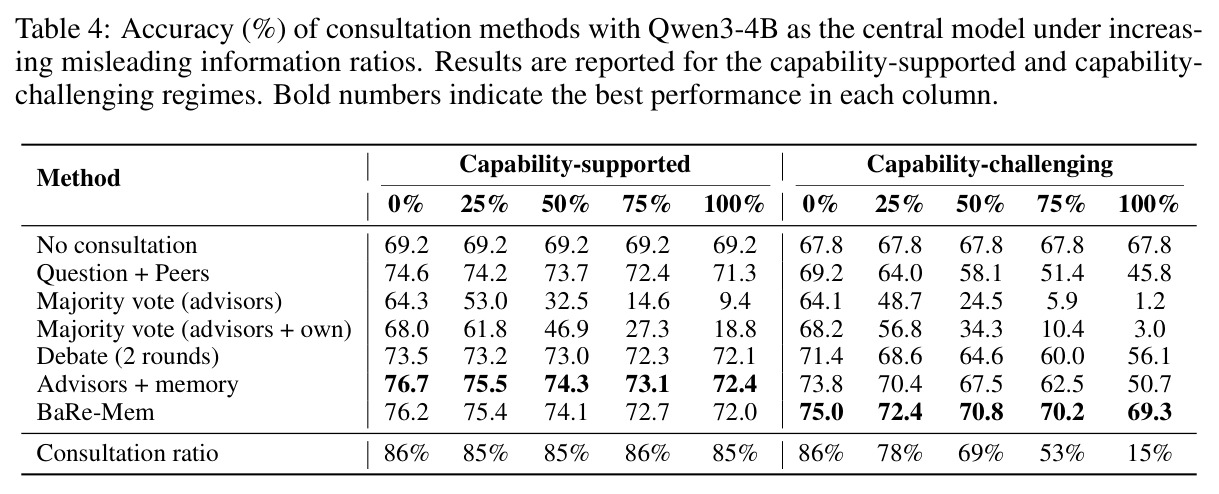
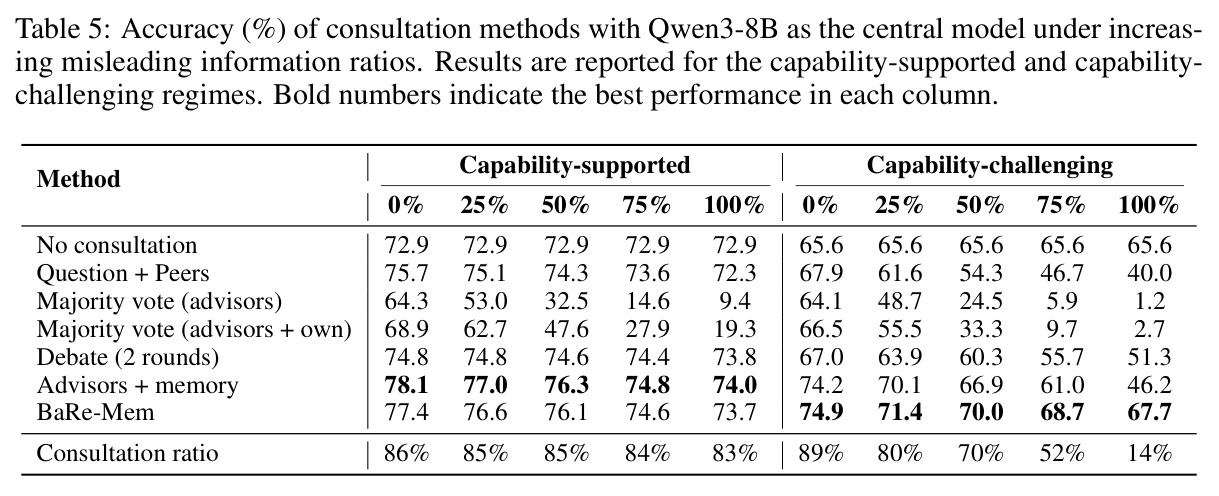
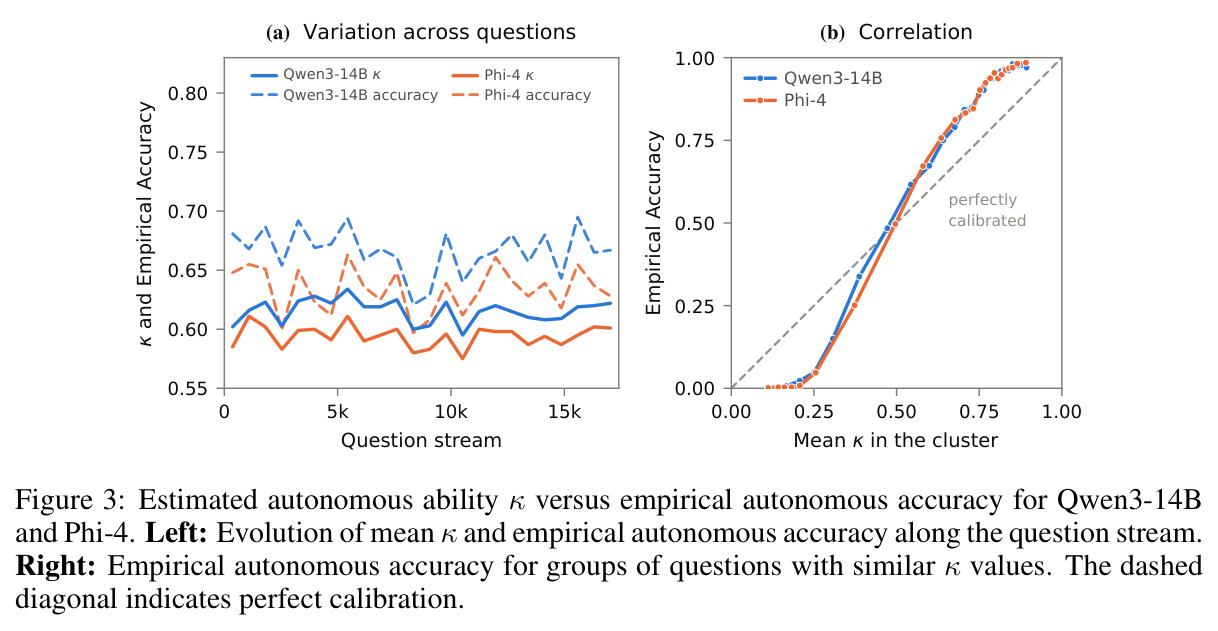
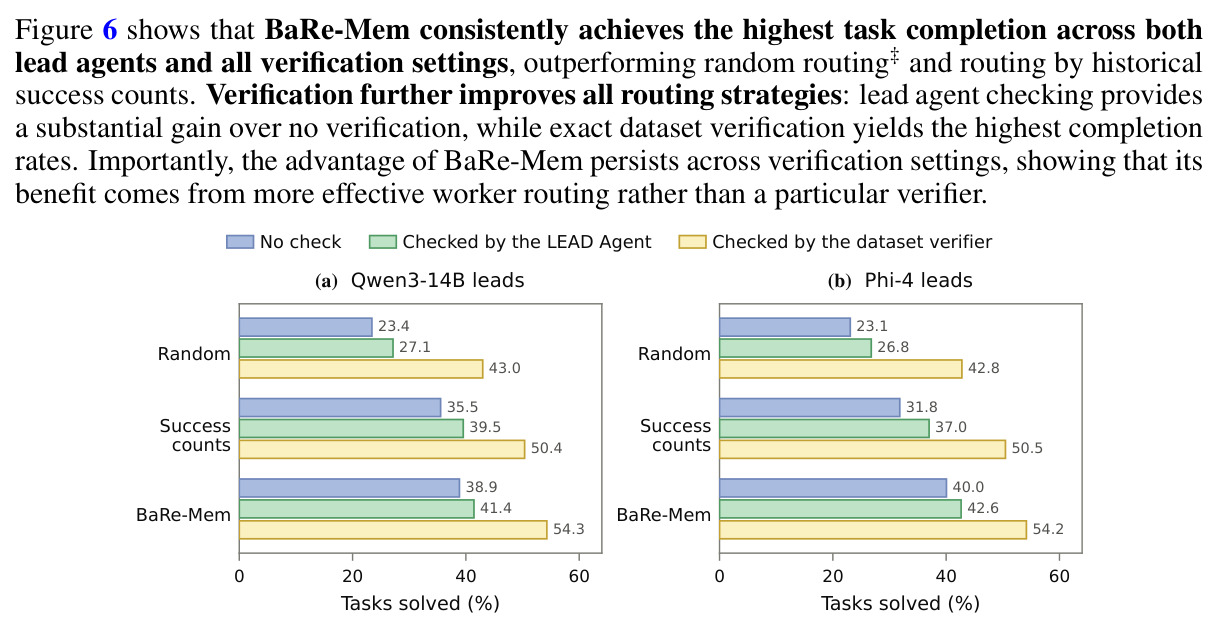
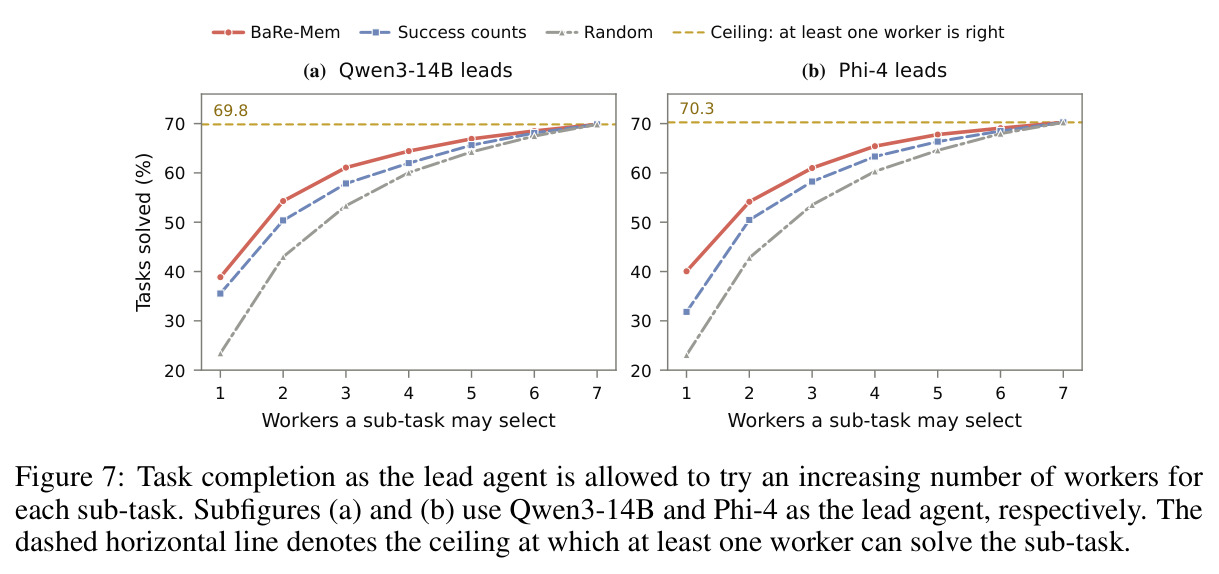
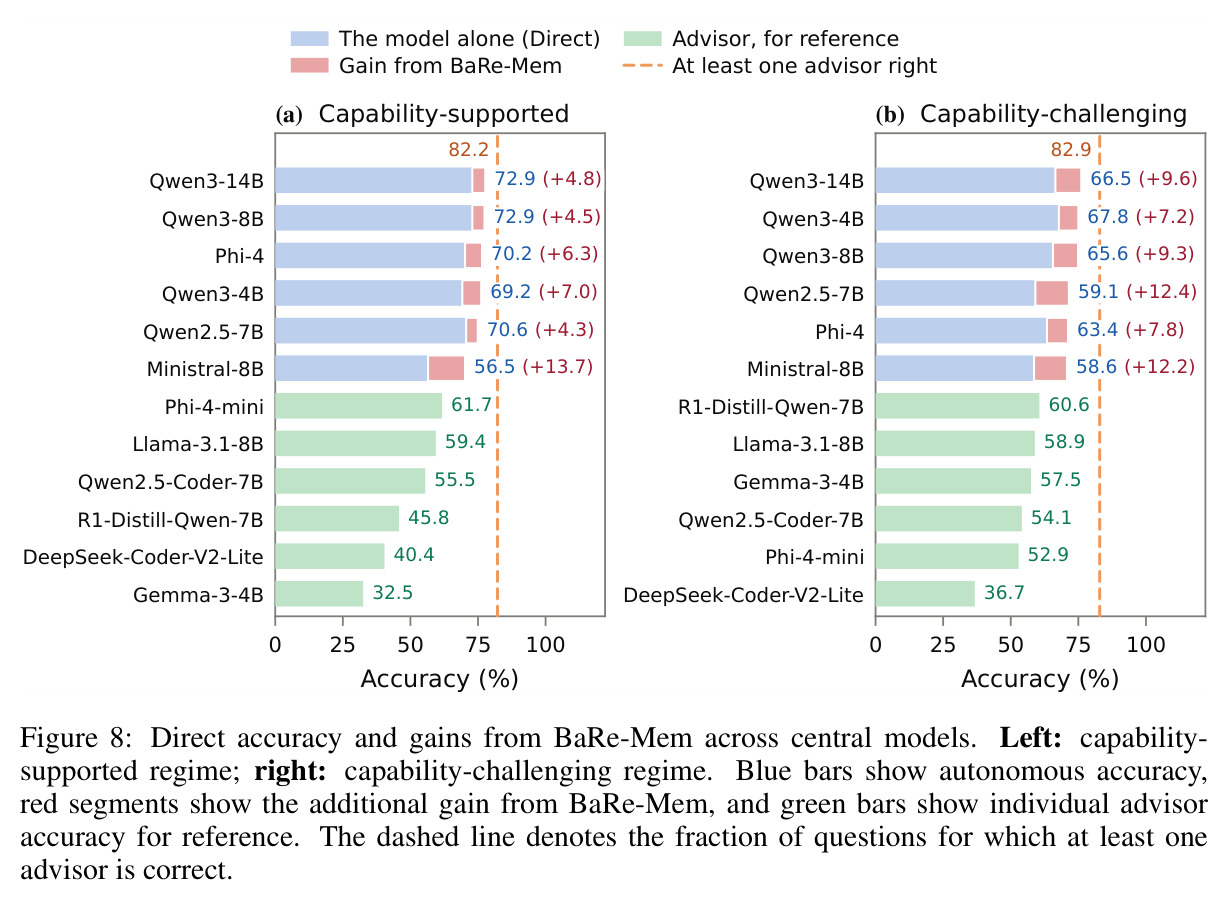
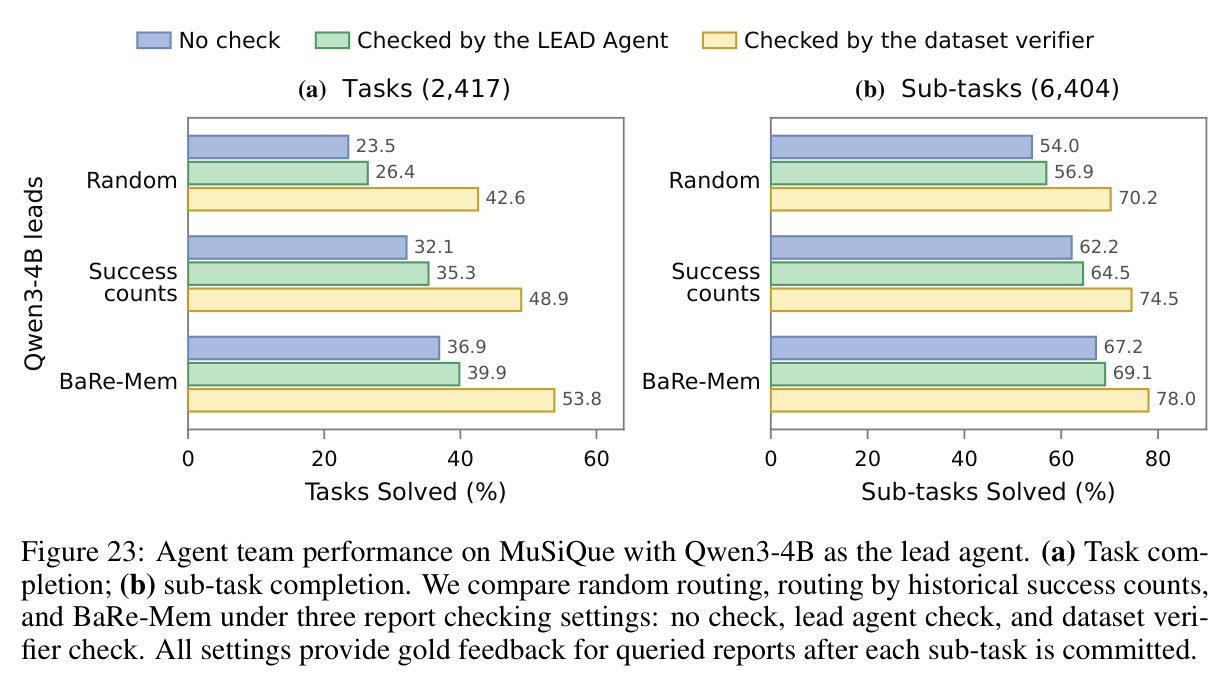
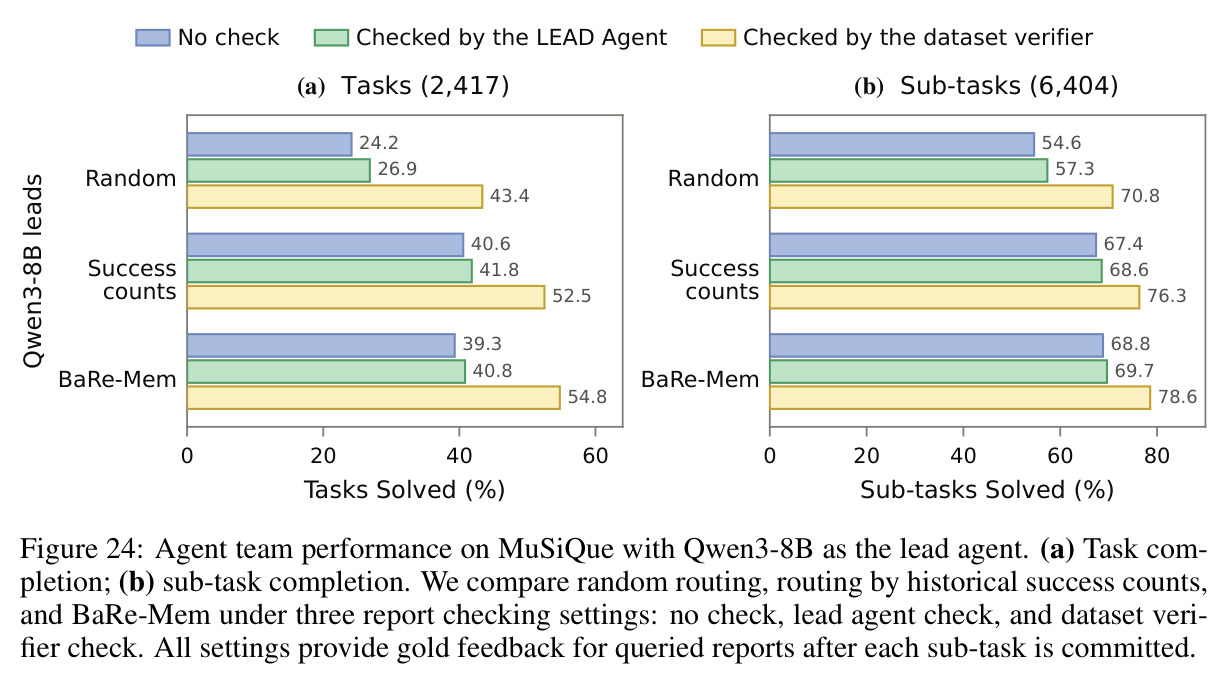
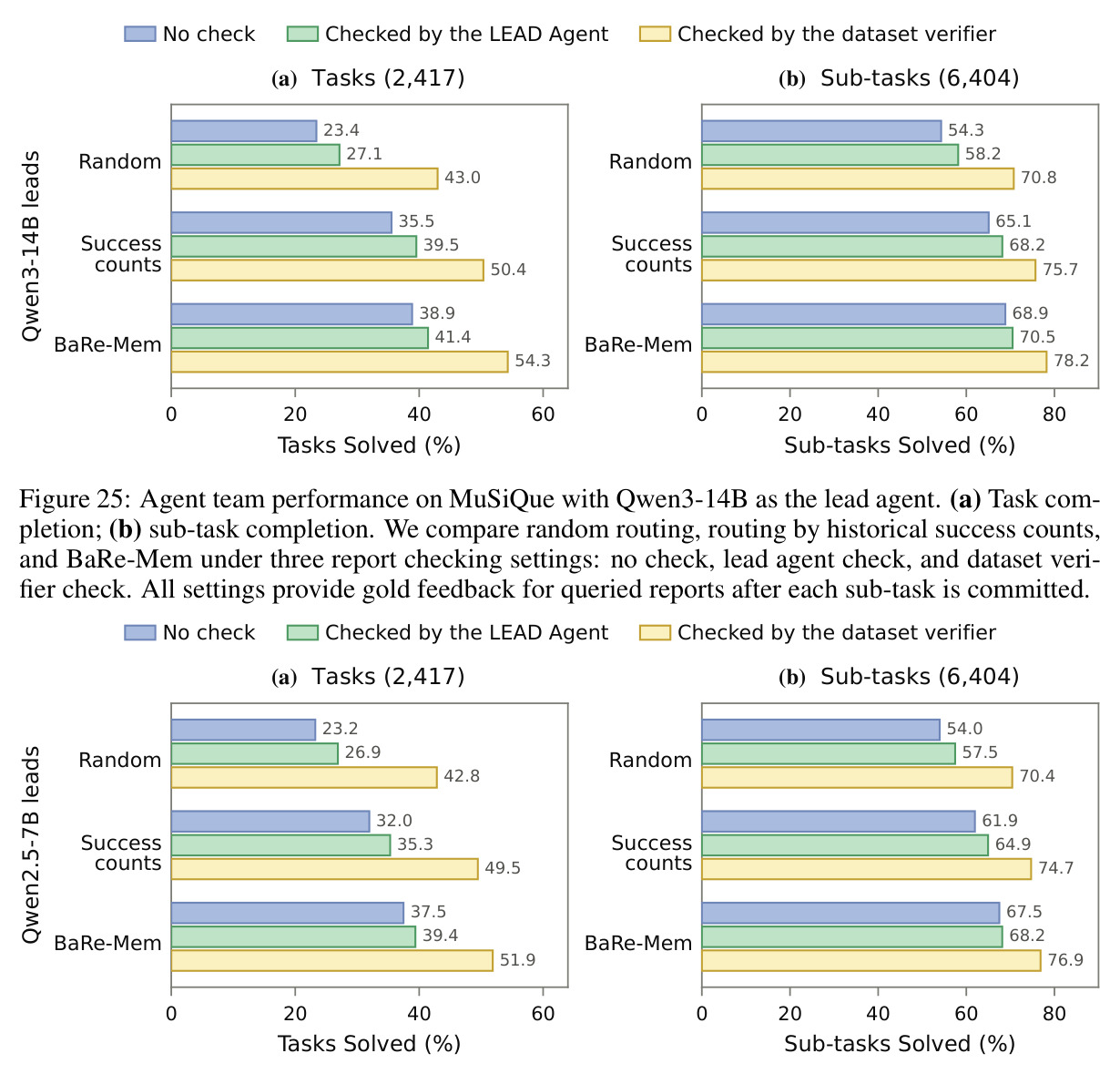
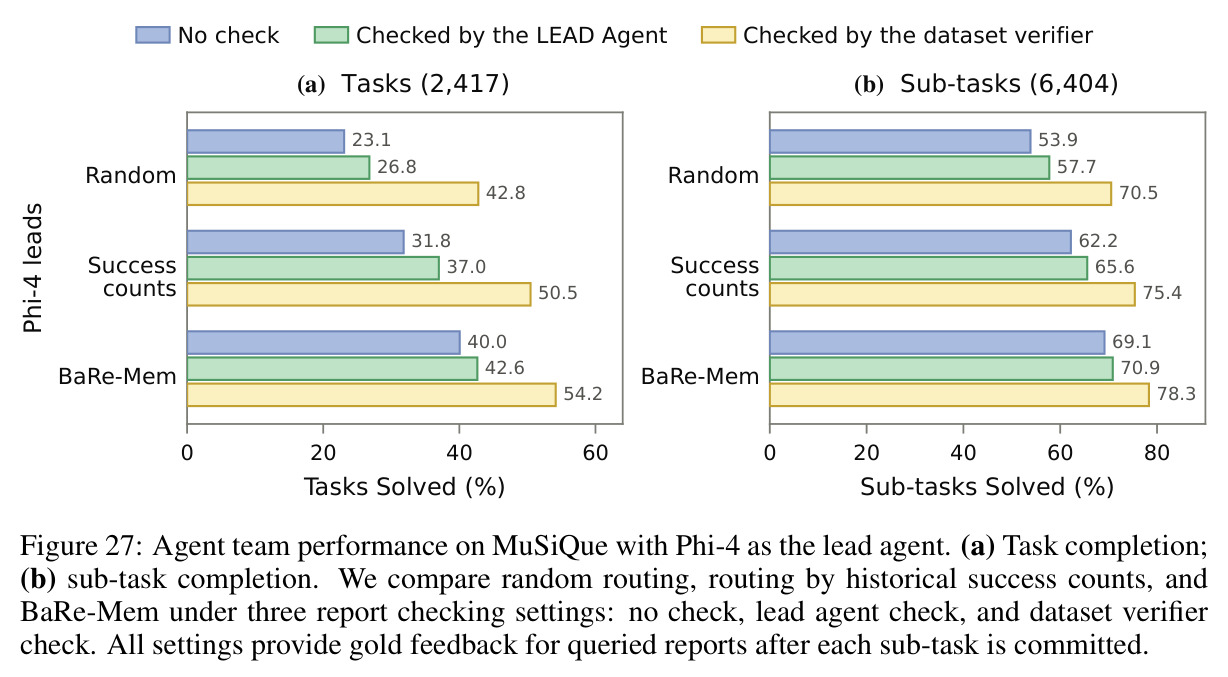
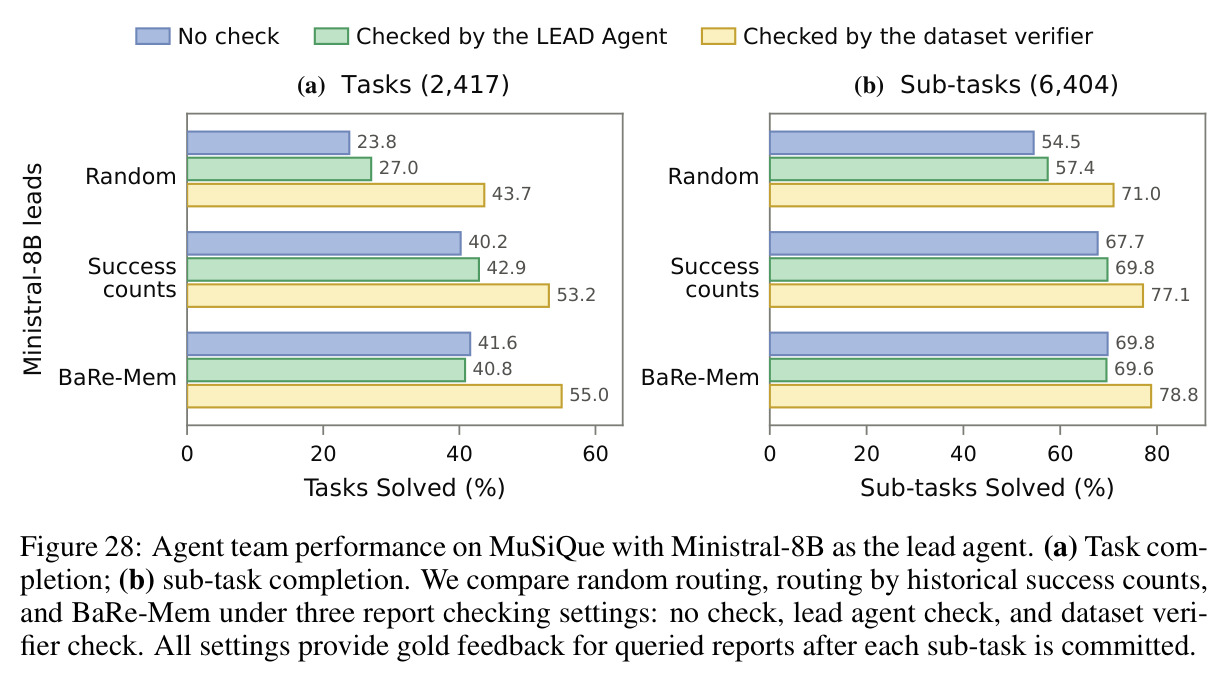
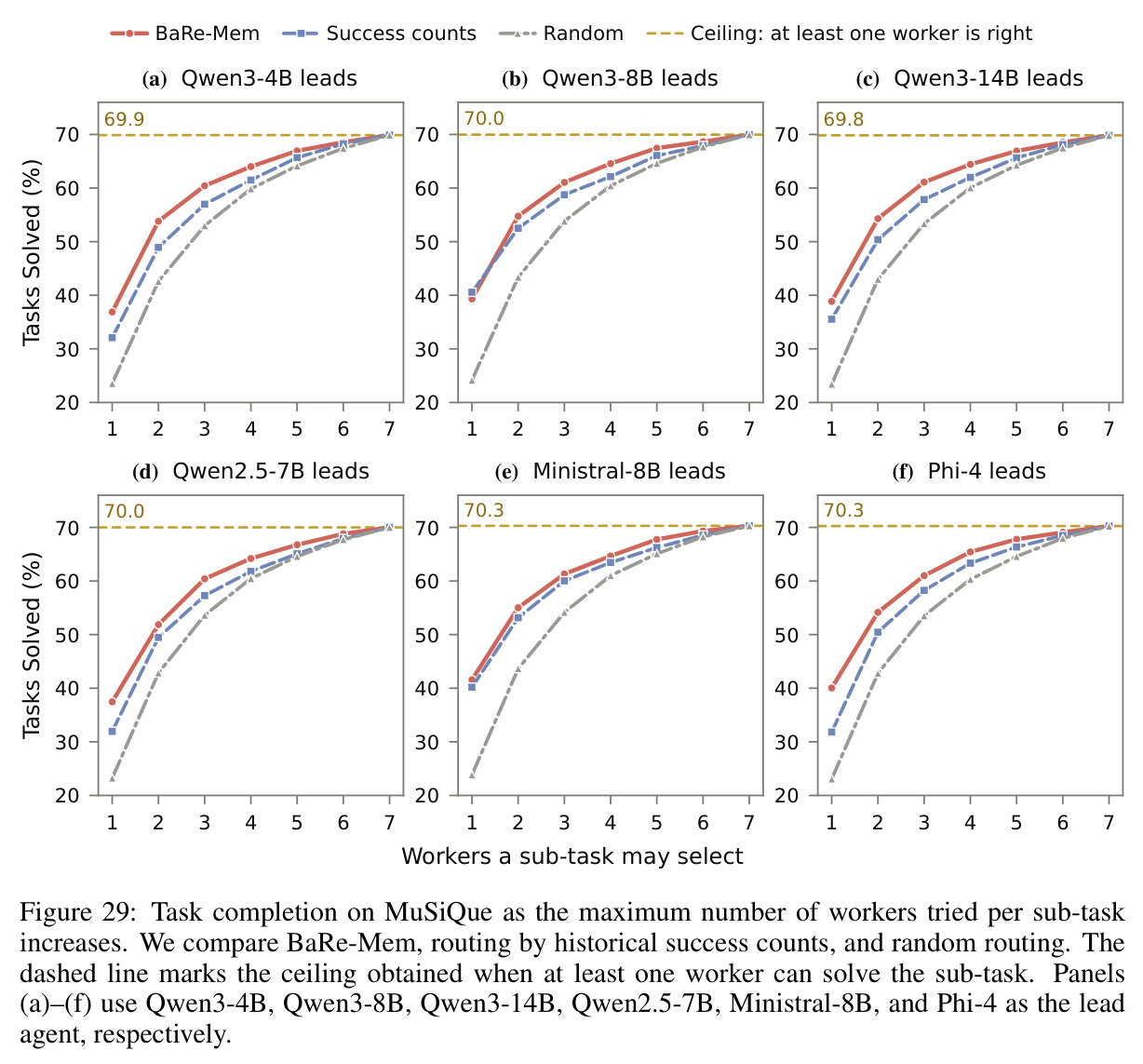
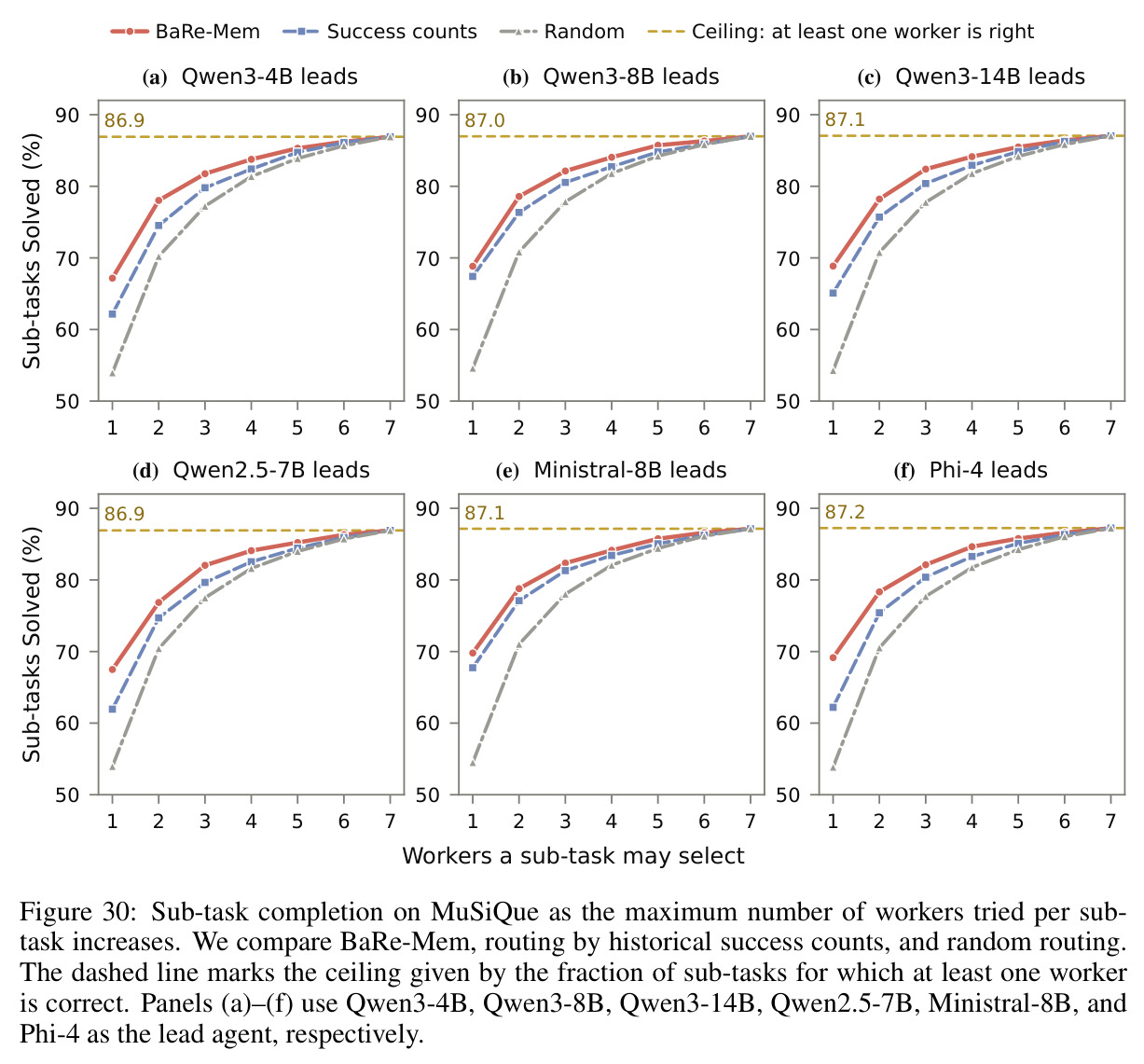
实验覆盖 9 个基准、6 个顾问、6 个中心模型,分能力支持型(GSM8K/APPS/SQuAD)与能力挑战型(PIQA/MMLU/OpenBookQA/SciQ/BBH/SuperGLUE)两套件,人为将 0–100% 的顾问回答替换为已验证错误的误导回答。(1) 鲁棒性:挑战型套件上 Question+Peers 与 Debate 在误导率超 50% 后跌破不咨询基线(Qwen3-14B:69.8%→50.6%),多数投票 100% 时仅 9.4%;BaRe-Mem 全程高于自主推理(100% 时 68.6% 对 66.5%),支持型仅从 77.7% 微降到 74.5%,Phi-4 同样(挑战型 65.0% 对 63.4%)。(2) 消融:只保留可靠性注意力的 Advisors+memory 在 50% 误导率的挑战型套件上比 Question+Peers 高 7.7–19.9 个百分点,但 100% 时仍跌破自主基线;BaRe-Mem 的咨询门控再抬高 13.0–34.6 个百分点,稳定高于自主 1.5–2.8 点。(3) 行为证据:挑战型套件咨询率从 90% 降到 21%(Qwen3-14B)/18%(Phi-4),支持型几乎不变(87%→85%),说明模型真的“该问才问”。(4) 校准诊断:$\kappa$ 与经验自主准确率单调一致(Figure 3);预测增益与实测增益在 $\hat{\Delta}=0$ 附近过零(Figure 4);不足 1%(约 170 条)验证反馈即现增益(Figure 5)。(5) 普适性:六中心模型增益为挑战型 +7.2~+12.4 点、支持型 +4.3~+13.7 点。(6) MuSiQue 团队路由:数据验证器设置下任务完成率 51.9–55.0%,超成功计数 1.8–4.9 点、超随机 9.1–11.4 点;更少 worker 调用即逼近同一上限,且前 800 个子任务内完成主要学习。
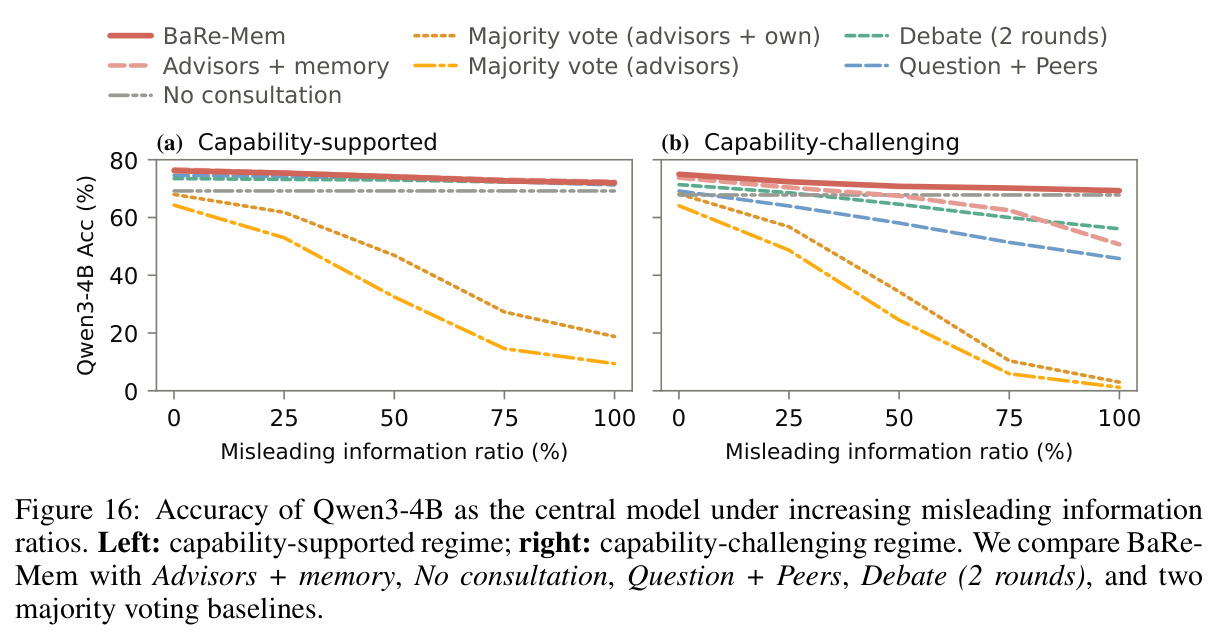
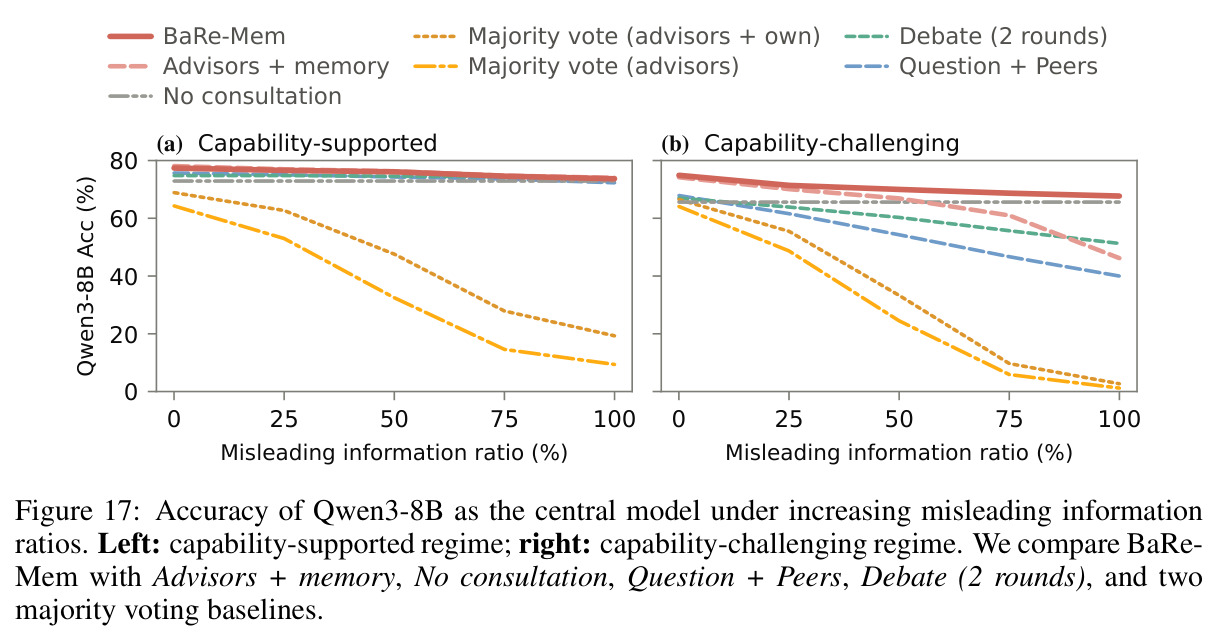
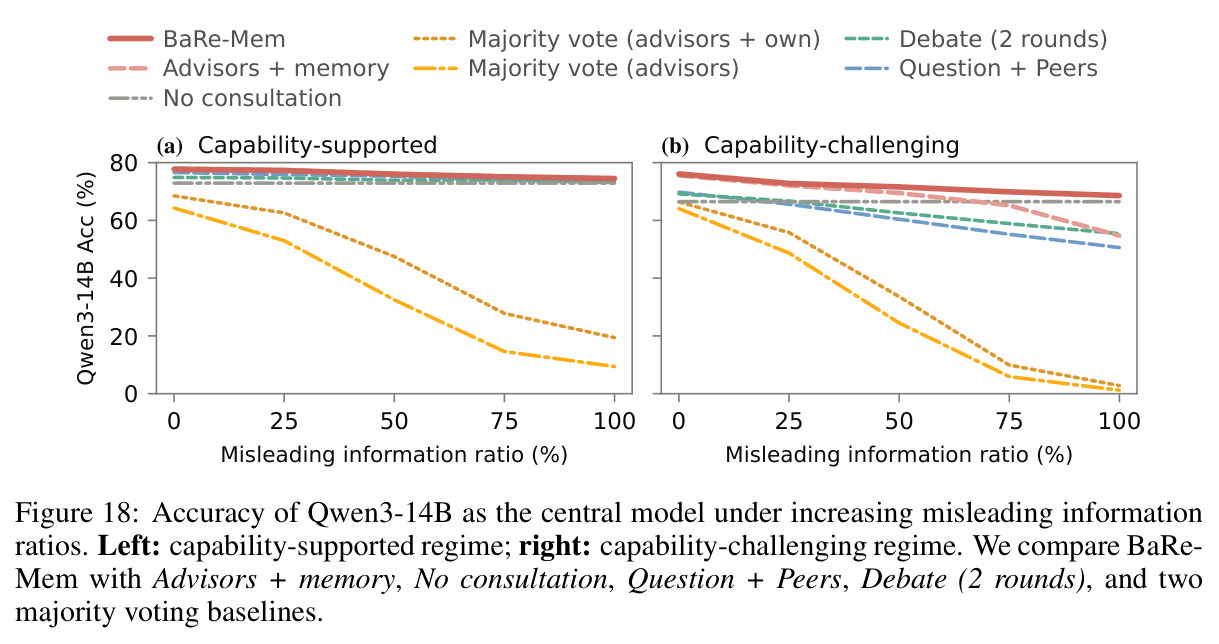
查看结构化数据
| 任务 | 指标 | 本文 | 基线 | 提升 |
|---|---|---|---|---|
| 能力挑战型套件(6 数据集混合,Qwen3-14B 为中心模型) | 误导率 100% 下的准确率 (%) | 68.6(咨询率降至 21%) | Question+Peers 50.6 / Debate(2轮) 55.4 / 多数投票 2.8 / 不咨询 66.5 | 较不咨询 +2.1,较朴素咨询 +18.0 |
| 能力支持型套件(GSM8K+APPS+SQuAD,Qwen3-14B) | 误导率 100% 下的准确率 (%) | 74.5 | 不咨询 72.9 / Question+Peers 73.2 | +1.6 / +1.3 |
| 全部六个中心模型 · 能力挑战型套件 | 相对自主推理的准确率增益(百分点) | +7.2 ~ +12.4 | 各模型自身 No consultation | 最大 +12.4(Qwen2.5-7B),最小 +7.2(Qwen3-4B) |
| 50% 误导率 · 挑战型套件 · 可靠性注意力消融 | Advisors+memory 相对 Question+Peers 的提升(百分点) | +7.7 ~ +19.9 | Question+Peers(无记忆等权咨询) | Ministral-8B 最大 +19.9;六模型全部为正 |
| MuSiQue 智能体团队(Qwen3-14B 为 lead,数据集验证器检查) | 任务完成率 (%) | 54.3 | 历史成功计数 50.4 / 随机路由 43.0 | +3.9 / +11.3 |
| MuSiQue 无检查初始分配(Phi-4 为 lead) | 任务完成率 (%) | 42.6 | 历史成功计数 37.0 / 随机路由 23.1 | +5.6 / +19.5 |
| 稀疏验证反馈(Qwen3-14B / Phi-4) | 写入记忆的验证样本占比 | 不足 1%(约 170 条)即显著超过零反馈设置 | 0% 反馈 | 低反馈区即现增益,随后快速饱和 |
局限与改进
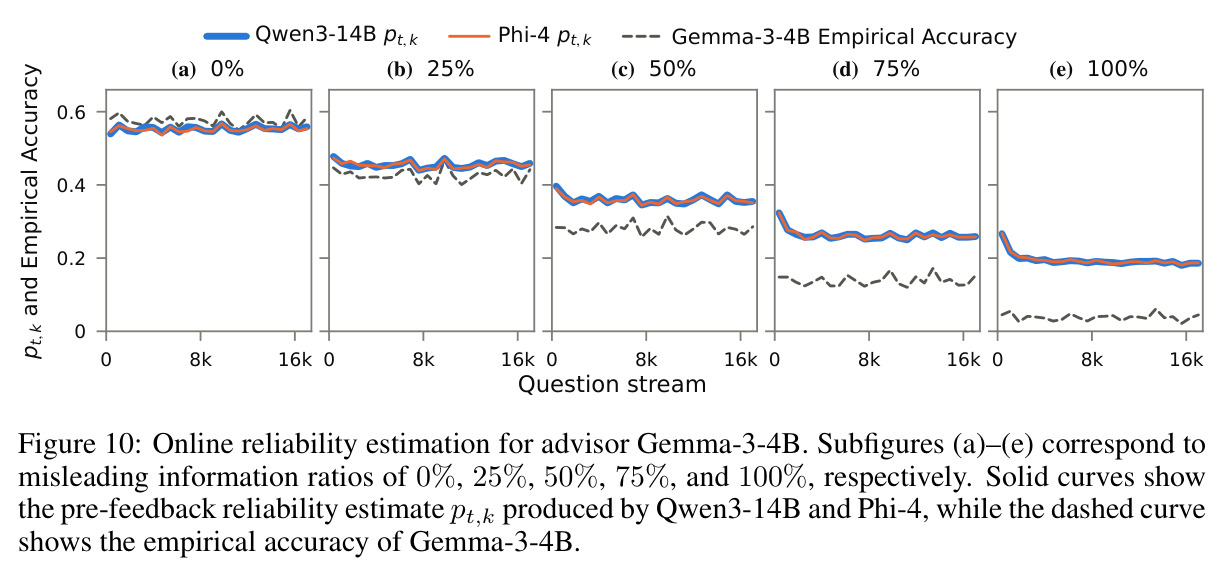
作者明确承认的局限:(1) 校准缺口——100% 误导率下顾问经验准确率趋近 0,而记忆给出的可靠性估计仍停在 0.2 左右;这是高斯预测映射的下限效应 $\Phi(-1)\approx0.159$:即使参数后验完全收敛,固定的单位观测噪声仍保留非零预测概率(附录 B.4),作者称其为“说明性下限而非普适下界”。(2) 注意力调制只作用于使用 softmax 归一化的全注意力层(正文脚注),对线性注意力或滑动窗口架构不适用。(3) 学习信号依赖事后可验证的正确性标签,论文中所有任务都有精确匹配判据,开放式生成任务如何获得可靠验证未讨论。我的补充观察:(4) 线性打分 $w^\top x_{t,k}$ 难以刻画“两个顾问各对一半、合起来才对”的高阶互补性;(5) 误导信息用随机替换构造,与真实世界中策略性欺骗、协同造假或模型系统性幻觉的分布不同;(6) 后验次序无关意味着没有遗忘机制,顾问能力随时间漂移(升级、换提示)时会失准;(7) 决策只在“咨询/自主”间二选一,未考虑选择性咨询顾问子集或多轮交互。
独立分析的弱点
独立分析的弱点与改进方向:(1) 校准偏高——高误导率下可靠性估计系统性停在约 0.2,根源是固定单位观测噪声 $\epsilon\sim\mathcal{N}(0,1)$;可改为在线估计噪声方差 $\sigma^2$,或用 Bernoulli 观测的贝叶斯 logistic 回归,使预测天然落在 $[0,1]$ 且极端情况下能压到接近 0。(2) 线性表达力不足——$w^\top x_{t,k}$ 难以刻画“两个顾问各对一半、合起来才对”的组合信号;可引入轻量核映射或二阶交互特征,同时保留闭式更新。(3) 无遗忘——后验对旧证据权重永不衰减,非平稳顾问池(模型升级、提示变化)下需加指数遗忘 $\Lambda\leftarrow\eta\Lambda+xx^\top$ 或滑动窗口。(4) 验证成本与标签噪声——开放任务缺少 gold label,可结合自一致性、执行反馈或 LLM 自评作为弱验证信号并做鲁棒化。(5) 超参 $\gamma$ 未做敏感性消融,偏置尺度如何随模型/任务自适应值得补实验。(6) 阈值 $T^*$ 依赖全局标量 $\hat{\rho},\hat{\delta}$,早期样本少时噪声大,可按任务类型条件化或加保守正则。
未来方向
作者提出的方向:把持久可靠性记忆作为长程多智能体系统中鲁棒、自适应咨询的实用基础,并继续扩展部署场景(已示范 worker 路由)。基于本文成果可延伸的方向:(1) 非平稳环境下的可靠性追踪——引入遗忘因子或变点检测,让记忆适应顾问能力漂移;(2) 把 $\rho,\delta$ 从全局标量扩展为任务类型或难度条件化的函数,刻画“有的任务咨询增益大、有的小”;(3) 与 RAG 结合,把可靠性记忆用于检索文档来源的可信度加权(与 CRAM 一脉相承);(4) 人在回路——把顾问扩展到人类专家,研究稀疏人工反馈下的信任校准与隐私问题;(5) 工具/API 选择——把每个工具视为一类顾问,用同一记忆指导工具路由与重试;(6) 与选择性辩论融合——用可靠性估计决定谁有资格进入辩论、何时截断轮数;(7) 理论延伸——A.8 已给出错误侧决策的期望代价刻画,可在在线学习框架下证明选择规则的遗憾界。
复现评估
复现条件相当好。代码开源(github.com/declare-lab/BaRe-Mem),数据集开源(huggingface.co/datasets/Sssunset/BaRe-Mem-Data),涉及的全部 12 个模型均为开放权重:中心模型 Qwen3-4B/8B/14B、Qwen2.5-7B、Ministral-8B、Phi-4;顾问 Gemma-3-4B、Phi-4-mini、Qwen2.5-Coder-7B、Llama-3.1-8B、DeepSeek-Coder-V2-Lite、R1-Distill-Qwen-7B。方法完全免训练:无需任何微调,只需冻结模型推理,外加维护一个 $d$ 维贝叶斯后验和一个二维后验,显存瓶颈主要在多模型并行推理(14B bf16 约需 28GB 以上,可多卡或量化)。主实验约为 1.6 万题级题目流、每题 6 个顾问,MuSiQue 为 2,417 任务/6,404 子任务、每子任务最多 7 个 worker,推理总量中等。误导信息构造协议(按比例替换为已验证错误的流畅回答)描述完整可复刻。门槛主要在多模型服务的工程编排(vLLM 可缓解)与各基准评测细节复刻;复现单一中心模型主线可行,完整 6×6 矩阵加团队实验算力开销较大。总体难度中等偏低。
论文图表
Qwen2.5-7B lead:数据验证器下任务完成 51.9,为六 lead 中区间下端。
给出任务完成率 51.9–55.0% 区间的下端证据。