Qwen3.8-Next 架构设计:评测、效率与训练稳定性 On the Design of Qwen3.8-Next Architecture: Evaluation, Efficiency, and Training Stability
以 GDN 混合、QSA 稀疏注意力与门控残差三大改动,用约 1/9 训练 FLOPs 追平 397B 旗舰
前置知识
稀疏混合专家(MoE)
MoE 把 Transformer 的前馈层替换为多个并行“专家”网络,由路由器为每个 token 只激活其中少数几个,从而在参数总量远大于计算量的前提下扩展容量。命名如 125B-A6B 表示总参数 125B、每个 token 仅激活 6B。
本文模型 Qwen3.8-Flash-Next 就是 125B-A6B 的稀疏 MoE,额外还挂 51B n-gram 嵌入表;文中消融多以 25B-A3B、35B-A3B 小规模 MoE 复现。分清总参数与激活参数是读懂全文效率对比的前提。
线性注意力与循环状态(Gated DeltaNet)
线性注意力把前缀压缩进固定大小的矩阵状态 $S_t \in \mathbb{R}^{d_k \times d_v}$ 并按内容更新,计算与显存随序列长度线性增长。GDN 在此之上加数据相关的衰减门 $\alpha_t$ 与写入门 $\beta_t$:先估计 key 已关联的旧值,只写入残差误差,实现“定向擦写”,区别于无界累加的加性线性注意力。
GDN 是本文 token 混合的主体:每四层中三层用 GDN。它以固定大小状态换取线性成本,是全文“效率-长程记忆”权衡的核心部件。
KV 缓存
自回归解码时,标准注意力需缓存全部历史 token 的 key/value 向量,显存随上下文线性增长;解码阶段的时间主要由搬运这些字节的内存带宽决定,而非算术计算。
“解码由访存主导”这一事实直接决定了本文多条设计:GDN 保留固定大小状态、GR 删去分支混合算子 $H_{res}$、残差状态改用 FP8 存储,都是为减少字节搬运。
稀疏注意力与索引器
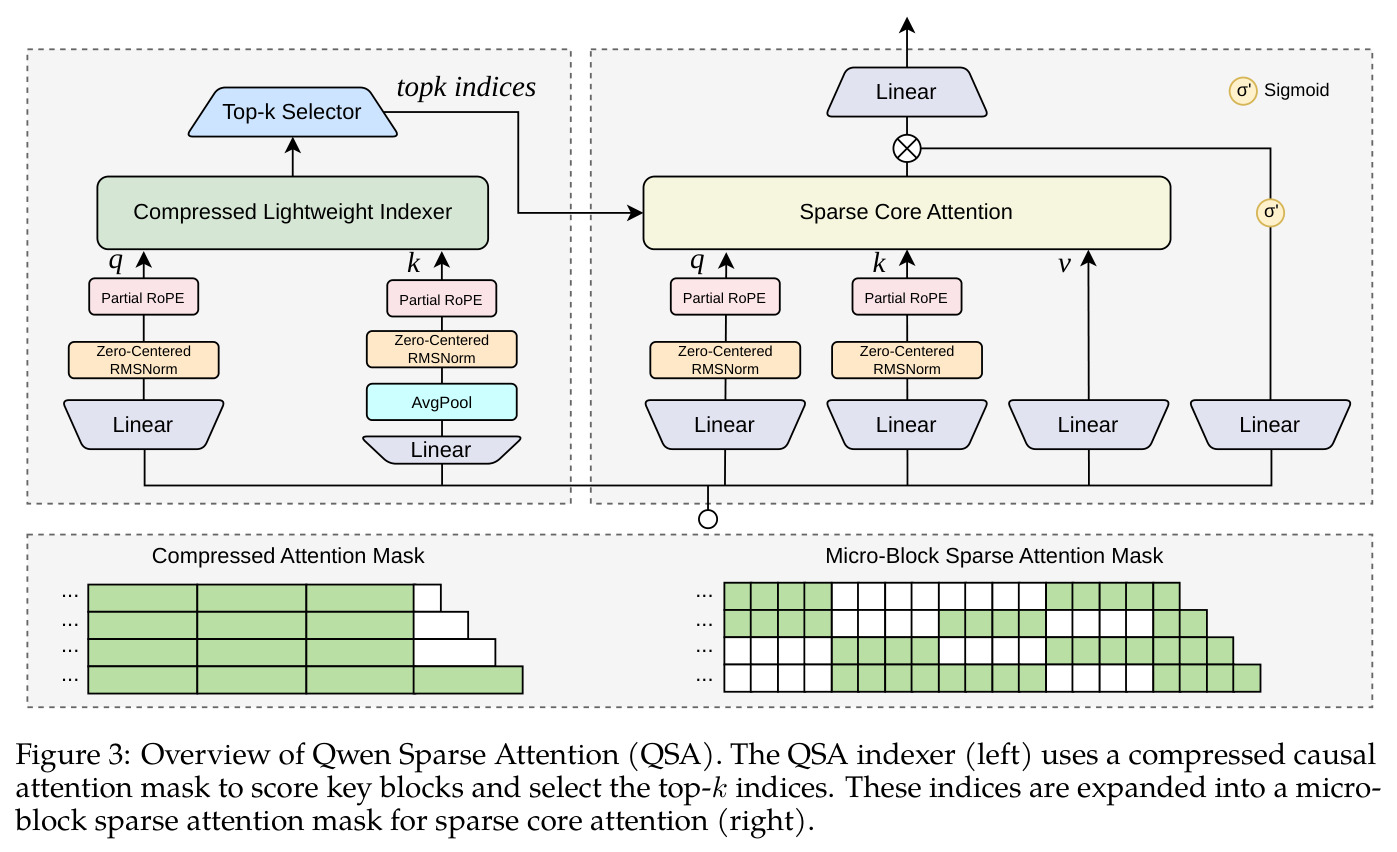
稀疏注意力用一个轻量“索引器”先估计每个 query 对上下文哪些位置重要,再只对选出的 top-k 位置做完整注意力,把 $O(n^2)$ 的注意力降为近似 $O(nK)$。DSA 等先前方法用 token 级索引器,但索引自身的打分开销仍随 $n^2$ 增长,长上下文时成为新瓶颈。
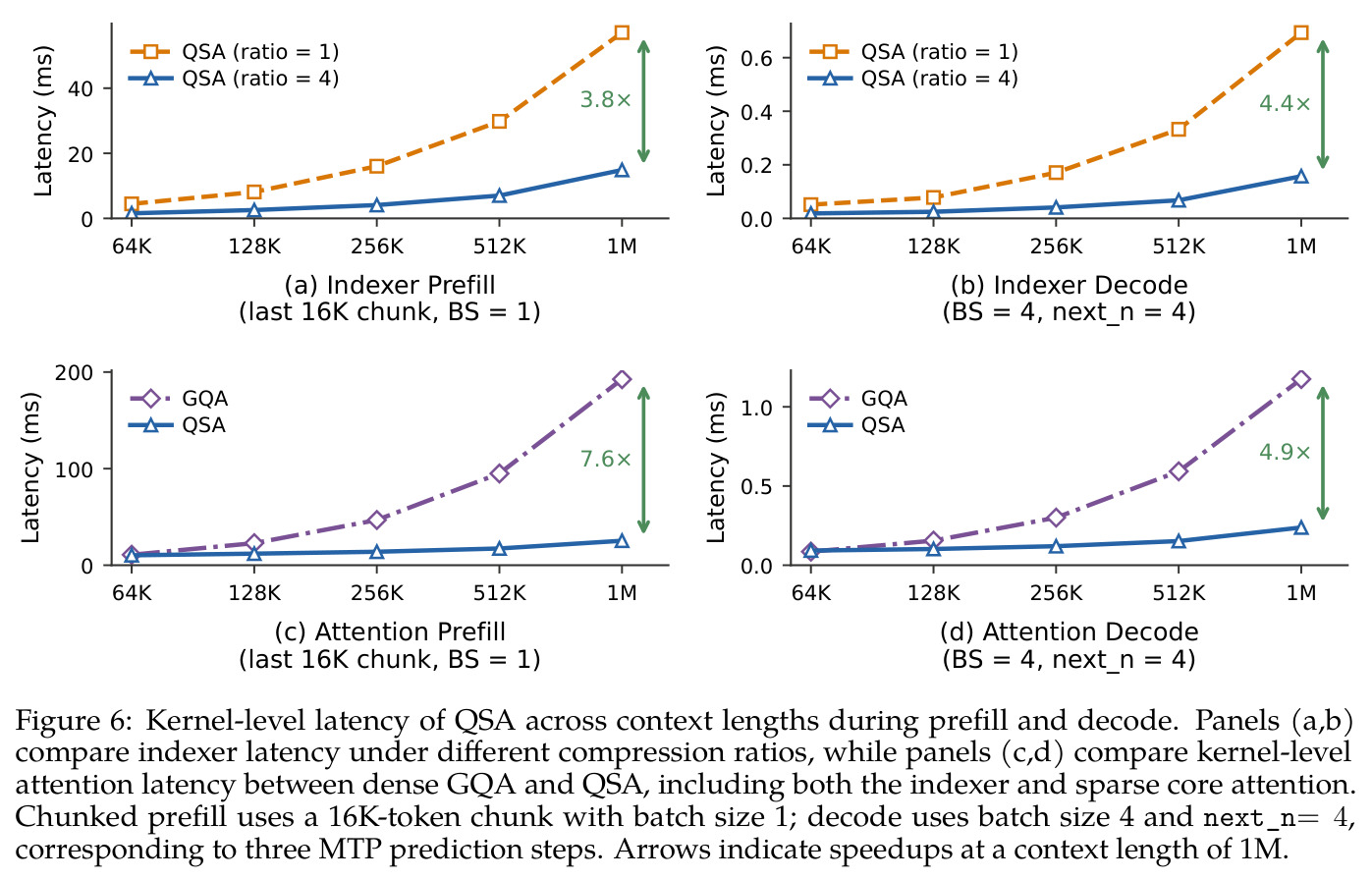
QSA 的关键改动就是把索引打分粒度从 token 压缩为 micro-block,使索引开销降为 $O(n^2/r)$,这是理解 1M 上下文 7.6× prefill 加速的入口。
残差流与 Pre-Norm
残差连接让每个子层输出直接累加到主干向量流上,为梯度提供直达输出之路;Pre-Norm 在每个子层读取前先做 RMSNorm,是大规模训练稳定的标配。代价是每层读同一条流,早写入的特征必须与之后所有写入竞争、被逐步稀释。
本文 Gated Residual 正是在这条主干上做文章:把单条残差流加宽为 4 条分支、读入时用逐元素 sigmoid 门控加权,并直接取代 Pre-Norm,是质量与稳定性双赢的关键组件。
Muon 优化器与 Newton–Schulz 正交化
Muon 是面向矩阵参数的优化器:对 Nesterov 动量($\mu=0.95$)用 Newton–Schulz 迭代做正交化(拉平更新方向的奇异值),再按 $\gamma=0.2\sqrt{\max(A,B)}$ 缩放,使更新 RMS 与矩阵形状无关,已在多个千亿模型上验证有效。
本文系统处理了 Muon 落地问题:哪些参数该用/不该用、融合矩阵先拆分再正交化、按正交化 FLOPs 重新做数据分区、CUDA graph 捕获优化步;且架构+Muon 共同改变了最优超参,是第 3 章一切讨论的基础。
缩放定律与超参迁移
缩放定律用小模型上的大量训练实验,拟合损失随参数量、数据量与超参(学习率 $\eta$、批大小 $B$)的变化规律,再外推到大模型规模选配方,避免大规模试错。架构与优化器一旦改变,旧配方的外推即失效,需要重新拟合。
本文重新拟合了超参缩放定律,预测出显著更大的最优批大小与学习率,并分别在 4T token 小模型和 156B-A7B 大模型上分轴验证外推可靠性,是其训练配方的核心。
MTP 多 token 预测与投机解码
MTP 在主干之外附加轻量预测模块,一次草拟后续多个 token,由主干并行验证,平均接受长度决定解码加速比。草稿模块自身的注意力开销会成为额外成本。
本文 MTP 模块跨投机步复用 QSA 的 top-k 索引以降低草稿成本,并用四步投机解码的平均接受长度(4.07 vs 4.06)验证复用无损,是推理效率设计的一环。
研究动机
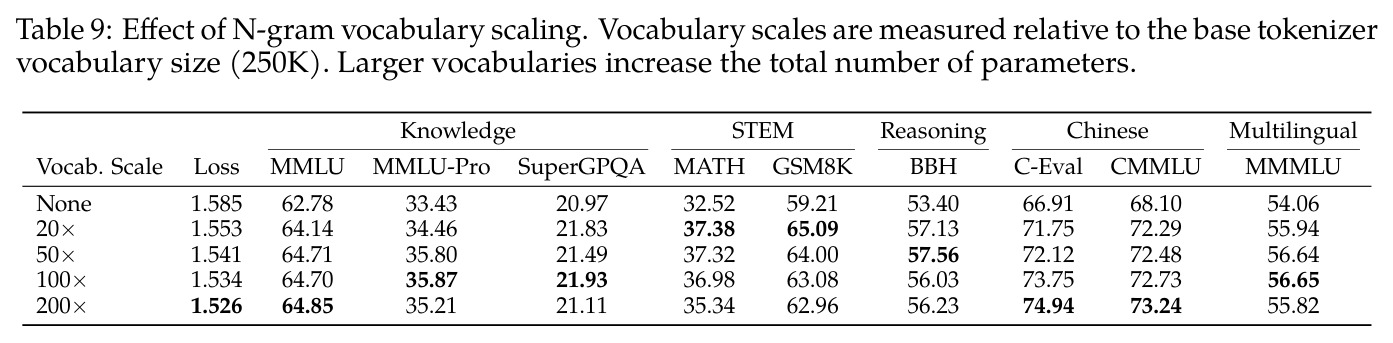
Transformer 的全局自注意力提供对全部历史 token 的直接内容寻址,但计算量随序列长度平方增长,KV 缓存随生成长度线性膨胀;滑窗注意力(SWA)虽把两项开销都变成常数,却只能靠层级深度间接传递窗口外信息,长程内容记忆受损。纯靠增大稠密参数或 MoE 专家数扩容量,则每 token FLOPs 与访存同步上涨,推理成本居高不下。训练侧同样有两类顽疾:一是上一代 397B-A17B 旗舰质量达标但激活参数、训练 token 与 FLOPs 都处于高位;二是大规模长程训练中损失尖峰与梯度异常频发,常需 checkpoint 回滚,qk-clip、SwiGLU-clip 这类显式裁剪成了标配。此外,架构选型长期依赖预训练损失这一单一指标,而本文观察到损失与下游基准并不总是一致——例如 n-gram 词表增大时损失单调下降、下游准确率却饱和——只看损失会做出错误决策。
本文的目标是本文的量化目标是在远低于上一代的算力预算下保住 397B-A17B 旗舰(Qwen3.7-Plus)的基座质量:在知识、STEM、推理、代码、多语言共 14 个预训练基准上追平或接近旗舰,同时每 token 激活参数约为其 1/3、训练 token 数约为 1/3、训练 FLOPs 约为 1/9。为此必须把三类耦合问题当作一个设计问题同时求解:架构能力(token 混合、残差结构、容量扩展方式的重新设计);效率(训练、prefill、decode 三阶段分别记账并针对性优化);优化与稳定性(新架构下最优学习率与批大小漂移的重新拟合、以压力测试验证大规模训练稳定性)。最终产出一个同时更高效、更强、更稳的配方,并保证全量训练零损失尖峰、不依赖显式激活裁剪。
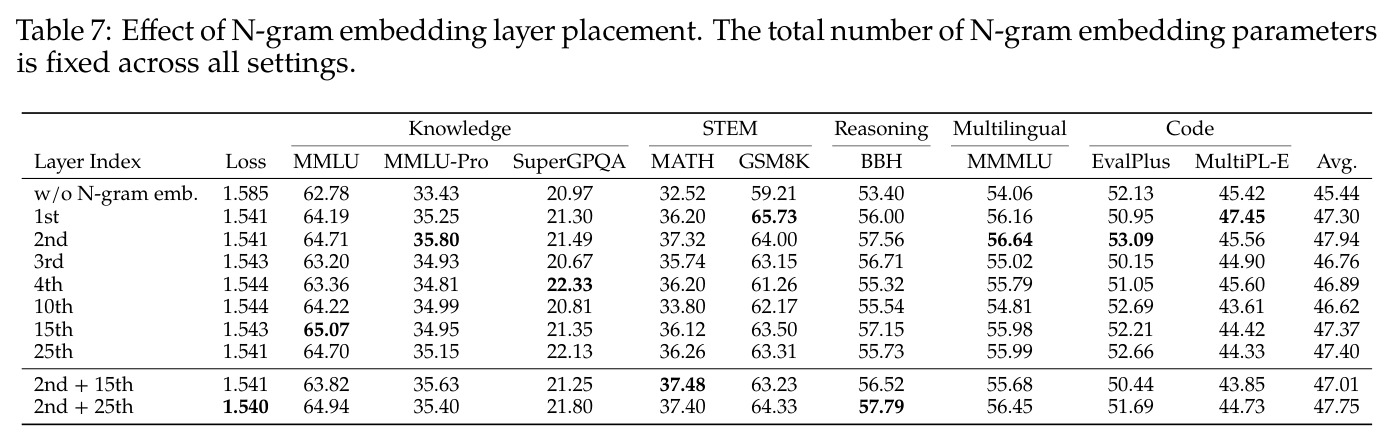
与已有工作不同的是,多数架构论文只报告最终模型的基准分数,或只用预训练损失做消融。本文的独特切入是把每一次候选改动放到三条正交轴上同时评估:(1) 损失+下游基准,并明确报告两者不一致的案例;(2) 改动在训练、prefill、decode 三阶段的成本账;(3) 对最优超参与训练稳定性的影响。这一协议暴露了只看损失会错过的现象:n-gram 词表增大损失单调降但下游饱和;GR 的动态化只降 0.002 损失却带来 1.98 分基准提升;限制残差读为门控最高的两个分支在预训练几乎免费,后训练后却明显掉质量;去掉全注意力层的位置编码预训练无差别,但后训练后“无限生成”(不终止)比例显著上升。作者据此主张损失、基准、效率与稳定性构成一个联合设计问题,这为架构研究提供了一套可复用的评估方法论。
核心方法
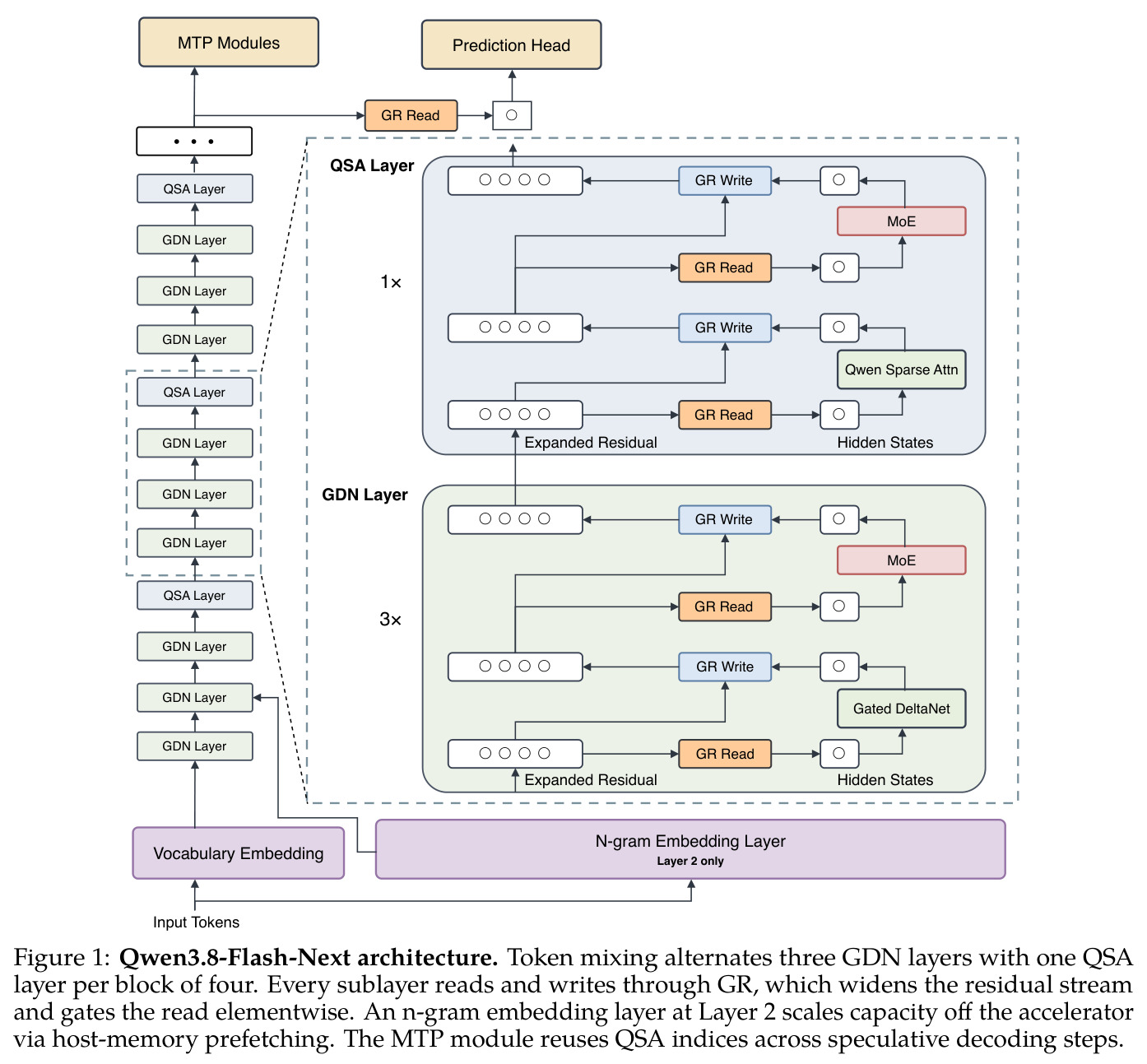
直觉上,模型的不同瓶颈要用不同手段解决:长程记忆与检索、残差通路容量、参数容量三者互不可替代。技术上,Qwen3.8-Flash-Next 由四大组件构成(Figure 1)。其一,token 混合采用逐层混合架构:每四层中三层用 Gated DeltaNet(GDN),把前缀压缩进固定大小循环状态、以线性成本更新,一层用全局注意力保留精确的 token 级检索;继续预训练(CPT)阶段再把全注意力层替换为 Qwen 稀疏注意力(QSA),用压缩索引器在 micro-block 粒度打分并选 top-k 上下文。其二,残差流加宽为 4 条分支,读取时经逐元素 sigmoid 门控加权平均(Gated Residual, GR),同时取代 Pre-Norm。其三,容量放到骨干之外:在第 2 层挂一层 n-gram 嵌入,多头哈希查表、上下文门控注入,51B 参数驻留主机内存并异步预取,几乎不增加每 token FLOPs 与延迟。其四,优化器用 Muon 正交化二维线性映射权重,配合重新拟合的缩放定律选取更大的最优批大小与学习率,并以抬高学习率的压力测试验收稳定性,最终全量训练零损失尖峰。
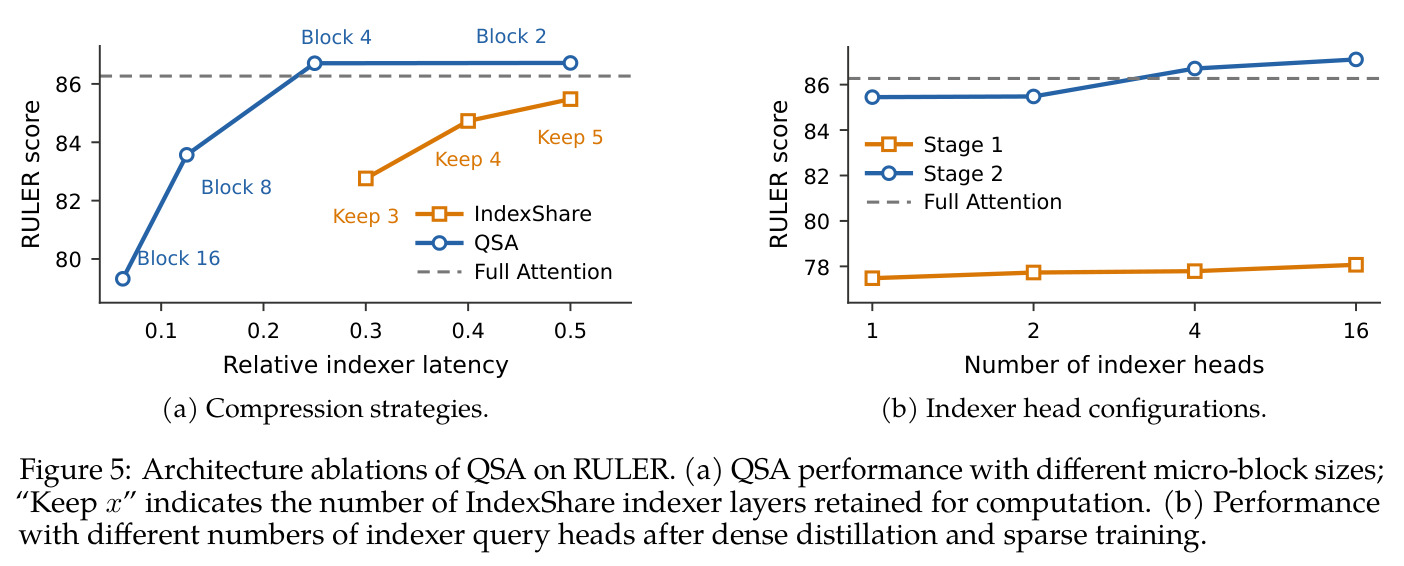
核心创新有三处。第一,GR 重新分配了“加宽残差流”的表达力去向:Hyper-Connections(HC)与 mHC 把读/写都保持为每分支标量、把容量投入分支间混合算子 $H_{res}$(mHC 还约束其为双随机矩阵),而 GR 把表达力花在读端——门控是逐元素(每分支每通道)的 sigmoid 门,同时彻底删去 $H_{res}$;消融显示删减无性能代价,却省掉每块一次对整个残差状态的读取(加宽流推理访存的大头),还带来显著稳定性增益。第二,QSA 改变了稀疏注意力的索引粒度:DSA 的 token 级索引器开销为 $O(n^2)$,QSA 先把 key 平均池化压缩 $r$ 倍成 micro-block 再打分,索引开销降为 $O(n^2/r)$;与跨层共享索引的 IndexShare 相比,层内压缩不依赖层间相似性,天然适配混合架构——QSA 在索引相对延迟 0.25 时即追平全注意力基线,IndexShare 在 0.5 时仍低于基线。第三,方法论上把架构、效率、优化、稳定性当耦合系统:GR 提供的重缩放使最优学习率与批大小上移,进而改善吞吐与收敛,批量预热被证明不再必要。
方法步骤详情
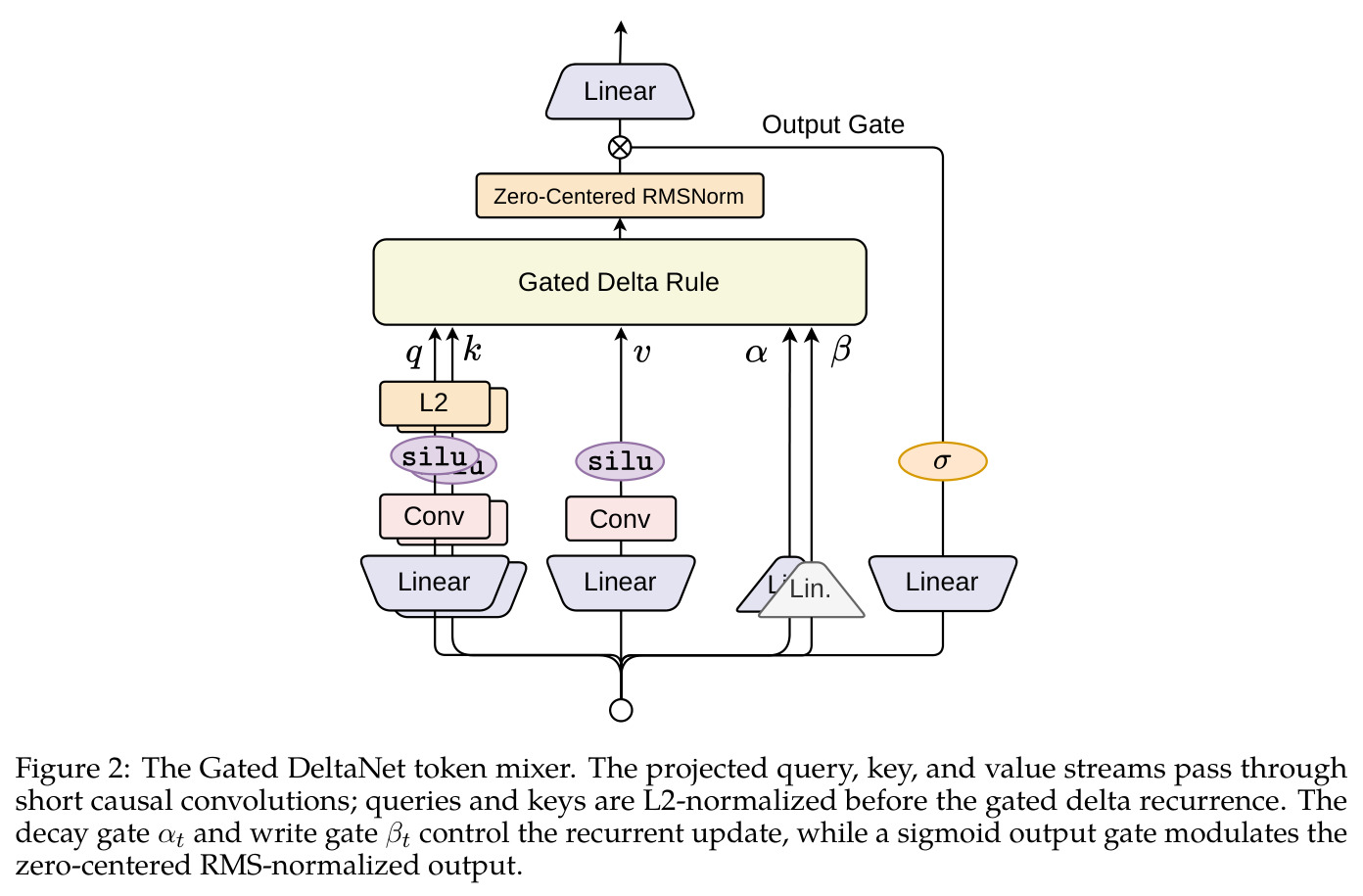
完整流程分五步。(1) 骨干搭建:每四层一组,三层 GDN + 一层全局注意力(保留 RoPE;NoPE 变体预训练无差别但后训练后不终止生成比例显著升高,故弃用)。GDN 中 $q_t,k_t$ 经短因果卷积与 L2 归一化,状态按 $S_t = \alpha_t(I-\beta_t k_t k_t^\top)S_{t-1} + \beta_t k_t v_t^\top$ 更新,$\alpha_t = \exp[-\exp(A)\,\mathrm{softplus}(W_\alpha x_t + b_\alpha)]$,输出经 zero-centered RMSNorm 与有界 sigmoid 输出门调制。(2) CPT 时把全部全注意力层换为 QSA:MQA 索引器(4 个查询头共享 1 个 key 头,128 维中 64 维加部分 RoPE)先把 key 按块大小 $r=4$ 平均池化,块级打分 $I_{ib}=\sum_h \mathrm{ReLU}\langle q_i^h, \bar{k}_b\rangle$(仅对已完整观测的块),选 top-$K_B=\lceil K/r\rceil$ 个块($K=2048$,即最多 512 块)加末尾不完整块;训练分两阶段——先以教师注意力分布(逐头 softmax 求和后 L1 归一化、max-pool 到块级)做 KL 蒸馏仅训索引器 1000 步(lr $10^{-3}$,约 2B token),再联合训练 8000 步(lr $2.5\times10^{-5}$,约 200B token)。(3) GR:$n_r=4$ 条分支各自独立 RMSNorm,从全部分支经低秩瓶颈(秩 $r=d/8$)预测逐元素门 $G$,加权平均得块输入;块输出经每分支标量 $s_i = 2\sigma(\cdot)$ 写回所有分支;残差状态 FP8 存储,读/写各融合为单 kernel。(4) 第 2 层插入 n-gram 嵌入层,主机内存预取与第一层计算重叠。(5) 优化:Muon 用于注意力 q/k/v 与输出投影、GDN 输入输出投影、专家 fc1/fc2,融合的 qkv、fc1 先按头/按半拆分再各自正交化(Newton–Schulz 8 步,Polar Express 系数,$\gamma=0.2\sqrt{\max(A,B)}$);嵌入、输出头、MoE 路由器、GR 低秩投影留在 AdamW;按新缩放定律取 $B=25.2M$ 等更大超参且不做批量预热;以恒定 2×/4× 最优学习率的压力测试验收。
技术新颖性
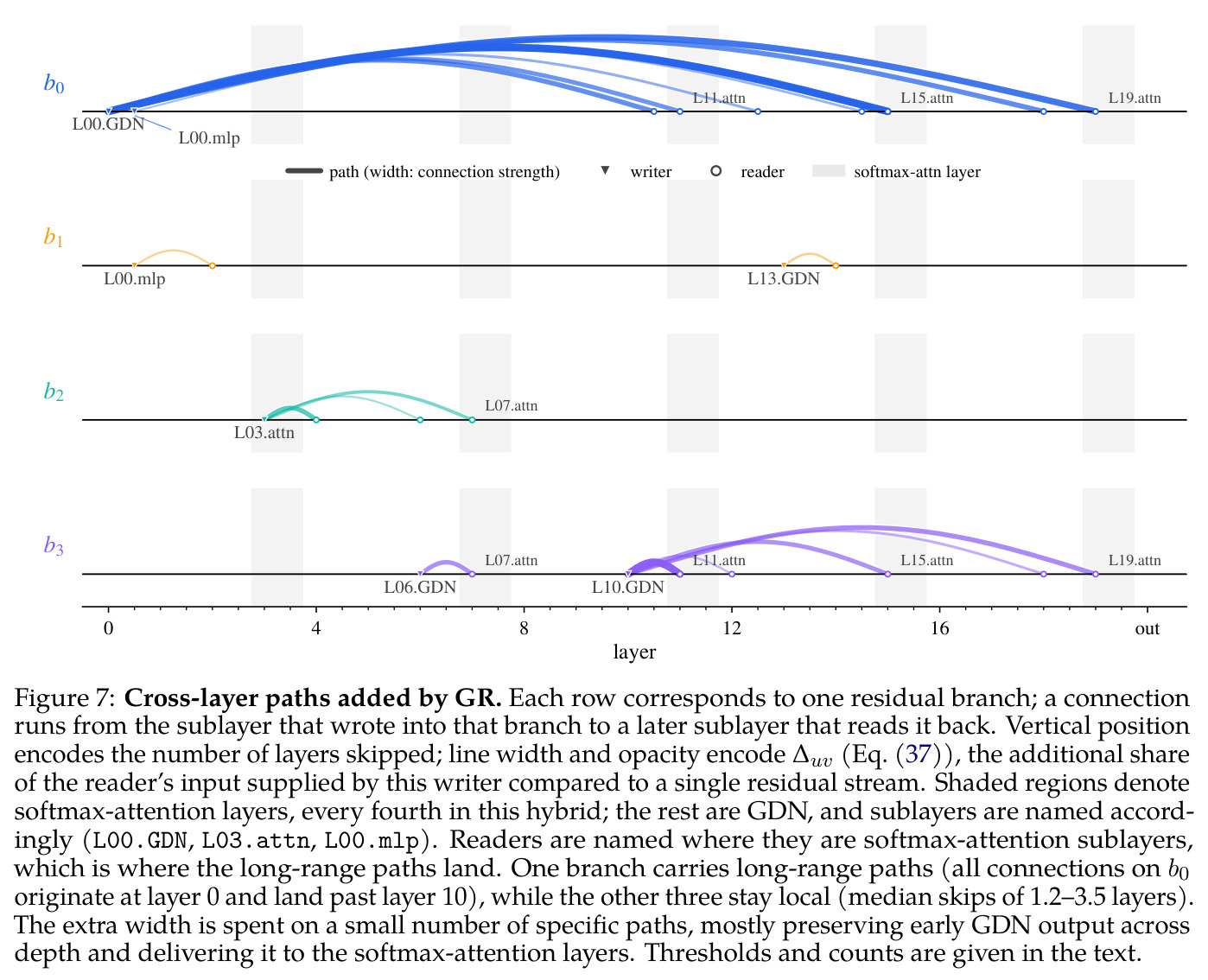
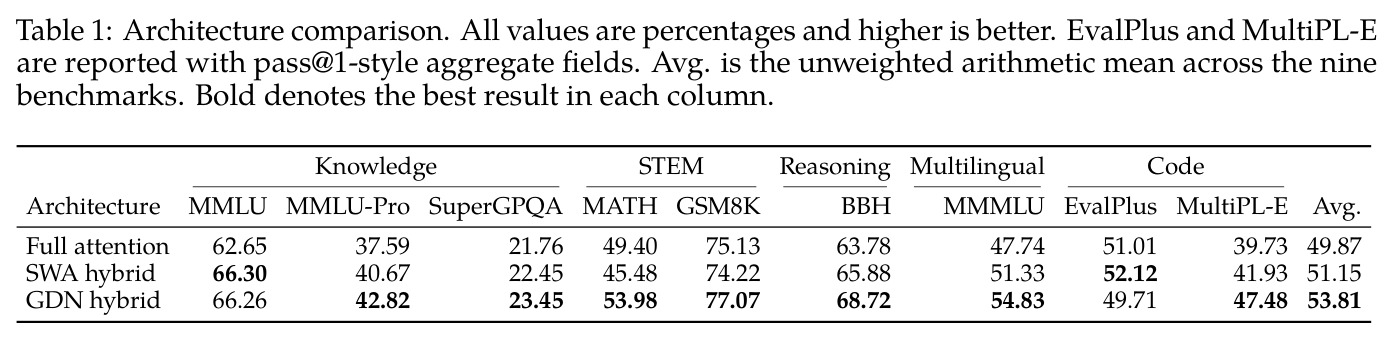
从新颖性看,本文不是单一技术突破,而是多个已知组件的非平凡重设计,外加一套严苛的评估协议。GDN 来自 Yang et al. 2024,但本文给出大规模“GDN vs SWA vs 全注意力”的同管线对照(Table 1:平均 53.81 vs 51.15 vs 49.87),并把 GDN 输出门从 SiLU 改为有界 sigmoid 取得一致改进。QSA 沿 DSA 的索引器路线,但把打分粒度从 token 压缩到 micro-block 是实质改动:索引成本随序列长度同比例下降,且与 MTP 跨步索引复用兼容(平均接受长度 4.07 vs 4.06 无损);对比 IndexShare 的跨层共享,层内压缩不赌层间索引相似性。GR 属于 HC/mHC/VWN 同族,但“表达力花在读端、删去混合算子”的取舍是新的,且作者用精确的贡献分解(式 36–37)证明加宽的分支确实被用于特定通路——每个 GR 模型都恰好演化出一条承载长程路径的分支(典型跳层 10.9 vs 其余 3.4–3.9),第 0 层 GDN 到第 15 层注意力的输入份额从 0.020 升至 0.138。优化层面,融合参数先拆分再正交化、按正交化 FLOPs 做 α-均衡静态分区(Canzona)、CUDA graph 捕获优化步,是 Muon 规模化落地的工程新贡献。
实验结果
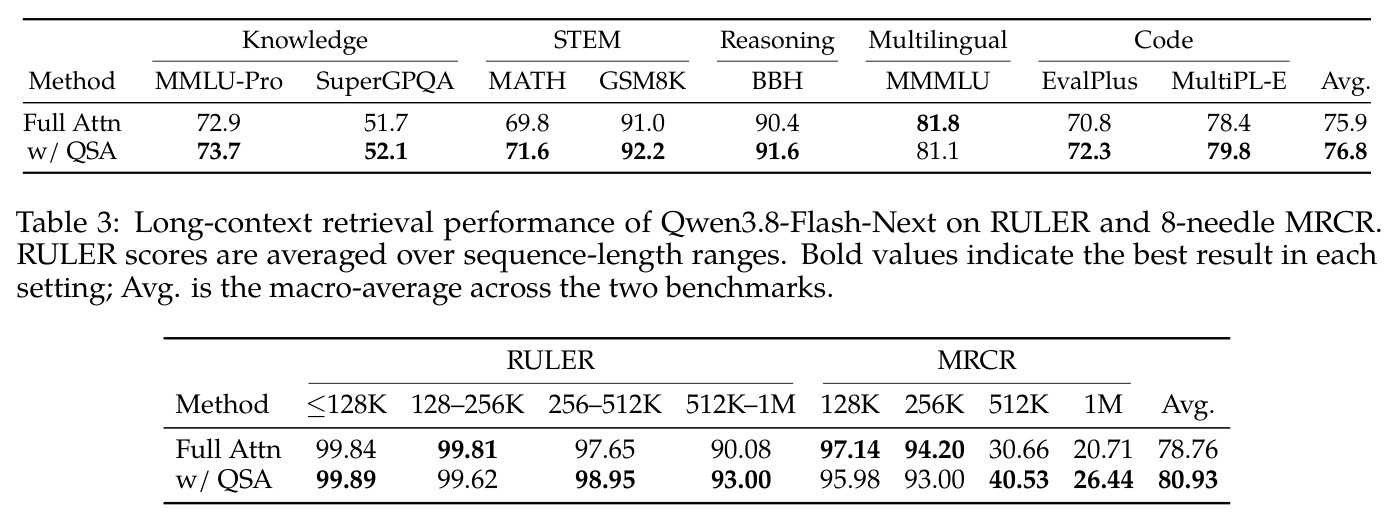
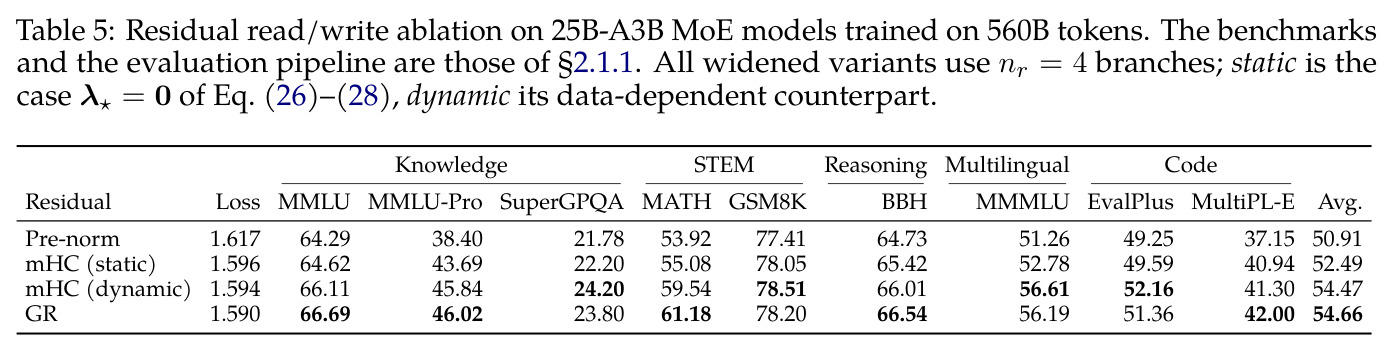
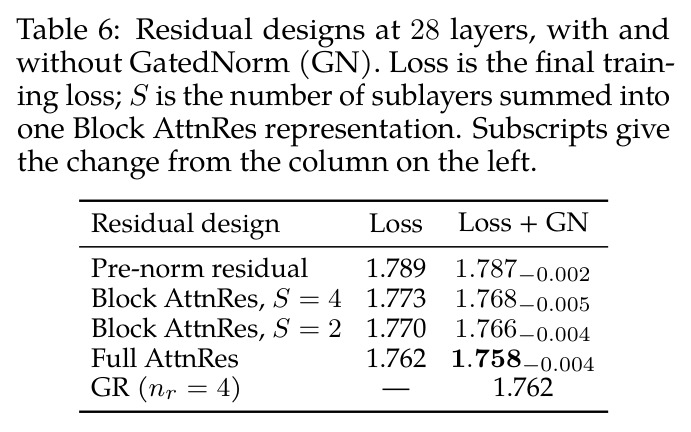
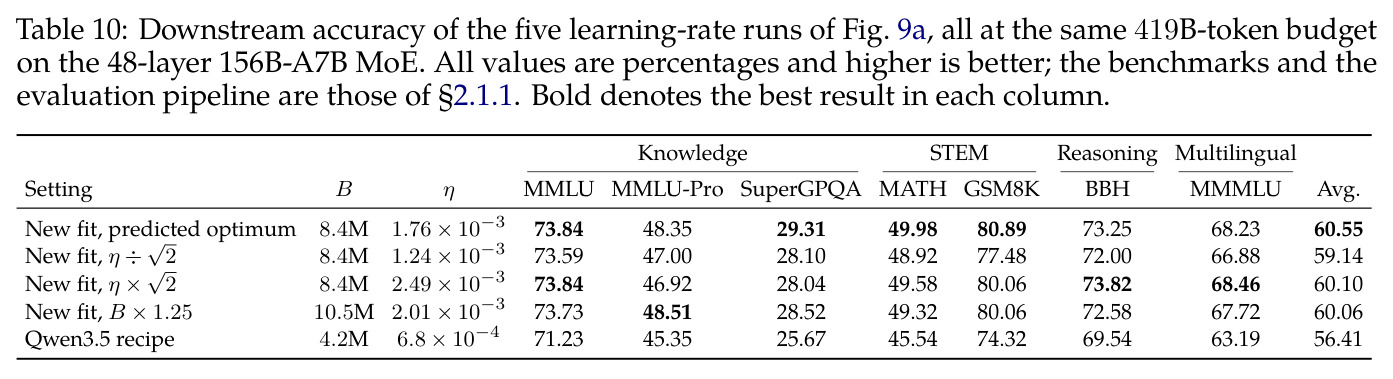
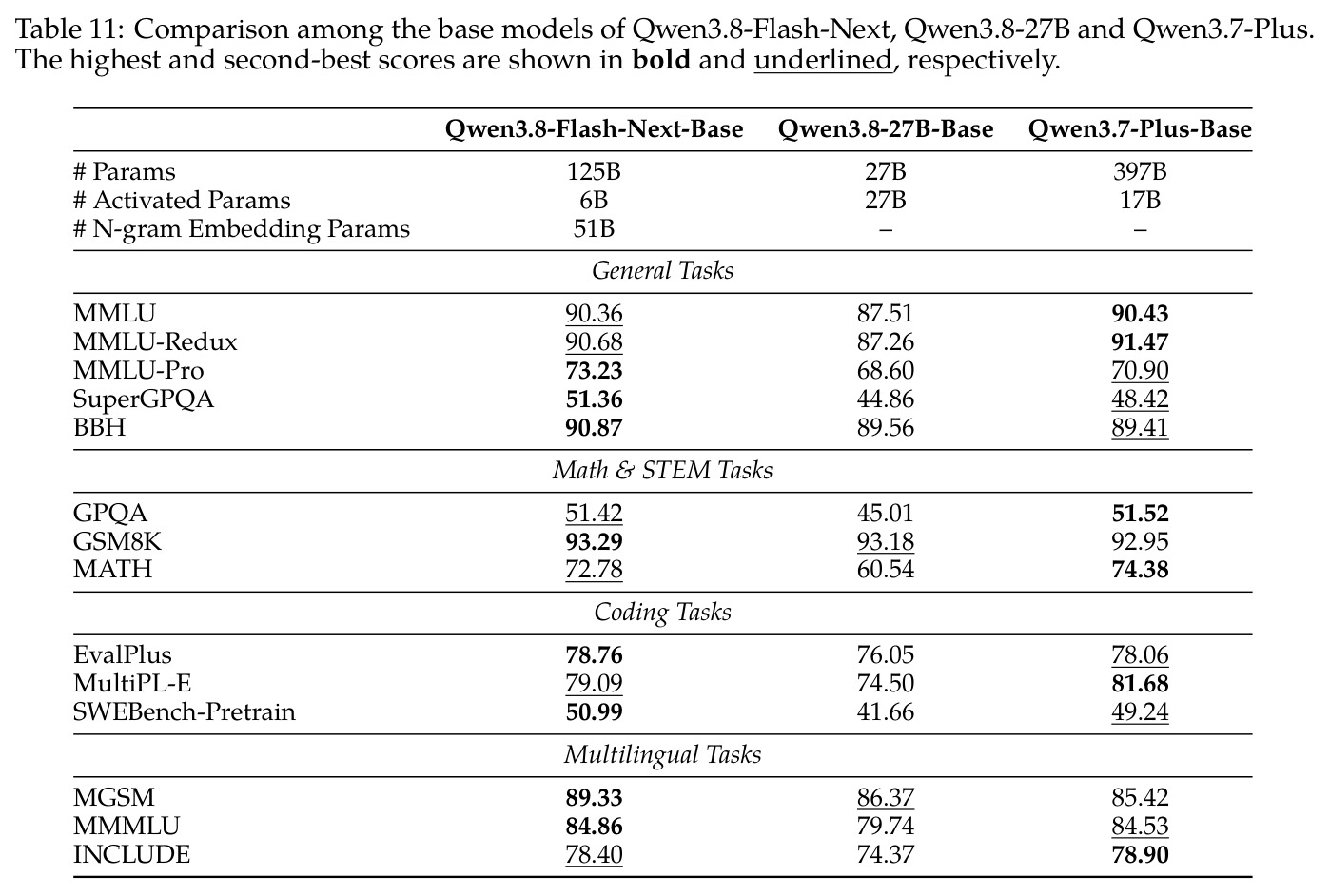
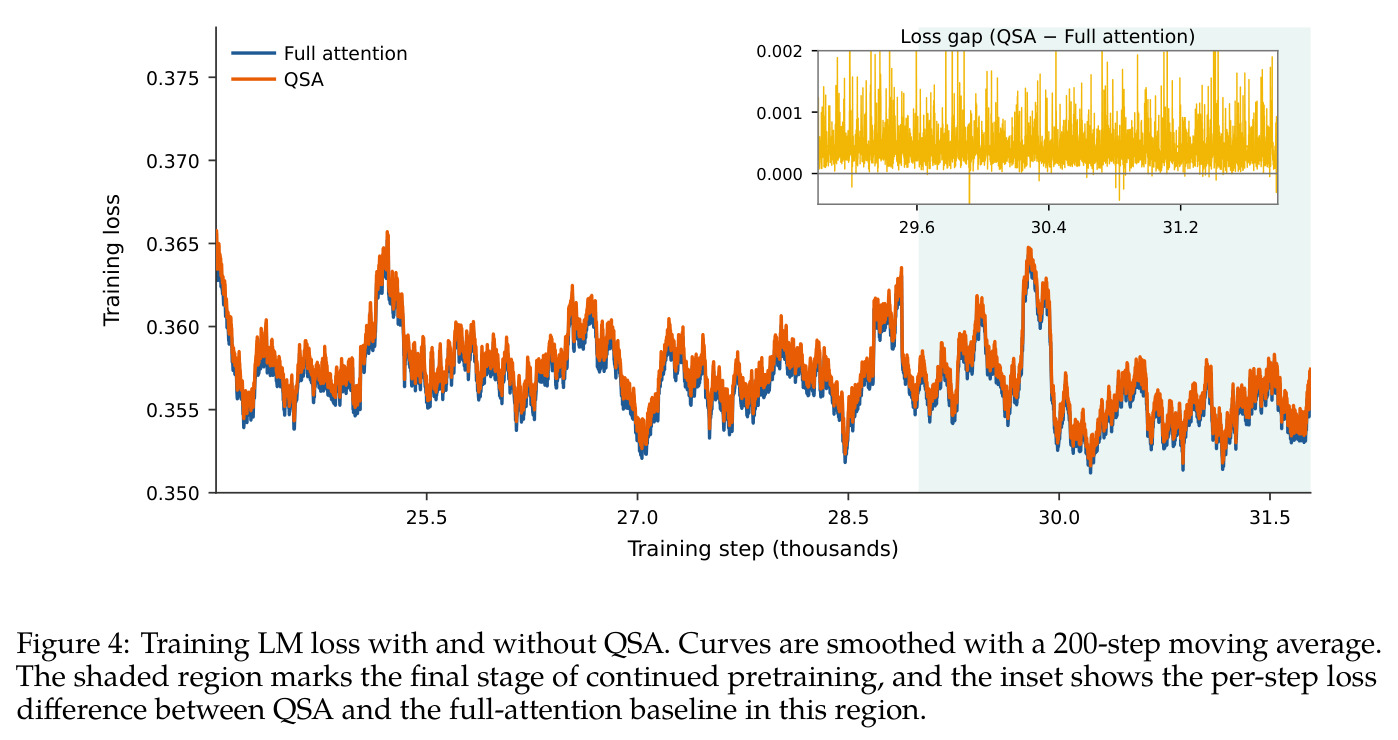
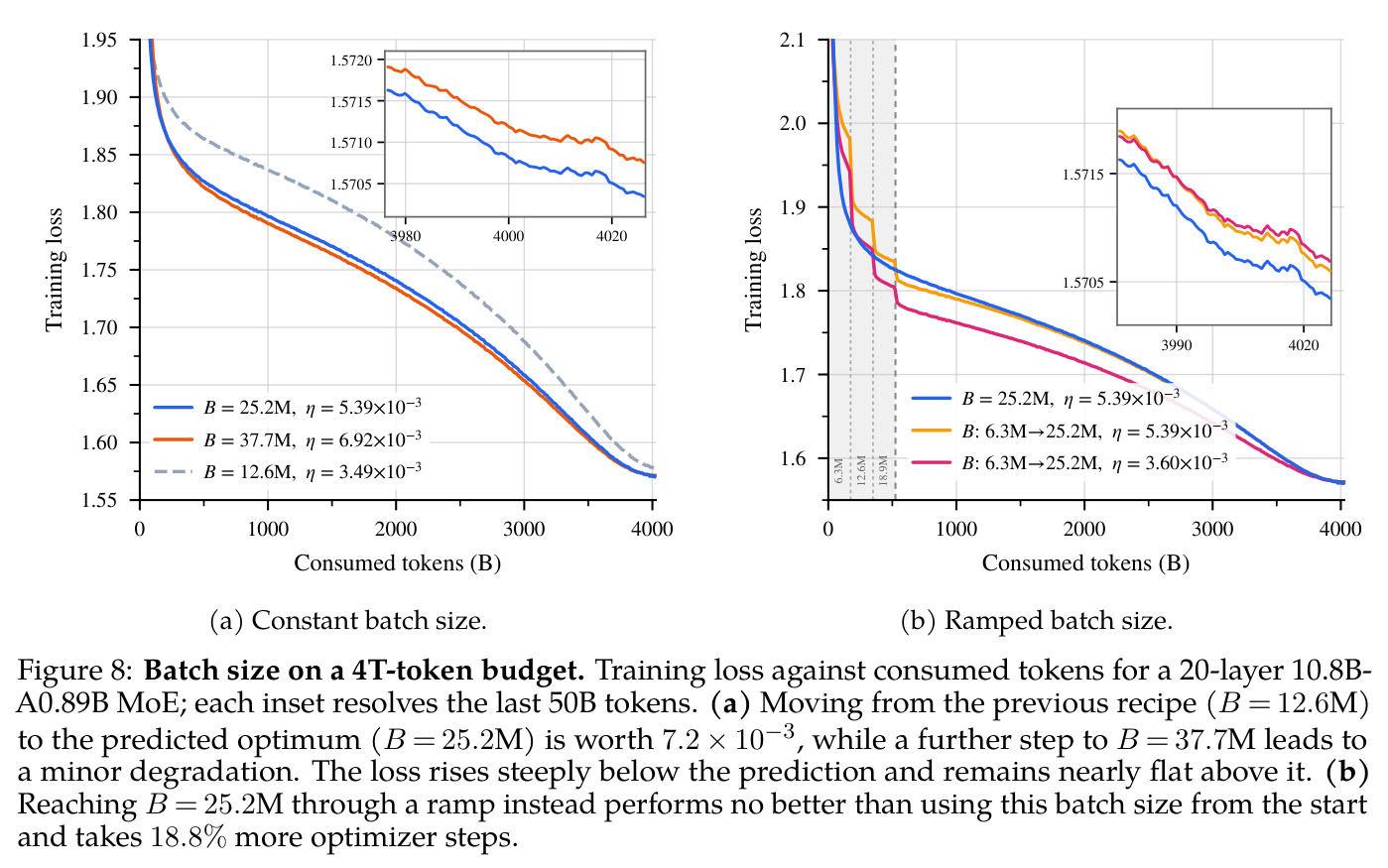
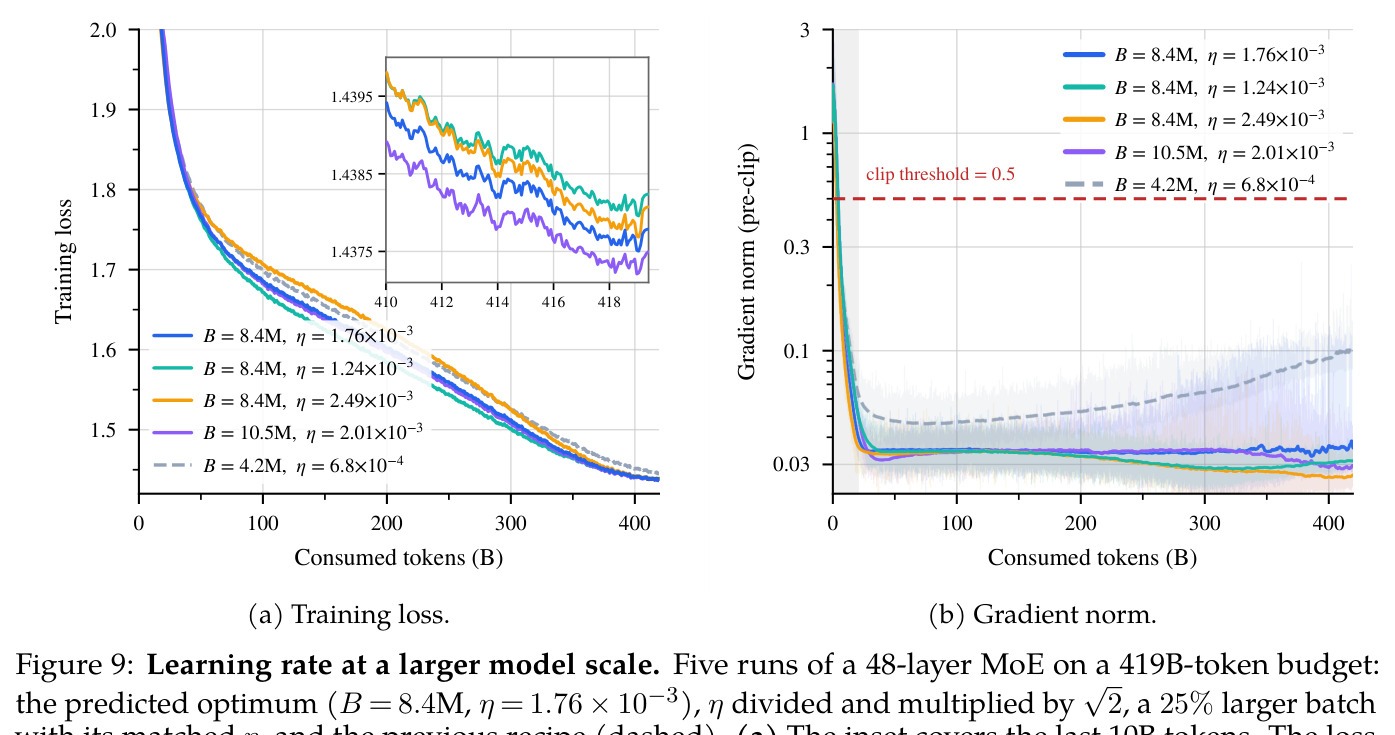
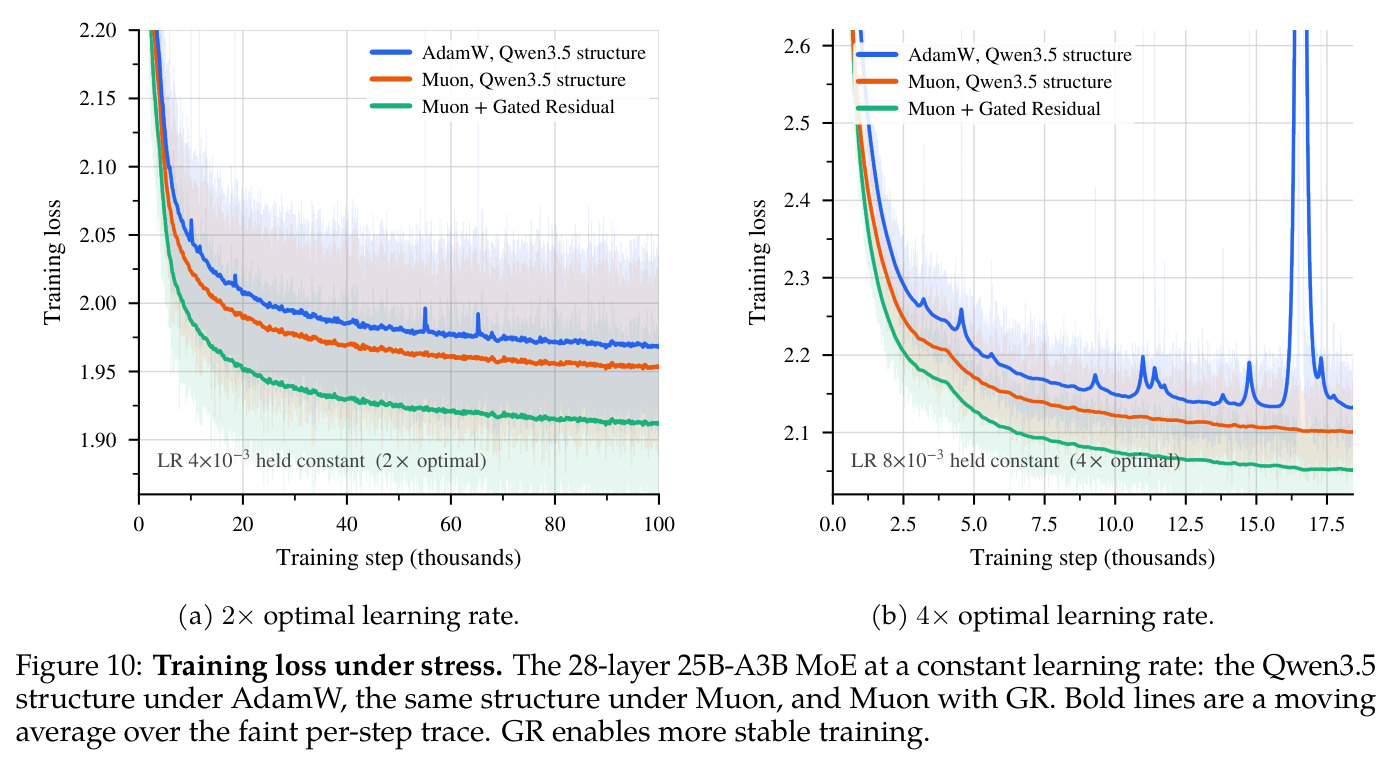
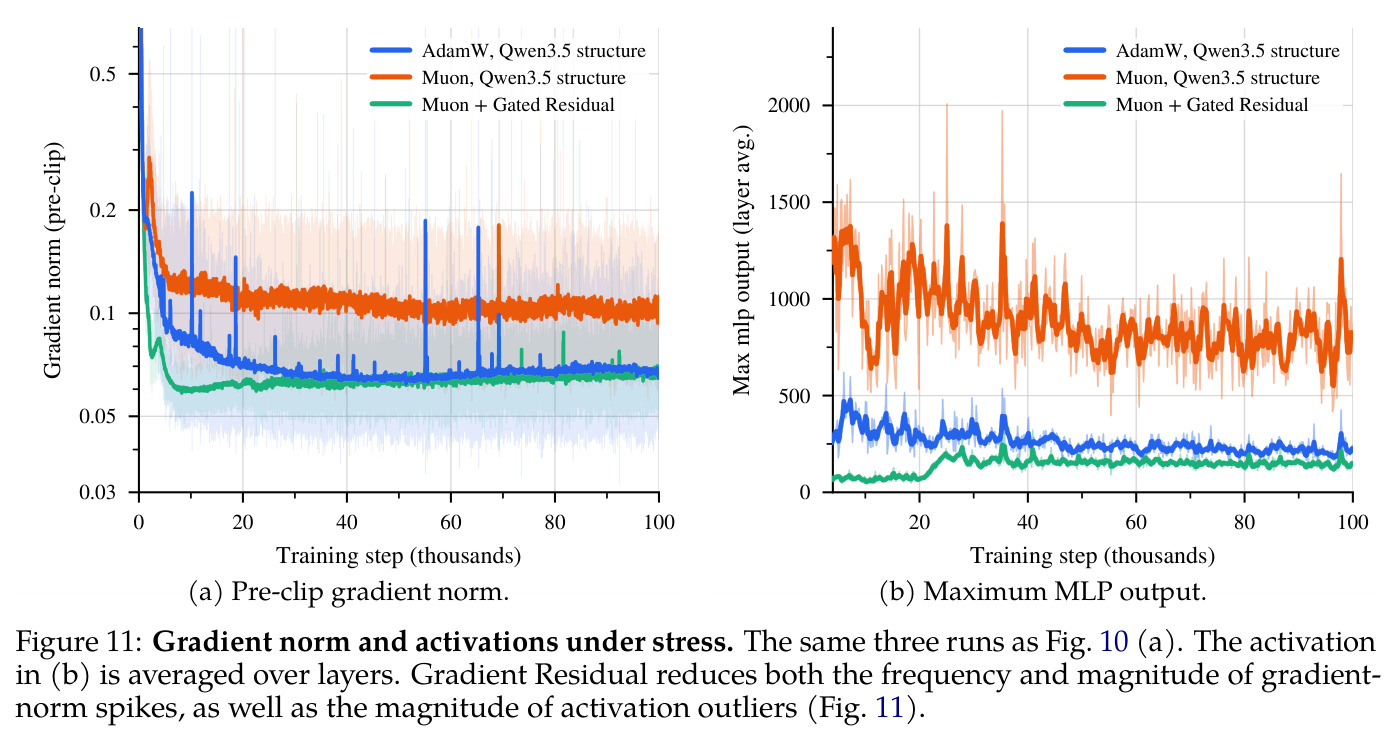
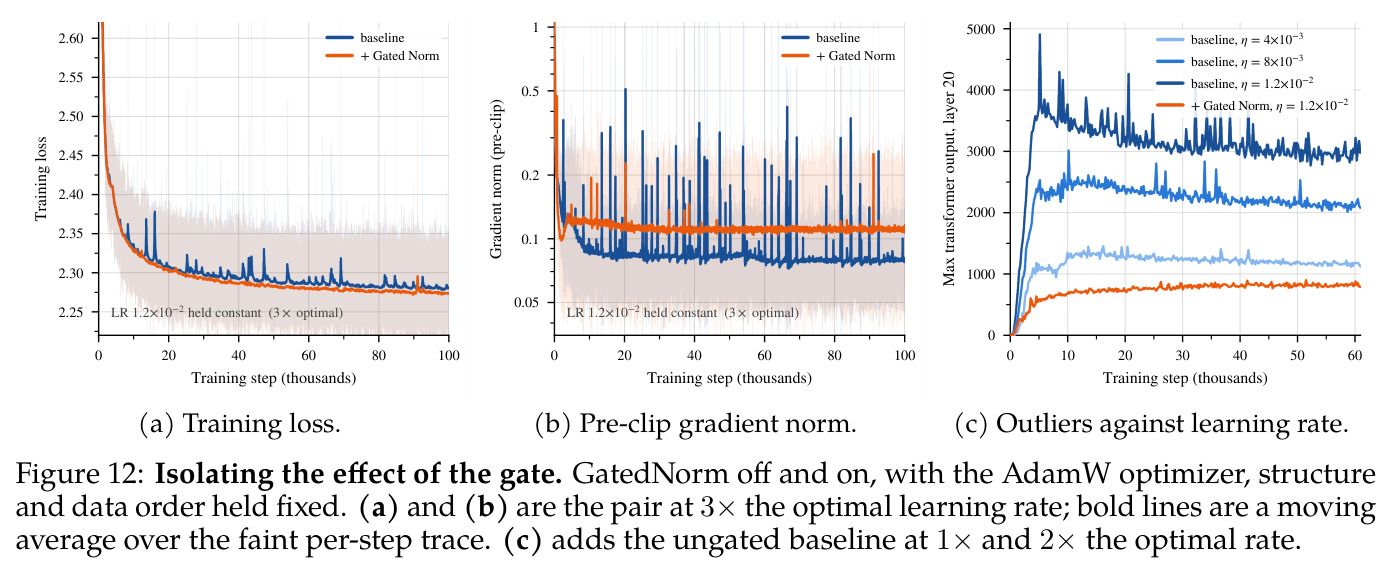
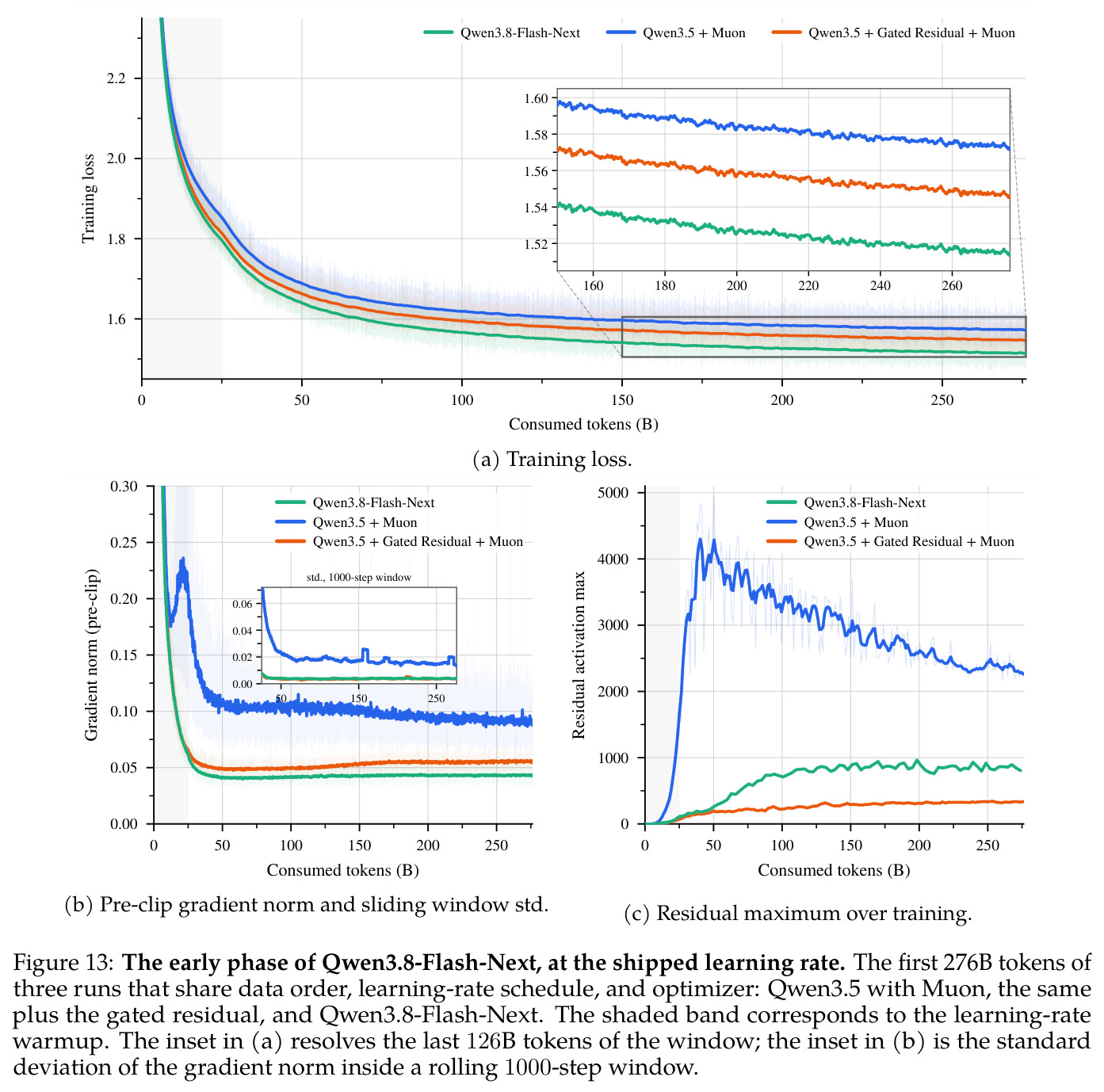
核心结果有五组。(1) 最终基座对比(Table 11):125B-A6B + 51B n-gram 的 Flash-Next-Base 在 14 个基准上全面超过 27B 稠密的 Qwen3.8-27B-Base(如 MMLU 90.36 vs 87.51、MATH 72.78 vs 60.54、SuperGPQA 51.36 vs 44.86),并在 8/14 上超过 397B-A17B 的 Qwen3.7-Plus-Base(MMLU-Pro 73.23 vs 70.90、MGSM 89.33 vs 85.42、SWEBench-Pretrain 50.99 vs 49.24),落后项目差距不超过 2.6 分,而激活参数与训练 token 约为 1/3、训练 FLOPs 约 1/9。(2) 架构消融(Table 1,25B-A3B):GDN 混合九基准平均 53.81,优于 SWA 混合 51.15 与全注意力 49.87,9 项中 8 项胜全注意力、7 项胜 SWA。(3) QSA(Table 2/3/4/6):短上下文平均 76.8 vs 全注意力 75.9(8 项中 7 项持平或更优);RULER 在 >512K 段 93.00 vs 90.08,MRCR 512K 40.53 vs 30.66、1M 26.44 vs 20.71;1M 上下文 kernel 级 prefill 提速 7.6×、decode 4.9×;与全注意力的预训练损失差仅 $10^{-4}$ 量级;MTP 平均接受长度 4.07 vs 4.06 无损。(4) 残差(Table 5/6/7 图):GR 平均 54.66、损失 1.590,优于 mHC dynamic 54.47/1.594 与 pre-norm 50.91/1.617;静态加宽已值 1.58 分、动态化再加 1.98 分;生产运行前 276B token 上 GR 降损失 0.026、完整配方共降 0.058。(5) 优化与稳定性:新缩放定律下 $B=25.2M$ 比旧配方省 $7.2\times10^{-3}$ 损失,批量预热无收益且多花 18.8% 优化步;156B-A7B 上预测最优超参平均基准 60.55 vs 旧配方 56.41;压力测试中 4× 学习率下 AdamW 基线每万步 183 次损失尖峰、Muon+GR 零尖峰且不触发裁剪;全量训练零损失尖峰、零梯度异常,无需 qk-clip/SwiGLU-clip。

查看结构化数据
| 任务 | 指标 | 本文 | 基线 | 提升 |
|---|---|---|---|---|
| 14 项预训练基准综合(vs 同代稠密模型) | 各基准准确率 | Qwen3.8-Flash-Next-Base 14/14 全面领先 | Qwen3.8-27B-Base(27B 稠密) | MMLU 90.36 vs 87.51,MATH 72.78 vs 60.54,SuperGPQA 51.36 vs 44.86 |
| 14 项预训练基准综合(vs 上代旗舰) | 领先基准数 / 最大落后幅度 | 8/14 领先,其余落后 ≤2.6 分 | Qwen3.7-Plus-Base(397B-A17B) | 以约 1/3 激活参数、1/3 训练 token、约 1/9 训练 FLOPs 达成 |
| token 混合架构消融(25B-A3B) | 9 基准平均分 | GDN 混合 53.81 | 全注意力 49.87 / SWA 混合 51.15 | +3.94 / +2.66 分 |
| 短上下文基准(CPT 后,25B→最终模型管线) | 8 基准平均分 | w/ QSA 76.8 | 全注意力 75.9 | +0.9 分,8 项中 7 项持平或更优 |
| 长上下文检索 RULER | >512K 长度段均分 | w/ QSA 93.00 | 全注意力 90.08 | +2.92 分 |
| 长上下文检索 8-needle MRCR | 512K / 1M 准确率 | w/ QSA 40.53 / 26.44 | 全注意力 30.66 / 20.71 | +9.87 / +5.73 分 |
| 1M 上下文注意力 kernel 延迟 | prefill / decode 提速倍数 | QSA 7.6× / 4.9× | FlashInfer paged GQA(1.0×) | 自 64K 起见效且随长度增长扩大 |
| 残差结构消融(25B-A3B,560B token) | 9 基准平均 / 训练损失 | GR 54.66 / 1.590 | Pre-norm 50.91 / 1.617;mHC dynamic 54.47 / 1.594 | +3.75 分 / −0.027 损失 |
| 训练稳定性压力测试(4× 最优学习率恒定) | 每万步损失尖峰数 | Muon + GR:0 | AdamW + Qwen3.5 结构:183 | 尖峰完全消除,且全程未触发梯度裁剪 |
| 学习率配方验证(156B-A7B,419B token) | 7 基准平均分 | 新缩放定律预测最优 60.55 | Qwen3.5 旧配方 56.41 | +4.14 分,且梯度范数峰值仅达裁剪阈值 28%(旧配方 51%) |
| 批大小验证(10.8B-A0.89B,4T token) | 末 20B token 平均损失 | B=25.2M:1.5702 | 旧配方 B=12.6M:1.5774 | −7.2×10⁻³;再增大到 37.7M 仅劣化 4.3×10⁻⁴ |
局限与改进
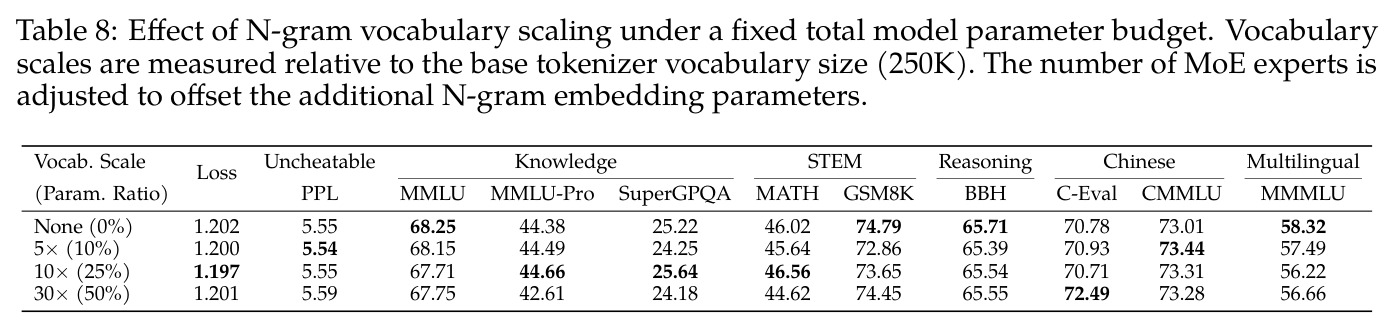
作者明确承认的局限有三。其一,多个“损失与基准不一致”的案例只能靠大规模评测发现:稀疏残差写入在预训练损失与基准上几乎无损,但后训练后质量明显下降,只好放弃;NoPE 在预训练与 RoPE 无差别,却使后训练后不终止生成比例升高;把每块限制为门控最高的两个分支几乎不影响预训练,却随训练推进退化。作者坦言当前最紧的瓶颈是评测吞吐——缺少能可靠预测后训练排序的廉价中期探针。其二,n-gram 词表增大只让损失单调下降(1.585→1.526),下游多数基准饱和甚至波动,仅中文基准(C-Eval 66.91→74.94)持续受益,说明该容量维度收益不均;固定参数预算下 10× 词表损失最优但下游不升,n-gram 与 MoE 专家的分工尚未被刻画。其三,学习率验证中前四名设置终损差距仅 $7\times10^{-4}$ 且每配置只评一次,作者自己把具体排名归为观测性结论。我自己的观察:QSA 依赖两阶段蒸馏+联合训练的 CPT 流程(约 202B token 额外开销),从零预训练直接用稀疏注意力的可行性未验证;51B n-gram 表驻留主机内存依赖确定性寻址与主机带宽,对部署环境有隐含假设;几乎所有消融在 25B/35B-A3B 规模完成,外推到 125B 靠缩放定律与压力测试间接保证。
独立分析的弱点
独立分析出四个弱点。第一,QSA 的两阶段训练流水线复杂且昂贵:先 1000 步蒸馏(lr $10^{-3}$,每步 8 条 256K 序列)再 8000 步联合训练(lr $2.5\times10^{-5}$,每步 96 条 256K 序列,约 200B token),需要预先有带全注意力的强骨干做教师;改进方向是把蒸馏目标并入常规预训练目标、或让索引器自举,使稀疏注意力可从头训练。第二,GR 的质量与可解释性都依赖“无 $H_{res}$、各分支独立累加”的结构,一旦为压缩访存引入稀疏写或分支混合,机制即失效——文中稀疏写失败发生在后训练阶段才被发现,说明缺少后训练前就能预警的中期探针;改进方向是构建小规模“后训练代理评测”管线,把指令跟随/生成终止等行为纳入常规消融。第三,n-gram 嵌入与 MoE 的容量分工不明:固定预算下 10× 词表损失最优但下游无提升,且作者尝试的词表压缩、非均匀阶分配、按频分区等参数效率策略均无一致收益;改进方向是按知识记忆 vs 推理分别度量两类容量的边际收益,并探索数据分布感知的槽位分配。第四,效率账绑定特定硬件:GR 去 $H_{res}$、FP8 残差、主机内存 n-gram 预取都针对特定内存层级,若部署环境主机带宽受限或 FP8 支持不佳,收益会缩水;改进方向是给出跨硬件成本模型与自适应配置开关。
未来方向
作者在结论中点名的方向是评测吞吐:需要一个“更便宜的中期探针,能可靠预测后训练排序”,让架构设计空间真正可搜索——这可能是比任何单一架构改进杠杆更大的后续工作。基于本文成果可延伸的方向包括:(1) 把 QSA 推广到预训练全程而非仅 CPT 阶段,检验稀疏注意力从零训练的缩放行为与索引器随数据量的进化;(2) 借鉴文中提到的 xHC 用更大分支数 $n_r$ 使稀疏分支更新可行的思路,在控制访存的前提下进一步压缩 GR 残差状态(文中因 $n_r$ 增大的访存代价未深入);(3) 把 GR 的精确贡献分解(式 36–37,各读者份额和为 1、误差 $3\times10^{-8}$)发展为残差网络的常规分析工具,用于指导分支分配与层间信息路由设计;(4) Canzona 的“逻辑优化器指派与物理布局解耦”抽象可推广到其他矩阵优化器,并与 FP8 优化器状态、通信-计算重叠进一步结合;(5) n-gram 嵌入与 MoE 的容量分工值得系统研究——中文基准持续受益暗示了与数据分布相关的记忆效应,可在知识密集场景定向扩展;(6) 稳定性方面,门控重缩放能否在更大规模、更多优化器组合下普遍替代 qk-clip/SwiGLU-clip 等显式裁剪,值得验证。
复现评估
复现难度较高但部分可行。开源情况:FlashQLA 内核库已在 GitHub(QwenLM/FlashQLA)开源并附基准;按 Qwen 惯例模型权重可能后续开源,但本报告未给出训练数据配方与训练代码,数据是最大缺口。算力:完整复现需要万卡级集群——正文验证实验包括 10.8B-A0.89B MoE 训 4T token、156B-A7B MoE 训 419B token(每配置一个 run 共五个)、多组 25B-A3B 级 560B-token 消融,仅超参验证一项就超出学术实验室预算;QSA 的 CPT 阶段每步 96 条 256K 序列共 8000 步,约 200B token。可行的降级路径:(1) 复现 25B-A3B 规模的 GDN/SWA/全注意力对照与 GR/mHC 消融(结论见 Table 1/5,约 400–560B token),多机可承受;(2) QSA 蒸馏+稀疏训练流程可在 35B-A3B 上按文中超参复现并用 RULER 对比(Figure 5 的协议);(3) 压力测试协议(恒定 2×/4× 学习率、统计每万步尖峰数与梯度范数 p99.9)成本极低,是最值得学术圈直接采纳的部分。总体评估:核心定性结论(GDN 优于 SWA、GR 的稳定性增益、门控机制)可在小规模复现,端到端定量结果依赖工业级资源与未公开数据。
论文图表
最终模型 CPT 后的短上下文对照:QSA 平均 76.8 vs 全注意力 75.9,8 项中 7 项持平或更优(MATH 71.6 vs 69.8,MultiPL-E 79.8 vs 78.4),仅 MMMLU 微降(81.1 vs 81.8)。
证明稀疏化在短上下文任务上无系统性损失,是“效率收益不以能力为代价”的关键证据。