扩散模型的在线策略自蒸馏 On-Policy Self-Distillation in Diffusion Models
用奖励梯度构造有界正负中间目标并在线自蒸馏拟合,把图像级奖励变成显式可诊断的监督。
前置知识
整流流与清洁输出预测
整流流(rectified flow)用路径 $z_\sigma=(1-\sigma)y+\sigma\epsilon$ 连接干净图像 $y$ 与噪声 $\epsilon$,模型预测速度 $v=\epsilon-y$。由代数关系可从速度预测恢复清洁输出预测 $y_\theta(s)=z_\sigma-\sigma v_\theta(s)$,它能经 VAE 解码器解码成图像、被图像级奖励直接打分。该映射不是等距的:$\delta y=-\sigma\,\delta v$,低噪声时速度扰动在图像空间被衰减。
本文全部监督都定义在这个可解码、可打分的清洁输出坐标上;不理解它就无法理解目标如何在查询处构造、又如何等价回速度空间拟合。
在线策略学习与行为策略 EMA
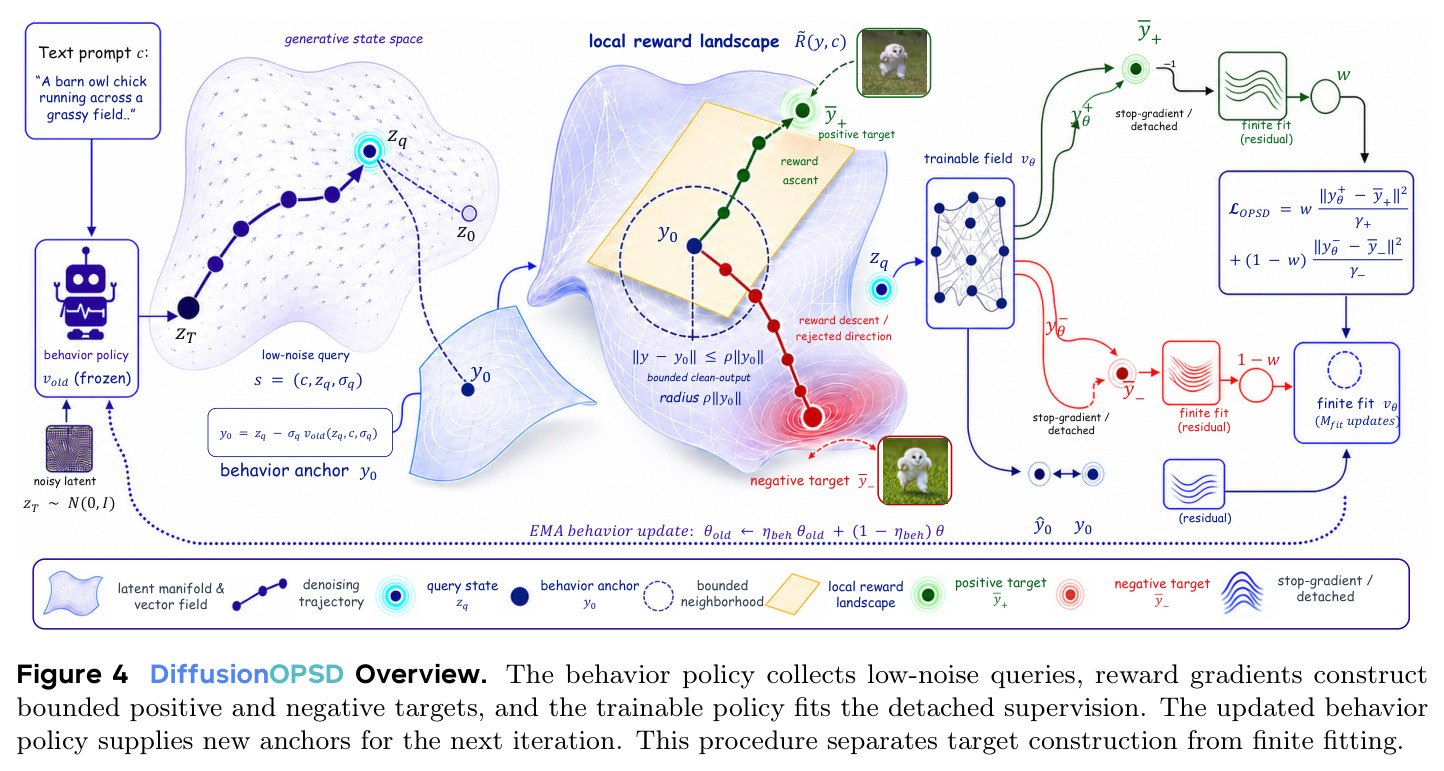
在线策略指训练数据由当前策略自身采样产生。本文用冻结的行为策略 $v_{old}$ 生成轨迹并提供查询状态与锚点,拟合若干步后用指数移动平均 $\theta_{old}\leftarrow\eta_{beh}\theta_{old}+(1-\eta_{beh})\theta$ 刷新它,在数据新鲜度与分布稳定性之间折中,类似 PPO 的 old policy 但更新更平滑。
目标锚在行为策略自己的预测上并随其演化而重建,这正是方法名里「在线策略」与「自蒸馏」两个词的准确含义。
可微奖励模型与奖励梯度
指对(图像,文本)打分的神经网络奖励模型,如 PickScore、HPSv2.1、ImageReward。由于解码器与奖励模型都可微,可以对清洁输出求局部奖励梯度 $\nabla_y\tilde R(y,c)$,它指示「往哪个方向修改图像能提高奖励」。
DiffusionOPSD 正是用这个梯度做归一化上升/下降步来构造正负目标,而不是像 ReFL 那样把梯度直接反传进模型参数。
蒸馏与自蒸馏
蒸馏让学生模型回归教师模型的预测;在线策略蒸馏沿学生自己的 rollout 采集监督以避免分布偏移。自蒸馏则不需要外部更强教师:「教师」就是自己加上改进——以行为策略的预测为锚,用奖励梯度把锚点推向好/坏方向,形成正负目标当作人造教师。
区别于 DanceOPD 等匹配外部冻结教师场的在线蒸馏,理解这一点才能抓住本文与现有 on-policy distillation 的本质分界。
停止梯度与分离式监督
stop-gradient(sg)切断张量的梯度回传,使其作为常数参与损失。本文中查询状态、锚点、组权重与正负目标全部 detach:$\nabla_\theta z_q=\nabla_\theta\omega=\nabla_\theta y_0=\nabla_\theta\bar y^\pm=0$,拟合阶段只保留普通回归梯度,不保留奖励与解码器计算图。
正是这种解耦让作者能把失败归因于「目标构造得差」还是「有限拟合没实现目标」,这是论文分析框架与可诊断性主张的基础。
组归一化优势(GRPO 风格权重)
同一 prompt 采样 $K$ 条轨迹为一组,组内奖励减去组均值、再除以整个 rollout 批的标准差并裁剪到 $[-1,1]$,得到 $\omega=\tfrac12+\tfrac12\,\mathrm{clip}(\cdot)\in[0,1]$,控制正负分支的相对拟合强度。组内中心化消除 prompt 间奖励偏移,全局尺度让不同 prompt 可比。
它继承了 GRPO/DiffusionNFT 的优势加权思想,但只决定两个分支各占多大权重——改进方向本身来自奖励梯度,这是两套信号的分工。
LoRA 低秩适配
冻结基座模型权重,只训练低秩增量 $\Delta W=BA$(秩 $r\ll d$)来微调大模型,大幅节省显存与算力。本文在 SD3.5-M 与 Z-Image-Turbo 上均使用秩 32、alpha 64 的 LoRA 适配器,而非全参数微调。
理解实验协议、显存占用(如 Z-Image-Turbo 峰值 61.5 GB)与复现成本(单节点 8×A800 即可训练)都需要知道训练对象是 LoRA。
研究动机
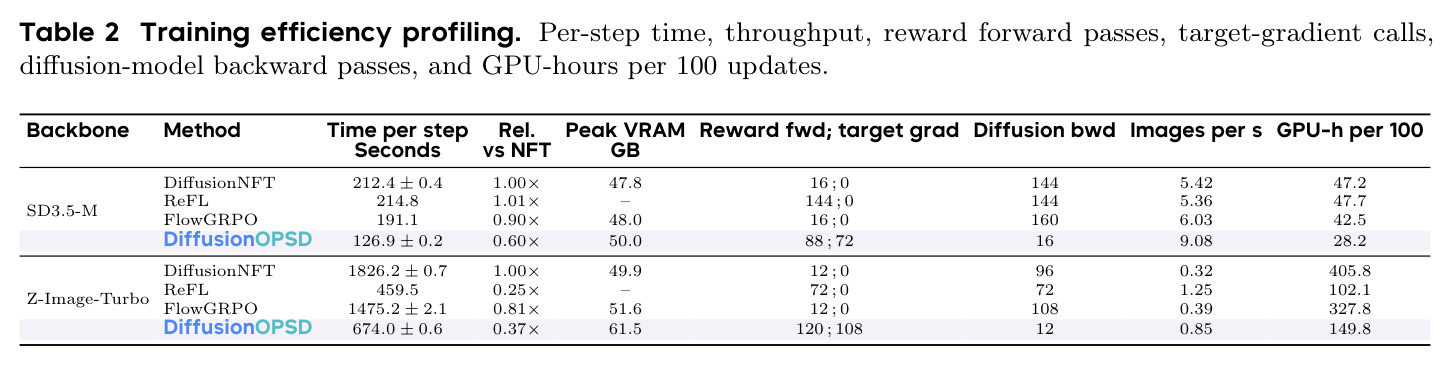
扩散/流模型的对齐训练普遍依赖「终点奖励」:一条 rollout 由多个相互依赖的去噪预测构成,而奖励只能在最终图像解码之后观测到。这造成监督位置与策略作用位置的结构性错配——要改进最终图像,必须把图像级奖励翻译成对中间去噪查询的可执行监督。现有三条路线各有痛点:FlowGRPO 用有限组采样优势加近似转移似然比做策略梯度,更新质量受采样预算、似然估计、离散化与 rollout 选择的制约;ReFL 把可微奖励直接反传穿过截断 rollout 的单个后段清洁输出预测,训练时保留奖励计算图、奖励评估与模型优化耦合,其标准化档案在 SD3.5-M 上每 100 更新耗 47.7 GPU 时、Z-Image-Turbo 上 102.1 GPU 时;DiffusionNFT 用奖励加权端点做前向过程回归,效率高,但目标仍是端点本身,没有说明「当前中间预测应当如何改进」。同时,未对齐的 SD3.5-M 无 CFG 基线在 HPSv3 上仅 $-6.47$、VLM-Pairwise 仅 $0.069$,说明对齐空间巨大,而「奖励如何变成目标」的接口选择直接决定了实际求解的优化问题。
本文的目标是本文的目标是把图像级奖励指导转化为对中间去噪预测的显式、有界且持续刷新的监督信号,并让「构造好目标」与「有限步拟合实现目标」成为两个可分别测量、可分别诊断的阶段。具体而言:在行为策略采样的低噪声查询处,围绕其清洁输出锚点构造保证落在信任域内的正/负目标(正目标提高局部奖励,负目标作排斥参考);让可训练策略以有限次优化器更新把这些目标当作 detached 监督来拟合;再用 EMA 刷新行为策略并重建目标,形成在线循环。作者希望该「在线策略自蒸馏」框架在 SD3.5-M 与少步蒸馏的 Z-Image-Turbo 两个骨干、十个评估器上取得最终留出集最优质量,同时显著降低训练算力(相对 DiffusionNFT 节省 40% 与 63% GPU 时),并能解释「更大的目标级增益为何不一定带来更大的拟合后增益」。
与已有工作不同的是,本文的独特切入是:不在参数梯度、优势权重或端点加权里隐式编码奖励,而是在更新模型之前先显式构造一个「奖励改进目标」。与三类近邻工作的本质差异:(1) 对比 FlowGRPO/DanceGRPO——它们用采样优势给轨迹赋权、避免构造局部改进方向,且对似然估计与采样器敏感;本文用奖励梯度给出确定性的改进方向。(2) 对比 ReFL——它把奖励梯度直接反传到参数、训练全程保留奖励图;本文只在构造阶段对临时清洁输出变量求一次梯度,拟合阶段不保留奖励图,且把位移限制在半径 $\rho\|y_0\|_2$ 的信任域内。(3) 对比 DiffusionNFT——它对奖励加权端点回归,端点不指示中间预测如何改进;本文把「查询状态来源」(前向加噪→rollout 切片)与「目标构造」(加权端点→奖励梯度目标)两个替换解耦,用析因分解 $\phi_{tgt}+\phi_{query}$ 定量归因。由此,目标构造与有限实现可以被恒等式 $G_{realized}=G_{construct}-G_{fit}$ 分开审计,这是此前工作不具备的可诊断性。
核心方法
直觉:与其让稀疏的终点奖励通过复杂的信用分配去扭曲每一步去噪,不如在每个查询处直接回答「当前预测应该变成什么样」。技术路线是三阶段在线循环。(1) 查询采集:冻结行为策略 $v_{old}$ 对每个 prompt 采 $K$ 条轨迹,得到端点奖励 $r_k$ 与最接近请求噪声级 $\sigma^\star$ 的查询 $s=(c,z_q,\sigma_q)$($\sigma^\star=0.278/0.273$),锚点为行为策略的清洁输出预测 $y_0=z_q-\sigma_q v_{old}(z_q,c,\sigma_q)$。(2) 目标构造:把 $y_0$ 解码后求局部奖励 $\tilde R$,从 $y_0$ 出发做 $M_{tgt}=2$ 步归一化梯度上升/下降,步长 $h_{step}=\eta_{tgt}\rho\|y_0\|_2/M_{tgt}$,每步投影回信任域球 $\|y^\pm-y_0\|_2\le\rho\|y_0\|_2$($\rho=0.10$),得到 detached 正负目标 $\bar y^\pm$。(3) 有限拟合:可训练策略在同一查询上输出 $y_\theta$,经分支 $y_\theta^+=\beta y_\theta+(1-\beta)y_0$ 与 $y_\theta^-=(1+\beta)y_0-\beta y_\theta$ 最小化 $\mathcal{L}_{OPSD}=\omega\,\mathrm{mean}[(y_\theta^+-\bar y^+)^2]/\gamma^+ +(1-\omega)\,\mathrm{mean}[(y_\theta^- -\bar y^-)^2]/\gamma^-$;组归一化权重 $\omega\in[0,1]$ 与自适应法向 $\gamma^\pm$ 都是 stop-gradient 量。规范设置每轮只做 $M_{fit}=1$ 次 AdamW 更新,随后用 EMA 刷新行为策略,进入下一轮采集—构造—拟合。
核心创新是「先造目标、再拟合目标」:奖励信息在构造阶段一次性用完(只对临时清洁输出变量求梯度),参数更新退化为普通的 detached 回归。三个本质区别:其一,目标是显式的中间监督而非隐式信号——ReFL 的奖励梯度、FlowGRPO 的优势、DiffusionNFT 的端点权重都没有说明「预测应变成什么」;本文的 $\bar y^\pm$ 直接给出图像空间位移 $d^\pm=\bar y^\pm-y_0$,对损失完成平方后理想解为 $\delta_\star=(a^+d^+-a^-d^-)/(\beta(a^++a^-))$,在局部对称情形退化为 $\bar h u_{grad}/\beta$,即纯沿奖励梯度方向的改进,正负分支的混合权重在理想解处恰好抵消。其二,有界性:归一化步长加球投影保证 $\|y^{(m)}_\pm-y_0\|\le\rho\|y_0\|_2$,一阶上升保证单步至少提升约 $h_{step}\|g\|_2^2/(\|g\|_2+\epsilon_g)-Lh_{step}^2/2$,是把经典信任域/保守策略改进思想实例化到清洁输出空间。其三,自蒸馏而非外蒸馏:目标锚在行为策略自己的预测上、随 EMA 刷新而重建,不需要外部教师;stop-gradient 分离让 $G_{realized}=G_{construct}-G_{fit}$ 成为精确可测的恒等式,从而第一次能把「目标没造好」与「目标没拟合上」区分开。
方法步骤详情
完整流程(Algorithm 1):输入可训练策略 $v_\theta$、奖励 $R$、解码器 $D$、prompt 集 $C$、组大小 $K$、请求噪声级 $\sigma^\star$、半径 $\rho$、目标步数 $M_{tgt}$、拟合预算 $M_{fit}$、分支系数 $\beta$、共享损失/裁剪尺度 $c_{adv}=5$ 与稳定子 $\epsilon_Z,\epsilon_g,\epsilon_\gamma$。第一步 rollout:行为策略每个 prompt 采 $K$ 条轨迹(SD3.5-M 为 24 张/组、48 组/轮;Z-Image-Turbo 为 12 张/组),得端点奖励 $r_{kc}$,选 $\sigma_q=\arg\min_j|\sigma_j-\sigma^\star|$,输出 detached 查询。第二步权重:$\omega_{kc}=\tfrac12+\tfrac12\,\mathrm{clip}\big((r_{kc}-\bar r_c)/Z_{\mathcal B},-1,1\big)$,$Z_{\mathcal B}=c_{adv}(\hat\sigma_{\mathcal B}+\epsilon_Z)$ 用整批标准差、$\bar r_c$ 为组内均值。第三步构造:从 $y_0$ 出发按 $y^{(m+1)}_\pm=y^{(m)}_\pm\pm h_{step}\,\nabla_y\tilde R/(\|\nabla_y\tilde R\|_2+\epsilon_g)$ 迭代 $M_{tgt}=2$ 步,每步投影回信任域球,输出 $\bar y^\pm=\mathrm{sg}(y^{(M_{tgt})}_\pm)$;正负路径共享 $y_0$ 处的同一奖励梯度以省算力。第四步拟合:用冻结行为策略重算锚点,按双分支加权归一化平方损失(自适应法向 $\gamma^\pm$ 为 stop-gradient 的残差平均绝对值)累积小批量,执行 $M_{fit}=1$ 次 AdamW 更新(学习率 $3\times10^{-4}$)。第五步刷新:$\theta_{old}\leftarrow\eta_{beh}^{(u)}\theta_{old}+(1-\eta_{beh}^{(u)})\theta$,$\eta_{beh}^{(u)}=\min\{10^{-3}u,0.5\}$,另有 checkpoint EMA 输出权重平均的最终模型。全部训练用 LoRA(rank 32、alpha 64),单节点 8×A800-80GB。
技术新颖性
新颖性体现在四个层面。第一,问题形式化:把扩散后训练明确拆成「reward-to-target 接口」与「有限实现」两个耦合阶段,给出 $G_{realized}=G_{construct}-G_{fit}$ 的精确分解和拟合鸿沟的三种失效模式(欠实现、旋转、过冲),这是此前工作没有的分析语言。第二,机制设计的自洽性:在清洁输出坐标上做信任域归一化梯度步,一般 affine 调度可由 $y_t=(\dot\sigma_t z_t-\sigma_t v_t)/\Delta_t$ 换算;证明低噪声解码稳定($\|y_v-y_{v^*}\|_2\le\sigma\|v-v^*\|_2$),并证明该损失精确等价于一对带 $\sigma_q^2$ 权重的速度 MSE($\sigma_q^2$ 因子在平方后消去),无需特殊策略梯度估计器。第三,正负双分支:与 DiffusionNFT 的端点分裂不同,正负目标由同一锚点的奖励上升/下降梯度推出,局部对称时两分支合力指向同一改进方向,$\omega$ 只在不对称时起调节作用;这把「采样优劣加权」升级为「构造优劣方向」。第四,实证方法论:同查询受控实验发现 HPSv2.1 上目标排序在单次 fresh-AdamW 拟合后以 62.3% 的 prompt 反转,说明构造增益不能预测实现增益——这一反直觉结论对整个奖励驱动后训练领域都有警示价值。附录 C.9 的 CFG 补偿恒等式 $\|A_{\zeta_{ev}}(\Delta v_c,\Delta v_u)-\Delta v_{tar}\|^2=(\zeta_{ev}-\zeta_{tr})^2\|\Delta v_{gap}\|^2$ 还解释了训练/评估引导尺度失配带来的二次惩罚。
实验结果
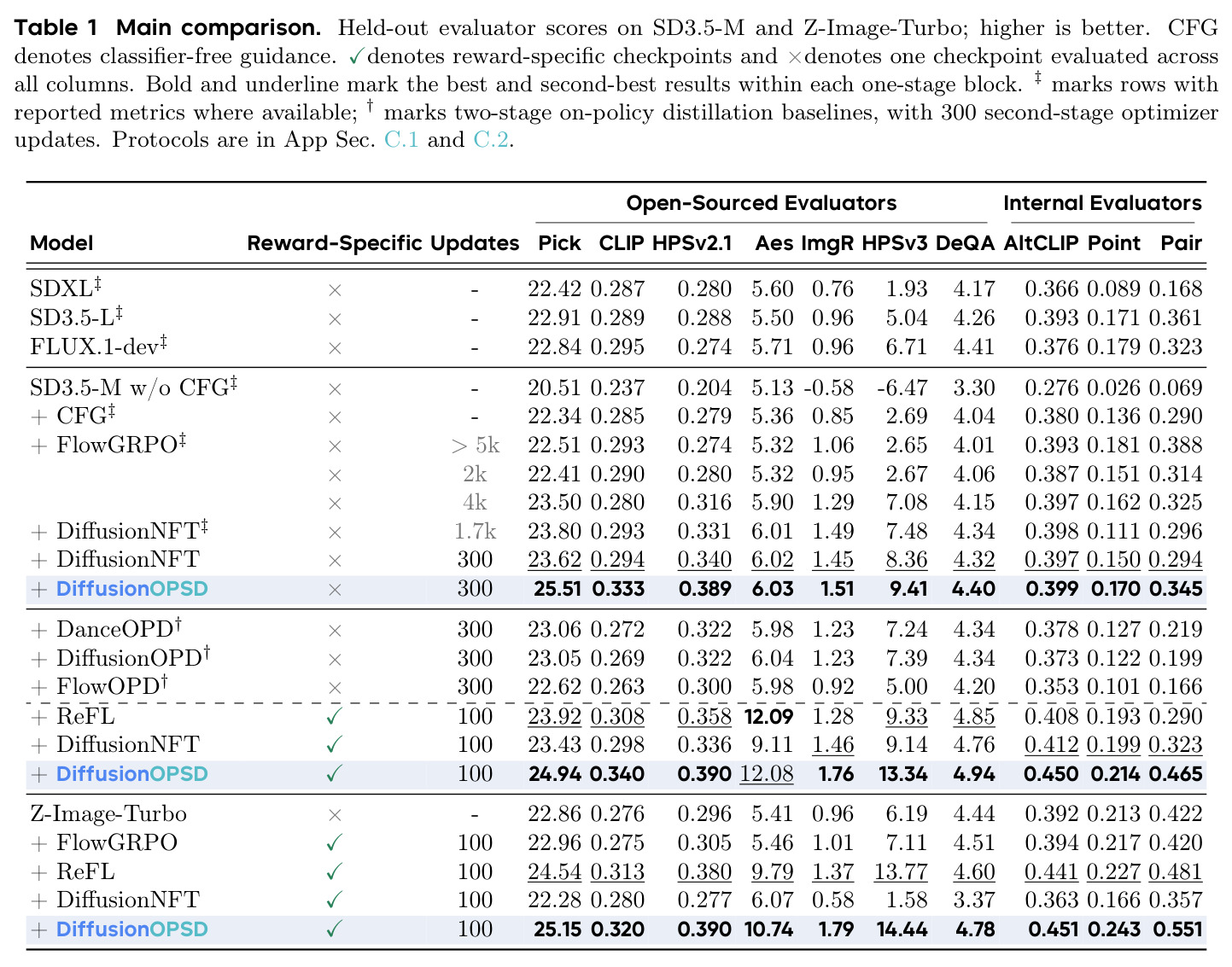
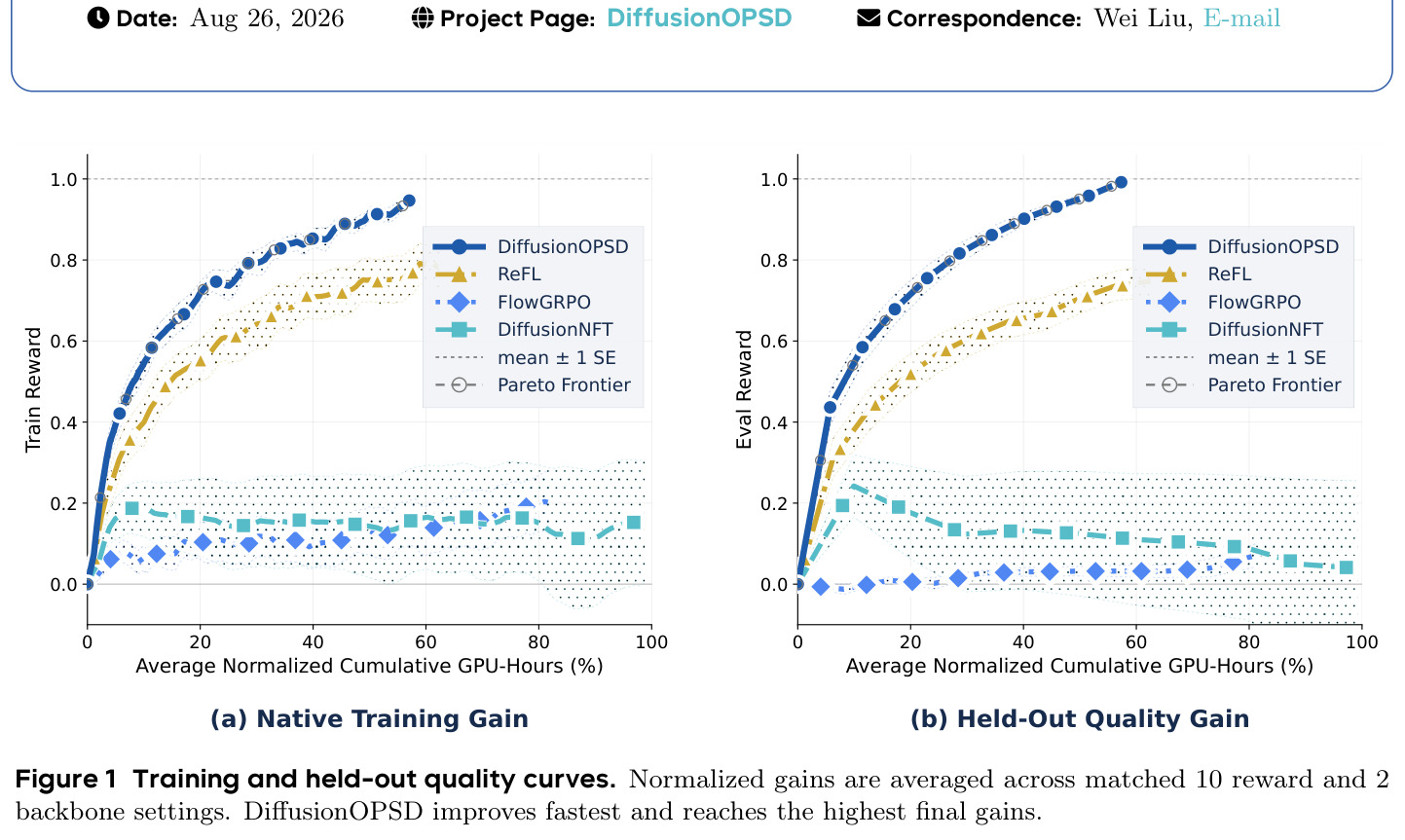
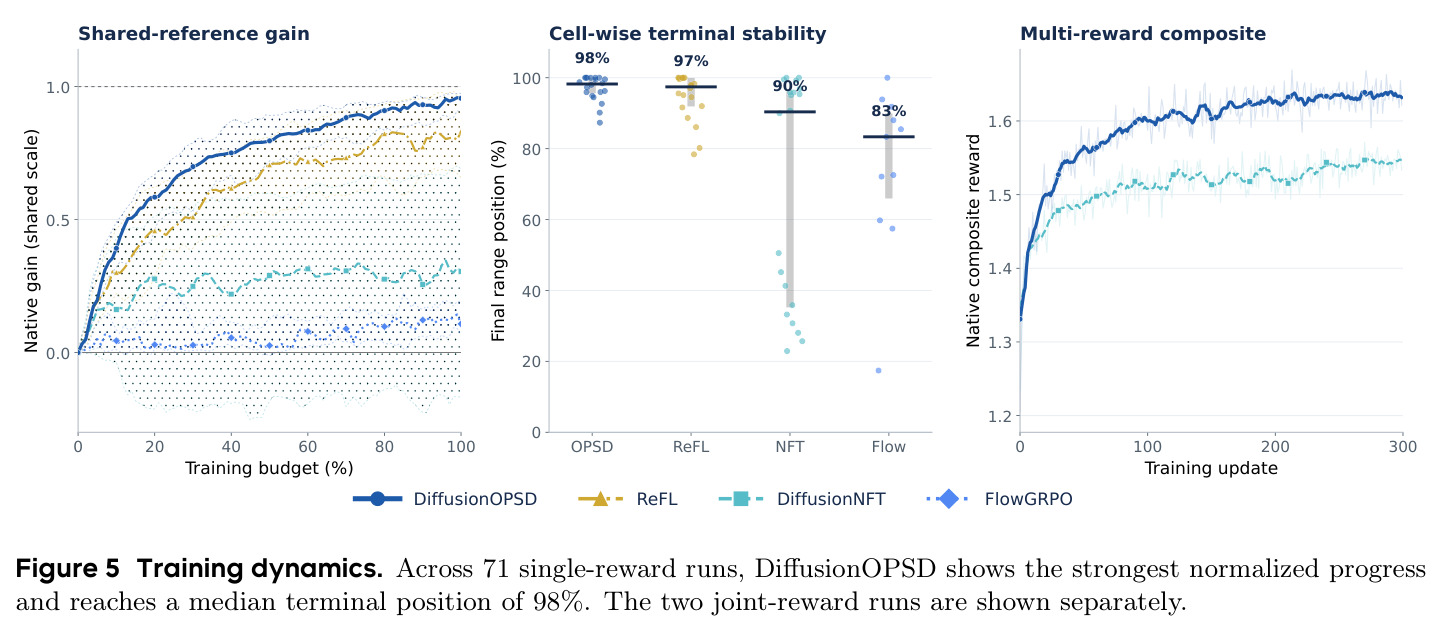
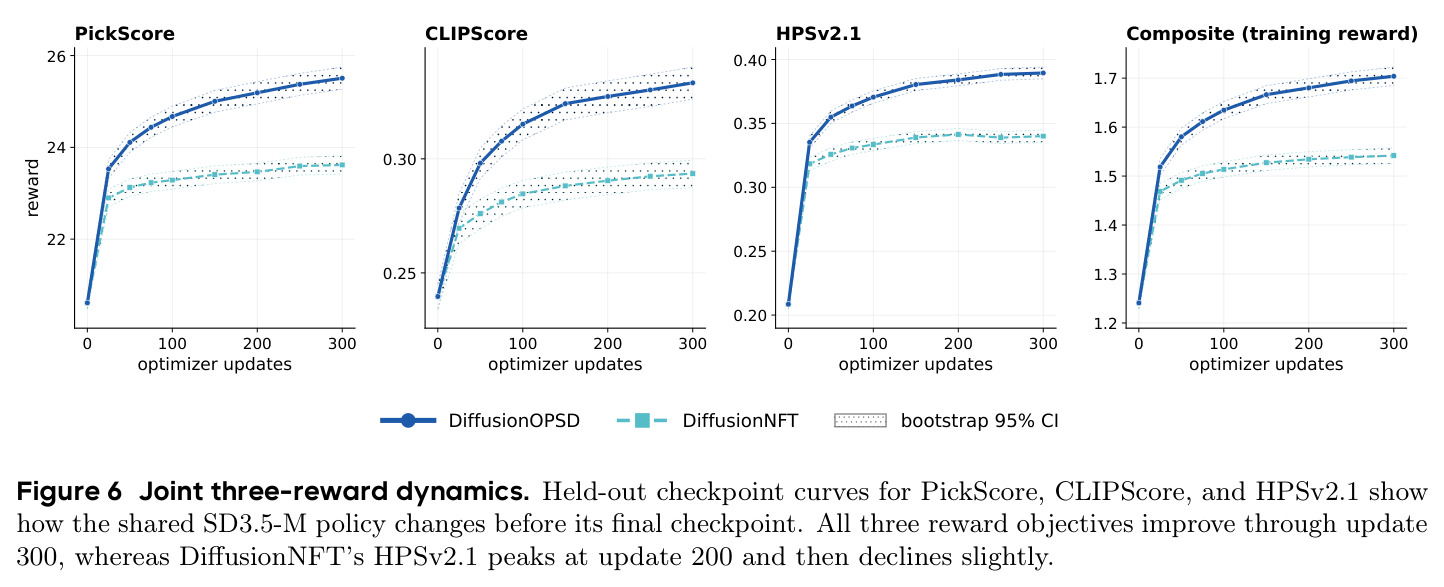
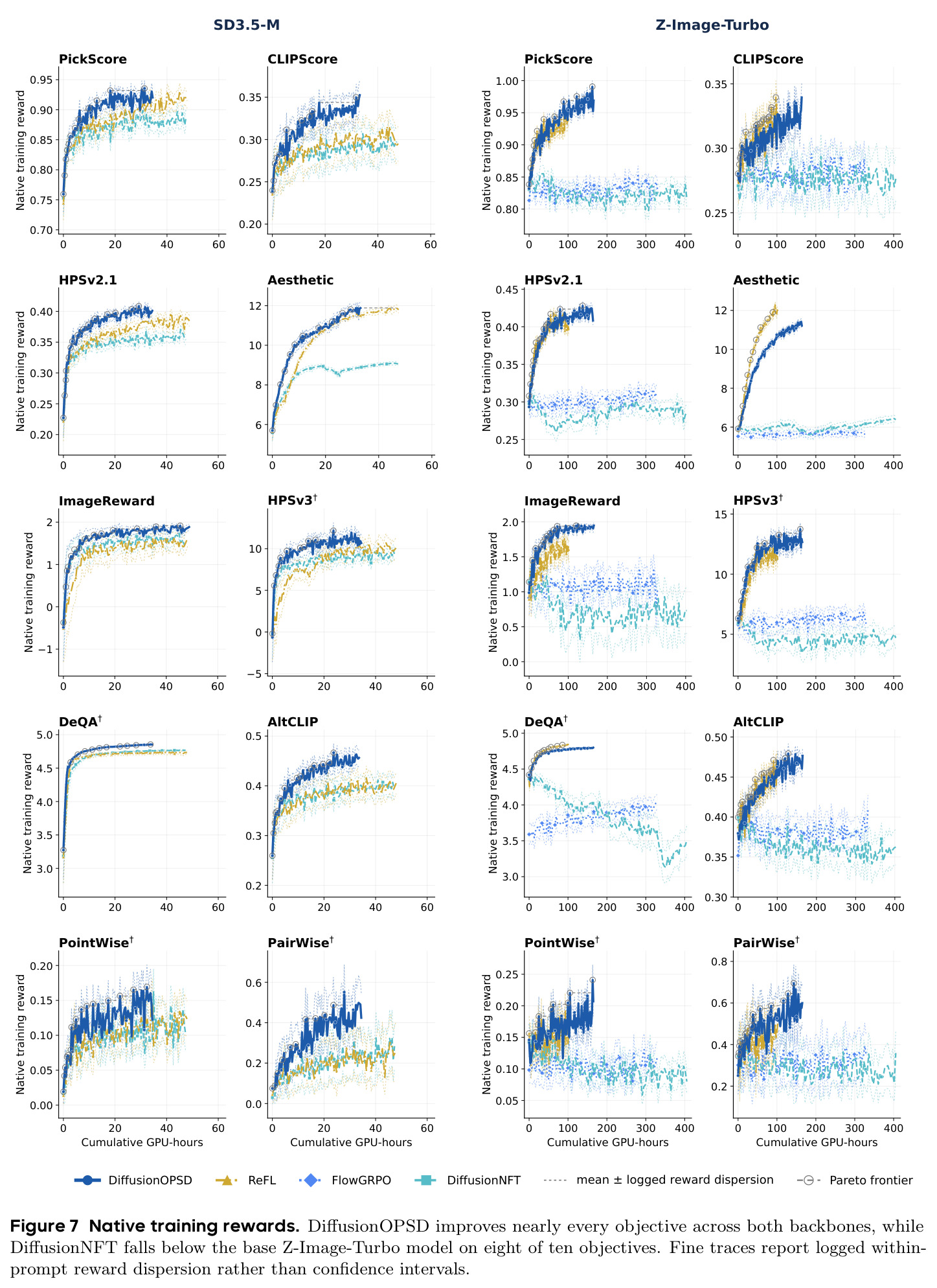
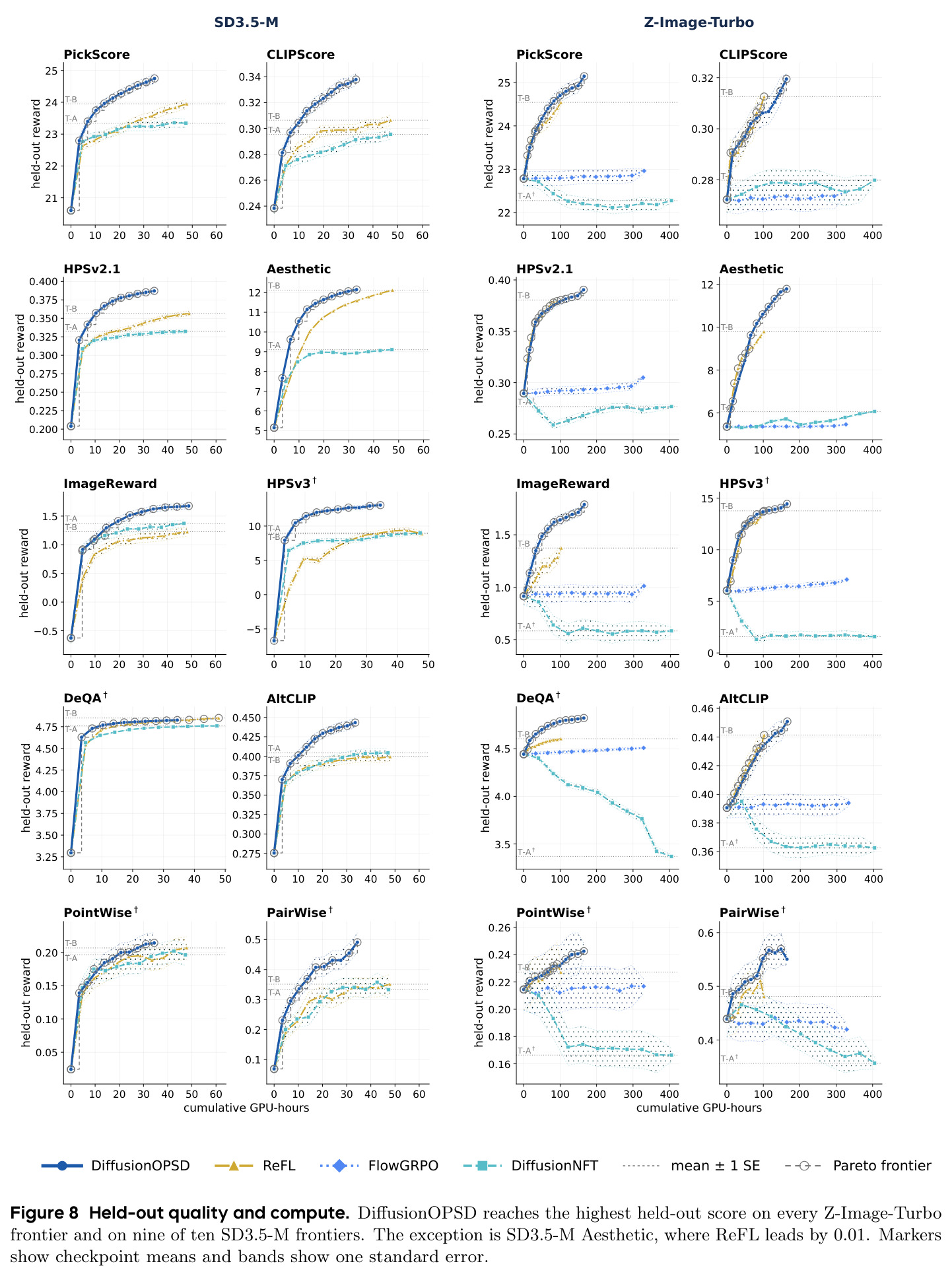
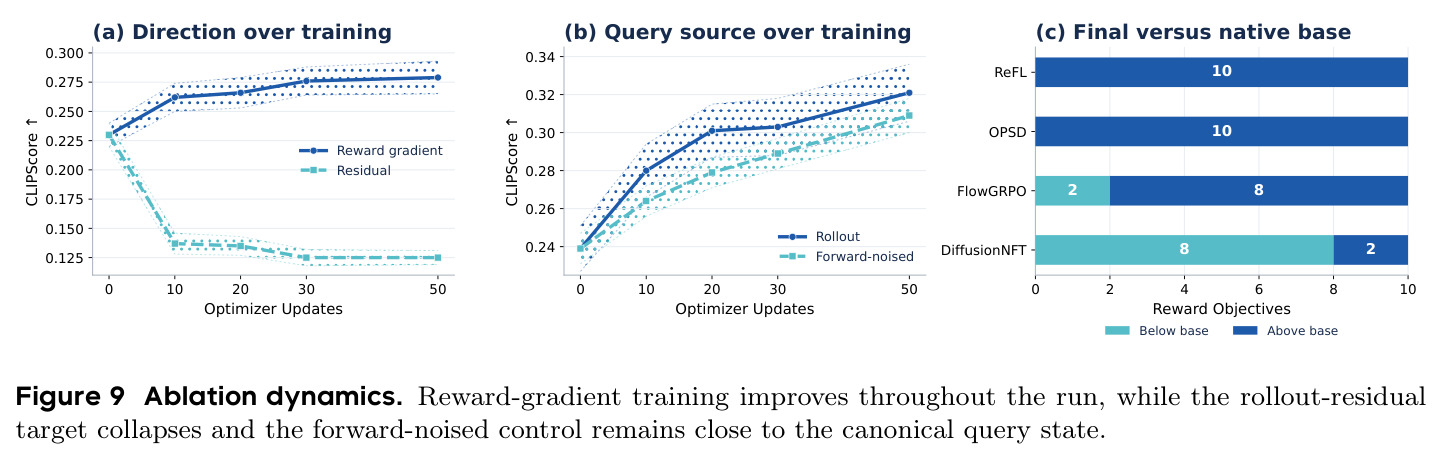
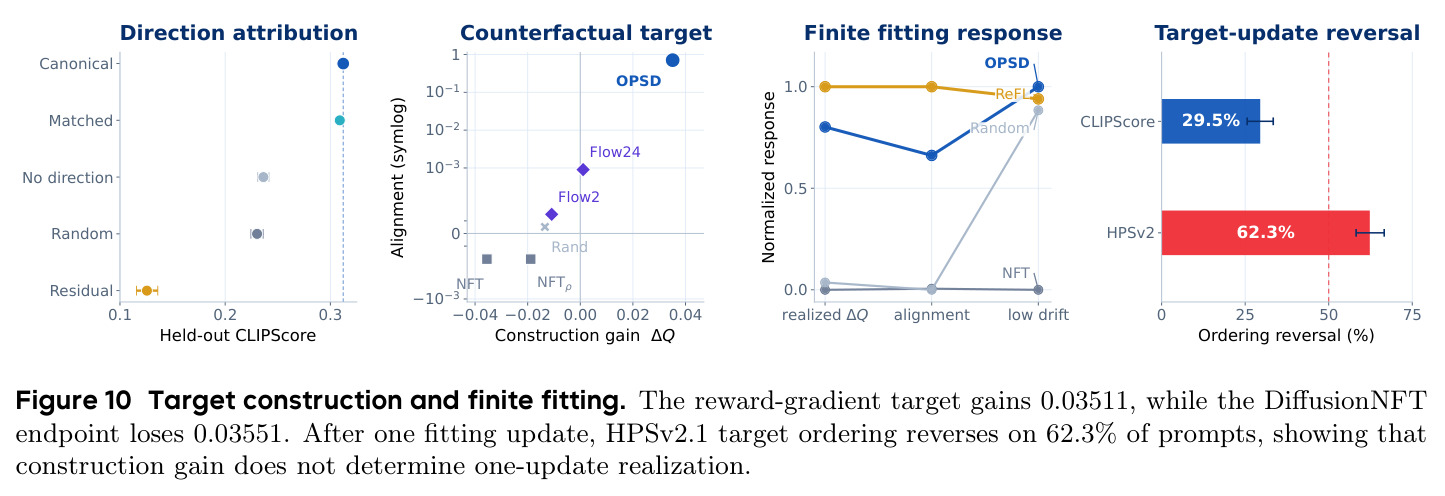
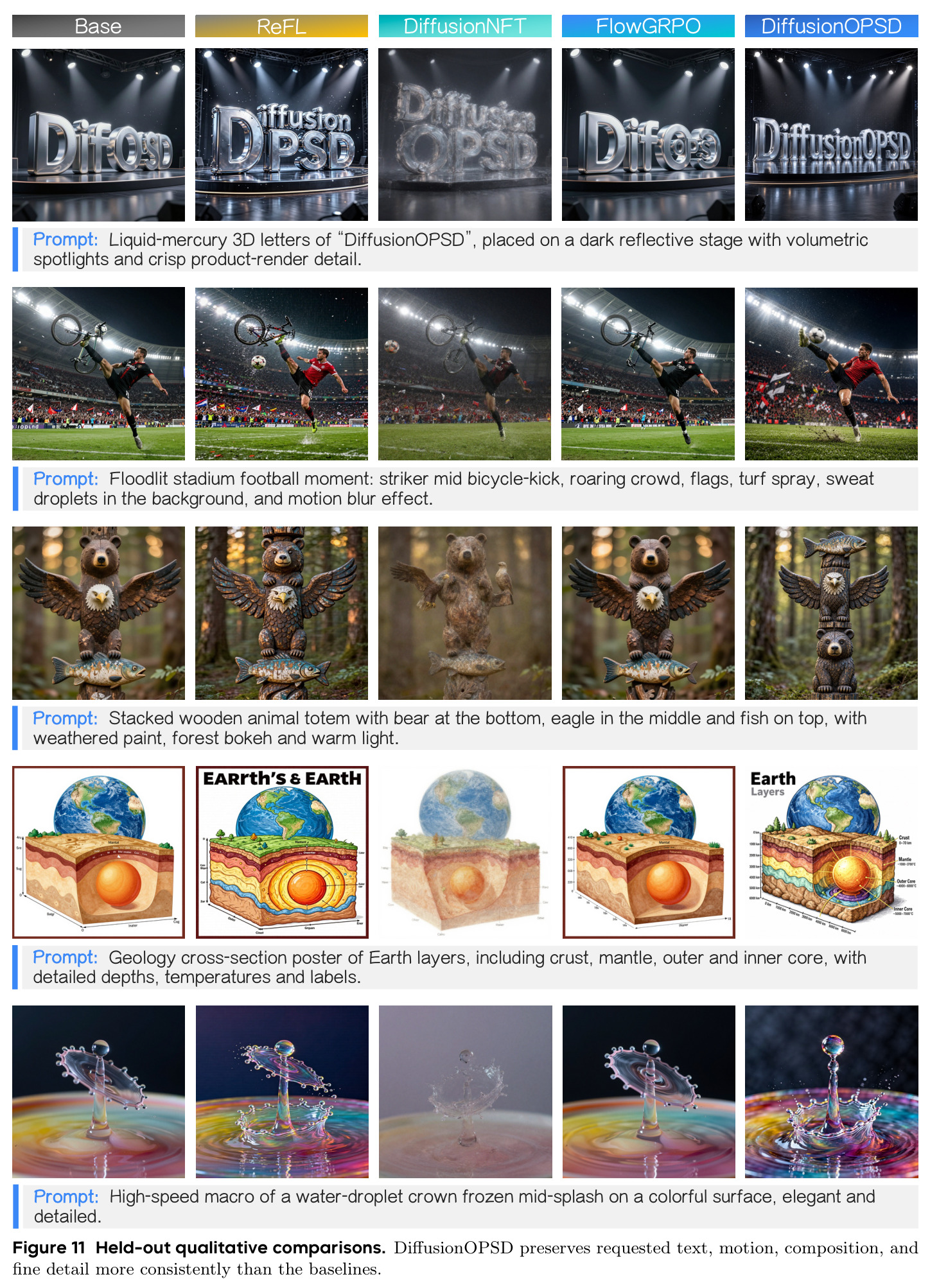
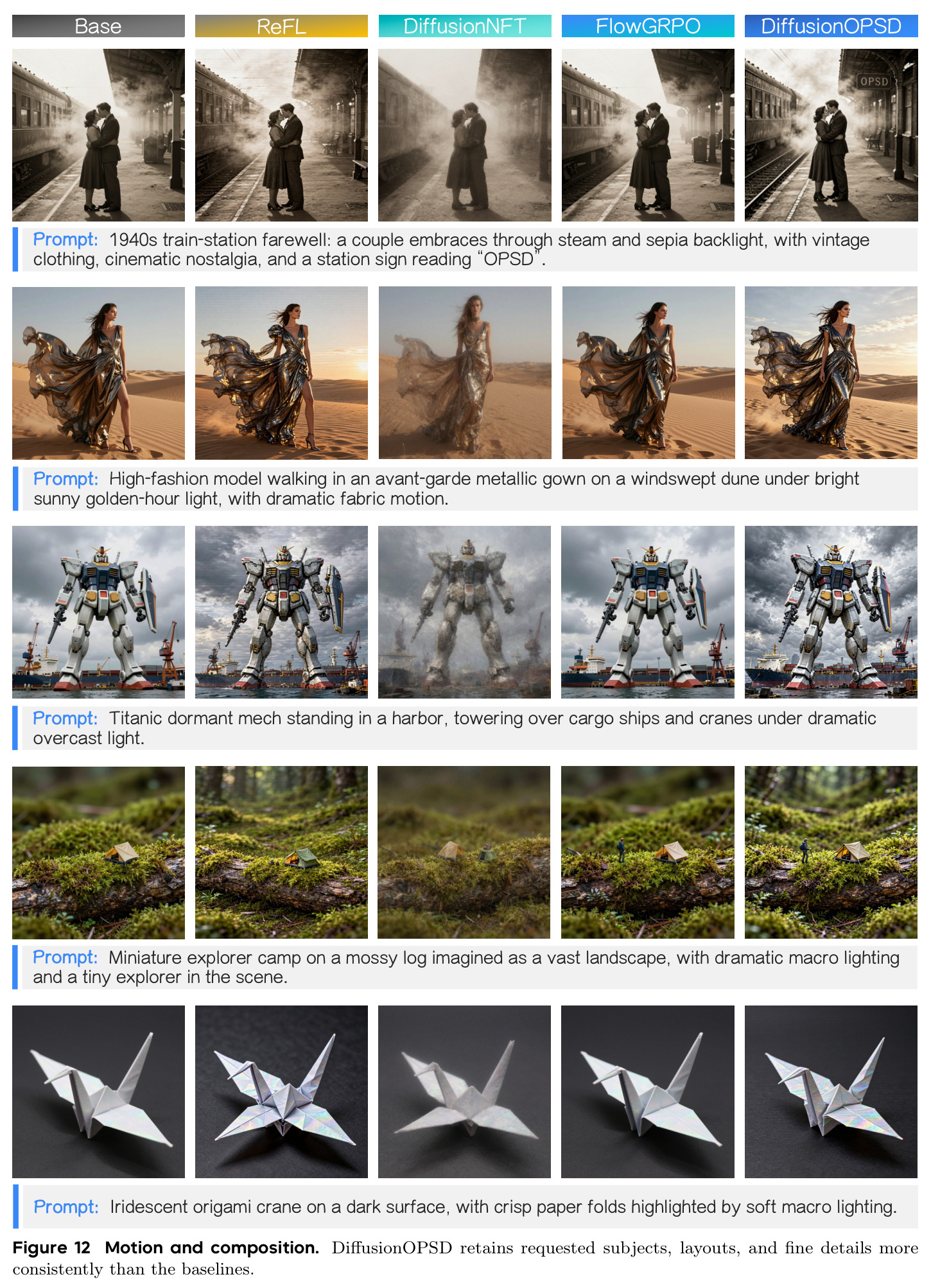
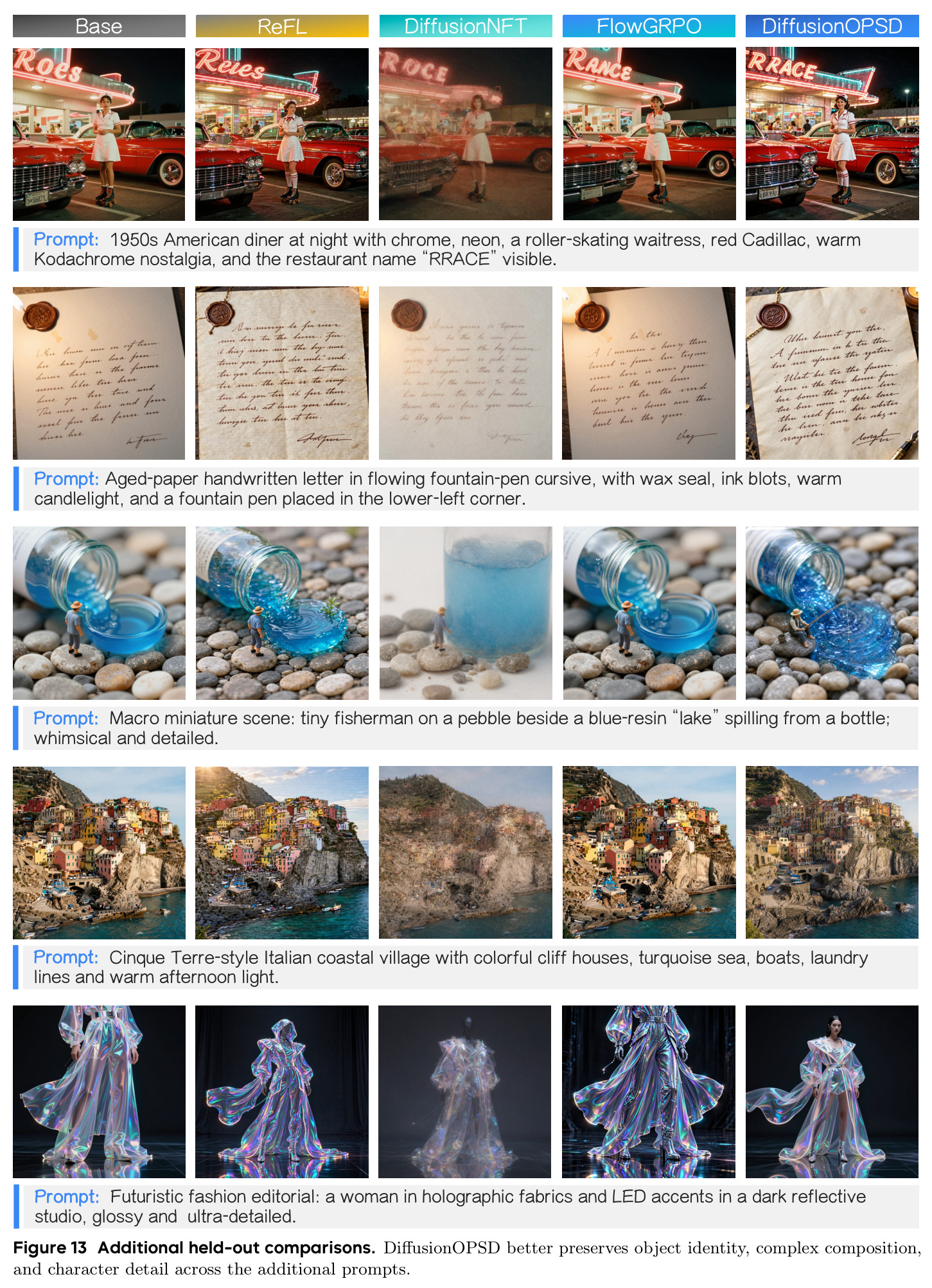
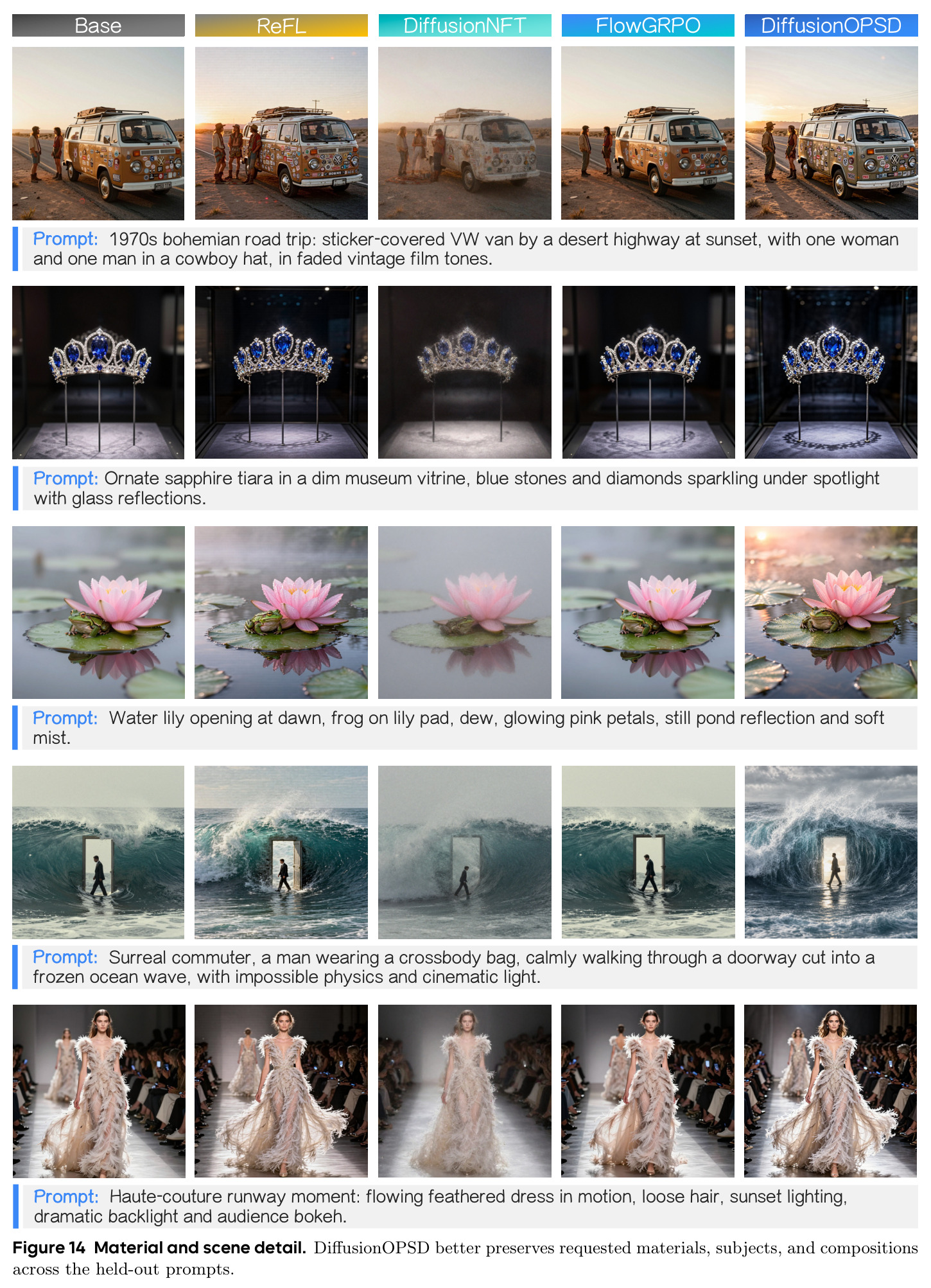
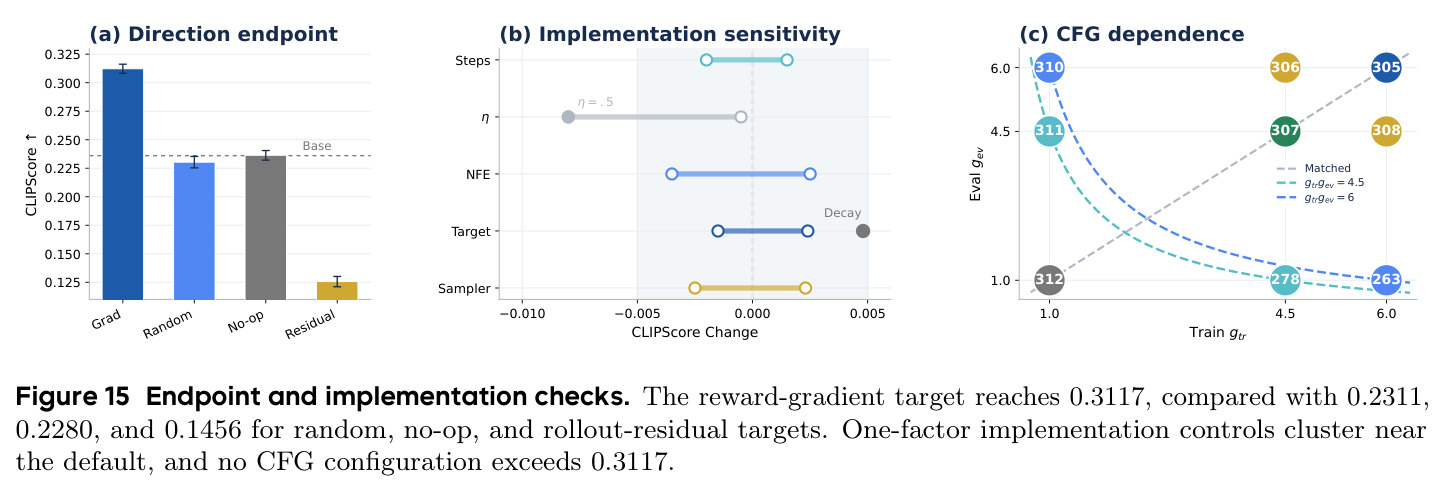
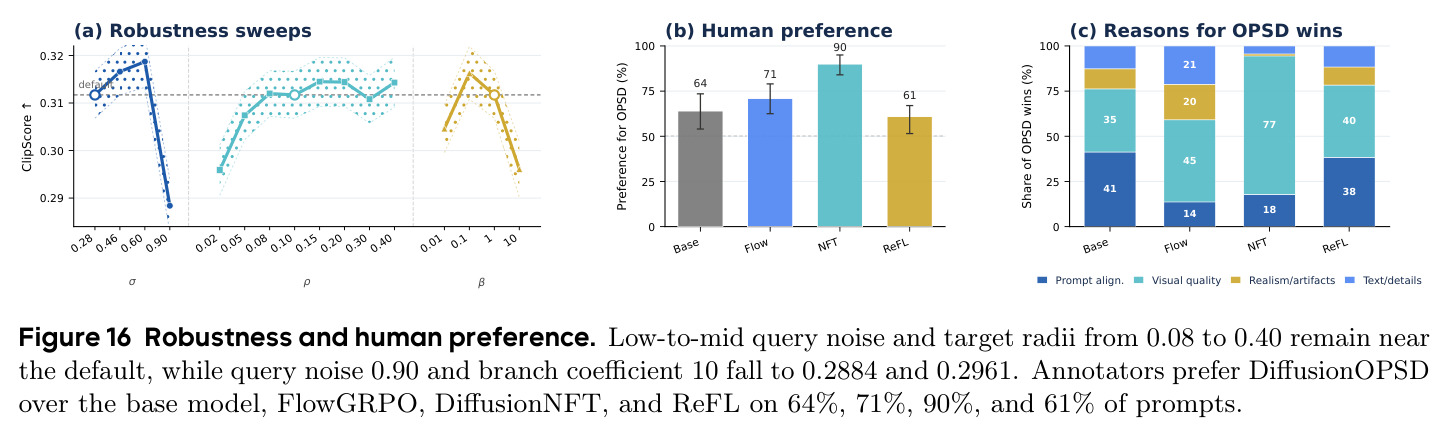
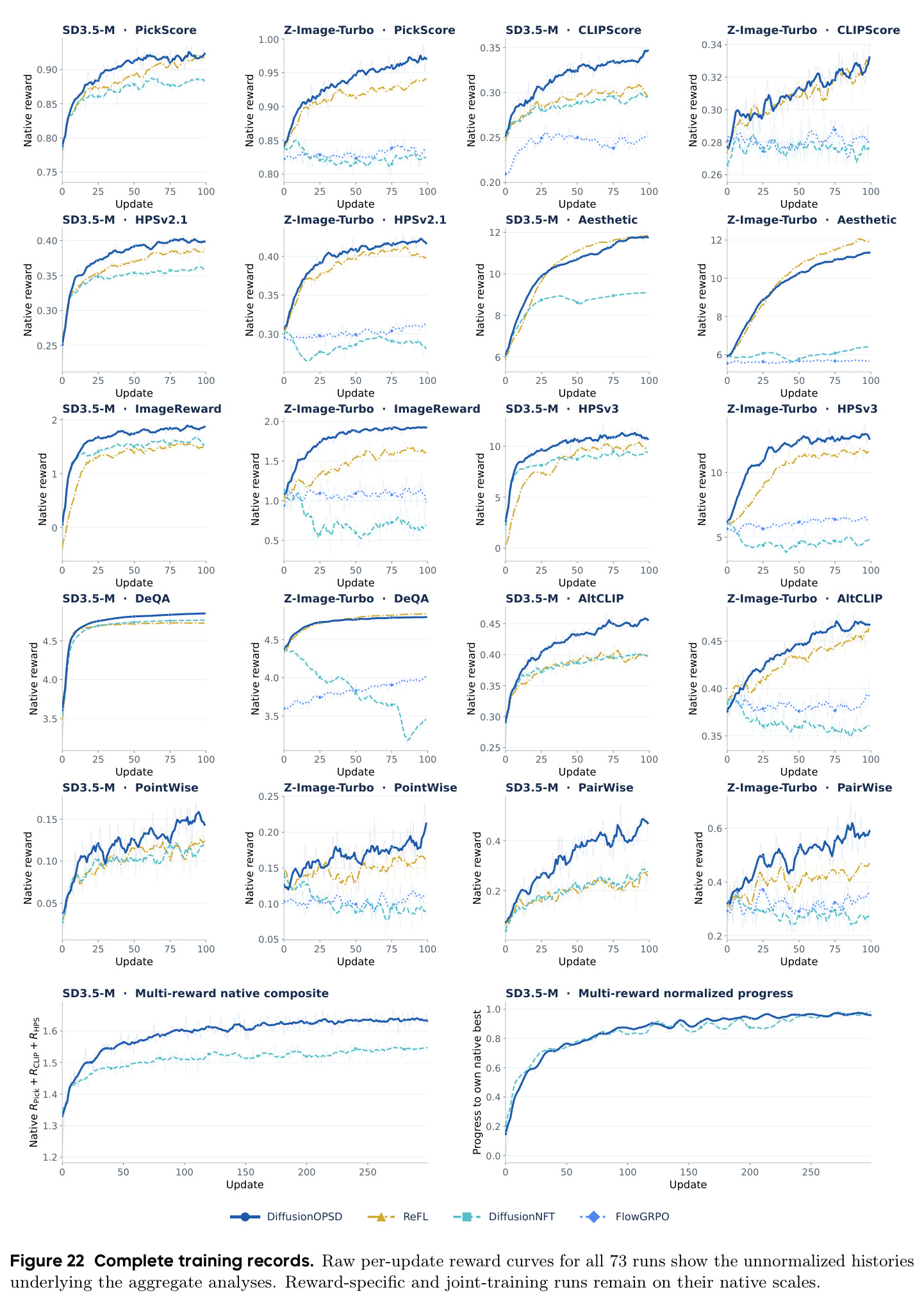
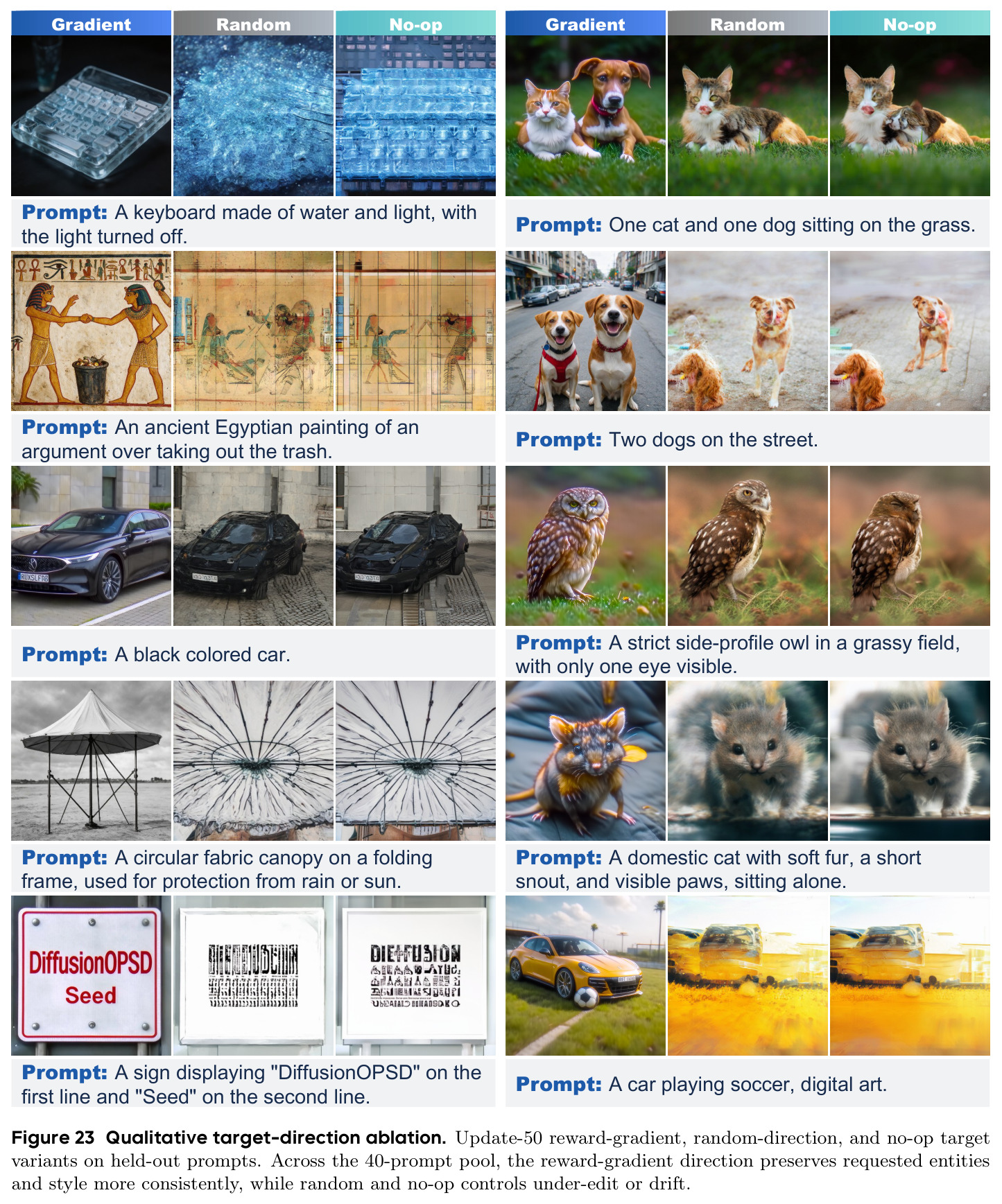
主表(Tab. 1):在 SD3.5-M 与原生 9 步 Z-Image-Turbo 上、以 Pick-a-Pic 训练、DrawBench 留出评测,DiffusionOPSD 在 20 个 reward-matched 设置中的 19 个取得最优最终留出分。奖励特定协议(100 更新)下,SD3.5-M 十项中九项领先:HPSv3 达 13.34 对最强基线 ReFL 的 9.33(+43.0%),VLM-Pairwise 0.465 对 DiffusionNFT 的 0.323(+44.0%),仅 Aesthetic 以 12.08 对 12.09 屈居第二。Z-Image-Turbo 上十项全胜:Aesthetic 10.74 对 9.79(+9.7%)、ImageReward 1.79 对 1.37(+30.7%)、HPSv3 14.44 对 13.77(+4.9%)、DeQA 4.78 对 4.60(+3.9%)、VLM-Pairwise 0.551 对 0.481(+14.6%);同协议下 DiffusionNFT 十项中八项低于未适配基线(HPSv3 仅 1.58 对 6.19)。效率(Tab. 2):每 100 更新 28.2/149.8 GPU 时(两骨干),比 DiffusionNFT 的 47.2/405.8 节省 40% 与 63%;质量-算力前沿(Fig. 8)在 Z-Image-Turbo 全部十条、SD3.5-M 九条居首。71 个单奖励运行的中位终位为 98%(ReFL 97%、NFT 90%、FlowGRPO 83%),末段优化几乎不回退。三奖励联合训练 300 更新得 PickScore 25.51 / CLIPScore 0.333 / HPSv2.1 0.389,分别超 DiffusionNFT 8.0%、13.3%、14.4%,并保留专家模型增益的 113.0%、92.9%、99.6%。人类盲评(100 prompt)对基线/FlowGRPO/NFT/ReFL 偏好率 64%/71%/90%/61%。机理实验:512 个同查询 prompt 上正目标固定后缀奖励 +0.03511、梯度对齐 0.7094,DiffusionNFT 端点为 −0.03551、对齐近 0;方向替换使训练后 CLIPScore 从 0.3122 跌至 0.2303–0.2363,查询源替换仅差 0.0033。关键的拟合审计:HPSv2.1 上构造增益 0.00245 的梯度目标经单步 fresh-AdamW 拟合后实现增益 −0.000740,反而差于随机目标(构造 −0.03251、实现 −0.000021),62.3% 的 prompt 排序反转;校准 plain-SGD 单步对比中 ReFL 实现增益 0.0005805 略高于有界 OPSD 的 0.0004588,而 DiffusionNFT 为负且离向漂移最大(0.6494)。
查看结构化数据
| 任务 | 指标 | 本文 | 基线 | 提升 |
|---|---|---|---|---|
| SD3.5-M 奖励特定后训练(留出 DrawBench) | HPSv3 分数 | 13.34 | 9.33(ReFL,次优) | +43.0% |
| SD3.5-M 奖励特定后训练(留出 DrawBench) | VLM-Pairwise $P$(生成>参考) | 0.465 | 0.323(DiffusionNFT,次优) | +44.0% |
| SD3.5-M 奖励特定后训练 | Aesthetic 美学分 | 12.08 | 12.09(ReFL) | −0.01(20 项中唯一未夺冠项) |
| Z-Image-Turbo 原生 9 步后训练 | ImageReward | 1.79 | 1.37(ReFL,次优) | +30.7% |
| Z-Image-Turbo 原生 9 步后训练 | Aesthetic 美学分 | 10.74 | 9.79(ReFL) | +9.7% |
| Z-Image-Turbo 原生 9 步后训练 | VLM-Pairwise $P$(生成>参考) | 0.551 | 0.481(ReFL) | +14.6% |
| 训练效率(8×A800 实测) | GPU 时 / 100 更新(SD3.5-M) | 28.2 | 47.2(DiffusionNFT) | −40% |
| 训练效率(8×A800 实测) | GPU 时 / 100 更新(Z-Image-Turbo) | 149.8 | 405.8(DiffusionNFT) | −63% |
| 三奖励联合训练(300 更新,单检查点) | PickScore / CLIPScore / HPSv2.1 | 25.51 / 0.333 / 0.389 | 23.62 / 0.294 / 0.340(DiffusionNFT 联合) | +8.0% / +13.3% / +14.4% |
| 人类盲评(100 留出 prompt,半平局计分) | 对 DiffusionNFT / ReFL 的偏好率 | 90% / 61% | 50%(随机偏好线) | 对全部四个对照均超多数线 |
局限与改进
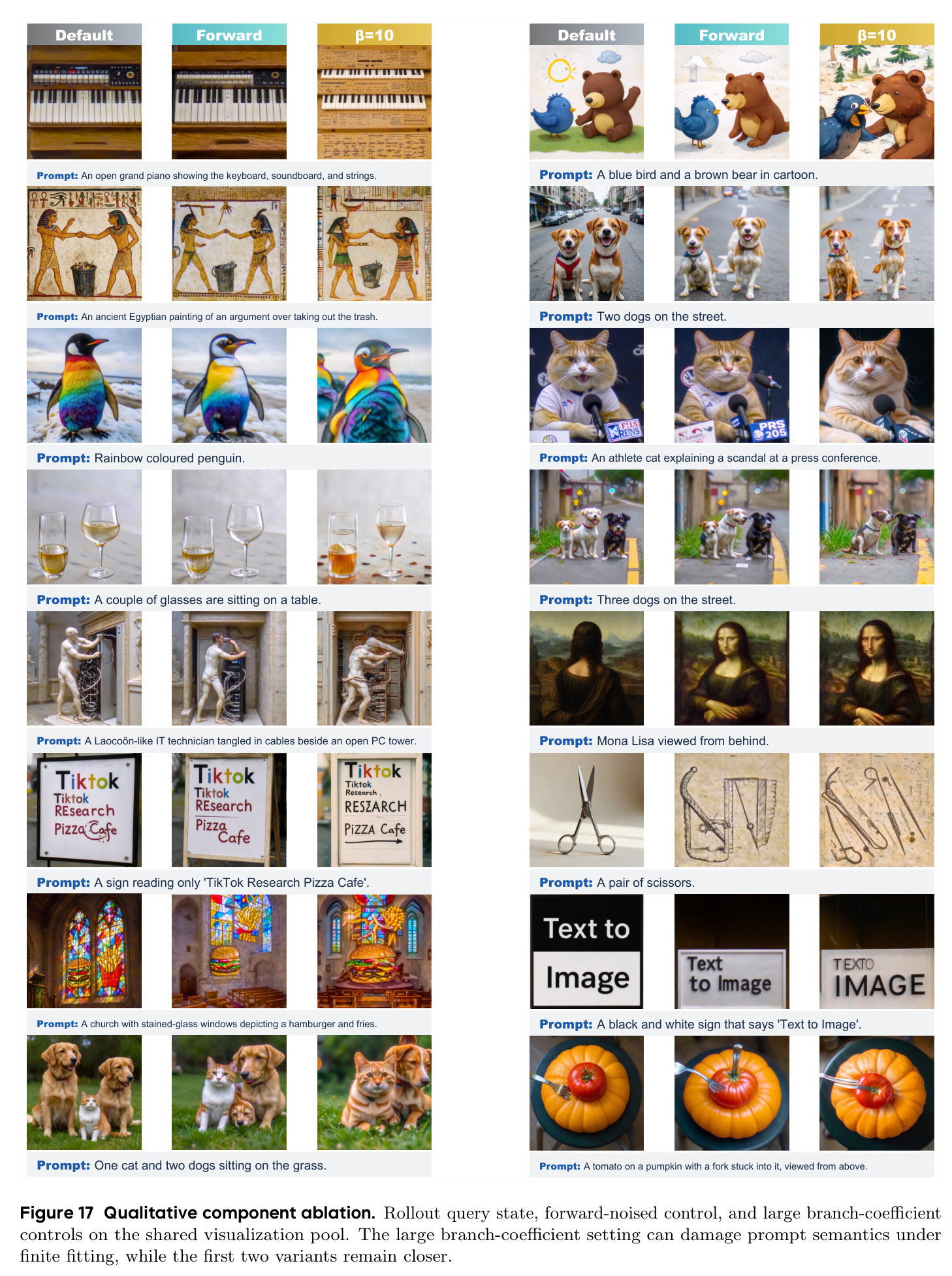
作者承认并实验揭示的局限:(1) 目标构造增益与有限拟合实现增益可以脱钩——HPSv2.1 反转率 62.3%(95% CI 58.2%–66.6%),且作者明确说明该审计是协议条件下的反例、不构成普适定理,分解也未推广到端到端在线训练(分布漂移项未估计);(2) 并非全面占优——SD3.5-M Aesthetic 以 0.01 之差落后 ReFL;(3) 显存代价——Z-Image-Turbo 上峰值 61.5 GB 高于 DiffusionNFT 的 49.9 GB,奖励梯度微批需缩到 1–2;(4) 联合训练只测试与加权组合的兼容性,作者声明不构成多目标优化的 SOTA 主张;(5) FlowGRPO 因需要随机 SDE 转移与对数概率,未做采样器严格匹配。我的补充观察:评测高度依赖模型化奖励(含三个内部评估器与 Seedream 5.0 Pro 固定参考图),奖励过优化与多样性损失未系统量化;人类评测仅 100 条 prompt、单一设置;查询固定在低噪声 $\sigma_q\approx0.278$,而 $\sigma=0.90$ 时 CLIPScore 跌到 0.2884,方法对早期高噪声去噪阶段(决定构图与布局)的覆盖缺失;组件消融用 20 prompt×5 图的小子集,作者自己也提醒结论需全量协议确认。
独立分析的弱点
独立弱点分析:(1) 依赖可微奖励——整条目标构造链需要 $\nabla_y\tilde R$,无法直接使用不可微信号(人类偏好对、点击反馈、不开放梯度的专有奖励 API)。改进方向:训练代理奖励模型提供替代梯度,或用无梯度搜索/图像编辑操作近似上升方向。(2) 单一低噪声查询——每条轨迹只在一个 $\sigma_q$ 处取监督,早期高噪声步决定的全局结构(布局、物体计数、构图)基本不受约束;论文证据是低噪声下前向加噪对照几乎无损,但 $\sigma=0.90$ 时性能明显崩落。改进方向:多噪声级查询并利用 $\partial y/\partial v=-\sigma I$ 的调度因子做预条件校正。(3) 拟合鸿沟不可预测——fresh-AdamW 的近似符号归一化使「半径匹配」不等于「参数步匹配」,目标排序可反转(62.3%);改进方向:把响应核 $K(s,s_i)$ 纳入目标设计的目标感知优化器、二阶/自然梯度预条件,或按测得的 $G_{fit}$ 在线自适应调整 $M_{fit}$。(4) 工程复杂度与显存——需并行奖励服务器(VLM 奖励占用 2 张 GPU)、Z-Image-Turbo 峰值显存更高;改进方向:奖励骨干量化、梯度检查点、目标库复用与新鲜度调度。(5) 奖励鲁棒性——100 更新内奖励大幅上涨,但对分布外 prompt 的泛化、图像多样性与奖励黑客风险只有 VLM-Pairwise 对固定参考图的间接检验,缺乏长期训练(>1000 更新)的稳定性证据。
未来方向
作者提出或可自然延伸的方向:(1) 更高效、可诊断的对齐——把 $G_{construct}/G_{fit}$ 审计做成常规训练仪表盘,用于在线监控、早停与超参搜索;(2) 推广到一般 affine 调度——只需替换清洁输出映射(式 21),可覆盖 DDPM 式调度与视频扩散模型;(3) 变噪声扩展——当前固定 $\sigma_q$ 使速度梯度带 $-\sigma_q/\Delta_q$ 因子,跨噪声级的等影响训练需要预条件校正;(4) 梯度差异诊断——在小验证集上估计固定后缀奖励梯度与局部奖励梯度的余弦相似度 $\kappa$,无需把端点反传放进训练环,用于验证局部目标的有效性假设;(5) 基于本文成果的延伸:把显式中间目标与少步/一致性蒸馏深度结合(Z-Image-Turbo 的结果已证明可行性);在加权组合之外引入偏好向量或 Pareto 目标处理多奖励冲突;用成对比较构造目标实现无需可微奖励的在线偏好学习;以及把构造-实现分解理论化到有限 AdamW、批量拟合与分布漂移并存的完整在线情形。
复现评估
复现评估:论文未提及代码开源(正文只给出 Project Page: DiffusionOPSD 与通讯邮箱),阅读时未见官方仓库链接,复现需自行实现。可复现性要素披露非常充分:全部超参数(AdamW lr $3\times10^{-4}$、betas $(0.9,0.999)$、权重衰减 $10^{-4}$、LoRA rank 32/alpha 64、$M_{tgt}=2$、$\eta_{tgt}=1.0$、$\rho=0.10$、$\beta=1.0$、$c_{adv}=5$、$\epsilon_Z=10^{-4}$、$\epsilon_g=10^{-12}$、$\epsilon_\gamma=10^{-5}$、$\sigma^\star=0.278/0.273$、$\eta_{beh}=\min\{10^{-3}u,0.5\}$、checkpoint EMA 规则)与数据协议(Pick-a-Pic 训练、DrawBench 留出)完全公开。十个评估器中七个开源(PickScore、CLIPScore、HPSv2.1、Aesthetic、ImageReward、HPSv3 7B、DeQA),三个内部评估器(内部对齐 RM、VLM-Pointwise、VLM-Pairwise 及其 Seedream 5.0 Pro 参考图)不可获得,对应列无法复现。算力:单节点 8×A800-80GB,单个 100 更新运行约 28–150 GPU 时(依骨干),主表背后有 70 个奖励特定运行加两个 300 更新联合运行,总量在千 GPU 时量级;VLM 奖励需另配奖励服务器。总体复现难度中高:主要工程量在 rollout + 奖励反传微批与多进程奖励服务;方法本身无外部教师、无似然估计、无轨迹级反传,工程难度低于 FlowGRPO 类方法。
论文图表
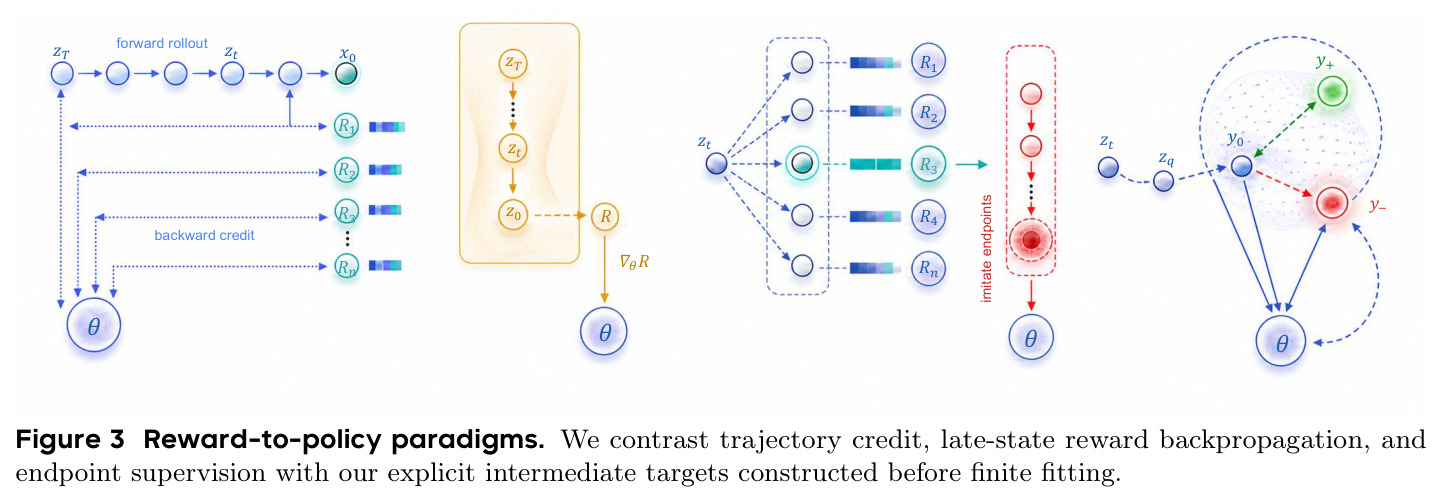
对比四类把奖励转成策略更新的范式:轨迹信用(FlowGRPO 式 backward credit)、后段状态奖励反传(ReFL 式 $\nabla_\theta R$)、端点监督模仿(DiffusionNFT 式 imitate endpoints),以及本文在查询 $z_q$、锚点 $y_0$ 附近先构造显式正负目标 $y^+/y^-$ 再拟合的方式。
一图定位本文在方法版图中的坐标,是理解引言与相关工作分歧点的钥匙。