交接税:LLM 智能体延续非原生轨迹的代价 The Handoff Tax: Continuing Non-Native Trajectories in LLM Agents
编码智能体中途换模需缴交接税:升级收不回一半质量差距且常不如重启,降档反而划算
前置知识
编码智能体与智能体轨迹
编码智能体在循环中反复执行「推理→工具调用→观察」步骤来完成软件任务,全过程产生的消息序列称为轨迹(trajectory)。长程任务可能包含几十到上百次模型调用,轨迹里既有有效推理,也有模型特有的措辞、假设、工具使用习惯和死胡同。
本文研究的核心对象正是这条轨迹:当另一个模型中途接手时,它继承的是一条自己没有生成的「非原生轨迹」,理解轨迹的构成才能理解交接税从何而来。
工作树(Working Tree)
指智能体运行过程中在磁盘上持续修改的代码仓库状态(被编辑的文件),论文记作 $W_K$。与对话轨迹 $T_{1:K}$ 不同,它是持久化的文件系统状态,模型切换后依然存在,代表已落盘的实际工作成果。
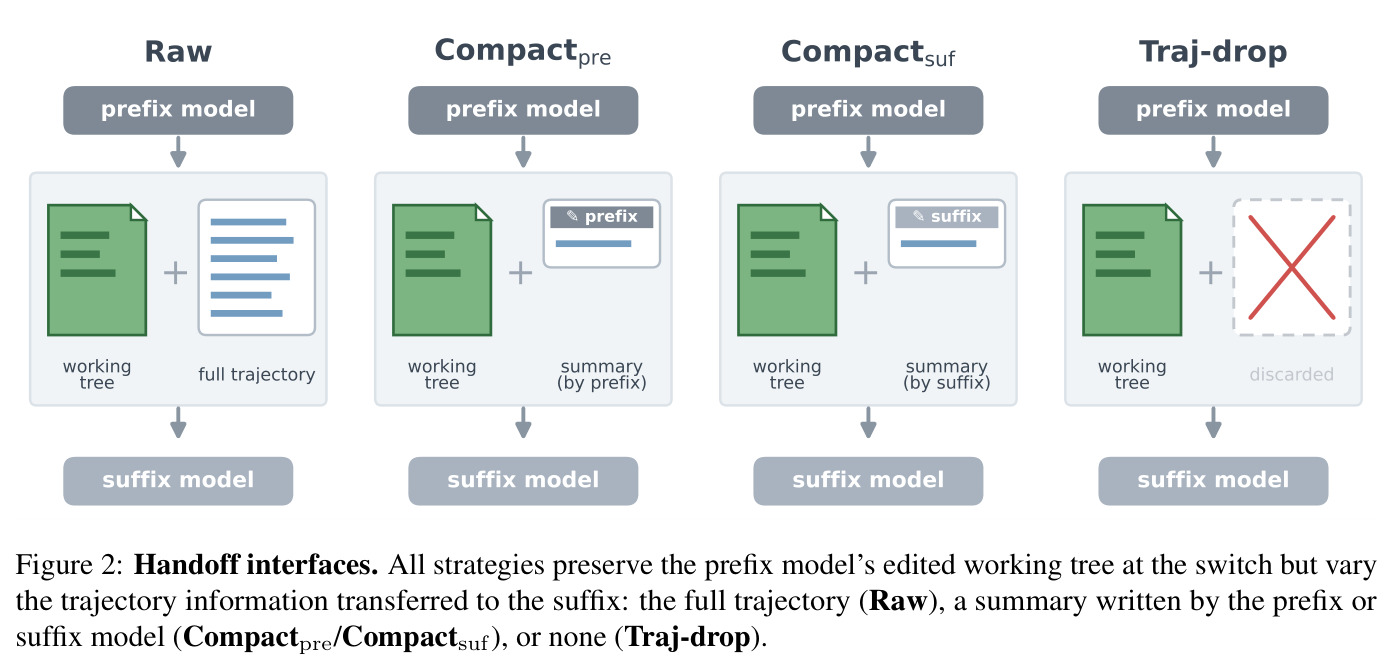
本文所有交接接口都保留 $W_K$、只改变传递的轨迹信息,这是把「工作成果」与「推理痕迹」分开、隔离轨迹本身影响的关键实验设计。
SWE-bench Verified
基于 500 个真实 GitHub issue 的代码修复基准,每个任务带可执行的通过/失败测试与人工校验,并有难度标注(<15 分钟、15–60 分钟、>1 小时三档),是编码智能体评测的事实标准。
论文的主实验全部在 SWE-bench Verified 上进行,难度分桶还被用来校准切换时机,读懂实验设置和难度分析都依赖对这个基准的理解。
模型升级与降档(Escalation / Downshift)
在同一模型家族内选一对低成本低能力(LC)与高成本高能力(HC)模型。升级指 LC 卡住时中途切到 HC 救场;降档指艰难推理完成后切回 LC 省钱。Kiro、Codex、Claude Code 等产品已用 /model 命令支持这种操作。
交接方向是本文第一自变量:升级呈现有限救援+高成本溢价,降档反而是划算的中间点,两个方向表现出方向对偶性,是全文最重要的发现。
QRec 与 CSRet 归一化指标
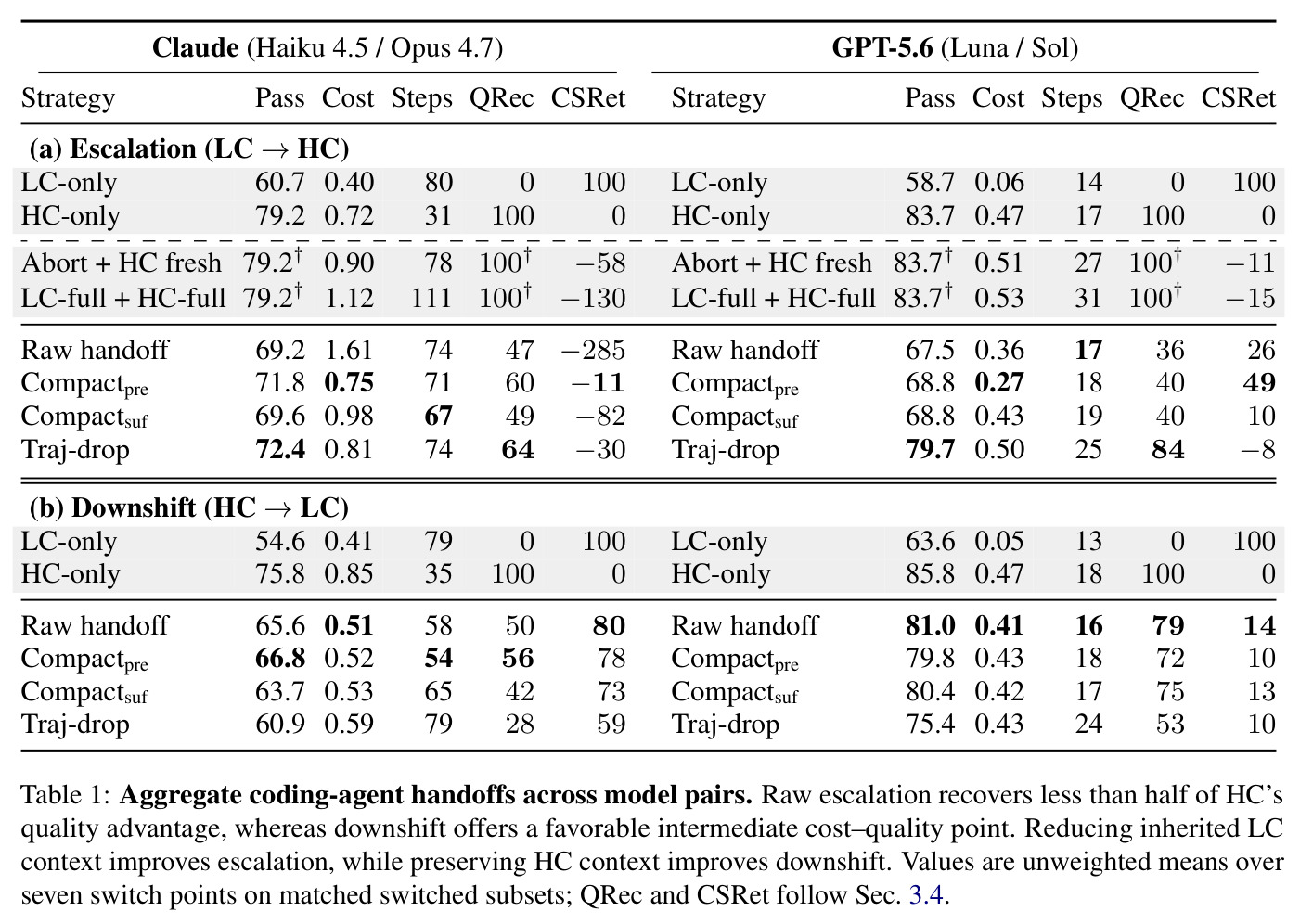
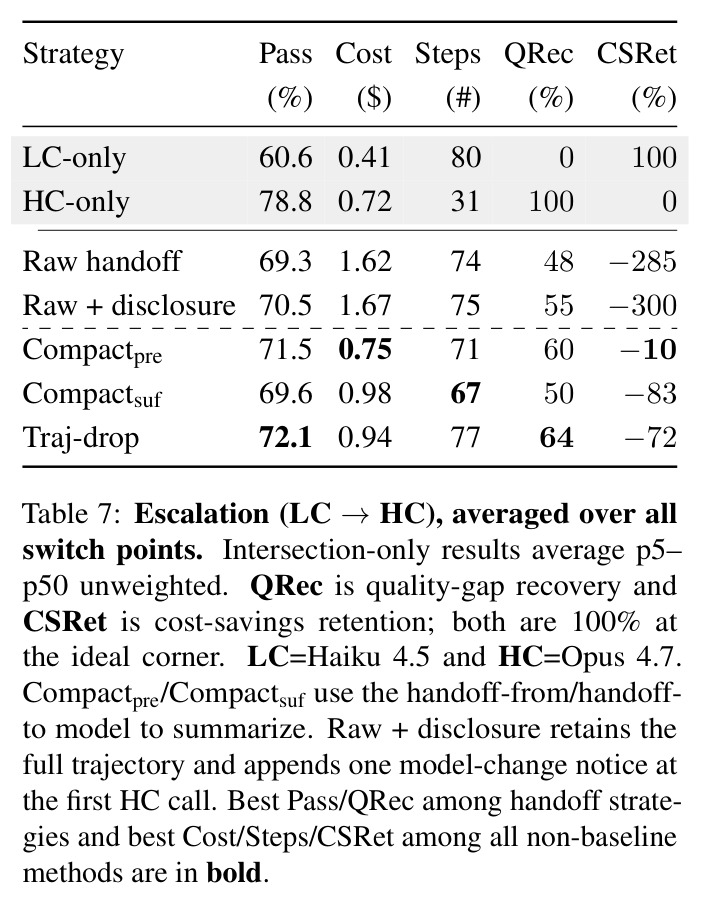
$Q_{Rec}=100\dfrac{R_m-R_{LC}}{R_{HC}-R_{LC}}$ 衡量某策略找回多少 HC 相对 LC 的质量优势;$CS_{Ret}$ 同理(分子换成本差)衡量保住多少 LC 的成本优势。二者均以匹配子集上的单模型基线为锚点,零与一百分别对应 LC 与 HC 的水平,负值表示比只用 HC 还要贵。
论文所有结果都用这两个归一化指标报告;不理解锚点定义,就无法跨切换点、跨模型对比较数字,也读不懂负值(如 CSRet=-285% 表示比只用 HC 还贵近 3 倍差距)的含义。
LLM API 定价与提示缓存
LLM API 按 token 计费,缓存读取与写入价格不同;智能体轨迹越长,每步重复送入的输入 token 越多,缓存策略显著影响实际美元成本。供应商价格卡(含跨区域溢价)决定最终账单。
论文的成本结论(如 Claude 上 Raw 交接 $1.61 是 HC-only $0.72 的两倍多)依赖具体定价与缓存费率,作者也明示美元结论会随价格变化,复现时需注意。
研究动机
编码智能体现在会在单个任务上链式调用几十到上百次模型调用,模型选择因此既是技术决策也是经济决策:高能力模型能解决更多 issue 但贵得多,便宜模型便宜但能力弱。麻烦在于,用户在任务开始时并不知道任务实际需要多强的能力。产品层面(Kiro、Codex、Claude Code 的 /model 命令)已经支持中途切换模型——LC 挣扎时升级到 HC 救场,或硬推理完成后降档回 LC 省钱——但这种切换的成本-质量后果此前从未被系统测量。一次中途交接把模型置于不寻常的处境:它必须延续另一模型生成的长轨迹,继承自己不会生成的推理和自己不会犯的错误。HC 可能被 LC 的错误回合锚定,LC 也可能躺在 HC 的铺垫上轻松收尾、或在超出自身能力的地方继续推理时崩溃。另外,接力式延续与「推倒重启」谁更划算,也没有人回答过。
本文的目标是本文要建立第一个针对长程编码智能体「中途能力交接」的系统实证研究,回答两个问题:继承一条非原生轨迹是否、以及如何改变成本-质量权衡;交接时传递的轨迹信息如何塑造这一效应。为此作者沿三个轴做扫描:交接方向(LC→HC 升级与 HC→LC 降档)、切换时机(在难度校准的步数分布百分位上扫 7 个切换点)、交接接口(全轨迹原样传递、压缩成摘要、丢弃轨迹但保留仓库编辑)。最终产出可操作的结论:升级时该用什么接口、什么条件下升级才值得、降档是否总是划算、以及成本惩罚通过什么机制产生。
与已有工作不同的是,已有工作的焦点都是「下一个该用哪个模型」:级联(cascade)在便宜模型不够时调用更强模型,路由器在模型池上分发请求,近年扩展到多轮场景;SWE-Router 用 LC 的部分轨迹决定继续还是让 HC 重启,但根本不传递轨迹;Khraishi 等只研究对话最后一轮的方向性漂移;KC & Budathoki 把模型当作接管中断任务的继任者,而非成本画像不同的 LC-HC 替代对。本文的独特切入是把「交接接口」(什么信息跨越模型边界)从「路由」(谁下一步行动)中解耦为独立的设计变量,并固定工作树 $W_K$ 不变、只操纵轨迹传递方式,从而第一次把「非原生轨迹本身是资产还是负债」变成可测量的命题,同时用重启对照检验「继续接手」是否根本优于「放弃重来」。
核心方法
先说直觉:中途换模时,接收方拿到两样东西——磁盘上已改好的工作树 $W_K$(几乎确定有用)和前一模型的对话轨迹 $T_{1:K}$(可能有用也可能有害)。本文固定 $W_K$,系统地改变传递的轨迹信息(全给/压缩/不给),在 SWE-bench Verified 全部 500 题上用统一的 mini-swe-agent 脚手架评测两个模型家族(Claude:Haiku 4.5 为 LC、Opus 4.7 为 HC;GPT:GPT-5.6 Luna 为 LC、Sol 为 HC)、两个方向、7 个切换点和 4 种接口。由于起始模型可能在切换点之前就完成任务,公平比较要求只在「四种接口下都真正发生切换的任务交集」上评估,并用同一子集上的单模型基线归一化出 QRec/CSRet 两个指标。总规模为每家族 58 种配置,共 58,000 次智能体运行、200 万次 API 调用、360 亿 token。
核心创新是把 handoff(交接)从 routing(路由)中剥离:路由决定「谁下一步行动」,接口决定「接收方继承什么」。通过保持工作树、只变轨迹信息,作者能直接回答「非原生轨迹本身是资产还是负债」,而答案具有方向对偶性——LC 轨迹对 HC 接收者是负担(丢弃反而提质),HC 轨迹对 LC 接收者是资产(丢弃大幅掉质量)。第二个关键设计是两个重启对照:Abort + HC fresh(为 LC 到切换点为止的工作付费后从原始任务状态重启 HC)和 LC-full + HC-full(付费完整跑一遍 LC 再完整跑一遍 HC)。它们按构造达到 HC-only 的质量,却为 LC 的工作计了费,从而把「继续接手 vs 推倒重来」变成可检验命题——对 Claude 升级,答案是推倒重来更便宜也更准,Raw 交接被严格支配。
方法步骤详情
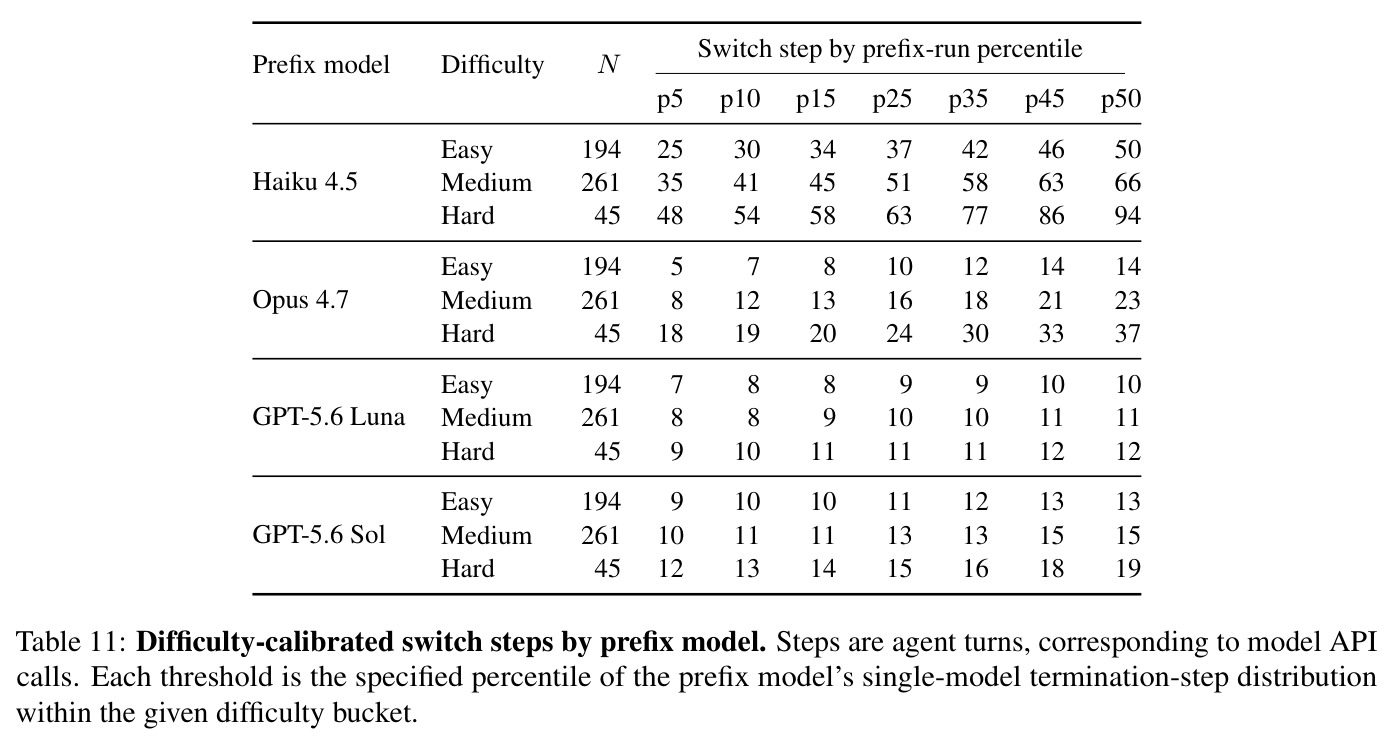
第一步,环境与模型:全部条件共用 mini-swe-agent 脚手架与 Bash 工具,输入 SWE-bench 任务、输出补丁由官方评测器打分,150 步上限。第二步,切换点校准:按难度桶(<15 分钟/15–60 分钟/>1 小时)在前缀模型终止步数分布上取百分位 $p\in\{5,10,15,25,35,45,50\}$ 为切换步 $s_b$:调用 $q<s_b$ 用前缀模型、$q=s_b$ 起用后缀模型,避免「简单任务更早完成」的分布偏移。第三步,四种接口:Raw 原样传全轨迹 $T_{1:K}$;Compactpre/Compactsuf 分别由前缀/后缀模型把轨迹压缩成续作摘要;Traj-drop 不传轨迹,只给系统提示、原任务、固定续作消息与工作树 $W_K$。第四步,评估集:取四接口都发生切换的任务交集,单模型基线在同一子集上算锚点。第五步,指标与成本:$Q_{Rec}=100(R_m-R_{LC})/(R_{HC}-R_{LC})$,$CS_{Ret}=100(C_{HC}-C_m)/(C_{HC}-C_{LC})$;成本按含缓存价格卡重建并审计对账。第六步,重启对照:Abort+HC fresh 与 LC-full+HC-full 为 LC 工作付费但丢弃轨迹与工作树,质量按构造取 HC-only。第七步,机制分解:交接后成本拆成接收方步数×每步成本。第八步,扩展:LiC(535 题、确定性分片)与 BrowseComp(200 题)只测 Raw 交接。
技术新颖性
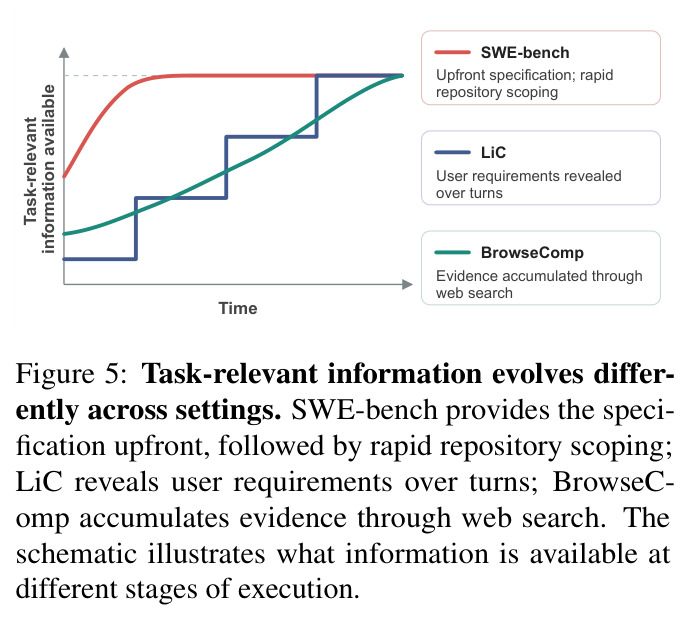
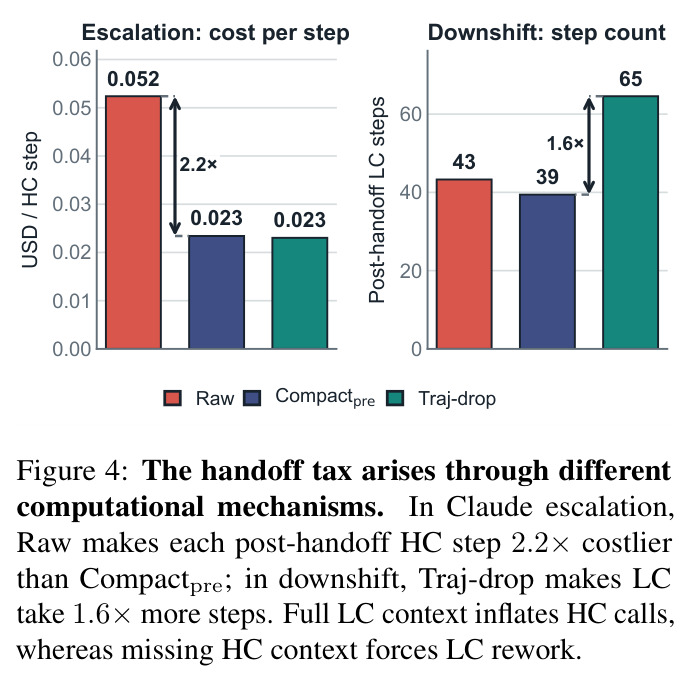
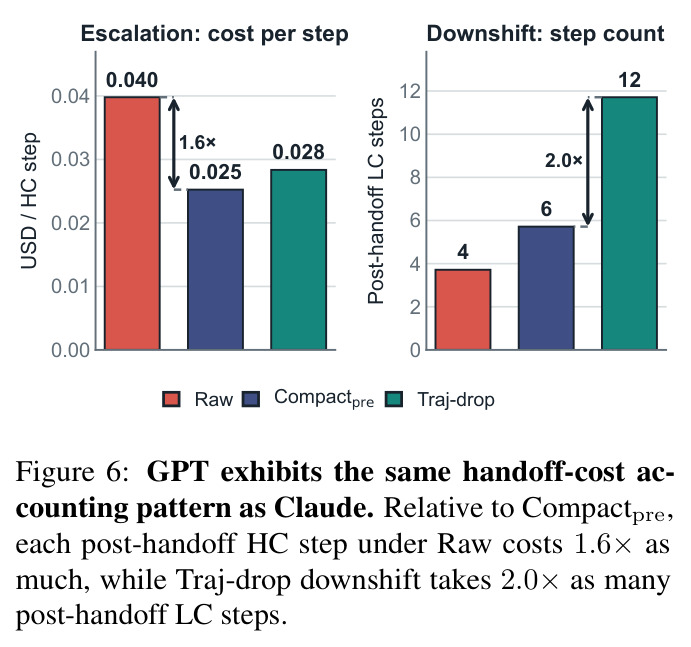
技术新颖性主要在实验设计与度量体系而非新算法。其一,这是首个对长程智能体中途交接的系统测量(58 配置/家族、58,000 次运行、36B token),远超此前只看最终一轮漂移或继任成本的工作。其二,接口×方向×时机的因子化设计加上「匹配切换子集」交集评估,解决了切换内生于任务难度的选择偏差;切换点按难度桶分别校准百分位也是对「简单任务更早完成」这一混淆的细致处理。其三,重启对照把「继续 vs 重来」形式化为可检验命题,并给出升级 Raw 被 strictly dominated 的干净结论。其四,机制分解把两个方向的成本惩罚归因到不同通道:升级税来自更贵的接收方调用(Raw 使每个 HC 步成本为 Compactpre 的 2.2×/1.6×),Traj-drop 降档税来自更多接收方步数(1.6×/2.0×),而步数/每步成本的另一半保持不变。其五,用信息动态(规格 upfront vs 需求渐进揭示 vs 证据渐进累积)解释交接价值何时为正,把结论从编码推广到一般智能体场景。
实验结果
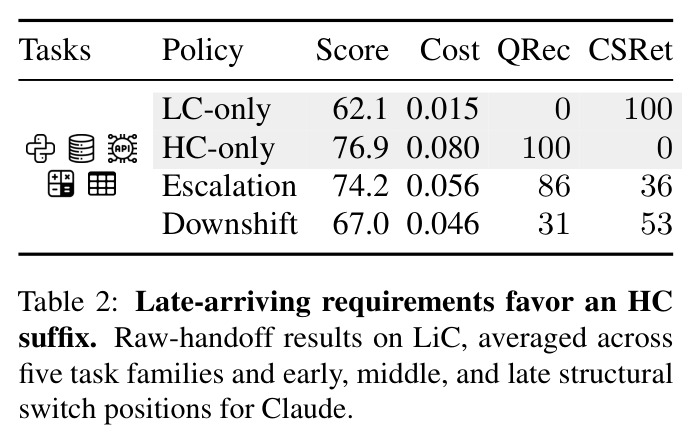
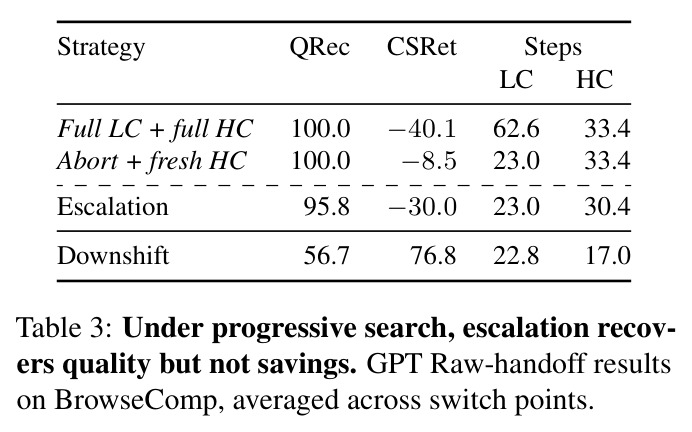
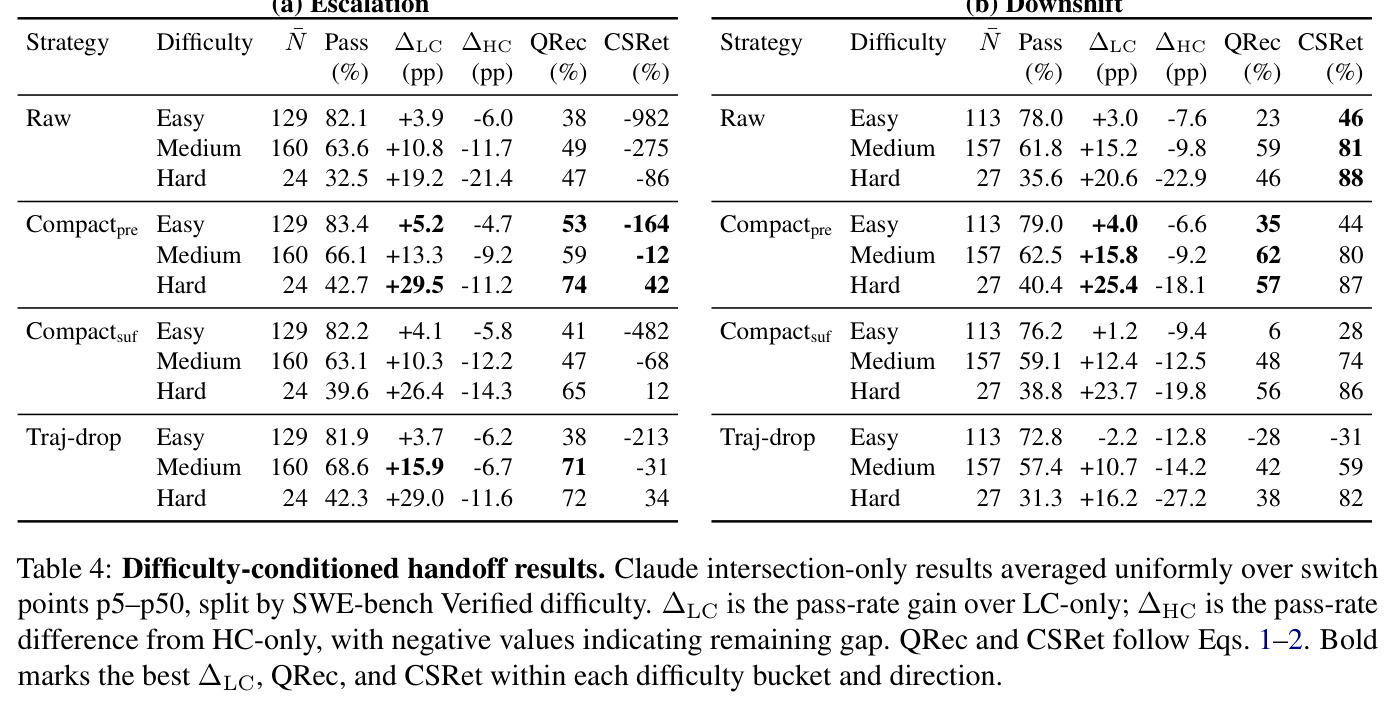
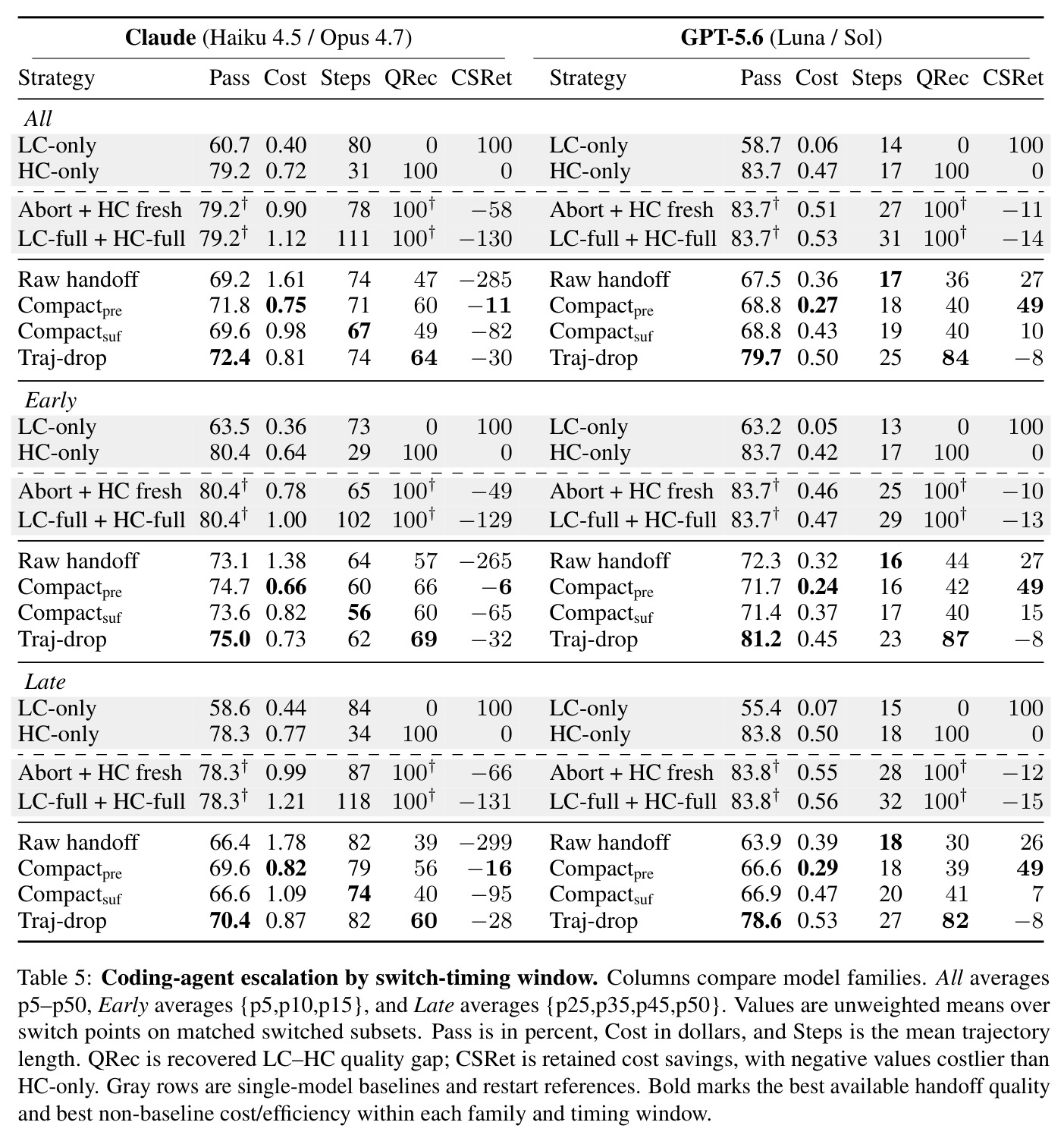
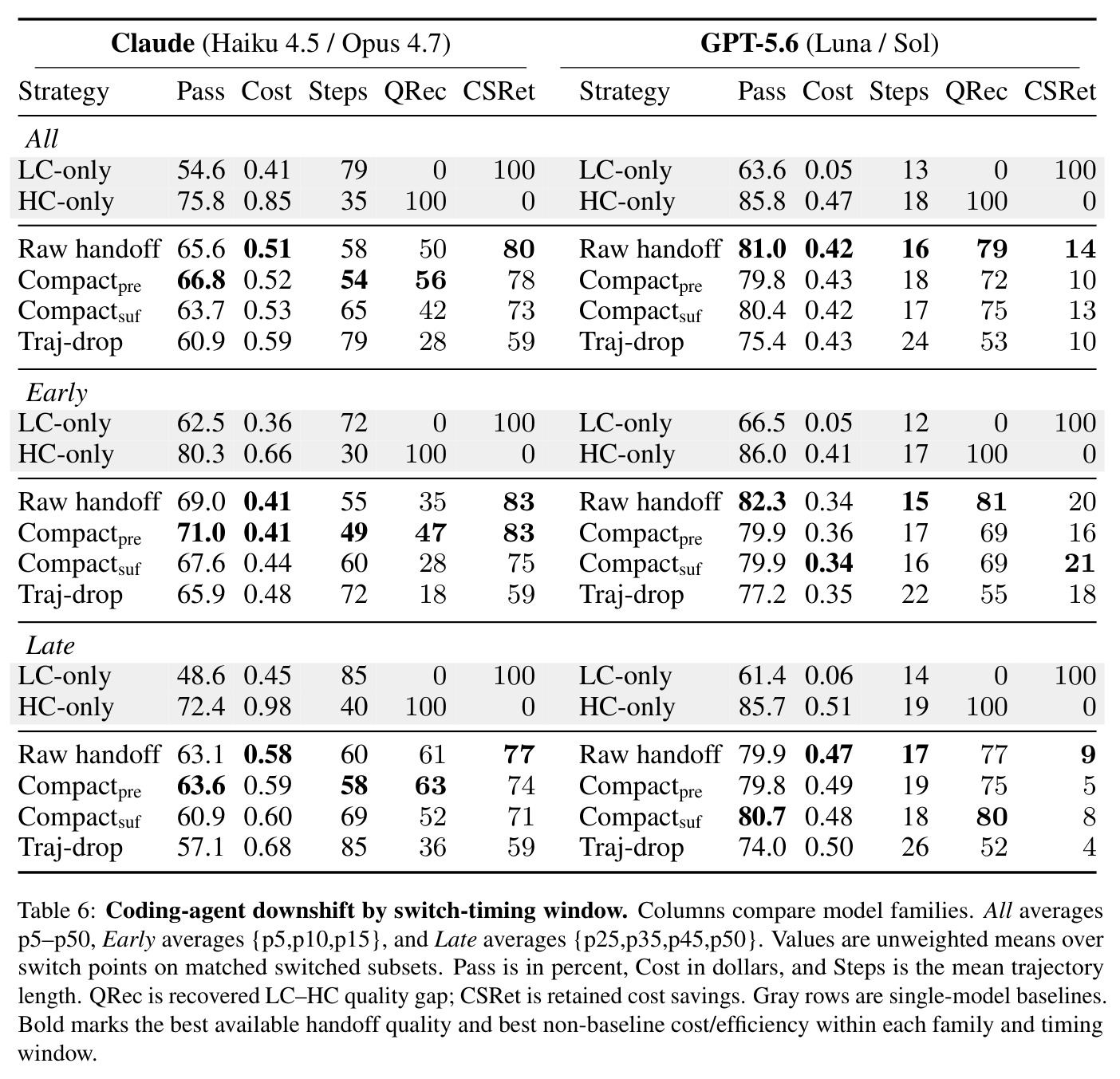
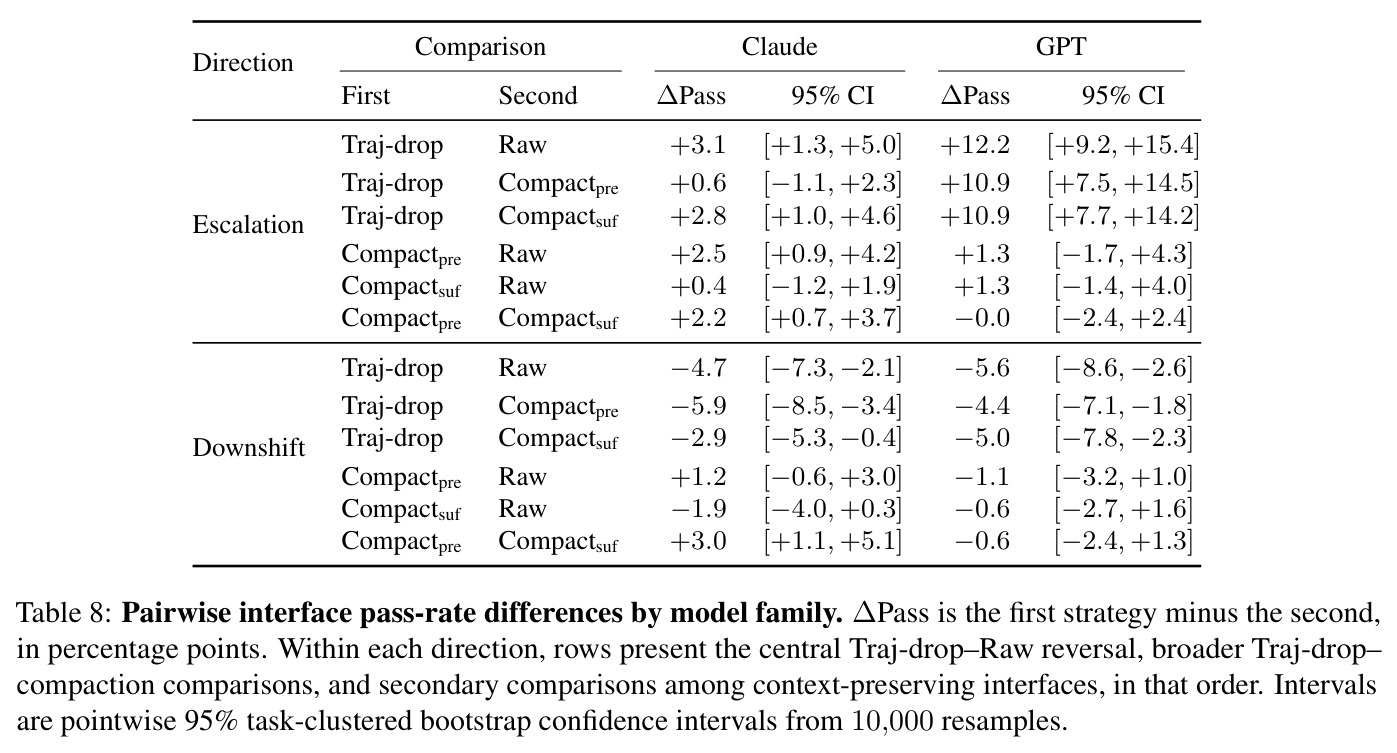
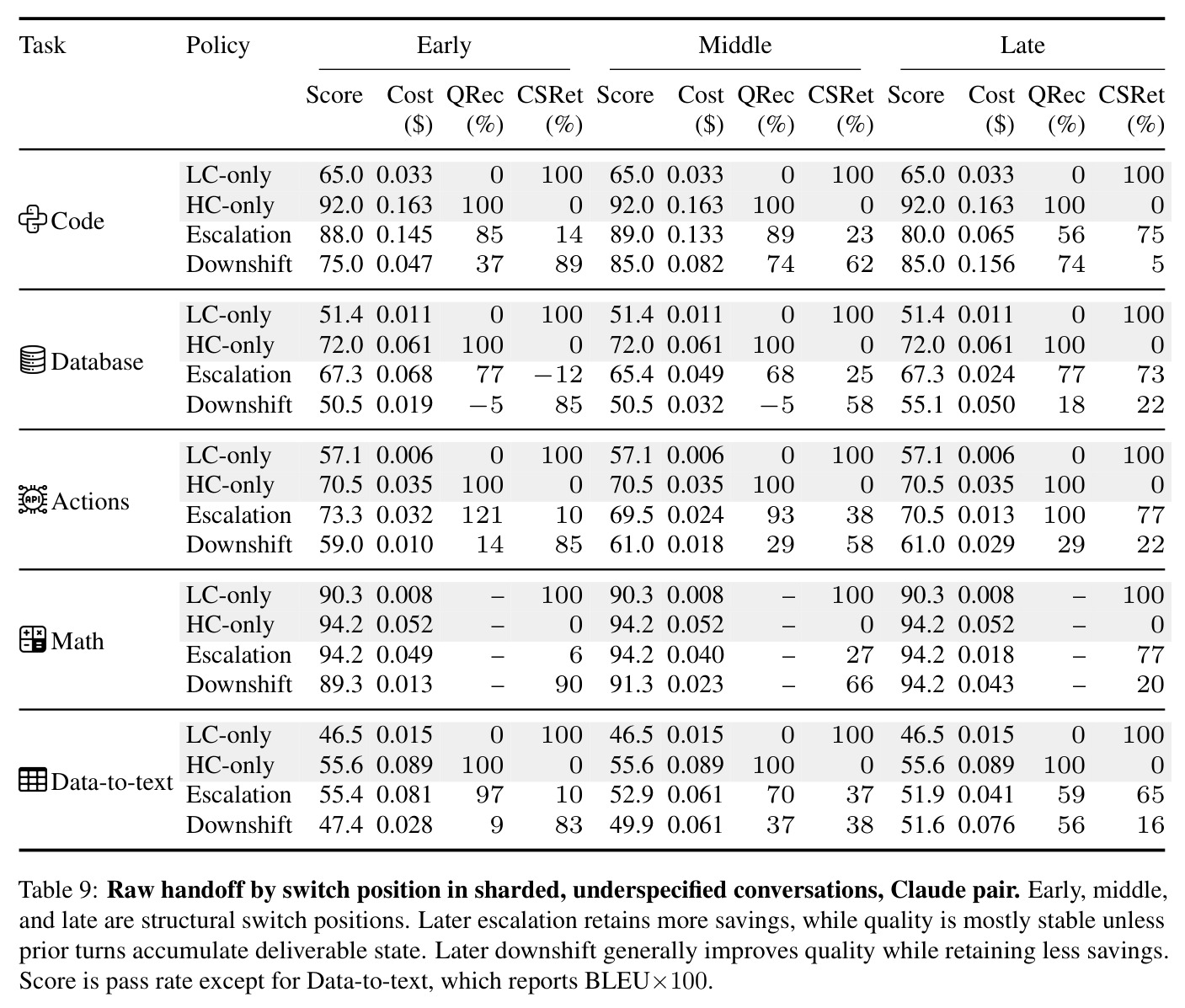
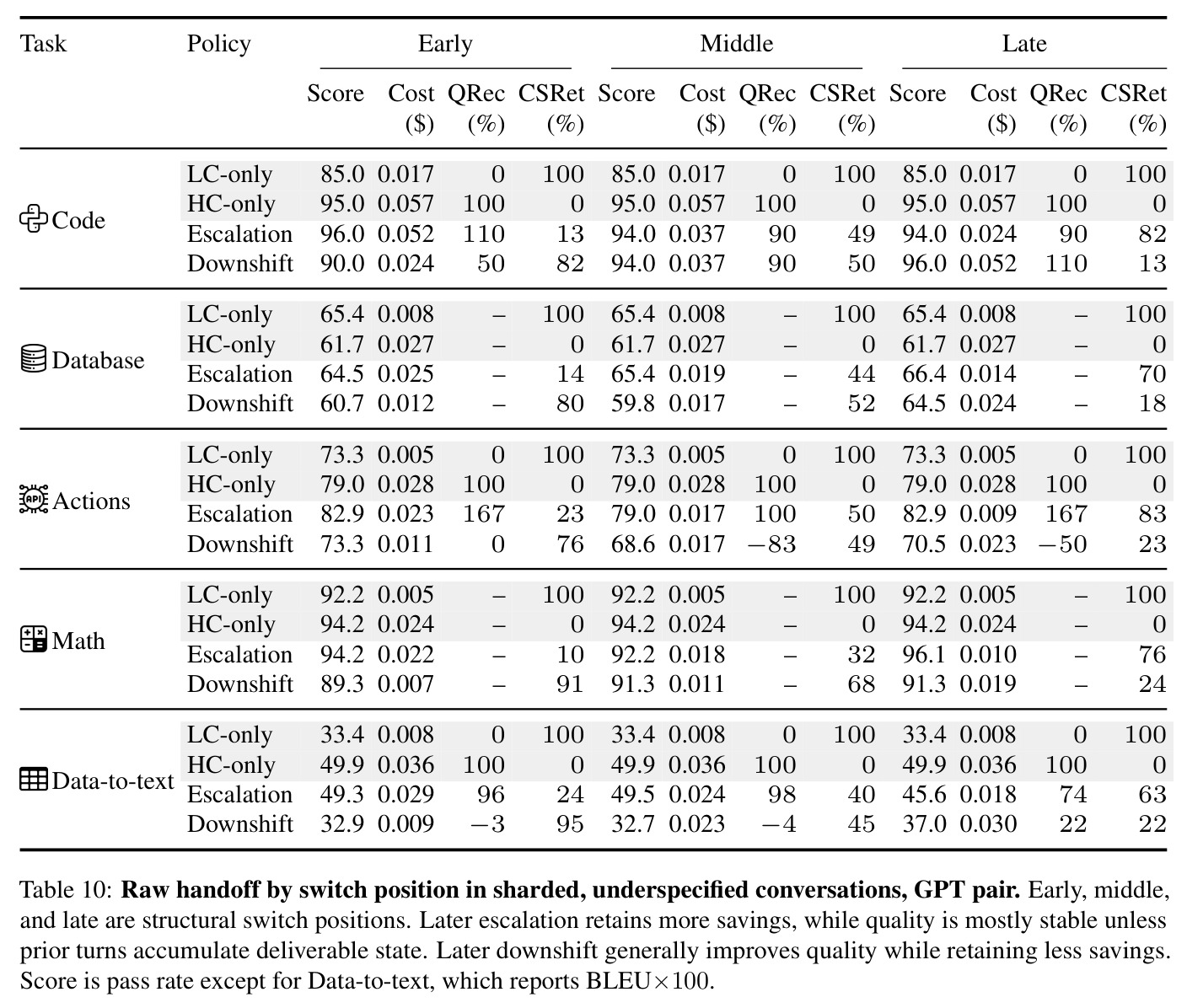
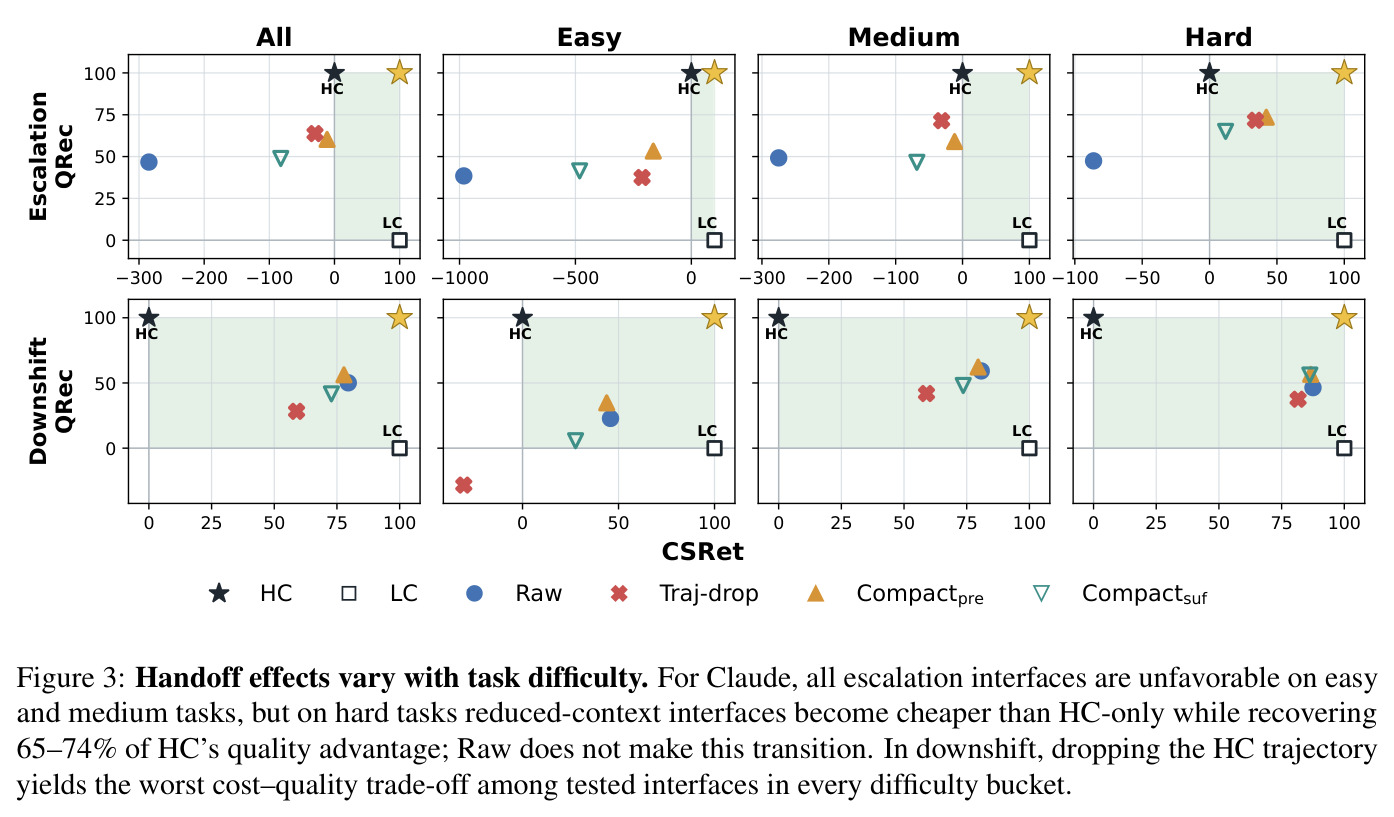
升级(Tab.1):Raw 只收回不到一半质量差距(QRec 47%/36%),成本约为 LC-only 的 4.0×/6.1×;Claude 上 Raw $1.61 是 HC-only($0.72)的两倍多,而 Abort+HC fresh($0.90)与 LC-full+HC-full($1.12)更便宜且同为 79.2% 通过率——Raw 升级被重启严格支配。降档相反:Raw 把 Claude 通过率从 54.6% 提到 65.6%,成本仅 $0.41→$0.51(QRec 50%、CSRet 80%);GPT QRec 79% 但 CSRet 仅 14%。接口效应呈方向对偶:升级时减少 LC 轨迹更好——Traj-drop 把 QRec 提到 64%/84%,Compactpre 把 Claude 的 CSRet 从 −285% 改善到 −11%;降档时去掉 HC 轨迹有害——Traj-drop 的 QRec 只剩 28%/53%。难度分析(Fig.3/4):易/中任务所有升级接口都比 HC-only 贵(CSRet 低至 −982%),难任务上减上下文接口变得比 HC-only 便宜且找回 65–74% 差距,Raw 未跨过这条线(难桶 N̄≈24,探索性)。机制(Fig.4/6):Raw 升级使每个交接后 HC 步成本为 Compactpre 的 2.2×/1.6× 而步数相近;Traj-drop 降档需 1.6×/2.0× 的 LC 步数而每步成本相近。LiC 上晚期需求使升级 QRec 86%、降档 31%;BrowseComp 上 GPT 升级 QRec 95.8% 但 CSRet −30%。统计(Tab.8):bootstrap 确认 Traj-drop−Raw 升级 +3.1pp(CI [1.3,5.0])/+12.2pp([9.2,15.4])、降档 −4.7pp/−5.6pp,均不含零。
查看结构化数据
| 任务 | 指标 | 本文 | 基线 | 提升 |
|---|---|---|---|---|
| SWE-bench Verified 升级(Claude Haiku 4.5→Opus 4.7,7 切换点平均) | Pass / QRec | Traj-drop:72.4%,QRec 64% | Raw(默认接口):69.2%,QRec 47% | +3.2pp / +17pp(丢弃 LC 轨迹、保留工作树显著提质) |
| SWE-bench Verified 升级(GPT-5.6 Luna→Sol) | Pass / QRec | Traj-drop:79.7%,QRec 84% | Raw:67.5%,QRec 36% | +12.2pp / +48pp(bootstrap 95% CI [9.2, 15.4]) |
| SWE-bench Verified 升级 vs 重启(Claude) | Pass / 成本 | Abort + HC fresh:79.2% / $0.90 | Raw handoff:69.2% / $1.61 | +10pp 且省 $0.71——Raw 被 strictly dominated |
| SWE-bench Verified 降档(Opus 4.7→Haiku 4.5) | Pass / CSRet | Raw handoff:65.6%,CSRet 80% | LC-only:54.6%(HC-only 75.8%,成本 $0.85) | +11.0pp,成本仅 $0.51,保留 80% 的成本优势 |
| LiC 分片对话(Claude,535 题 5 任务族) | QRec / CSRet | 升级:86% / 36% | 降档:31% / 53% | 晚期到达的需求逆转方向排序:解出完整规格任务的第一模型是后缀,利好 HC 接手 |
| BrowseComp 渐进搜索(GPT,200 题) | QRec / CSRet | 升级:95.8% / −30.0% | 降档:56.7% / 76.8%;Abort+fresh HC:CSRet −8.5% | 升级几乎追平质量却比重启更贵;降档是良好的中间点 |
局限与改进
作者承认的局限:只研究了两个模型对(Haiku 4.5/Opus 4.7 与 GPT-5.6 Luna/Sol);主研究只用 SWE-bench Verified 一个基准;每任务每配置只跑一次 episode,不估计同配置重复运行的方差,靠交集子集与任务聚类 bootstrap 弥补;难任务桶匹配子集很小(每格 N̄≈24–27),难度结论标注为探索性;LiC 与 BrowseComp 只测 Raw,接口结论主要限于编码场景;切换点固定先验设定而非自适应触发;美元结论依赖供应商定价与缓存费率。我的补充观察:第一,「重启被支配」只在 Claude 成立——GPT 上 Raw($0.36)仍比 HC-only($0.47)便宜,根源是两家族 HC/LC 单任务成本比不同(约 8× vs 2×),结论对定价高度敏感;第二,压缩接口的摘要质量依赖模型总结能力,论文未分析摘要内容或失败模式;第三,mini-swe-agent 单智能体加单一 Bash 工具较简,与生产级多工具智能体的交接税可能不同;第四,未研究多次交接或来回切换的复合效应;第五,「LC 轨迹锚定 HC」「缺 HC 上下文迫使返工」是描述性解释,缺少干预实验定位因果通道。
独立分析的弱点
第一,单次采样噪声:每格只跑一个 episode,SWE-bench 通过/失败对采样敏感,几个百分点的接口差异(如 Claude 升级上 Compactpre 与 Compactsuf 的 2.2pp)可能被运行间方差淹没,应每格重复 3–5 次并报告实例级方差。第二,固定切换点:真实用户不会按预设百分位切换,缺少「何时触发升级/降档」的策略研究,可把切换触发(LC 自估置信度、测试失败信号)与接口选择联合建模成在线决策问题。第三,接口粗糙:Raw/压缩/丢弃是三个极端,选择性保留(如保留工具调用与文件编辑、丢弃失败假设)、结构化交接 schema、学习式压缩等中间地带空白。第四,成本结论定价敏感:CSRet 对价格线性,两家族 HC/LC 成本比不同导致「重启优于继续」只在 Claude 成立,应给出价格比相图与升级划算边界。第五,披露消融仅 Claude 且只有一条固定消息,未测试更强的接收侧指令(如先运行测试验证前任声明)。第六,跨家族交接(如 Haiku→Sol)未研究,方向对偶性暗示税可能更大。第七,论文未提供公开代码仓库链接(仅提随附 artifact),第三方需自行重建 58,000 次运行流水线。
未来方向
作者明确提出四个方向:研究自适应、感知进度的切换策略,联合决定何时切换与哪个模型接续;开发结构化交接,选择性保留、总结或丢弃特定轨迹成分;把交接接口纳入路由策略的一等公民,而非假设全轨迹天然前传;扩展到更多模型家族、能力差距、定价 regime、重复 rollout 与单轨迹多次交接。基于本文成果还可延伸:一是用释放的 58,000 条轨迹训练「交接感知」的压缩模型或接收方 warm-up 程序,把减税从提示工程变成学习问题;二是把 QRec/CSRet 作为目标函数做切换时机优化,例如用 LC 的自估置信度或沙盒测试信号作触发器,验证难任务上「减上下文升级变划算」的边界;三是理论化「非原生锚定」,如通过 counterfactual 重采样测量轨迹依赖度,解释为何 LC 轨迹伤 HC 而 HC 轨迹助 LC;四是研究跨家族与多轮交替交接的税累积;五是把信息动态假说推广到计算机使用、深度研究类智能体,检验「交接价值取决于交接时刻可用的任务相关状态」这一论断的普适性。
复现评估
数据与脚手架基础公开:SWE-bench Verified 500 题与 mini-swe-agent、LiC、BrowseComp 均公开,LiC 采用确定性分片协议(用户轮字节级一致),协议可复现性好。主要门槛是预算与模型版本:实验基于商业 API(Claude 经 LiteLLM、GPT-5.6 经 Bedrock OpenAI 兼容端点),总量 58,000 次运行、200 万次调用、360 亿 token;按 Table 1 单任务成本(约 $0.05–1.61/任务×配置)粗估,全量复现需数万美元级预算。论文提及随附 artifact 记录精确调用标识、价格卡条目与实现/评测器版本,成本可审计。风险点:GPT-5.6/Opus 4.7 快照可能下线或改价;缓存费率与跨区域溢价随时间变化,美元结论需固定价格卡;采样设置(Haiku 温度 0,Opus/GPT 用 provider 默认加 medium/high 推理档)引入非确定性,单 episode 结果有小幅波动。工程难度低(接口以提示替换实现),总体属「资源门槛中高、工程门槛低」:预算有限的团队可只跑 2–3 个切换点×两方向×四接口验证核心结论。
论文图表
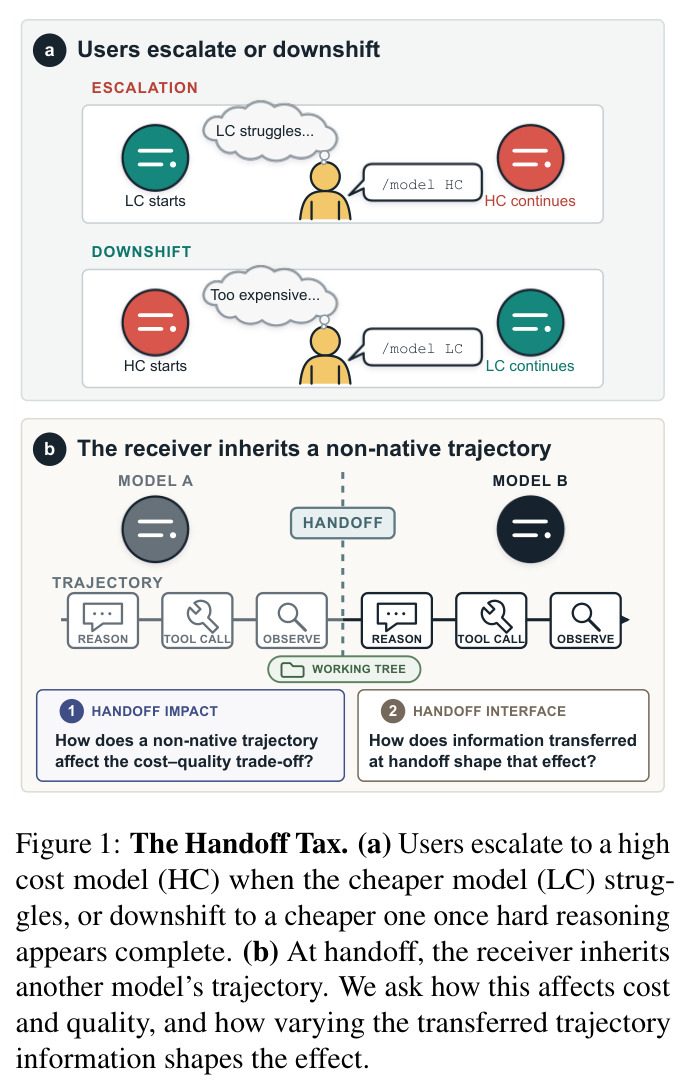
概念总览图。(a) 展示两种用户行为:LC 挣扎时通过 /model 命令升级到 HC(escalation),硬推理完成后降档回 LC(downshift);(b) 放大交接瞬间——接收方模型 B 继承的是模型 A 产生的「推理→工具调用→观察」交替轨迹,外加磁盘上的工作树。右侧标注两个研究问题:交接如何影响成本-质量权衡?传递的轨迹信息如何塑造该效应?
一图定义全文问题:「交接税」是什么、两个方向各自的用户动机、以及核心研究问题。读懂此图才能理解后续所有实验设计为何围绕方向、时机、接口三轴展开。