SimpleOPD:面向长上下文推理的简单分词器无关在线蒸馏 SimpleOPD: Simple Tokenizer-Agnostic On-Policy Distillation for Long-Context Reasoning
共享文本空间对齐加稳定化技巧,实现跨分词器的长上下文推理在线蒸馏
前置知识
在线蒸馏
与离线蒸馏直接在教师生成的固定数据集上做监督训练不同,在线蒸馏让学生模型自己采样生成回答轨迹,再由教师模型对学生轨迹上的每个 token 逐点给出 log-probability 作为监督信号,从而在学生自身的策略分布上提供稠密的 token 级反馈。它优化师生分布间的反向 KL 散度,比离线方案遗忘更少、泛化更好,已被 GLM-5、DeepSeek-V4、Qwen3.5 等旗舰模型采用。
本文全部技术贡献都建立在 OPD 框架内:跨分词器对齐解决的核心问题就是'教师如何在学生自己采样的轨迹上打分',不理解 OPD 的采样-评分-更新循环就无法理解对齐为何必要。
反向 KL 散度
衡量学生分布 $\pi_\theta$ 相对教师分布 $\pi_\phi$ 差异的量,形式为 $D_{\mathrm{KL}}(\pi_\theta\|\pi_\phi)=\mathbb{E}_{y\sim\pi_\theta}[\log(\pi_\theta/\pi_\phi)]$。与正向 KL 不同,反向 KL 在学生自己的分布下取期望,是'mode-seeking'的:学生倾向于集中到教师高概率区域,配合 on-policy 采样天然避免了在教师分布上做重要性采样。
SimpleOPD 的蒸馏目标就是反向 KL 的 token 对齐替身,论文证明了当分词器完全一致时目标严格退化为反向 KL,这是方法正确性的关键论据。
PPO 截断策略损失
强化学习中常用的策略梯度目标:定义新旧策略的概率比 $r_t=\pi_\theta(y_t|\cdot)/\pi_{\theta_{old}}(y_t|\cdot)$,以 $\min(r_t \tilde{A}_t, \mathrm{clip}(r_t,1-\epsilon,1+\epsilon)\tilde{A}_t)$ 为损失,$\epsilon$ 通常取 0.2。截断防止单次更新偏离采样策略太远,使同一批 rollout 数据可以复用多次更新。
SimpleOPD 把教师 log-prob 与学生旧策略 log-prob 之差当作固定优势 $\tilde{A}_t$,再用 PPO clip 做多次更新,训练细节(clip 0.2、每批更新 4 次)直接来自这套机制。
分词器(BPE 与 SentencePiece)
分词器把文本切分为 token 序列,不同模型家族的词表和切分策略不同:Qwen 系用 byte-level BPE,GLM-4.7 也用 BPE 但词表不同,Gemma 用 SentencePiece,同一段文本会被切成完全不同的 token 序列。因此两个模型对同一字符串的 token 级概率分布定义在不同的随机变量空间上,不能逐位置比较。
这正是本文要解决的问题根源:教师和学生的 log-prob 无法直接对齐,论文用'共享文本空间+文本跨度一致才对齐'的方案绕开了它。
参考 KL 正则
在训练目标中加入当前策略与某个固定参考策略(此处是学生自己的初始策略)之间的 KL 散度惩罚项,约束策略不要漂移过远:$\mathcal{L}=\mathcal{L}_{\mathrm{Distill}}+\beta\,D_{\mathrm{KL}}(\pi_\theta\|\pi_{\theta_{init}})$,$\beta$ 是需要调节的系数,太大限制学习、太小失去约束。
它是本文两大稳定化技巧之一,论文消融显示系数取值因模型而异(Qwen/Intern 取 0.5,GLM 最优 1.0),是理解训练稳定性设计的关键。
研究动机
此前 OPD 研究几乎都假设教师和学生共享同一模型家族与词表。当把长上下文推理教师(如 SU-01,可对奥赛难题持续输出 10 万 token 以上推理)蒸馏给短上下文学生时,会同时出现四类问题。其一,师生分词器不同(Qwen 用 byte-level BPE,GLM 的 BPE 词表不同,Gemma 用 SentencePiece),token 级分布无法逐位置对齐。其二,容量与上下文长度差异造成师生分布错配,教师偏好的回答经常超出学生的上下文预算。其三,论文实测直接 OPD 会让 Intern-S2-Preview 和 Qwen3.5-35B-A3B 的平均回答长度在 100 个训练步内急剧增长,截断率与重复率持续攀升,Qwen3.5-35B-A3B 的 AnswerBench 从 0.78 一路跌到 0.60 附近,输出质量与任务分数出现背离。其四,教师监督会系统性抑制 、<|im_end|> 等终止 token,学生逐渐丧失正常结束回答的能力,案例研究中甚至出现答对后把自检重复 972 次或推理塌缩成单 token 死循环的现象。
本文的目标是本文的目标是设计一套简单、稳定、完全不依赖共享词表的在线蒸馏方法,把 IMO 金牌级别的长上下文数学证明模型 SU-01(30B-A3B,基于 Qwen3-30B-A3B,ProofBench 上与 DeepSeek-V3.2-Speciale 同档)的证明推理能力迁移到一批短上下文学生模型,覆盖同族的 Qwen3-4B 与 Qwen3-30B-A3B,以及跨族的 Qwen3.5-4B、Qwen3.5-35B-A3B、Intern-S2-Preview、GLM-4.7-Flash、Gemma-4-26B-A4B 共 7 个学生。方法要同时满足三点:不在教师轨迹上做监督微调(SFT),不人工构造不兼容分词之间的对应关系,并把蒸馏过程稳定在学生的上下文预算内,消除长度爆炸与截断,最终在 ProofBench、AnswerBench、AIME25、AMOBench 上取得一致提升。
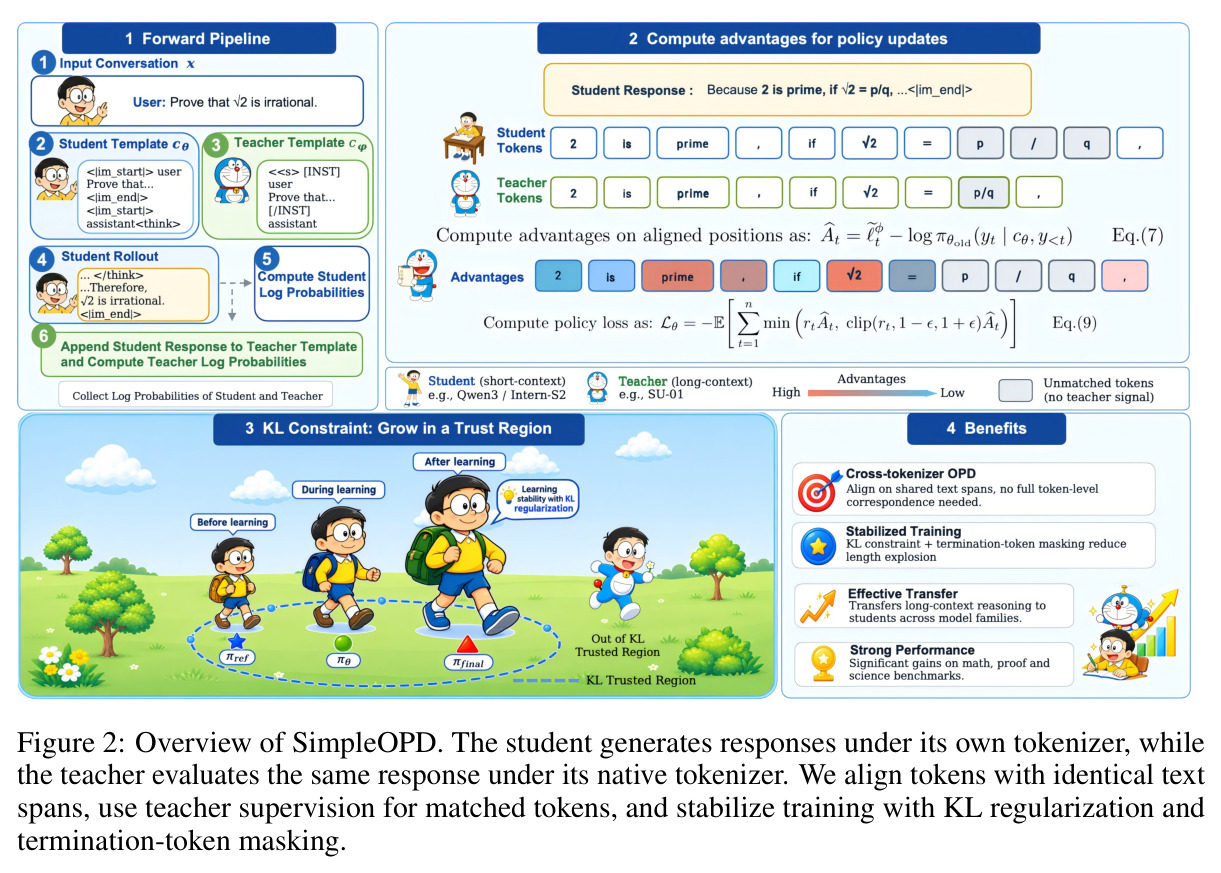
与已有工作不同的是,独特的切入角度是把整个蒸馏搬到'共享文本空间'中:学生用自己的分词器生成并解码出表面字符串 $s$,教师用原生分词器和聊天模板对同一段文本重新编码,然后只对'累计前缀相同且当前 token 文本跨度完全一致'的 token 对建立对齐,其余位置回退到学生自身 log-prob。这与已有跨分词器方案的本质区别在于不做任何 logit 投影、概率合并或词表映射这类有损近似。在此之上,论文第一次系统刻画了'长上下文教师蒸馏给短上下文学生'特有的长度爆炸、截断与终止失败病理,并用终止 token 优势掩码和学生参考 KL 两个极简技巧将其解决,把一个此前被忽视的异构蒸馏场景真正做通。
核心方法
方法回答的核心问题是“教师怎么给学生的 rollout 打分”:既然两边分词不同,就让双方在同一段文本上工作。学生先用聊天模板 $C_\theta$ 构造上下文 $c_\theta$,采样回答 $y_{1:n}$ 并解码成字符串 $s$;教师用模板 $C_\phi$ 构造 $c_\phi$ 后拼接同一段 $s$,用教师分词器编码为 $z_{1:m}$。随后做线性双指针扫描,找出文本跨度完全一致的对齐对集合 $\mathcal{M}$,构造学生长度的教师目标:对齐位置继承教师 $\log\pi_\phi(z_i|c_\phi,z_{<i})$,未对齐位置回退为学生自身 log-prob。在此目标上定义优势并用 PPO 截断损失(clip 0.2)更新,叠加终止 token 掩码与参考 KL 两个稳定化手段。训练基于 Slime 框架,共 100 个 rollout 迭代,学习率 1e-6,批 64,每 prompt 采 4 条回答。
核心创新有二。第一是跨分词器对齐规则:$\mathcal{M}=\{(i,t): P_\phi(i)=P_\theta(t) \wedge \tau_\phi(z_i)=\tau_\theta(y_t)\}$,其中 $P_\theta(t)$、$P_\phi(i)$ 是该位置之前的累计响应文本,$\tau$ 是 token 贡献的文本跨度。只有前缀和跨度都相同才对齐,构成部分一对一映射;部分重叠的 token 一律不对齐,因为一个教师 token 的 log-prob 无法唯一分摊给多个学生 token。这个设计有一个漂亮的理论性质:当分词器完全一致时每个位置都对齐,目标严格退化为反向 KL $D_{\mathrm{KL}}(\pi_\theta\|\pi_\phi)$,说明它是精确目标的合法替身而非粗糙近似。第二是首次把 OPD 的长度爆炸当作可测量、可修复的病理:掩掉 与 <|im_end|> 的优势以阻止教师监督抑制终止,再加对初始策略的参考 KL 约束策略漂移,把截断率从持续上升压到接近 0。
方法步骤详情
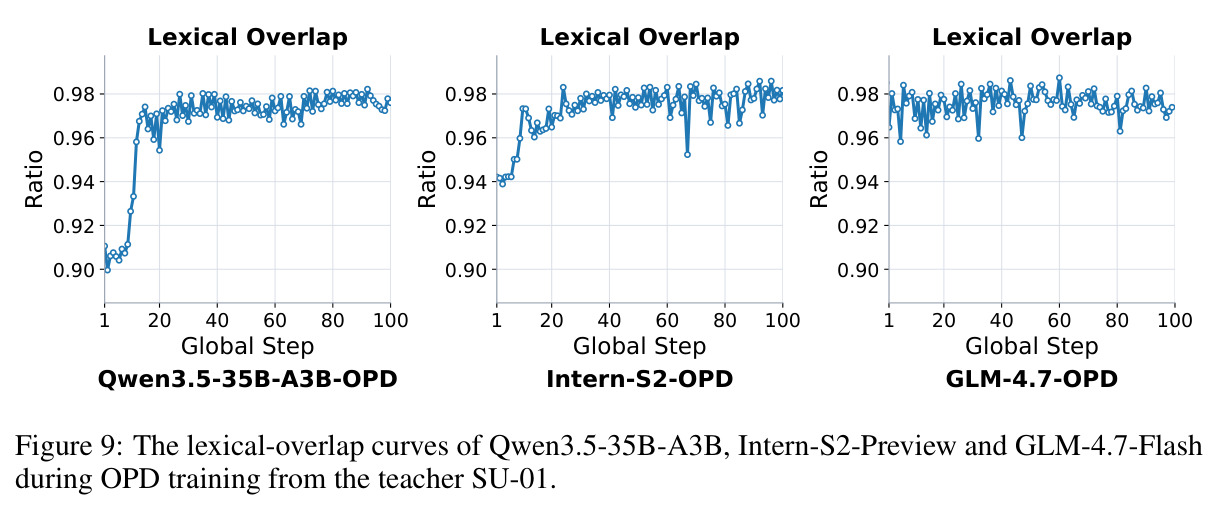
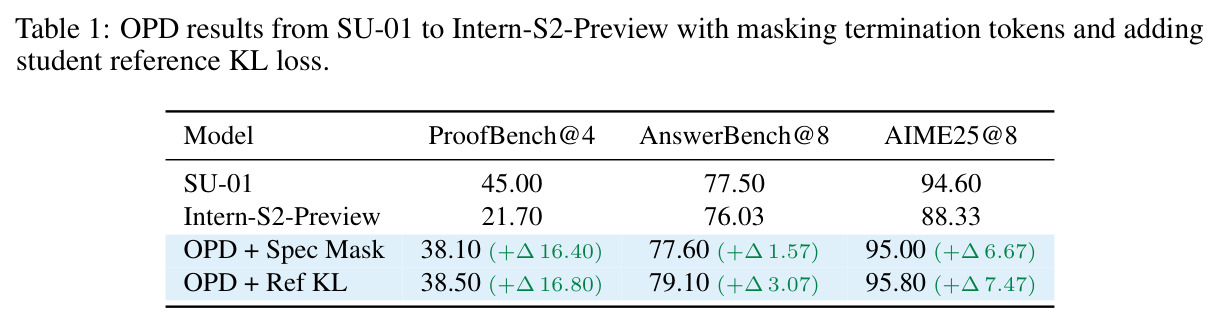
流程分五步。(1) 采样:学生输入 $c_\theta=C_\theta(x)$,rollout 引擎采出 $y_{1:n}$,解码得回答文本 $s=D_\theta(y_{1:n})$。(2) 教师编码:构造 $c_\phi=C_\phi(x)$,把 $c_\phi\oplus s$ 交给教师,得 $E_\phi(s|c_\phi)=(z_1,\dots,z_m)$。(3) 对齐:计算累计前缀 $P_\theta(t)$、$P_\phi(i)$,双指针扫描——前缀与跨度均一致则对齐并双双前进,否则文本消耗少的一侧前进追赶,得到对齐指示 $a_t=\mathbb{1}[\exists i,(i,t)\in\mathcal{M}]$ 与词法重叠率 $\rho=|\mathcal{M}|/n$(实测开局即超 0.9)。(4) 目标与优势:对齐位置取教师 log-prob、未对齐位置回退学生自身得目标 $\tilde{\ell}^{\phi}_t$;定义固定优势 $\tilde{A}_t=\tilde{\ell}^{\phi}_t-\log\pi_{\theta_{old}}(y_t)$,终止 token 优势置零。(5) 更新:PPO 截断损失(clip 0.2)加参考 KL(Qwen/Intern 0.5,GLM/Gemma 1.0),每批更新 4 次,Qwen 系长度 32K、GLM/Gemma 6K,共 100 个迭代。
技术新颖性
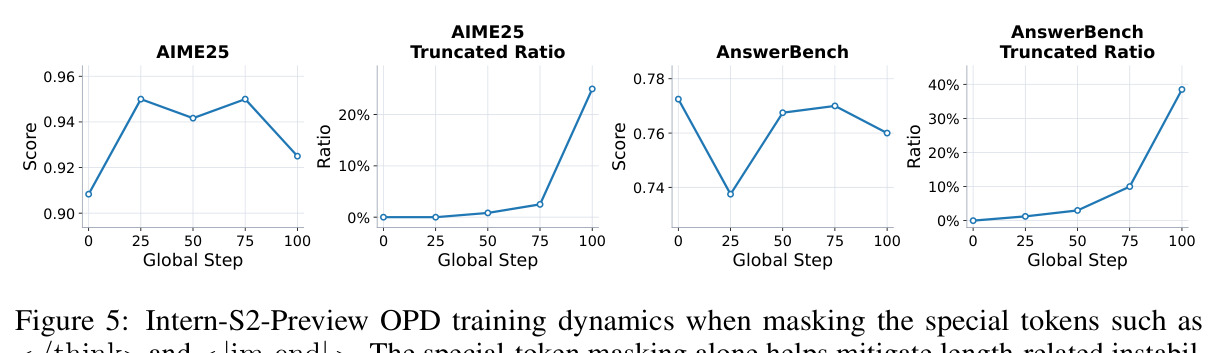
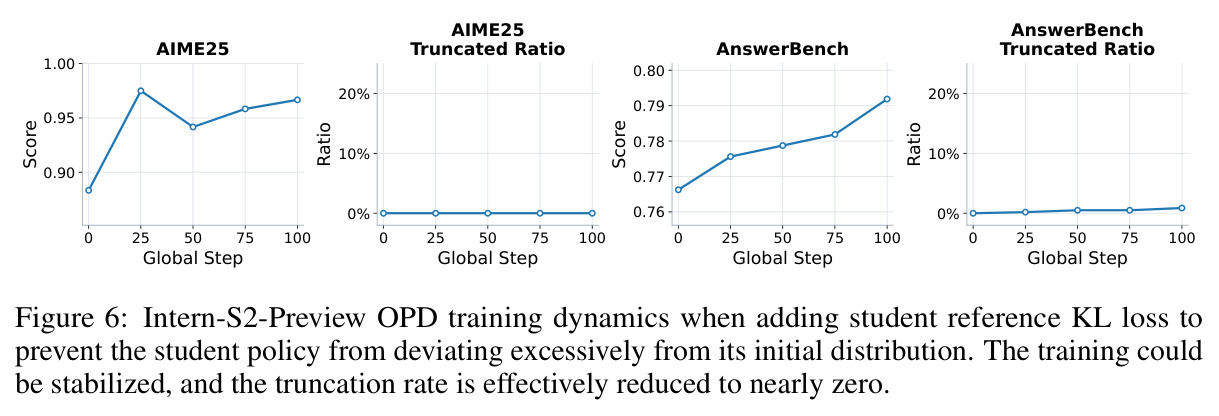
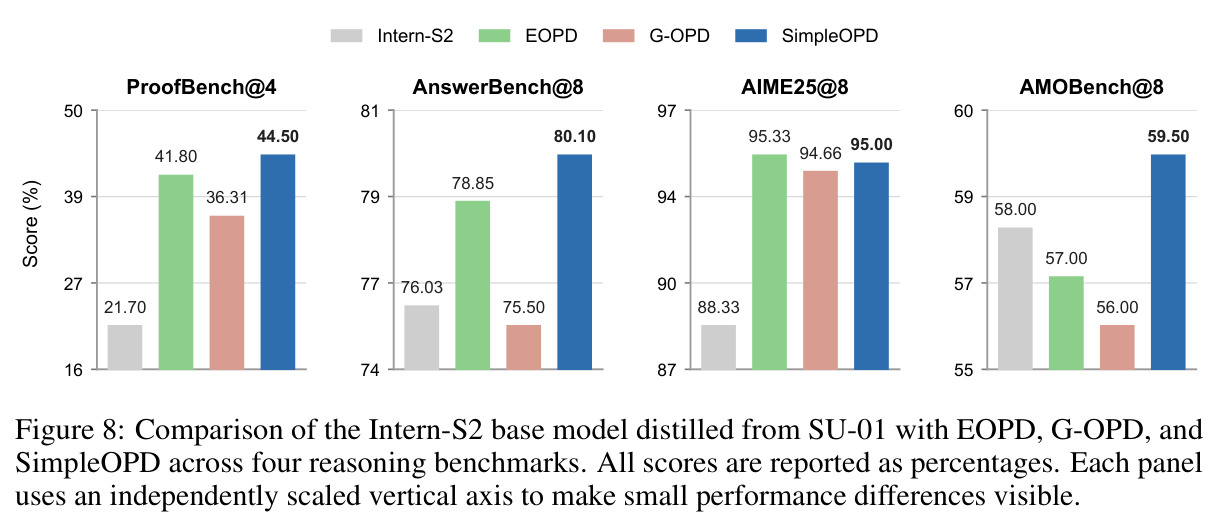
与已有工作的本质区别有三点。其一,自 MiniLLM/GKD 以来的 OPD 工作都默认共享词表,跨分词器时要么做 logit 投影要么放弃 token 级蒸馏;本文证明'共享表面文本+跨度一致才对齐'即可保留绝大部分监督信号(词法重叠率全程 0.9 以上),完全不触碰词表结构,且同分词器情形无损退化为标准 OPD。其二,与 EOPD(在教师高熵位置补前向 KL)和 G-OPD(灵活参考模型加奖励缩放)这类修改目标函数的方案不同,SimpleOPD 的两个稳定化技巧作用于训练动态而非目标形式,实现极简且与前者正交,实验中在 ProofBench、AnswerBench、AMOBench 三项上大幅超越这两个基线。其三,本文首次把'长上下文教师→短上下文学生'场景下的长度爆炸、截断、终止失败作为系统性病理来研究,给出从现象(Figure 3/4)、单因素修复(Figure 5)到组合修复(Figure 6)的完整消融链,并发现参考 KL 强度需随师生差距与分词差异调节,这为后续异构蒸馏工作提供了方法论模板。
实验结果
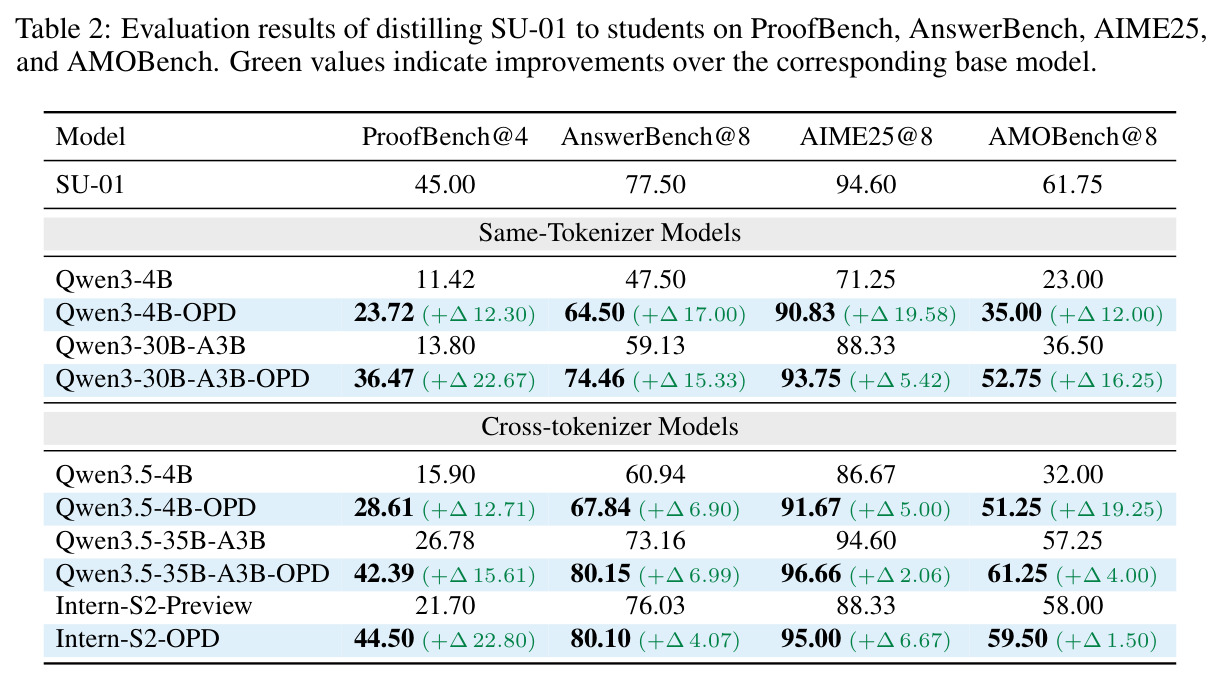
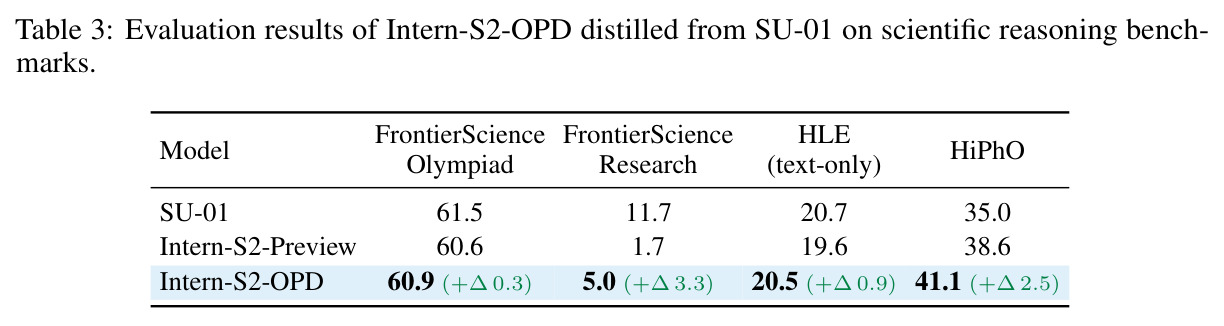
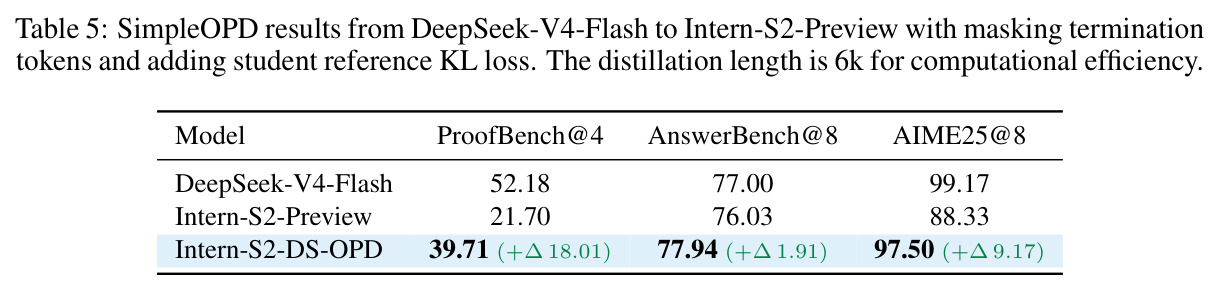
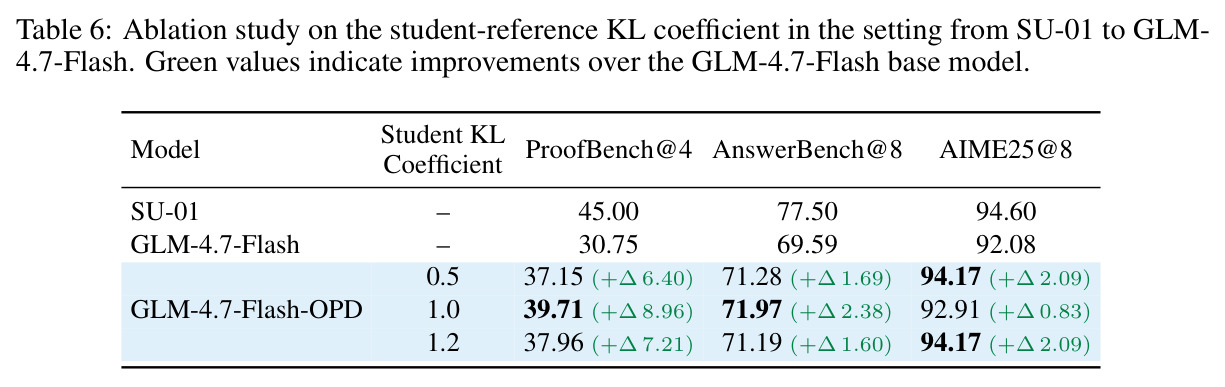
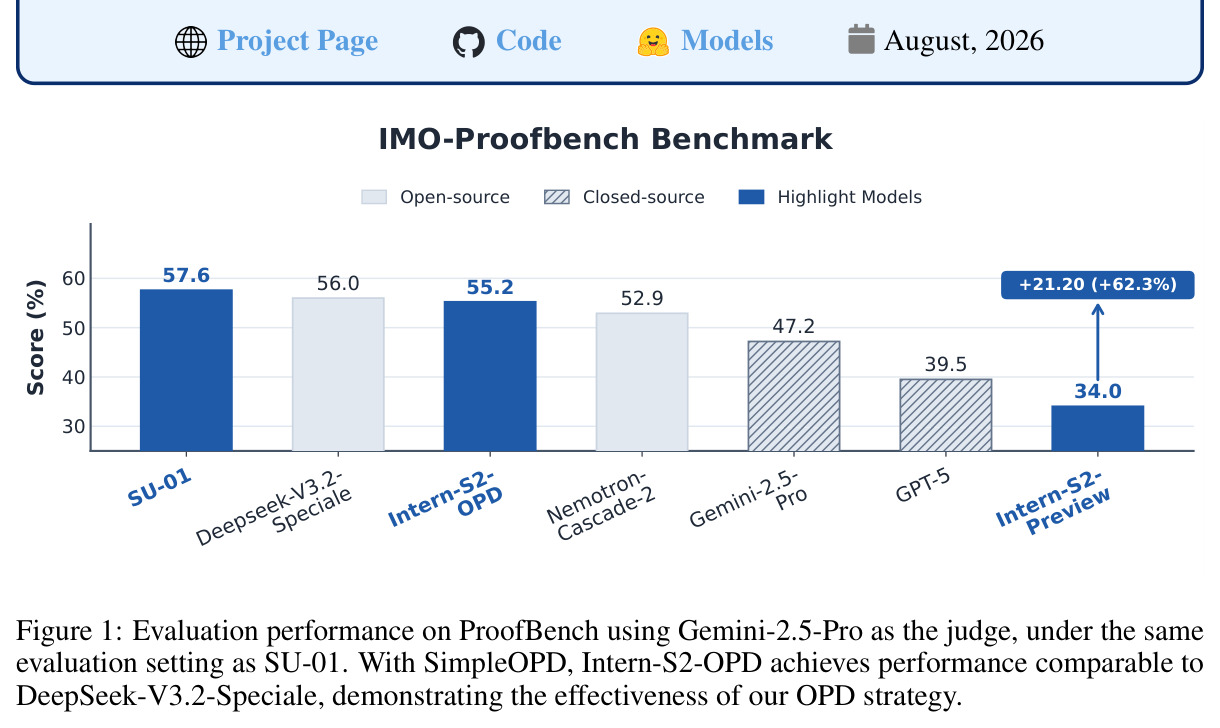
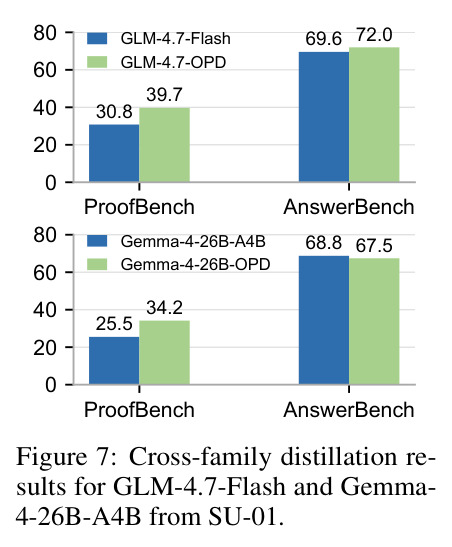
主实验(Table 2)中 Intern-S2-Preview 的 ProofBench@4 从 21.70 升至 44.50(+22.80),几乎追平教师 SU-01 的 45.00;换 Gemini-2.5-Pro 评审(Figure 1)则从 34.0 升至 55.2(+21.2,+62.3%),超过 Gemini-2.5-Pro(52.9)和 GPT-5(47.2)。同族 Qwen3-4B 四项全涨:ProofBench +12.30、AnswerBench 47.50→64.50、AIME25 71.25→90.83;Qwen3-30B-A3B 的 ProofBench 13.80→36.47。跨族 Qwen3.5-35B-A3B ProofBench 26.78→42.39;GLM-4.7-Flash 30.8→39.7;分词差异最大的 Gemma-4-26B-A4B 仅 ProofBench 25.5→34.2,AnswerBench 反而 68.8→67.5。稳定化消融(Table 1):仅终止 token 掩码提至 38.10,加参考 KL 后 38.50、AIME25 95.80,截断率归零。换 158B 的 DeepSeek-V4-Flash 当教师(Table 5),6K 长度即把 AIME25 提到 97.50(+9.17)。域外(Table 3):HiPhO 38.6→41.1、HLE 38.6→41.1。基线对比(Figure 8):四项基准中三项大幅领先 EOPD 与 G-OPD。
查看结构化数据
| 任务 | 指标 | 本文 | 基线 | 提升 |
|---|---|---|---|---|
| 数学证明 ProofBench(Gemini-2.5-Pro 评审) | 评分(%) | Intern-S2-OPD 55.2 | Intern-S2-Preview 34.0 | +21.2(+62.3%),超过 Gemini-2.5-Pro 的 52.9 与 GPT-5 的 47.2 |
| 数学证明 ProofBench@4(DeepSeek-V4-Flash 评审) | 评分(%) | Intern-S2-OPD 44.50 | Intern-S2-Preview 21.70 | +22.80,几乎追平教师 SU-01 的 45.00 |
| AIME25@8(同族学生) | 准确率(%) | Qwen3-4B-OPD 90.83 | Qwen3-4B 71.25 | +19.58 |
| AnswerBench@8(同族学生) | 准确率(%) | Qwen3-4B-OPD 64.50 | Qwen3-4B 47.50 | +17.00 |
| ProofBench@4(30B 级同族学生) | 评分(%) | Qwen3-30B-A3B-OPD 36.47 | Qwen3-30B-A3B 13.80 | +22.67 |
| ProofBench@4(跨族 GLM) | 评分(%) | GLM-4.7-OPD 39.7 | GLM-4.7-Flash 30.8 | +8.9(AnswerBench 69.6→72.0) |
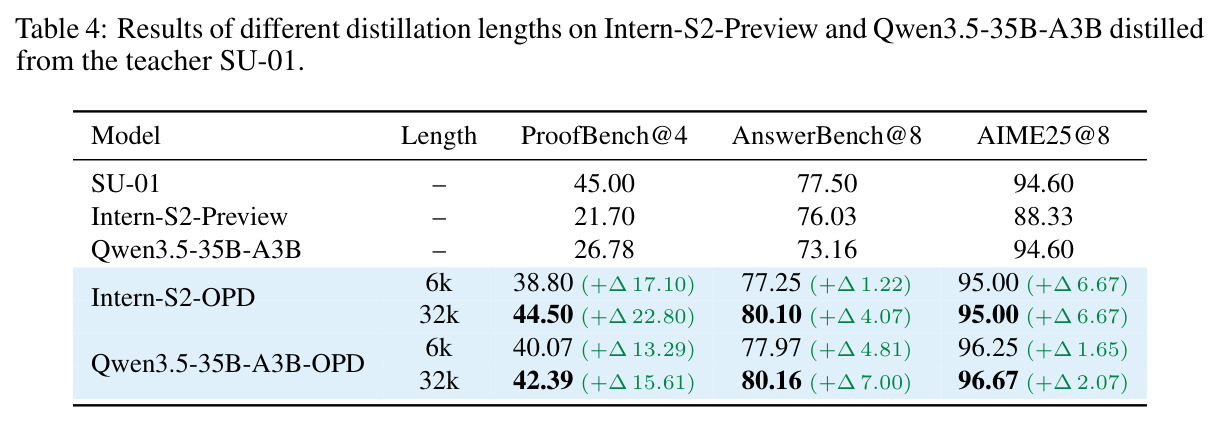
| AIME25@8(换更强教师,6K 长度) | 准确率(%) | Intern-S2-DS-OPD 97.50(教师 DeepSeek-V4-Flash) | Intern-S2-Preview 88.33 | +9.17,ProofBench 39.71 反超同长度 SU-01 教师的 38.80 |
局限与改进
作者承认的局限:跨族蒸馏效果与分词差异强相关,Gemma-4-26B-A4B 用 SentencePiece、词表与分段行为差异大,AnswerBench 从 68.8 微降至 67.5,只有 ProofBench 提升;学生参考 KL 系数需按模型手工调节(0.5 对 GLM 欠正则、1.2 又限制吸收能力,最优 1.0)。我的补充观察:(1) ProofBench 高度依赖 LLM-as-judge,SU-01 自身在两个评审下分别为 45.00 与 57.6,相差 12.6 分,跨论文比较需谨慎;(2) 部分重叠 token 被完全丢弃,教师信号在跨度不匹配处全部浪费,对词法重叠率低的学生损害更大;(3) 参考 KL 锚定在学生初始策略上,若基座较弱会拖慢向教师靠拢;(4) 训练只用约 4528 道数学证明题,域外提升有限(FrontierScience-Research 仅 1.7→5.0);(5) 教师需对每条学生 rollout 做完整前向打分,32K 蒸馏比 6K 贵数倍,论文未给出训练成本数字。
独立分析的弱点
弱点一:硬对齐浪费监督。未对齐位置的优势实际为零,等于没有学习信号;对 BPE 与 SentencePiece 这类差异大的分词,可改用字符级重叠比例做软分配,把教师 token 的 log-prob 按跨度重叠比例摊给相邻学生 token,或用动态规划允许 k:m 跨度合并。弱点二:KL 系数与蒸馏长度是静态超参,GLM 最优 1.0 与 Qwen 系的 0.5 不同,可设计随词法重叠率、截断率等在线指标自适应的调度器。弱点三:终止 token 掩码是补丁式方案,更根本的做法是把长度预算显式纳入目标(预算内奖励或长度控制头)。弱点四:ProofBench 靠 LLM judge 且取 4 次平均,论文未报告 judge 与人工评审的一致性,建议补充多 judge 相关性或小规模人工抽查。弱点五:只在数学证明域训练,虽 HiPhO 有 +2.5 的物理迁移证据,但代码、agent 等长程推理域未验证,FrontierScience-Research 仅 1.7→5.0。
未来方向
作者方向上,论文给出三条明确延伸:更强的教师带来更大的学生收益(DeepSeek-V4-Flash 在同 6K 长度下 ProofBench 反超 SU-01 达 0.91 分),跨分词器 OPD 因此可无缝接入任何前沿闭源或开源大模型当教师;蒸馏长度从 6K 增至 32K 在所有基准一致有益,值得探索按任务难度的课程式长度调度;纯证明数据优于混合可验证数学数据(ProofBench 44.50 对 38.50),提示按目标能力定制蒸馏数据比堆数据更重要。基于成果可继续延伸:把 OPD 与 RLVR 串联成'先蒸馏对齐、后强化突破'的两阶段后训练流水线;多教师跨分词器集成蒸馏,让不同家族的强项互补;把终止 token 掩码与参考 KL 推广到 agent 长程任务与视觉-语言推理模型;从理论上分析对齐映射的覆盖率与蒸馏收益的关系,指导针对低重叠分词对的预对齐或词表适配。
复现评估
复现条件较好。方法组件(双指针对齐、优势掩码、参考 KL)在开源框架 Slime 中实现,评测 rollout 用 SGLang;论文页面提供 Project Page、Code 与 Models 链接,预计会放出蒸馏后权重。训练数据全部公开:Open Proof Corpus 63 题、AoPS 2948 题、竞赛书籍 900 题、数谜米论坛与 Evan Chen 材料 617 题,合计约 4528 题。算力方面,需同时部署教师(30B-A3B 级)做逐 token 打分并训练学生:100 个 rollout 迭代、批 64、每 prompt 4 条回答、Qwen 系 32K 最大长度,估计需要多卡 A100/H100 集群,成本低于完整 RL 但显著高于普通 SFT。评测需 LLM judge(DeepSeek-V4-Flash 或 Gemini-2.5-Pro)跑 ProofBench@4 与 8 次采样的 AIME25 等,开销不小。总体难度中上:算法简单易实现,门槛主要在基础设施与教师推理成本。
论文图表
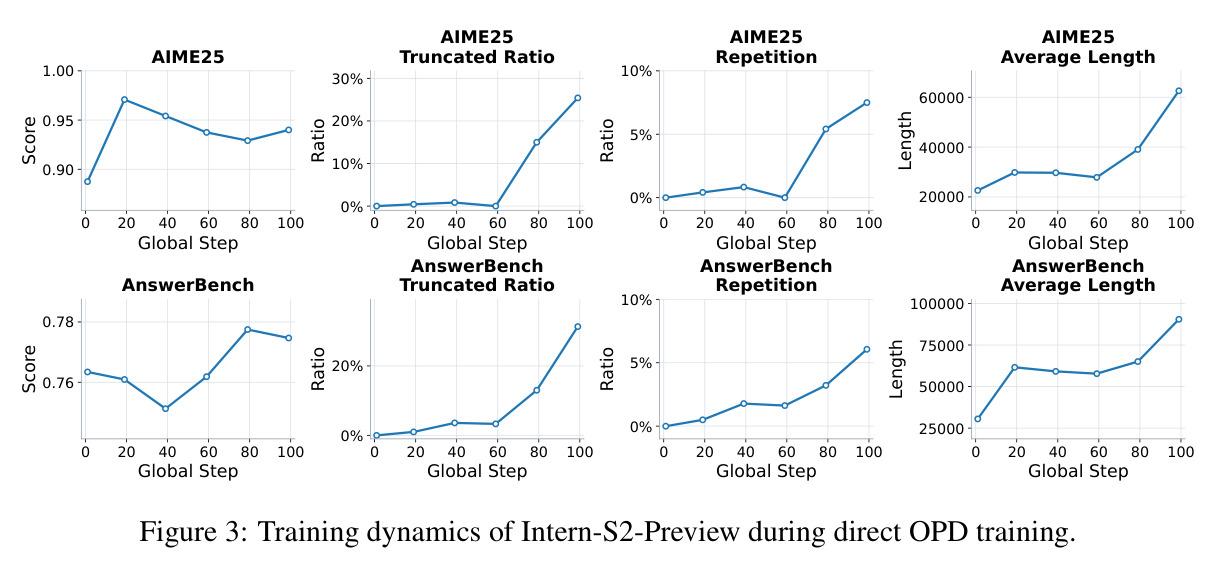
直接 OPD 训练 Intern-S2-Preview 的四联曲线(AIME25、AnswerBench 的分数/截断率/重复率/平均长度随 global step 变化):平均回答长度从约 2 万 token 持续增长到 5-10 万,截断率与重复率同步攀升,AnswerBench 分数从 0.78 滑落到 0.76 以下。
提供'长度爆炸与截断'这一核心病理的第一手实验证据,是引入终止 token 掩码和参考 KL 的直接动机。
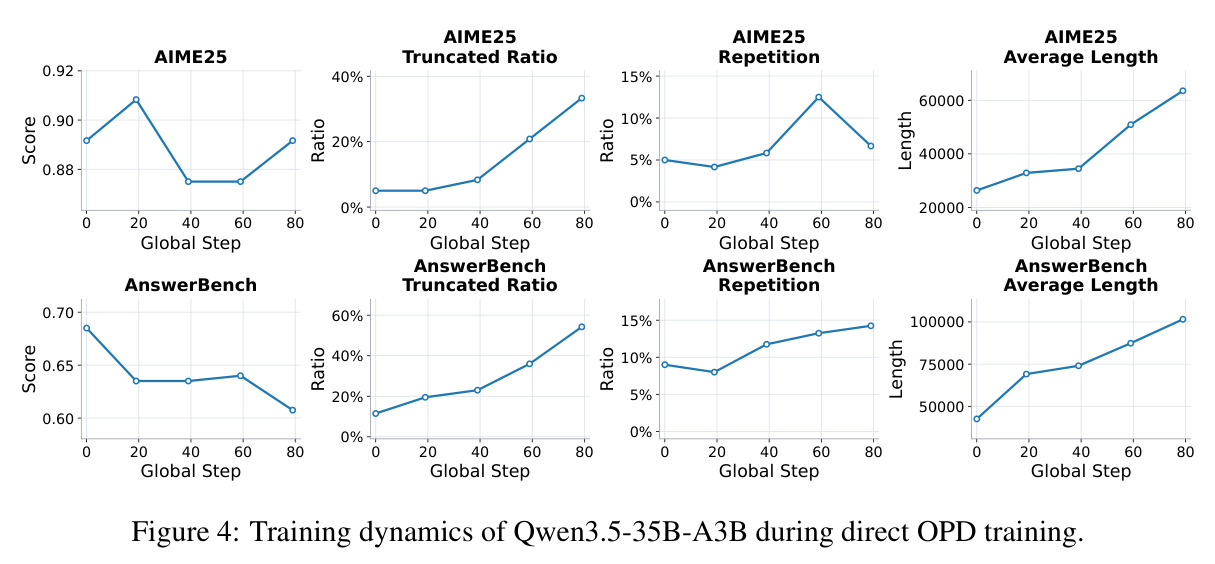
Qwen3.5-35B-A3B 直接 OPD 的同款四联曲线:退化比 Intern-S2 更严重,截断率一度逼近 40-60%,平均长度冲向 7.5 万-10 万 token,AnswerBench 从 0.70 跌至 0.60。
证明长度爆炸不是单模型个例而是跨族普遍现象,强化了问题陈述的普适性。