空间记忆智能体:面向空间智能的经验驱动程序性记忆 Spatial Memory Agent: Experience-Grounded Procedure Memory for Spatial Intelligence
冻结VLM用可迁移教训记忆与迁移可靠性校准,实现免训练的空间推理自进化
前置知识
冻结模型自进化(parameter-update-free self-evolution)
在不修改模型任何权重的前提下,通过外部状态(经验库、记忆、技能库)让智能体随交互积累而持续变强的范式。模型本体保持不变,所有「学习」都发生在外部存储中:部署时只需加载记忆文件,不需要 GPU 训练、不需要微调流水线,也不会发生灾难性遗忘。
本文全部贡献都建立在「权重不动」这一约束上,SMA 是该范式在空间智能领域的首次系统实践,理解这一约束才能明白它与后训练、工具调用两条路线的本质区别。
程序性记忆与可迁移教训(procedural memory / transferable lesson)
不同于存储具体问答实例的情景记忆(episodic memory),程序性记忆存储「怎么做」的可复用原则。本文的记忆卡是紧凑文本:任务、摘要、一条可迁移教训,外加访问数、累计奖励、可靠性分数三个统计字段。检索时只暴露任务、摘要与教训,不暴露历史预测或标准答案,从接口层面禁止答案抄袭。
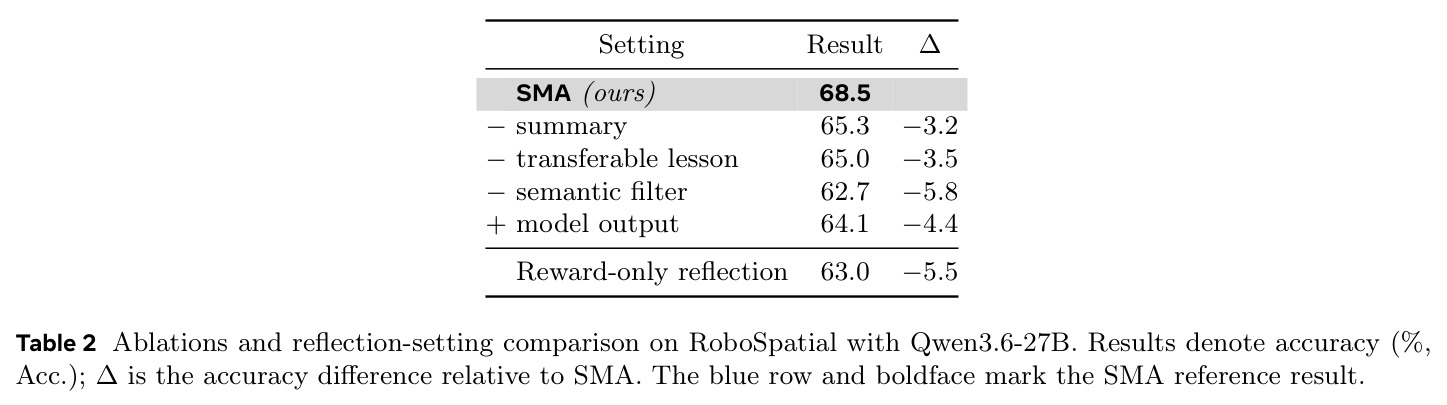
SMA 记忆单元的这个设计决定了它迁移的是推理程序而非实例答案,是理解消融实验(去掉教训字段损失 3.5 分)和案例研究的钥匙。
验证器引导反思(verifier-guided reflection)
用可验证奖励(答案对错的标量 $r_i \in [0,1]$)和标准答案 $y^\star$ 共同指导反思模型,把一次 rollout 压缩为摘要与教训的机制。反思输出严格 JSON,且有防泄漏规则:可以看答案来诊断对错原因,但禁止在教训中复述答案本身。
反思信号的质量直接决定记忆质量——论文的 reward-only 对照(反思时看不到标准答案)在 RoboSpatial 上掉 5.5 分,量化了这一设计的价值。
收缩估计与贝叶斯先验(shrinkage estimator)
用先验「虚拟样本」平滑小样本统计量的经典方法。SMA 的可靠性更新 $v_j = \frac{\lambda v_0 + c_j}{\lambda + n_j}$ 等价于 $\lambda$ 次均值为 $v_0$ 的虚拟访问与 $n_j$ 次真实访问的凸组合:$v_i = \frac{\lambda}{\lambda+n_i} v_0 + \frac{n_i}{\lambda+n_i}\cdot\frac{c_i}{n_i}$。访问少时贴近中性先验 $v_0=0.5$,访问多时由经验成功率主导。
这是 TRS 公式的数学本质:理解它才能明白为什么低访问记忆天然保守、$\lambda=2$ 相当于「一胜一负两次虚拟访问」、以及为什么更新满足次序不变性。
两阶段检索:语义过滤 + 联合重排序
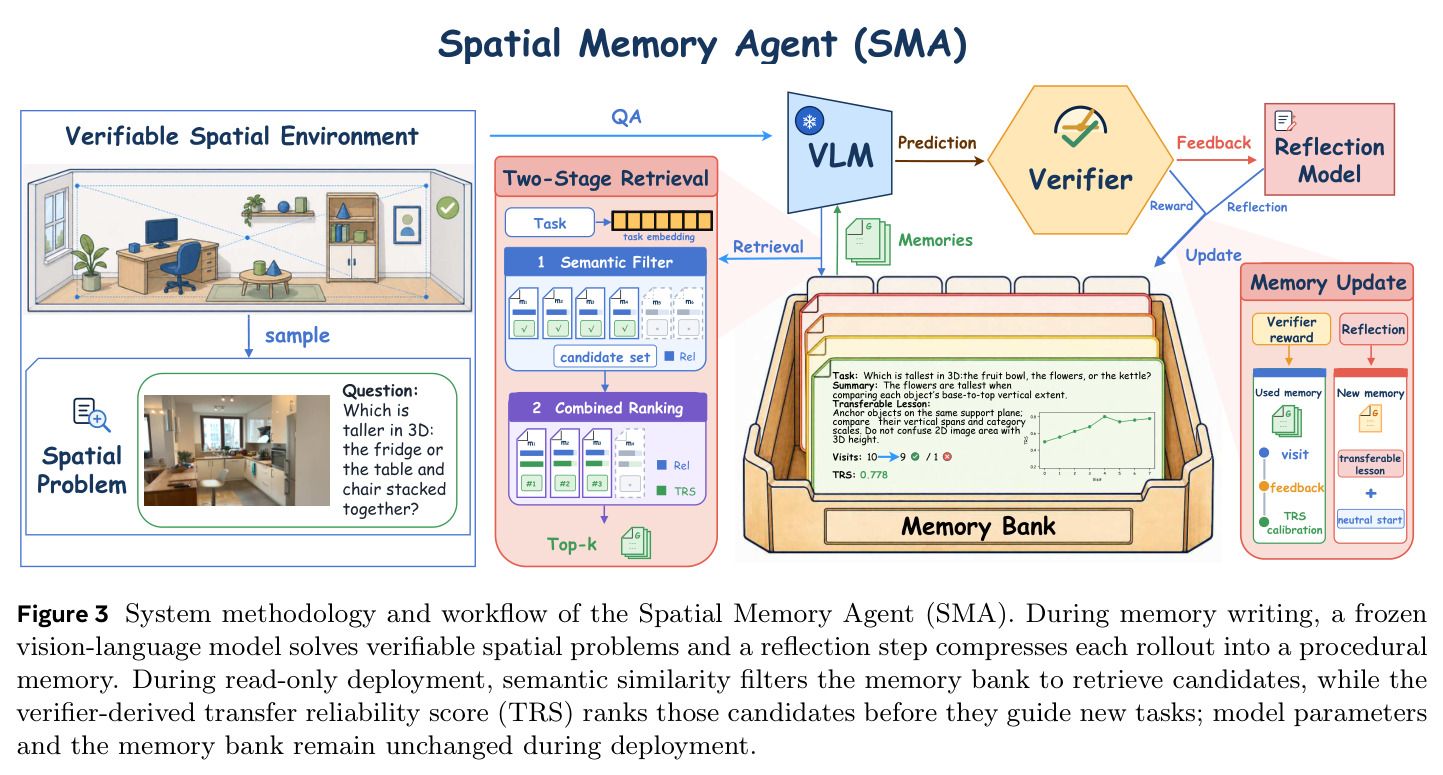
第一阶段用任务嵌入余弦相似度 $\text{rel}_{ij}=\cos(\psi(t_i),\psi(t_j))$ 与阈值 $\delta$ 过滤出候选集;第二阶段把归一化相似度与归一化 TRS 加权融合 $S_{ij}=(1-\eta)z(\text{rel}_{ij})+\eta z(v_j)$($z(\cdot)$ 为截断 z-score),取 top-$k$ 作为指导集注入提示。
论文的核心论点「最相近的记忆未必最好」就落在这套规则上:消融显示去掉语义过滤损失 5.8 分,而把 $\eta$ 从 0 调到 0.5 正是超越 MemP 的关键。
研究动机
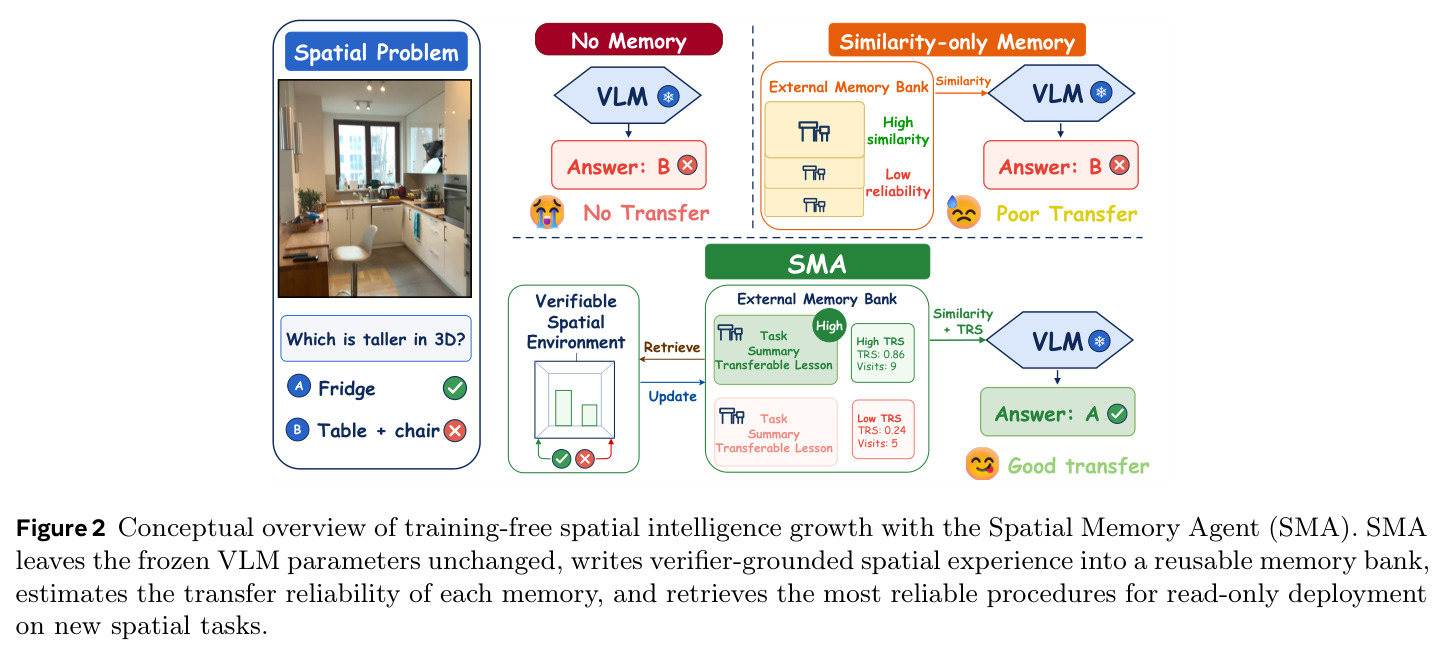
VLM 的空间推理仍然是明显短板:论文的无记忆基线在四个基座模型上,Omni3D(需要估计真实 3D 数量、遮挡、容纳关系的基准)准确率只有 37.2%–41.6%,RoboSpatial 也只有 54.1%–61.2%,说明静态识别之外的 3D 量化、视角变换、空间关系判断远未解决。现有改进集中在两条路:其一是后训练(SpatialVLM 构建空间指令数据做 SFT、RoboSpatial 融合 2D/3D 数据训练、SpatialEvo/SAGE 等用自生成数据和强化学习),代价是需要构建空间标注、消耗大量 GPU 算力更新权重,而且换一个基座模型就要重训一遍;其二是智能体工具调用(S-Agent 在推理时调用深度估计、3D 重建等专家空间工具,SpaceTools 用 RL 训练工具调用策略),代价是推理期依赖外部专家工具,带来延迟、API 成本和部署复杂度。与此同时,文本智能体社区的记忆方法(MemP、MemRL 等)大多按语义相似度检索经验,无法区分「表面上文本相关」和「这条经验在新视觉场景下真的能帮对」,直接搬到空间任务上会检索出语义接近但实际误导的经验。
本文的目标是本文提出第三条互补路线——免参数更新的空间自进化:让一个完全冻结的 VLM 在「可验证空间环境」中积累经验,把验证器打分过的 rollout 经验证器引导反思压缩成一条条可迁移教训,存入外部记忆库;再给每条记忆在线校准一个迁移可靠性分数(TRS),估计它对未来新空间问题的实际帮助程度;部署阶段进入只读模式,用「语义相似度 + TRS」联合检索出最可靠的教训引导冻结模型推理。整个过程不改一个权重、推理时不调用任何专家空间工具,目标是在四个不同规模的冻结基座、多个空间基准上稳定超过无记忆、RAG、相似度记忆和 MemRL 类基线。
与已有工作不同的是,独特切入角度有三层。第一,作者把文本智能体的 agentic memory 范式首次系统地引入空间智能,明确指出已有记忆方法的两个缺口:主要面向文本中心任务、检索主要依赖语义相似度。第二,SMA 把「记忆的价值」与「产生它的那次 rollout 对不对」解耦:每条新记忆的 TRS 均匀初始化为 $v_0$,之后完全由「被检索之后是否真的反复帮助模型拿到验证奖励」的访问证据来校准——这是与 MemRL 类价值更新规则的本质区别。第三,检索上把相似度降级为初筛,最终排序由相似度与 TRS 联合决定,把检索从语义匹配升级为证据加权的程序选择;写入上采用 One-Pass 协议(只写一遍、后续只更新可靠性),避免记忆库随遍数膨胀冗余。
核心方法
直觉是:如果模型每做完一道空间题,都能提炼出一条「下次遇到类似套路该注意什么、该避免什么坑、该做什么检查」的通用教训,并且知道哪些教训真的靠谱、哪些只是碰巧,那么不改权重也能越做越好。技术路线分写、读两个阶段。写阶段(经验获取):在环境划分 $X$ 上逐题作答,先检索记忆做提示,冻结 VLM 输出 $o_i=\mathcal{F}(V_i,t_i,G_i)$ 并解析预测 $\hat{y}_i$,验证器给标量奖励 $r_i=\text{Eval}(\hat{y}_i,y_i^\star)$;只在第一遍由反思模型 $R_\phi$ 把 $(o_i,t_i,y_i^\star,r_i)$ 压缩成记忆卡 $m_i=(t_i,s_i,l_i,n_i,c_i,v_i)$,即任务、摘要、可迁移教训、访问数、累计奖励、TRS 六个字段(One-Pass 写入,后续遍只复用记忆库更新被检索卡片的可靠性)。读阶段(只读部署):在留出划分 $D$ 上执行同样的两阶段检索,把 top-$k$ 卡片暴露的任务、摘要、教训拼进提示引导冻结模型,不写新记忆、不更新任何统计量。
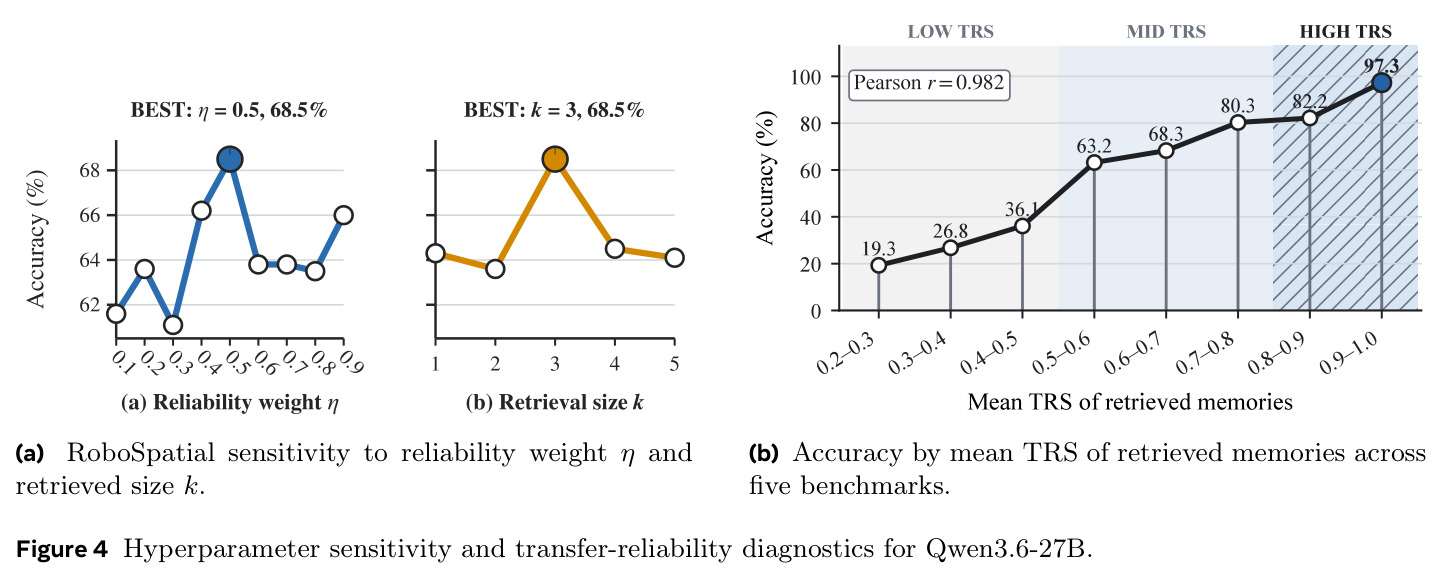
核心创新是访问证据校准的迁移可靠性分数(Transfer Reliability Score, TRS)。每张新卡初始化 $n_i\leftarrow 0$、$c_i\leftarrow 0$、$v_i\leftarrow v_0$(默认 $v_0=0.5$,$\lambda=2$);每当该卡被选入指导集 $G_i$ 且本次答案获得奖励 $r_i\in[0,1]$,就更新 $n_j\leftarrow n_j+1$、$c_j\leftarrow c_j+r_i$、$$v_j \leftarrow \frac{\lambda v_0 + c_j}{\lambda + n_j}。$$ 这个估计器可解读为 $\lambda$ 次虚拟访问(均值为 $v_0$)与 $n_j$ 次真实访问的凸组合,满足论文要求的五条性质:均匀初始化(不因来源题对错而偏袒)、访问证据依赖、次序不变(只看访问总数与累计奖励)、低访问保守(一两次访问不会剧烈改变分数)、证据驱动收敛(频繁帮助答对的经验被 promote、反复有害的被 suppress)。与 MemRL 的本质区别在于:记忆价值不来自写出它的那道题是否做对,而来自它之后被检索时的实际迁移战绩,把检索从语义匹配升级为证据加权的程序选择。论文数据强力支持这一点:按检索记忆平均 TRS 分桶,部署准确率从 $[0.2,0.3)$ 桶的 19.3% 单调升到 $[0.9,1.0]$ 桶的 97.3%。
方法步骤详情
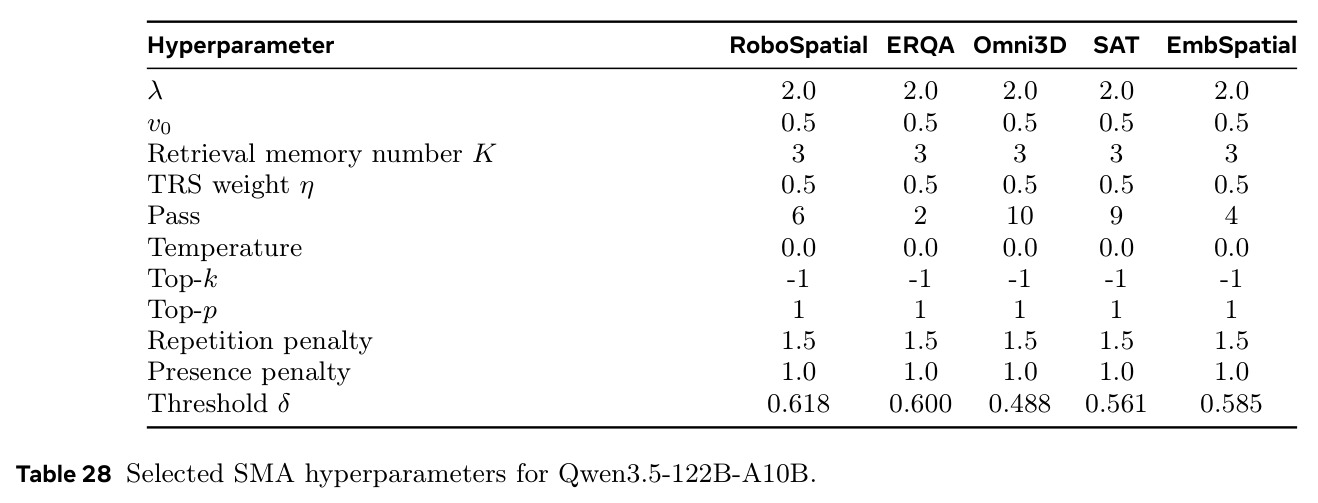
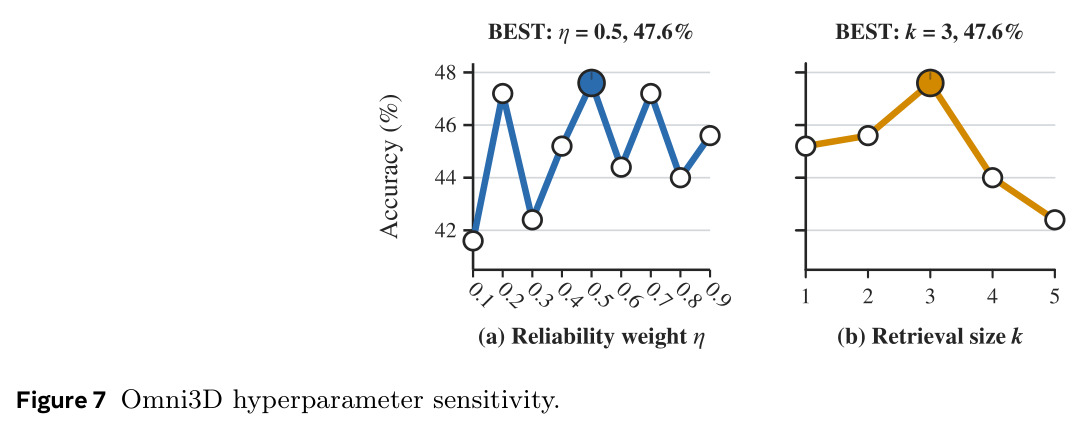
完整流程(算法 1):输入冻结 VLM $\mathcal{F}$、反思模型 $R_\phi$、环境划分 $X$、部署划分 $D$;参数为遍数 $T$、检索数 $k$、相似度阈值 $\delta$、TRS 权重 $\eta$、先验值 $v_0$、先验强度 $\lambda$。第一步,初始化空记忆库 $M$。第二步,循环 $T$ 遍,每遍随机打乱 $X$:对每个问题 $\xi_i=(V_i,t_i,y_i^\star)$,先算任务嵌入余弦相似度,过滤出 $C_i=\{m_j\in M: \text{rel}_{ij}\ge\delta\}$,再按 $S_{ij}=(1-\eta)z(\text{rel}_{ij})+\eta z(v_j)$ 取 top-$k$ 组成指导集 $G_i$;调用冻结 VLM 生成输出并解析预测 $\hat{y}_i$;验证器打分 $r_i$;对 $G_i$ 中每张卡更新 $(n_j,c_j,v_j)$;仅当处于第一遍($e=0$)时,反思模型以 $(o_i,t_i,y_i^\star,r_i)$ 为输入输出严格 JSON 的摘要 $s_i$ 与教训 $l_i$,并以均匀初始值写入新卡。第三步,只读部署:对 $D$ 中每个 $\xi_i$ 重复相同的两阶段检索,将 top-$k$ 卡的任务、摘要、教训字段拼入用户提示,保存预测,但不写记忆也不更新 $(n_j,c_j,v_j)$。默认超参:$k=3$、$\eta=0.5$、$\lambda=2.0$、$v_0=0.5$、temperature=0、top-p=1,$\delta$ 按基准在 0.488–0.618 之间选取,嵌入用 text-embedding-3-large。
技术新颖性
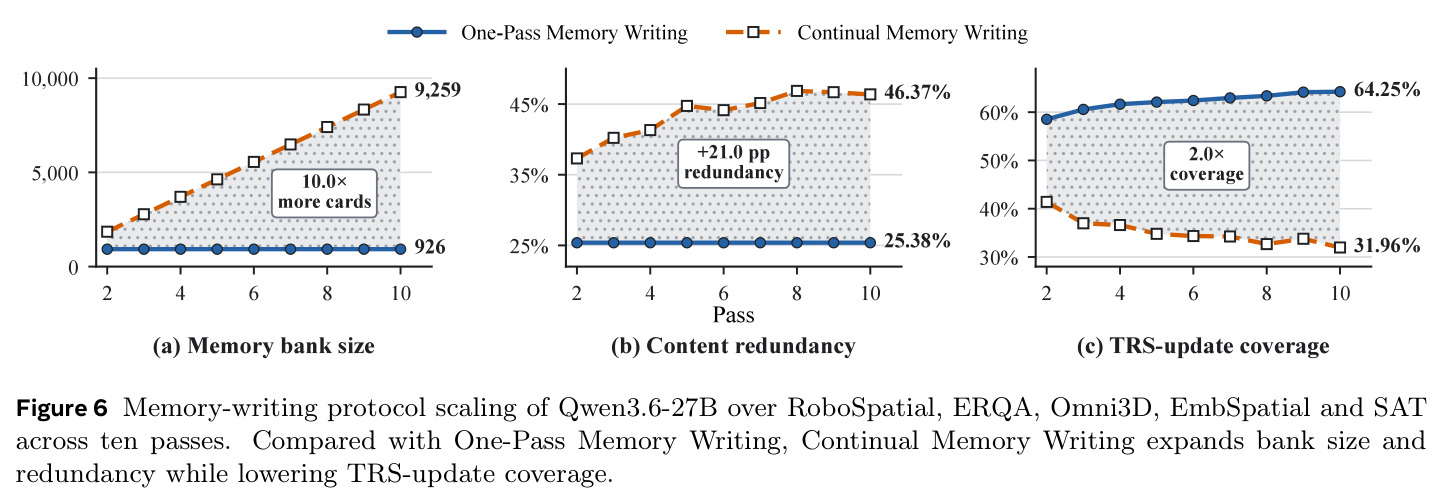
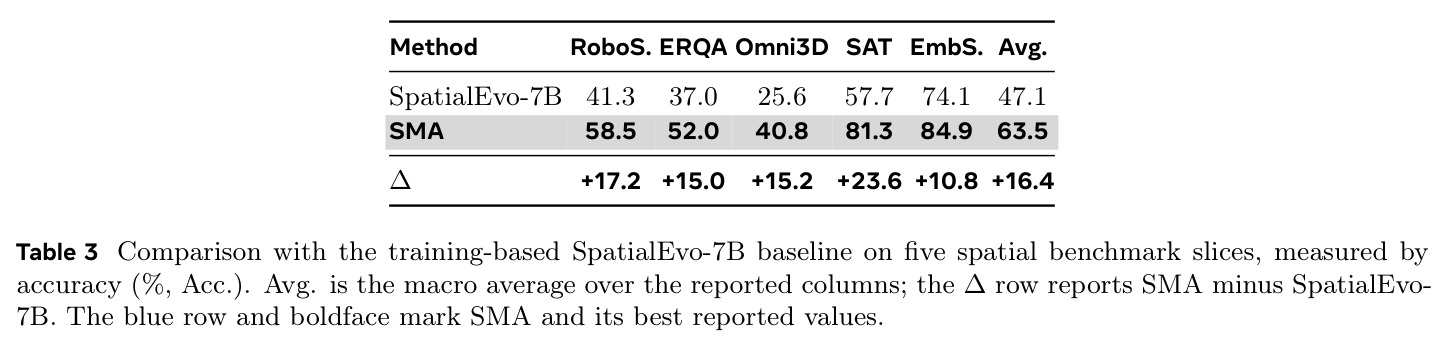
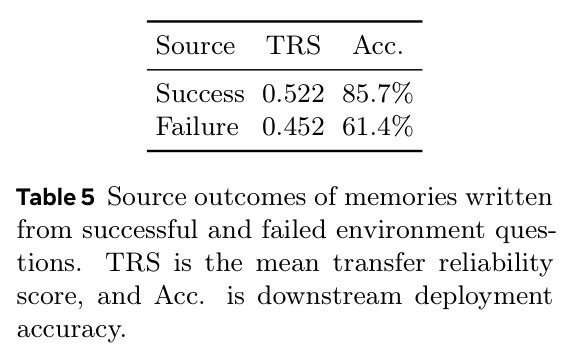
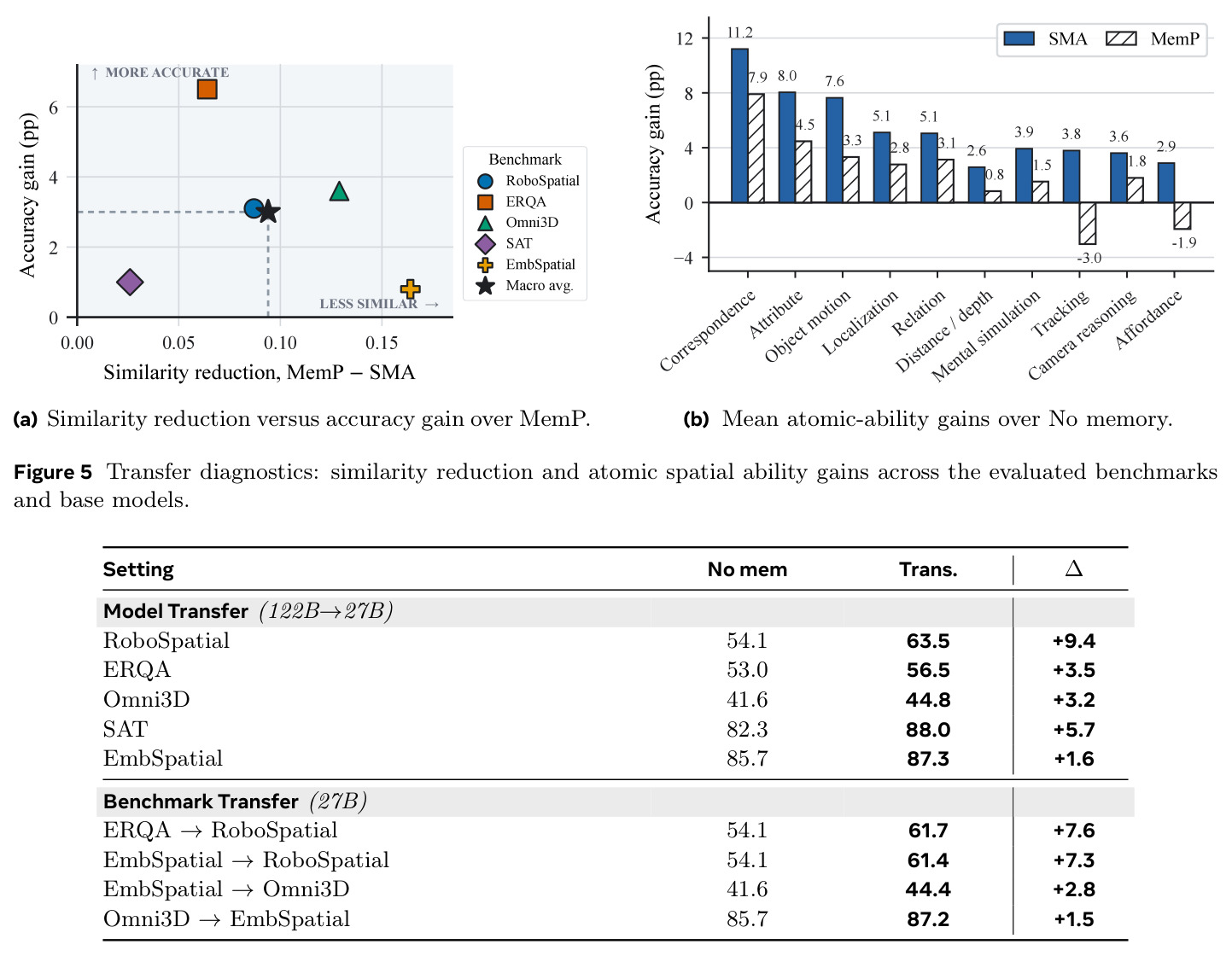
技术新颖性体现在四个层面。(1)问题层面:首次把免训练 agentic memory 引入空间智能,与空间后训练、工具调用形成第三条正交路线,并以训练类方法 SpatialEvo-7B 为参照证明外部记忆路线可以更强(宏平均 +16.4 分)。(2)记忆价值估计层面:均匀初始化 + 访问证据校准把「来源 rollout 质量」与「未来迁移价值」解耦——论文实证二者确实不同:成功来源的记忆下游准确率 85.7%,失败来源的也有 61.4%,说明一次失败的 rollout 也能产出有用教训,一次正确的 rollout 也可能产出过窄的教训,这是对 MemRL 类「按对错记账」规则的实质改进。(3)检索层面:两级过滤 + z-score 归一化加权明确论证「最近邻未必最好」——SMA 把宏平均检索相似度从 MemP 的 0.792 降到 0.698,宏平均准确率却从 66.8% 升到 69.8%,说明刻意放弃部分语义相似性换取更高的实证可靠性是划算的。(4)写入协议层面:One-Pass 写入以十分之一的记忆量、低 21% 的冗余、约两倍的 TRS 更新覆盖率取得更好效果,是对「持续写入」直觉的反结构性发现。
实验结果
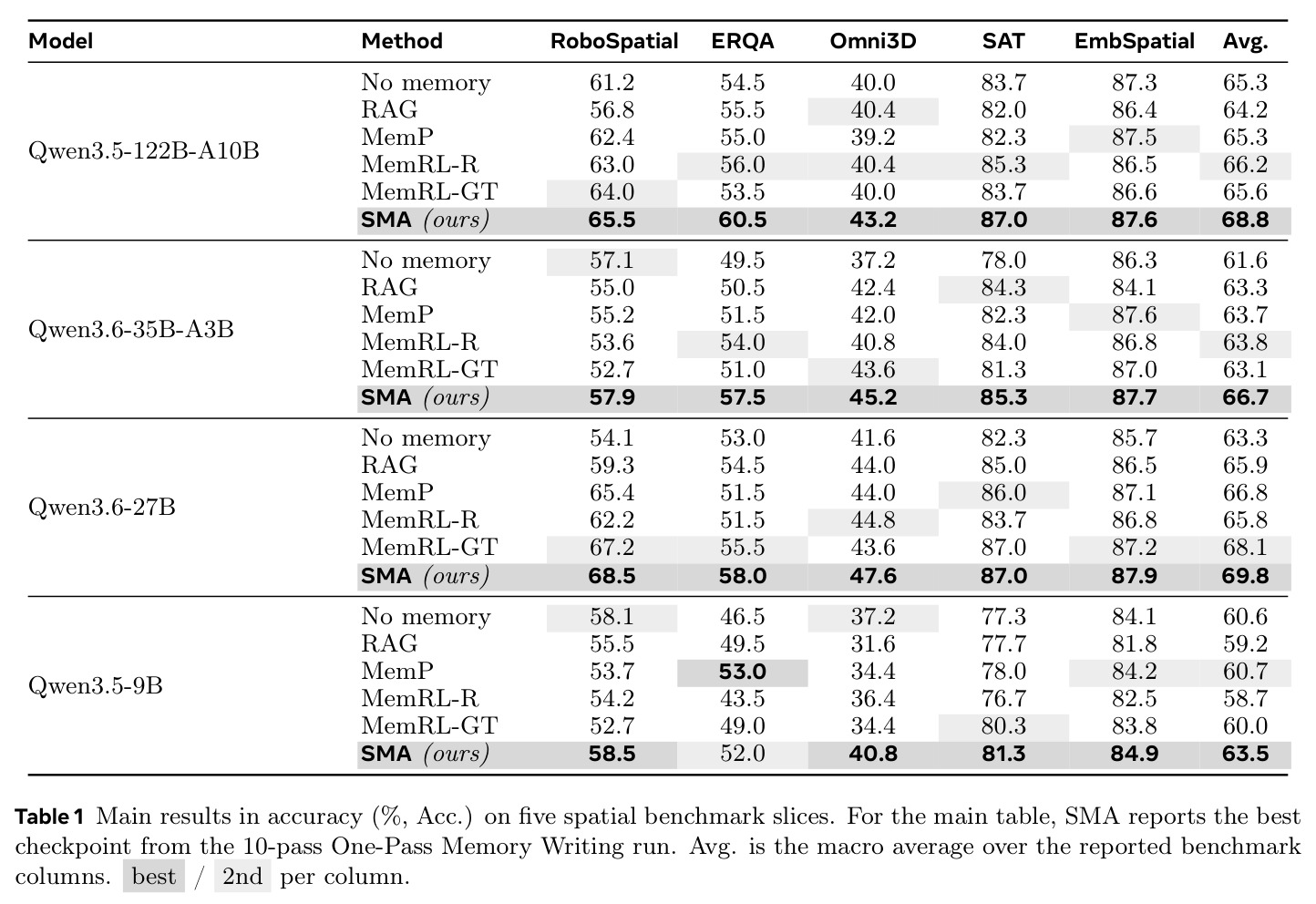
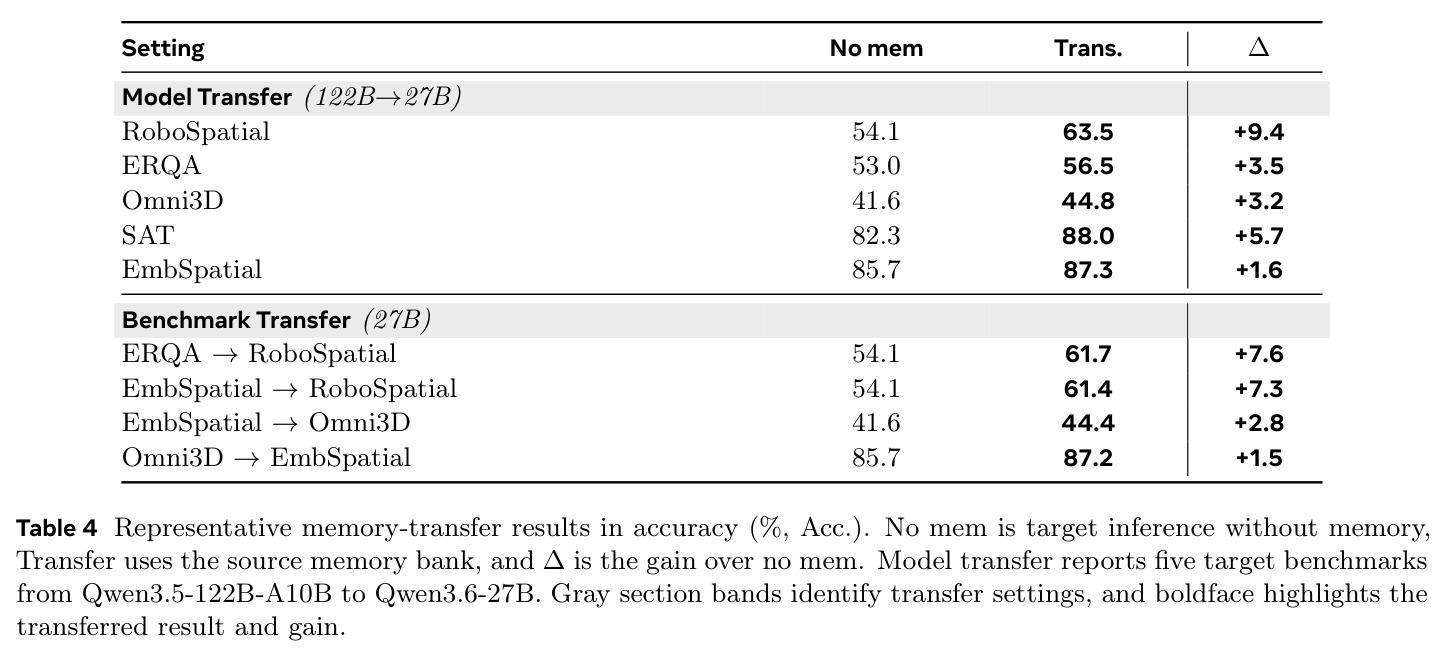
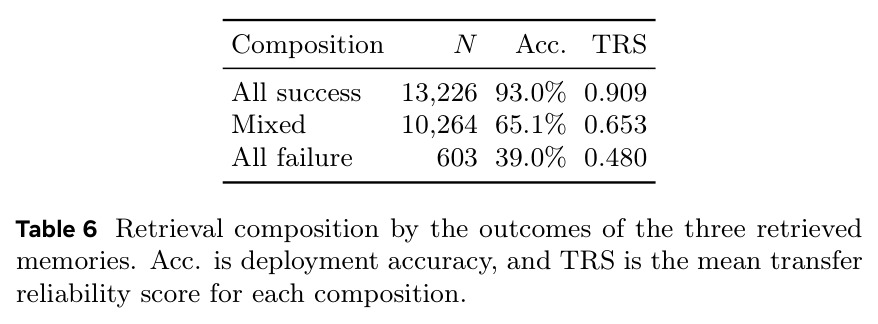
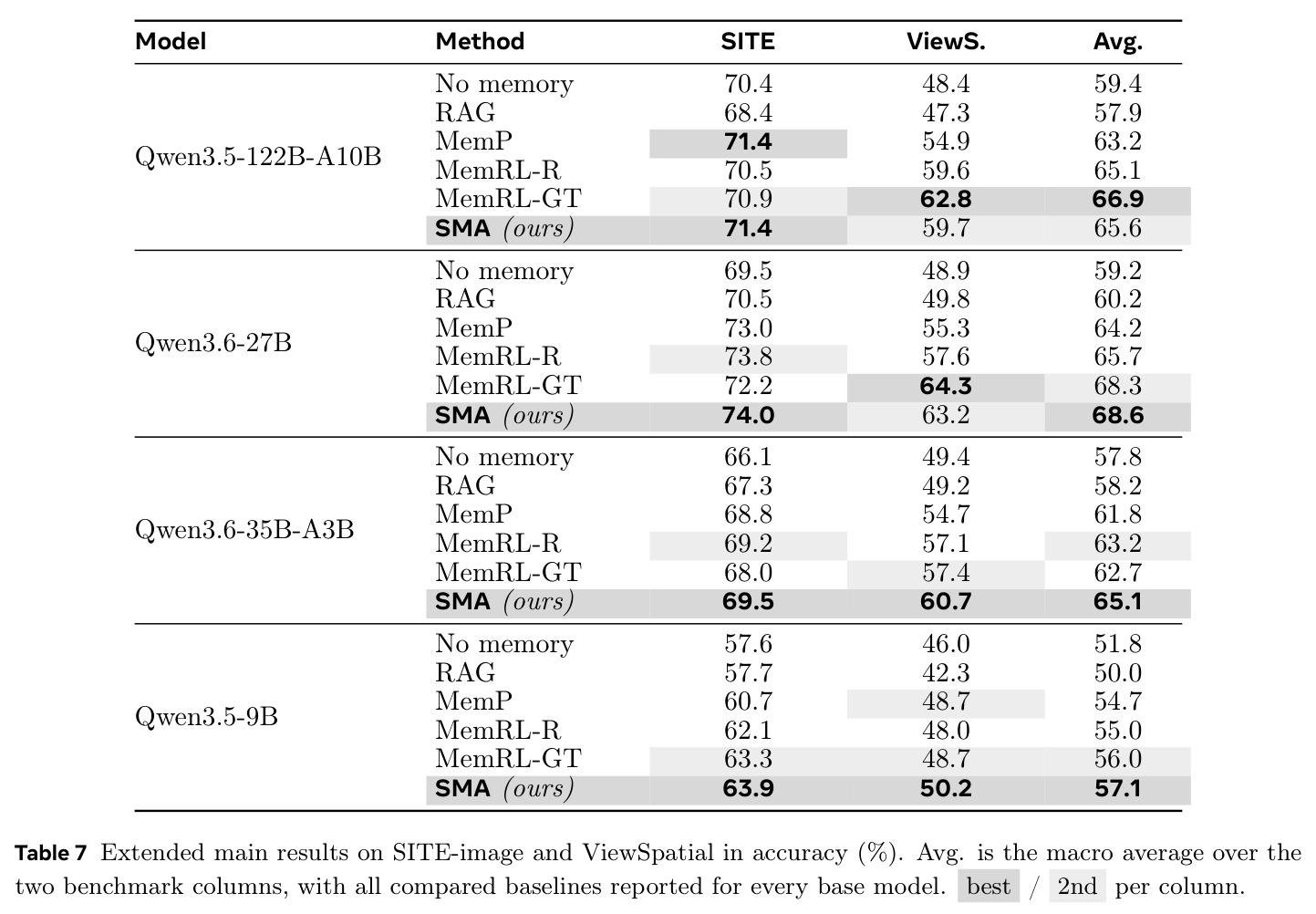
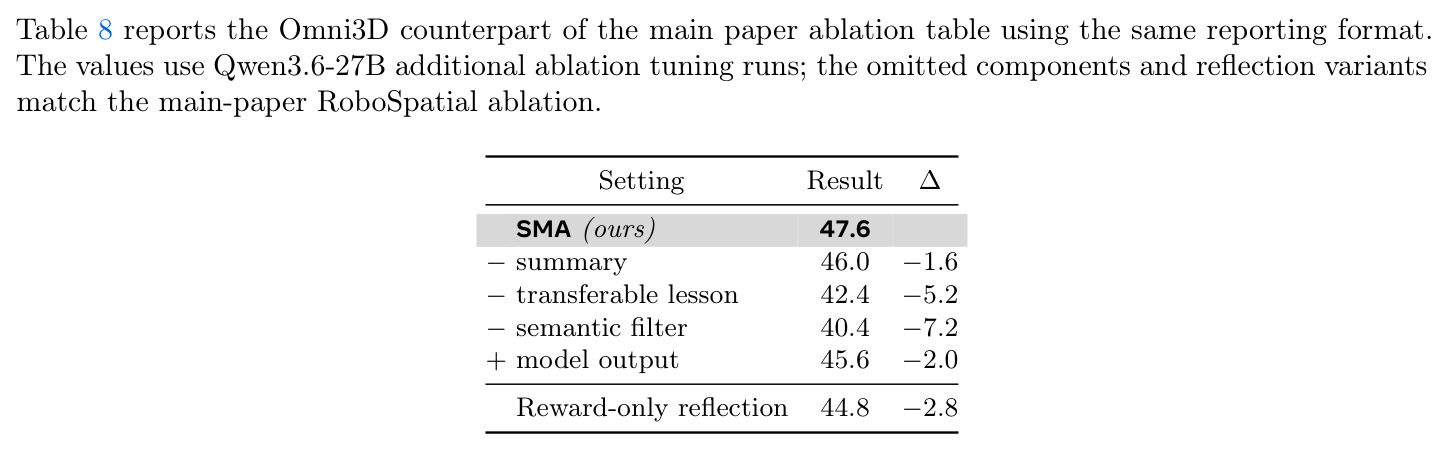
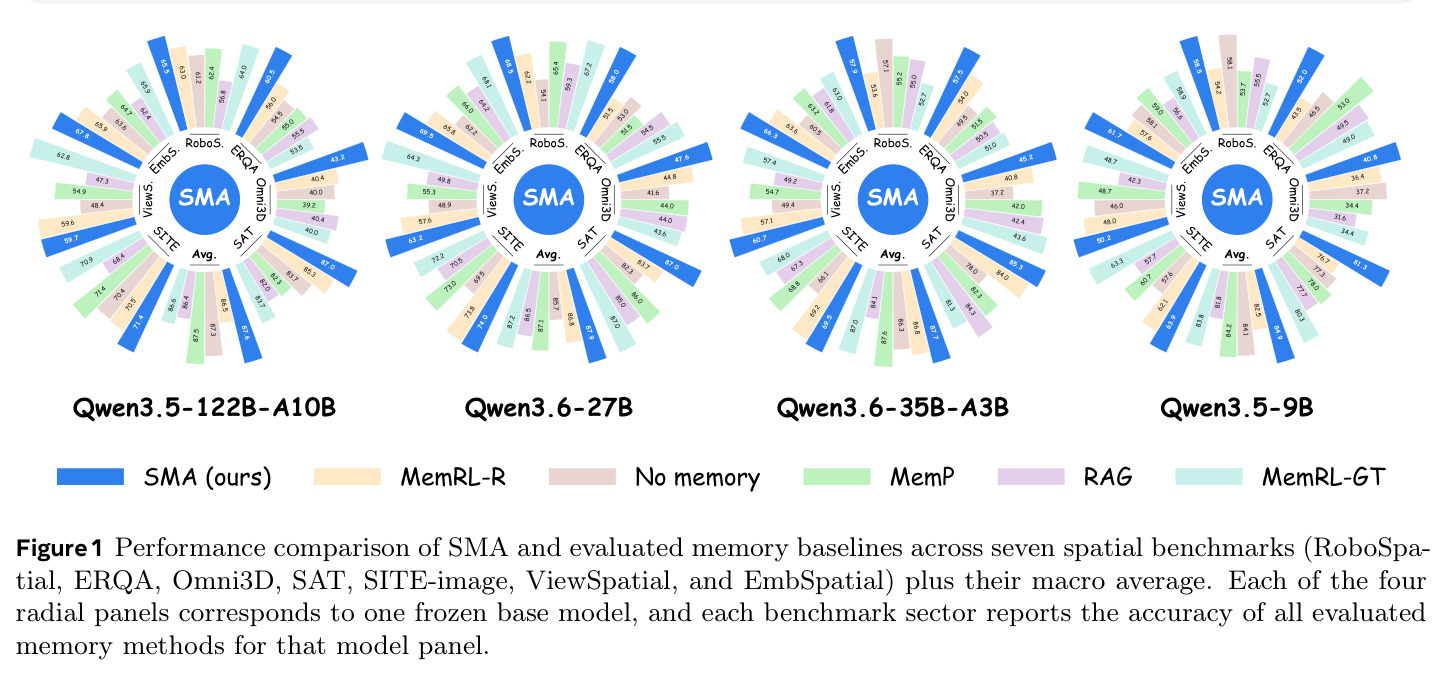
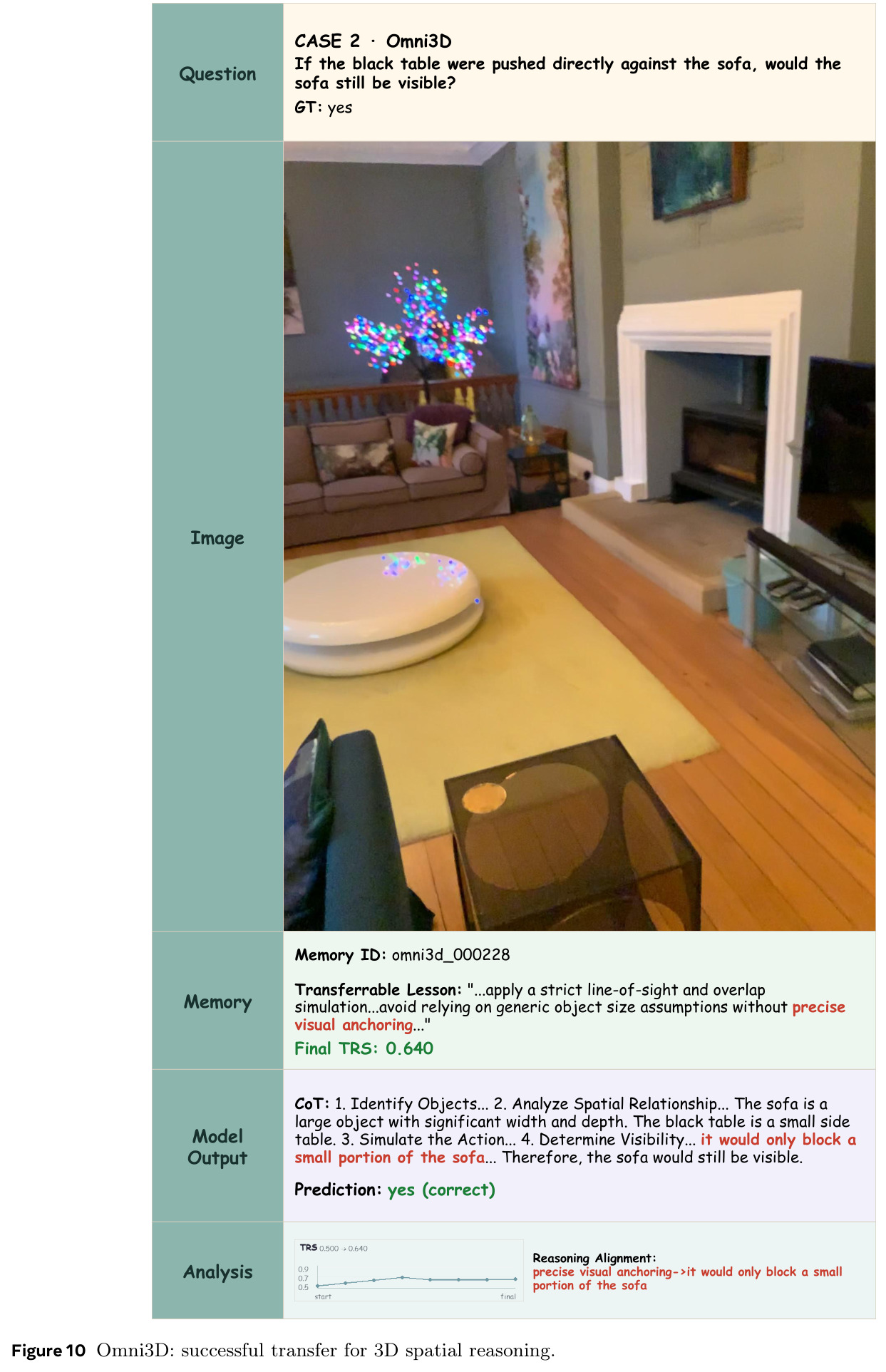
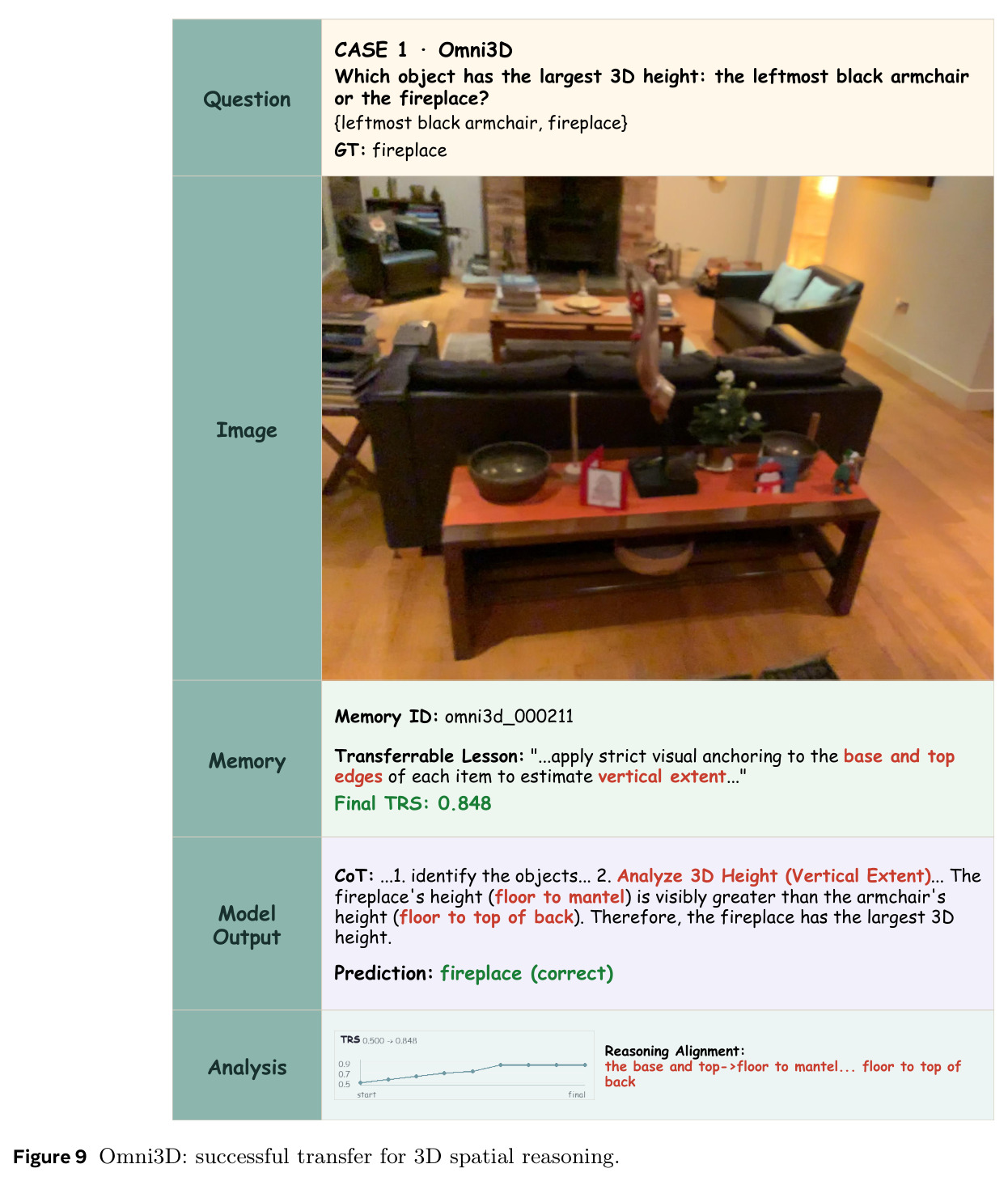
主实验覆盖 5 个基准(RoboSpatial、ERQA、Omni3D、SAT、EmbSpatial)× 4 个冻结基座共 20 组评估,SMA 在每个模型块都拿到最高宏平均:Qwen3.5-122B-A10B 68.8(最强基线 MemRL-R 66.2,+2.6)、Qwen3.6-35B-A3B 66.7(+2.9)、Qwen3.6-27B 69.8(MemRL-GT 68.1,+1.7)、Qwen3.5-9B 63.5(MemP 60.7,+2.8)。以 27B 为例相对无记忆基线:RoboSpatial 54.1→68.5、Omni3D 41.6→47.6、EmbSpatial 85.7→87.9,宏平均 +6.5。附录扩展的 SITE-image 与 ViewSpatial 上 SMA 多数领先,但 ViewSpatial 被 MemRL-GT 反超(27B:63.2 vs 64.3;122B:59.7 vs 62.8)。消融(RoboSpatial,27B):去掉摘要 −3.2、去掉可迁移教训 −3.5、去掉语义过滤 −5.8、把原始模型输出塞进记忆 −4.4、仅用奖励反思 −5.5;Omni3D 上语义过滤的代价更大(−7.2)。与训练类 SpatialEvo-7B(同为 9B 级)比:宏平均 47.1→63.5(+16.4),五个基准全面领先,SAT 差距最大(+23.6)。迁移分析:用 122B 写的记忆给 27B 用,RoboSpatial +9.4、SAT +5.7、ERQA +3.5;跨基准迁移 ERQA→RoboSpatial +7.6、EmbSpatial→RoboSpatial +7.3,全部探针为正。TRS 诊断:检索记忆平均 TRS 从 $[0.2,0.3)$ 桶到 $[0.9,1.0]$ 桶,准确率 19.3%→97.3% 单调上升;成功来源记忆组(TRS 0.522)比失败来源组(0.452)下游准确率高 24.3 个百分点;三张检索卡全成功的检索(N=13,226)准确率 93.0%,全失败(N=603)仅 39.0%。写入协议:十遍后 One-Pass 记忆量只有 Continual 的 1/10、冗余少 21%、TRS 更新覆盖约 2 倍。原子能力层面:十项空间能力平均全部正增长,Correspondence +11.2pp、Attribute +8.0pp、Object motion +7.6pp、Distance/depth +2.6pp、Affordance +2.9pp;而 MemP 在 Tracking(−3.0pp)和 Affordance(−1.9pp)为负,说明无过滤的程序记忆可能帮倒忙。
查看结构化数据
| 任务 | 指标 | 本文 | 基线 | 提升 |
|---|---|---|---|---|
| 五基准宏平均(Qwen3.6-27B) | Accuracy (%) | 69.8 | No memory 63.3;最强基线 MemRL-GT 68.1 | +6.5 / +1.7 |
| RoboSpatial(Qwen3.6-27B) | Accuracy (%) | 68.5 | No memory 54.1 | +14.4 |
| Omni3D(Qwen3.6-27B) | Accuracy (%) | 47.6 | No memory 41.6 | +6.0 |
| 五基准宏平均(Qwen3.5-122B-A10B) | Accuracy (%) | 68.8 | 最强基线 MemRL-R 66.2 | +2.6 |
| 五基准宏平均(Qwen3.5-9B) | Accuracy (%) | 63.5 | 最强基线 MemP 60.7 | +2.8 |
| 对比训练类自进化(Qwen3.5-9B 基座) | 五基准宏平均 Accuracy (%) | SMA 63.5 | SpatialEvo-7B 47.1 | +16.4(SAT 上 +23.6 最大) |
| 跨模型记忆迁移(122B 写记忆 → 27B 部署)RoboSpatial | Accuracy (%) | 63.5 | No memory 54.1 | +9.4 |
| ViewSpatial(Qwen3.6-27B,附录扩展) | Accuracy (%) | 63.2 | MemRL-GT 64.3 | −1.1(此基准未取得最优,是少数失利点) |
局限与改进
作者在附录 D 明确承认两点局限。一是信用分配缺口:当最终答案变好或变坏时,框架无法精确区分功劳/责任该归给记忆写入、反思、检索、语义过滤还是模型对检索内容的最终使用,而空间推理中一个正确答案往往依赖识别目标物体、估计尺度、变换视角、套用放置规则等多个耦合操作,整卡级别的更新粒度太粗。二是缺乏长期记忆维护生命周期:随着记忆库增长,旧教训可能冗余、冲突、过度拟合早期环境样本或相对部署分布过时,当前只能靠 TRS 降权和语义过滤间接抑制,没有显式的删除、合并、压缩、过期与重写机制。我自己的观察还有六点:(1)主表报告的是 10 遍 One-Pass 运行中的「最佳检查点」,这实际上是在部署集上做了检查点选择,存在轻微的乐观偏差,真实部署没有测试反馈时难以复现这种选择;(2)语义阈值 $\delta$ 需按基准在 0.488–0.618 间分别调优,跨到新域时如何设定没有给出方案;(3)方法依赖环境划分上有标准答案的可验证奖励,纯无标注的真实部署场景既写不了记忆也校准不了 TRS;(4)检索只用任务文本嵌入、完全不看图像内容,视觉相似但文本表述不同的场景可能漏检,文本相似但视觉迥异的场景可能误检;(5)ViewSpatial 上败给监督更强的 MemRL-GT,暗示多视角类任务中访问证据校准未必是最优信号;(6)失败案例分析显示当基准本身有歧义(RGB 证据不足以唯一确定答案)或基座视觉 grounding 出错(误读运动方向、物体计数、空间连通性)时,即便检索到 TRS≥0.6 的相关记忆也无济于事——记忆能引导推理但替代不了准确的视觉感知。
独立分析的弱点
独立分析六个弱点及改进方向。(1)检查点选择依赖部署集:主表取 10 遍中最佳检查点,隐式使用了测试分布的反馈,严格意义上高估了性能;改进方向是引入无泄漏早停准则,例如用 TRS 分布的稳定性、验证集代理指标或相邻遍准确率的一致性来选检查点。(2)信用分配粒度太粗:奖励只记在整张卡上,无法知道教训里哪句话起效;改进方向是借鉴作者引用的 AttriMem 做过程级归因,或对教训做原子化拆分、按成分分别累计战绩。(3)检索通道是纯文本的:空间任务高度依赖图像,任务文本相似不等于视觉场景相似(两张都是「物体在哪里」的题,一张室内一张航拍,教训可能完全不通 用);改进方向是把图像嵌入或视觉-文本联合嵌入纳入第一阶段过滤,或对候选集做视觉重排序。(4)强依赖验证器与标注:环境划分需要 $y^\star$ 才能反思和校准,开放式真实任务不可用;改进方向是用自一致性投票、工具校验或训练一个奖励模型来近似验证器,并量化近似噪声对 TRS 的污染。(5)没有记忆生命周期:记忆库单调增长,长期运行会积累冲突与过时教训;改进方向是接入存储预算下的删除-合并-压缩策略与基于年龄/使用率的过期机制。(6)超参跨域不友好:$\delta$、$k$、遍数逐基准调优($\delta$ 从 0.488 到 0.618),新领域需重新搜索;改进方向是自适应阈值(按候选相似度分布分位数动态定)或用少量元任务学习检索超参。
未来方向
作者提出的方向:(1)细粒度信用分配——把 AttriMem 的归因引导过程反馈、Memory-R2 的局部重 rollout 与全局目标、MemQ 的来源 DAG 信用传播引入免训练空间自进化,让记忆构建本身获得更局部的奖励信号;(2)长期记忆生命周期管理——借鉴 MemRefine 的存储预算决策、TRUSTMEM 的可信合并(防止写/改/删操作引入幻觉持久状态)、memorywire 的 remember/recall/forget/merge/expire 接口化标准。基于本文成果可以延伸的方向:(3)与工具调用正交结合——用记忆决定何时调用深度估计/3D 重建工具,并把工具产出也沉淀为教训,形成「记忆指导工具、工具反哺记忆」的闭环;(4)视觉感知检索与多模态记忆卡——在卡片中存关键帧、区域坐标或草图,使检索能对齐视觉内容;(5)把框架推向视频、3D 场景与真机在线部署,在持续运行的机器人上做在线 TRS 校准;(6)无验证器场景的奖励近似——用自一致性或评分模型替代 ground-truth,把方法扩展到开放式空间问答;(7)跨模型记忆复用经济——论文已证明 122B 写的记忆能让 27B 在 RoboSpatial 上 +9.4,可进一步探索「大模型为小模型代写经验库」的蒸馏式记忆服务,以及记忆库的跨任务市场化和隐私审计。
复现评估
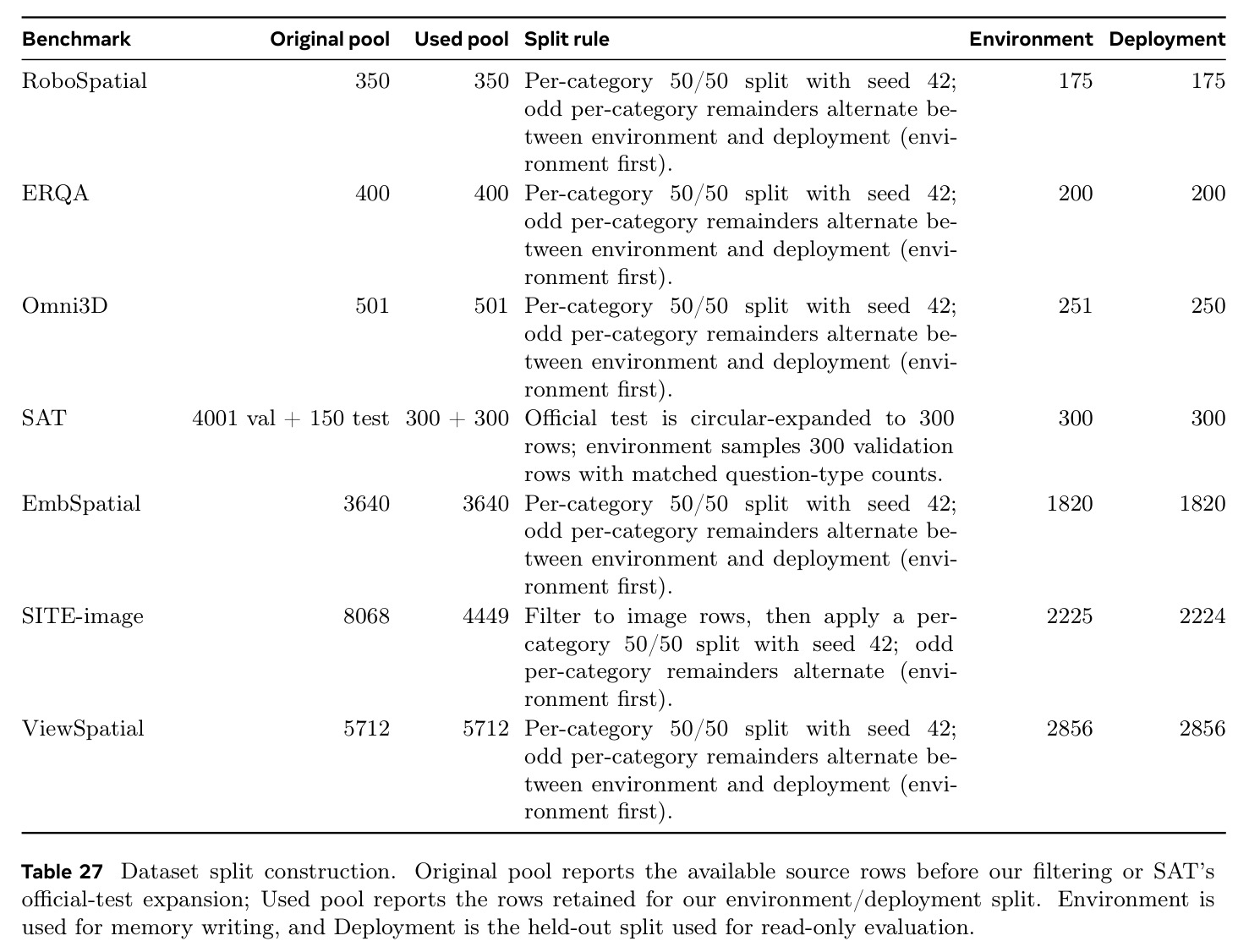
复现评估:论文给出项目页(aim-uofa.github.io/SMA/),附录质量很高——算法 1 提供完整伪代码,Tables 28–31 逐基座×基准列出全部超参($\lambda=2.0$、$v_0=0.5$、$k=3$、$\eta=0.5$、temperature=0、repetition penalty 1.5,$\delta$ 逐基准给出),数据划分规则明确(seed 42 按类别 50/50,SAT 用官方测试集扩展为 300 行、验证集采样 300 行匹配题型分布),五个基线的实现差异也逐一说明。数据全部来自公开基准,规模从 RoboSpatial 的 350 条到 SITE-image 的 4449 条,无需自建标注。算力门槛较高:4 张 NVIDIA H200(每张约 143GB 显存)、vLLM 0.20.0 服务 Qwen3.5/3.6 系列,另需 OpenAI text-embedding-3-large API 做任务嵌入——这是一个外部依赖,换成开源嵌入模型虽可行但检索分布可能漂移。整体难度中等偏上:方法核心(余弦过滤 + 计数更新)本身很简单,但完整复现主表需要 6 种方法 × 4 基座 × 7 基准 × 多遍环境遍历的推理量,非常昂贵;此外反思与检索的提示模板若未随代码发布则需自行还原,可能引入数个点的偏差;主表的「10 遍最佳检查点」协议也要求完整跑完 10 遍才能对齐。代码开源情况:正文未明确声明,仅给出项目页,实际代码与记忆库是否可下载需以项目页为准。
论文图表
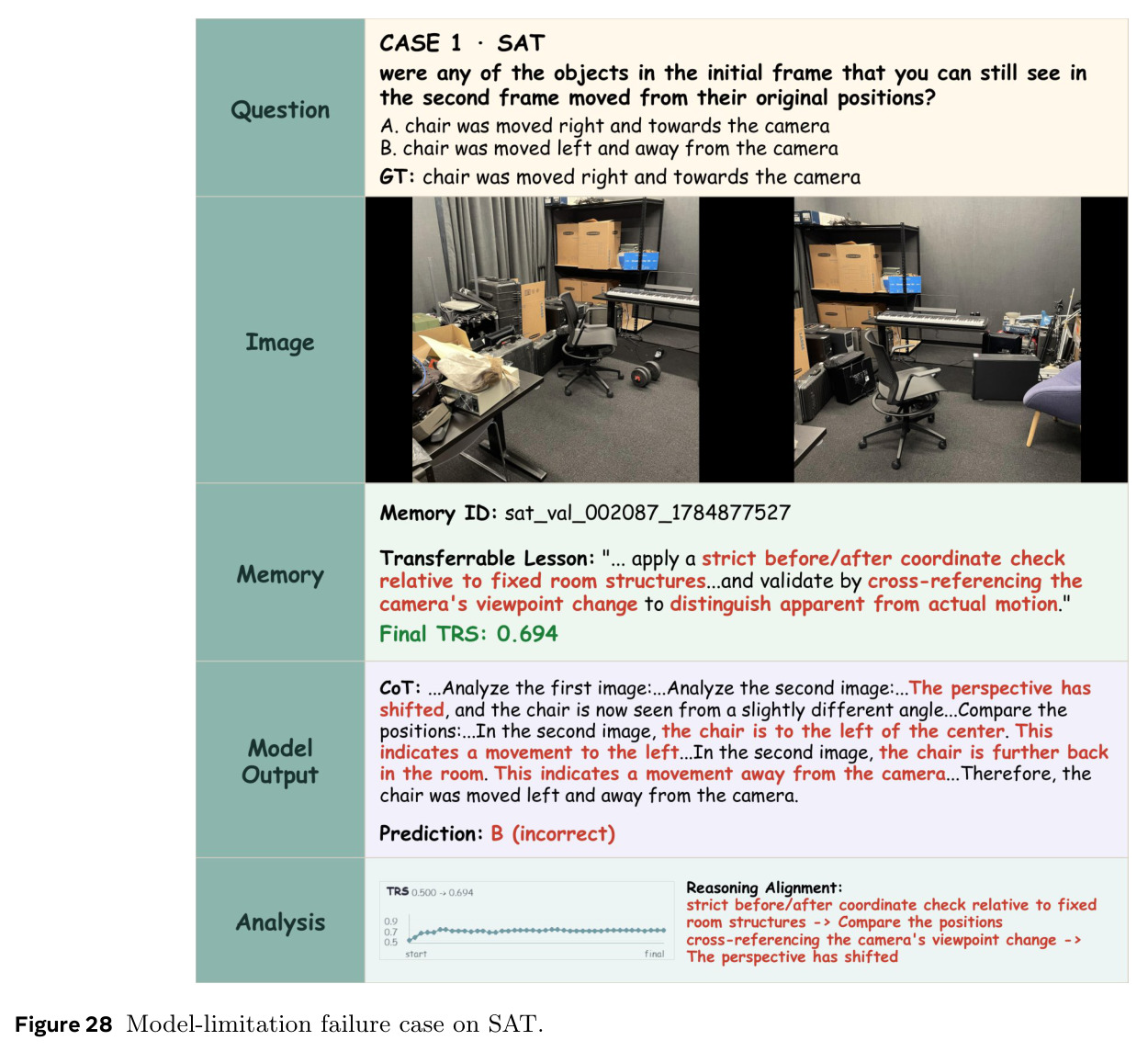
基座模型视觉感知局限失败案例(Figures 28–30)之一:即便检索到语义相关且 TRS≥0.6 的高质量记忆,基座模型仍因误读运动方向、物体计数或空间连通性而答错,说明记忆可以引导推理过程但无法替代准确的视觉 grounding。
与基准歧义类失败(Figures 23–27)共同划定了方法的能力边界,是理解「记忆不是万能药」的关键证据。