PASA:面向语义不变攻击的、基于嵌入空间的原则化大语言模型文本水印方法 PASA: A Principled Embedding-Space Watermarking Approach for LLM-Generated Text under Semantic-Invariant Attacks
将水印锚定在潜在语义聚类而非词表上,理论保证失真自由并抵抗释义攻击。
前置知识
LLM文本水印(Text Watermarking)
在LLM生成文本的过程中嵌入人类不可察觉但可被统计检测的信号,从而区分机器生成文本与人类撰写文本。经典方法如KGW将词表随机划分为绿/红列表并在采样时偏向绿词,检测端用z检验统计p值。但这类基于token级别身份的方法在释义改写时极易失效,因为token表面被改写但语义不变。
本文的研究对象就是水印,读者需了解绿色列表、统计检测、失真自由、释义攻击等基本概念,才能理解PASA的动机和创新点。
语义不变攻击(Semantic-Invariant Attack)
保持文本语义不变、但改变表面token序列的对抗性修改,包括同义词替换、句子重排、释义改写、基于T5的token替换(mask ratio r∈{0.3, 0.5})和DIPPER释义(控制词序多样性Ord与词汇多样性Lex)等。这类攻击对token级水印是致命的,但对语义级水印影响较小。
本文的核心研究问题是抵御此类攻击,必须理解攻击如何运作、为什么它们能破坏token级水印,才能体会PASA将水印锚定在语义层面的价值。
词嵌入与潜在语义空间(Token Embedding & Latent Semantic Space)
LLM将每个token映射为高维向量(如4096维),使语义相近的token在向量空间中距离也近。本文用gte-Qwen2-7B-instruct对token做编码并ℓ2归一化,使相似度由余弦相似度衡量,再通过K-means聚类把整个词表分成K个语义簇(默认K=4)。
PASA的全部机制建立在潜在语义空间之上:语义映射f:V→[K]把每个token指派到一个语义簇,检测时只比较簇索引而非具体token,因此能抗释义。
伪随机函数与共享密钥同步(PRF & Secret-Key Synchronization)
伪随机函数(PRF)以密钥key和一段公开上下文为输入,输出伪随机比特。生成端用seedt = PRF(key, {f(xj)}t-wj=t-1)产生种子,再用Gumbel-Max等机制从辅助分布Pζt中采样ζt;检测端用同一密钥和观察到的语义历史重现seedt,重新采样ζt。密钥保证第三方无法伪造水印。
PRF是PASA检测端能恢复生成端随机序列的关键,没有它就无法对齐统计量,整个水印体系无法运行。
二值假设检验与受控FA率(Binary Hypothesis Testing with FA Constraint)
水印检测建模为H0(人写)vs H1(机器含水印)的二元检验,本文把虚警率FA作为硬约束α∈(0,1),把漏检率MD作为优化目标。这与统计检测中的Neyman-Pearson范式一致:固定一类错误率、最小化另一类。
理解最优化问题P的目标函数(最小化MD、约束FA≤α、失真≤ε)是阅读Theorem 1和Theorem 2的前提。
研究动机
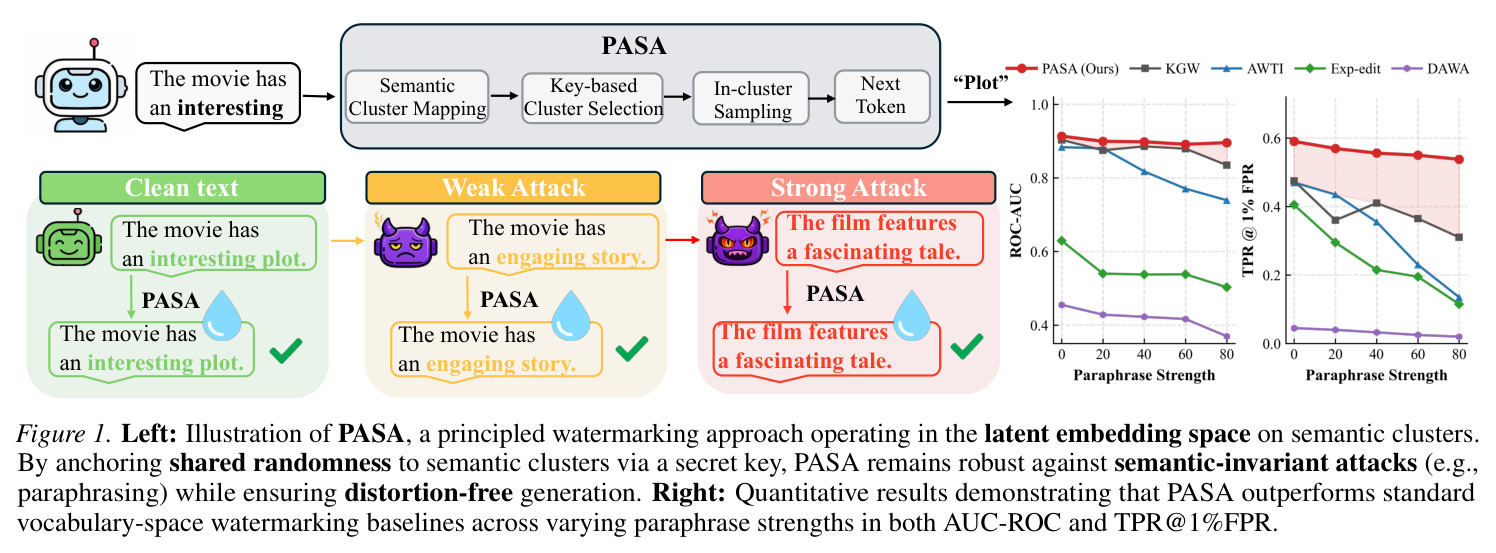
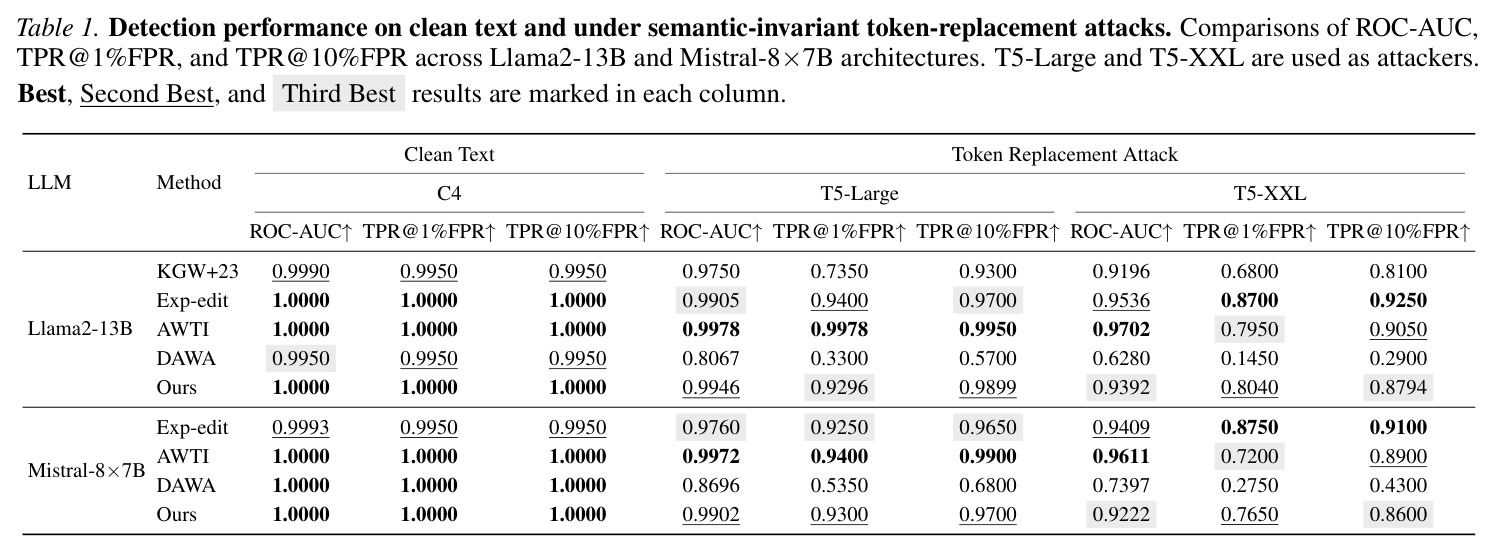
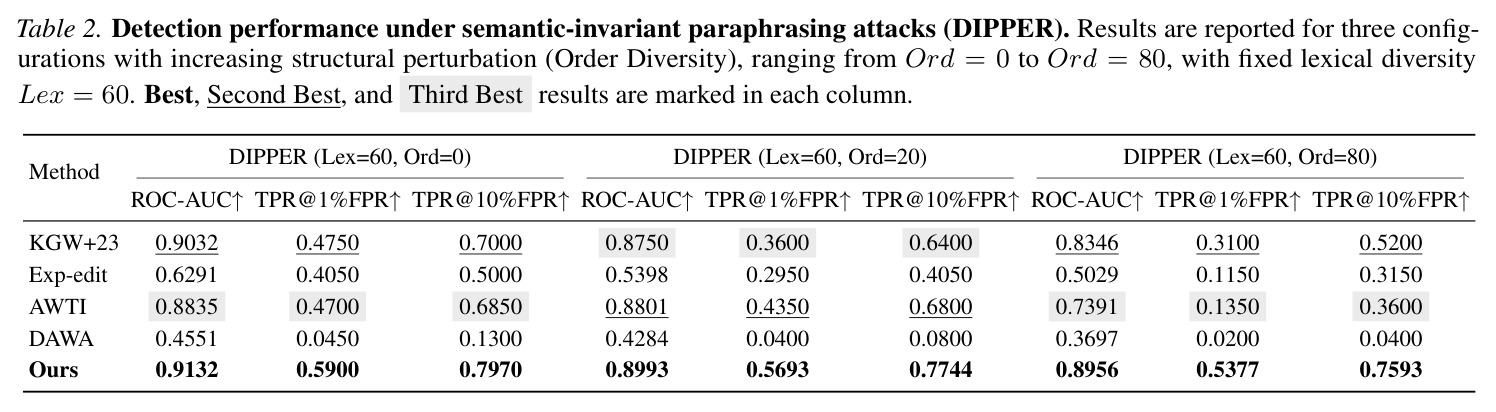
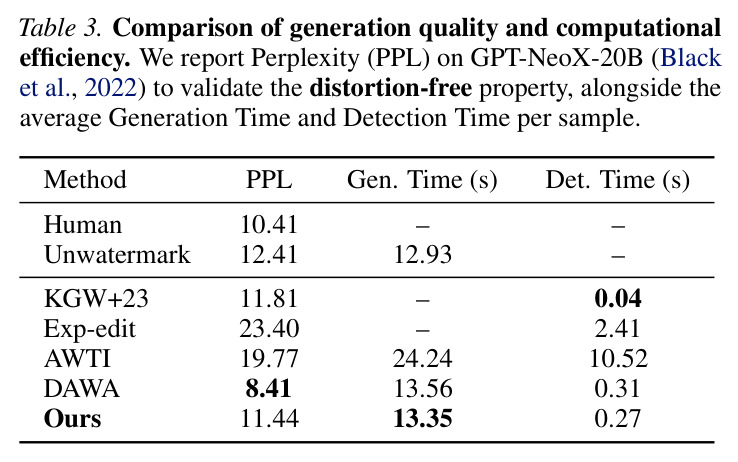
现有LLM水印方法几乎全部运行在token词表空间,KGW、DAWA等通过偏置logit或扰动采样让特定token出现得更频繁,再用z检验或p值统计检测。但这类token级水印在面对释义改写、同义词替换、句法重排等语义不变攻击时非常脆弱:攻击者可以把'The movie has an interesting plot'改写成'The film features a fascinating tale',表面token几乎全变但语义完全一致,于是水印的统计信号被同步抹除。论文中Table 1显示,DAWA在Llama-2-13B上遭遇T5-Large替换攻击时TPR@1%FPR从1.0暴跌到0.3300,KGW也跌到0.7350;Table 2中DAWA遭遇DIPPER(Ord=80)释义时TPR@1%FPR仅0.0200,几乎失效。此外,启发式的语义感知方法(AWTI、Exp-edit)虽提升了鲁棒性,但本质仍是token级偏置,必然改变生成分布、抬高困惑度,Exp-edit PPL高达23.40,无法满足'失真自由'要求。
本文的目标是本文提出PASA,目标是在三个维度上同时达到最优:(i) 在语义不变攻击(释义、token替换、句法重排)下保持高检测率;(ii) 严格保持原模型的逐token NTP分布不变(distortion-free,ε=0);(iii) 在极低虚警率(1% FPR)下也能给出高真阳率(高TPR@1%FPR),并具备可证明的统计最优性。具体而言,PASA要把水印从'哪个token出现'提升到'落在哪个语义簇',使统计量对释义天然鲁棒。
与已有工作不同的是,过去工作形成两条互不沟通的路线:经验派(SemStamp/k-SemStamp/CoheMark)尝试用LSH或聚类把句子级或话语级水印嵌入语义空间,但都缺乏理论保证,只能靠调参;理论派(DAWA、Takezawa等)在token级别证明了最优性,但完全没把'语义不变攻击'纳入优化目标。PASA的独特切入点是第一个在'语义簇'这个抽象层级上同时给出'误差-鲁棒性-失真'三方权衡定理(Theorem 1)和'联合最优嵌入-检测对'构造(Theorem 2)的框架,并把理论结果直接实例化为可部署的两阶段采样算法。
核心方法
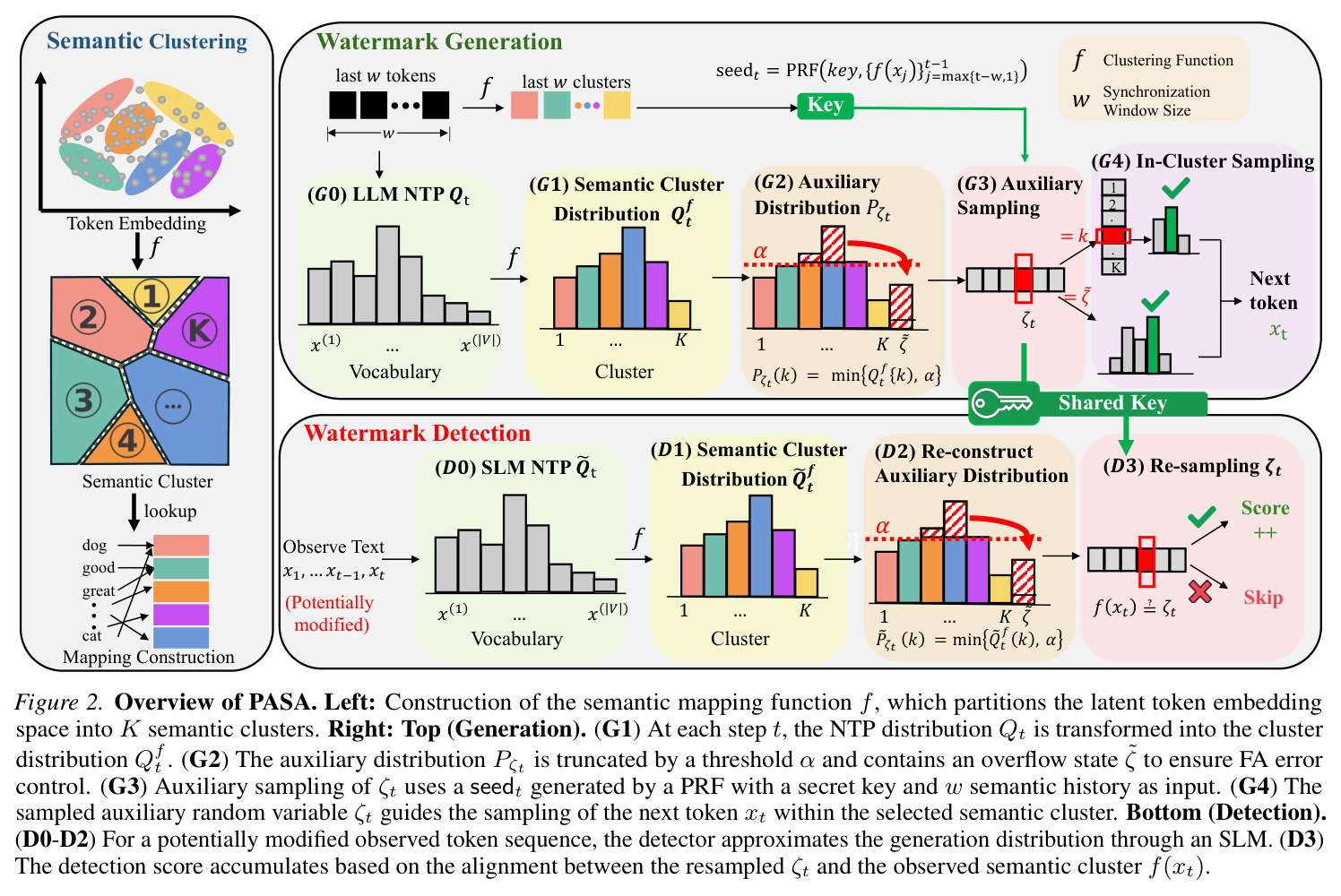
PASA的整体思路是:把词表V中的每个token通过语义映射f:V→[K]指派到K个语义簇(用gte-Qwen2-7B-instruct编码+K-means聚类得到,默认K=4),然后在生成每个token时分两阶段采样——先在K个簇上依据截断辅助分布Pζt(用PRF+密钥+前w个簇的历史做种子)采样一个簇索引ζt,再在该簇内按原NTP分布重归一化后采样具体token。检测时只需用同一密钥和观察到的语义历史重现ζt,再与观察到的token的簇f(xt)对齐计分。关键直觉:把水印从token身份'升维'到语义簇,攻击者改写表面词但改不掉语义簇,于是水印信号对释义天然鲁棒。
PASA与已有方法的本质区别在于:(1) 锚定层级不同——KGW/DAWA锚定在token身份,Aaronson/Kuditipudi锚定在采样分布的逆变换上,SemStamp锚定在句子级LSH区域,而PASA锚定在token级语义聚类,这是首个把生成端和检测端统一对齐到同一抽象层级(cluster-level shared randomness)的方法;(2) 失真自由性来自严格的理论保证——Theorem 2证明其条件采样分布P(Xt|xt-1,ζt)对ζt取期望后恰好等于原NTP分布Qt,与θ和AWTI依赖启发式logit偏置有本质不同;(3) 引入'溢出状态'ζ̃控制FA——辅助分布Pζt(k)=min{Qft(k),α}对每个簇截断,把溢出质量累计到ζ̃,检测时ζ̃对应的token直接跳过,这种截断机制使得FA被严格夹在α以下。
方法步骤详情
PASA算法的具体步骤为:**(G0) 准备阶段**:用预训练编码器gte-Qwen2-7B-instruct对词表V中所有token做编码并ℓ2归一化,再用K-means聚成K=4个簇,得到语义映射f:V→[K]。**Stage 1辅助分布构造与采样(G1-G3)**:在生成第t个token时,先(G1)把NTP分布Qt按簇聚合得到Qft(k)=Σx:f(x)=k Qt(x);再(G2)按FA阈值α构造截断辅助分布Pζt(k)=min{Qft(k),α},把溢出质量1-Σk min{Qft(k),α}累计到溢出态ζ̃;再(G3)用seedt=PRF(key, {f(xj)}t-1j=max{t-w,1})(默认w=3,密钥key为共享密钥)作为随机种子,从Pζt中采样ζt。**Stage 2簇内采样(G4)**:若ζt=k∈[K],则按重归一化分布Qt(x)·1{f(x)=k}/Qft(k)在簇k内采样Xt;若ζt=ζ̃,则按Qt(x)·(Qft(f(x))-α)+/Qft(f(x))在所有簇上采样以保持期望分布。**检测端(D0-D3)**:用一个轻量代理模型SLM(Llama-2-7B或Mistral-7B)得到近似NTP分布Q̃t,重构Q̃ft和P̃ζt;用同一密钥和观察到的f(xt)历史重现seedt和ζ̃t;计分1{f(xt)=ζt},ζ̃t=ζ̃或f(xt)≠ζt时跳过该token。
技术新颖性
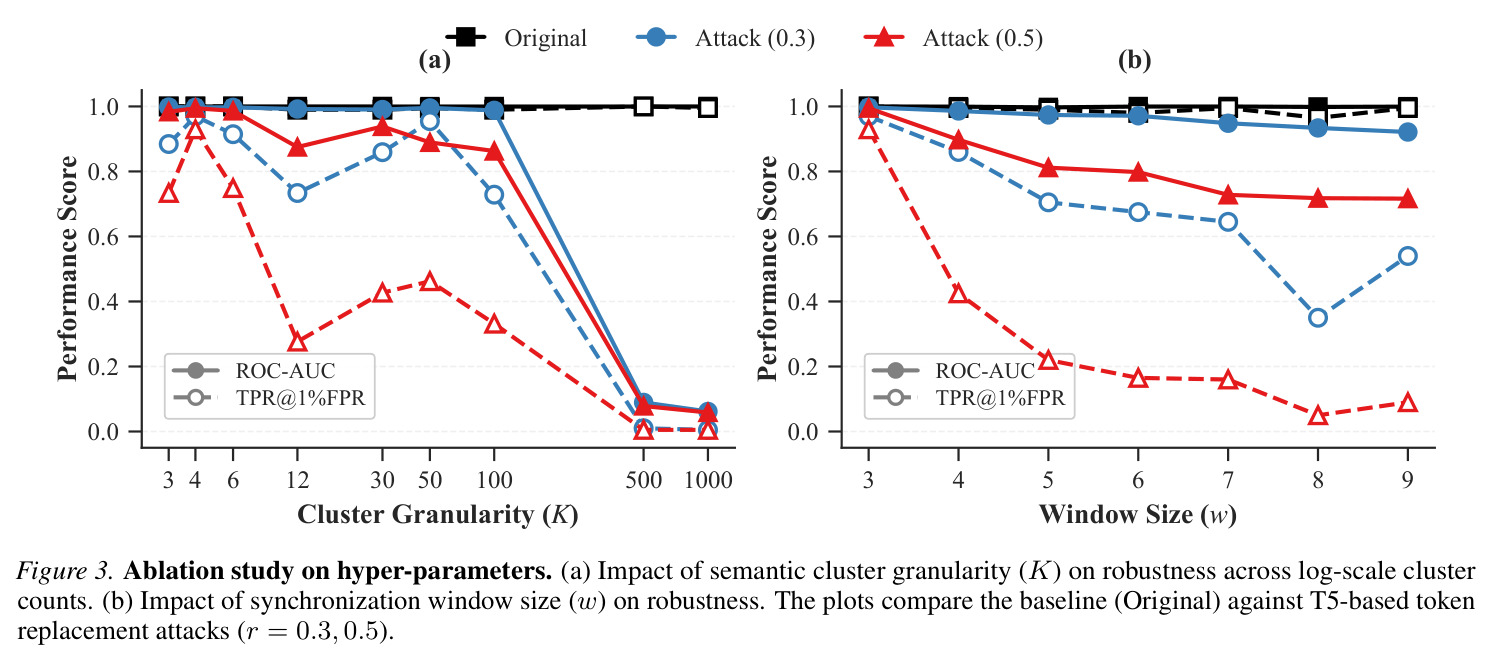
PASA的技术新颖性体现在三个层面。理论层面,论文把水印设计提升到序列级(整个X_T而非单token),把'语义不变攻击'显式形式化为等价类Bf(xT)={x̃T : f(x̃T)=f(xT)},从而推导出误差-鲁棒性-失真的精确权衡公式β*f,1=Σk ΣxT:f(xT)=k (QXT(xT)-α)+,并证明两阶段采样即达此下界。算法层面,截断+溢出态的辅助分布Pζt巧妙地保证了detector只需在簇索引层面对齐,避开了token级精确匹配的脆弱性;同时溢出态让低熵token被概率性地跳过,进一步压低FA。系统层面,本文首次把gte-Qwen2-7B-instruct这类通用文本嵌入模型用作token级语义编码器,并仔细设计K=4、w=3、α=0.4的默认值,通过消融研究验证K∈[3,100]均较鲁棒。
实验结果
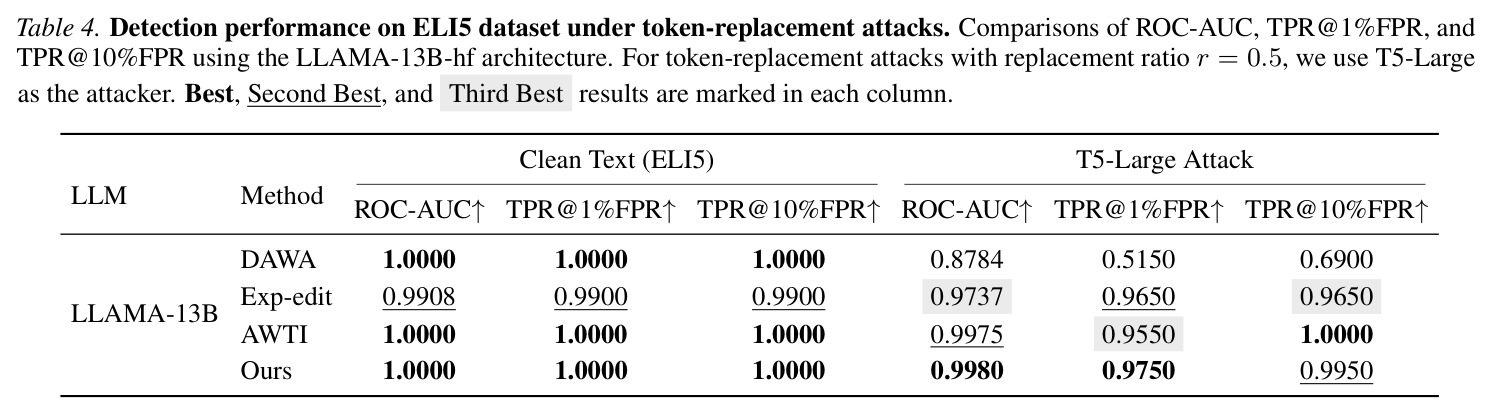
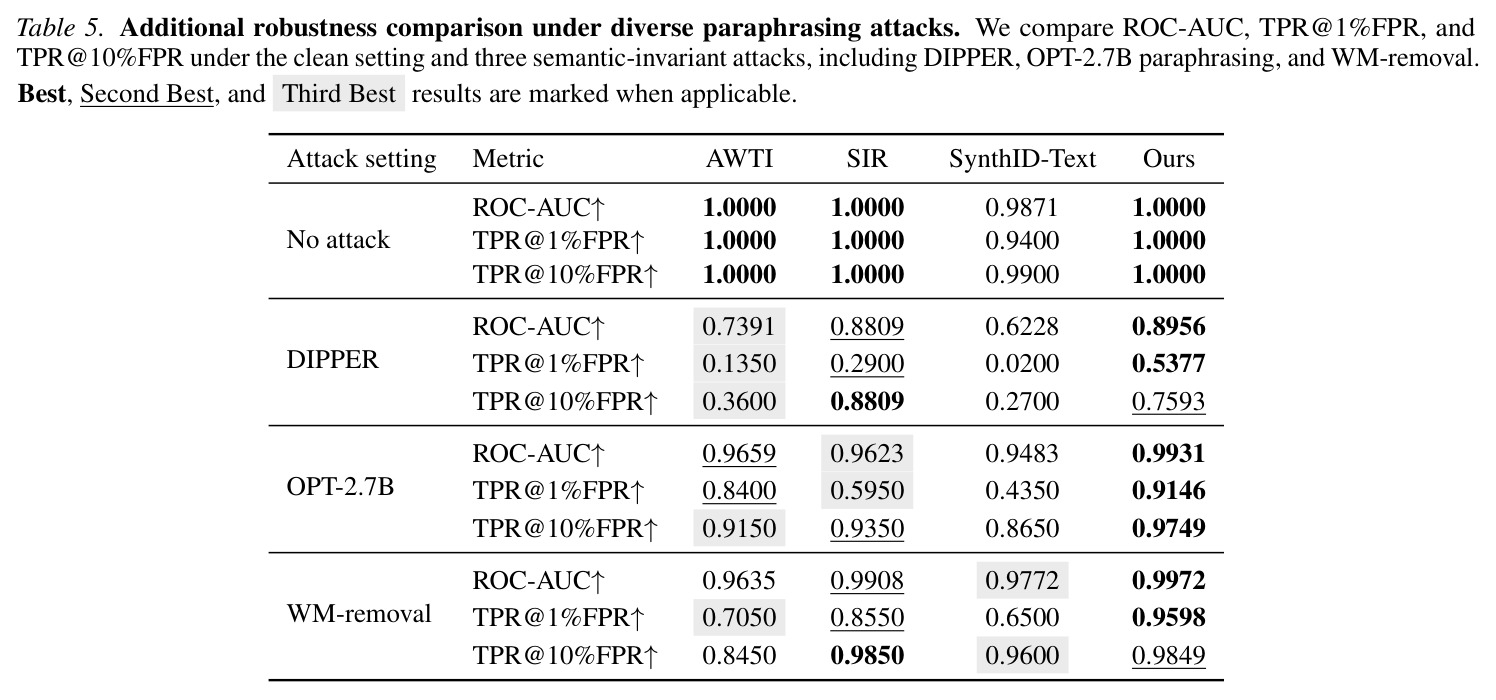
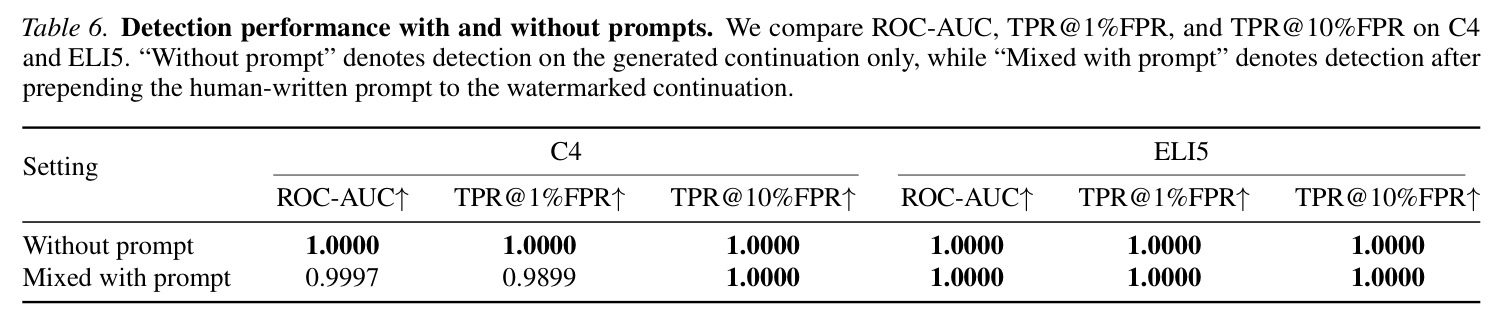
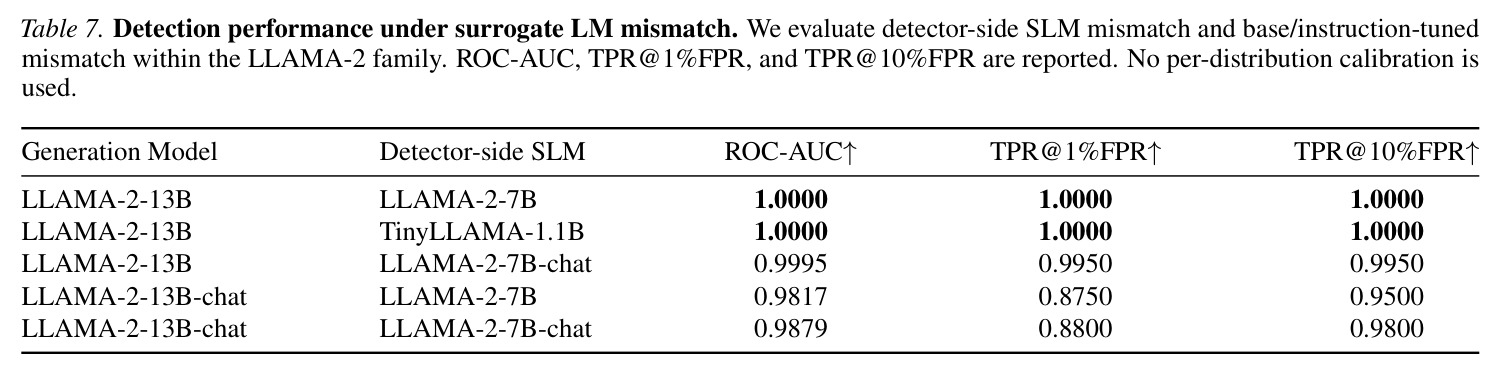
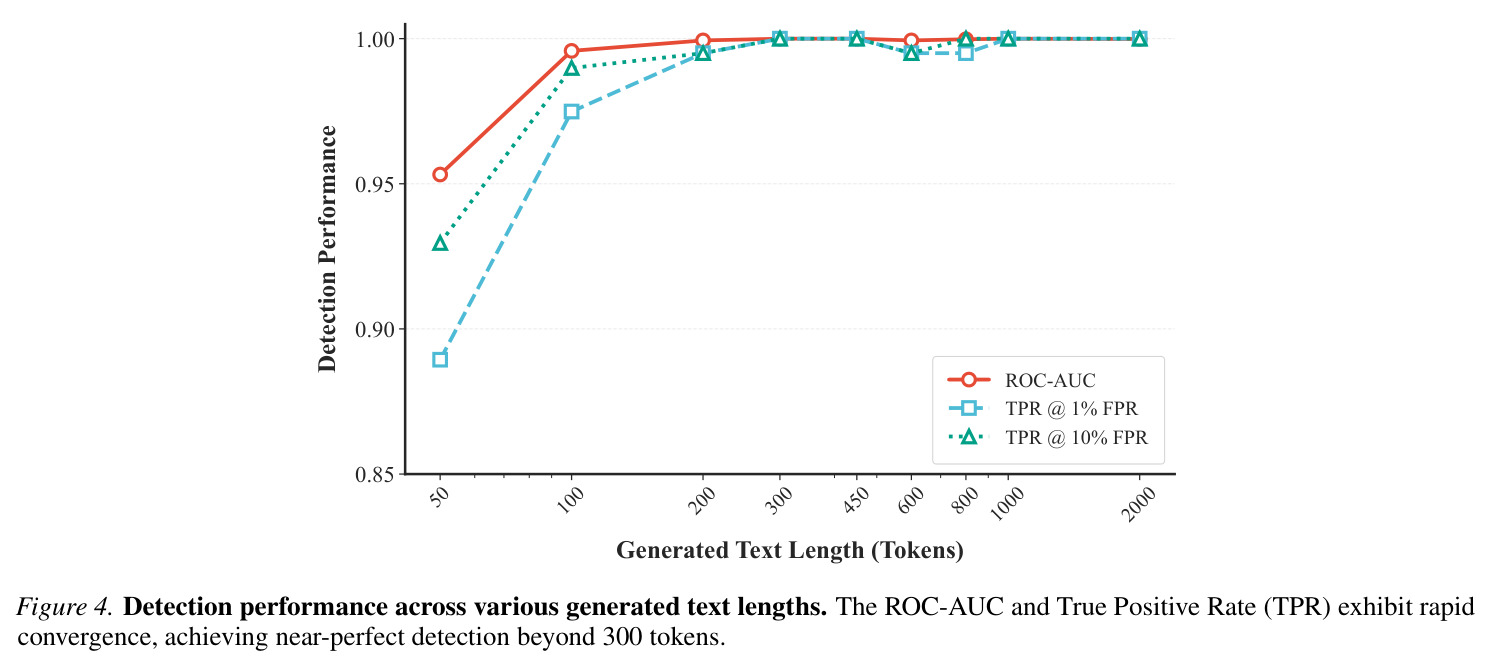
PASA在所有测试场景下都接近或刷新了SOTA。**(1) 干净文本与token替换**:在C4数据集上、Llama-2-13B和Mixtral-8×7B两个模型下,PASA对干净文本均达到ROC-AUC=1.0000、TPR@1%FPR=1.0000的完美检测。在T5-Large(r=0.3)替换攻击下,Llama-2-13B上PASA取得TPR@1%FPR=0.9296,显著超过KGW(0.7350)和DAWA(0.3300),与AWTI(0.9978)相当;在T5-XXL更强攻击下仍保持0.8040,优于KGW的0.6800。**(2) 释义攻击鲁棒性**:DIPPER释义(Lex=60,Ord∈{0,20,80})下PASA在Ord=0/20/80分别取得TPR@1%FPR=0.5900/0.5693/0.5377,Ord=80下DAWA已跌至0.0200、KGW跌至0.3100、Exp-edit跌至0.1150,PASA比次优基线AWTI(0.1350)高出约4倍。**(3) 文本质量**:PASA的PPL=11.44,与无水印基线12.41和人类文本10.41极为接近,明显优于Exp-edit(23.40)和AWTI(19.77),略逊于DAWA(8.41)但PASA具有鲁棒性。**(4) 计算效率**:PASA生成时间13.35s(vs无水印12.93s、AWTI 24.24s、DAWA 13.56s),检测时间0.27s是所有方法中最低(Exp-edit 2.41s、AWTI 10.52s、KGW 0.04s因简单计数),检测内存2892MB、GFLOPs 6.21×10²低于AWTI的2.85×10⁵。**(5) 消融**:K=4为最优,过细(K>500)水印退化为token级,过粗则丧失区分度;w=3最优,w从3增到8时TPR@1%FPR从0.7236降至0.1508。**(6) 泛化**:ELI5长文本QA上PASA对T5-Large攻击ROC-AUC=0.9980、TPR@1%FPR=0.9750(vs DAWA 0.5150);SLM失配下同家族模型仍保持近完美检测(ROC-AUC≥0.9995)。

查看结构化数据
| 任务 | 指标 | 本文 | 基线 | 提升 |
|---|---|---|---|---|
| 干净文本检测 (C4 realnewslike, Llama-2-13B) | ROC-AUC / TPR@1%FPR / TPR@10%FPR | 1.0000 / 1.0000 / 1.0000 | KGW 0.9990/0.9950/0.9950;DAWA 0.9950/0.9950/0.9950;AWTI 1.0000/1.0000/1.0000;Exp-edit 1.0000/1.0000/1.0000 | PASA与最优基线持平,达到完美检测 |
| T5-Large token替换攻击 (Llama-2-13B, r=0.3) | TPR@1%FPR | 0.9296 | KGW 0.7350;DAWA 0.3300;AWTI 0.9978;Exp-edit 0.9400 | PASA较DAWA提升约2.8倍,较KGW提升约26%,与AWTI/Exp-edit同处第一梯队 |
| T5-XXL token替换攻击 (Llama-2-13B) | TPR@1%FPR | 0.8040 | KGW 0.6800;DAWA 0.1450;AWTI 0.7950 | PASA较DAWA提升约5.5倍,超过KGW与AWTI |
| DIPPER释义攻击 (Lex=60, Ord=80, Llama-2-13B) | TPR@1%FPR | 0.5377 | KGW 0.3100;DAWA 0.0200;AWTI 0.1350;Exp-edit 0.1150;SIR 0.2900;SynthID-Text 0.0200 | PASA较DAWA提升约27倍,较AWTI提升约4倍,刷新强释义下的SOTA |
| DIPPER释义攻击 (Ord=0) | ROC-AUC | 0.9132 | KGW 0.9032;AWTI 0.8835;Exp-edit 0.6291;DAWA 0.4551 | PASA较DAWA提升约一倍AUC |
| OPT-2.7B释义攻击 (Llama-2-13B) | TPR@1%FPR / ROC-AUC | 0.9146 / 0.9931 | SIR 0.5950/0.9623;AWTI 0.8400/0.9659;SynthID-Text 0.4350/0.9483 | PASA较SIR提升约54% TPR@1%FPR |
| WM-removal攻击 (Llama-2-13B) | TPR@1%FPR / ROC-AUC | 0.9598 / 0.9972 | SIR 0.8550/0.9908;AWTI 0.7050/0.9635;SynthID-Text 0.6500/0.9772 | PASA较AWTI提升约36% TPR@1%FPR |
| ELI5长文本QA (LLAMA-13B, T5-Large攻击) | ROC-AUC / TPR@1%FPR | 0.9980 / 0.9750 | DAWA 0.8784/0.5150;AWTI 0.9975/0.9550;Exp-edit 0.9737/0.9650 | PASA较DAWA提升约89% TPR@1%FPR,泛化性最强 |
| 文本质量 (PPL via GPT-NeoX-20B) | Perplexity | 11.44 | 人类 10.41;无水印 12.41;DAWA 8.41;KGW 11.81;AWTI 19.77;Exp-edit 23.40 | PASA接近无水印和人类基线,验证distortion-free |
| 计算效率 (检测时间/样本) | Latency (s) | 0.27s | KGW 0.04s;DAWA 0.31s;Exp-edit 2.41s;AWTI 10.52s | PASA较AWTI提速约39倍,仅慢于KGW简单计数 |
局限与改进
**作者承认的局限**:(1) 在极强释义或水印移除攻击下(同时改变语义内容与分布结构)性能会下降,需引入句级/段级语义以提升鲁棒性;(2) 短文本检测仍具挑战性,因为token级统计量随序列长度变短而减弱,论文中50 token时ROC-AUC≈0.95,300 token才接近完美;(3) 检测端SLM与生成端tokenizer必须兼容,否则会削弱跨家族迁移性,建议部署多个轻量SLM并行检测。**笔者观察的额外局限**:(a) 语义聚类质量高度依赖gte-Qwen2-7B-instruct,若生成模型使用与该编码器语义不一致的token空间(如代码或多语种),K-means得到的簇可能不语义对齐,影响水印信号;(b) K=4的默认值在通用文本上最优,但面对专业领域(医学、法律)时粗粒度可能不够——粒度可解释性问题未深入讨论;(c) 实验只在Llama-2和Mixtral-8×7B上评估,未在GPT-4、Claude等闭源模型上验证,蒸馏/黑盒场景的实用性未充分证明;(d) DIPPER释义虽然多样,但实验缺少对最新LLM驱动的GPT-4释义、人机协作改写等更强攻击的测试;(e) PASA的设计高度依赖词表语义聚类,对多语种、code-switching等异质token环境的鲁棒性未评估。
独立分析的弱点
**弱点1:聚类粒度K=4的硬编码**:PASA默认K=4由消融实验得出,但这一选择对所有生成场景统一。若应用在低熵领域(如数学推理、表格生成)可能需要更细粒度的K;而面对高熵创意写作则可更粗。具体改进方向:让K根据每步NTP分布的熵自适应调整,或采用层次化聚类(hierarchical clustering)让检测端在多粒度上投票。**弱点2:依赖单一嵌入模型gte-Qwen2-7B-instruct**:若攻击者知道嵌入模型,可以构造性地寻找'同簇异义'的对抗token绕过检测。改进方向:训练阶段使用集成嵌入(ensemble of encoders)或多视图聚类,或在生成端引入随机旋转/扰动让攻击者难以推断簇边界。**弱点3:检测端需要SLM重新计算NTP分布**:每个token位置都需SLM前向一次,虽只需2892MB内存和6.21×10² GFLOPs,但增加了部署门槛。改进方向:对低熵token跳过SLM估计,或用轻量N-gram模型做粗近似,仅在检测失败时升级到SLM。**弱点4:未充分考虑自适应攻击者**:假设攻击者不知道f和key,但攻击者可以迭代地做query-based estimation来推断簇分布。改进方向:周期性更新key和聚类映射、或加入扰动使攻击者的统计估计失效。**弱点5:跨家族迁移性有限**:Table 7显示,当生成模型是LLAMA-2-13B-chat、检测端用LLAMA-2-7B时TPR@1%FPR降至0.8750。改进方向:训练一个与tokenizer无关的通用检测器,或采用对比学习让不同tokenizer的语义空间对齐。
未来方向
**作者提出的方向**:(1) 引入句级或段级语义(如句子嵌入的cluster)以抵抗极强释义攻击;(2) 结合token级与sentence级证据缓解短文本检测问题。**基于成果可延伸的方向**:(a) 把PASA的语义簇概念推广到多模态水印——视觉-语言模型的'语义'可以定义为CLIP空间中的图像-文本联合簇,构造多模态失真自由水印;(b) 用PASA的两阶段采样框架做'可验证的推理链水印'——在Chain-of-Thought推理中对中间步骤嵌入水印,检测时可识别AI推理痕迹;(c) 探索PASA在agent轨迹水印中的应用,每个tool-call的语义类型构成自然簇;(d) 发展分布式密钥管理——把secret key拆成多份交给不同检测方,避免单点泄漏;(e) 把K=4的K-means替换为可微分聚类,让簇边界与下游任务联合训练,进一步提升鲁棒性;(f) 探索PASA在低资源语言水印中的扩展——通过跨语言嵌入对齐实现多语种共享水印。
复现评估
**开源情况**:论文标注'Webpage: PASA',但正文未明确提供完整代码仓库链接,从实验设计看应包含PASA算法实现、检测脚本、攻击脚本等模块。**数据**:使用公开C4(realnewslike子集)和ELI5数据集,攻击模型T5(Large/XXL)、DIPPER、OPT-2.7B均为公开权重,gte-Qwen2-7B-instruct嵌入模型公开可得。**算力要求**:所有实验在单卡NVIDIA RTX PRO 6000上完成,生成端LLAMA-2-13B和Mixtral-8×7B(生成显存25,376MB),检测端SLM仅需Llama-2-7B或Mistral-7B(显存2,892MB),属中等门槛,独立实验室可复现。**复现难度**:中等。优势在于:(i) 理论结果可独立验证(Theorem 1/2的证明在Appendix C/D);(ii) 默认超参K=4、w=3、α=0.4明确给出;(iii) 评估协议(ROC-AUC、TPR@1%FPR)和攻击设置(DIPPER Lex/Ord、T5 mask ratio)都标准化。难点在于:(a) K-means聚类依赖随机种子,复现时需固定seed才能保证f完全一致;(b) PRF的具体实现未说明,需自行选择HMAC或AES-CTR等密码学原语;(c) 检测端SLM的选择可能影响NTP分布估计的精度,需要谨慎匹配生成模型家族。
论文图表