强化多模态推理在视觉退化下的鲁棒性:ROMA 框架 Reinforcing Multimodal Reasoning Against Visual Degradation
提出双前向传播RL框架,使MLLM抗视觉退化且不牺牲干净精度。
前置知识
GRPO(Group Relative Policy Optimization)
GRPO 是 DeepSeek 提出的 critic-free 强化学习算法,针对每个 prompt 采样一组 rollout,用组内奖励的相对优势代替价值网络(critic)来估计 baseline,因此省去了单独训练 value network 的显存开销。在 SFT 之后的 RL 微调阶段,GRPO 已成为 MLLM 推理能力激发的事实标准,公式可写为 $J_{GRPO}(\theta) = \mathbb{E}_{\text{group}}[\min(\rho_t A, \text{clip}(\rho_t, 1-\epsilon, 1+\epsilon) A)]$,其中 $A$ 是组内归一化奖励优势。
本文 ROMA 的基线和底层 RL 算法都是 GRPO;其核心动机正是 critic-free 设定下传统视觉鲁棒性正则器无法直接迁移。
Teacher Forcing 与双前向传播
Teacher forcing 指在自回归训练中用 ground-truth(或已采样)的 token 作为下一步的条件,而非用模型自己生成的 token;它让前向传播计算的是 $p_\theta(y_t | v, x, y_{<t})$,即每一步条件概率的乘积。双前向传播则是同时跑两次前向:一次在干净视图上 rollout 采样轨迹,另一次在多个退化视图上用 teacher forcing 重放同一轨迹。两次共享输入 token,仅图像编码不同,从而可以离线比较两种视觉条件下的 token 分布偏移。
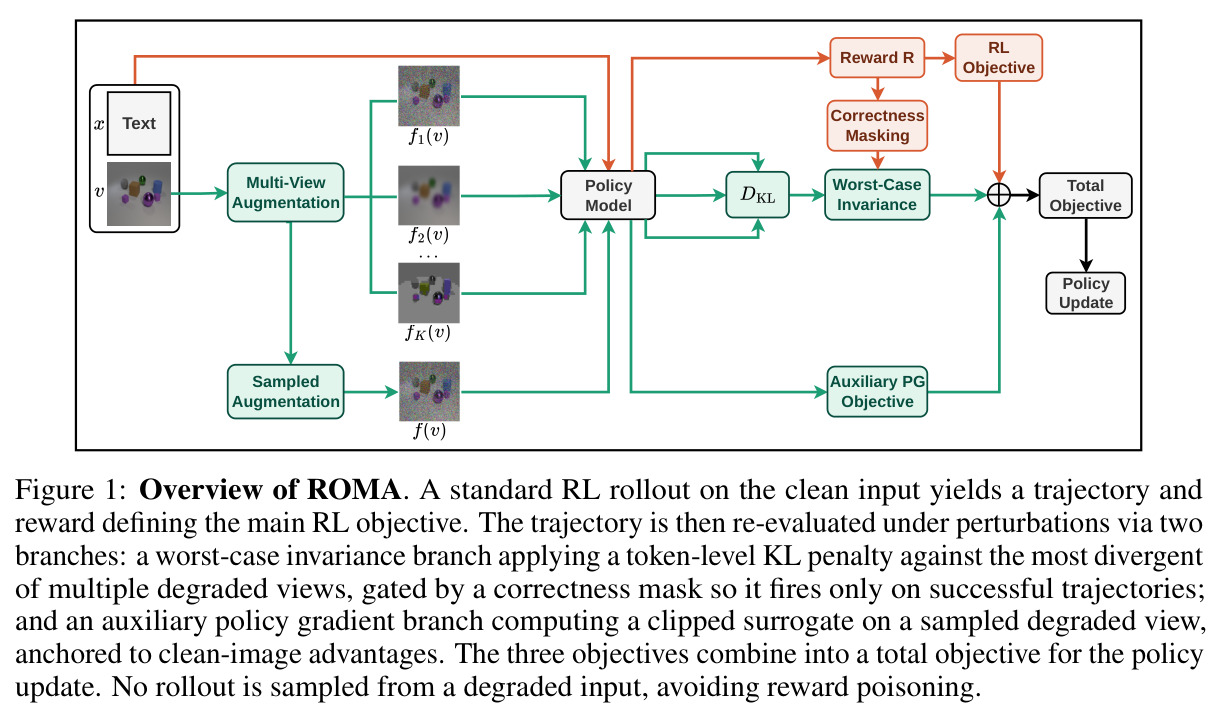
ROMA 的核心架构创新正是 dual-forward-pass:第一次 rollout 在干净图上产生轨迹和奖励,第二次 teacher forcing 在退化图上重放同一轨迹,避免在退化图上 rollout 引发 reward poisoning。
KL 散度作为分布一致性正则
KL 散度 $D_{KL}(p\|q) = \sum_x p(x)\log\frac{p(x)}{q(x)}$ 衡量两个分布在同一定义域上的差异,常被用作分布对齐损失。在 RL 微调中,对干净和增强状态下的策略分布施加 KL 惩罚可以强制策略对视觉扰动保持不变性。在 RLHF 训练中 surrogate 形式常用 $D^{(t)}_{KL} \approx p_t \cdot (\log p_t - \log q_t)$,其中 $p_t$ 在 stop-gradient 之外。
ROMA 的三项正则之一就是 token 级 surrogate KL 惩罚 $G_\pi(\theta, f)$,用于在 worst-case 退化视图上对齐 clean 锚定的 token 分布。
ImageNet-C 与视觉鲁棒性基准
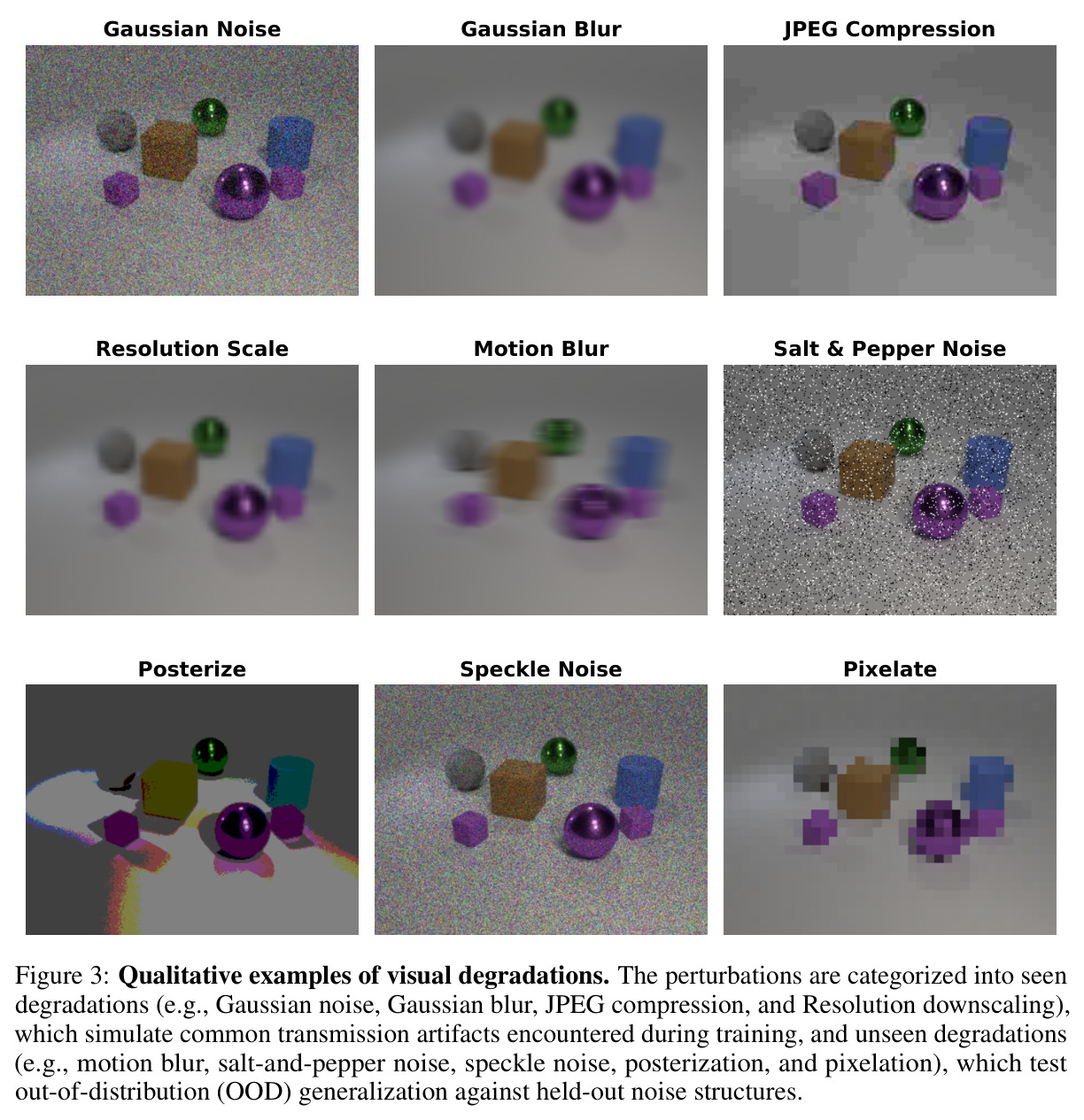
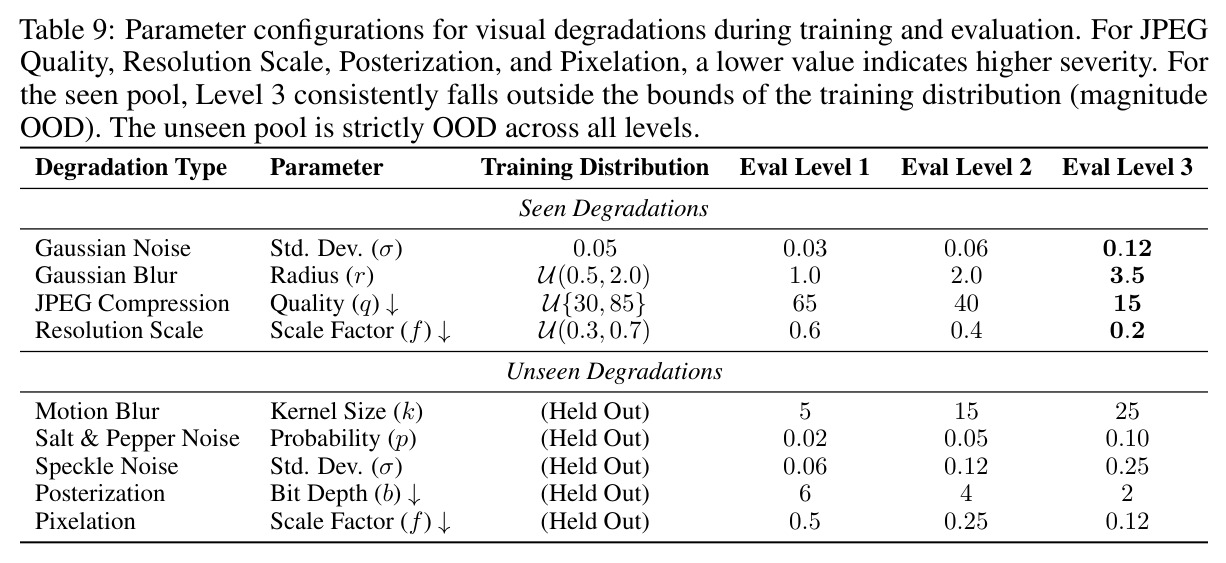
ImageNet-C 是一套系统化设计的图像损坏基准,包含 noise(高斯/椒盐/散斑)、blur(高斯/运动/玻璃/散焦)、weather(雾/雪/霜)、digital(对比度/像素化/JPEG)等多类扰动,每类有 5 个 severity 等级。论文借鉴该框架,训练时所见扰动(seen)有 4 类,未见扰动(unseen)有 5 类,并在 Level 3 上刻意超出训练分布参数上界,测试 OOD 鲁棒性。
理解 ImageNet-C 协议才能看懂 ROMA 中「seen vs unseen」划分以及 Level 3 严重程度(σ=0.12 等)代表什么含义——这是实验能否证明泛化能力的关键设计。
研究动机
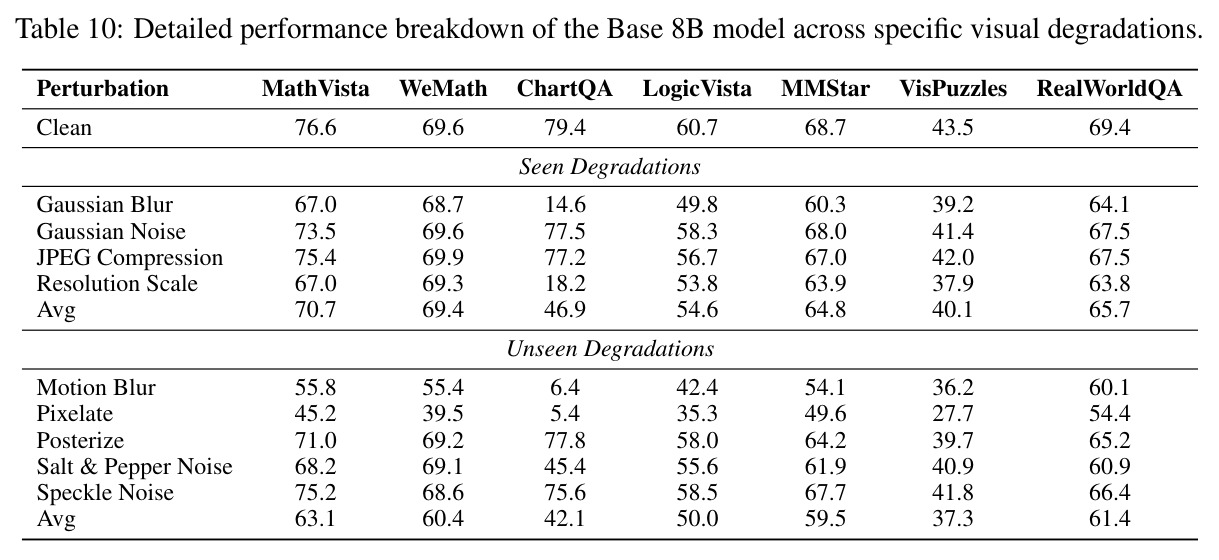
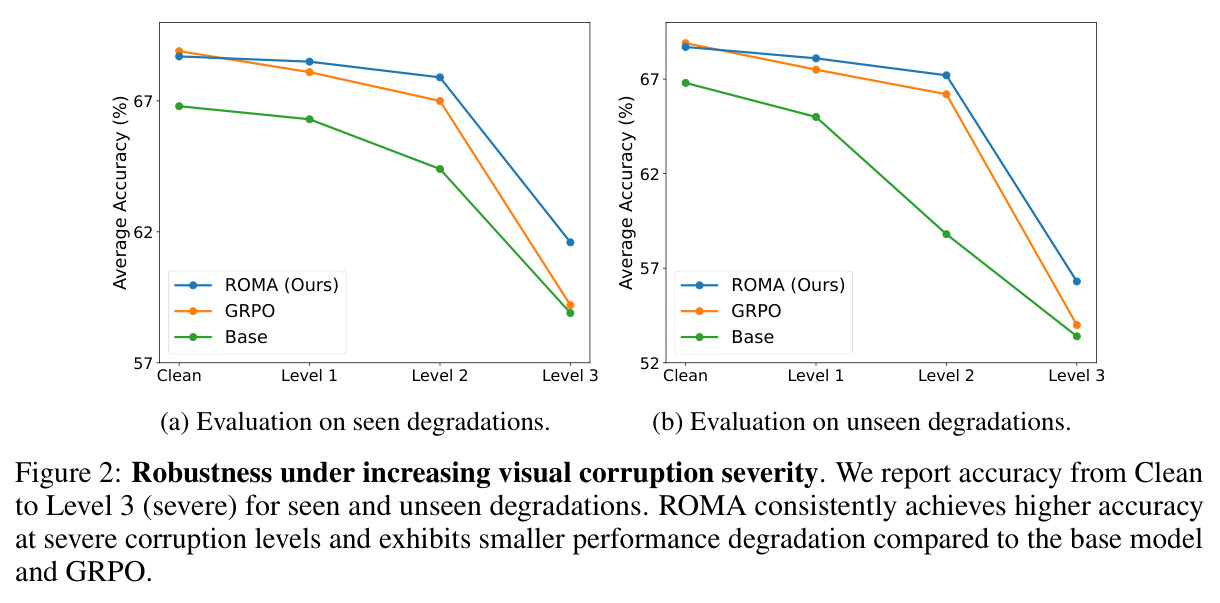
用 GRPO 等 critic-free RL 微调出来的多模态大语言模型在干净测试集上表现优秀(Qwen3-VL-8B + GRPO 在 7 个推理基准上的平均分达到 68.9%),但一旦遇到真实世界的视觉退化——模糊、JPEG 压缩、低分辨率扫描、传感器噪声——性能就急剧下滑:同样的 8B 模型在 seen 退化下平均掉到 59.2%(-9.7 个百分点),在 unseen 退化下平均只剩 54.0%(-14.9 个百分点)。换言之,clean-to-degraded 的鸿沟对标准 GRPO 来说非常严重,这意味着一个在高质量 PDF 上推理良好的模型在模糊照片上可能彻底失效,成为实际部署的关键瓶颈。问题根源有两点:一是架构失配,传统鲁棒性方法(DrAC、DrQ、DrQv2)都依赖 actor-critic 框架,价值网络正则器对 critic-free 的 GRPO 不直接适用;二是 reward poisoning,如果在退化图像上 rollout 采样轨迹,模型会因为视觉证据不足而被迫幻觉,奖励信号就会惩罚感知失败而非推理错误,最终导致策略崩溃。
本文的目标是本文的核心目标是设计一种 RL 微调框架,使 MLLM 在保持干净输入推理精度的同时,对真实世界的视觉退化具备鲁棒性。具体目标有三个:(1)匹配 GRPO 在干净数据上的精度(避免牺牲基础能力);(2)在训练中见过的 4 类退化(高斯噪声、高斯模糊、JPEG、分辨率缩放)上较 GRPO 取得明显提升;(3)在训练中完全未见的 5 类退化(运动模糊、椒盐噪声、散斑噪声、posterization、像素化)上展示零样本泛化能力。形式化地,作者希望在 Qwen3-VL-4B/8B 两个尺寸上,把 seen / unseen 退化的 clean-to-degraded 跌幅分别从 9.7% / 14.9%(8B + GRPO)压缩到 7.1% / 12.4% 以内。
与已有工作不同的是,作者指出,已有处理 MLLM 视觉鲁棒性的工作(NoisyRollout、PAPO、Vision-R1、VL-Rethinker)大多从数据增强或 rollout 注入的角度出发,Liu et al. (2025b) 甚至直接往 RL rollout 阶段注入降质图像——这恰恰会触发本文反复强调的 reward poisoning。另一条线(DrAC、DrQ、DrQv2、DrG)则是连续控制或标准离散环境中的 actor-critic 鲁棒正则,无法直接迁移到 critic-free 的 GRPO 设定。本文的独特切入角度是:不修改 rollout(避免 reward poisoning),不依赖 critic(避免架构失配),而是在优化动力学的层面引入三个针对 critic-free 自回归 MLLM 的正则项:(i) worst-case 多视图 token 级 KL 惩罚、(ii) 锚定干净优势的辅助策略梯度、(iii) 正确性条件化的正则化(仅对 R>0 的成功轨迹施加)。这套组合在双前向传播框架下用 teacher forcing 重放同一冻结轨迹,从而既不污染奖励信号,又能约束策略在退化视图下的分布漂移。
核心方法
ROMA 的整体思路是:在一次优化步内,先用标准 GRPO 在干净图像 $v$ 上做一次前向传播采样整条推理轨迹 $y$,得到每条轨迹的奖励 $R$ 和归一化优势 $A$;然后在 $K$ 个不同退化视图 $f_k(v)$ 上用 teacher forcing 重放完全相同的轨迹 $y$,重新计算每个 token 在退化视觉条件下的对数概率 $\log\pi_\theta(y_t|f_k(v),x,y_{0$ 的成功轨迹上计算,以避免「系统性错误不变性「;(2) 辅助策略梯度损失 $J^{aug}_{pg}$,它从 $\mathcal{F}_K$ 中随机抽一个视图计算 clipped-surrogate,但优势 $A$ 仍来自干净 rollout,从而把「在噪声下也能解题「作为一个直接学习信号;(3) 正确性掩码 $\mathbb{I}[R(v,x,y)>0]$,确保正则只在成功轨迹上生效。最终损失为 $J_{total}(\theta) = J_{RL}(\theta) + \alpha J^{aug}_{pg}(\theta) - \beta \mathbb{E}[G^\pi_{worst}(\theta) \cdot \mathbb{I}[R>0]]$。
与已有 MLLM 鲁棒性方法(NoisyRollout 直接在退化图上 rollout 注入噪声、PAPO 通过大幅 mask 鼓励视觉依赖、传统 DrAC 对策略+价值网络同时正则)相比,ROMA 的本质区别可以归纳为三处:第一是「轨迹不变,图像变」——通过 teacher forcing 在冻结的干净 rollout 轨迹上评估多个退化视图,从而把 rollout 阶段和鲁棒性评估阶段解耦,从根本上规避 reward poisoning;第二是「worst-case 而非平均「——不平均 $K$ 个视图的 KL 损失,而是取最大值 $G^\pi_{worst}(\theta) = \max_{f_k} G_\pi(\theta, f_k)$,把正则聚焦在最对抗的扰动上(实验显示 mean penalty 比 worst-case 在 seen 上低 1.6%,unseen 上低 1.8%);第三是「正确性条件化」——只在 $R>0$ 的成功轨迹上施加 KL 惩罚,避免模型去保守地把错误的推理模式也「鲁棒地「固化下来(无条件正则会让 seen/unseen 平均掉 2.2%)。这三个设计相互配合:dual forward pass 提供信号、worst-case 提供对抗强度、正确性条件化确保正则方向正确、辅助 PG 防止纯 KL 正则下的策略坍缩。
方法步骤详情
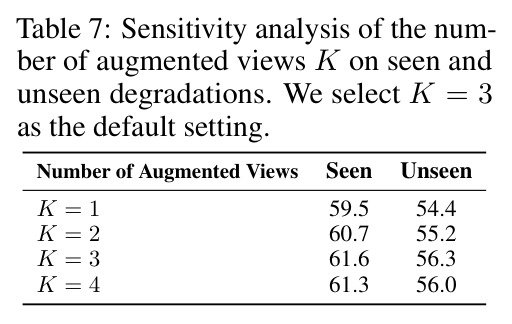
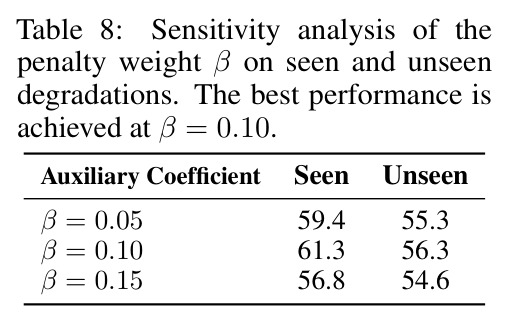
完整训练流程由以下步骤组成,每步对应一个 batch:(1) 对 batch 中每条样本 $(v_i, x_i)$,先在干净图像 $v_i$ 上做一次 GRPO rollout:温度 1.0 采样 $G=8$ 条轨迹,得到奖励 $R_i^{(g)}$,按组内均值-标准差归一化得到优势 $A_i^{(g)}$。(2) 采样 $K=3$ 个不同的视觉增强函数 $f_1, f_2, f_3 \in \mathcal{F}$(训练分布:Gaussian noise σ~0.05, Gaussian blur r~U(0.5,2.0), JPEG q~U{30,85}, Resolution f~U(0.3,0.7)),对每条成功轨迹 $y_i^{(g)}$(即 $R_i^{(g)}>0$)用 teacher forcing 在 $f_k(v_i)$ 上重放,计算 $\log\pi_\theta(y_{i,t}^{(g)}|f_k(v_i),x_i,y_{i,0]]$,作者用 $\alpha=\beta=0.10$。(6) 用 AdamW 更新参数(lr=$1\times 10^{-6}$,wd=0.01,全局 batch 128),共训 120 步。超参网格搜索显示 $\alpha=0.10$、$\beta=0.10$、$K=3$ 是 best,偏离会掉 0.5%–5% 不等。
技术新颖性
技术上 ROMA 的新颖性可以拆成四点:(1) 双前向传播结构第一次在 critic-free 的 MLLM RL 微调中实现「干净 rollout + 退化重放」的解耦——之前 NoisyRollout 等工作做不到这一点的根本原因是它们直接在退化视图上做 rollout,奖励信号被污染;ROMA 通过 teacher forcing 在冻结的干净轨迹上做第二次前向,从根本上绕开了 reward poisoning。(2) 将传统 DrAC 中「对策略和价值网络联合正则「重写为只对自回归策略有效的 token 级 surrogate KL——这是一种从连续控制到离散自回归生成的迁移技术贡献,因为传统 value-based 正则对 critic-free GRPO 完全没有接口。(3) worst-case 多视图优化把 ImageNet-C 风格的「多 severity / 多 corruption「思路从评估协议借鉴到训练目标中,使得每一优化步都聚焦在最对抗的扰动上。(4) 正确性条件化把 RLHF 中「只对正确输出做约束「的直觉(避免 policy collapse 到稳定但错误的模式)形式化为一个 $\mathbb{I}[R>0]$ 掩码,与 RL 主损失完美解耦。综合来看,论文的贡献是工程+方法论的:工程上给出三个超参($K,\alpha,\beta$)的合理搜索结果,方法论上证明在 critic-free 自回归设定下「改优化动力学「是一条可行且优于「改数据/改 rollout」的鲁棒性路线。
实验结果
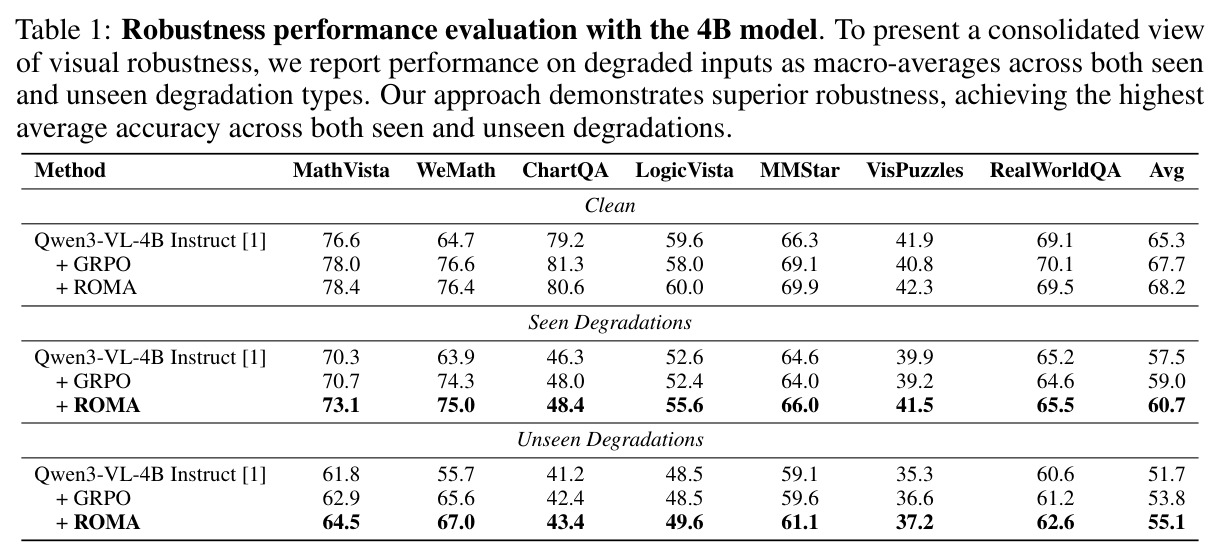
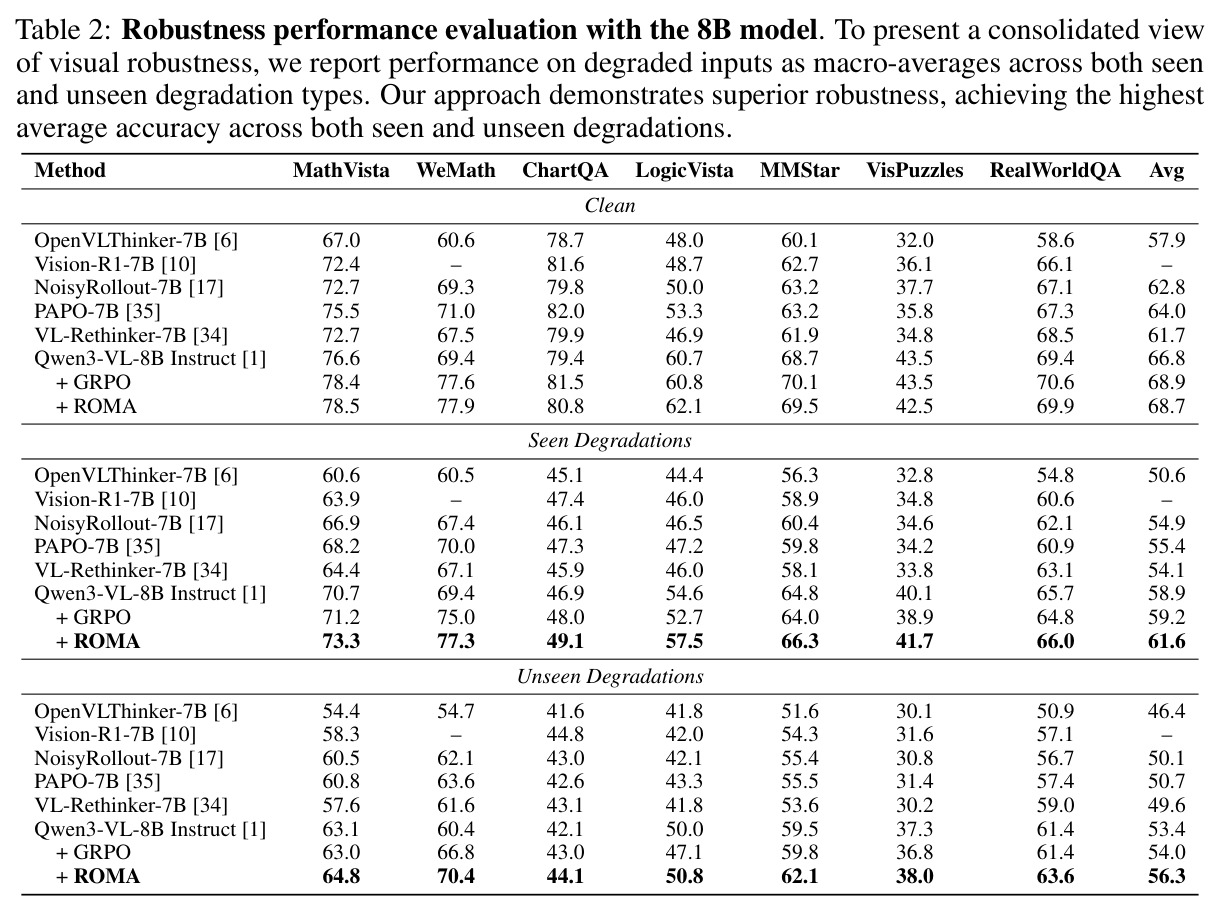
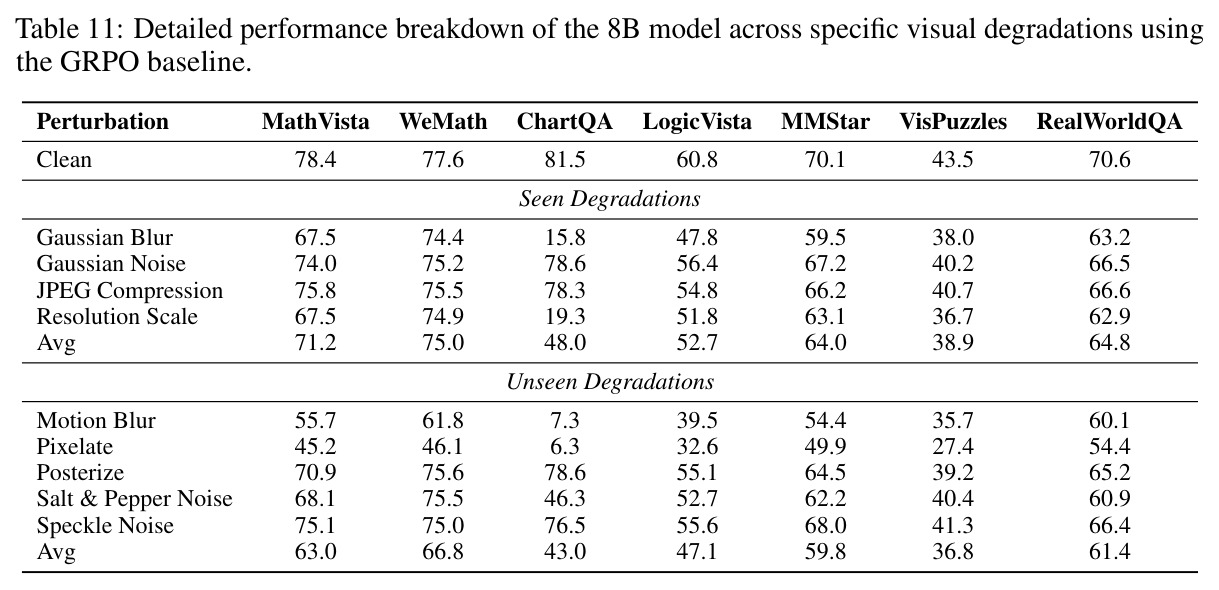
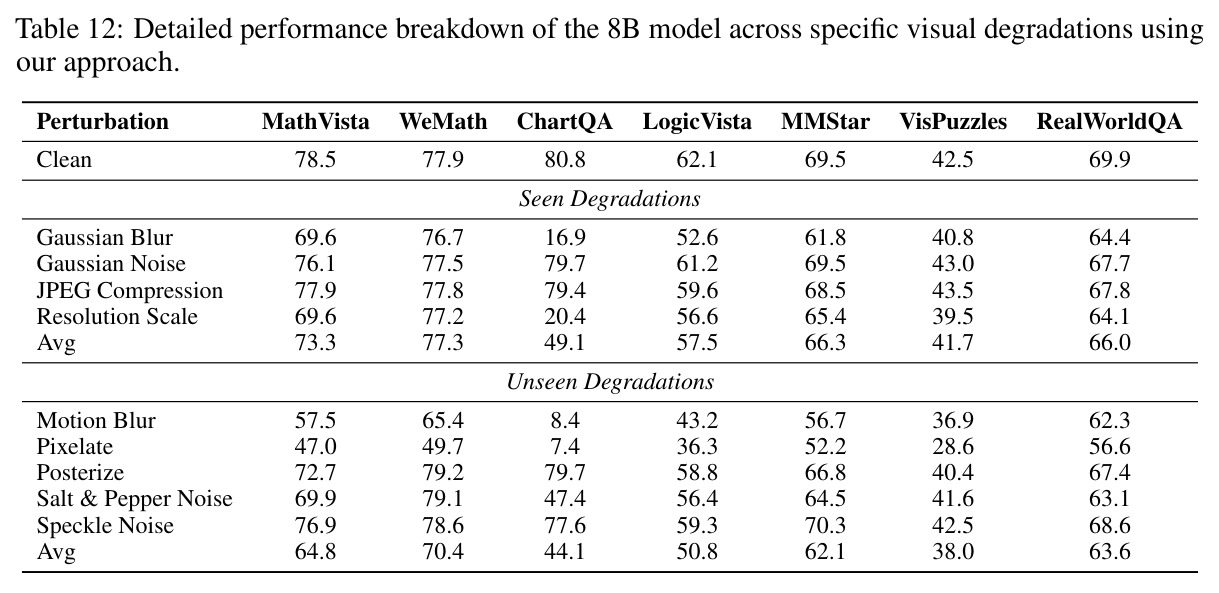
主要实验在 Qwen3-VL-4B / 8B Instruct 两个尺寸上完成,训练集 MMRL30k(~30K 样本),评估在 MathVista、WeMath、ChartQA、LogicVista、MMStar、VisualPuzzles、RealWorldQA 七个推理基准上。**Clean 精度**:ROMA 在 4B 上取得 68.2%(vs GRPO 67.7%、基线 65.3%),8B 上取得 68.7%(vs GRPO 68.9%、基线 66.8%),与 GRPO 持平甚至略高,证明其不牺牲基础推理能力。**Seen 退化鲁棒性(4B/8B 平均)**:ROMA 在 4B 上达到 60.7%(vs GRPO 59.0%、基线 57.5%),在 8B 上达到 61.6%(vs GRPO 59.2%、基线 58.9%、Vision-R1 56.5%、NoisyRollout 54.9%、PAPO 55.4%、VL-Rethinker 54.1%),比最强基线 GRPO 提 +2.4%(8B Level 3)。**Unseen 退化鲁棒性(4B/8B 平均)**:ROMA 在 4B 上 55.1%(vs GRPO 53.8%),8B 上 56.3%(vs GRPO 54.0%、NoisyRollout 50.1%、PAPO 50.7%、VL-Rethinker 49.6%),比 GRPO 提 +2.3%。**Clean-to-degraded 跌幅**:8B 上 ROMA 把 seen 跌幅压到 7.1%(GRPO 9.7%),unseen 跌幅压到 12.4%(GRPO 14.9%)。**逐项退化(8B 详细表)**:在 Motion Blur 上 ROMA 达到 43.2% 平均(vs GRPO 39.5%),在 Salt & Pepper Noise 上 56.4% vs 52.7%,在 Speckle Noise 上 59.3% vs 55.6%;对 ChartQA 的 Resolution Scale(20.4% vs 19.3%)和 LogicVista 的 Gaussian Blur(52.6% vs 47.8%)也都有提升。**消融实验(8B)**:把 worst-case 换成 mean penalty 后 seen 掉 1.6%、unseen 掉 1.8%(Table 3);去掉辅助 PG 后 seen 掉 1.1%、unseen 掉 0.9%(Table 4);去掉正确性条件化后 seen 掉 2.2%、unseen 掉 2.2%(Table 6)——三者都是有效组件,且正确性条件化贡献最大。**敏感度分析**:$\alpha$ 在 0.10 取得最佳(seen 61.6/unseen 56.3,偏离 0.05 或 0.15 都掉 1 个百分点以上),$\beta$ 同理(0.10 时 seen 61.3/unseen 56.3,$\beta=0.15$ 时 seen 暴跌到 56.8),$K=3$ 是 sweet spot($K=1$ seen 59.5/$K=4$ seen 61.3,$K=3$ 是峰值)。
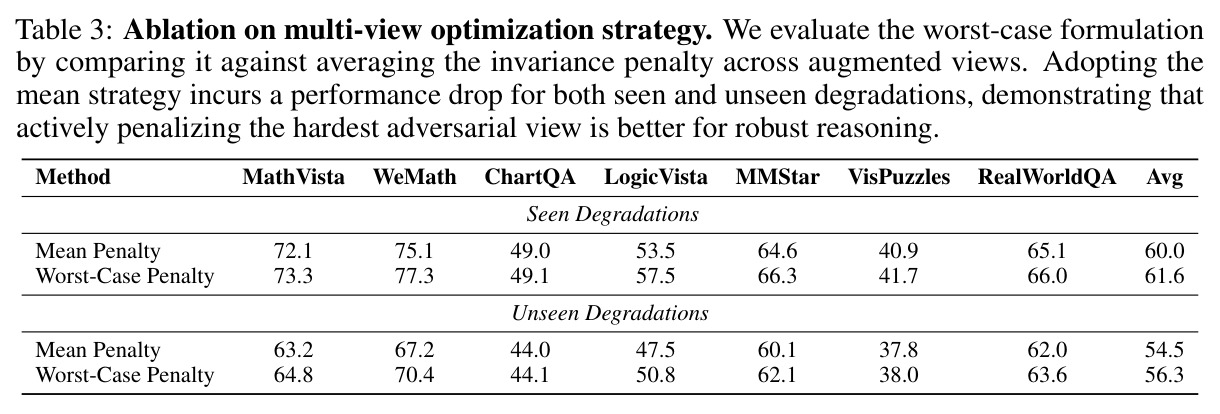
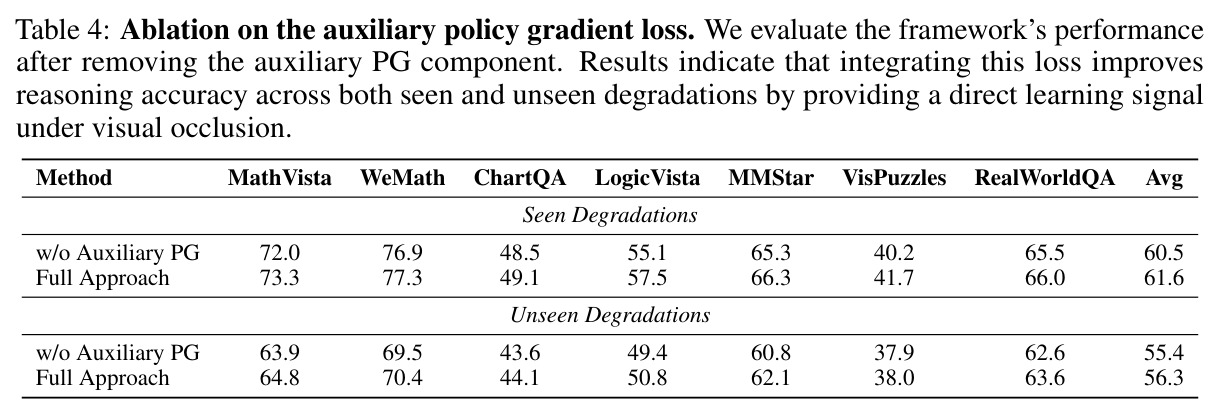
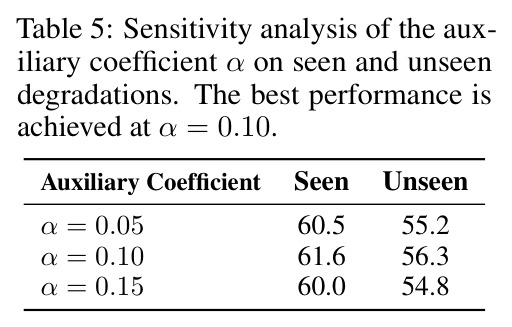
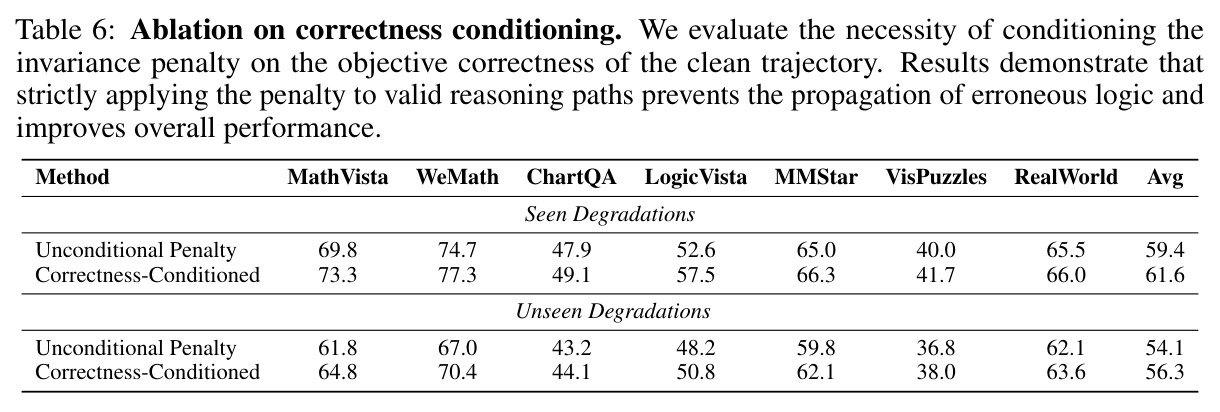
查看结构化数据
| 任务 | 指标 | 本文 | 基线 | 提升 |
|---|---|---|---|---|
| 8B 模型 Seen 退化平均 (Level 3) | Accuracy (%) | 61.6 | 59.2 (GRPO) | +2.4 个百分点(vs GRPO);+2.7 vs 最强非 GRPO 基线 PAPO (55.4) |
| 8B 模型 Unseen 退化平均 (Level 3) | Accuracy (%) | 56.3 | 54.0 (GRPO) | +2.3 个百分点(vs GRPO);+5.6 vs PAPO (50.7) |
| 8B 模型 Clean 精度 (7 benchmarks avg) | Accuracy (%) | 68.7 | 68.9 (GRPO) | -0.2 (匹配干净精度,差异在统计噪声范围内) |
| 4B 模型 Seen 退化平均 | Accuracy (%) | 60.7 | 59.0 (GRPO) | +1.7 个百分点 |
| 4B 模型 Unseen 退化平均 | Accuracy (%) | 55.1 | 53.8 (GRPO) | +1.3 个百分点 |
| 8B 模型 Clean-to-Seen 跌幅 | 百分点 drop | 7.1 | 9.7 (GRPO) | 跌幅压缩 2.6 个百分点 |
| 8B 模型 Clean-to-Unseen 跌幅 | 百分点 drop | 12.4 | 14.9 (GRPO) | 跌幅压缩 2.5 个百分点 |
局限与改进
作者在正文和 Appendix 中明确承认的局限:(1) 实验规模——仅在 Qwen3-VL-4B/8B 两个尺寸上验证,更大模型(如 72B)是否仍能获得 +2.4% 增益未知;(2) 训练步数少——只训 120 步,远少于实际 MLLM RL 微调常见的数千步,长期训练曲线是否稳定或会出现新的 reward hacking 不确定;(3) 数据集单一——MMRL30k 主要是数学/推理类样本,缺少开放域视觉问答、文档理解等场景;(4) 退化池有限——seen 仅 4 类、unseen 仅 5 类,对更复杂的真实世界混合退化(同时叠加多种损坏)未做评估。我自己的观察:(5) 基线比较有限——主要和 GRPO 头对头,没有和更近期的 RLOO、ReMax、DPO 等非 GRPO 算法做对比;(6) 评估器依赖——用 Qwen2.5-72B-Instruct 做答案抽取打分,这意味着绝对精度有 1-2% 的评分误差,对 seen/unseen 之间 +1.3% 这种小差距要谨慎对待;(7) 表格里不同 benchmark 的退化敏感度差异巨大(ChartQA 在 Resolution Scale 上从 79.2% 暴跌到 18.2%,而 MMStar 在 Gaussian Noise 下几乎不掉),但论文没有按 benchmark 子项做归因分析;(8) Table 7 的 $K$ 敏感度只到 $K=4$,没有继续往上扫,理论最优 $K$ 可能更大;(9) 缺少在真实世界失真(如真实手机拍照)上的 zero-shot 评估,模型在 synthetic ImageNet-C 风格扰动上的提升未必能完全迁移到自然噪声。
独立分析的弱点
从独立分析角度看,ROMA 主要有以下可改进的弱点:(1) **算力开销**:双前向传播意味着每次优化步要算 $1+K=4$ 次前向(1 干净 + 3 退化),相比标准 GRPO 翻 4 倍显存/计算,限制了可扩展性;改进方向是用 LoRA 冻结主 backbone、只在 image encoder 或浅层做扰动副本,或用共享 attention KV cache 复用干净前向结果。(2) **$K$ 视图采样的随机性**:当前每次步独立采 3 个增强,没有考虑到样本难度自适应——简单样本分配简单扰动、难样本分配极端扰动,会让 worst-case 更有效率。(3) **静态 $\alpha, \beta$ 系数**:Table 8 显示 $\beta=0.15$ 直接让 seen 掉到 56.8%,说明正则权重极其敏感;可考虑用课程学习(curriculum)从 $\beta=0$ 逐步升到 0.10,或基于梯度范数自适应调节。(4) **正确性掩码过于严格**:仅在 $R>0$ 上施加 KL,但很多轨迹是 $R=0$ 的「接近正确「(如数学题只差一步),可能错失半对推理的鲁棒性学习;可考虑用 $R$ 的 soft 版本(如 $R \geq 0.5$)放宽条件。(5) **teacher forcing 误差累积**:第二次前向完全依赖干净采样的轨迹,如果干净 rollout 出现明显低质量样本,KL 惩罚会把策略推向模仿一个不好的 teacher,理论上 self-critical 或在退化图上重采少量验证或许能缓解。(6) **未见扰动提升有限**:unseen 上 +2.3% 仍然不算大,特别是 Motion Blur 在所有方法上都很低(8B ROMA 也只到 43.2%),说明对运动模糊这种结构性失真仍缺乏针对性机制。
未来方向
作者在 Appendix A.4 中明确提到的未来方向:(1) 把 worst-case 多视图优化推广到时序模态(如视频推理),把「逐帧图像增强」扩展为「逐段视频增强 + 时间一致性 KL」;(2) 引入自适应机制,根据推断的视觉退化严重度动态调整 $\alpha$ 和 $\beta$,把「防御「集中投入到真正高对抗的样本上。基于本文成果还可以延伸的方向:(3) 把 ROMA 框架从图像扩展到 3D 点云/雷达/深度图等多模态感知,研究不同模态的退化是否需要不同的 worst-case 度量;(4) 与视觉去噪/超分模型协同——先用一个轻量去噪预处理图像,再做 RL 微调,看是否能拿到 +1-2% 额外收益;(5) 在多模态 RLHF 中推广,把「鲁棒性正则「和「对齐正则(KL to ref model)「统一到一个 surrogate KL 框架下,研究两个正则项是否冲突;(6) 把 worst-case 视角和 adversarial training 形式化结合,在 pixel 空间直接做 PGD-style 攻击,生成真正 worst 的视觉扰动,而不是从 4 个预设增强里挑最大;(7) 探索 ROMA 在 OOD 检测中的应用——token 级 KL 散度本身就是一个不确定度估计器,可以用来识别「模型对当前图像是否自信「;(8) 跨模型迁移实验:把 Qwen3-VL 上训好的 ROMA 权重迁移到 LLaVA-OneVision、InternVL 等其他 MLLM 上,看鲁棒性是否可迁移。
复现评估
复现评估:作者构建在 EasyR1 框架([42])之上,代码、配置、训练脚本的具体开源情况在论文中未明确说明(不像 MM-EUREKA 等项目有明确 GitHub),但 EasyR1 本身是公开的 RL 训练框架,复现门槛主要是数据 + 算力。**数据**:MMRL30k([43])约 30K 样本,作者未给出获取方式,读者需邮件索要或自行从其引用源抓取;评估数据 MathVista/WeMath/ChartQA 等都是公开 benchmark,可直接下载。**算力**:Qwen3-VL-8B 双前向传播,batch 128,rollout 256,每条 prompt 8 次采样,120 步——按 GRPO 经验,8B 模型完整复现至少需要 32 张 A100/H100,训一次 ~3-5 天;4B 规模可以压缩到 16 卡。**实现细节完整度**:附录 A.1 给了学习率 $1\times 10^{-6}$、weight decay 0.01、batch 配置、温度 1.0、$\alpha=\beta=0.10$、$K=3$,以及训练格式(`...\boxed{}`),参数基本齐全;附录 A.2 给了 9 种退化的具体参数表(包括训练分布上下界和 3 个 eval level),可复现性较好。**难度评估**:方法层中等——KL surrogate 实现、teacher forcing 重放、worst-case 选择都需要细致的工程;最大的不确定性来自 MMRL30k 的数据获取和 EasyR1 框架的稳定性。**评分器**:用 Qwen2.5-72B-Instruct 抽取答案,这个模型公开,评分 pipeline 可复现。
论文图表