LIVEditor-14B:通过上下文稀疏注意力实现闪电式统一视频编辑 Lightning Unified Video Editing via In-Context Sparse Attention
提出首个面向ICL视频编辑的近无损稀疏注意力ISA,配合1.7M数据集与14B模型,在四个基准上超越SOTA并将注意力延迟降低约60%。
前置知识
In-Context Learning (ICL) 视频编辑
在扩散 Transformer 中,把源视频 token 和参考/上下文 token 直接拼接到同一序列里做全注意力,让模型从上下文直接学到编辑关系,省去显式的 ControlNet、跨注意力注入等额外模块。代价是序列长度翻倍、注意力从 $O(N^2 D)$ 涨到约 $O((L_{src}+L_{ctx})^2 D)$,成为推理瓶颈。
本文方法专门针对 ICL 这一范式做设计,ICL 是 2025 年视频编辑从专用模型走向统一框架的关键架构选择;不理解 ICL 就无法理解为什么 context token 和 source token 要被区别对待。
标准缩放点积注意力 (SDPA) 与 FlashAttention v2/v3
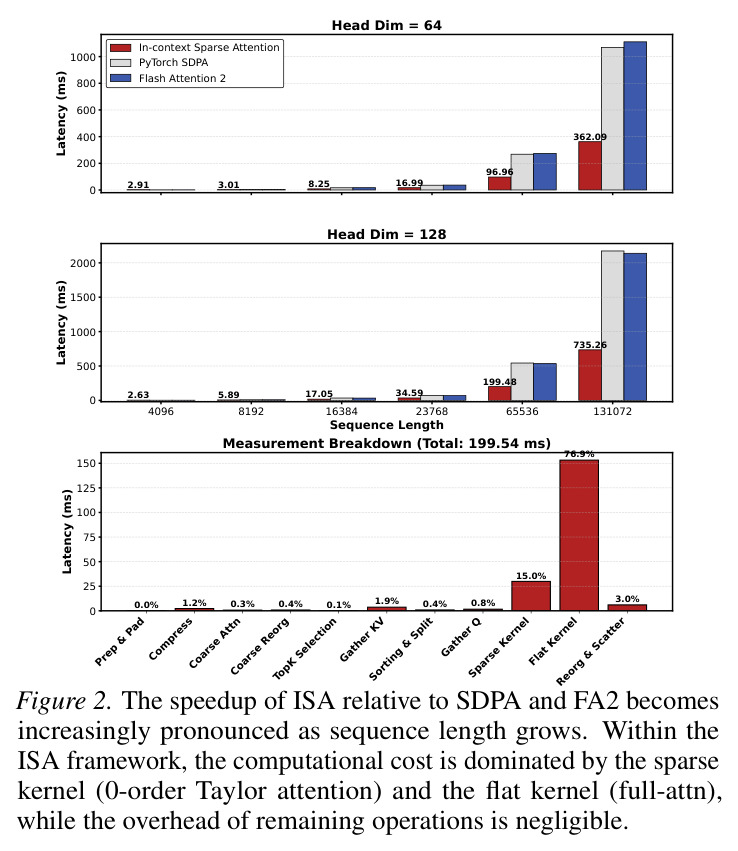
SDPA 是 $O(N^2)$ 的密集注意力,FlashAttention 通过分块和 online softmax 将复杂度降到 $O(N^2)$ 但常数项小很多,并显著降低 HBM 读写。本文中以 SDPA、FA2、FA3 作为延迟基准:在 head dim 64、序列长 23768 时 SDPA 耗时约 735ms,FA2 约 199ms,FA3 约 96ms,FA3 是 ISA 的对照线。
ISA 是相对这一族高效注意力做进一步稀疏的加速方案,必须先理解 FA 才能理解 ISA 的贡献定位。
块稀疏注意力与 Pooling Attention
把 Q/K/V 切成大小为 $b$ 的连续块,在块级别计算 mask $M \in \{0,1\}^{N_Q \times N_K}$,复杂度从 $O(N S D)$ 降到 $O(N_Q N_K b D)$。Pooling Attention 是其中一种 mask 推导方式:先对块做平均池化得到 $Q_c, K_c$,在低分辨率 $S_{coarse}=Q_c K_c^\top$ 上做注意力,再用 TopK 选出重要块。
ISA 的 pre-selection 阶段直接复用 Pooling Attention 的低分图,所以读者需要先理解分块和粗打分这两个前置工具。
0 阶 Taylor 近似注意力
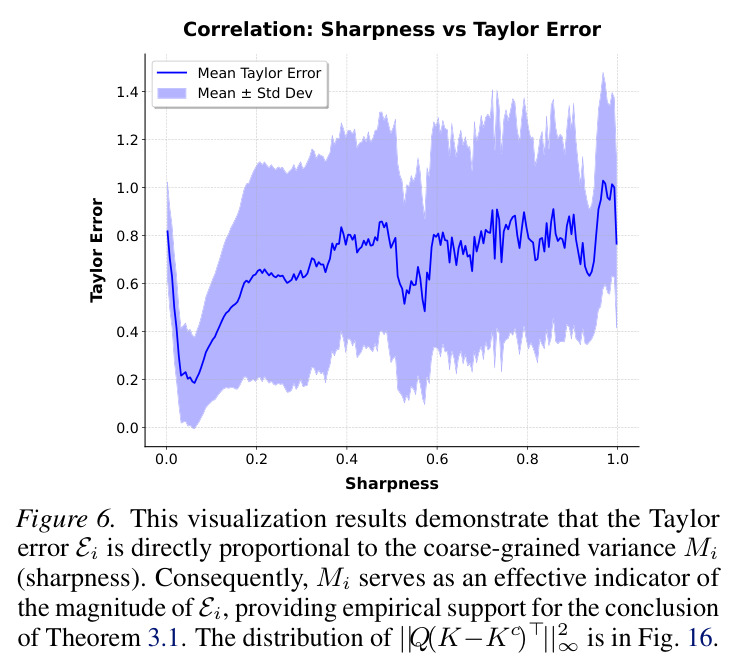
用 $\exp(Q_i K_c^\top) V_c$ 替代 $\exp(Q_i K^\top) V$,即用块均值 $K_c, V_c$ 代替块内所有 token。本质上把 $L_Q L_K$ 次乘法降到 $L_Q$,把 $O(L_Q L_K D)$ 降到 $O(L_Q D)$。证明上对应把 softmax 内的 $Q K^\top$ 替换成常数 $Q K_c^\top$,误差与块内方差成正比。
这是 ISA 的核心计算 kernel,论文有完整的误差上界定理 3.1 把 Taylor 误差和 query sharpness 联系起来。
研究动机
视频编辑正从跨注意力机制(VACE、AVID 等)迁移到 In-Context Learning 范式(EditVerse、UniVideo、InstructX 等),把源视频和参考视频在 token 序列层面直接拼接做全注意力。在 ICL 设定下,context token 数量通常与 source token 相当,序列长度从 5K 翻倍到 10K-50K,注意力计算量随长度二次增长,导致 GPU 显存与延迟同步爆炸。论文 Fig. 2 的实测显示,序列长 23768、head dim 128 时 SDPA 需要约 735ms,FA2 仍需约 199ms。现有稀疏注意力方案(VSA、Sparge、STA、SWA、Radial Attention)都基于通用视频生成设计,把所有 token 等同看待,既没有利用 ICL 中 source 与 context 的结构差异,也未考虑 context token 在注意力打分上显著低于 source token 的特性(Fig. 5 实证:越深的层两者差距越大),因此难以在 ICL 场景中既快又好。
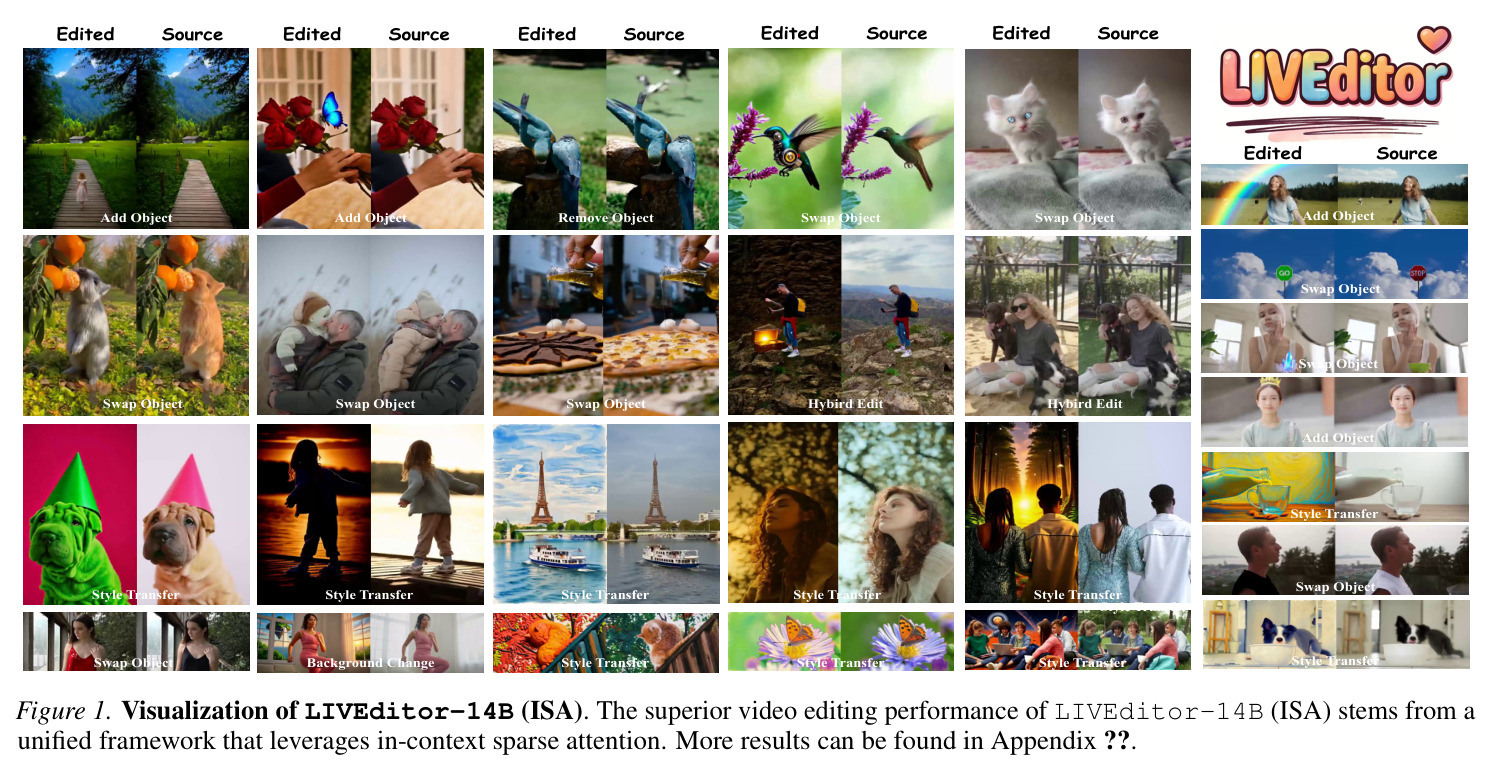
本文的目标是作者要构建一个 14B 参数级别的统一视频编辑模型 LIVEditor-14B,通过把稀疏注意力直接整合进模型架构,在 32 步 CFG 推理全流程中实现比 FlashAttention-3 高约 1.47× 的端到端加速,同时在 EditVerseBench、VIE-Bench、IVE-Bench、FiVE-Bench 四个基准上全面超越现有 SOTA(EditVerse、Lucy Edit、InsV2V、Ditto、Pika、VACE、Omni-Video 等),并保持视觉质量不降级甚至小幅提升。
与已有工作不同的是,论文从两个相互支撑的角度切入:第一,从理论层面证明 query 块内 softmax 分布的能量(即 block-wise sharpness $M_u$)和 0 阶 Taylor 近似的误差上界成正相关(Theorem 3.1),由此可以按 sharpness 把 query 切分成高/低两组分别走精确和近似路径;第二,从 ICL 数据特征出发,发现 source 注意力远强于 context 注意力,因此可以通过 TopK 预选在 context 维度上直接裁掉大量低显著性 token。两点结合形成了 ISA 这套『context 预选 + query 锐度分组』的稀疏方案,与已有通用稀疏方法在设计哲学上根本不同。
核心方法
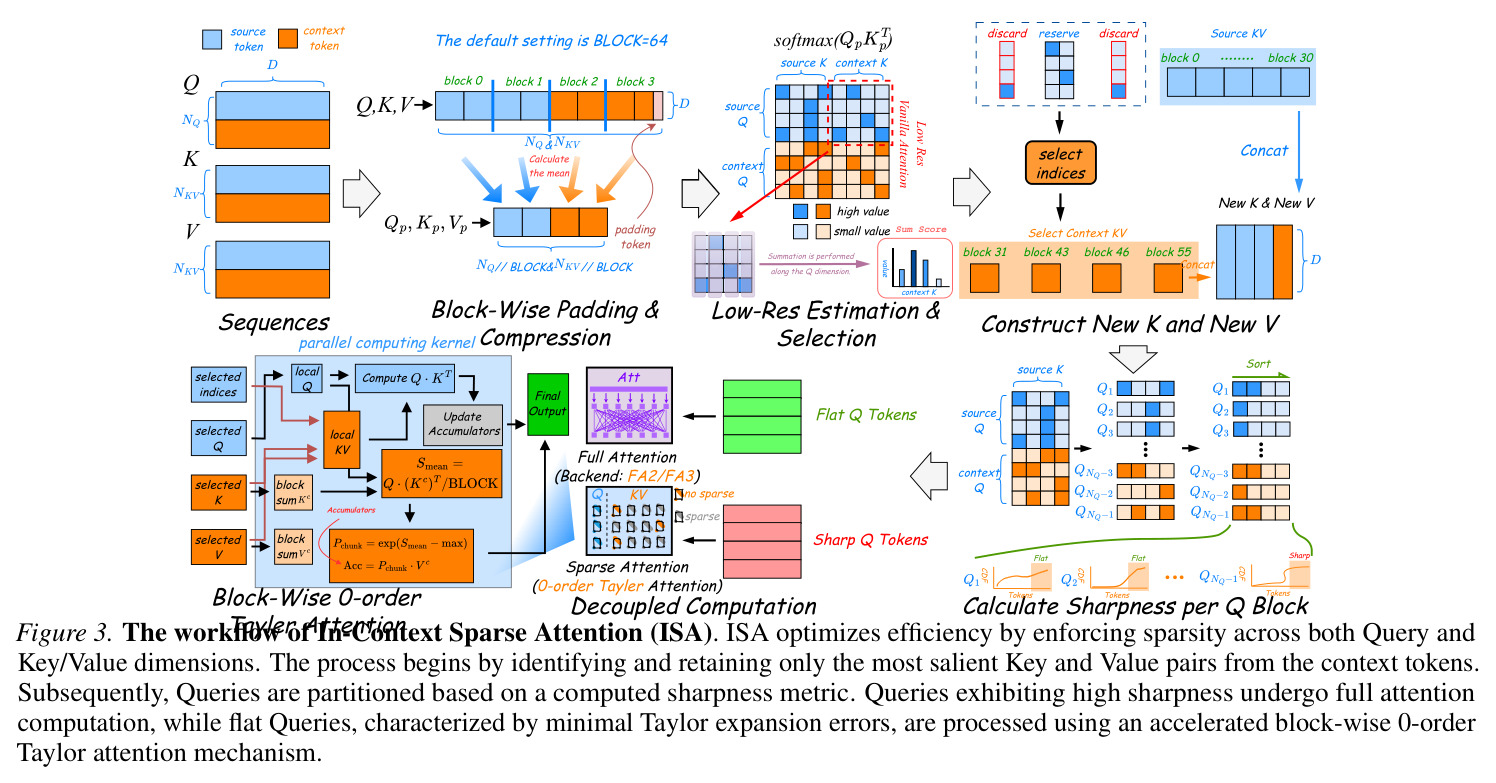
ISA 的整体思路可以拆成三层流水线:先在低分辨率上做 Pooling 注意力,根据 source×context 的打分对 context 块做 TopK 预选(Select Ratio $\alpha_s=0.125$),把 KV 序列从 $L_{src}+L_{ctx}$ 砍到 $L_{src}+\alpha_s L_{ctx}$;然后在粗分数图上计算每个 query 块的 sharpness $M_i = \mathrm{Var}(\mathrm{softmax}(Q_c K_c^\top))$,按 $\alpha_f=0.5$ 把 query 切成 sharp 块和 flat 块;最后 sharp 块走标准 FlashAttention,flat 块走本文新提的 block-wise 0 阶 Taylor 稀疏注意力(No-Sparsity Ratio $\alpha_{ns}=0.0625$ 决定精确注意力密度),用 online softmax 累加器把两条路径的输出融合。这一整套机制用 Triton 实现前向+反向并端到端可训练,配合两阶段训练(1.7M→0.089M)和 decoupled RoPE,最终得到 LIVEditor-14B。
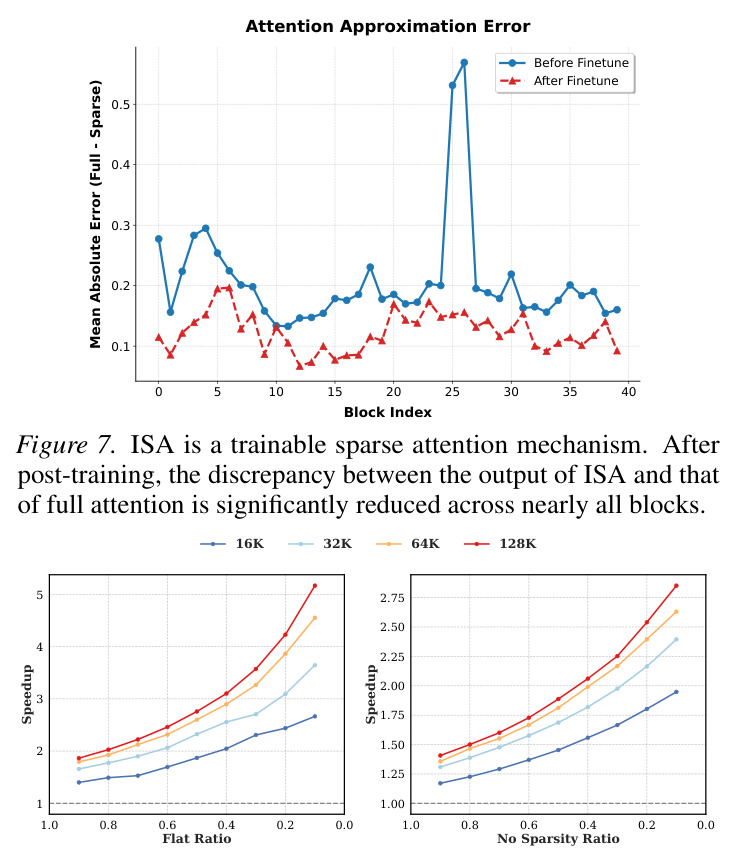
与已有稀疏方法的关键区别在于:通用稀疏方法(如 VSA 的 trainable mask、Radial 的能量衰减、STA 的滑动窗口)都把所有 token 一视同仁,主要利用『距离远的不重要』这一时间-空间局部性;ISA 利用的是 ICL 特有的 source-context 二分结构 + 概率分布锐度差异。具体而言,ISA 同时在 KV 维度(context TopK 预选,把上下文砍掉 87.5%)和 query 维度(按 sharpness 把 50% 的 query 改用 Taylor 近似)做稀疏,理论上有 Theorem 3.1 证明 sharpness 与误差上界成正比作为依据,训练上有 fine-tune 后近似误差从 0.5 降到 0.1 以下(Fig. 7)的实证支撑,最终实现 93.75% 的 Taylor 路径稀疏率而几乎不掉点。
方法步骤详情
完整推理步骤:(1) 块化与压缩:把 $Q, K, V$ 按 $b=64$ 分块并 padding,对每块做平均池化得 $Q_c, K_c, V_c \in \mathbb{R}^{B\times H\times T\times D}$,再算粗分数 $S_{coarse}=Q_c K_c^\top/\sqrt{D}$。(2) 预选 context KV:取出 $S_{coarse}$ 的 source×context 区域,沿 Q 维度求和得到每个 context 块的重要性分数,做 TopK 保留 $\alpha_s \cdot \lceil L_{ctx}/b\rceil$ 个,gather 出 $K_{ctx}^{sel}, V_{ctx}^{sel}$,与源 KV 拼接成 $K_{new}, V_{new}$,复杂度从 $O(NSD)$ 降到 $O(N(L_{src}+\alpha_s L_{ctx})D)$。(3) 计算 sharpness:对每个 query 块 $i$ 算 $M_i=\mathrm{Var}(S_{coarse}[:,:,:, :L_{src}/b])_i$,按降序排序,sharp 块(占比 $1-\alpha_f$)保留走 FA,flat 块(占比 $\alpha_f=0.5$)走 0 阶 Taylor 路径。(4) Sharp 块精确注意力:对 $Q_{sharp}$ 用 $K_{new}, V_{new}$ 跑标准 FA2/FA3,按 online softmax 公式更新 $\ell_i$ 和 $O_i$。(5) Flat 块 Taylor 注意力:对每个 query 块 $Q_i$,已选中的块($\alpha_{ns} \cdot$ 总块数)做 $\exp(Q_i K_j^\top/\sqrt{D})V_j$ 精确计算;其余块加载压缩后的 $K_c^j, V_c^j$,用 $\exp(Q_i (K_c^j)^\top/\sqrt{D}) \cdot V_c^j \cdot L_K$ 近似,并按 $m_i, \ell_i, O_i$ 累加,最后 $O_i = O_i/\ell_i$。(6) 残差融合:把 sharp 与 flat 两组输出 scatter 回原顺序,加上 $\gamma \cdot O_{coarse}$ 作为低频残差。训练阶段对 $\alpha_s, \alpha_{ns}, \alpha_f$ 三个超参做 ablation,验证稀疏率与性能的权衡。
技术新颖性
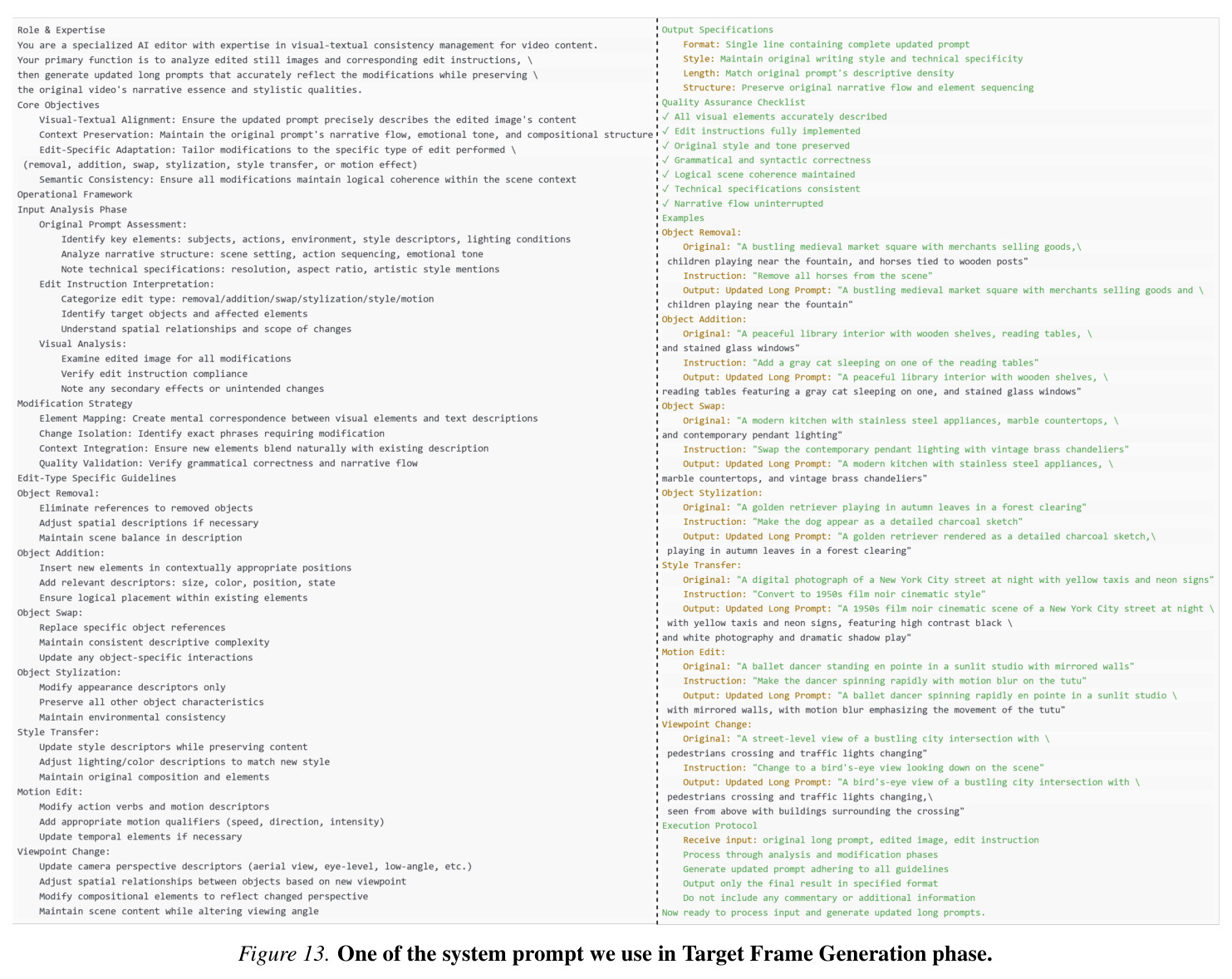
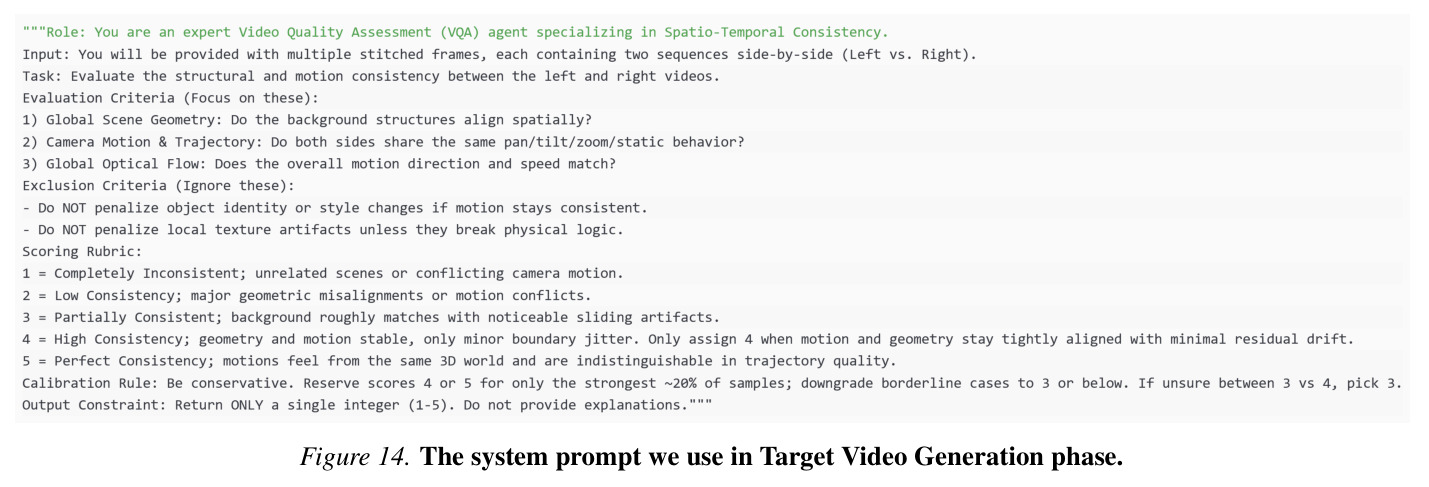
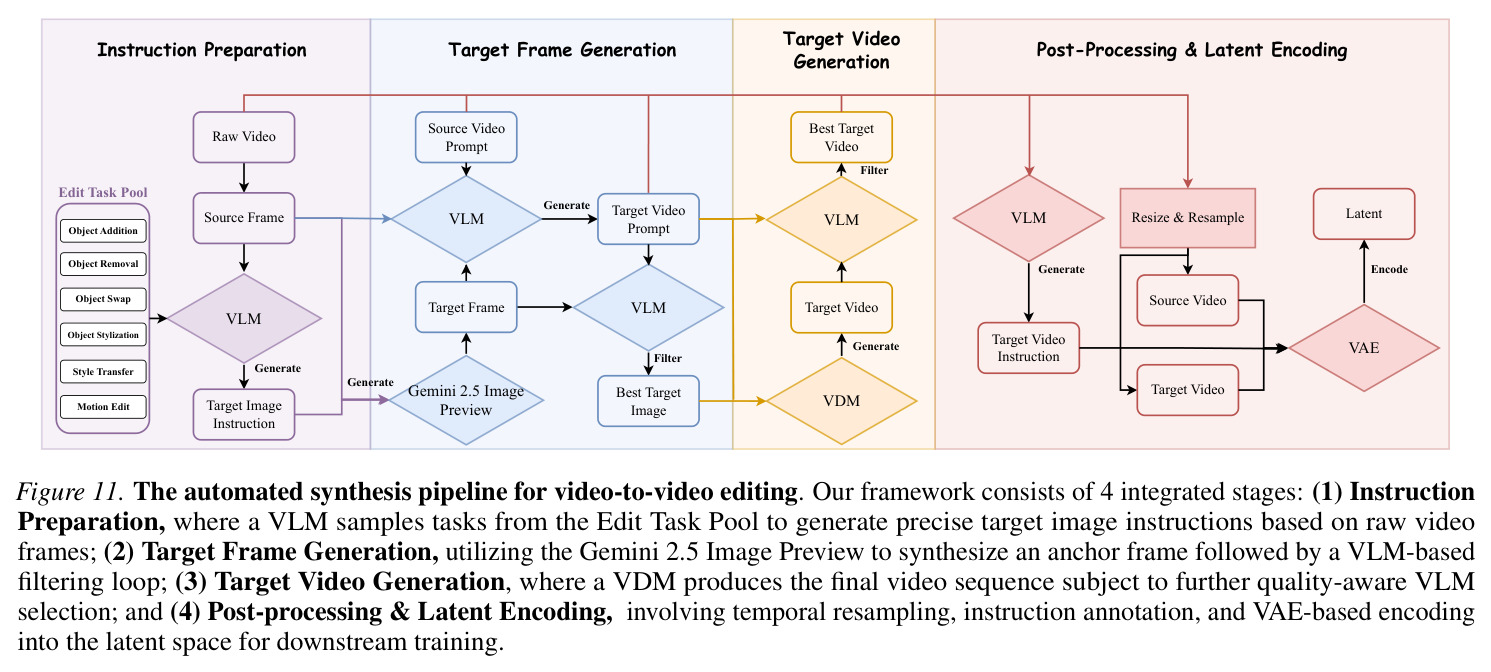
技术新颖性体现在四点:(a) 首次为 ICL 视频编辑量身设计的稀疏注意力框架,区别于通用稀疏方案只利用时空局部性;(b) 给出严格误差上界定理 3.1,把 0 阶 Taylor 误差与 block-wise sharpness 通过 Jacobian 谱范数和 Lipschitz 常数联系起来,且证明 $M_u$ 主导误差项,为分组计算提供理论保证;(c) 完整的 Triton 前向+反向实现使 ISA 完全可微,训练时 32 个 80GB GPU、DeepSpeed ZeRO-3 训练 1.7M 样本 0.089M 样本两阶段;(d) 把 0 阶 Taylor 与 TopK 预选融合,论文 Fig. 7 显示 fine-tune 后与全注意力的逐块误差从最高 0.5 降到 0.1 以下,这是稀疏后还能反超 dense 的关键。补充创新包括 decoupled RoPE(source/context 各自从 0 开始编码位置)和 4 阶段自动化数据合成 pipeline(Gemini 2.5 Flash + Gemini 2.5 Image Preview + 自研 14B T2I2V + YOLO/DINO/SAM 一致性过滤)。
实验结果
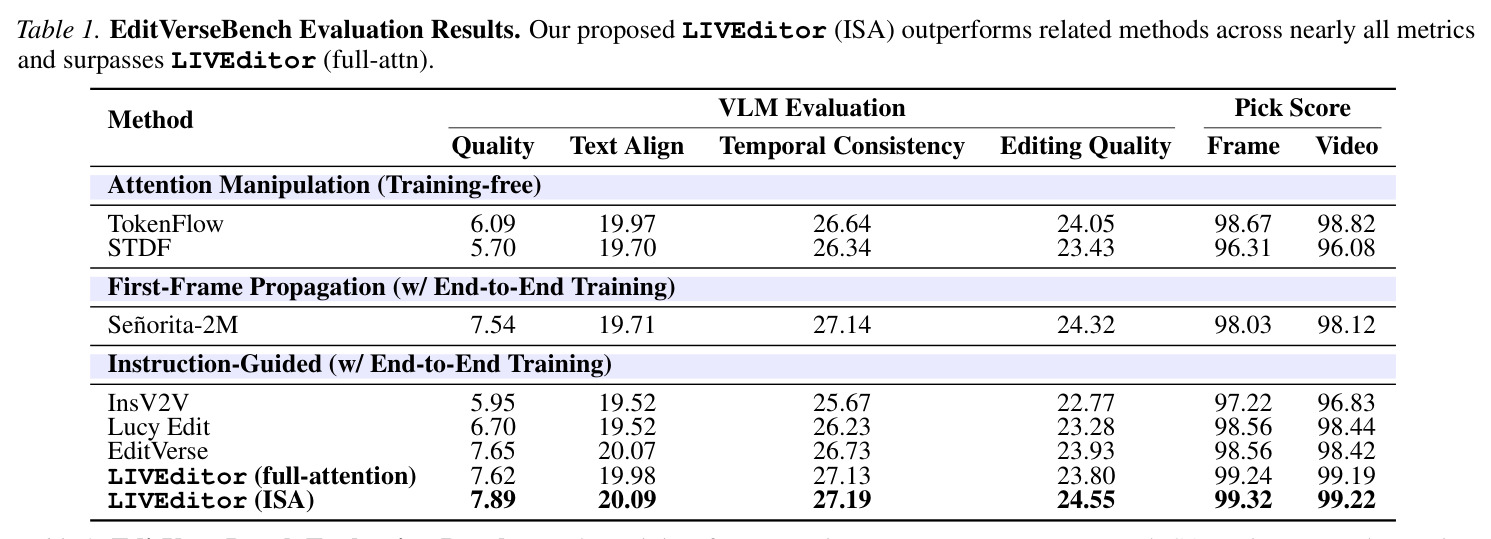
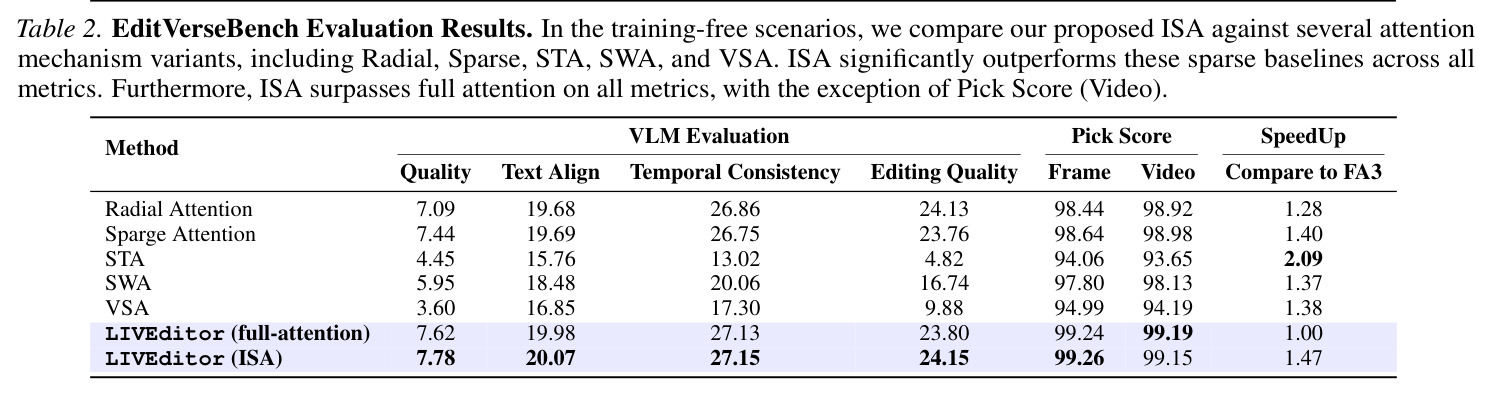
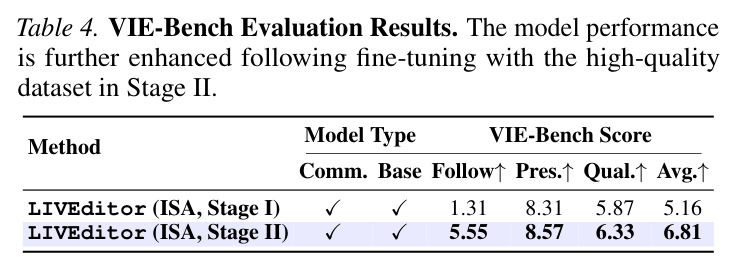
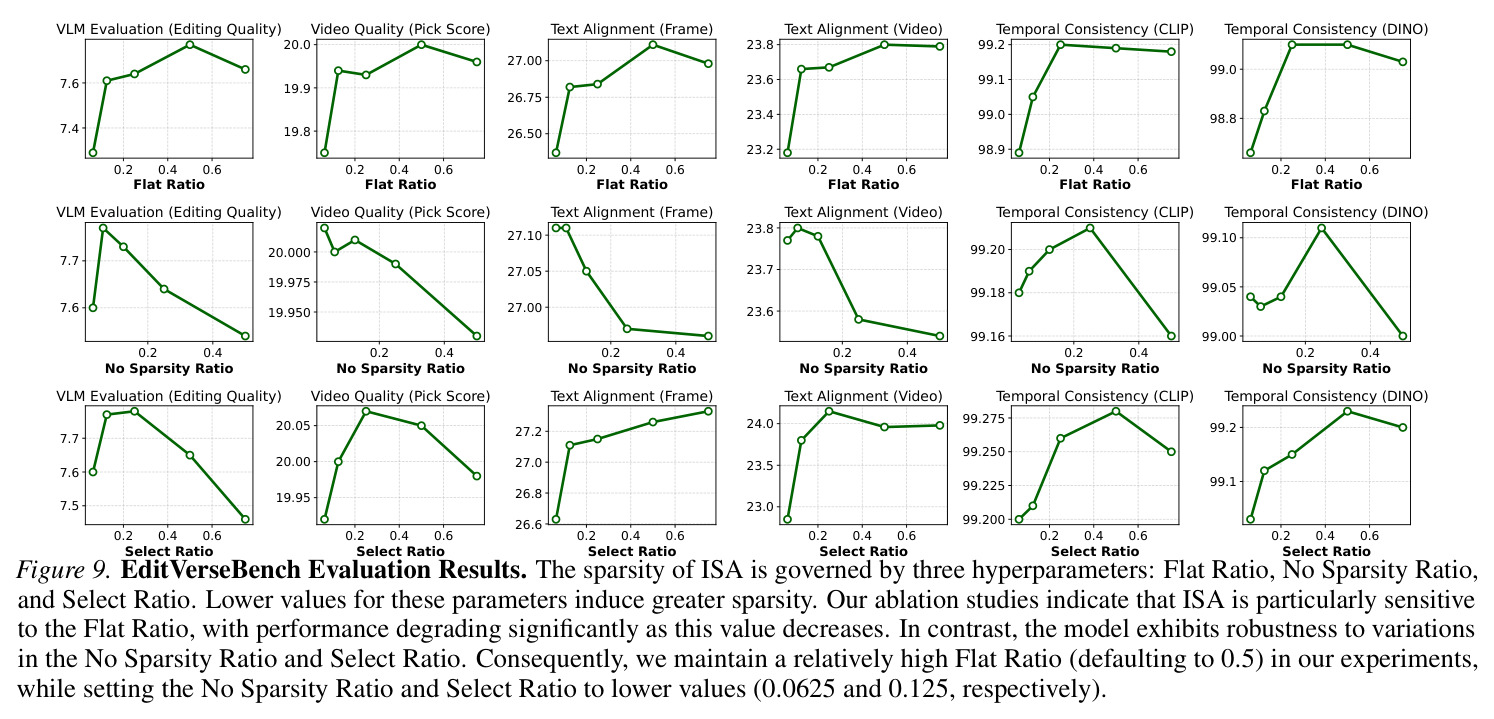
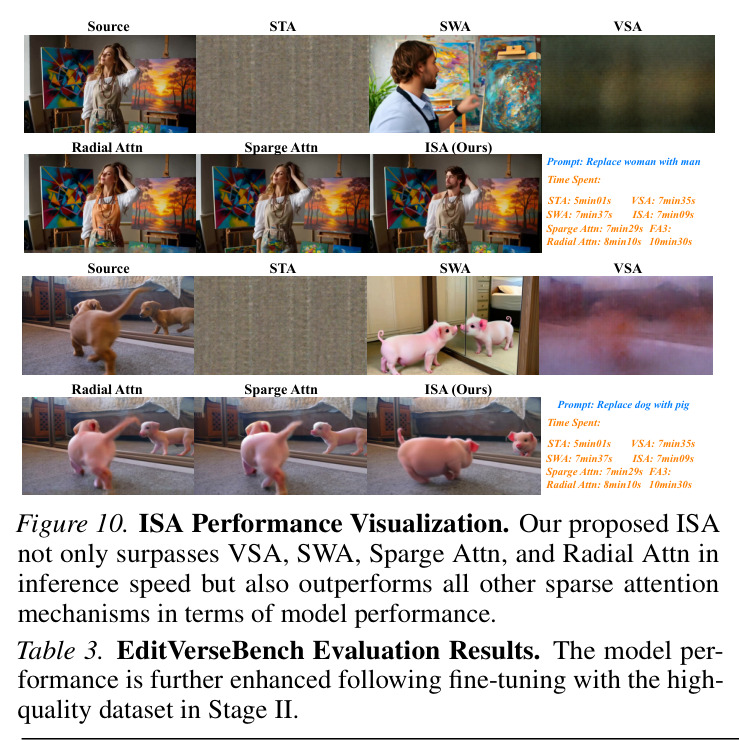
主实验覆盖 4 个基准。EditVerseBench(Table 1)LIVEditor(ISA) 在 VLM 评测四项均第一:Quality 7.89(vs EditVerse 7.65 +0.24)、Text Align 20.09(vs 20.07 +0.02)、Temporal Consistency 27.19(vs 27.14 +0.05)、Editing Quality 24.55(vs Señorita-2M 24.32 +0.23);Pick Score Frame 99.32 / Video 99.22,比此前最高的 98.56/98.44 分别提升 0.76/0.78。同时在所有指标上反超 LIVEditor(full-attn),唯一例外 Video Pick Score 略低 0.04。Table 2 训练-free 场景下与 Radial/Sparse/STA/SWA/VSA 对比,ISA 在 7 项指标上全部领先 sparse 基线并超过 full-attn,1.47× 加速比。VIE-Bench(Table 14)五类任务 Add/Remove/Swap/Style/Hybrid 平均分 8.84/6.81/8.14/8.16/8.12,全面超越 Omni-Video(6.24/5.59/4.75/5.37/5.43)、InsV2V、VACE、Pika,Add 任务对 Omni-Video 提升 2.6 分。IVE-Bench(Table 13)总分 0.67 与 Ditto/InsV2V 并列第一,但在 Video Quality 四子项拿到最高 0.97/0.98/0.99/1.00,Instruction Compliance 从 full-attn 的 0.43 升到 0.47。FiVE-Bench(Table 5-12)四个细粒度任务(Rigid Replace / Non-Rigid Replace / Color Alter / Material / Add)上 ISA 在 Structure Dist.、PSNR、LPIPS、SSIM、CLIP-S、FiVE-Acc 上几乎全面超越 full-attn,最显著的是 Object Addition 任务 Motion Fidelity 从 57.05 跳到 76.39。Table 3-4 显示第二阶段 fine-tune 后 VLM Quality 从 6.46 升到 7.89,VIE-Bench Avg 从 5.16 升到 6.81,验证了 0.089M 高质量子集的关键作用。Fig. 8 显示稀疏率与加速比呈单调关系,$\alpha_{ns}$ 降到 0 时 128K 序列可达 5× 加速。Fig. 9 三组超参扫描揭示模型对 $\alpha_f$ 高敏感、$\alpha_s/\alpha_{ns}$ 低敏感,因此默认 $\alpha_f=0.5, \alpha_{ns}=0.0625, \alpha_s=0.125$。






查看结构化数据
| 任务 | 指标 | 本文 | 基线 | 提升 |
|---|---|---|---|---|
| EditVerseBench VLM Quality | VLM Quality Score (越高越好) | 7.89 | EditVerse 7.65;LIVEditor(full-attn) 7.62 | +0.24 vs EditVerse SOTA;+0.27 vs full-attn |
| EditVerseBench Editing Quality | VLM Editing Quality (越高越好) | 24.55 | Señorita-2M 24.32;LIVEditor(full-attn) 23.80 | +0.23 vs SOTA;+0.75 vs full-attn |
| EditVerseBench Pick Score | Pick Score Frame / Video | 99.32 / 99.22 | Lucy Edit 98.56 / 98.44 | +0.76 / +0.78 |
| VIE-Bench Object Addition | VLM Average Score | 8.84 | Omni-Video 6.24 | +2.60 |
| VIE-Bench Video Stylization | VLM Average Score | 8.16 | Omni-Video 5.37;InsV2V 7.45 | +2.79 vs Omni;+0.71 vs InsV2V |
| IVE-Bench Total | Total Score | 0.67 | Ditto 0.67;InsV2V 0.67;LucyEdit 0.64;LIVEditor(full-attn) 0.66 | 并列第一且 Instruction 0.43→0.47 |
| FiVE-Bench Object Addition | Motion Fidelity (越高越好) | 76.39 | LIVEditor(full-attn) 57.05 | +19.34 |
| FiVE-Bench Object Replacement (Rigid) | FiVE-Acc (越高越好) | 50.71 | LIVEditor(full-attn) 43.80 | +6.91 |
| 推理加速(end-to-end 32 步 CFG) | Speedup vs FA3 | 1.47× | Radial 1.28×;Sparge 1.40×;STA 2.09×;SWA 1.37×;VSA 1.38× | STA 虽 2.09× 但 VLM Quality 仅 4.45(崩溃);ISA 1.47× 同时 Quality 7.78(最高) |
局限与改进
作者承认的局限:(1) ISA 对 $\alpha_f$ 高度敏感(图 9),Flat Ratio 必须保持 0.5 不能降,否则性能显著下降,意味着至少 50% 的 query 必须走精确注意力,稀疏率上限被锁死;(2) Stage I 训练后 object removal 任务存在明显缺陷(VIE-Bench Remove Avg 仅 5.16),需要 Stage II 用 Minimax Remover 生成的 0.06M 数据专门修补,揭示稀疏机制对长程去除这类任务的学习更困难;(3) 仅在 Wan 2.2 高噪声分支上做了 post-training,未验证 ISA 在原生训练流程中的可学习性,扩展到 100K+ 极长序列时仍未充分测试;(4) 与最新 MLLM-based 方法(EditVerse、UniVideo、InstructX)因无可用实现而未对比,无法判断 ISA 在 MLLM 编辑范式下的相对位置。我自己的观察还包括:(a) 1 阶/2 阶 Taylor 因硬件不友好被放弃,但代价是丢掉高阶修正项,在 sharpness 边界附近的 query 可能引入系统性偏差;(b) Decoupled RoPE 解决了位置编码冲突,但完全 reset 索引等于丢掉相对位置信息,可能在依赖相对位移的任务(如 motion edit)上影响精度;(c) Triton 实现在 64K 以上序列长时 TileLang 已超过它(Fig. 17),目前采用 Triton 是因为训练需要反向,但生产部署时 TileLang 可能更适合。
独立分析的弱点
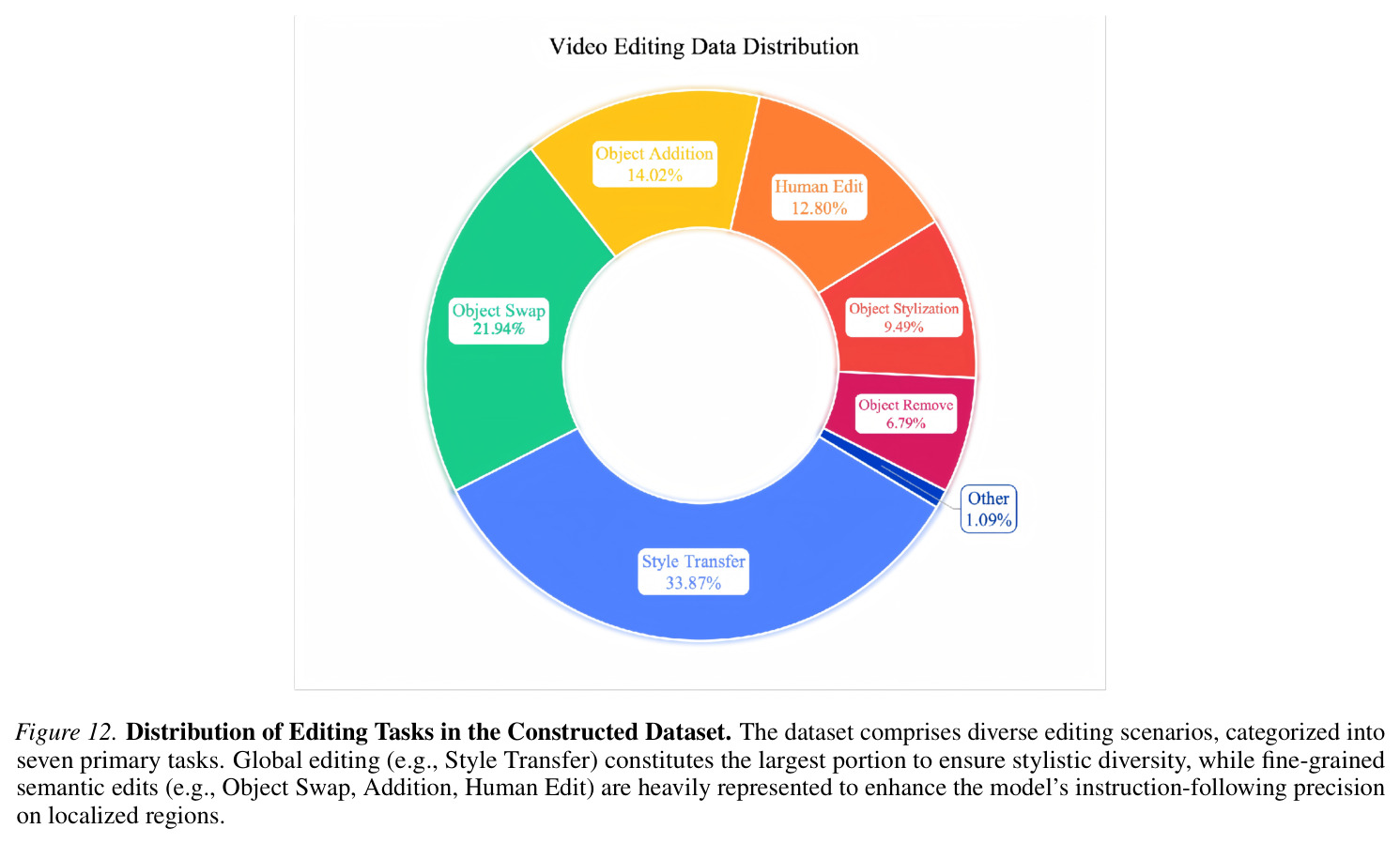
独立分析的弱点:(1) TopK 预选只在 KV 维度做了一次性筛选,没有迭代式 refine,当 context 内部存在层级相关(如参考视频含多帧)时可能选错块;改进方向是引入 dynamic KV eviction 配合 query 端信号在推理时迭代。(2) Decoupled RoPE 把 source 和 context 都 reset 到 0,对依赖时序的运动/视角类编辑(数据中 Other 类仅 1.09%)可能不够友好,可改为 source 保留绝对位置、context 端引入独立相对位置编码。(3) $\alpha_f=0.5$ 的硬性下限意味着 Taylor 路径最多处理一半 query,理论稀疏率天花板约 50%;可探索用 learning-to-route 替代固定阈值,让模型自己学哪些 query 适合近似。(4) 数据合成 pipeline 高度依赖 Gemini 2.5 Flash/Image Preview 闭源 API,prompt 调整与版权可解释性都受限,且 human edit 类别仅 12.80%,对人类中心编辑的细粒度控制仍弱;改进方向是开源 caption 模型+ControlNet-Style 的本地化合成,并扩大人像/手势类数据。(5) 仅在视频编辑单任务验证 ISA,对通用 ICL 视频生成/理解的迁移性未给出证据。
未来方向
作者提出 + 我基于结果的延伸:(1) 把 ISA 推广到 100K-1M token 的极长视频生成与多镜头理解任务,验证 Theorem 3.1 在长程注意力上的可推广性;(2) 探索与 diffusion 蒸馏(作者团队积累的 MagicDistillation、Catch-up Distillation 等)结合的稀疏-蒸馏联合加速,目标 4-step 内编辑;(3) 把 ISA 作为通用 ICL 加速 backbone 应用到图像编辑、3D 编辑、文档编辑等多模态统一模型;(4) 引入 RLHF/VLM-as-judge 微调(Table 13 显示 Object Removal 上 LIVEditor 仍不如 Minimax Remover 等专用模型),用偏好学习补齐 Stage II 未覆盖的细粒度能力;(5) TileLang 在 64K+ 序列已超过 Triton,预期把 forward kernel 切到 TileLang、backward 仍用 Triton,可在生产环境拿到更高加速比;(6) 把 sharpness 指标 $M_i$ 引入 diffusion 采样步的 early-exit,跳过 $\alpha_{ns}$ 之外的 query 在所有 step 的更新,进一步节省 30%-50% 算力。
复现评估
复现评估:作者声称开源 LIVEditor-14B 仓库,模型基于 Wan 2.2 高噪声分支 post-training,训练分两阶段——Stage I 1.7M 样本、lr=1e-5、global batch 16,Stage II 0.089M 样本、lr=5e-6、EMA=0.995,使用 AdamW($\beta_1=0.9, \beta_2=0.999$, weight decay=1e-2),32 张 80GB GPU 跨 4 节点 + 序列并行 size 2 + DeepSpeed ZeRO-3 Offload。数据 pipeline 完全依赖 Gemini 2.5 Flash/Image Preview 闭源 API 和自研 14B T2I2V 扩散模型,外部复现需要先复刻其 14B 内部 T2V 模型,否则只能复用其 1.7M 公开数据子集(Ditto 0.7M + 自合 1M 中的开源部分)。ISA 算法本身在 Triton 上完整开源,包含 Algorithm 1/2 伪代码和 Triton vs TileLang 性能对比(Fig. 17),因此稀疏机制本身易复现;但端到端 14B 模型复现算力门槛约 $32 \times 80GB \times 2 \text{ stages} \times \text{数天}$,对大多数研究组偏高。整体难度评估:算法级中、数据级难、模型级高。
论文图表
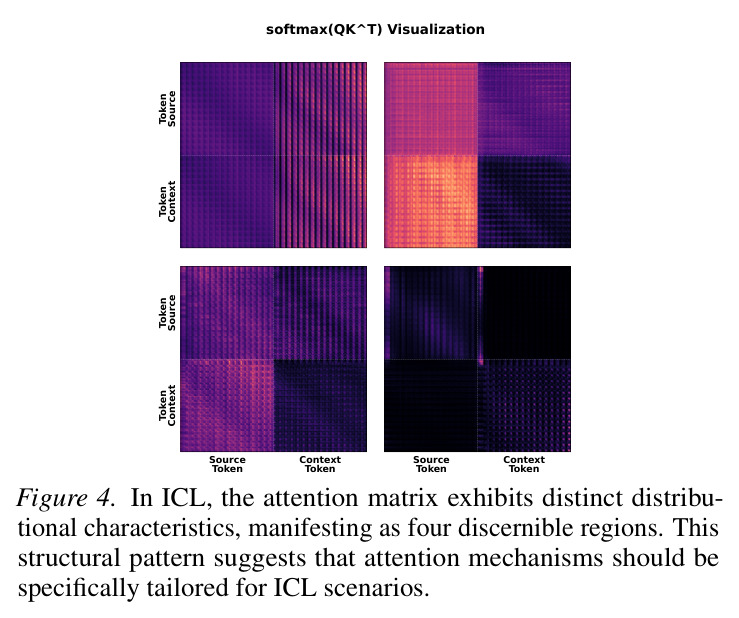
softmax 后的注意力矩阵可视化,标记出 4 个区域:source Q×source K(左上,最亮)、context Q×context K(右下)、source Q×context K(右上,色暗)、context Q×source K(左下,色暗),证明 ICL 注意力矩阵有明显分块结构。
直接支撑论文『source 与 context 应区别对待』的核心动机。
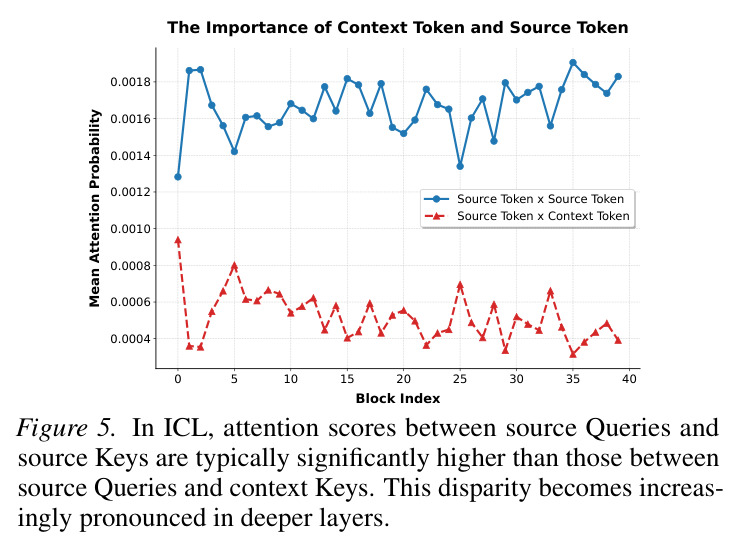
横轴为 Block Index 0-40,纵轴为注意力分数概率。蓝线(source×source)始终在 0.001-0.0018 之间,红线(source×context)从约 0.0008 衰减到 0.0004,差距随深度递增。
为 TopK context 预选提供经验证据:context token 的显著性确实远低于 source token。