重复优于多样:高信号数据过滤实现德语语言模型的样本高效训练 Repetition over Diversity: High-Signal Data Filtering for Sample-Efficient German Language Modeling
针对德语语料受限场景,证明在严格质量过滤后的小规模高密度子集上多轮训练,明显优于在大规模低过滤语料上的单轮训练。
前置知识
FineWeb-2 多语言数据流水线
FineWeb-2(FW2)是 Hugging Face 团队提出的多语言网页语料处理框架,针对每种语言独立完成 URL 去重、语言识别、启发式清洗和质量打分等流程,并按语言输出对应子集。德语子集 FW2-DE 是本文的唯一数据起点,包含约 5 亿份文档,提供了基础的去重和粗粒度过滤。
本文所有过滤、子集划分与对比都建立在 FineWeb-2 之上,读者需要先理解 FineWeb-2 已经做过哪些预处理,才能看清本文额外施加的三层语义过滤到底增加了什么价值。
数据约束下的扩展律(Scaling Laws under Data Constraint)
Muennighoff 等人 2023 年提出的设定:当唯一 token 数量不足以支撑单轮训练时,研究者应如何在「追加唯一数据」和「复用现有数据」之间取舍,并提出 4 epoch 是回报拐点的经验法则。
本文的核心问题就是非英语场景下这一拐点是否仍然成立;读者只有先掌握「数据约束扩展律」才能理解作者为什么把多 epoch 实验当成主要验证手段。
分层质量分类器(Hierarchical Quality Classifier)
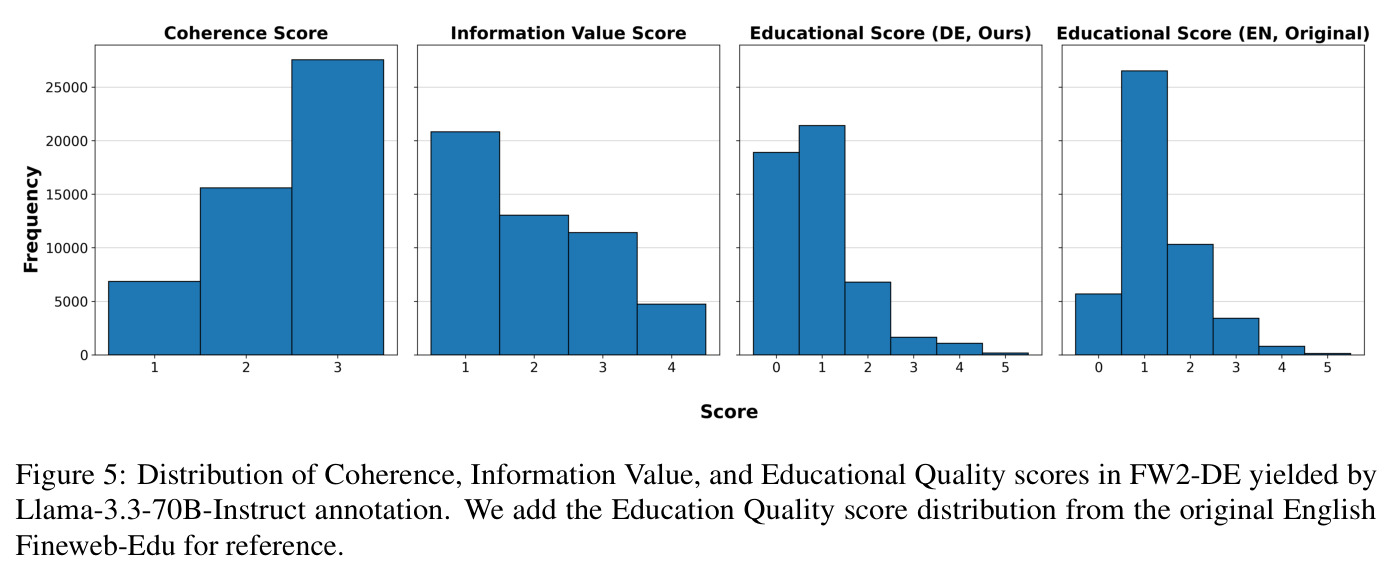
用 LLM 对文档逐条打分,再用轻量级回归头(如 Arctic Embed)训练成可批量打分模型,从而把教师模型的判断投影到亿级文档上的做法。本文的三层分别是连贯性、信息量、教育质量。
这是本文数据流水线的中枢——先由 Llama-3.3-70B 打标,再由雪球 Arctic Embed 回归拟合,最后才在 5 亿文档上跑批。理解这条链路是理解方法创新点的关键。
Tokenizer Fertility(分词器膨胀率)
指同一段文本在目标分词器下产生的 token 数与原文长度的比值,数值越高说明分词器对语料的切分效率越低,常被用作「该语料是否符合分词器训练分布」的代理指标。
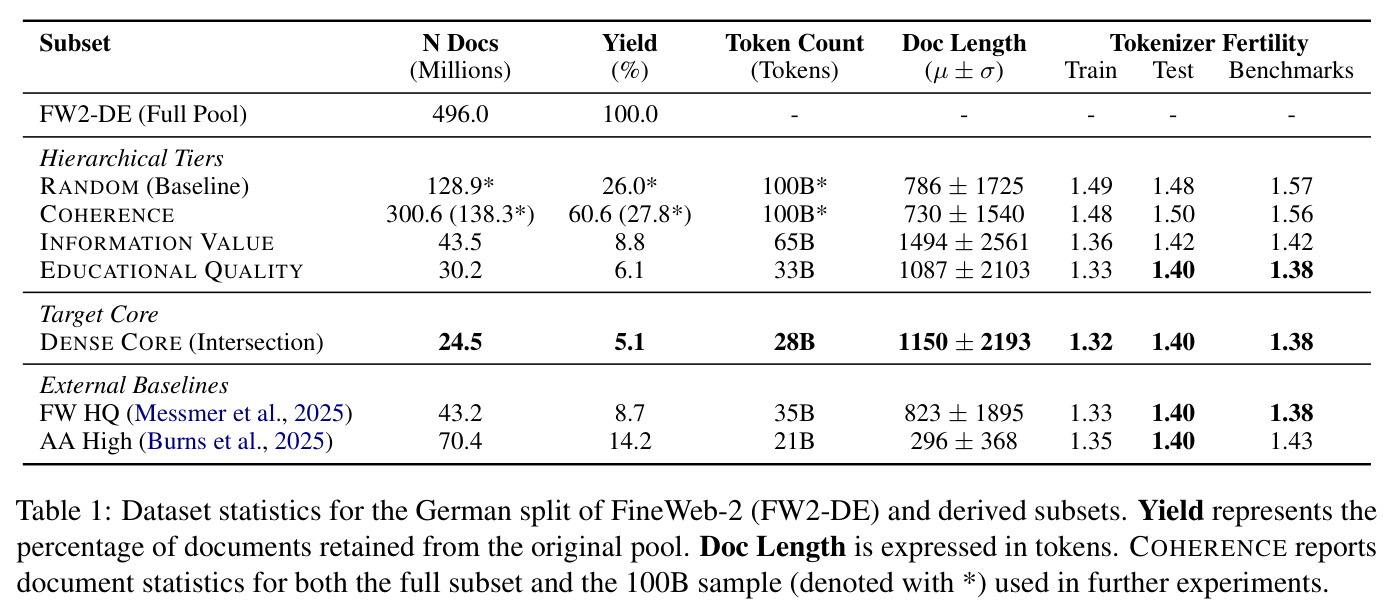
Table 1 反复出现 Fertility 列,且随过滤变严而下降;理解这一指标才能看懂作者为什么主张要按子集训练专属 BPE,而不是直接用现成词表。
研究动机
英语 LLM 已经能用十亿至万亿级 token 单轮训练,并通过在「教科书式」高质量子集上训练 Phi 系列等模型证明激进过滤可以显著提升样本效率。但德语、法语、日语等高资源非英语语种情况不同:FineWeb-2 全量德语去重后只有约 5 亿份网页文档,可用的总 token 量在百亿级别,距离英语万亿 token 的规模差了 1–2 个数量级。在这个「数据受限但并非极端匮乏」的中间地带,实践者面临一个尴尬的战略抉择:是弱过滤保多样性单轮训完百亿 token,还是强过滤、缩小到几十 B token 然后反复多 epoch?Muennighoff 等人 2023 年的研究说 4 epoch 后重复收益骤降,但 Fang 等 2026 又把上限推到 10 epoch,而这两项结论都来自英语场景,几乎没有针对德语等非英语的严格实验。
本文的目标是本文以德语为代表性案例,系统量化「多样性的广度」与「语义密度」之间的取舍。作者用三层语义过滤(连贯性、信息量、教育质量)从 5 亿份德语网页中提炼出一个 28B token 的 DENSE-CORE 核心,并在固定的 100B、200B token 预算下,对比「随机单轮训完」与「高质量多轮反复训」两种策略。核心问题是:在德语这种百亿级数据规模下,重复是否真的优于多样性?Muennighoff 等人 2023 年的研究主张 4 epoch 是收益拐点,Fang 等 2026 年又把上限推到 10 epoch,但这两项结论都来自英语场景,作者希望通过 350M 至 1B 模型的对照实验,在非英语上验证 Multi-epoch 拐点是否仍然存在,并给出数据过滤与训练预算的最佳配比。
与已有工作不同的是,既有工作在数据过滤层面大多仿照 FineWeb-Edu 用单一教育质量分数,或者像 FW2-MKC 用嵌入相似度对齐指令集,却忽略了「连贯性—信息量—教育性」三层过滤各自的边际贡献。同时,英语场景下的多 epoch 研究是否能在德语上复现也完全没有验证。本文正是沿着这两个缺口切入:先解构三层过滤各自的价值,再用德语从 350M 一直扩到 1B 来验证 Muennighoff-Fang 结论在非英语上是否成立。
核心方法
直觉上,作者主张把有限的德语语料「浓缩」为高质量核心,反复让模型浸入高信号文本——就好比让一个学生反复精读一本好书,而不是泛读一百本平庸教材。技术路线上分两步:第一步是数据侧,把 FineWeb-2 德语子集按「连贯性-信息量-教育质量」三个递进维度用 LLM 打标、再训练轻量回归头,最后在 5 亿文档上做整库打分,取三层交集得到 28B token 的 DENSE-CORE;第二步是训练侧,使用 Llama 风格的 Dense Transformer,固定 100B 或 200B token 总预算,用专属 BPE 分词器做多 epoch 训练。
核心创新点是「分层语义过滤 × 多 epoch 预算对等」的实验设计:先用三层过滤把语料压到 5.1%,再让模型在固定 token 预算下反复训练这个核心。它与 FineWeb-Edu 等工作的本质区别不在过滤本身,而在把「过滤比例」与「epoch 次数」做了显式的算术对齐——别人训练 100B 单遍都在大集上,本文的 100B 预算在 DENSE-CORE 上等价于 3.6 遍,由此让「重复」和「多样」可以直接 A/B 对比,而不是比较两个完全不同的算力配置。
方法步骤详情
数据侧:(1) 取 FineWeb-2 德语子集 FW2-DE 约 5 亿文档起点;(2) 用 Llama-3.3-70B-Instruct 对 50 万样本按 prompt 打 Coherence(1–3)、Info Value(1–4)、Edu Quality(1–5)三类分;(3) 用 snowflake-arctic-embed-m-v2.0 在带标签样本上回归三个打分头,对 5 亿文档整库打分;(4) 取三层交集得 DENSE-CORE(24.5M 文档、28B token,保留率 5.1%),并为每子集单独训 vocab=32k BPE。训练侧:(1) 350M 24 层 hidden=1024 FFN=4096,1B 16 层 hidden=2048 FFN=8192 Llama 风格;(2) AdamW(β1=0.9, β2=0.95, weight decay=0.1),cosine + 1% warmup,峰值 lr=5e-4 衰减到 1%,batch=0.5M,grad clip=1.0;(3) 上下文 2048、bf16、8×A100;(4) 固定 100B/200B 预算,DENSE-CORE 对应 3.6/7.2 epoch;(5) SFT 用 SMOLTALK2 德语子集 lr=5e-5,最终 Llama-3.3-70B 做 LLM-as-a-judge。
技术新颖性
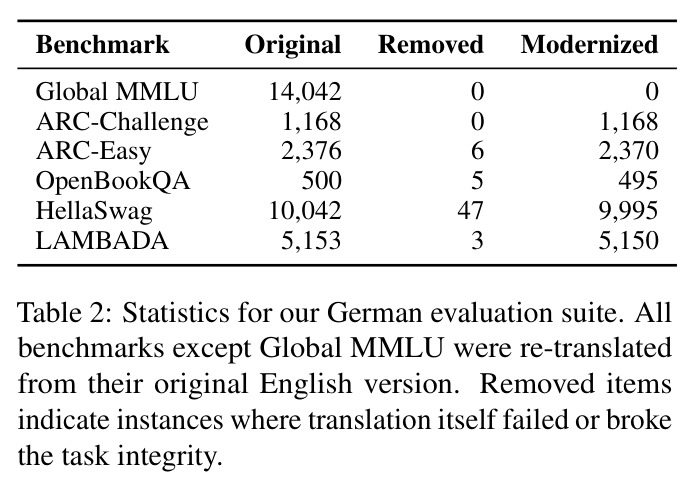
技术新颖性体现在三方面:第一,分层标签的设计把「教育质量」这一单一维度拆成「能否读懂—是否含事实—是否教科书式」三阶,从而第一次在德语上量化了每一层的边际收益;第二,作者把每条子集都训了专属 32k BPE,使 tokenizer fertility 从 RANDOM 子集的 1.49 降到 DENSE-CORE 的 1.32,证实了「分词器—语料」联合优化在非英语小语种上的额外收益;第三,他们发布了 5 张 A100 × 8 可复现的实验配方,并把评测基准中德语翻译缺陷系统性修复,使后续研究有干净的可比基线。
实验结果
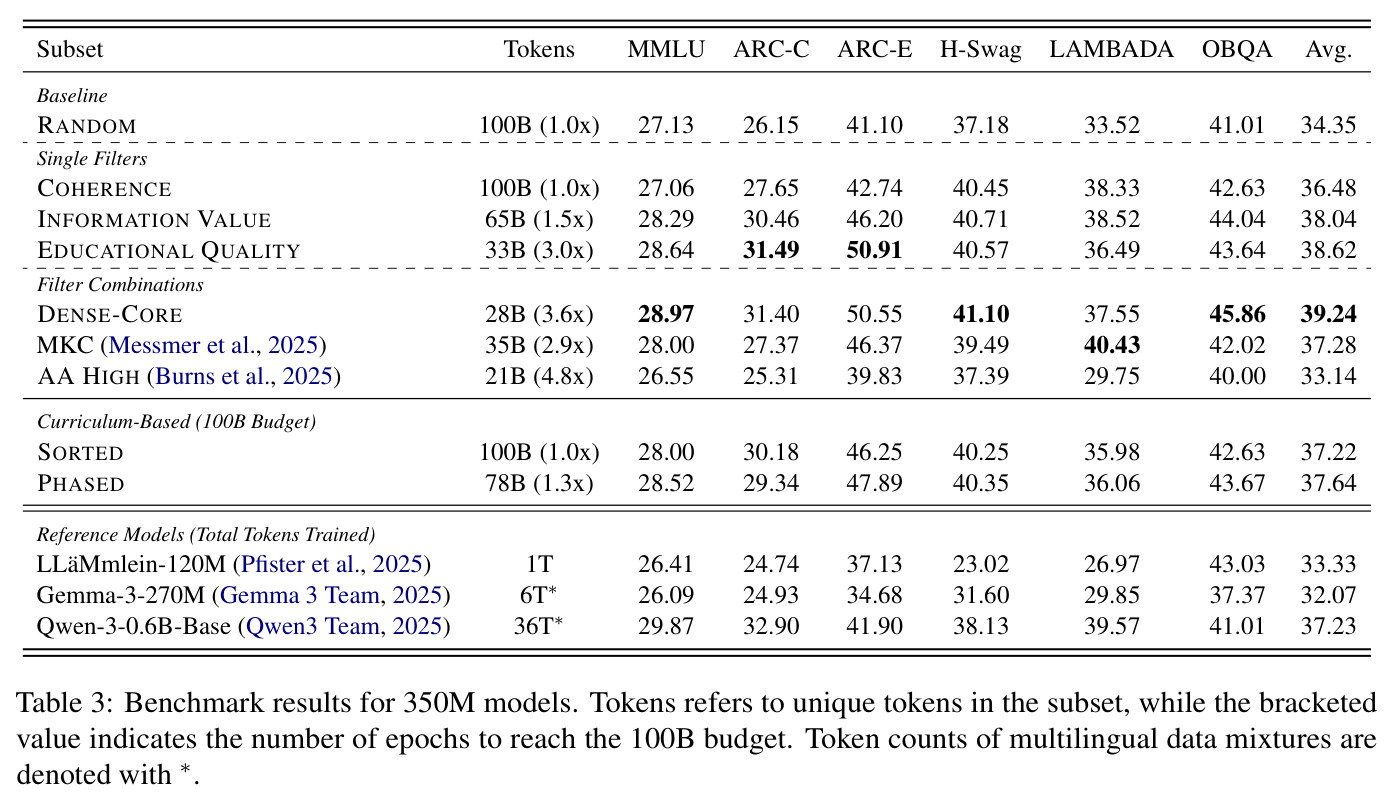
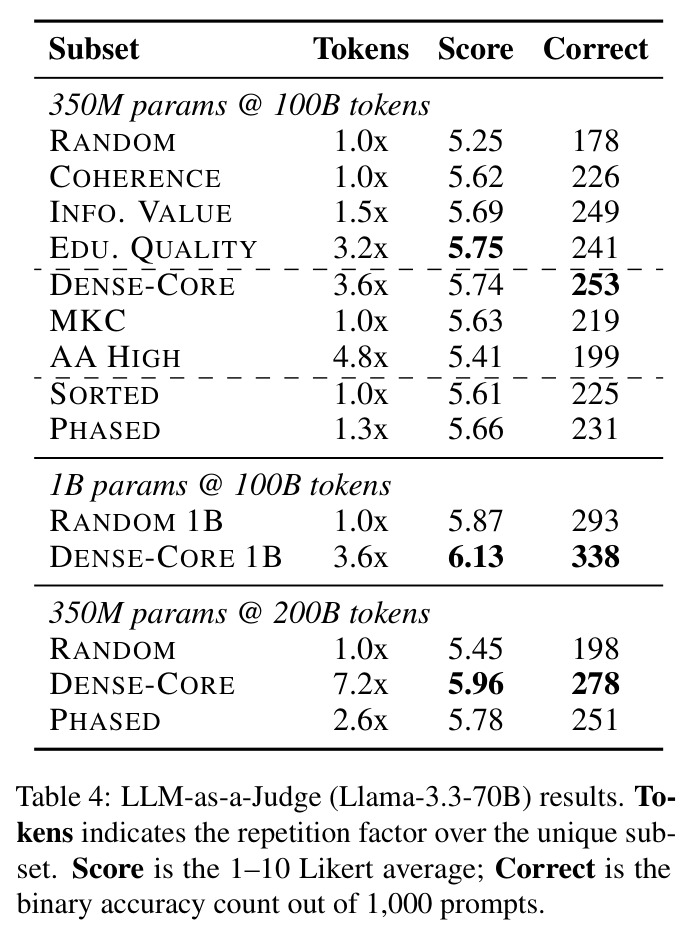
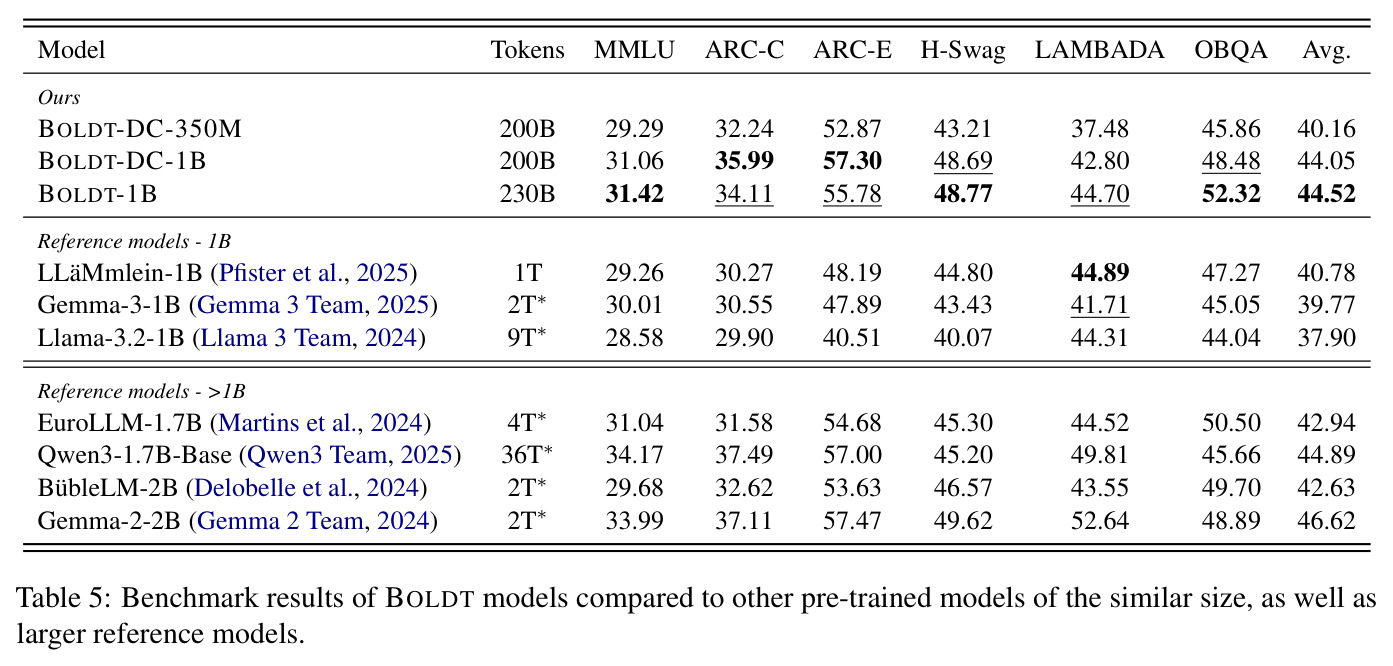
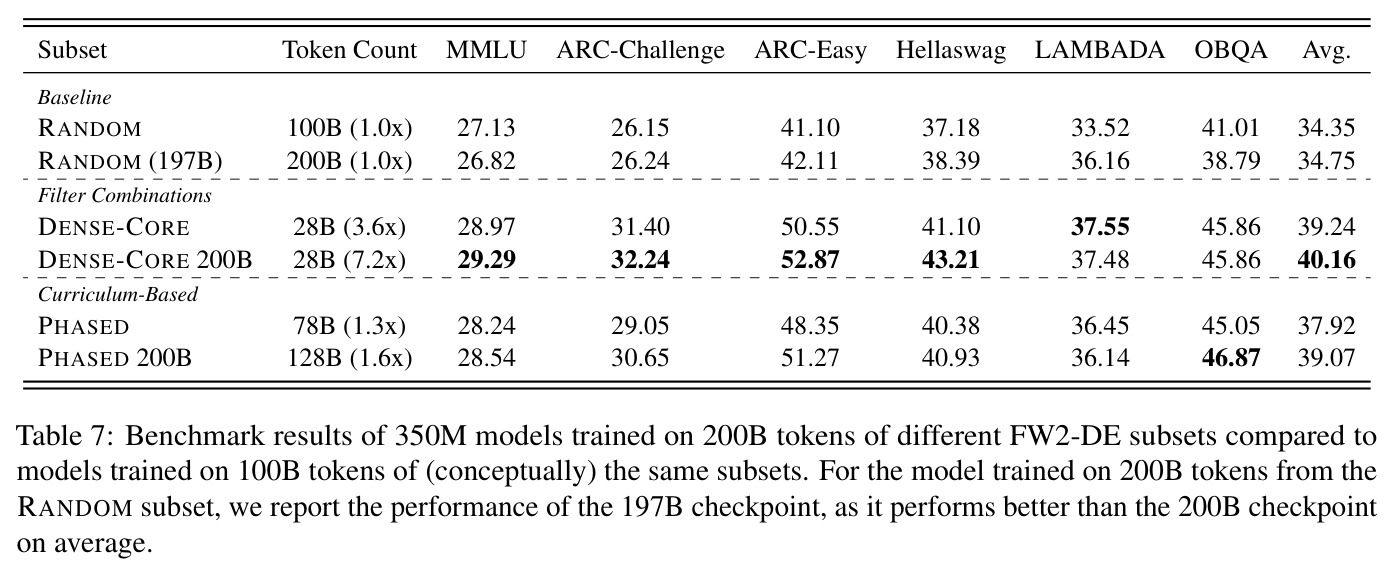
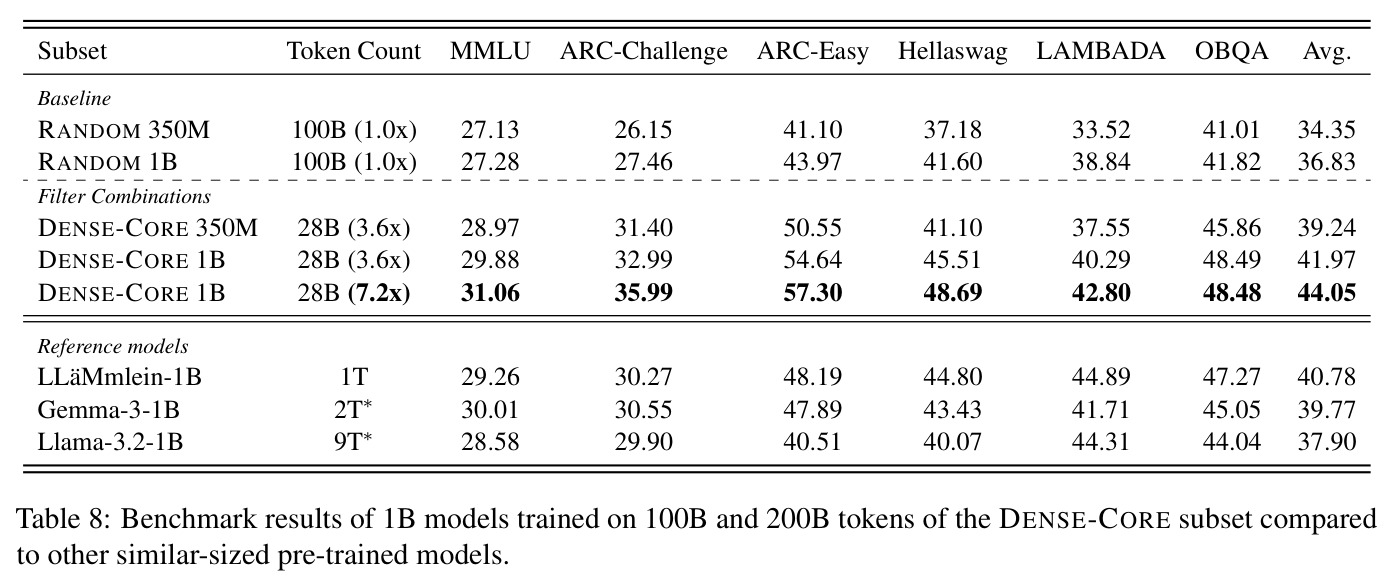
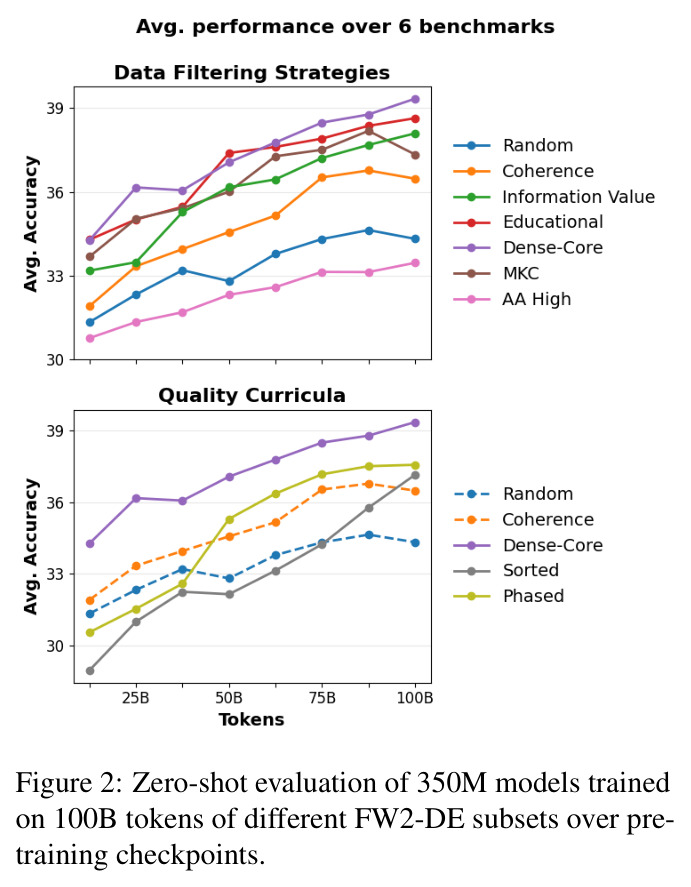
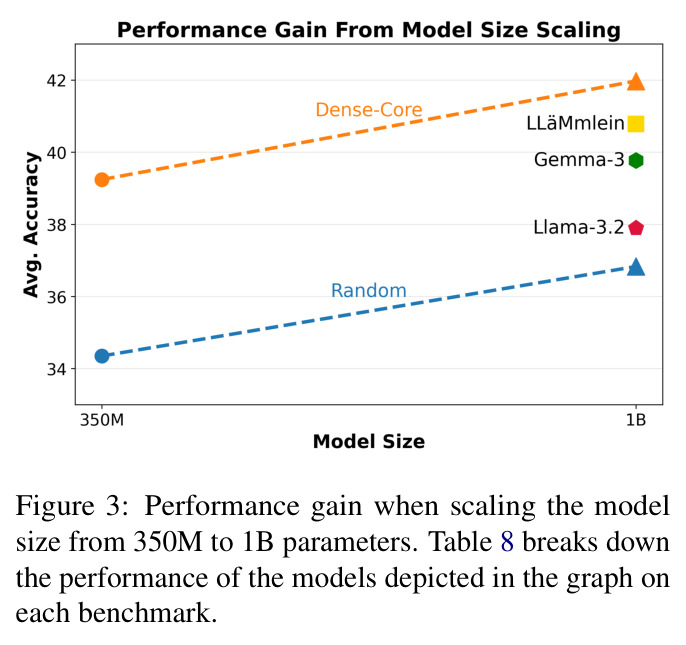
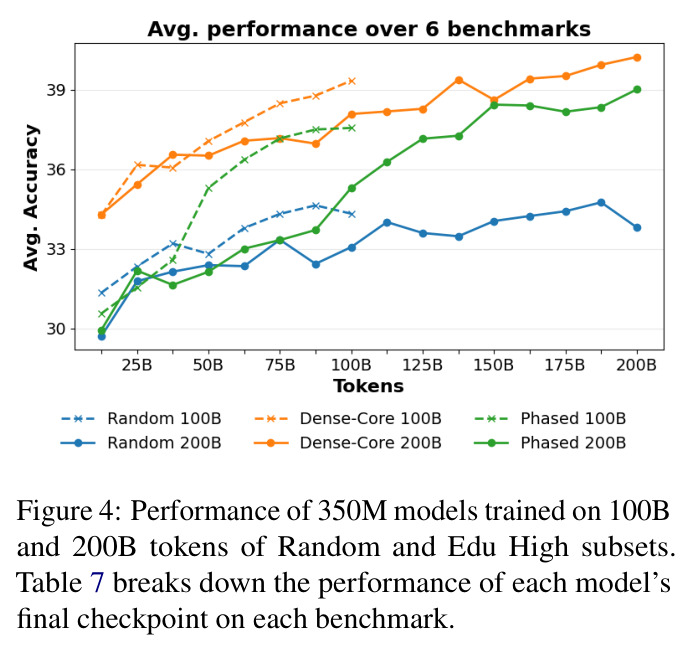
Table 3:350M、100B 预算下 DENSE-CORE(28B × 3.6 epoch)获 39.24 均值,比 RANDOM 34.35 高 4.89 分,亦超 Coherence(36.48)、Info Value(38.04)、Edu Quality(38.62)单层过滤。AA HIGH(21B × 4.8 epoch)仅 33.14 反低于 RANDOM,印证「多 epoch 只对真正高质量数据有效」。Table 5/8:1B 模型差距扩到 5.14 分(41.97 vs 36.83);1B 在 200B、7.2 epoch 下达 44.05,超 EuroLLM-1.7B(4T token,42.94)。Table 4:密度优势传导到 SFT——350M DENSE-CORE 1000 提示得 253 binary 正确(比 RANDOM 178 多 75);1B Likert 6.13 vs 5.87 同步上升。Table 7 反驳 4 epoch 拐点:3.6 epoch(39.24)→ 7.2 epoch(40.16)仍 +0.92;RANDOM 100B → 200B 仅 +0.4。
查看结构化数据
| 任务 | 指标 | 本文 | 基线 | 提升 |
|---|---|---|---|---|
| Global MMLU (DE) - 57 学科事实知识 | Acc. | 31.42 (BOLDT-1B) | 29.26 (LLäMmlein-1B, 1T tokens) | +2.16 / 约 5× 少 token |
| ARC-Challenge (DE) | Acc. | 35.99 (BOLDT-DC-1B, 200B × 7.2ep) | 29.90 (Llama-3.2-1B, 9T tokens) | +6.09 且用 ~45× 少 token |
| ARC-Easy (DE) | Acc. | 57.30 (BOLDT-DC-1B) | 47.89 (Gemma-3-1B, 2T tokens) | +9.41 |
| HellaSwag (DE) | Acc. | 48.77 (BOLDT-1B, 230B) | 44.80 (LLäMmlein-1B, 1T tokens) | +3.97 |
| LAMBADA (DE) | Acc. | 44.70 (BOLDT-1B) | 41.71 (Gemma-3-1B) | +2.99 |
| OpenBookQA (DE) | Acc. | 52.32 (BOLDT-1B) | 45.05 (Gemma-3-1B) | +7.27 |
| SFT 1000-prompt LLM-as-a-judge (1B) | Likert 1–10 | 6.13 (DENSE-CORE 1B, 3.6ep) | 5.87 (RANDOM 1B, 1.0ep) | +0.26 |
| SFT 1000-prompt LLM-as-a-judge (1B) | Binary Correct | 338/1000 | 293/1000 (RANDOM 1B) | +45 (相对 +15.4%) |
| 350M Random vs DENSE-CORE 均值 (100B budget) | Avg. of 6 benchmarks | 39.24 | 34.35 | +4.89 (+14.2%) |
局限与改进
作者明确声明的局限性:本文只测了德语一种语言,对汉语、日语等字符差异更大或语料更小的语言是否一致尚不清楚;模型规模上限 1B、token 上限 200B,远未触及工业级千亿 token、万卡预算,因此该结论在工业级是否存在收益拐点尚需验证;只研究了 Dense Transformer,未涉及 MoE 等替代架构;没有评估有害内容、人口统计偏见和 prompt 注入安全性——这一点尤其关键,因为多 epoch 重复有可能放大而不是缓解偏见。除此之外,评测采用单一 LLM-as-a-judge(Llama-3.3-70B),没有与人工评分或多评判模型取平均做敏感性分析;DENSE-CORE 只有 28B token,单调地加 7 epoch 后是否终将崩溃亦不明确。
独立分析的弱点
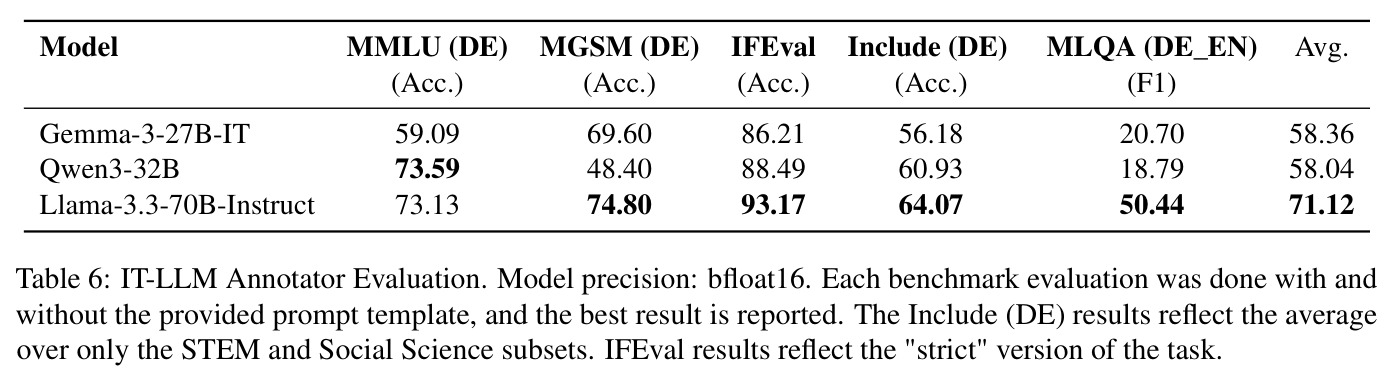
独立审视本文有以下值得改进之处。其一,三层过滤的标注均依赖 Llama-3.3-70B-Instruct,但论文 Table 6 显示其全球平均只有 71.12 分,意味着打标本身就带噪声——可以加入 RLHF 或多模型集成(gpt-4 + claude)以提高标签信噪比。其二,BPE 是每个子集单独训的,但这隐含了「测试时也用同一 tokenizer」——若改用统一词表,需要重新测 fertility,否则跨子集评测不公平;建议作者公开 vocabulary 与合并规则文件。其三,实验仅对比 RANDOM/COHERENCE/MKC/AA HIGH,未与 self-instruct 或 deduplication-by-embedding 等强基线比较,且没有 ablation「去掉任意一层过滤」对最终分数的独立贡献。其四,多 epoch 训练虽在 7 epoch 仍上升,但未做学习率 / dropout / 梯度裁剪随 epoch 衰减的鲁棒性测试,仍有过度依赖超参设置的嫌疑。
未来方向
作者明确把跨语言验证(法语、日语、汉语)列为下一步,同时呼吁对毒性、偏见进行系统性审计。基于成果我认为还有几条可延伸的方向:(1)把 DENSE-CORE 思路与 MoE 架构结合——专家路由天生偏好「不同数据」是否与高质量小集冲突,是有趣的实证问题;(2)把三层过滤改造成可学习的 RL 策略,让模型在训练过程中动态分配预算给「见过的 epoch 数 vs 新样本概率」,而不是固定先验 epoch;(3)将 DENSE-CORE 28B token 做 embedding 检索当成持续预训练语料,结合 instruction 后训练看是否能进一步压低算力到 10×10^6 FLOPs 量级;(4)探索把多 epoch 「重复」与 knowledge distillation / speculative decoding 联合,是否能在推理侧得到二阶收益。
复现评估
复现评估总体良好:作者承诺在 HuggingFace「Boldt」组织下开源 BOLDT-DC-350M、BOLDT-DC-1B、BOLDT-1B 与指令微调预览版,以及人工修复过的 6 张德语评测基准(Table 2)。预处理流水线明确给出标签 prompt(Figure 6–8)和超参(Appendix B),预训练在 8×A100 bf16 上单次训练以 200B token 约耗费数十到数百 GPU·天,是中小实验室力所能及的范围。仍存在复现难点:单次完整 200B 7-epoch DENSE-CORE 训练对显存、IO 要求很高,需分布式 checkpoint;评测依赖特定版本的 Eleuther Harness、lm-eval 与 vLLM,主版本漂移可能引入 ±0.5 分噪声;最后,LLM-as-a-judge 的随机种子和 prompt 在公开仓库中需要严格审查,避免误用 German 评分时仍触发默认英文 prompt 而导致分数虚高。
论文图表
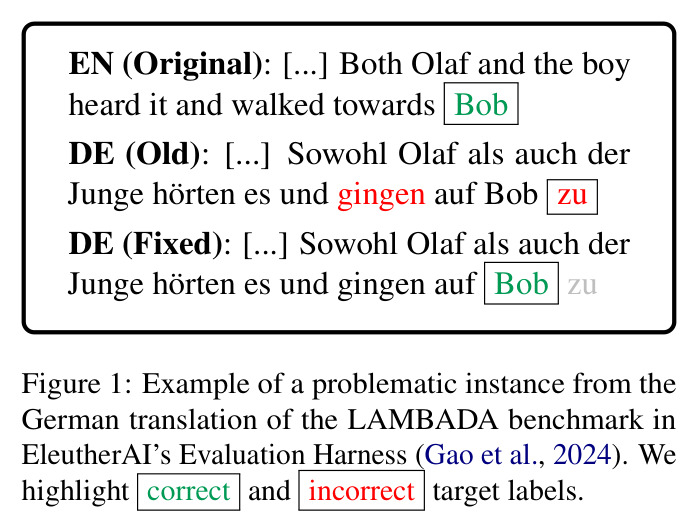
原文给出一句完成式任务的实例,英文版需要模型根据上下文预测句末实体 'Bob';德语旧翻译把句末词改成了动词变位 'zu',导致正确答案变到了句中两词之外,相当于把任务从「实体追踪」偷换成了「动词词尾预测」。
这是作者动机的关键证据之一:直接说明德语翻译基准存在「词序错位」会让原本的任务难度被无声地扭曲,也解释了他们为什么要重新翻译、清洗 6 张评测基准。
完整标注 prompt:先解释「信息价值」和「连贯性」分别是什么,列出 4 档 / 3 档评分标准,最后要求 LLM 在 100 词解释后给出 'Coherence score: X. Information value score: Y'。
这是方法可复现性的核心资产之一;任何想重建论文标签的人都必须照搬此 prompt,否则打分分布会偏移。
给 LLM-as-a-judge 的 1–10 评分模板,要求给出简短解释并以 'Rating: [[N]]' 的固定格式输出,明确要求英文作答、避免德语样本诱发语言偏差。
它对应 Table 4 中 5.62–6.13 的 Likert 分数,是指令微调阶段主结论的评分逻辑。
在 Figure 7 基础上追加「参考答案」段,要求模型对比助手答案与参考答案并以 '[[1]]' 或 '[[0]]' 输出正确性。
它是 Table 4 中「Correct」列的判定来源;了解 prompt 才知道作者为何平均正确数能从 178 升到 253。