记忆迁移学习:编码智能体中跨领域记忆如何迁移 Memory Transfer Learning: How Memories are Transferred Across Domains in Coding Agents
首次系统研究编码智能体在不同领域间迁移记忆的机制与规律,证明抽象的元知识是最有效的迁移载体,平均提升 3.7% 性能。
前置知识
基于记忆的自进化智能体 (Memory-based Self-Evolving Agents)
一类 LLM 智能体范式,它把过去的推理执行轨迹(命令、观察、奖励)存为'记忆',在后续任务中检索并复用其中的成功模式、失败教训或抽象洞察,从而在测试时无需再训练就能持续提升能力。代表性工作如 ReasoningBank、AgentKB、MemEvolve 等。
本论文的核心研究对象正是这类系统;理解它们的'记忆生成—检索—复用'闭环机制,是看懂本文做异构记忆池统一化、以及讨论四种记忆格式抽象度差异的前提。
迁移学习与非参数知识迁移 (Transfer Learning & Non-parametric Knowledge Transfer)
传统迁移学习利用参数化适配(fine-tune、adapter)将源域知识迁移到目标域;而非参数化迁移(如 in-context learning、agent 自身的 memory)则不改模型权重,仅在推理时通过上下文/记忆传递知识。本文研究的 MTL 属于后者——通过检索异构记忆实现跨域知识迁移。
本文借鉴传统迁移学习'源域—目标域'框架来分析编码任务间的迁移,并提出'抽象度—可迁移性'命题,这是连接迁移学习经典理论与现代智能体记忆系统的桥梁。
嵌入检索与相似度匹配 (Embedding-based Retrieval)
用文本嵌入模型(如 text-embedding-3-small)把任务和记忆都映射到向量空间,通过 cosine similarity 选出 top-N 最相关的记忆注入到系统 prompt。论文中所有检索都基于这种范式,并对比了 LLM 重排序、自适应改写等高级方法。
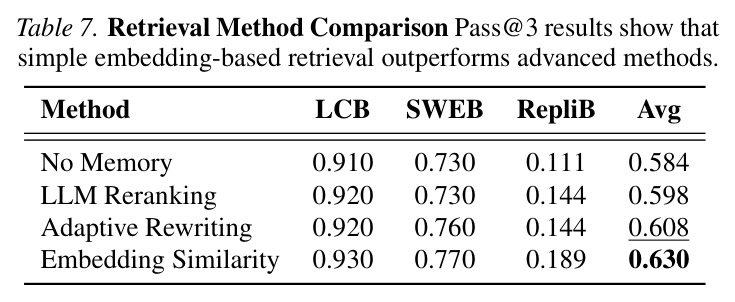
理解检索管线是看懂全文实验设计的基础——Table 7 的对比实验就揭示了简单嵌入检索在异构设置下反而优于复杂方法,这是论文的核心反直觉发现之一。
代码智能体与执行环境 (Coding Agents & Execution Environment)
基于 LLM 的、通过 bash、文件读写、调试等工具与代码仓库交互以完成任务的系统(如 mini-swe-agent、OpenHands)。它们共享 Linux shell、Python/R/C++ 运行时、跨文件依赖栈等底层基础设施,而这些共通层正是跨领域记忆可以被有效迁移的前提。
论文之所以能跨领域迁移,前提就是不同编码任务(竞赛编程、仓库级工程、ML 复现)共用同一执行栈;不了解这点就难以理解为什么 SWE-Bench 和 MLGym-Bench 的记忆可以互相帮助。
Pass@k 评测指标 (Pass@1 / Pass@3)
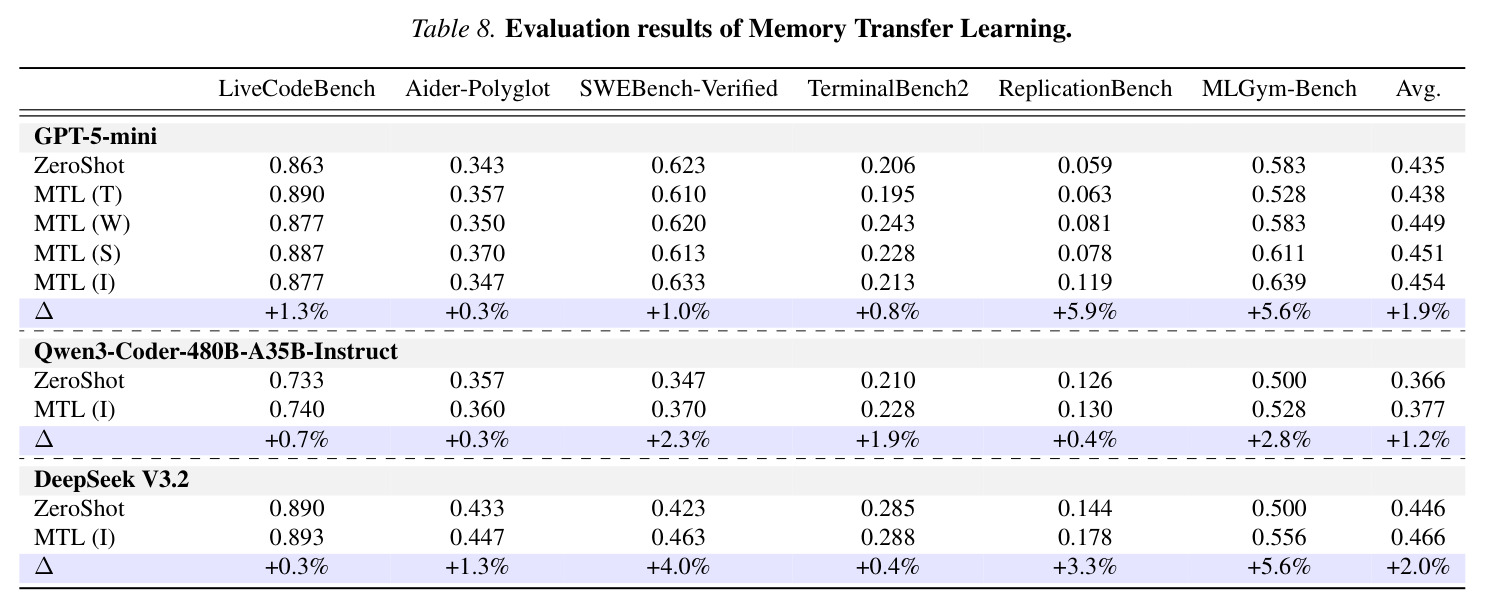
在编码任务中,让模型对每个问题采样 k 次(可用不同温度),只要有一次通过单元测试即视为成功。Pass@k 通常取多轮平均。论文主表用 Pass@3,附录 Table 8 给 Pass@1 数值。
懂 Pass@k 才知道论文里 0.910→0.940 看似小数点的差异在统计上稳健可信,这也是为什么每条结论都用三跑平均来报告。
研究动机
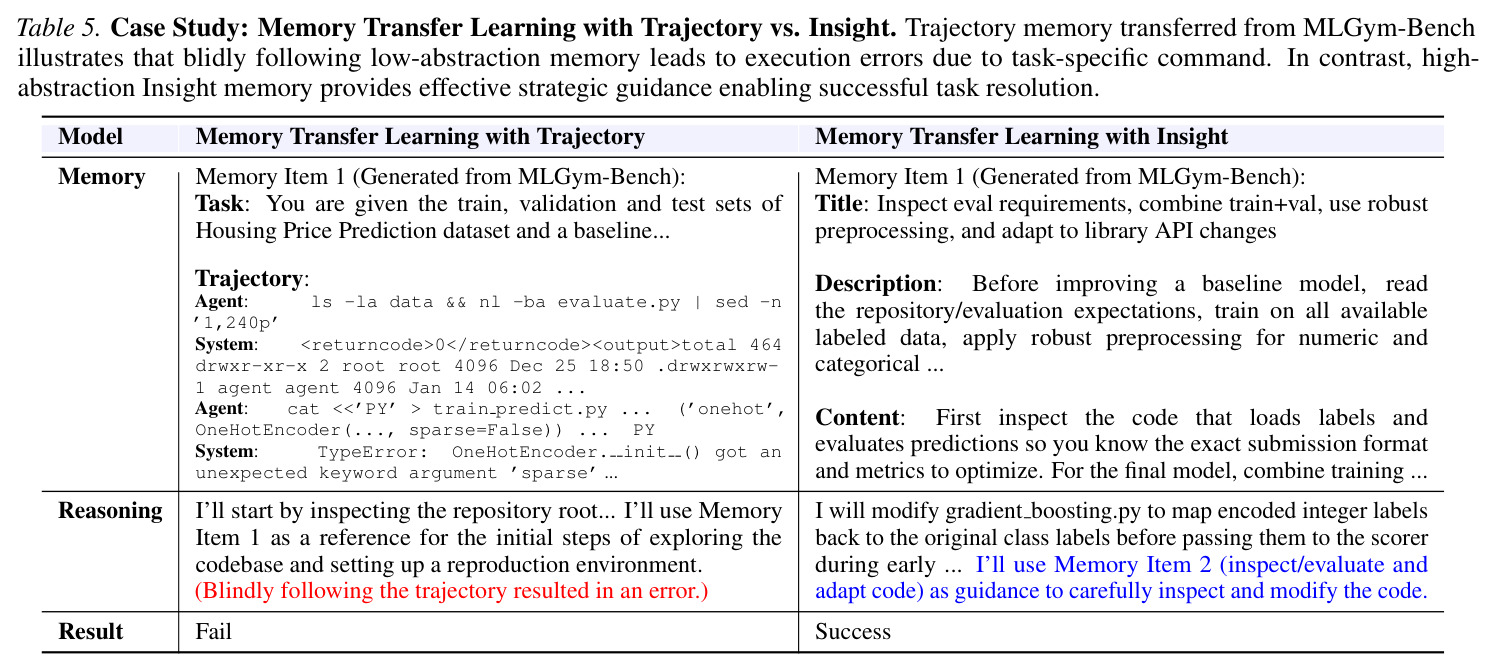
现有基于记忆的自进化编码智能体(如 ReasoningBank、AgentKB、MemEvolve)几乎都把记忆的产生和检索严格限制在同一领域、同一基准内——比如 SWE-Bench 上构建的记忆只用来解下一道 SWE 题。然而真实编码场景的领域跨度极大:函数级竞赛编程(LiveCodeBench、Aider Polyglot)、仓库级工程修复(SWE-Bench Verified、Terminal-Bench2)、科学论文代码复现(ReplicationBench)、ML 研究任务(MLGym-Bench)。这些任务虽然表面上很不一样,但底层共享 Linux shell、Python/C++ 运行时、依赖管理等基础设施。论文指出:当前方法'有意无意'地把记忆池'围栏化'在单一基准里,造成三大浪费——(1) 跨领域元知识(如安全写盘、最小补丁、断言验证)无法被新任务复用;(2) 即使 AgentKB 这种'跨任务'方案也只是塞入 5899 条噪声记忆却没做机制分析;(3) 检索到的低层命令级轨迹(Trajectory)经常把任务特定代码细节强加给风格/环境都不同的目标任务,反而引发负迁移。
本文的目标是本文的核心目标是对'编码智能体中的跨域记忆迁移学习'(Memory Transfer Learning, MTL)做第一次系统性、机制层面的实证研究,把异构领域中产生的记忆统一汇入一个共享记忆池,并在 6 个差异极大的编码基准上量化迁移效果,最终回答三大研究问题:RQ1 异构记忆能否提升编码智能体性能;RQ2 为什么迁移过来的记忆有用;RQ3 哪些因素决定迁移有效度。作者并不只是给一个 SOTA,而是想要建立一套'什么时候用、用什么格式、怎么检索'的设计原则。
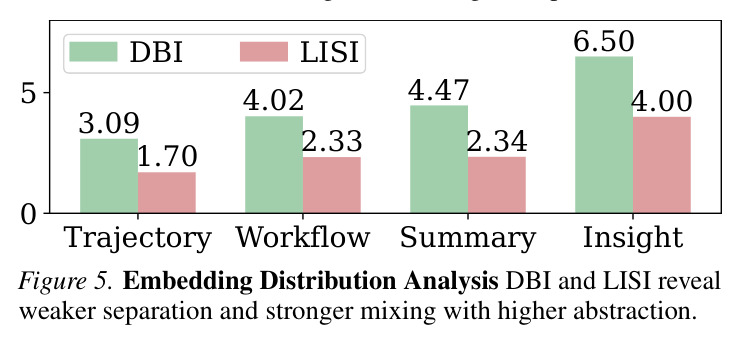
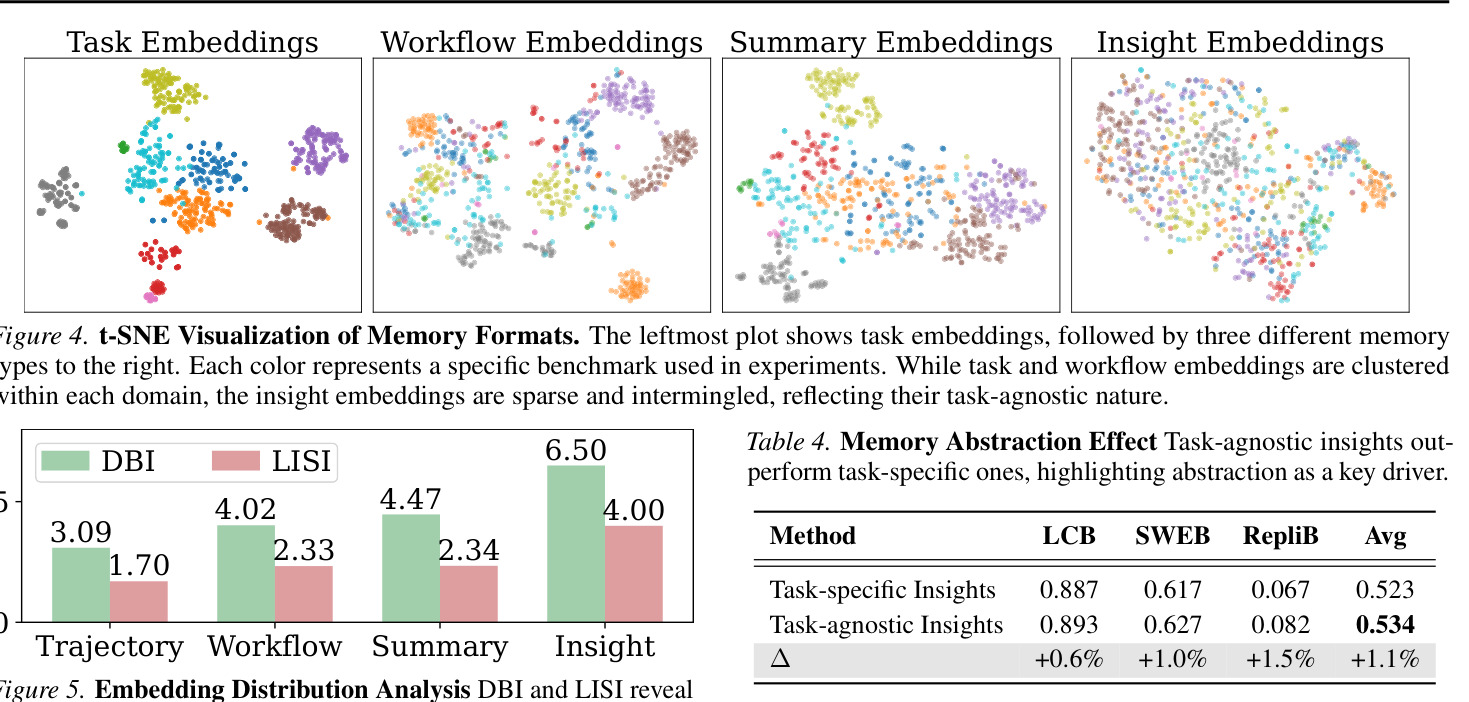
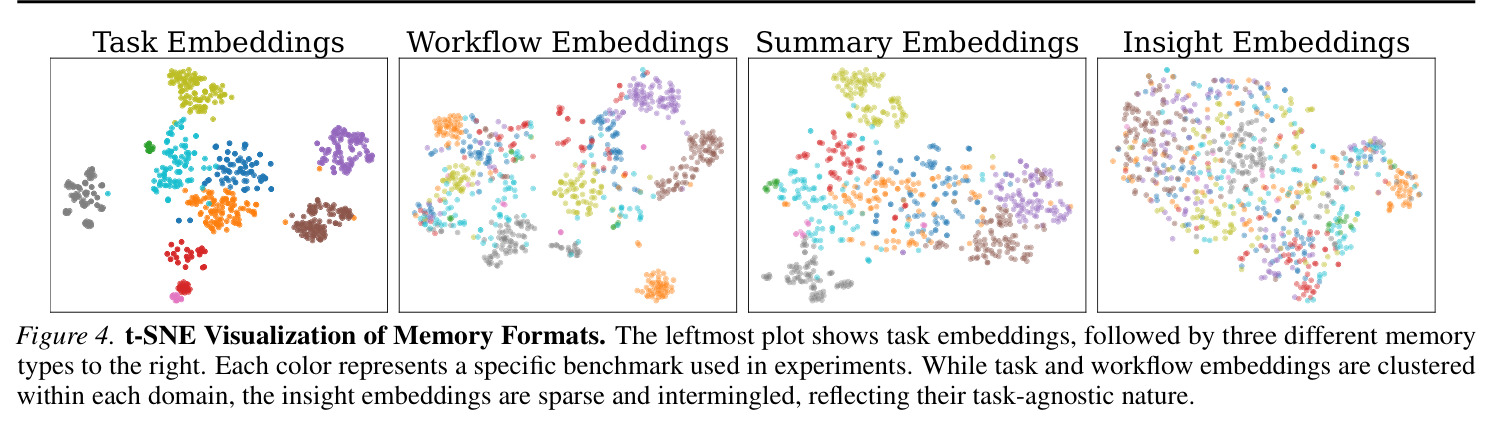
与已有工作不同的是,切入角度的独特性有两层:第一,把研究从'记忆库越大越好'转向'记忆池的领域构成和抽象度构成',用 DBI/LISI、t-SNE、命题 1 形式化模型给出量化结论;第二,本文是第一个系统拆解'高层洞察(Insight)vs 低层轨迹(Trajectory)'在跨域时表现差异的工作,并通过嵌入式聚类证明 Insight 嵌入几乎失去任务聚类结构——这比之前工作(如 AgentKB 简单堆记忆、ReasoningBank 只用同域 97 条记忆)都更精细。
核心方法
方法直觉很朴素:与其让每个基准各自维护一份记忆,不如把所有基准上跑出来的成功/失败轨迹都送进一个共享池,提取成四种抽象度递增的记忆格式(Trajectory→Workflow→Summary→Insight),离线索引好。在线推理时根据目标任务的嵌入相似度取出 top-3(也可以是 LLM 重排序或重写)注入系统 prompt。技术上设计为两阶段——离线'记忆生成'和在线'记忆检索'。生成阶段用 gpt-5-mini 当 LLM judge 判定每条轨迹成功/失败,再用专门 prompt 产出对应格式的记忆;检索阶段对每个 query 任务取出 top-3 嵌入最相似的记忆。整个评估在 6 个基准 × 3 个底座模型(GPT-5-mini/DeepSeek V3.2/Qwen3-Coder-480B)上进行,并引入领域排除(leave-one-benchmark-out)的记忆池构造,保证没有数据泄露。
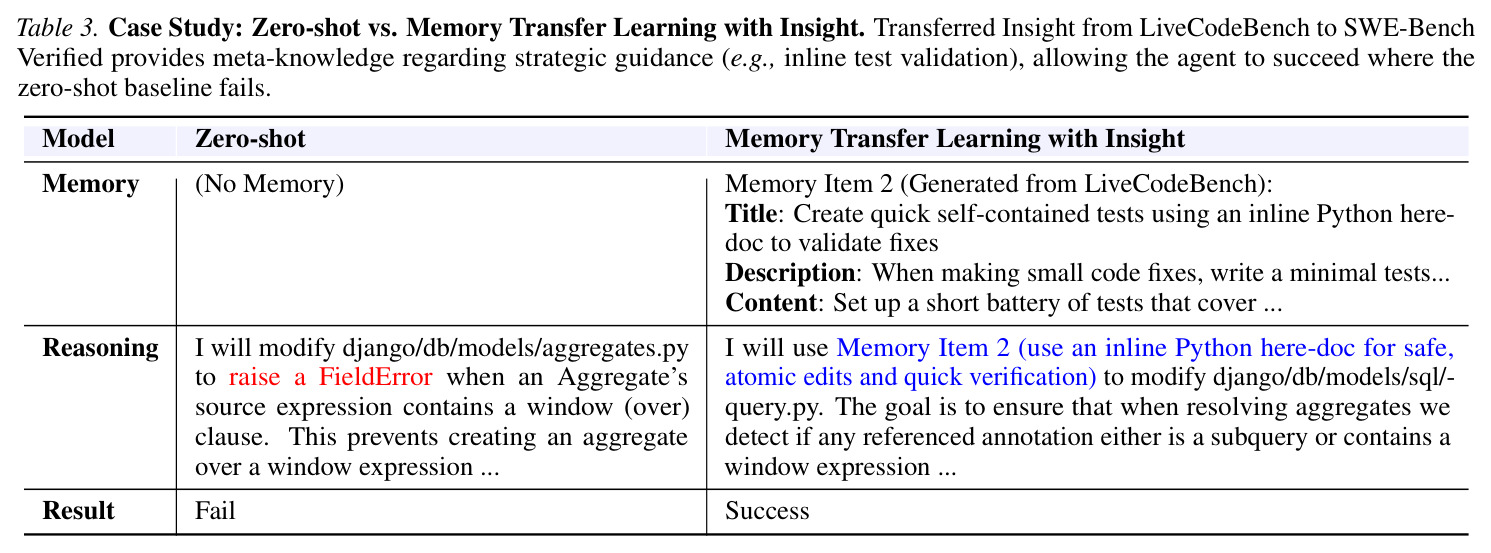
核心创新在于把'记忆抽象度'作为一个独立可控的变量进行端到端实验,而不是把它当成一个固定超参。具体说,本文的 MTL 让跨领域记忆可以'跨任务边界'流动的同时,量化了'越抽象越能迁移'的规律:Insight 这种 title-description-content 三段式、且在 prompt 里就显式禁止提及具体文件名的高层知识,比照搬原命令的 Trajectory 在 6 个基准上平均高出 6 个百分点(0.560 vs 0.534),且在最容易负迁移的 MLGym-Bench(零样本 0.667→Trajectory 0.583 退化;Insight 反过来升到 0.750)上差异最显著。这与已有 AgentKB'量取胜'和 ReasoningBank'域内取胜'思路形成鲜明对比。
方法步骤详情
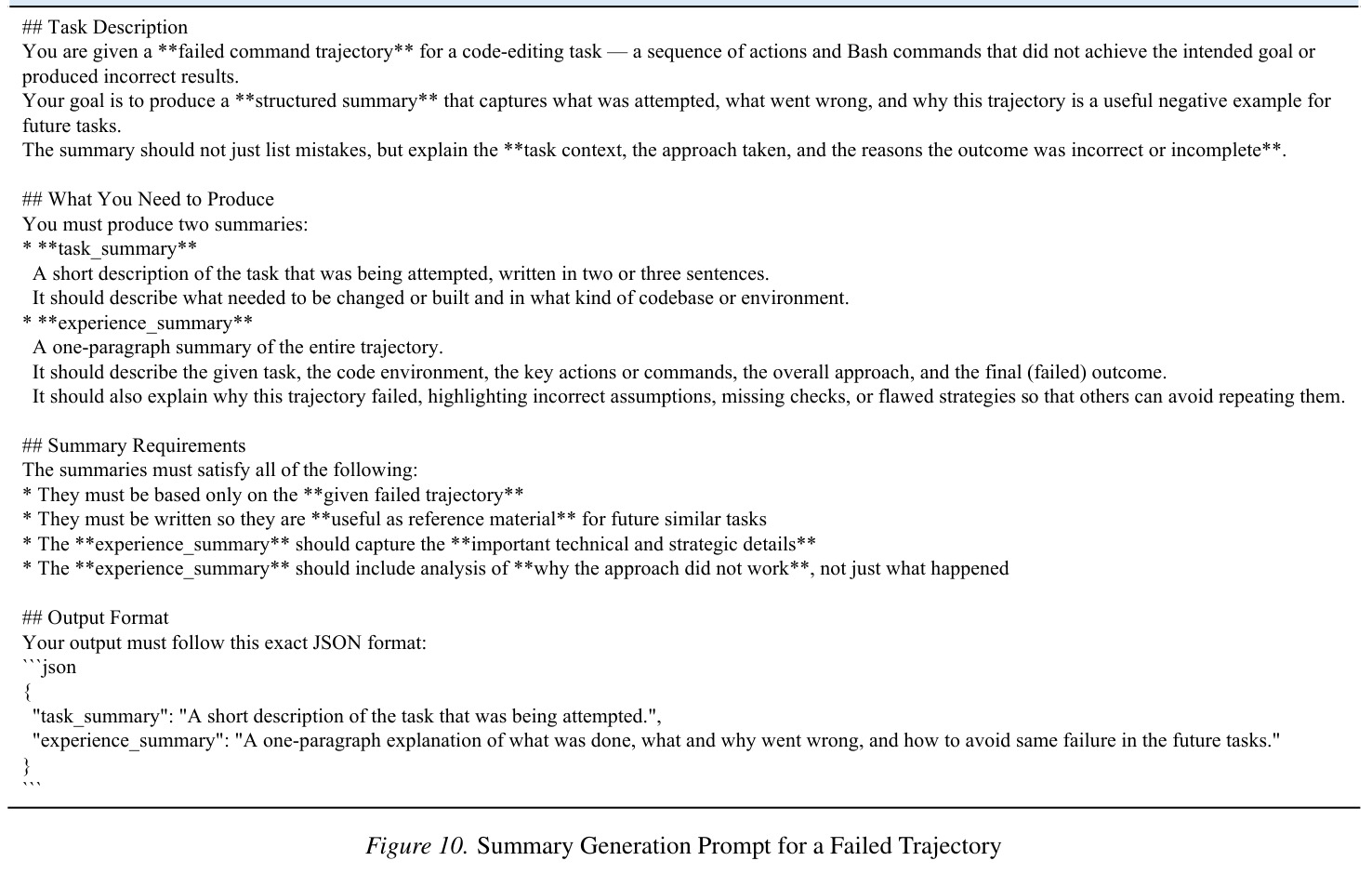
完整 pipeline 包括:(1) 全基准推理——先用 mini-swe-agent 在 6 个基准上跑一遍收集完整轨迹 H=(t, [(r₁,a₁,o₁),...(rₙ,aₙ,oₙ)]);(2) 成功/失败判定——用 LLM judge 区分轨迹,如果成功就把整段轨迹当成原料,失败也保留以提取反例;(3) 四格式记忆生成——Trajectory 直接拼 (a,o) 对;Workflow 用 prompt 抽'goal+可复用动作序列';Summary 生成'任务摘要+经验段';Insight 生成 (title, description, content) 三段且 content 必须 task-agnostic;(4) 异构记忆池构造——对目标基准 Bᵢ,记忆池 P_τ(Bᵢ) = {M_τ^(k) | t^(k) ∉ Bᵢ},即包含除本基准外所有来源任务的同格式记忆;(5) 嵌入索引——用 text-embedding-3-small 把每条记忆的 task 信息(Trajectory)或计划(Workflow/Summary/Insight)编码成向量存库;(6) 在线检索——对当前 query 任务生成嵌入(Trajectory 用任务嵌入;其余三种用 LLM 写 4-5 句任务计划再嵌入),取 cosine top-3 注入 mini-swe-agent 的系统 prompt;(7) 评测——同 Benchmark 跑三遍报告 Pass@3。
技术新颖性
技术新颖性主要体现在三方面:(a) 抽象度作为显式自变量——论文不是设计一种新记忆格式,而是把现有四种格式排在一个抽象度光谱上系统比较,并通过'将同一格式按 task-specific 度再切两半'进一步剥离'格式 vs 抽象度'两个变量,得出即使 Insight 内部 task-agnostic 子集也比 task-specific 子集高 1.1%;(b) 异构记忆池的 leave-one-out 构造——比 AgentKB 那种扁平堆叠更严谨,避免数据泄露;(c) 形式化建模——附录 C 把每条记忆嵌入分解为 z_inv(域不变元知识)+z_sp(领域特定),定义抽象度 A=∥z_inv∥²/(∥z_inv∥²+∥z_sp∥²),并证明命题 1:在嵌入范数有界假设下,期望迁移收益随 A 严格递增。这把工程经验转化成了可证伪的理论。
实验结果
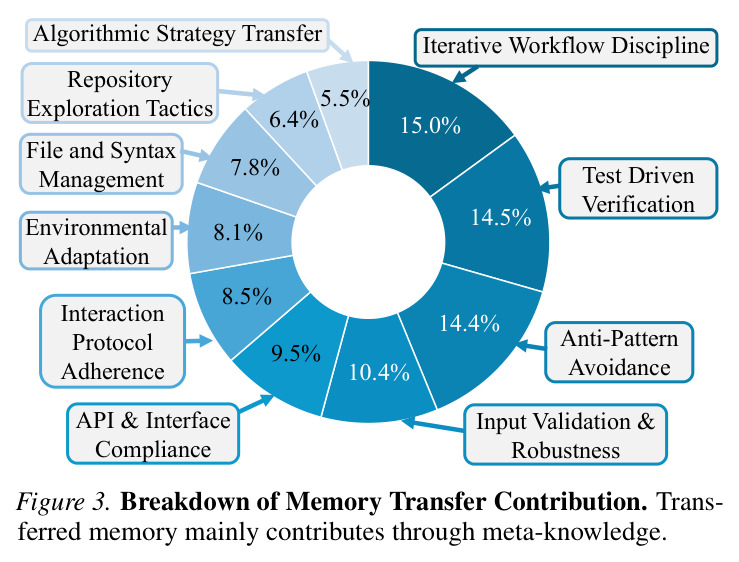
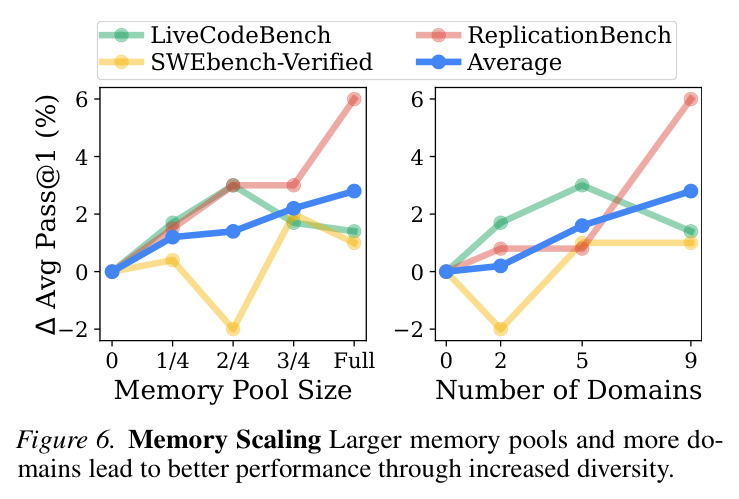
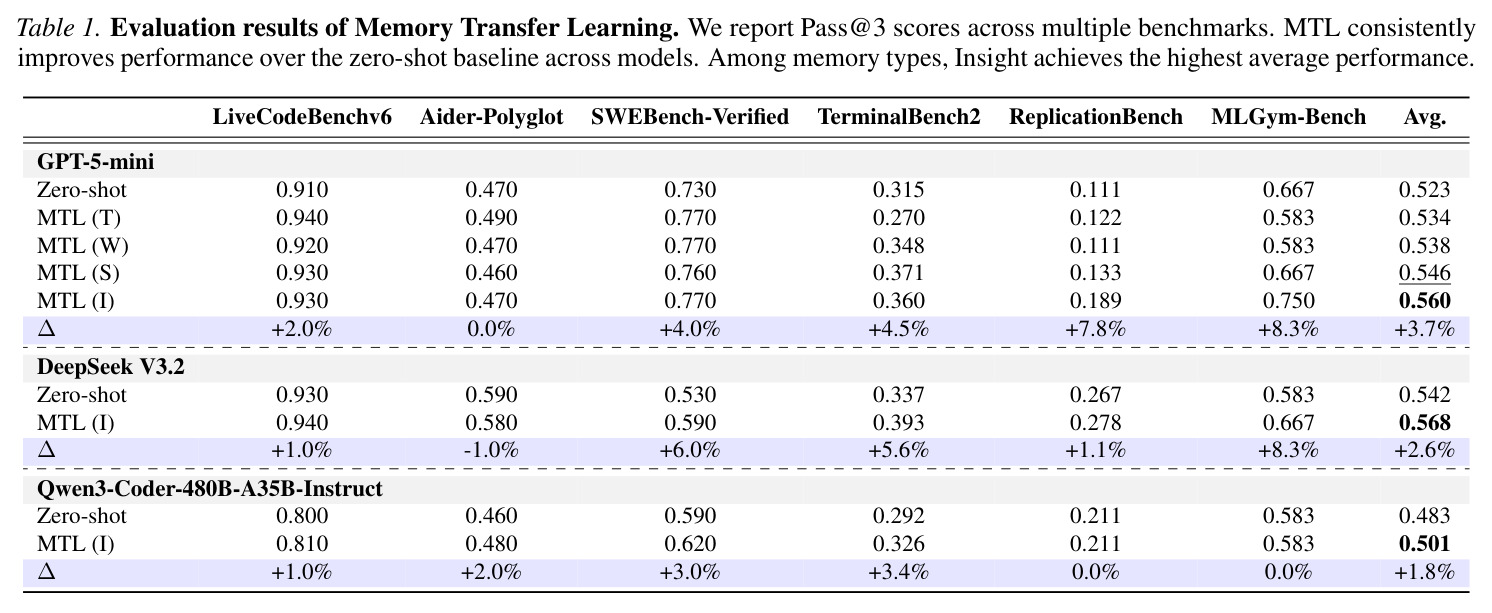
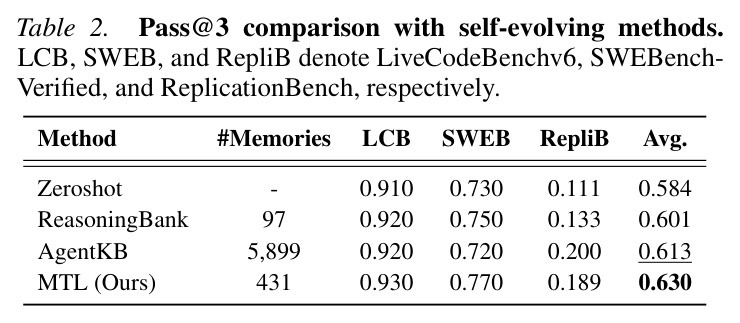
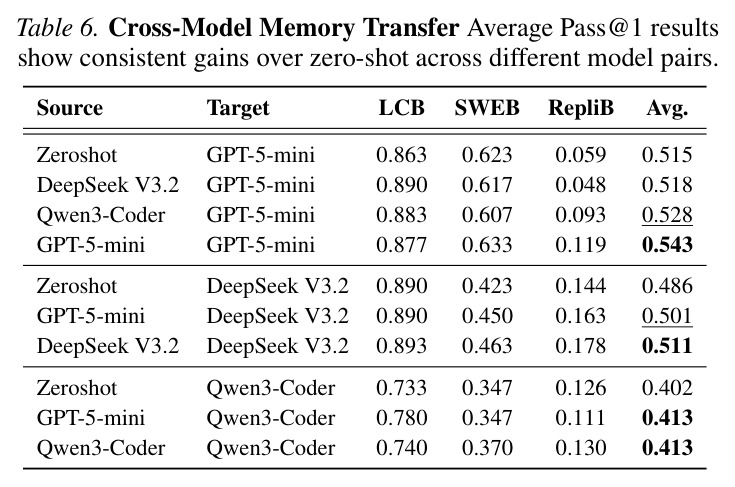
在 6 个基准 × 3 模型 = 主表 1 的系统评测中,MTL 用 Insight 时在 GPT-5-mini 上平均比 zero-shot 提升 3.7%(从 0.523 到 0.560),其中 MLGym-Bench 升 8.3%(0.667→0.750)、ReplicationBench 升 7.8%(0.111→0.189)、Terminal-Bench2 升 4.5%、SWE-Bench Verified 升 4.0%,但 LiveCodeBench v6 和 Aider-Polyglot 上几乎持平。迁移有效性随抽象度梯度递增——Insight(0.560) > Summary(0.546) > Workflow(0.538) > Trajectory(0.534),且在最容易出现负迁移的 MLGym-Bench 上 Insight 反向把 Trajectory 的'反向坑'(0.583 < 0.667 退化 12.6%)逆转成正收益,说明抽象度比格式本身更重要。Table 2 的自进化基线对比更说服力:MTL 仅用 431 条记忆,平均 0.630 超过 AgentKB(5899 条记忆、0.613)和 ReasoningBank(97 条记忆、0.601)分别 +1.7% 和 +2.9%。Figure 6 的池规模/领域数消融显示,把记忆池从 1/4 扩到 Full(或从 2 个域扩到 9 个域)时平均分单调上升。Table 6 的跨模型迁移说明:GPT-5-mini 生成的记忆喂给 DeepSeek V3.2 仍能比 zero-shot 高 +1.5%,反向也行,证明被迁移的是模型无关的元知识。Table 4 把 Insight 内部按'可否反推原任务'切成任务特定 vs 任务无关两组,任务无关组仍稳定胜出(平均 0.534 vs 0.523),进一步剥离'格式'的混杂因素。Figure 3 把贡献拆成 10 类(迭代工作流纪律 15.0%、探索策略 14.5%、测试驱动验证 14.4%、交互协议 10.4%、API 合规 8.5%、环境适配 8.1%、文件语法 7.8%、反模式回避 9.5%、输入校验 5.5%、算法策略 5.5%),可见元过程类贡献合计 ~80%,而直接的算法策略只占 5.5%,有力支持'MTL 迁移的是元知识不是算法本身'的核心论断。
查看结构化数据
| 任务 | 指标 | 本文 | 基线 | 提升 |
|---|---|---|---|---|
| LiveCodeBench v6 (函数级竞赛编程) | Pass@3 | MTL(Insight) = 0.930 | Zero-shot = 0.910 | +2.0% |
| Aider-Polyglot (函数级多语言编程) | Pass@3 | MTL(Insight) = 0.470 | Zero-shot = 0.470 | 0.0%(无增益,函数级任务本身已接近上限) |
| SWE-Bench Verified (仓库级真实 GitHub Issue) | Pass@3 | MTL(Insight) = 0.770 | Zero-shot = 0.730 | +4.0% |
| Terminal-Bench2 (命令行长链路任务) | Pass@3 | MTL(Insight) = 0.360 | Zero-shot = 0.315 | +4.5% |
| ReplicationBench (科学论文代码复现) | Pass@3 | MTL(Insight) = 0.189 | Zero-shot = 0.111 | +7.8%(绝对提升最显著基准之一) |
| MLGym-Bench (ML 研究任务代理) | Pass@3 | MTL(Insight) = 0.750 | Zero-shot = 0.667 | +8.3%(单基准最大提升) |
| 对比自进化方法(AgentKB / ReasoningBank) | Pass@3 平均(LCB+SWEB+RepliB) | MTL = 0.630(431 条记忆) | AgentKB = 0.613(5899 条)/ ReasoningBank = 0.601(97 条) | vs AgentKB +1.7%、vs ReasoningBank +2.9% |
| DeepSeek V3.2 跨模型兼容性 | Pass@3 平均 | MTL(I) = 0.568 | Zero-shot = 0.542 | +2.6% |
| Qwen3-Coder 跨模型兼容性 | Pass@3 平均 | MTL(I) = 0.501 | Zero-shot = 0.483 | +1.8% |
| 抽象度隔离实验(同 Insight 内 task-agnostic vs task-specific) | Pass@3 平均 | Task-agnostic Insights = 0.534 | Task-specific Insights = 0.523 | +1.1%(证明抽象度本身是迁移驱动因素) |
局限与改进
作者承认的局限主要有两点:(1) 当某些基准(如 LiveCodeBench v6、Aider-Polyglot)在零样本上已经接近上限(如 0.91、0.47 的天花板效应)时,MTL 的增益空间被压扁,方法优势难以体现;(2) Table 7 揭示在异构设置里先进的检索方法(LLM 重排、自适应改写)反而不如简单嵌入检索,说明静态检索设计无法应对智能体在多步推理中的动态需要——这是开放问题。我自己额外观察三点:(a) 主表 Pass@3 但附录 Pass@1 也有规模类似改善但绝对值明显更低,说明单样本下 MTL 优势仍然有效;(b) LiveCodeBench 上 Trajectory 反而得到最高 Pass@3 (0.940),与 Insight 几乎打平,提示在高度函数化、极少环境交互的任务上低层细节也能用;(c) 跨模型迁移虽然有效但始终小幅低于自生成记忆(附录 Table 6 GPT5 记忆用在 GPT5 上 0.543 vs 用于其他模型最多 0.528),说明模型特定偏差仍存在,论文没深挖;(d) 所有实验都基于 gpt-5-mini 一个 LLM judge 去标注成功/失败,存在 judge 偏差传导到记忆质量的风险。
独立分析的弱点
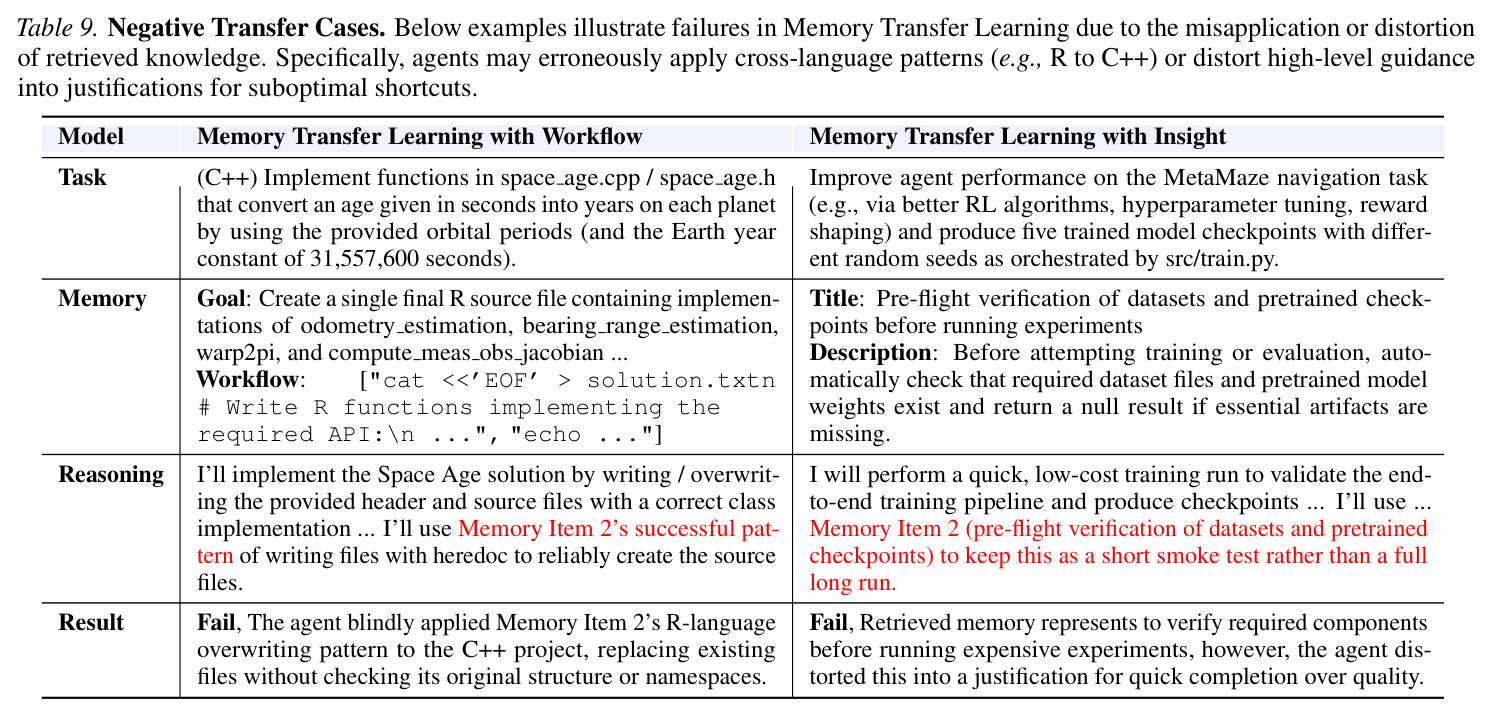
独立分析几个值得改进的弱点:(1) 检索管线静态——目前 top-3 是在任务最开始一次性注入的,但论文 Table 5/Table 9 的案例都展示出'步骤级误导'(如在第 N 步才发现匹配错环境),未来可引入 step-wise dynamic retrieval,根据当前执行上下文实时更新;(2) 负迁移检测缺失——AgentKB 那种堆叠 5899 条记忆时显然噪声很多,但 MTL 没有内置检测/降权机制,应该引入打分或拒答模块,自适应决定是否使用某条记忆;(3) 评测覆盖偏差——6 个基准里只有 SWE-Bench Verified 和 Terminal-Bench2 是真正仓库级长链路,MLGym/ReplicationBench 又有各自领域特殊性,未来应加入 multi-turn editing、cross-file refactor、CI-failure fix 等更日常的工程场景;(4) 记忆编码依赖 LLM judge,对小模型不友好——如果部署到 Qwen3-Coder 这种本地部署场景,昂贵 gpt-5-mini 调用就是瓶颈;(5) 缺乏理论保证——附录 C 命题 1 假设嵌入'范数有界',但真实 embedding 模型不一定满足,且没用真实数据验证该命题是否与实际迁移收益相关。改进方向可考虑:用 ReMe 的 memory refinement 做动态改写;引入 self-consistency 判断拒绝有害记忆;构建 benchmark-of-memory-quality 评测集;用蒸馏把 gpt-5-mini 的 judge 换成 7B 本地模型。
未来方向
作者在 Conclusion 给出的延伸方向包括:(1) 把 MTL 从编码智能体推广到通用 agentic memory;(2) 研究更鲁棒的检索/适配模块,避免负迁移;(3) 探索系统级记忆演化框架(与 MemEvolve 结合)。基于成果还可延伸:(a) 把元知识聚类为'通用 SOP 库'(验证流、错误恢复、最小补丁、安全文件操作 4 类),做成可即插即用的元模式工具集;(b) 引入 persona-conditioned memory——让同一类记忆对不同抽象度的目标智能体(如规划强 vs 编码强)选择性呈现;(c) 与 self-rewarding / RLVR 结合,让检索成功率作为反馈训练记忆优选器;(d) 把 MTL 与 web agent、GUI agent 记忆池做成统一跨模态 memory bus,研究'领域迁移性'在文本/视觉/代码三栖上的统一度量;(e) 探索 memory-to-memory distillation,让一个智能体的高速记忆通过教师-学生压缩到另一模型中。
复现评估
复现评估:作者在 https://memorytransfer.github.io/ 提供主页,但正文及 README 范围内未明确给出代码仓地址(论文未声明正式开源仓库)。实验依赖方面:(1) 模型——gpt-5-mini、DeepSeek V3.2、Qwen3-Coder-480B-A35B-Instruct 均为公开 API/权重;(2) 框架——mini-swe-agent 作为 coding agent、harbor 作为评测平台、text-embedding-3-small 作为嵌入模型,这三者都是 github 开源;(3) 数据——6 个基准(LiveCodeBench v6、Aider Polyglot、SWE-Bench Verified、Terminal-Bench2、ReplicationBench、MLGym-Bench)均公开可下;(4) 算力——每个基准 100 个 sample,三跑平均,总任务量 6×100×3=1800 次推理 × 加上记忆生成约 4 倍轨迹 ≈ 7200 次 LLM 调用,按 GPT-5-mini 价计约数十美元量级,可见中小实验室就能复现;(5) 实现难度——prompt 模板(Appendix E 完整给出)可逐字复现;memory pool 构造、leave-one-out 切分、DBI/LISI 评估指标都是标准做法。整体复现门槛中等偏低,主要风险在于 LLM judge 可能因 API 升级而出现判定不一致。
论文图表
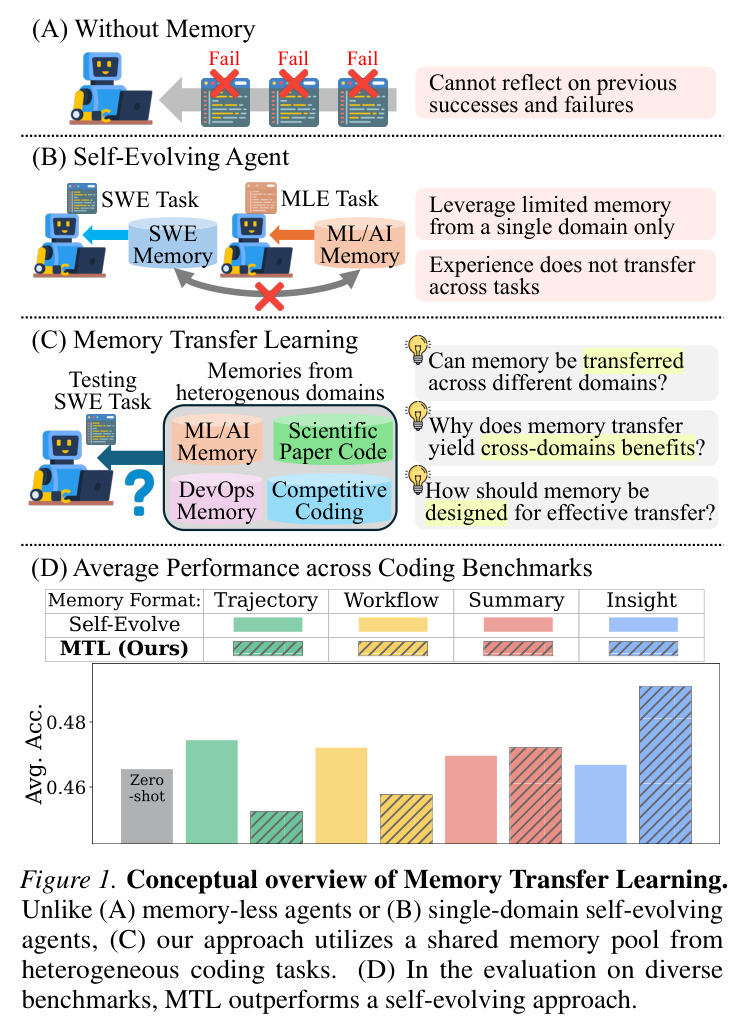
四面板对比图:(A) 'Without Memory'面板显示无记忆智能体在 SWE/MLE 任务上反复失败、无法从过往经验反思;(B) 'Self-Evolving Agent'展示传统单域自进化智能体,每个任务维护自己领域的 Memory,三种任务(Testing/SWE/ML)互相不共享;(C) 'Memory Transfer Learning'面板展示本文提出把异构领域记忆(Testing/SWE/ML/Scientific/Paper Code/DevOps/Competitive Coding)汇入共享池;(D) 柱状对比各方法的平均性能,MTL 显著高于基线。
这张图是整篇论文的核心动机图,把'为什么需要跨域记忆'用对比方式直观呈现出来,几乎所有章节都会回扣到这四张子图,特别是 introduction、motivation 和 method 部分会反复引用。
Figure 3 那个饼图对应的 10 个 category 详细定义表:迭代工作流纪律、算法策略、测试驱动验证、环境适配、反模式避免、输入校验、API 合规、交互协议、文件语法、仓库探索,每类给出定义和触发语境。
为 Figure 3 提供文字版的可机读 schema,是后续 reuse 该分析框架的人需要的资料。