GameWorld:迈向多模态游戏智能体的标准化与可验证评估 GameWorld: Towards Standardized and Verifiable Evaluation of Multimodal Game Agents
首个浏览器环境内、支持18个模型接口对、覆盖34款游戏170个任务的标准化可复现游戏智能体基准。
前置知识
MLLM(多模态大语言模型)
多模态大语言模型指同时处理图像、文本乃至音频输入并生成文本或工具调用输出的基础模型,例如 GPT-5.2、Claude-Sonnet-4.6、Gemini-3-Flash 等。其内部通常以视觉编码器+语言模型的耦合架构实现图文交错推理,本文所有被测智能体都基于此类模型。
GameWorld 直接以 MLLM 作为游戏智能体的「大脑」,因此读者需要先了解模型如何把截图当作观察并通过函数调用(function calling / tool use)输出动作,否则无法理解 Computer-Use 与 Generalist 两种接口差异。
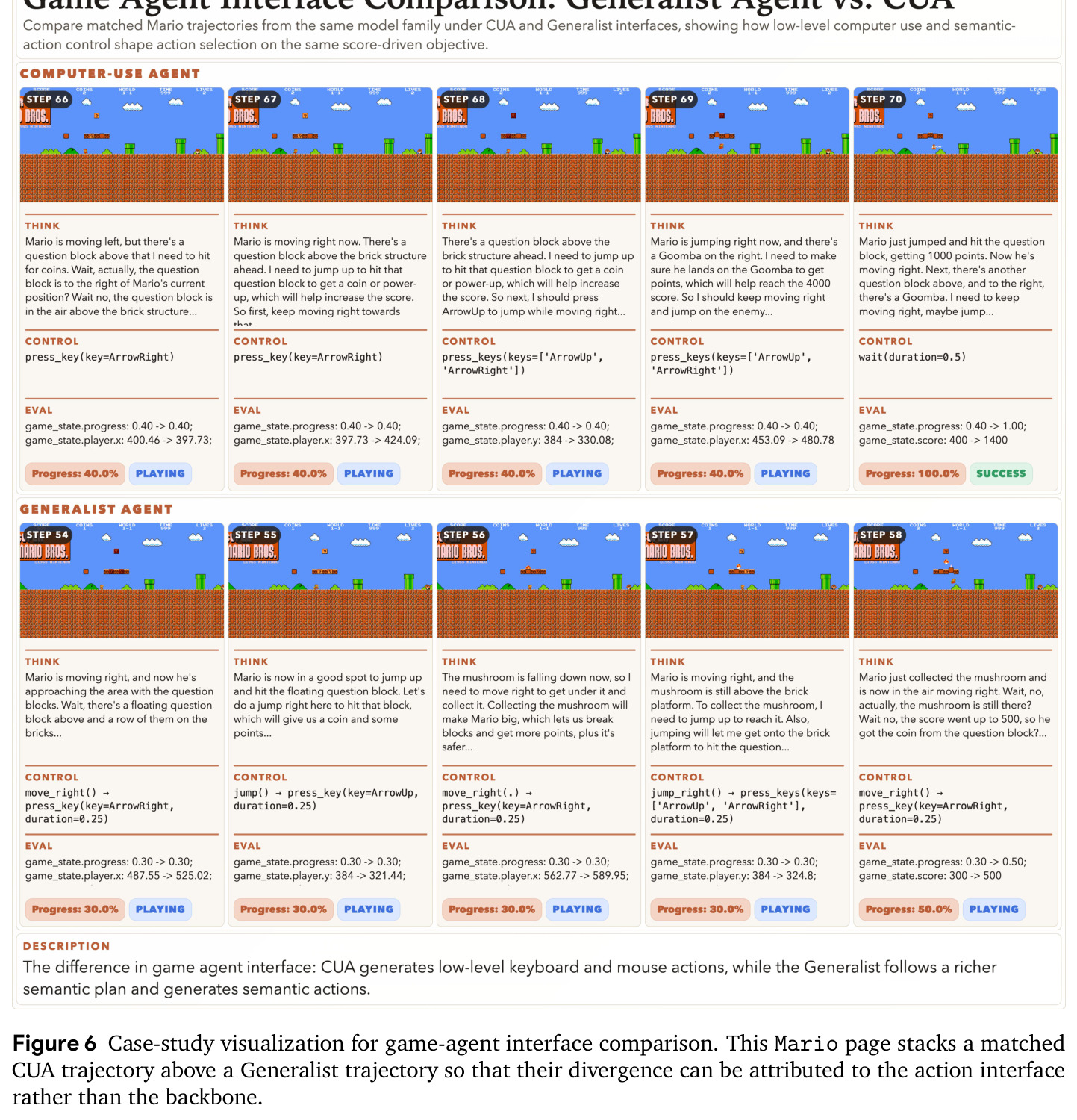
Computer-Use Agent(CUA)
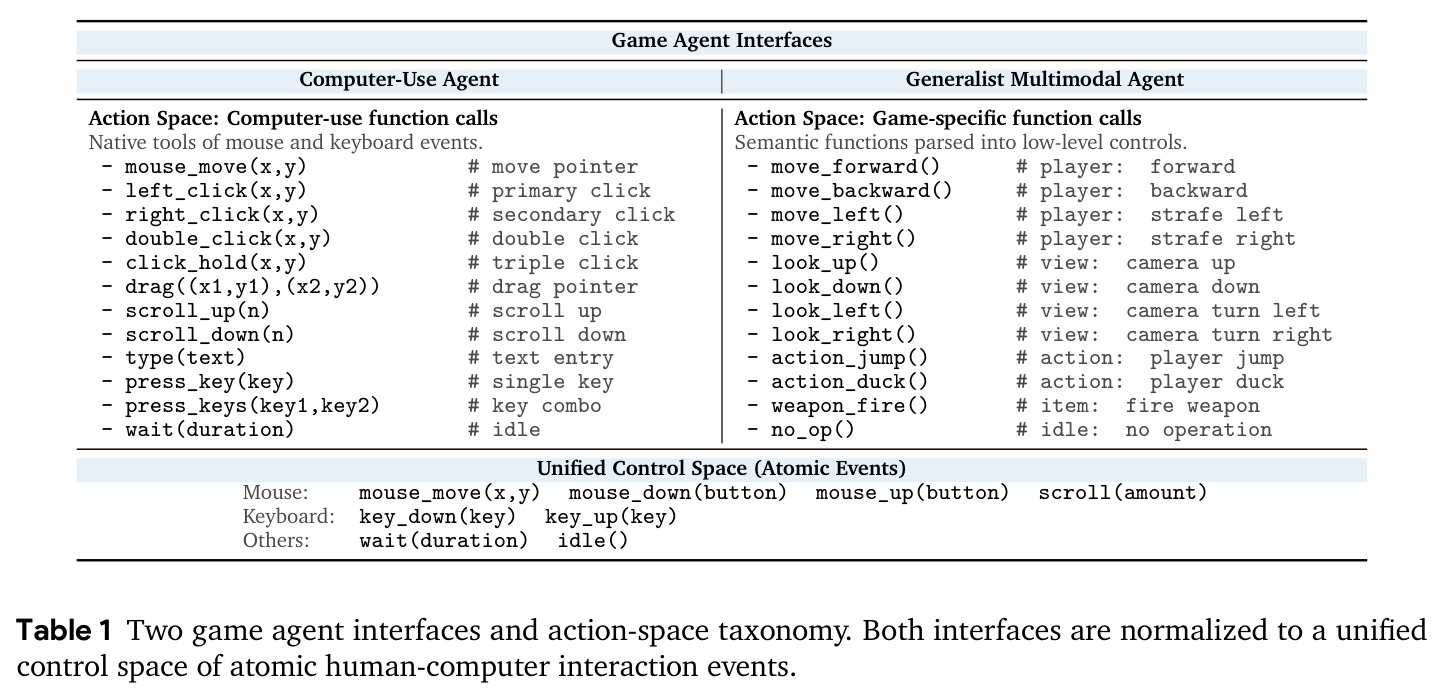
指直接以鼠标、键盘等原子交互事件(mouse_move、key_down、scroll 等)作为输出的智能体,类似 GPT-Computer-Use、Claude Computer Use 等原生 GUI 操控系统。它需要模型自己进行像素坐标定位和按键组合,对低层 grounding 与时序控制要求很高。
CUA 与 Generalist 接口的对比是 GameWorld 实验设计的核心轴之一;理解 CUA 的原子动作语义才能读懂 Shared Executor Action Space 与 Invalid Action Rate 等评测设计。
Semantic Action Parsing(语义动作解析)
语义动作解析指把模型输出的高层语义动作(如 move_right、jump、shoot)通过确定性映射表自动转译为底层鼠标键盘事件的机制。这一映射是预先定义且无随机性的,因此可以剥离「解析器噪声」、在不同接口间做公平对比。
它把 Generalist MLLM 拉到了与 CUA 完全相同的执行层,是本文统一评测基础的关键技术;不理解这一点,就无法体会 GameWorld 如何在同一验证器下同时跑两类智能体。
Outcome-Based State-Verifiable Evaluation(基于结果的状态可验证评估)
通过注入 JavaScript 桥把游戏的内部状态(如 score、lives、coins_collected 等)序列化为 JSON,再由评估器读取这些状态计算 Success Rate 与归一化 Progress。这种方式不依赖 OCR 或 VLM-as-Judge,因此去除了感知噪声,可完全复现。
这是 GameWorld 与 OSWorld、VideoGame-Bench 等启发式评测基准的关键区别,对长尾真实场景下 MLLM 评估的「可复现性」问题至关重要。
Function Calling / Tool Use(函数调用)
现代模型 API 提供的结构化输出接口:模型按 JSON Schema 输出工具名与参数(OpenAI function calling、Claude tool use、Gemini function declarations 等),由宿主系统实际执行。这是 MLLM 智能体落地到 GUI / 游戏控制的标准通道。
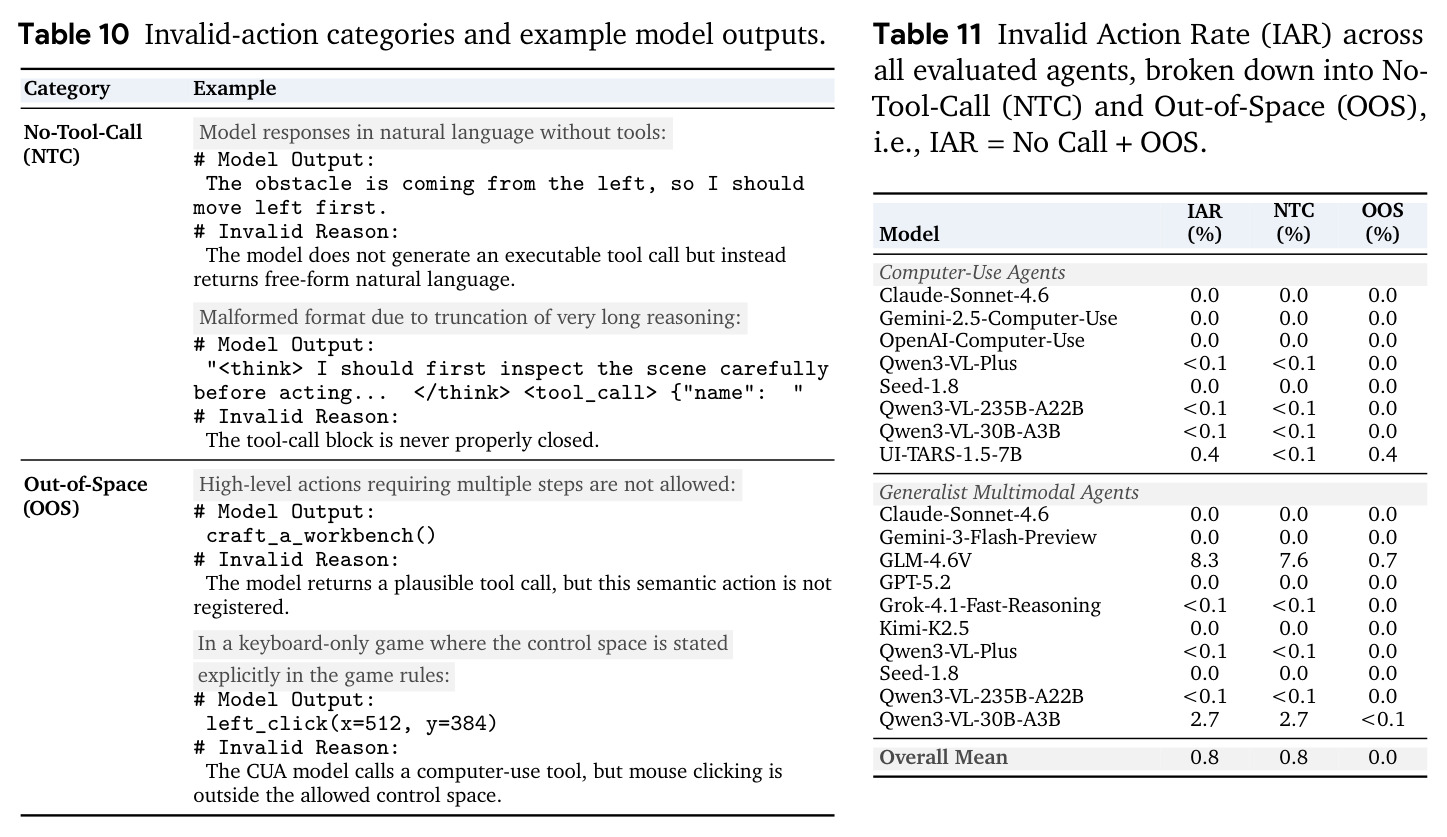
GameWorld 在统一 runner 中为每个模型注册其原生函数调用格式,是其「跨模型公平评测」的工程基础;只有理解工具调用,才能区分 No-Tool-Call 与 Out-of-Space 两类非法动作。
研究动机
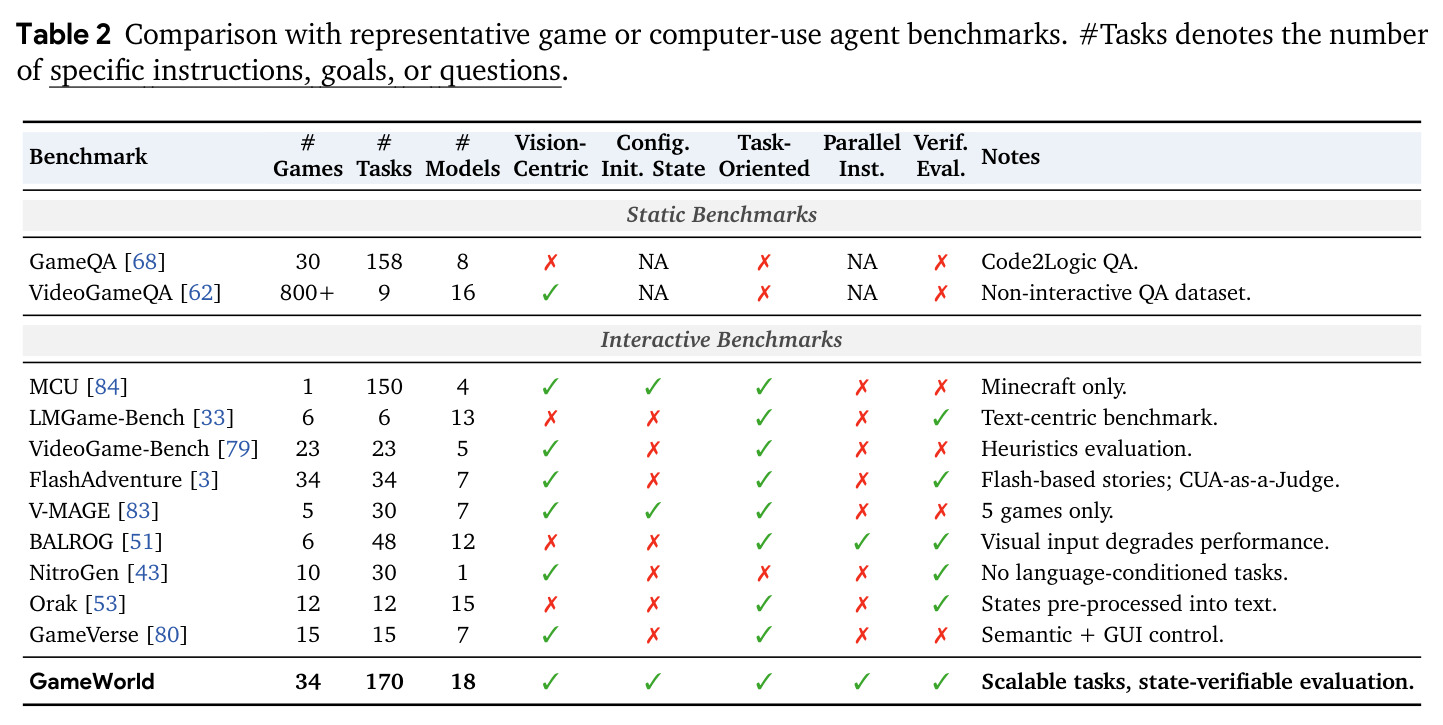
近一年涌现出 LMGame-Bench(6 款游戏)、BALROG(6 款游戏)、VideoGame-Bench(23 款)、Orak(12 款)、FlashAdventure(34 款)、GameVerse(15 款)等多个游戏智能体基准,但都存在三类系统性问题:第一,动作接口异质,有的输出 raw key/mouse,有的输出 SDK 函数,有的用 MCP 协议,导致不同模型分数无法在同一坐标下比较;第二,评测充满噪声,多数基准仍依赖 OCR、像素启发式或 VLM-as-Judge 来判断成败,Verification 不可复现且容易被模型「骗过」;第三,实时游戏中的推理延迟与游戏状态强耦合——一个 2 秒的思考窗口就可能让角色已经坠崖,导致分数混淆了「决策质量」与「反应速度」。这些缺陷使公开 leaderboard 难以反映真实能力差距。
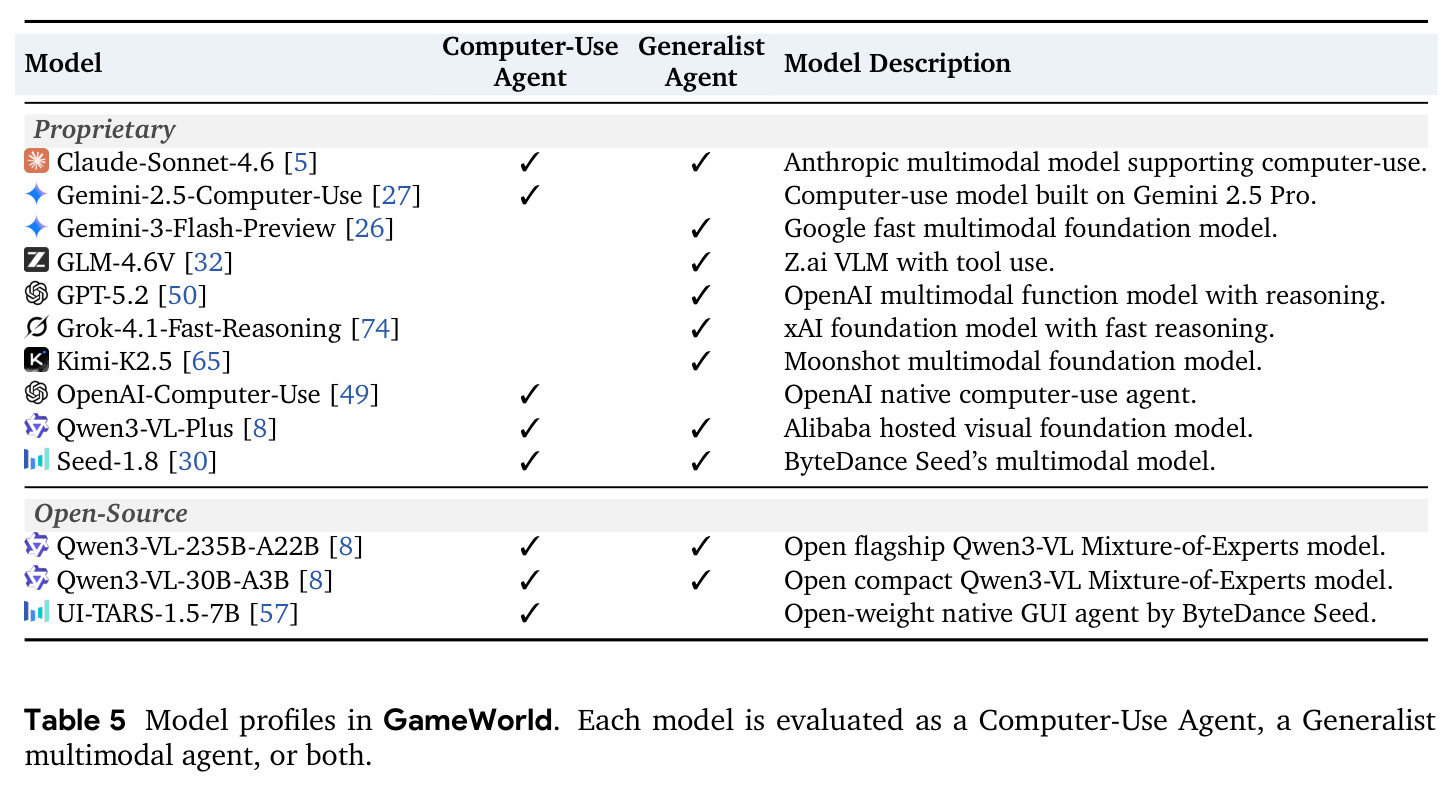
本文的目标是GameWorld 旨在交付一个在浏览器环境内、对所有 MLLM 公平且可复现的标准化评测平台,核心目标包括三件事:(1) 把当前 13 个 base 模型、两种接口(CUA + Generalist,共 18 对)放在同一个 runtime、verifier、prompt 模板与 harness 下比较;(2) 通过 outcome-based state-verifiable evaluation,把每款游戏的内部状态显式序列化出来,让成功 / 进度信号完全确定且无噪声;(3) 在主排行榜之外,提供「真实时变体 GameWorld-RT」「记忆轮数 ablation」「动作合法性诊断」「能力分层 curriculum」等附加分析,刻画当前 MLLM 游戏智能体的真实短板。
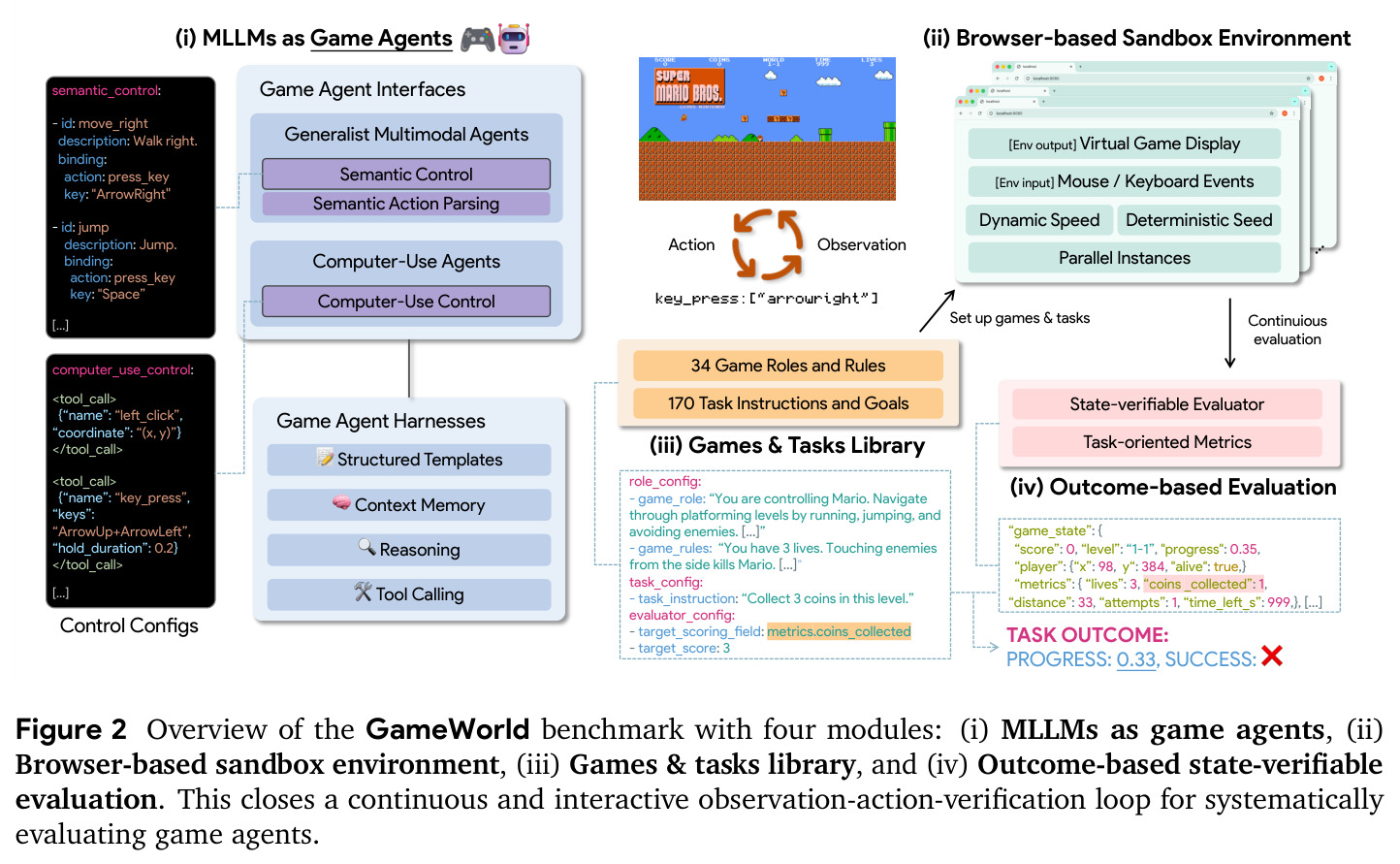
与已有工作不同的是,GameWorld 的独特切入角度是「通用执行层 + 浏览器沙盒 + 可验证游戏 API」三位一体:把所有 CUA 与 Generalist 输出归一到一套 mouse / keyboard / scroll / wait 原子事件,并在浏览器侧把每个游戏 patch 出 window.gameAPI 接口,主动上报 score、lives、checkpoint 等 233 个任务相关字段(共 34 款,平均每款 6.85 个),让验证器只看序列化数字而非像素。这一做法使「实时游戏的延迟解耦(暂停推理)」与「重置失败保留最佳进度(reset-on-fail)」成为可能,进而支撑重复实验的稳定性验证——这是先前所有依赖启发式或 VLM-as-Judge 的基准做不到的。
核心方法
GameWorld 的整体思路可以概括为「统一动作空间 + 浏览器沙盒 + 可验证状态」:先用 Browser-Based Sandbox(基于 Chromium + Chrome DevTools Protocol + readiness gate)把 34 款浏览器游戏在隔离实例里跑起来,并在模型推理期间可暂停游戏,从而把推理延迟与游戏时序解耦;然后让每个基础模型套上共享的 Agent Harness(含 Structured Prompt、Context Memory、Reasoning、原生 Function Calling)以统一日志与轨迹结构;接下来把模型输出规范化进一个 Executor-Level Unified Control Space(鼠标点击、键盘 down/up、滚轮、等待等原子事件),无论模型走 CUA 路径直接发键鼠还是走 Generalist 路径通过 Semantic Action Parsing 自动映射成键鼠,都收敛到同一可执行空间;最后由 Evaluvator 读取每个游戏通过 JavaScript bridge 暴露的可验证 gameAPI 状态,计算 Success Rate(SR)与归一化 Progress(PG),并支持 reset-on-fail 等鲁棒性策略。
GameWorld 与已有方法最本质的区别在于「评测信号的来源」:既不是直接看 VLM 输出,也不是把模型输出反复抽样让 VLM 打分(容易诱发 reward hacking),而是把游戏内部状态主动暴露在序列化 gameAPI 中,让评估器精确读出 score、lives、coins、checkpoint 等 6.85 项/游戏的可验证字段。任何想绕过这一信号的尝试都无法在黑盒截图上作弊,因为成功是由 game 自身评分函数决定的。这同时配合「沙盒暂停机制」解决了实时游戏中的延迟耦合问题——每一步决策的时间由沙盒统一抹平,分数只反映决策质量。
方法步骤详情
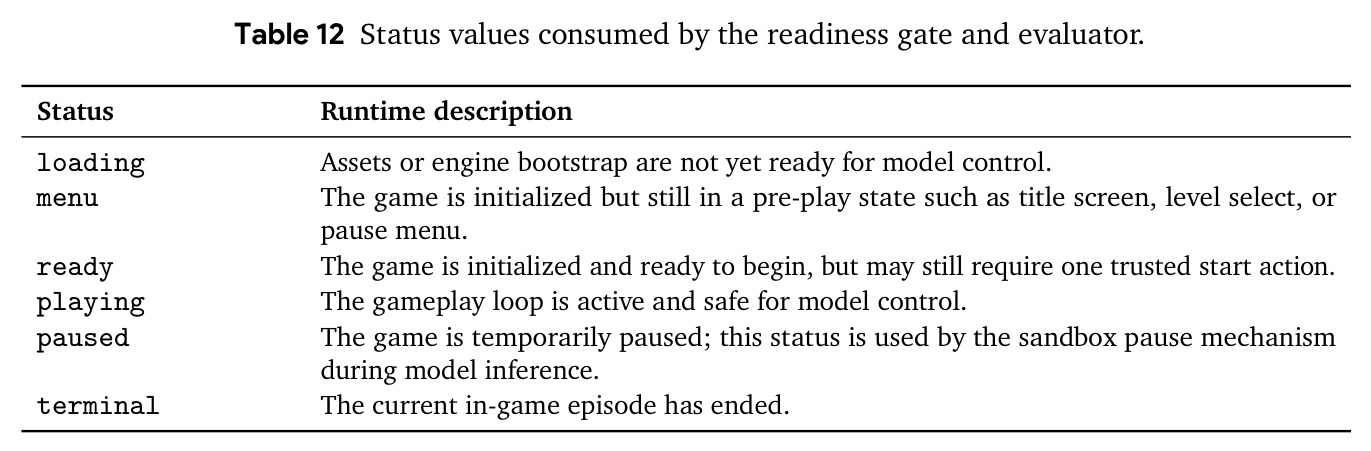
GameWorld 评测一次智能体任务的完整流程包含八个步骤:(1) Runtime Coordinator 通过 GameLauncher 启动本地 HTTP 服务并加载 game HTML,由 Browser Manager 在固定 viewport 的 Chromium 中打开游戏,禁用后台节流并通过 Chrome DevTools Protocol 截屏,避免 headed 模式闪烁;(2) 执行 readiness gate,等待游戏 status 转为 ready 或 playing 才开始第一步,把 menu/loading 阶段吸收掉;(3) 抓取当前 game state 的截图与 window.gameAPI 快照(包括 gameId、timestampMs、status、terminal、game_state、metrics、raw 七层结构);(4) 在 Agent Object 中组装 prompt = Game Rules + Role and Controls + Task Instruction + Output Format 四个 block,并把近 memory_rounds 轮的 user_prompt→screenshot→reasoning→action 滚动记忆以 Action History 形式注入;(5) 调用 Provider 原生 function calling(OpenAI、Claude、Gemini、Qwen、Seed、GLM 等各家)获取 raw response,并在语义层面(Generalist)或原子动作层面(CUA)校验 IAR;(6) 把 raw action 经过规范化层转译为 Playwright mouse / keyboard / wheel / type / wait 原语,喂给浏览器;(7) 读回新的 gameAPI state,由 Evaluator 按 pregress_i = clip[0,1] ((q_max_i - b_i) / (τ_i - b_i)) 计算该步 PG,结合 status.terminal、step budget、target threshold、task-specific end-field 决定是否停止或 reset;(8) 若 continue_on_fail 开启且遇到 terminal failure,则调用 gameAPI.reset() 进入新 episode 但保留 run-level best progress,最终对全任务平均出 SR 与 PG,并对所有实验在 suite runner 中以 –max-parallel 进程并行重跑。
技术新颖性
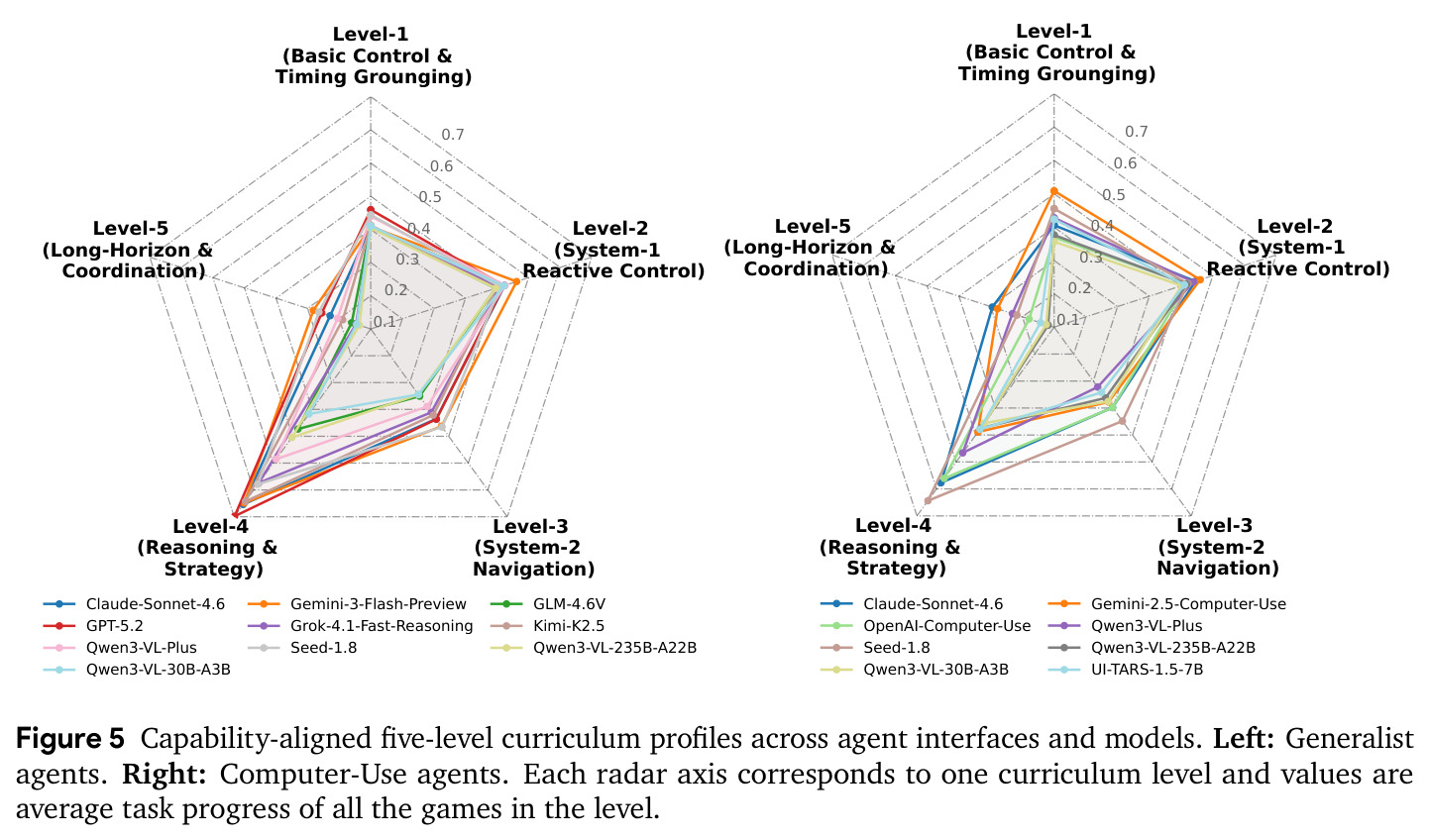
本文技术新颖性体现在四个层面:其一,构造了一个跨 34 款游戏、5 种流派、6.85 个状态字段/游戏的 gameAPI 注释体系,共 233 个任务相关字段全部由人工设计而非自动挖掘,从而支撑 outcome-based evaluation;其二,提出了把 CUA 直接键鼠流与 Generalist 语义动作流经由确定性 Semantic Action Parsing 合并到同一 Executor-Level Unified Control Space 的统一范式,避免了之前 BALROG、LMGame-Bench 等把两种接口跑在不同 evaluation harness 的不一致问题;其三,Browser-Based Sandbox 在模型推理期间 pause gameplay(默认 paused 评测)并支持 unpaused 实时变体 GameWorld-RT,从而把「决策质量」与「反应时延」剥离开来,这是 VideoGame-Bench 仅做到局部隔离的工作基础上的系统化扩展;其四,提供了 capability-aligned 五级 curriculum 诊断(Level 1 基础控制与时序、Level 2 System-1 反应、Level 3 System-2 空间导航、Level 4 推理与策略、Level 5 长程协调),并配套 Reset-on-Fail(保留 run-level best progress)、Interactive-Visual Heatmap、Repeated-Full-Benchmark Rerun(10 次 ± STD)三套可复现性保障,使基准本身具备了「基准的基准」属性。
实验结果
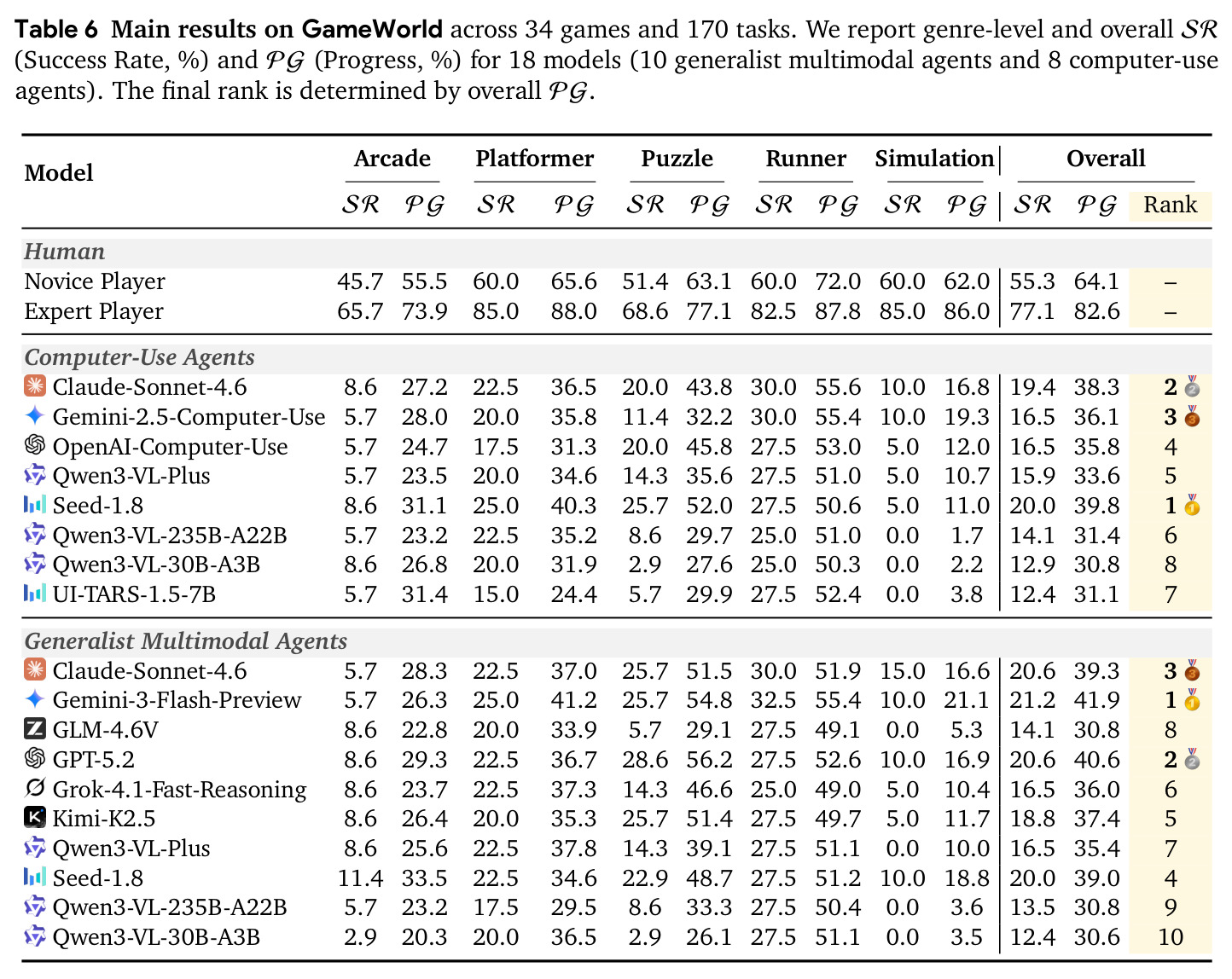
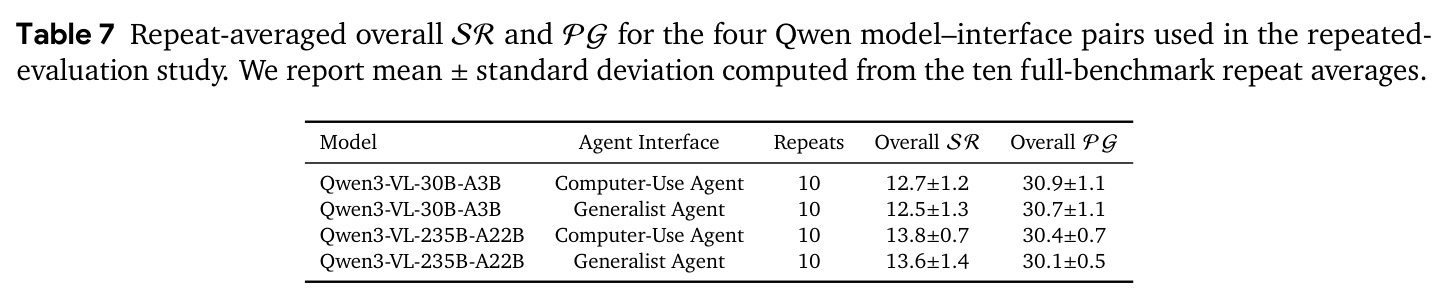
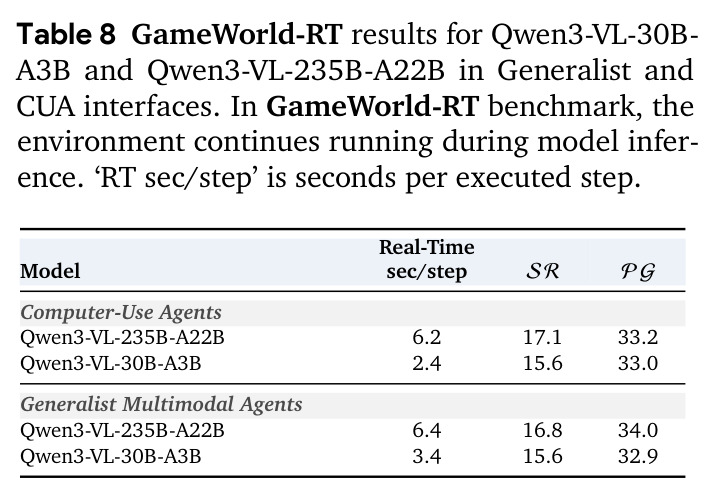
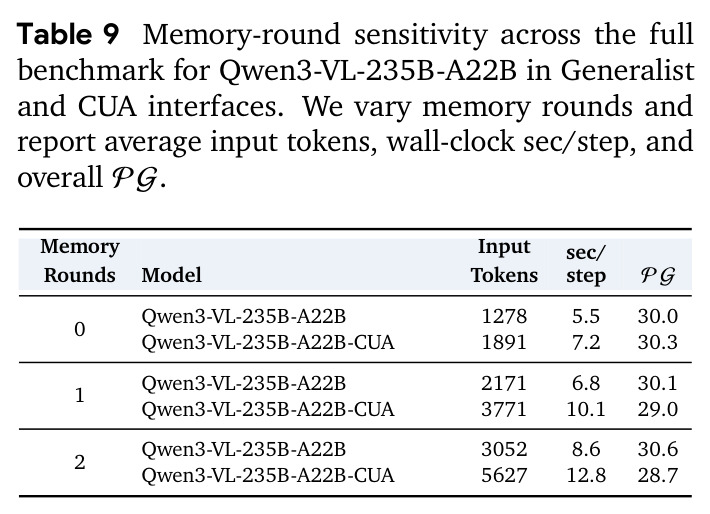
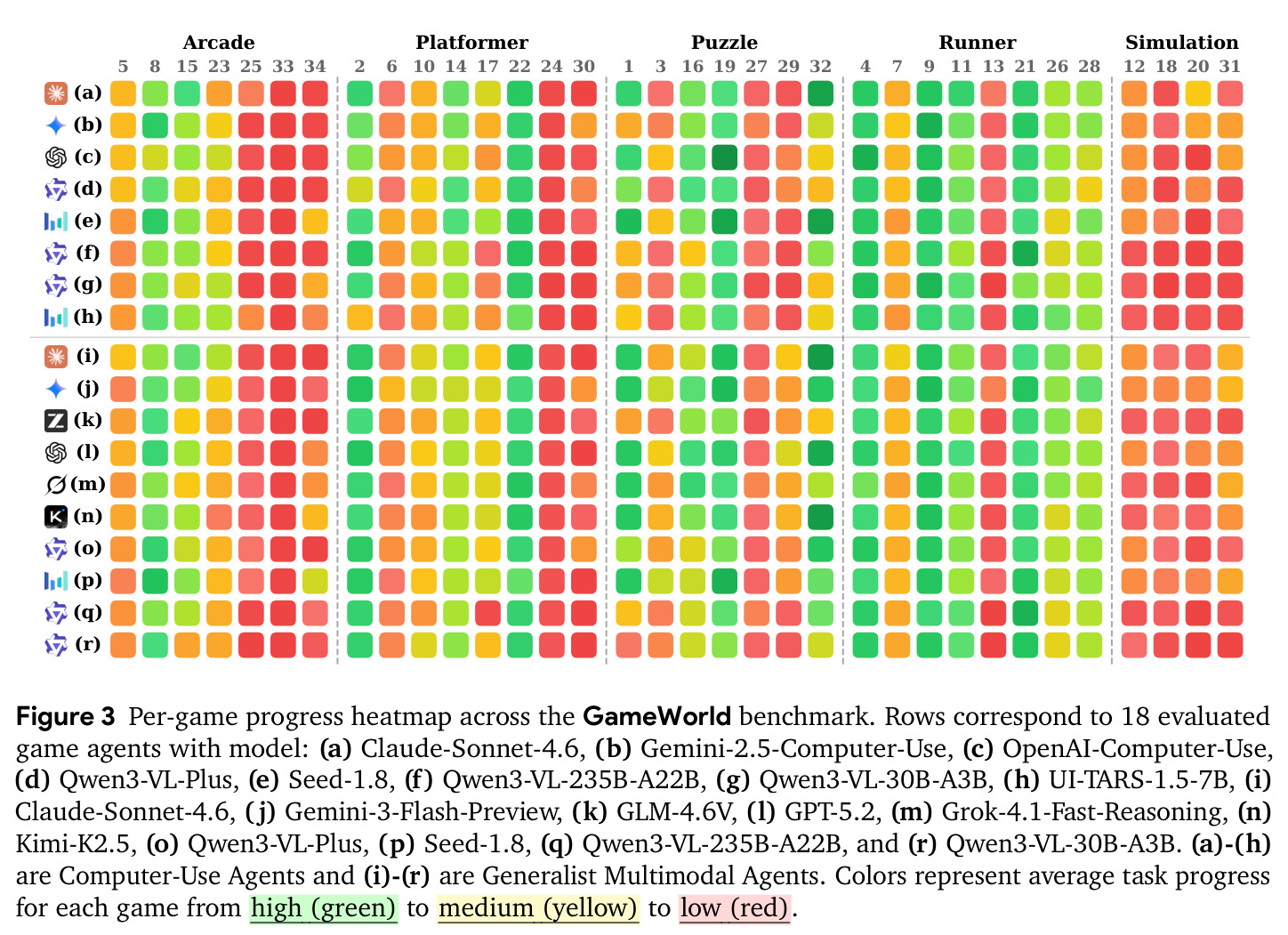
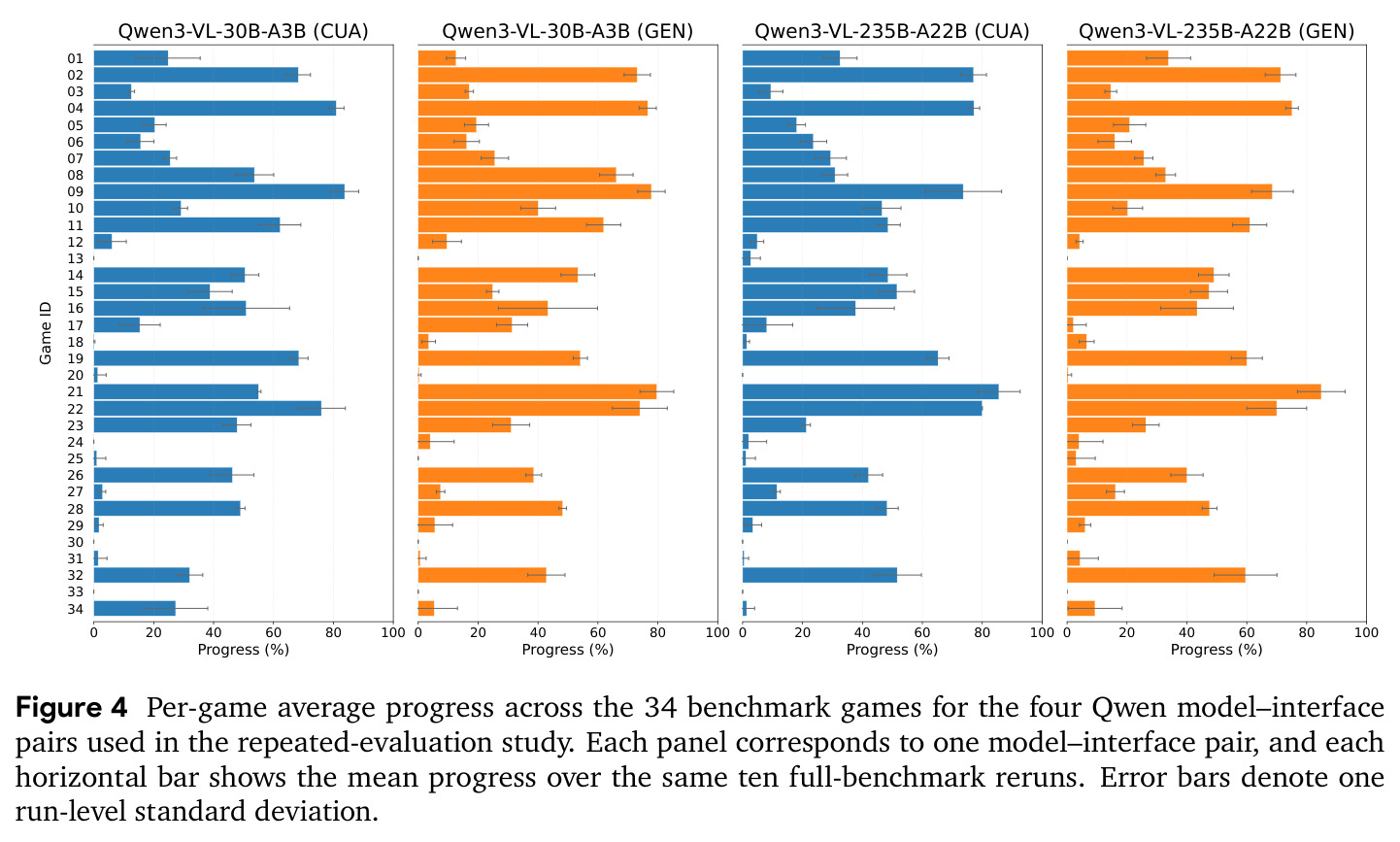
在 18 个模型-接口对、34 款游戏、170 个任务的主评测中,最佳 Generalist Agent 是 Gemini-3-Flash-Preview(Overall SR=21.2%、PG=41.9%),其次是 GPT-5.2(SR=20.6%、PG=40.6%)、Claude-Sonnet-4.6(SR=20.6%、PG=39.3%)、Seed-1.8(SR=20.0%、PG=39.0%);最佳 CUA 是 Seed-1.8(SR=20.0%、PG=39.8%),Claude-Sonnet-4.6 紧随其后(SR=19.4%、PG=38.3%)。Human Player 中 Novice Player 达到 SR=55.3%、PG=64.1%,Expert Player 达到 SR=77.1%、PG=82.6%——当前最佳智能体仍比 Novice Player 差约 22.2 PG,比 Expert Player 差约 40.7 PG,说明通用智能体与人类还有显著差距。从类型看,Runner 类(Flappy Bird、Temple Run 2、Chrome Dino 等高频反应型)多数模型表现最佳(PG=49.0–55.6%),Platformer 和 Puzzle 居中(PG≈36–55%),而 Simulation(Minecraft Clone、Monkey Mart、Fireboy-and-Watergirl)几乎所有模型都跌到 PG=0.0–21.1%,凸显长程开放环境是当前最棘手的难点;Robustness 上 Qwen3-VL-30B-A3B 与 Qwen3-VL-235B-A22B 在两种接口下 10 次全基准重跑的 SR/PG 标准差仅为 0.7–1.4 个百分点(PG 区间 30.1±0.5 至 30.9±1.1),证实 Benchmark 是可复现平台;Capability-Aligned Curriculum 表明所有模型在 Level-2 反应式控制和 Level-4 符号推理上最强,但在 Level-1 基础时序控制和 Level-5 长程协调上跌到谷底;Memory ablation 把 Qwen3-VL-235B-A22B 的记忆轮数从 0 涨到 2,Generalist 端 input tokens 从 1278 涨到 3052、PG 从 30.0 微升到 30.6,而 CUA 端则从 1891 涨到 5627、PG 从 30.3 反而下降到 28.7,说明长程低级动作日志会干扰 GUI 模型;Invalid Action Rate 在 GLM-4.6V 上达到 8.3%、Qwen3-VL-30B-A3B 在 CUA 模式下也有 0.4%,其余模型普遍 <0.1%;GameWorld-RT 中两个 Qwen 模型的 SR 仅约 15.6–17.1%、但 PG 仍维持 32.9–34.0%,揭示「思考即落后」是实时场景的独立挑战。
查看结构化数据
| 任务 | 指标 | 本文 | 基线 | 提升 |
|---|---|---|---|---|
| Arcade(街机) | SR / PG (%) | Seed-1.8 (CUA) SR=8.6 / PG=31.1;Gemini-3-Flash (Gen) SR=5.7 / PG=26.3 | Human Novice SR=45.7 / PG=55.5;Expert SR=65.7 / PG=73.9 | CUA 最佳 Seed-1.8 比 Novice Player 低 24.4 PG,差距巨大;Generalist 最佳 Gemini-3-Flash 比 Expert Player 低约 47.6 PG |
| Platformer(平台跳跃) | SR / PG (%) | Gemini-3-Flash (Gen) SR=25.0 / PG=41.2;Claude-Sonnet-4.6 (Gen) SR=22.5 / PG=37.0 | Human Novice SR=60.0 / PG=65.6;Expert SR=85.0 / PG=88.0 | Generalist 在该类型领先 CUA 约 0.3 PG,Gemini-3-Flash 与 Expert Player 仍有 46.8 PG 差距 |
| Puzzle(解谜) | SR / PG (%) | GPT-5.2 (Gen) SR=28.6 / PG=56.2;Gemini-3-Flash (Gen) SR=25.7 / PG=54.8 | Human Novice SR=51.4 / PG=63.1;Expert SR=68.6 / PG=77.1 | GPT-5.2 在解谜类取得最佳,但仍落后 Expert 约 20.9 PG |
| Runner(无尽跑酷) | SR / PG (%) | Gemini-3-Flash (Gen) SR=32.5 / PG=55.4;Claude-Sonnet-4.6 (CUA) SR=30.0 / PG=55.6 | Human Novice SR=60.0 / PG=72.0;Expert SR=82.5 / PG=87.8 | Runner 是智能体最接近人类的类型,但 PG 仍差 Expert 约 32 PG |
| Simulation(模拟经营) | SR / PG (%) | Gemini-3-Flash (Gen) SR=10.0 / PG=21.1;Claude-Sonnet-4.6 (Gen) SR=15.0 / PG=16.6 | Human Novice SR=60.0 / PG=62.0;Expert SR=85.0 / PG=86.0 | Simulation 是难度最大差距最显著的类型,最佳智能体与 Expert Player 相差近 65 PG |
| Overall(综合 34 款) | SR / PG (%) | Gemini-3-Flash (Gen) SR=21.2 / PG=41.9;Seed-1.8 (CUA) SR=20.0 / PG=39.8 | Human Novice SR=55.3 / PG=64.1;Expert SR=77.1 / PG=82.6 | 整体最佳 PG 比 Novice Player 低 22.2 PG,比 Expert Player 低 40.7 PG |
| Robustness(10 次复跑 PG STD) | PG ±σ (%) | Qwen3-VL-30B-A3B CUA PG=30.9±1.1;235B-A22B Generalist PG=30.1±0.5 | 未提供历史基准 STD | 实现了首次公开报告的<1.5 PG 标准差,证明 GameWorld 的可复现性 |
| GameWorld-RT(实时变体) | SR / PG (%) / sec-per-step | Qwen3-VL-235B-A22B (Generalist) SR=16.8 / PG=34.0 / 6.4s;30B-A3B PG=32.9 / 3.4s | Paused 评测:235B PG=30.1、30B PG=30.7 | 实时下 SR 仍 >15.6%,但 PG 没有突破 34.0,表明「思考速度」与「准确性」需要更深度联合 |
局限与改进
作者在 Limitations and Future Work 中承认 Bench 仍依赖为每款新环境设计一套独特的指令集与 Semantic Action Parsing,action space 与 task 紧耦合,无法规模上线性扩展;目前没有自动化用 MLLM-driven 探索来生成 Semantic Action Parsing 的流水线。从评测指标观察到的局限包括:(1) Agent SR 普遍低于 22%,意味着二值成功信号仍偏稀疏,需要更密集的归一化 PG 才能区分领先者,例如最佳 PG 与次佳只差约 2 PG,让 leaderboard 上的「第一」高度依赖种子与抽样;(2) Simulation 类四款游戏的整体表现拉低了 Overall PG,统计意义上的均值被几个极难任务主导,可能掩盖其他类型的真实改进;(3) GameWorld-RT 只跑 Qwen 系列,未覆盖闭源实时模型,且实时评测的步长预算与暂停评测不严格可比;(4) Evaluvator 的状态字段是人工设计的 233 项,未来加入更多游戏时仍需保证字段语义一致性;(5) Prompt 模板强制要求模型只用 function call,但 IAR 在 GLM-4.6V 上仍达 8.3%、UI-TARS-1.5-7B 也有 0.4%,说明某些模型在长上下文或深 reasoning 后会忘记自己的 action space。
独立分析的弱点
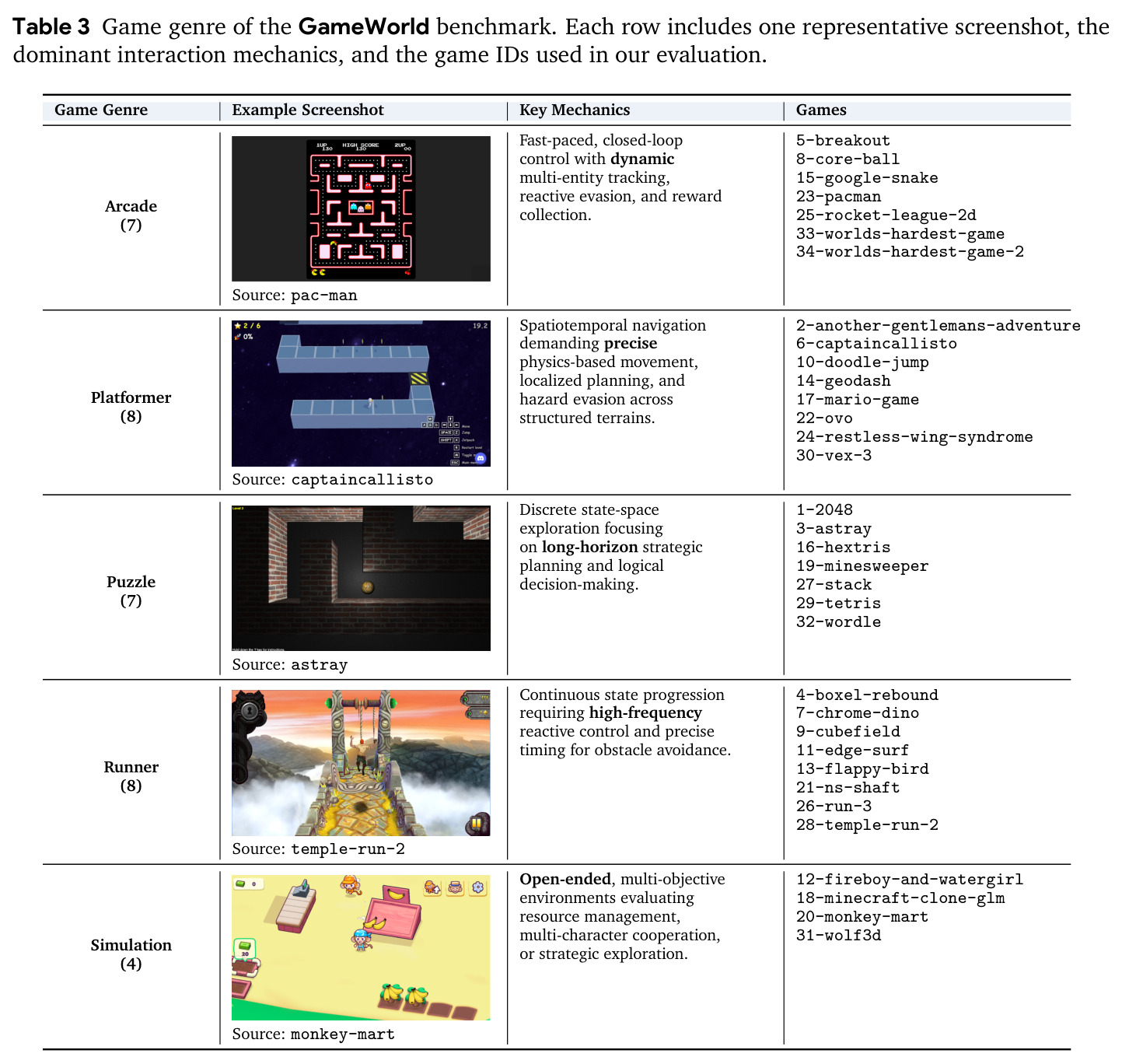
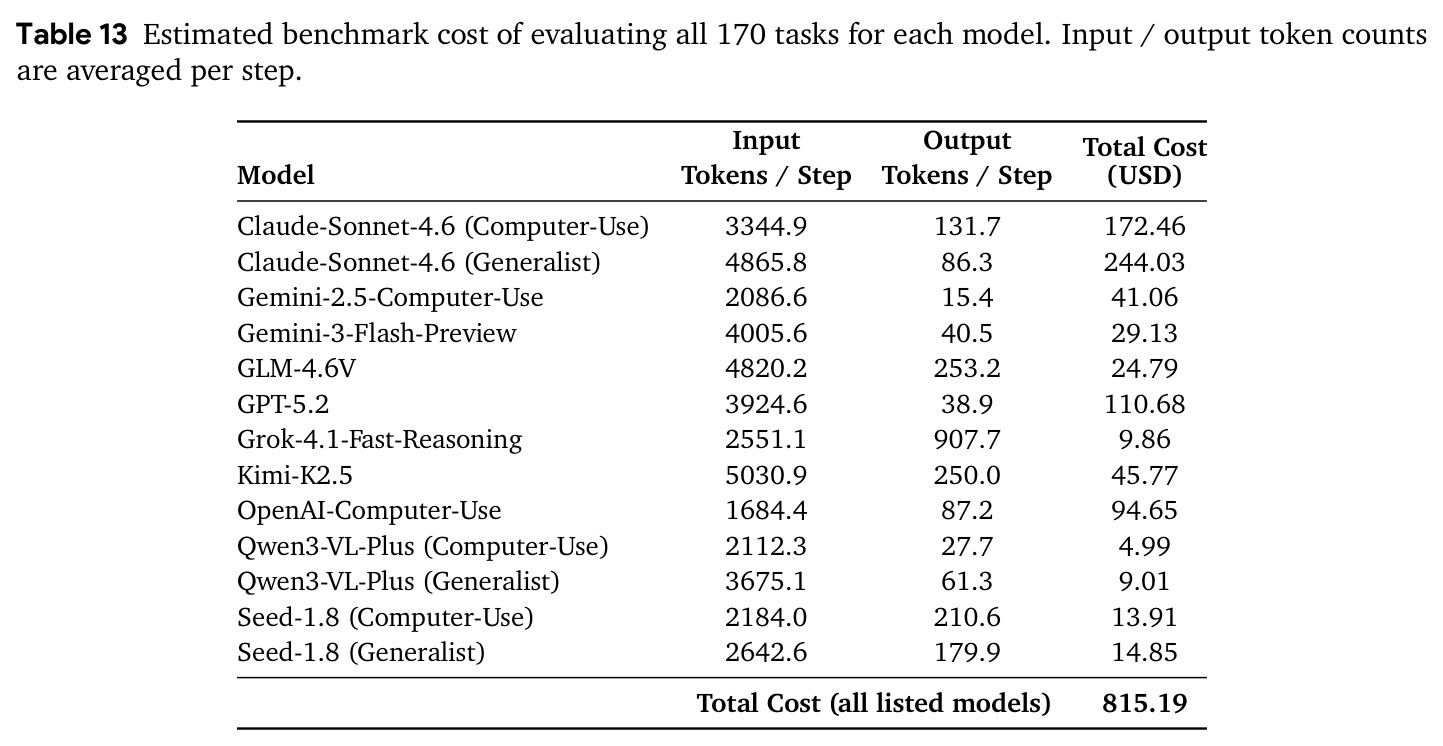
独立分析 GameWorld 在几个层面仍可改进:第一,PG 与 SR 都按任务线性平均,但 Runner 类任务天然有更长轨迹与更高分母,可能压低其他类型模型的归一化得分,提议改为按 genre 内归一化或按 PG 排名(rank-average)作为副榜;第二,34 款游戏分布在 5 类里有明显不均(Runner 8、Puzzle 7、Arcade 7、Platformer 8、Simulation 仅 4),导致 Simulation 的统计方差最大,提议扩充 Simulation 类(如增加 Cooking Mama、Stardew Valley 等更复杂经营类);第三,Semantic Action Parsing 强制一个语义动作→一个原子事件,但 Wolfenstein 3D 这种需要「同时前进 + 开火」的复合动作被拒之门外,提议允许 pair-wise 组合动作以覆盖更多真实玩法;第四,Pause 模式虽剥离了延迟,但关闭了「思考过久就输」的真实信号,提议在 GameWorld-RT 之外增设预算感知档位(如 step budget=20 vs 100)以阶梯评估推理代价;第五,模型对比基准的 cost 差距过大(Claude-Sonnet-4.6 全任务 244 美元 vs Grok 仅 9.86 美元,详见表 13),纯粹性价比分析缺位,提议引入 cost-normalized PG 作为辅助指标。
未来方向
作者明确提出的未来方向是用 MLLM-powered agent exploration 来自动生成与对齐 Semantic Action Parsing,从而把新游戏的接入从「人工写 yaml」解放到「agent 跑一下就生成 binding」。基于 GameWorld 已有的拆解,还可延伸出几条值得探索的方向:第一,把 18 个模型-接口对的 Interleaved Multimodal History 收集成共享 trajectory 语料,用行为克隆或 RL 训练新一代 game agent,正如 Game-RL、WebGym 等工作展示的;第二,把 GameWorld-RT 与 paused 评测结合为「双轨 leaderboard」,并引入 step-budget aware 评分,迫使模型在算力受限下做更经济的决策;第三,在 outcome-based state-verifiable evaluation 基础上做 reward shaping,结合 reset-on-fail 中的 run-level best progress 构造 dense reward 供 RL 微调;第四,将 Capability-Aligned 5-Level Curriculum 作为 curriculum learning 课程,先在 Level-1/2 上微调再过渡到 Level-5,进而系统化评估通用游戏智能体训练路径;第五,扩展 Human Study 至更大玩家池并按段位分析,把 Novice/Expert 两点扩展为细粒度能力曲线,使人类基线成为可比较的连续参考。
复现评估
GameWorld 在可复现性方面下了很大功夫:作者开源了完整代码与 prompt 模板(在附录 E 列出了 34 款游戏 × 两种接口的 4 类 prompt 块 + 13 个模型的 output_format 块),并把 34 款游戏作为浏览器游戏挂在公开仓库 url,授权与合规说明在 Appendix F 单独声明;Benchmark 内置 readiness gate、deterministic seed、game speed control 与 pause 等随机源隔离机制,确保每次跑同一种子下行为一致;最关键的可复现性证据是对两个开源 backbone(Qwen3-VL-30B-A3B 与 Qwen3-VL-235B-A22B)在两种接口下各跑 10 次全基准重跑,Overall SR 标准差控制在 0.7–1.4 个百分点、PG 标准差 0.5–1.1 个百分点(详见表 7)。复现所需算力方面,闭源模型一次全任务成本约 4.99–244.03 美元(Claude-Sonnet-4.6 Generalist 最贵 244 美元、Gemini-3-Flash 最便宜 29 美元),加总 815.19 美元;开源模型 Qwen3-VL-235B-A22B 与 30B-A3B 需要 235B / 30B MoE 体量部署,单卡推理困难、需多卡并按 token 计费;UI-TARS-1.5-7B 较小,可在单卡复现。复现难度整体为中等——基础设施齐备、prompt 与 harness 已列全,但评估 170 个任务 × 18 个配置仍需要约一周级别工程与数百美元 API 额度。
论文图表
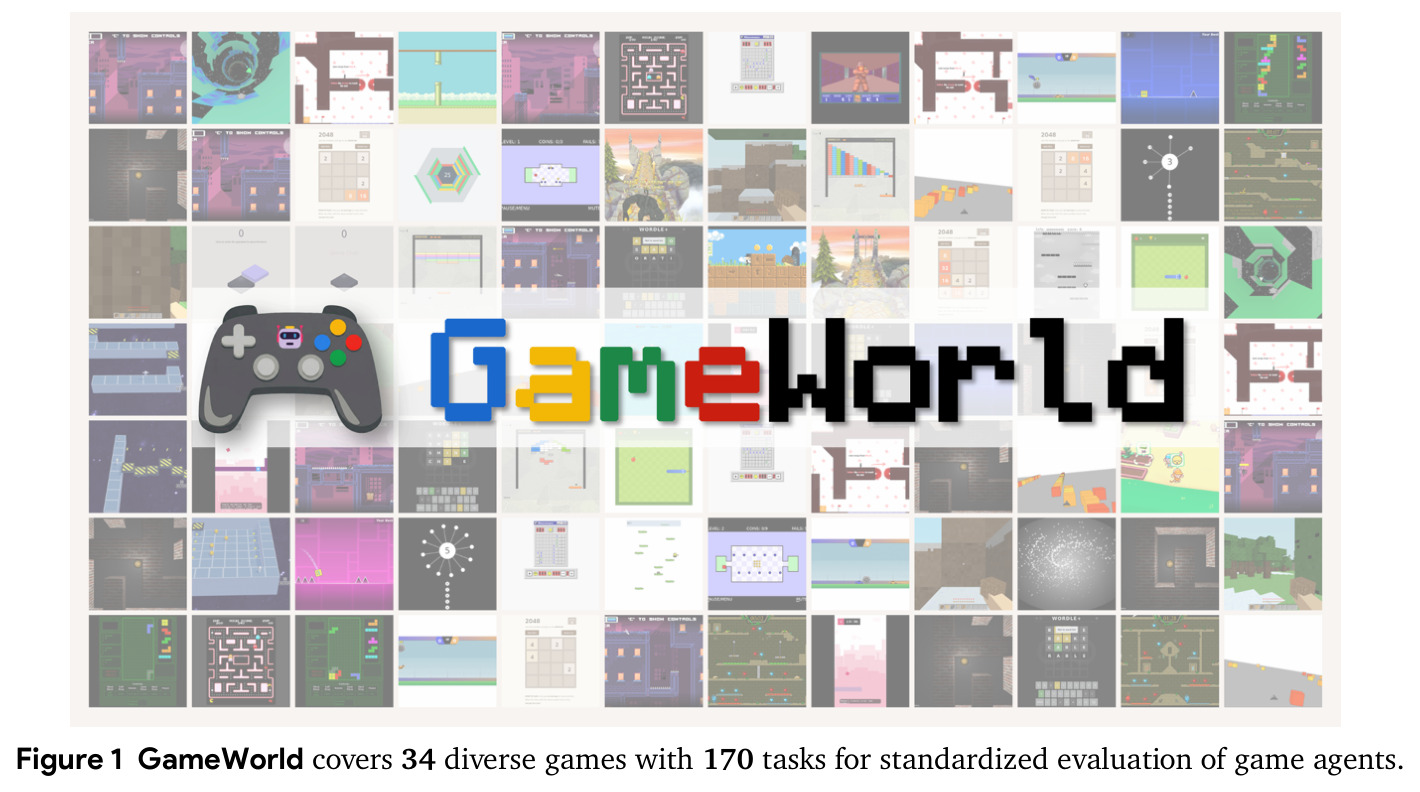
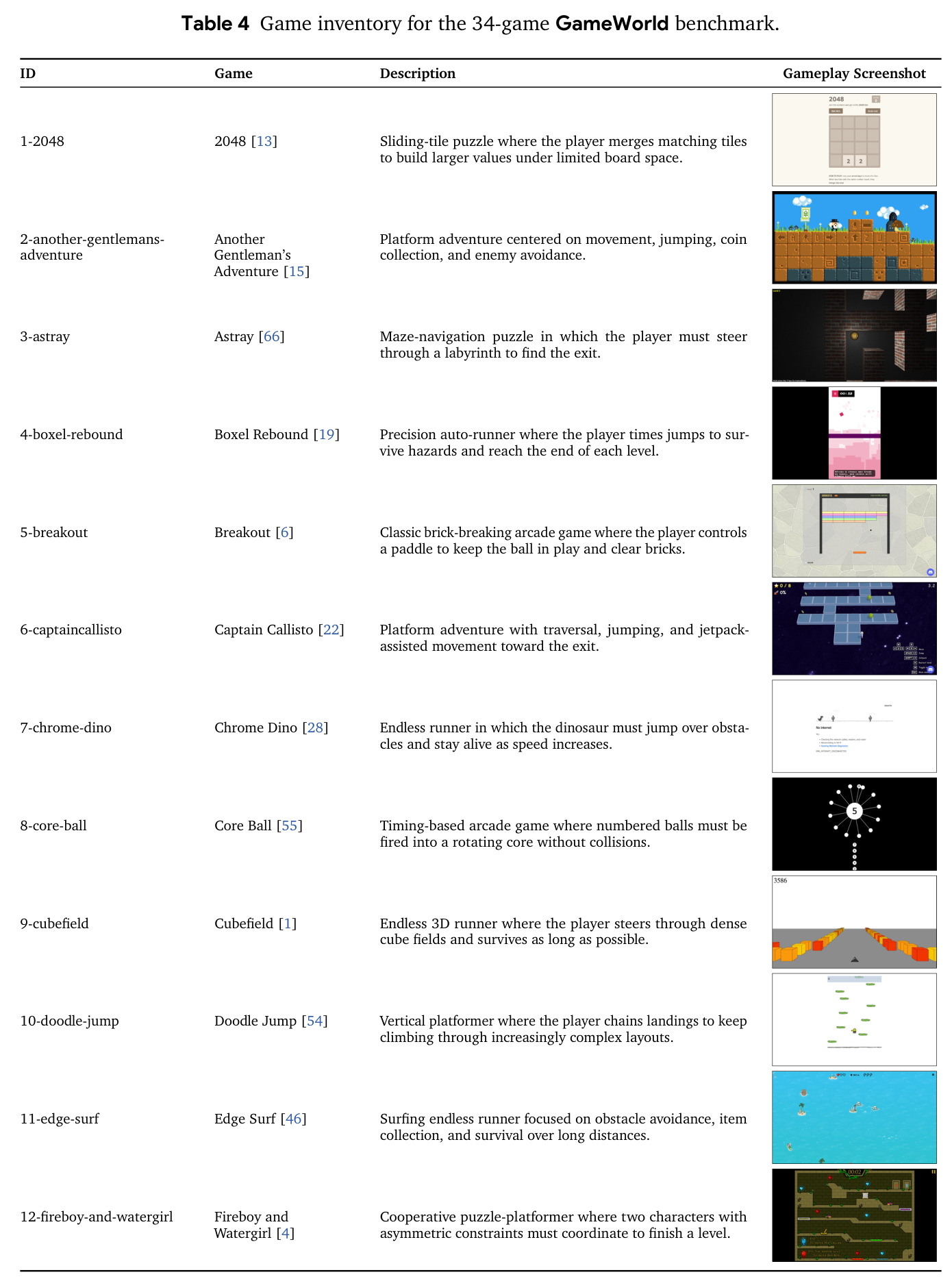
一张封面式汇总图,横轴展示 34 款游戏的缩略图与名称(涵盖 5 大流派:Arcade 7 款、Platformer 8 款、Puzzle 7 款、Runner 8 款、Simulation 4 款),并以彩色色块标识流派,强调 GameWorld 的规模与多样性。
这张图是论文的门面图,能让读者一眼把握基准的覆盖广度(34 款 / 170 任务)与五大流派的多样性,是动机部分最重要的视觉证据。
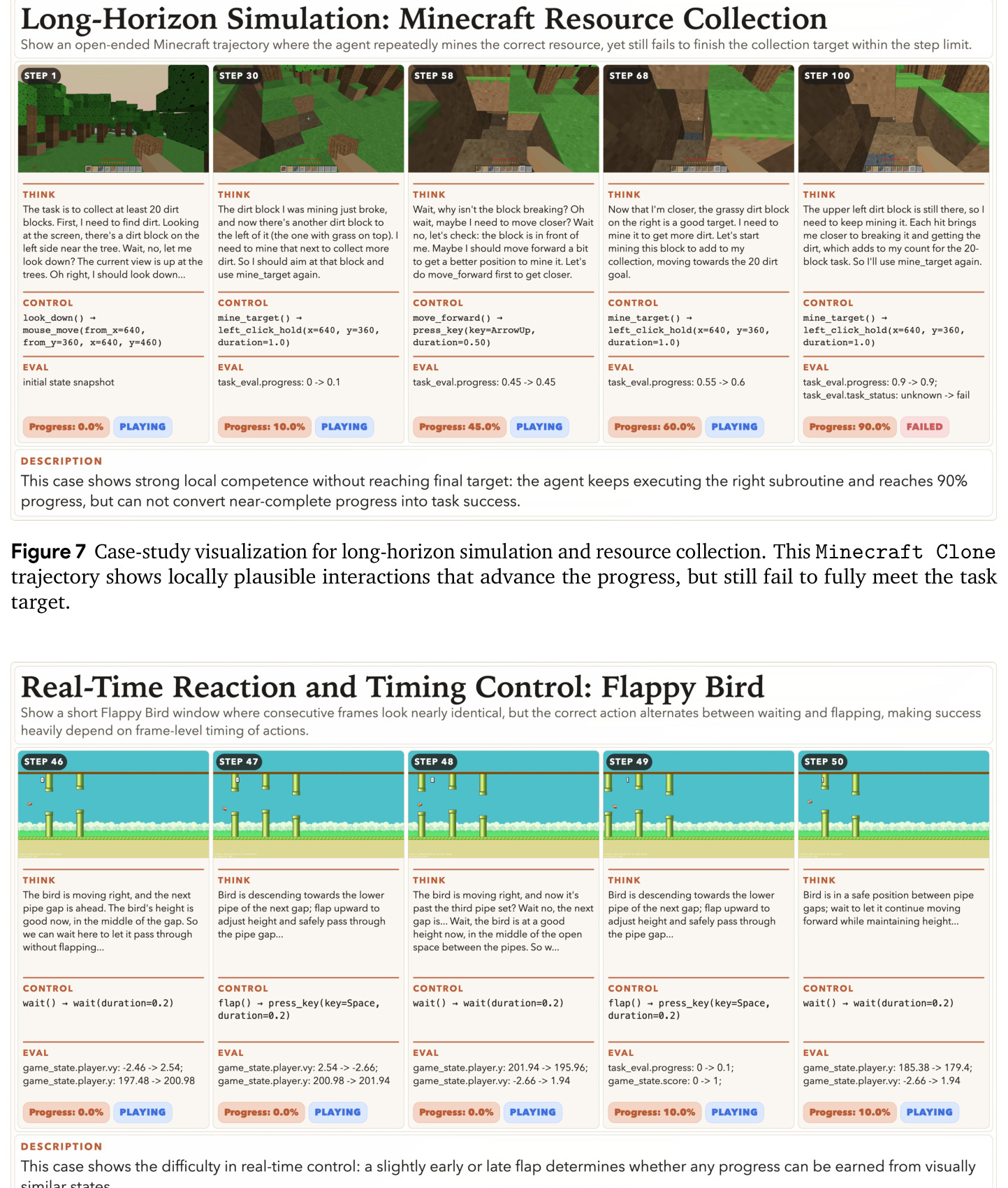
5 帧 Minecraft-Clone GLM 任务轨迹,每帧展示第一人称视角 + 当前 reasoning + 提议的 action + progress metric,从 0% 一路推进到 90% 但在 100 action 预算内未达 target score。
揭示「长程开放环境」是当前 agent 的痛点——它们能做到局部合理但缺少 closure,对应 failure modes 中的 Long-horizon memory failure。
5 帧 Flappy Bird 截图,相邻两帧肉眼几乎一致,模型却在 wait 与 flap 之间交替;其中一帧因等待过久直接撞管。
直观演示 GameWorld-RT 实时挑战:像素级差异极小但动作必须精确对应,是 real-time timing bottleneck 的关键案例。
18 行表,列示 8 个 CUA 与 10 个 Generalist 各自的 IAR(%)、NTC(%)、OOS(%),其中 GLM-4.6V 在 Generalist 下的 IAR 高达 8.3%,UI-TARS-1.5-7B 在 CUA 下为 0.4%,其余多在 <0.1%。
提供全模型 IAR 数值对比,是 instruction-following reliability 论点的量化依据。