Token Warping:让多模态大模型从邻近视角看世界 Token Warping Helps MLLMs Look from Nearby Viewpoints
用反向几何变换搬运图像 token,使 MLLM 在单图条件下完成邻近视角的 3D 空间推理。
前置知识
Vision Transformer (ViT) 与图像 token
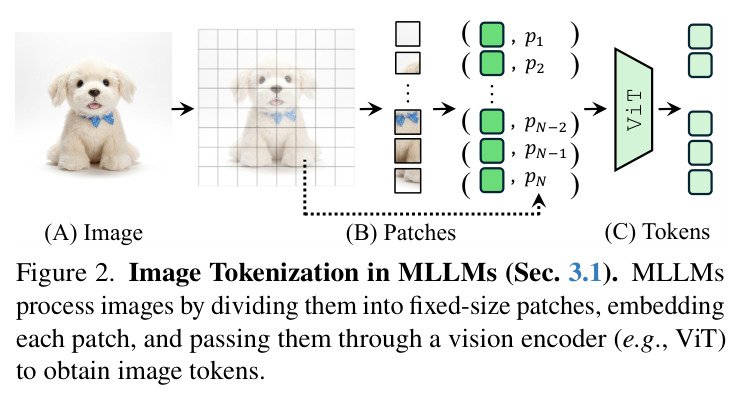
ViT 将输入图像按固定 patch 网格切分(例如 14×14 或 16×16 像素一块),每块经线性嵌入后形成一个 token,并附上 patch 中心的 2D 位置编码,再送入 Transformer。多模态大模型(MLLM)通常用 ViT 把图像编码为 $M=HW/l^2$ 个 token 序列,再与文本 token 拼接后送入 LLM。本文的图像 token 就是这些携带局部语义和位置编码的原子单元。
全文核心论点是 token 是介于像素和物体整体之间的合适粒度。如果不清楚 ViT 如何把图像切成 token 并附带位置信息,就无法理解 backward token warping 为什么要在目标视图上铺一个规则网格、然后去源视图取 token,也无法理解位置扰动实验的设计。
前向 warping 与反向 warping(geometric image warping)
在已知源视图深度 $D$、相机内参 $K$、相对位姿 $\Pi_{S\to T}$ 时,可以定义两种映射:前向映射 $f_{S\to T}$ 把源图像素/网格点投影到目标视图位置;反向映射 $f_{T\to S}$ 先在目标视图定义规则网格,再把每个目标点投回源视图取对应像素。形式上若 $x_i = d_i K^{-1}\tilde p_i$ 是反投影、$\tilde p^*_j = K\Pi_{T\to S}\tilde x^*_j$ 是回投影,$g^*_j=\pi(\tilde p^*_j)$ 就是反向 warping 后的源图像坐标。
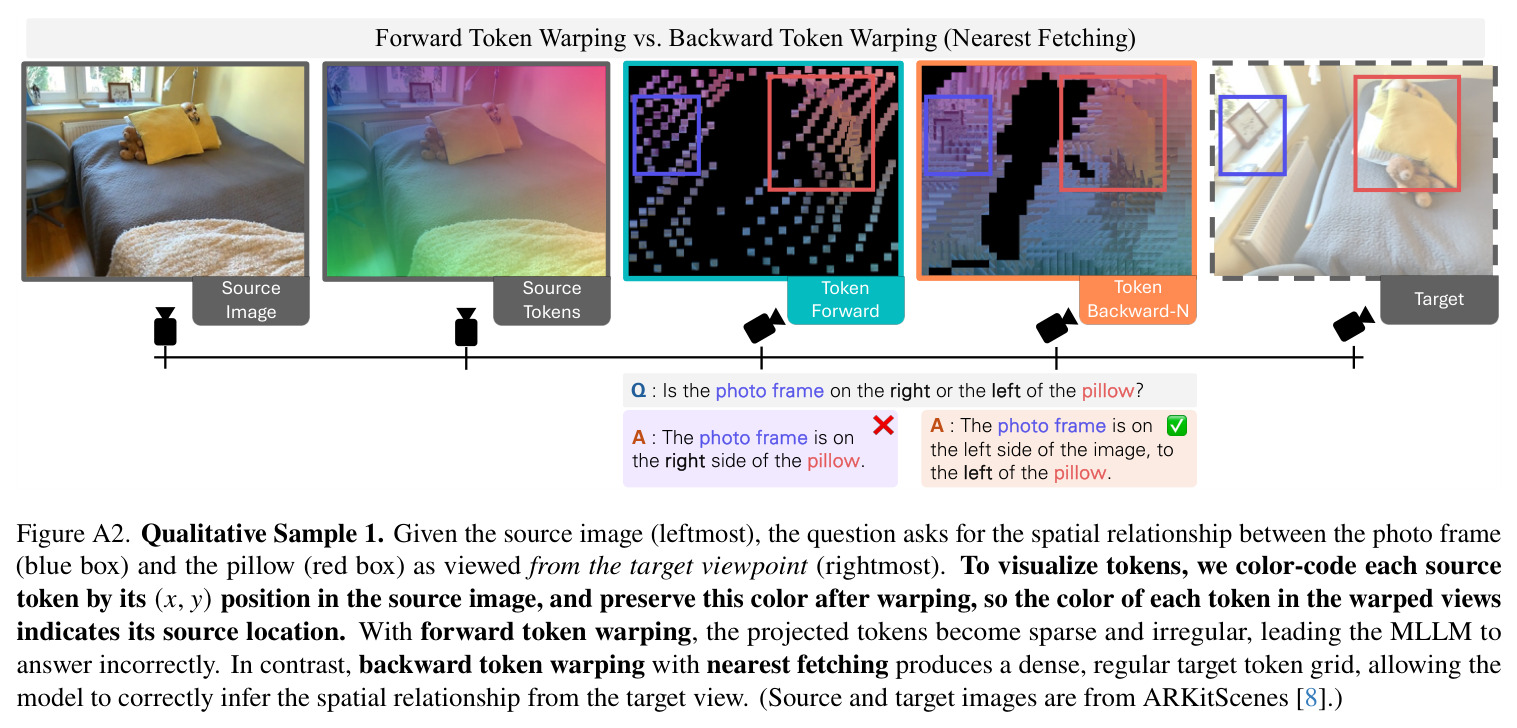
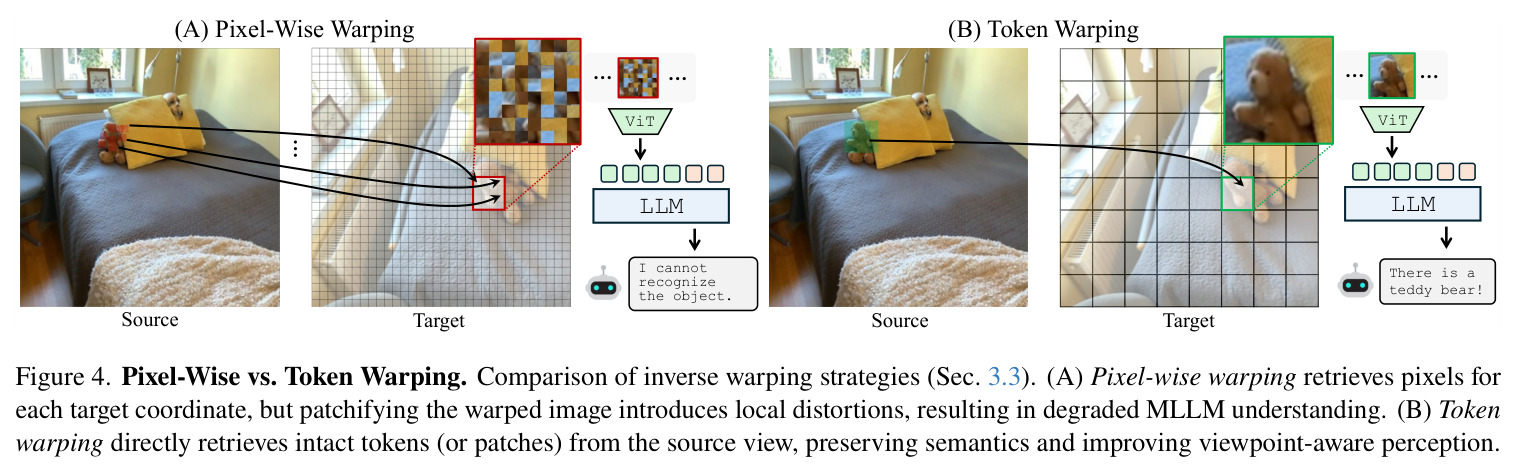
本文区分 forward vs backward token warping 是关键实验设计。前向 warping 在目标视图留下稀疏、不规则的 token 分布(大量空洞),对在规则网格上训练的 MLLM 而言是 out-of-distribution 输入;反向 warping 天然保证目标网格密集、规则。这是论文 backward 远胜 forward 的技术根源。
单目深度估计与 MLLM 的 3D 注入
Depth Anything v2、Depth Pro 等模型可以从单张 RGB 估计稠密深度图 $\hat D$。把它们预测的深度通过 unprojection 投到 3D、再以点云/法向等形式注入 MLLM,是 2024–2026 年 MLLM 3D 增强的常用路线,代表工作有 SpatialVLM、VLM-3R、VG-LLM、CUT3R、VGGT 等。
理解这条路线才能体会本文的对比基线(VLM-3R、VG-LLM 等都是把 3D 特征/几何直接拼进模型),以及作者为什么强调就算用估计深度,token warping 仍显著优于直接喂 3D 特征的 SOTA 模型——这是论文最有力的卖点之一。
mental imagery 与 part-level representation(心象与部件级表征)
Shepard、Minsky、Hinton、Pylyshyn 等人的经典认知科学理论认为:人类在脑中旋转物体时操作的不是整张图,而是基于 part-level 的结构描述。这条线索与计算机视觉从 holistic 特征到 patch token 的演进一脉相承:ViT 的 token 正是机器可感知的 part-level 原子。
这是论文 Section 1 和 Section 3 的理论锚点。作者明确说 we extend the concept of mental imagery to these perceptual atomic units rather than to object-level abstractions,把 token warping 包装为对认知理论的工程实现,从而解释为什么在物体级抽象和像素级表征之间要选 token。
研究动机
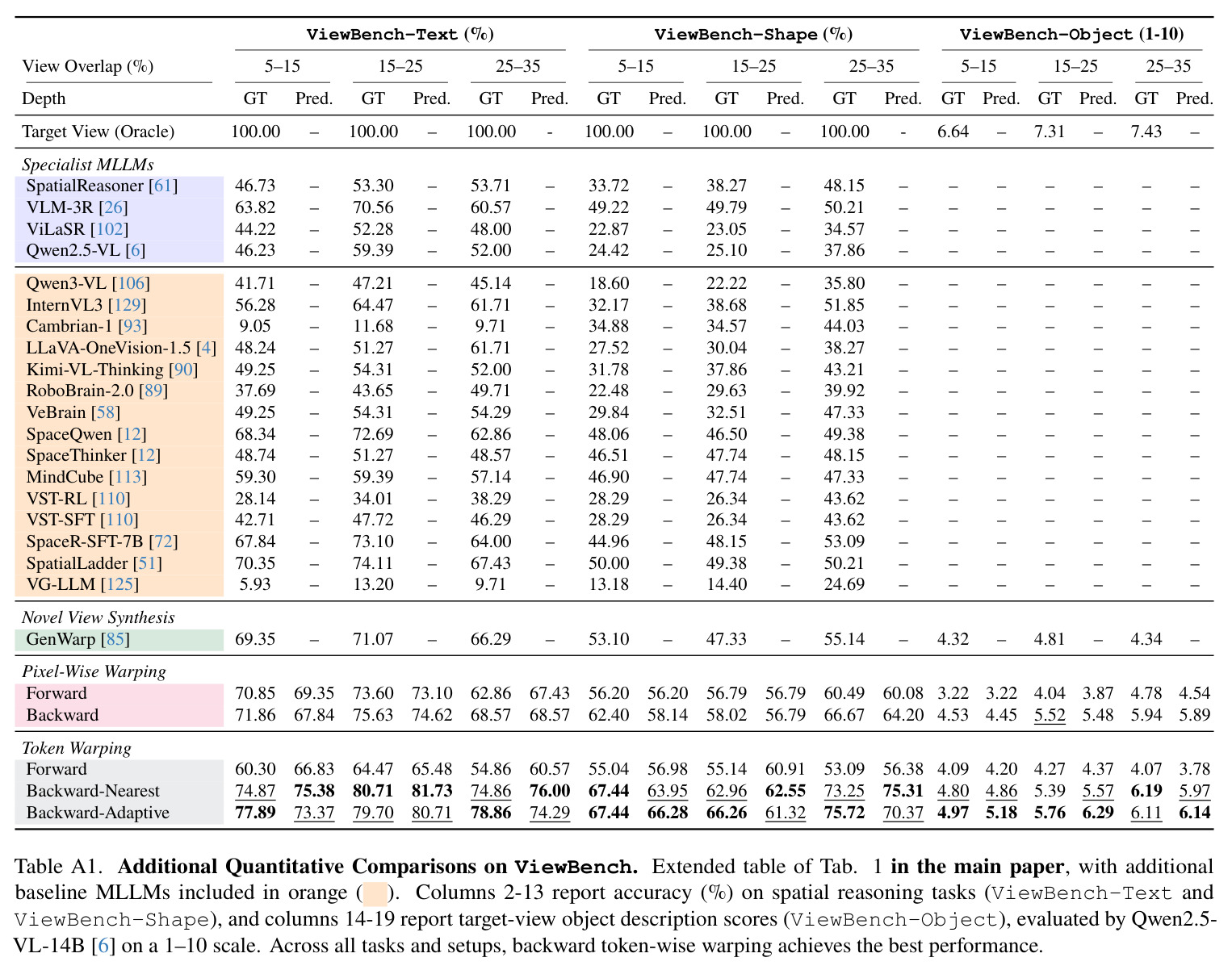
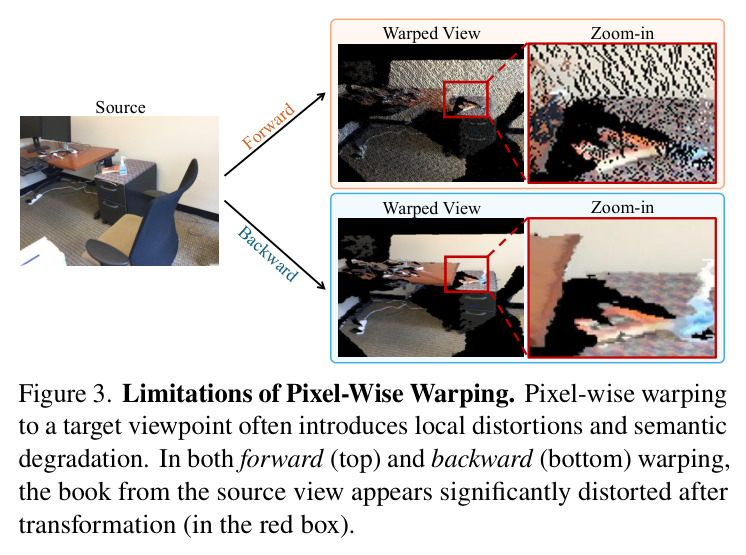
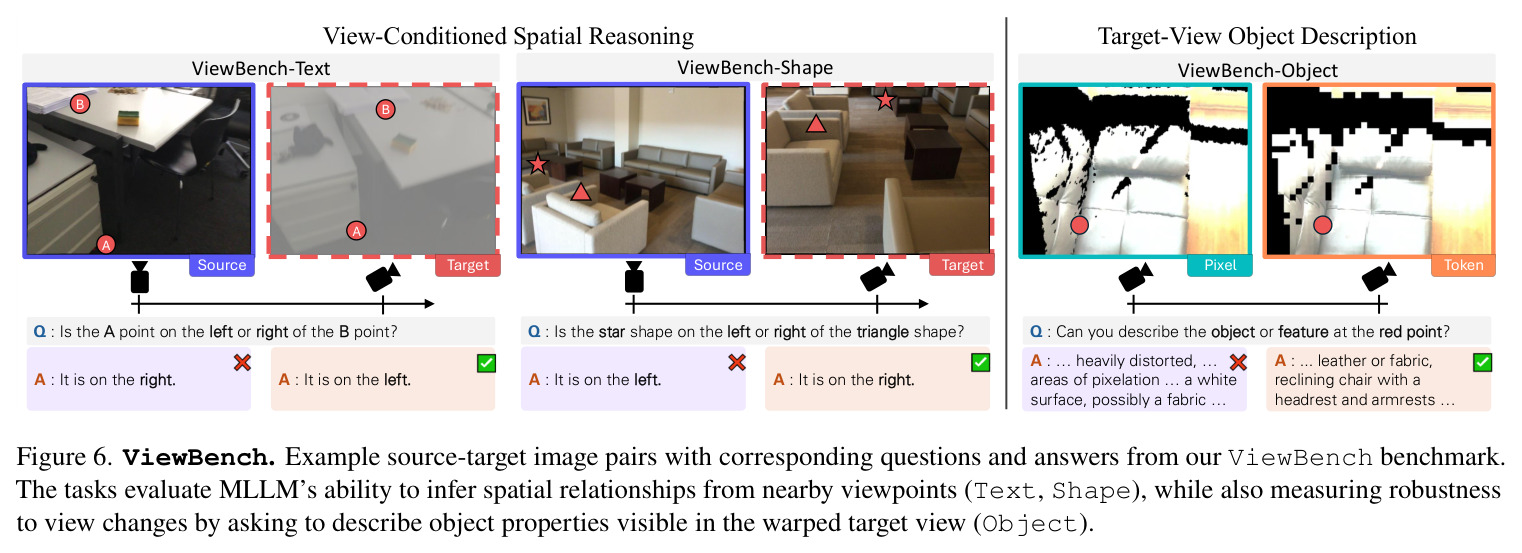
MLLM(以 Qwen2.5-VL、VLM-3R、VG-LLM 等为代表)在换个视角看同一个场景这种基础空间推理任务上表现非常差。Tab. A1 给出最直观的证据:在 ViewBench-Text 的最小重叠区间(5–15%)上,未经 3D 微调的 Qwen2.5-VL 仅 46.23%,号称显式 3D 监督的 SpatialReasoner 也只有 46.73%,而结合 VGGT 几何特征的 VG-LLM 更是跌到 5.93%。常见的两条改进路线都有明显短板:其一是把深度图或 3D 特征直接拼进模型(VLM-3R、Spatial-MLLM、VG-LLM),这些模型虽然能拿到 3D 先验,但当几何预测有误差时,反而把误差放大、损害了底座 MLLM 的通用能力;其二是像素级 warping——把源图按深度与位姿 warp 到目标视图再 patchify 成新图像喂给 MLLM,然而 Fig. 3 与 Fig. 8 显示,即使是当前最准的单目深度(Depth Pro/DA-v2),前向/反向像素 warping 都会在书脊、文字等细节上产生明显扭曲,导致模型在 ViewBench-Shape 5–15% 上只到 56.20–62.40%。问题的根源是:像素级 warping 把小深度误差乘以大位移直接变成像素级几何失真,而 MLLM 的 ViT 编码器对这种带空洞和拉伸的图非常敏感。
本文的目标是论文的核心目标是:给定单张源图像 $I$、对应深度图 $D$、相机内参 $K$ 和目标相机位姿 $\Pi_T$,让一个不重新训练的 MLLM(如 Qwen2.5-VL-7B)能够从邻近目标视角可靠地完成两类任务——(1) View-Conditioned Spatial Reasoning:在目标视角下判断两个标注点的左右关系(ViewBench-Text / ViewBench-Shape,共 571+744 题);(2) Target-View Object Description:在目标视角下描述指定位置物体的属性(ViewBench-Object,300 题)。作者追求的是轻量、推理期几乎无额外成本、不破坏底座模型通用能力的方案。
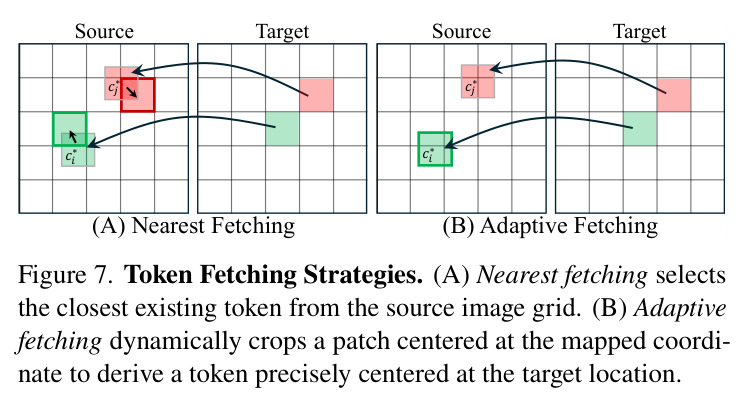
与已有工作不同的是,已有方法的共同思路是先合成新像素再让 MLLM 看,或把 3D 特征塞进 MLLM,本文的独特切入角度是直接操作 MLLM 内部的图像 token 本身。具体而言,作者提出 backward token warping:在目标视图先铺一个与训练分布一致的规则网格 $\{g_j\in\mathbb{R}^{M\times 2}\}$,再用 $f_{T\to S}$ 把每个目标网格中心 ray-cast 回源视图,得到源图像上的取 token 坐标 $g^*_j$,最后用 nearest 或 adaptive 方式取回完整 token。这条路线绕开了像素级 warping 的失真问题,也避免了对 MLLM 做 SFT/RL 微调。理论锚点是认知科学中的 part-level mental imagery——token 恰好是机器可感知的部件粒度,比物体级抽象更细、比像素级表征更鲁棒。
核心方法
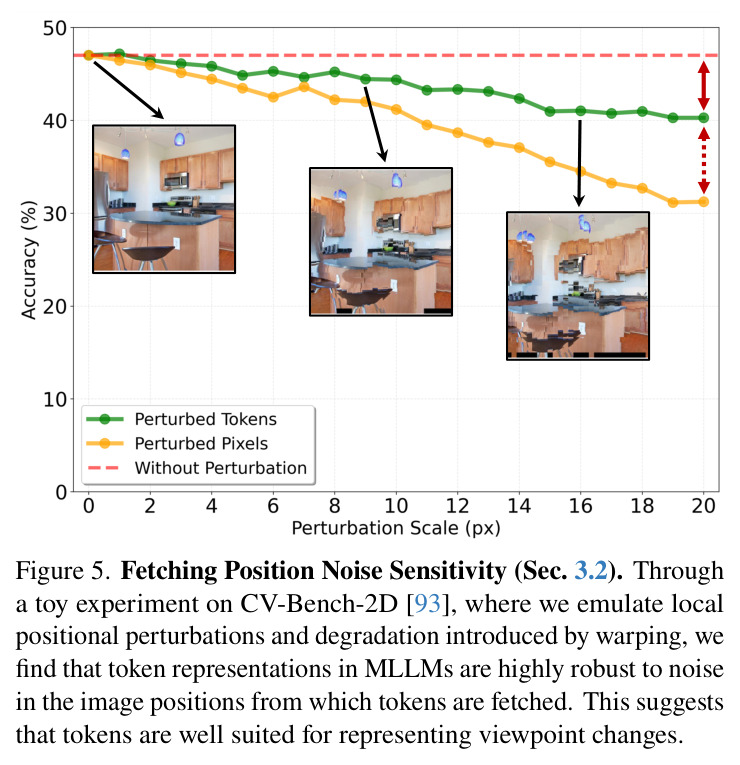
方法分三步。第一步(Sec. 3.2)是概念验证:用一个 toy 扰动实验证明 ViT token 对位置噪声天然鲁棒——把每个 token 的取 patch 中心加 0–20 像素的高斯抖动后送入 Qwen2.5-VL,CV-Bench-2D 上的 VQA 准确率几乎不变,而同样幅度的像素扰动则导致明显下降。这为后续在 token 空间做变换提供证据。第二步(Sec. 3.3)是核心算法:定义 backward warping 函数 $f_{T\to S}$——先用源深度图 $D$ 和内参 $K$ 构造代理三角网格 $M_S$(unproject 每个像素到 3D、相邻 2×2 像素构成两个三角面),再对目标视图每个规则网格中心 $g_j$ 从目标相机发射光线、与 $M_S$ 求交得到 3D 击中点 $x^*_j$,最后用 $\Pi_{T\to S}$ 和 $K$ 投影回源图像平面 $g^*_j=\pi(K\Pi_{T\to S}\tilde x^*_j)$。第三步是 token 取回:nearest fetching 直接复用源图固定网格上最接近 $g^*_j$ 的预计算 token;adaptive fetching 则以 $g^*_j$ 为新中心重新裁 patch 重新编码。这三种 backward 变体(Nearest/Adaptive)不需任何微调,仅推理时增加极少量计算。
核心创新是用反向 warping 在 token 空间完成视角变换,与已有方法的本质区别体现在三点:(1) 粒度选择——物体级抽象(Lee et al. 2025 mental imagery simulation)牺牲细节,像素级 warping 牺牲鲁棒性,本文选 token 作为 part-level 原子;(2) warping 方向——forward warping 在目标视图留下稀疏不规则 token,是 MLLM 的 OOD 输入(forward token warping 在 Tab. 1 ViewBench-Text 5–15% 上仅 60.30%,远低于 backward 74.87%),backward 通过目标规则网格到源图取 token 保证 token 排列与训练分布一致;(3) 几何噪声容忍——token 本身在 MLLM 中是携带位置编码的语义单元,小的取 token 偏移不会破坏其语义(Sec. 3.2 噪声实验),所以即使深度图有 1–2 像素误差,token 仍能正确表征局部内容。
方法步骤详情
完整 backward token warping 流水线如下。输入:源图像 $I\in\mathbb{R}^{H\times W\times 3}$、深度 $D\in\mathbb{R}^{H\times W\times 1}$(GT 或 Depth Anything v2 / Depth Pro 估计)、相机内参 $K\in\mathbb{R}^{4\times 4}$、相对位姿 $\Pi_{S\to T}=\Pi_T\Pi_S^{-1}$。Step 1 构造目标网格:与 ViT patch 划分一致,在目标视图定义 $M=(HW)/l^2$ 个规则网格中心 $g\in\mathbb{R}^{M\times 2}$。Step 2 构造 3D 代理网格 $M_S$:对 $I$ 中每个像素 $p_i=(u_i,v_i)$,用 $d_i$ 和 $K_{3\times 3}$ 反投影 $x_i=d_i K_{3\times 3}^{-1}\tilde p_i$,$\tilde p_i=[u_i,v_i,1]^\top$,得到 3D 点;相邻 2×2 像素构造两个三角面形成 $M_S$。Step 3 反向 ray casting:对每个 $g_j$,从目标相机按 $\Pi_T$ 和 $K$ 发射光线,与 $M_S$ 求交得到击中点 $x^*_j$;若未命中(遮挡/视野外)则标记无效。Step 4 投影回源图:计算 $\tilde p^*_j=K\Pi_{T\to S}\tilde x^*_j$,取 $g^*_j=\pi(\tilde p^*_j)$,其中 $\pi([u,v,w,1]^\top)=(u/w,v/w)^\top$。Step 5 token 取回(两种策略):(a) Nearest——找到源图固定 patch 网格中心 $c\in\mathbb{R}^{M\times 2}$ 中欧氏距离 $g^*_j$ 最近的 $c_{i'}$,把该 patch 编码得到的 token 赋给 $g_j$,即 $i'=\arg\min_i\|g^*_j-c_i\|_2$;(b) Adaptive——以 $g^*_j$ 为中心从 $I$ 重新裁 $l\times l$ patch、重新过 ViT patch 嵌入得到 token。Step 6 送入 MLLM:把取回后的 $M$ 个 token 按目标视图规则网格的位置编码排列,与问题文本 token 拼接,送入冻结的 Qwen2.5-VL-7B 出答案。整条流水线只新增一次 unproject + 一次 ray cast + 一次 re-patchify,对 MLLM 主体完全黑盒。
技术新颖性
技术新颖性可拆为三点。第一,token 作为 warping 单位的论证——Sec. 3.2 的扰动实验(Fig. 5)首次定量证明 ViT token 对 0–20 像素的取 patch 偏移几乎无精度损失(Qwen2.5-VL 在 CV-Bench-2D 上保持稳定),并把这种鲁棒性显式归因到 mental imagery 的 part-level 假设,这在前人 object-centric mental imagery(Lee et al. 2025)和 pixel warping 之间填补了粒度空缺。第二,backward warping 形式的系统性设计——论文不是简单用 backward,而是把它形式化为 $f_{T\to S}$:unproject→triangulate→ray cast→project 的完整几何管线,并讨论 nearest/adaptive 两种 fetch 的等价性(Tab. 1 中 Backward-Nearest 74.87% 与 Backward-Adaptive 77.89% 接近),证明核心收益来自目标视图规则网格这一约束而非 re-patchify 本身。第三,与生成式 novel view synthesis 的对比——同样用扩散模型 GenWarp 做对照,token warping 在 ViewBench-Text 5–15% 上以 74.87% 超过 GenWarp 的 69.35%,且不需要任何生成训练,展示了几何变换优先于像素合成的工程优越性。
实验结果
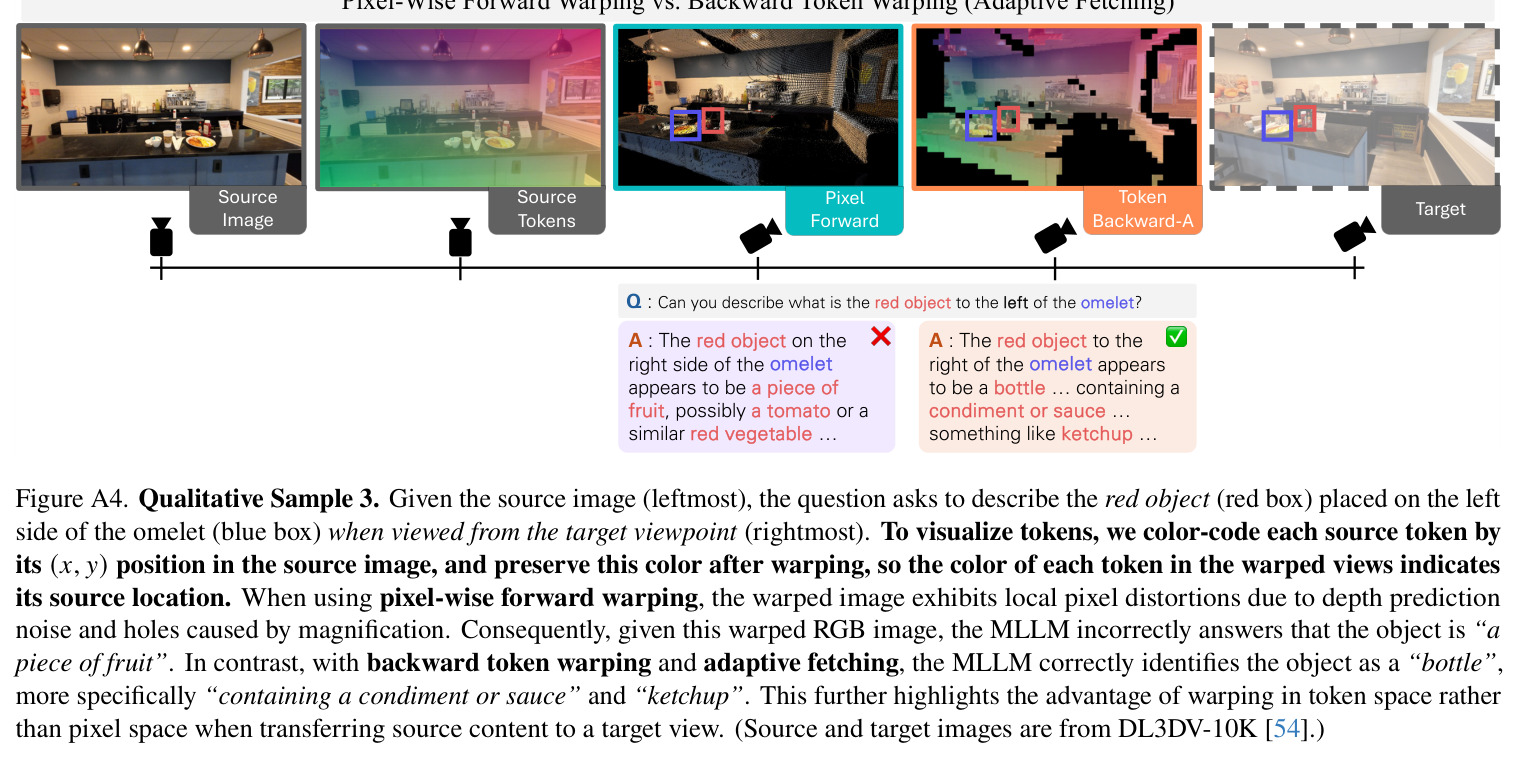
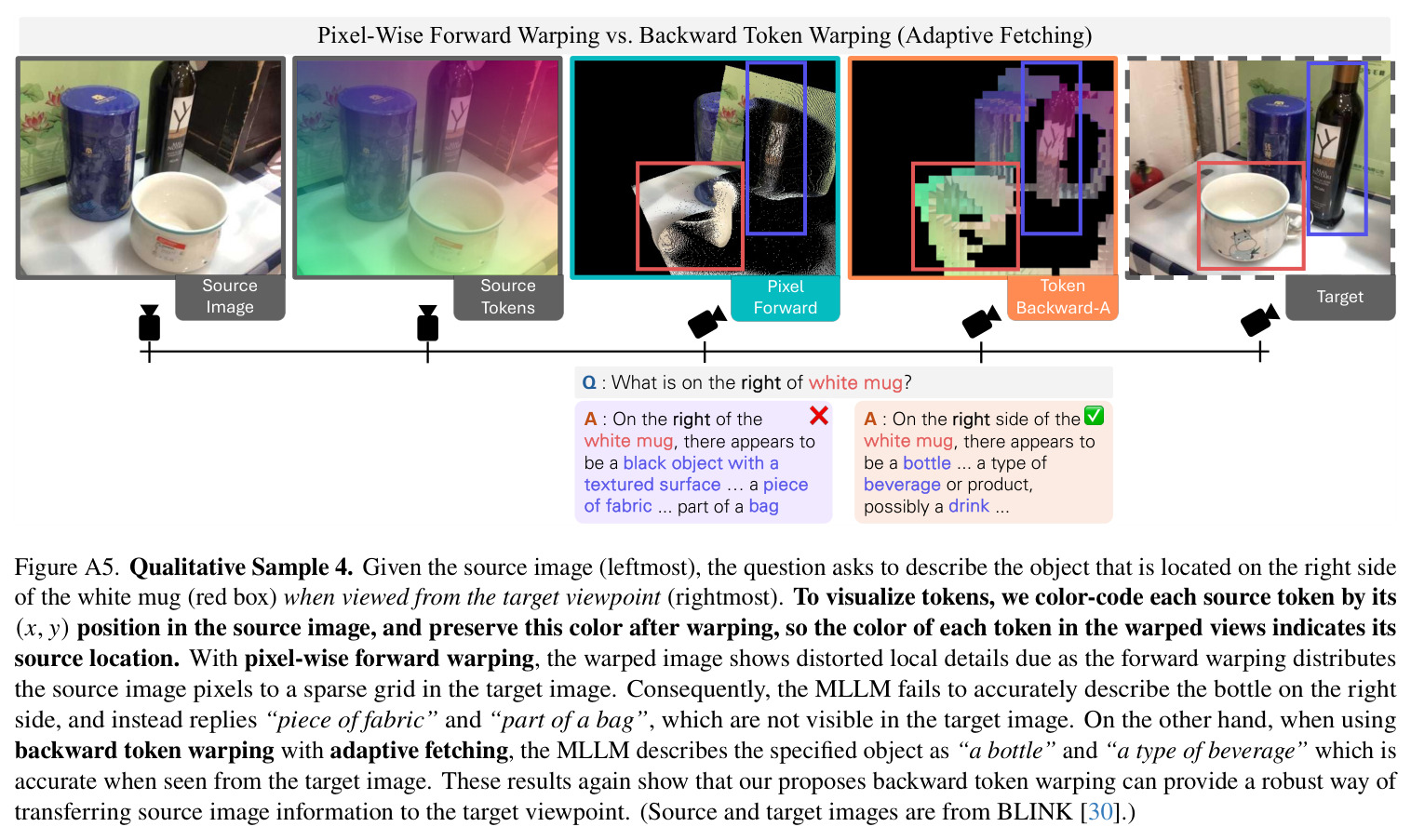
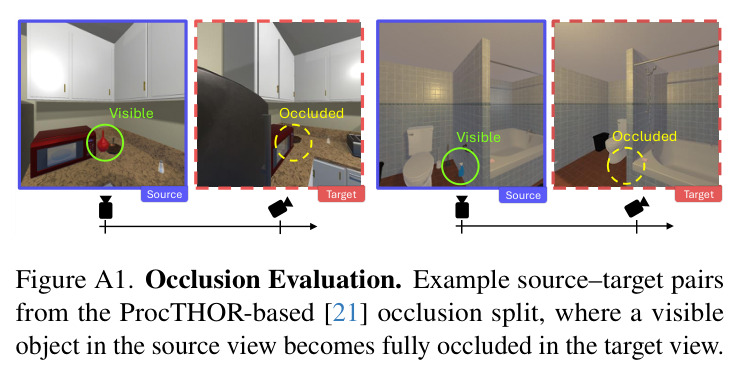
实验 1:取 token 位置扰动鲁棒性(Sec. 3.2, Fig. 5)——在 CV-Bench-2D VQA 上,Qwen2.5-VL 在最大位移 0–20 像素下准确率几乎持平,曲线只在 19–20 像素出现轻微下降;而同样扰动幅度的像素级 baseline 立刻退化,从一开始就明显低于 token。实验 2:ViewBench 空间推理(Tab. 1)——这是核心定量结果。在最难的 5–15% 重叠区间,Backward-Adaptive 拿到 ViewBench-Text 77.89%、ViewBench-Shape 67.44%(GT depth),相比 VLM-3R(63.82% / 49.22%)分别高 14.07 和 18.22 个百分点;相比 SpatialReasoner(46.73% / 33.72%)的提升更夸张,达到 31 和 34 个百分点。Backward-Nearest 紧随其后(74.87% / 67.44%),且不需 re-patchify,推理开销更小。Forward token warping 在同区间只有 60.30% / 55.04%,明显低于 backward,证实了目标规则网格的必要性。实验 3:目标视图物体描述(Tab. 1 列 14–19)——Qwen2.5-14B 评分(1–10)下,Backward-Adaptive 在 25–35% 重叠区间达到 6.11(GT)和 6.14(估计深度),明显高于像素级 backward(5.94 / 5.89)和 GenWarp(4.34)。实验 4:估计几何鲁棒性(Tab. A2)——用 Depth Anything v2 / Depth Pro / VGGT 估计深度时,token warping 仍保持 65.84 / 67.74 / 68.95% 的 ViewBench-Shape 平均精度,比像素级 warping(60.49 / 62.76 / 63.58)高 5–6 个百分点,且都大幅超过 no-warping baseline(31.48%)。实验 5:极端视角(Tab. A3)和遮挡(Tab. A4)——在 2–5% 极低重叠的 ScanNet 拆分上,token warping 仍达 65.08%(GT)和 66.14%(估计),像素级仅 61.90% / 61.38%;ProcTHOR 遮挡场景下 token 46% vs 像素 38% vs 原版 Qwen2.5-VL 32%,趋势一致。实验 6:定性与几何 oracle(Fig. 8、Tab. A5)——可视化显示像素级 warping 把书脊变形成像素化白色块,导致 VLM 回答 a piece of fabric / part of a bag;token warping 则保持原物体结构,回答 a bottle ... ketchup。Geometry-based oracle 在所有重叠区间都达到 93–95%,证实剩余差距来自 MLLM 感知/推理而非几何。
查看结构化数据
| 任务 | 指标 | 本文 | 基线 | 提升 |
|---|---|---|---|---|
| ViewBench-Text (5-15% overlap, GT depth) | Left/Right 准确率 (%) | 77.89 (Backward-Adaptive) / 74.87 (Backward-Nearest) | 63.82 (VLM-3R) / 46.73 (SpatialReasoner) / 46.23 (Qwen2.5-VL) | +14.07p vs VLM-3R, +31.16p vs SpatialReasoner |
| ViewBench-Shape (5-15% overlap, GT depth) | Left/Right 准确率 (%) | 67.44 (Backward-Adaptive/Nearest) | 49.22 (VLM-3R) / 33.72 (SpatialReasoner) / 24.42 (Qwen2.5-VL) | +18.22p vs VLM-3R, +43.02p vs Qwen2.5-VL |
| ViewBench-Text (25-35% overlap, GT depth) | Left/Right 准确率 (%) | 78.86 (Backward-Adaptive) | 60.57 (VLM-3R) / 53.71 (SpatialReasoner) / 75.63 (Pixel Backward) | +18.29p vs VLM-3R, +3.23p vs pixel-level backward |
| ViewBench-Object (25-35% overlap, GT depth) | Qwen2.5-14B 1-10 评分 | 6.11 (Backward-Adaptive) / 6.19 (Backward-Nearest) | 5.94 (Pixel Backward) / 4.34 (GenWarp) / 3.22 (Pixel Forward) | +0.17 vs Pixel Backward, +1.85 vs GenWarp |
| ViewBench-Shape (estimated depth, DA-v2 / Depth Pro / VGGT) | 平均准确率 (%) | 65.84 / 67.74 / 68.95 | 60.49 / 62.76 / 63.58 (Pixel-Wise Warp) / 31.48 (No-warp Qwen2.5-VL) | +5.35 / +4.98 / +5.37 p over Pixel Warp; 30+p over no-warp |
| Extreme 2-5% overlap (ViewBench-Shape, ScanNet) | 准确率 (%) | 65.08 (GT) / 66.14 (estimated) | 61.90 / 61.38 (Pixel Backward) / 34.39 (Qwen2.5-VL) | +3.18p / +4.76p over Pixel Backward |
| ProcTHOR 全遮挡场景 | 准确率 (%) | 46.00 (Token Warp, GT depth) | 38.00 (Pixel Warp) / 32.00 (Qwen2.5-VL) | +8p vs Pixel Warp, +14p over base MLLM |
局限与改进
作者承认的局限:(1) 评测范围受限于 ScanNet、ARKitScenes、ProcTHOR、DL3DV-10K、BLINK 等室内或近距离数据,没有验证室外大场景或剧烈视角变化(>60°)下的行为;(2) 论文承认 token warping 仍依赖深度图估计,在深度图大范围缺失(玻璃、镜面反射、远景)时效果会退化,但未给出量化分析;(3) 与 SFT/RL 微调后的 specialist MLLM 对比时,作者也承认这些模型在跨数据集泛化上仍可能更强,本文未做跨域测试。我观察到的额外局限:(1) viewpoint 范围窄——重叠区间仅覆盖 5–35% 加极端 2–5%,没有测试大角度旋转、纯平移、纯缩放等典型运动分量,导致方法在 general navigation/embodied 场景的可移植性未知;(2) 遮挡完全失败——Tab. A4 的 ProcTHOR 全遮挡场景下即使 token warping 也只有 46%,远低于 5–15% 区间 65–67%,说明 token warping 本质是搬运源图内容,无法对源中不可见区域做合理补全,这与其 NVS-free 的定位一致;(3) 依赖目标网格与源图同分辨率假设——Sec. B.2 明确写 we assume the target image has the same resolution as the source,真实应用中如果目标视角分辨率变化(如用户指定不同焦距/视场),需要重做网格尺寸设定;(4) 评测规模偏小——ViewBench-Text 仅 571 题、Object 仅 300 题,对小样本波动敏感;(5) 缺乏真实部署开销数据——文中仅说 minimal inference-time computation,但未给出 forward/reverse ray cast、re-patchify 的具体延迟与显存占用,对实时机器人决策等场景的可落地性未知。
独立分析的弱点
弱点 1:仅适用于邻近视角——backward token warping 假设源图能看到目标视图的大部分内容;当视角变化大、目标视图有大量源图未覆盖区域时(如 360° 旋转 90° 后的另一面墙),所有 backward-warped 坐标要么落在源图外,要么命中错误内容。改进方向:可与扩散式 NVS(如 GenWarp)混合,对 warping 命中失败的区域触发局部 inpainting;或者先用 VGGT/DUSt3R 重建稀疏 3D,再决定哪些区域用 token warping、哪些用 NVS。弱点 2:依赖高质量深度——即使 token 比像素更鲁棒,本质上仍受 $D$ 误差影响。Tab. A2 显示从 GT 70.99% 降到 DA-v2 65.84%,绝对值 5p+ 的下降在安全敏感场景不可忽略。改进方向:可以引入 depth uncertainty 估计,对低置信度区域降权或融合多帧深度(NeRF-style 的多视角一致性正则),或把 warping 与 monocular 3D 重建结合(类似 MonST3R)以获得更稳的 3D proxy。弱点 3:网格与位置编码耦合——adaptive fetching 虽然更精确,但需要重新 patchify 整张图并重新计算位置嵌入,与 ViT 训练时的固定网格不严格一致;nearest fetching 又会因为取错相邻 token 在剧烈深度变化处失真。改进方向:探索 deformable attention(Deformable DETR 类)让 token 取样位置可微学习;或对 backward warping 后的 token 加一层 learnable refinement adapter,但需注意不破坏 MLLM 通用能力。弱点 4:评测场景单一——所有定量结果都来自室内 ScanNet 衍生数据。改进方向:补充室外街景(KITTI、nuScenes)、动态场景(Waymo、Ego4D)、艺术/抽象场景的测试,验证方法对非刚性对象、纹理贫乏区域、强烈光照变化下的鲁棒性。
未来方向
作者明确提出的方向:(1) 论文 Conclusion 与 Sec. 5 都强调 backward token warping 是对认知科学 part-level mental imagery 的工程实现,未来可探索 token warping 与 LLM 推理链结合(如 CoT prompting 在 warp 后再让模型自检);(2) 与 generative warping(GenWarp)的混合方案已在前文 Sec. A.3 部分隐含,作者暗示可以在 token 搬运失败时回退到 NVS。基于成果可延伸的方向:(1) 多帧输入——把单图扩展到多源图 backward token warping,相当于在 target grid 上做多视角 token 融合,类似 NeRF 的多视角一致性,可处理更大视角变化;(2) 视频时序扩展——连续帧间复用 token warping 的几何代理网格 $M_S$,做成 video-as-token-stream 的 MLLM 推理加速,避免逐帧重新编码;(3) 3D-aware 预训练目标——把 backward token warping 作为预训练 augmentation:在训练时随机对图像做几何变换,让 MLLM 学会看 token 就能反推视角,理论上可以替代或补充现有 3D 注入式微调(Spatial-MLLM、VG-LLM 路线),且无需 3D 标注;(4) 机器人/导航落地——结合 VLN-R1、EmbodiedBench 等具身基准,把 token warping 作为 agent 在未知视角下的低成本 mental rotation 模块;(5) 与 diffusion 联合——把 warped token 作为 cross-attention 条件喂给图像生成模型,实现可控的 token-driven novel view synthesis,结合两者优势。
复现评估
开源情况:作者在文末给出 project page https://token-warping-mllm.github.io/,并在论文多处引用 ViewBench、ScanNet、Depth Anything v2、Depth Pro、VGGT、DUSt3R、GenWarp、Qwen2.5-VL 等成熟开源资源;没有显式声明代码仓库链接(论文中无 GitHub URL),但 viewBench 数据集、warping 函数(Eq. 3.1, B.4)描述详尽到变量级。数据规模:训练/评测完全基于已有数据集——ScanNet 提供 1613 个室内场景的 RGB-D + 位姿,Depth Anything v2 / Depth Pro 是开源的 monocular depth model,无需自行训练。算力需求:核心是推理 pipeline,不需训练,单卡 A100/A800 即可在数小时内完成全部 ViewBench 评测(571+744+300 题 × 17 个 baseline × 2 种 depth × 3 个 overlap 区间)。复现难度:中等偏低——需要实现 (a) 3D proxy mesh 构造(unproject + triangulate,约 50 行 PyTorch);(b) ray casting(推荐用 PyTorch3D 或 nerfacc,约 100 行);(c) nearest/adaptive token fetching(两段 indexing 代码);(d) 与 Qwen2.5-VL-7B 的 token-level 接口对接(参考 HuggingFace transformers + 一个 custom vision encoder wrapper)。潜在坑点:(1) target grid 的 patch size $l$ 必须与底座 ViT 完全一致(Qwen2.5-VL 用 14×14 patch、448×448 输入、1024 tokens),改分辨率需重新校准;(2) ScanNet 的 overlap 计算公式 Eq. C.6 依赖完整 3D 点云与可见性判断,需要预先 unproject 所有帧;(3) ViewBench-Object 评测依赖 Qwen2.5-14B 作为 LLM-judge,prompt 模板(Sec. C.2)必须严格照抄以保证可比性。
论文图表
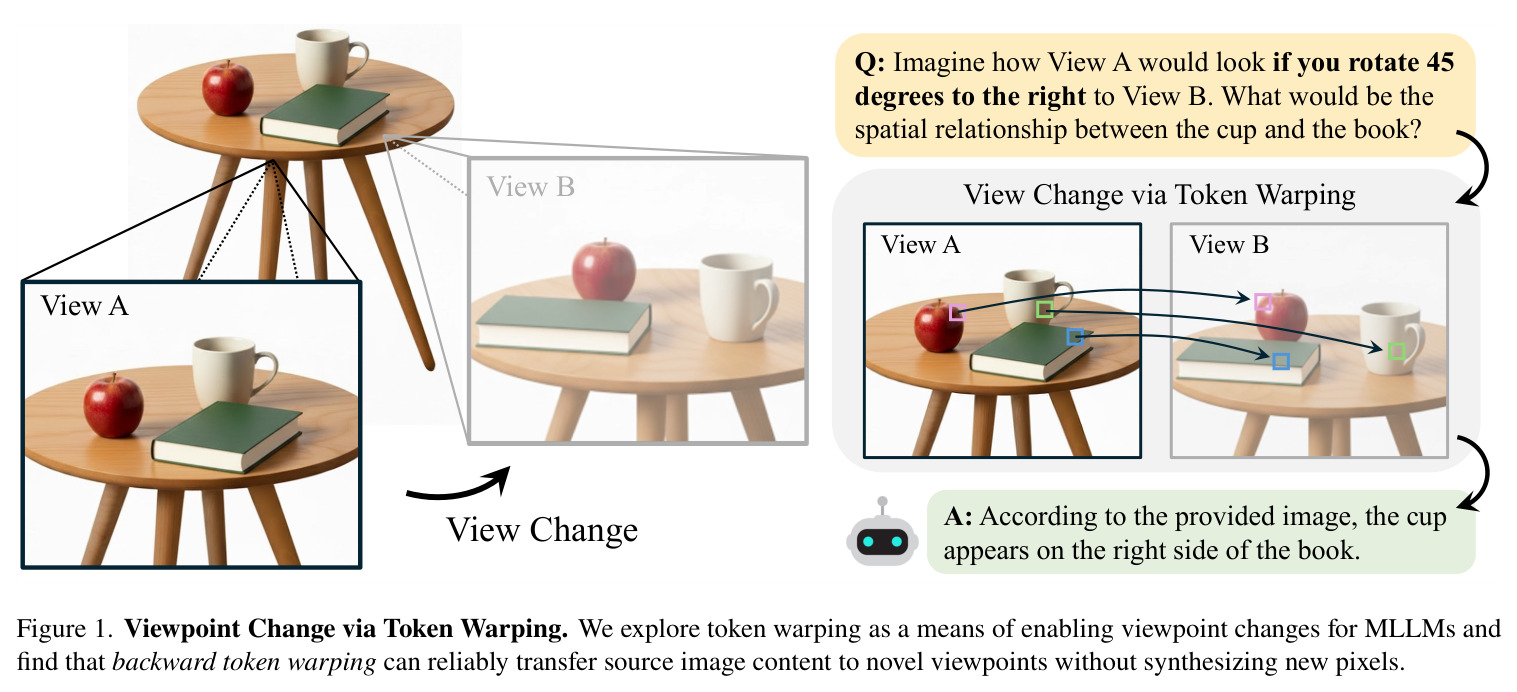
顶部为论文核心 motivation:给一张 View A 的厨房图(左下)配一段相机运动描述(rotate 45° to the right),向 Qwen2.5-VL 提问从 View B 看,杯子和书的空间关系是什么。右侧是 token warping 后的 View A(中间)和 View B(warped 结果)。模型给出正确答案 cup appears on the right side of the book,对应 GT。
整篇论文的 teaser figure,一句话传达三个关键信息:(1) 任务是从单图+相机运动描述生成目标视角下的空间关系回答;(2) 解决方法不合成新像素,只搬运 token;(3) 搬运后 MLLM 能正确回答。读者第一眼就能 get 论文的卖点。
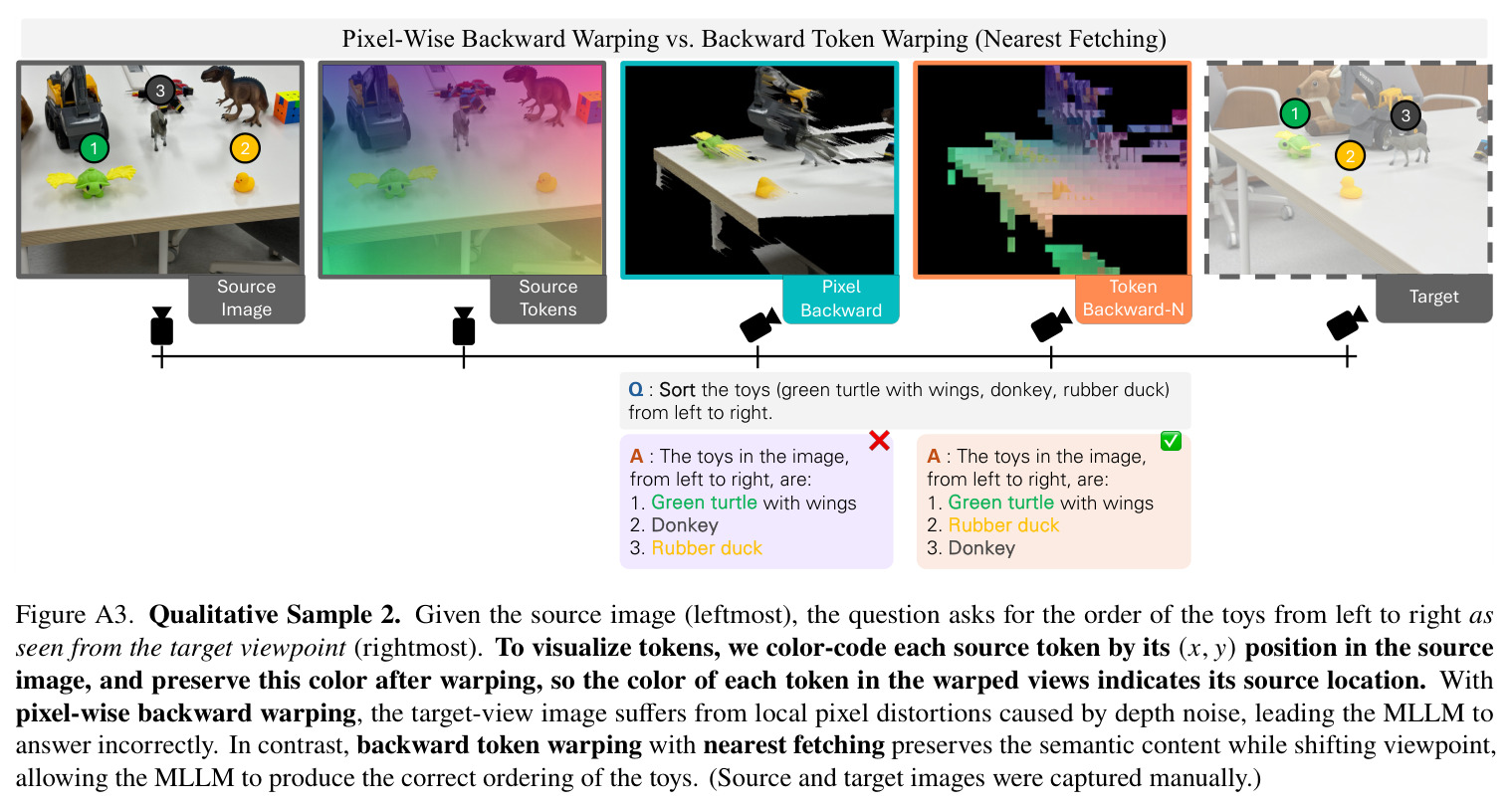
上下两行对比 forward / backward 像素 warping 的失败案例:源图是 View A(包含一本边缘清晰、带文字的书的特写);warped 后红色框内书的边缘出现明显锯齿、几何拉伸和空洞——forward 在目标视图留下大块未覆盖区域,backward 把书脊的文字和图案扭曲成模糊的色块。
直接给出像素级 warping 的失败证据,铺垫为什么要在 token 空间做的论点。与 Fig. 8 的对比实验呼应,是 Sec. 3 引出 token warping 的关键 visual motivation。