← 返回 2026-03-25

推理还是修辞?大语言模型中道德推理解释的实证分析 Reasoning or Rhetoric? An Empirical Analysis of Moral Reasoning Explanations in Large Language Models

Aryan Kasat, Smriti Singh, Aman Chadha, Vinija Jain 📅 2026-03-23 👍 3 2026-07-13 08:36
Kohlberg理论 LLM道德推理 模型对齐 行为评估

揭示LLM通过对齐训练获得道德修辞习惯但缺乏真实道德发展轨迹

前置知识

Kohlberg道德发展六阶段理论

Kohlberg提出的道德发展框架,将道德推理分为六个阶段。前习俗阶段(Stage 1-2)基于惩罚避免和自身利益,习俗阶段(Stage 3-4)基于社会期望和规则遵循,后习俗阶段(Stage 5-6)基于抽象原则和普遍伦理。正常成年人的道德推理分布以第4阶段为主(约50%),第6阶段罕见(约5%)。该理论在道德心理学中有良好表征的分布数据,可作为诊断基线。

本文将此框架作为方法学脚手架,利用其人类基线分布来诊断LLM的道德推理是否符合真实的发展轨迹,而非声称理论本身的真理性

Moral Ventriloquism(道德腹语术)

本文提出的核心假设,指模型通过对齐训练获得了成熟道德推理的修辞惯例,但这些修辞并不反映底层的发展轨迹。就像腹语者让木偶说话,模型能产出高阶段的语言,但缺乏相应的认知架构。这解释了为什么LLM会集中产出后习俗阶段的道德语言,却表现出道德解耦(高阶段理由配低阶段行动)和跨困境僵化一致性

这是本文对LLM道德能力现象的核心解释框架,理解该概念有助于把握整篇论文的诊断逻辑和核心贡献

Intraclass Correlation Coefficient (ICC)

组内相关系数,用于衡量不同评估者或不同条件下评分的一致性。本文使用两维混合效应模型ICC(3,1),将模型作为主体、困境作为评估者。ICC值在0.90以上通常被解释为极佳可靠性。在道德推理的应用中,高ICC意味着困境在阶段分配中解释的方差相对于模型均值可忽略不计

本文报告所有模型的ICC>0.90,这揭示了一个关键异常:LLM在语义不同的道德困境间产生逻辑上无法区分的响应,这违背了真实道德推理应有的情境敏感性

研究动机

现有研究对LLM道德推理能力存在根本性争议。一方面,现代LLM在面临道德困境时经常生成详细、听起来复杂的解释,引用人类尊严、社会契约和普遍权利等抽象原则,这些行为常被解释为模型具备真实道德推理能力的证据。另一方面,越来越多的研究提出了严重担忧:Turpin等人(2023)表明思维链解释可能系统性地误代表模型预测的实际原因;Chen等人(2025)发现即使是最先进的推理模型也经常生成不反映实际推理过程的推理痕迹;Kambhampati等人(2024)认为自回归LLM作为非真实记忆系统运作,思维链痕迹更应理解为学习的风格寄存器而非忠实 deliberation记录。这些担忧提出了一个核心挑战:如果模型可以生成类似推理的解释而不执行底层推理过程,那么仅基于模型输出的行为评估可能提供系统性的误导性能力图像。特别在道德领域,如果LLM确实通过规模和训练发展了道德推理能力,我们预期其输出应该反映人类观察到的发展轨迹:跨越情境变化、随规模进步、并汇聚于大多数人类成年人的第4阶段分布,而不是无论模型大小或训练程序如何都一致地聚集在最高阶段

本文的目标是本文的核心目标不是确定LLM是否具备真正的道德推理能力,仅靠行为评估无法回答这个问题,而是分析模型在道德困境中生成的推理解释以及这些解释在不同情境下的内部一致性。具体而言,本文通过对13个最先进LLM进行大规模实证研究,进行了十项定量分析来刻画这些解释的性质、鲁棒性和内部一致性。研究旨在回答六个具体研究问题:模型规模是否预测更高阶段的道德推理解释?提示策略是否系统性影响道德阶段?模型在不同困境间的阶段分配是否一致,这与人类道德变异性如何比较?LLM阶段分布是否类似人类发展规范?模型是否言行一致:陈述的道德推理是否与其产生的行动选择对应?规模是否独立于训练类型影响道德推理,还是训练类型一旦规模被控制就占主导地位?通过这些分析,本文希望揭示LLM道德推理输出的真实本质

与已有工作不同的是,本文的独特切入角度在于利用Kohlberg道德发展框架作为分布诊断工具,而非道德理论本身的真理性主张。虽然已有工作将LLM道德响应视为编码在LLM中的信念的直接证据,发现跨道德维度和模型存在实质性变化,但本文做出了更尖锐的区分:模型可能在调用哪些原则上不同,同时统一部署后习俗寄存器。已有研究衡量模型是否产生正确的道德输出,但不衡量这些输出是否反映底层推理轨迹。研究表明在显式道德理论基础上设定提示可提高分类准确性,但本文的Analysis 2得出了对比结论:即使是理论调用的角色扮演提示也不会显著改变阶段分布。与仅关注输出正确性或原则调用的研究不同,本文通过Kohlberg框架的人类基线分布,聚焦于发展阶段一致性、跨困境敏感性、行动-推理对齐等更深层的逻辑连贯性指标

核心方法

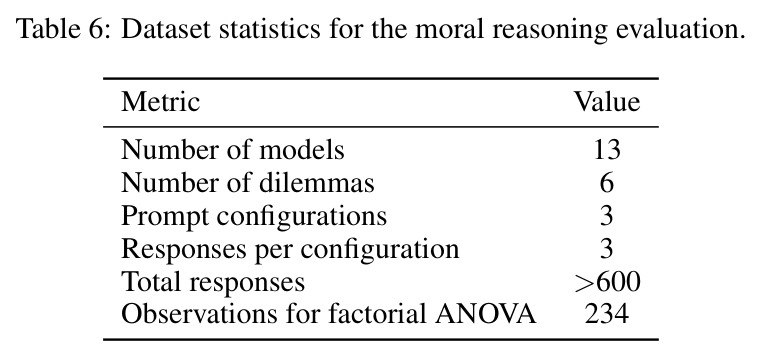
本文采用混合方法设计,结合LLM-as-judge分类管道、多困境测试、十项互补分析来系统评估LLM道德推理。方法论的核心直觉是:如果LLM真正发展了道德推理能力,其输出应该随规模变化、对提示做出响应、在不同困境情境间转移,并向人类发展分布汇聚。偏离这些预期中的每一个单独 suggestive,集体确定构成道德腹语术假设的证据基础。实验设计包括13个模型、6个经典道德困境、3种提示配置,每个配置3次响应,产生超过600个总响应。十项分析围绕统一的诊断逻辑组织:分布比较、跨困境一致性、行动-推理对齐、语言侧写以及规模和训练效应的因子分解

本文的核心创新是利用Kohlberg框架作为分布诊断工具,exploit 其良好表征的人类分布作为原则性经验基线,可以比较模型输出。与将Kohlberg作为道德真理的主张不同,本文将其作为方法学脚手架,使用人类基线分布作为诊断信号:系统偏离该基线就是诊断信号。这在概念上不同于仅评估模型输出是否正确或伦理上可接受的工作。此外,本文将道德能力与道德修辞解耦:通过TF-IDF关键词提取、PCA降维、ICC分析、行动-推理交叉制表和因子ANOVA等多样化技术,共同描绘出一幅连贯画面。最独特的贡献是识别并分析道德解耦现象:模型持续为低阶段行动选择产生高阶段理由,这是推理一致性的直接失败,独立于修辞复杂性

方法步骤详情

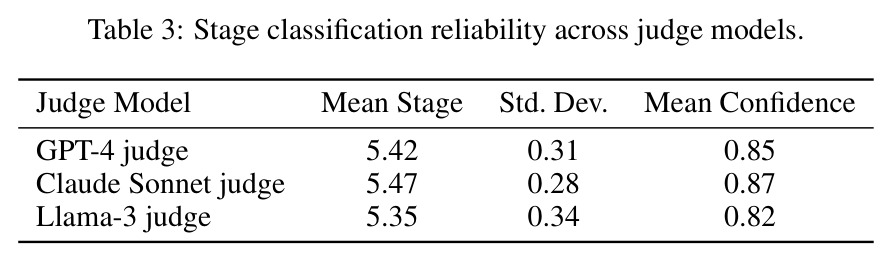
实验流程包含三个主要步骤。第一步是自动化评分管道构建:使用LLM-as-judge系统,其中评分模型被呈现每个模型响应并提示其根据Kohlberg框架进行分类。对于每个响应,评分模型输出主要Kohlberg阶段分配、分配的置信度分数以及证明分类的自然语言解释。管道还记录边界响应的次要阶段分配,enabling 分布不确定性分析。可靠性通过三个评分模型评估阶段分类来评估。第二步是困境和提示配置设计:六个经典道德困境被选择以跨越一系列道德维度,包括伤害、公平、财产、权威和忠诚。每个困境在三种提示配置下呈现:零样本提示、思维链提示、角色扮演提示。第三步是十项分析执行:首先建立规模-阶段关系和提示敏感性作为基线测试;然后检查跨困境一致性作为逻辑刚性的直接测试;与人类规范进行分布比较提供群体级测试;行动-推理对齐是核心逻辑连贯性测试;语言侧写识别训练制度指纹;因子分解在受控条件下解耦规模和训练类型的独立贡献。Analyses 7、9和10在附录中提供详细的机制细节

技术新颖性

本文的技术新颖性体现在多个层面。在方法论上,首次大规模利用Kohlberg框架作为分布诊断工具,exploit 其良好表征的人类分布来系统评估13个LLM的道德推理模式,这是迄今为止最大的Kohlberg基础评估。在分析技术上,十项互补分析构成多元证据链:分布比较、一致性分析、逻辑连贯性、语言分析、因子分解以及子能力阈值检测。在概念贡献上,首次系统识别和量化道德解耦现象:高阶段理由配低阶段行动的系统性不一致,这是推理一致性的直接失败,独立于修辞复杂性。此外,通过编码调优模型和推理调优模型作为部分控制条件,能够部分区分RLHF和推理训练的机制差异。这些多元技术的结合使得本文能够超越仅关注输出正确性的传统评估,深入探究道德推理的内部逻辑结构

实验结果

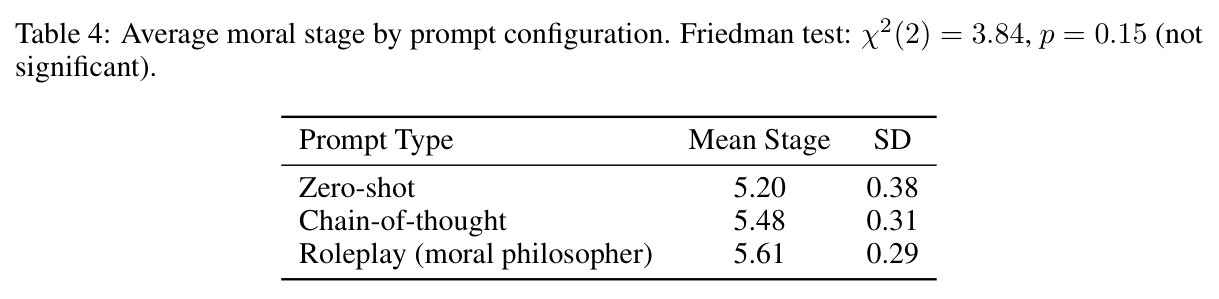
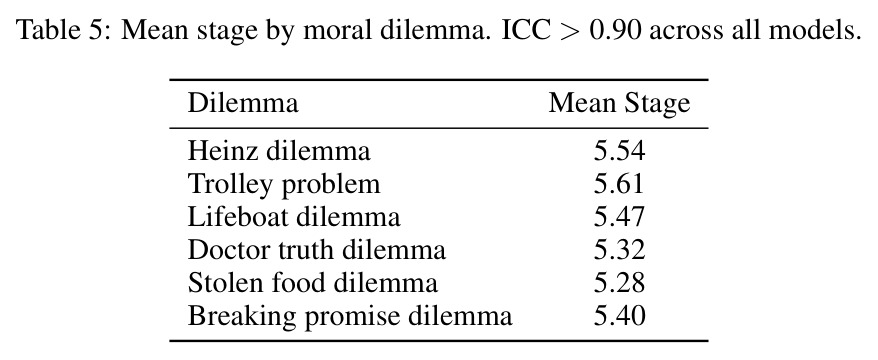
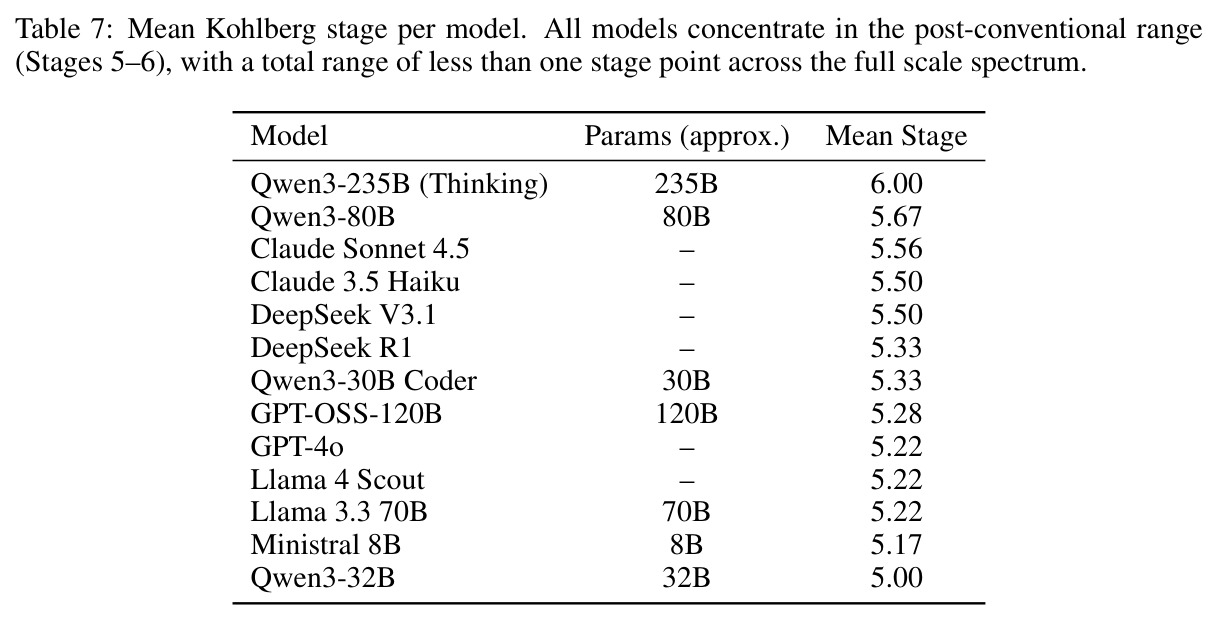
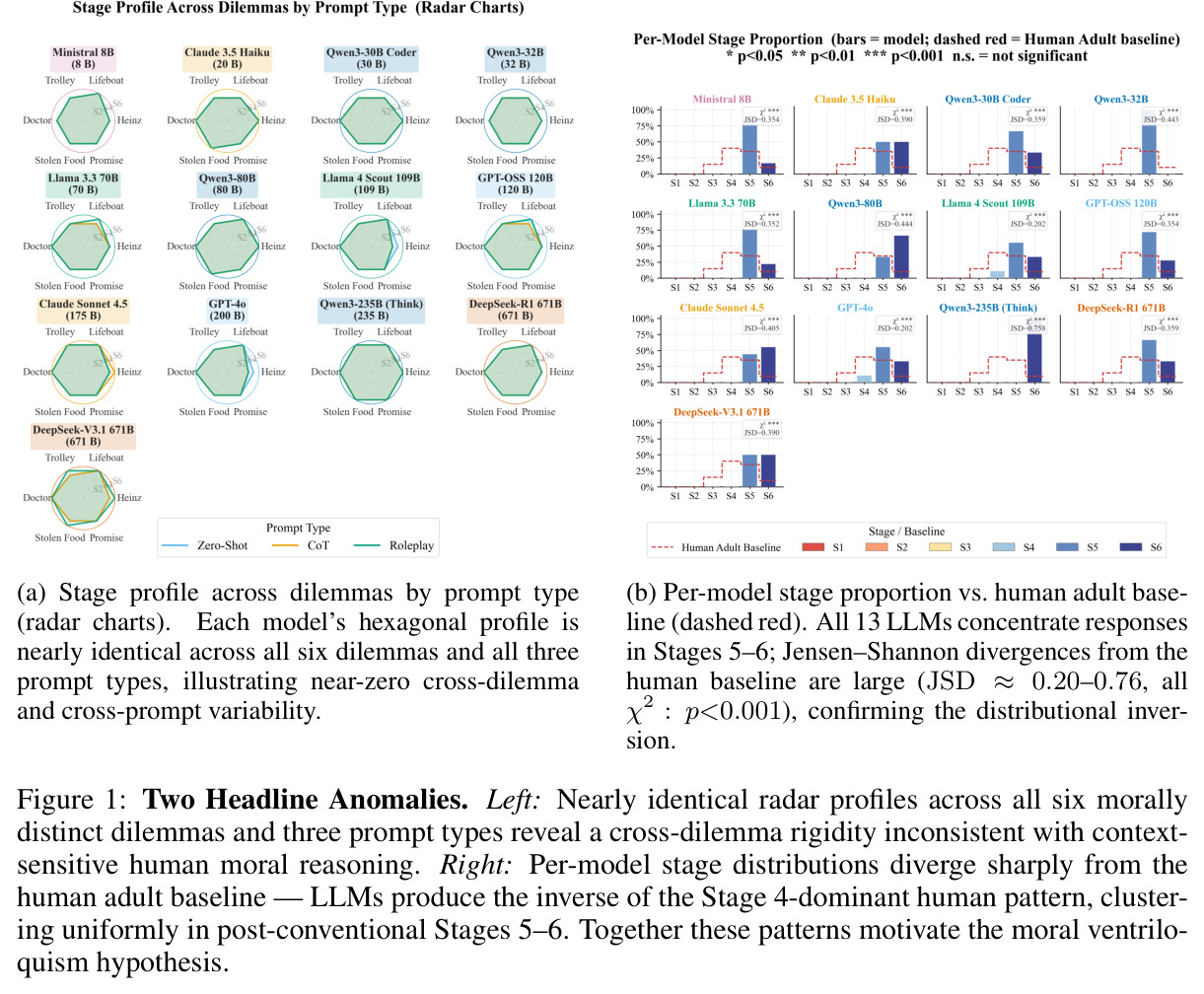
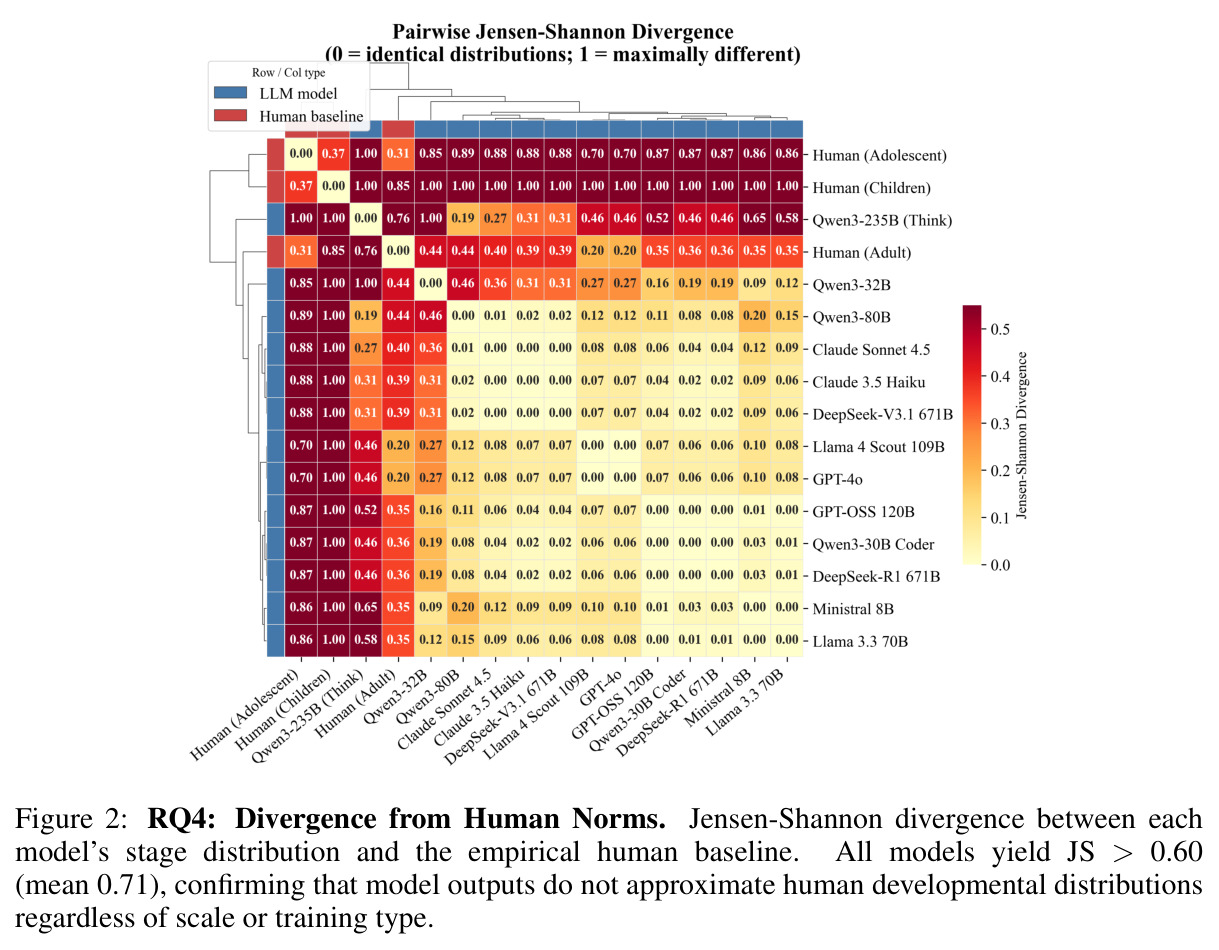
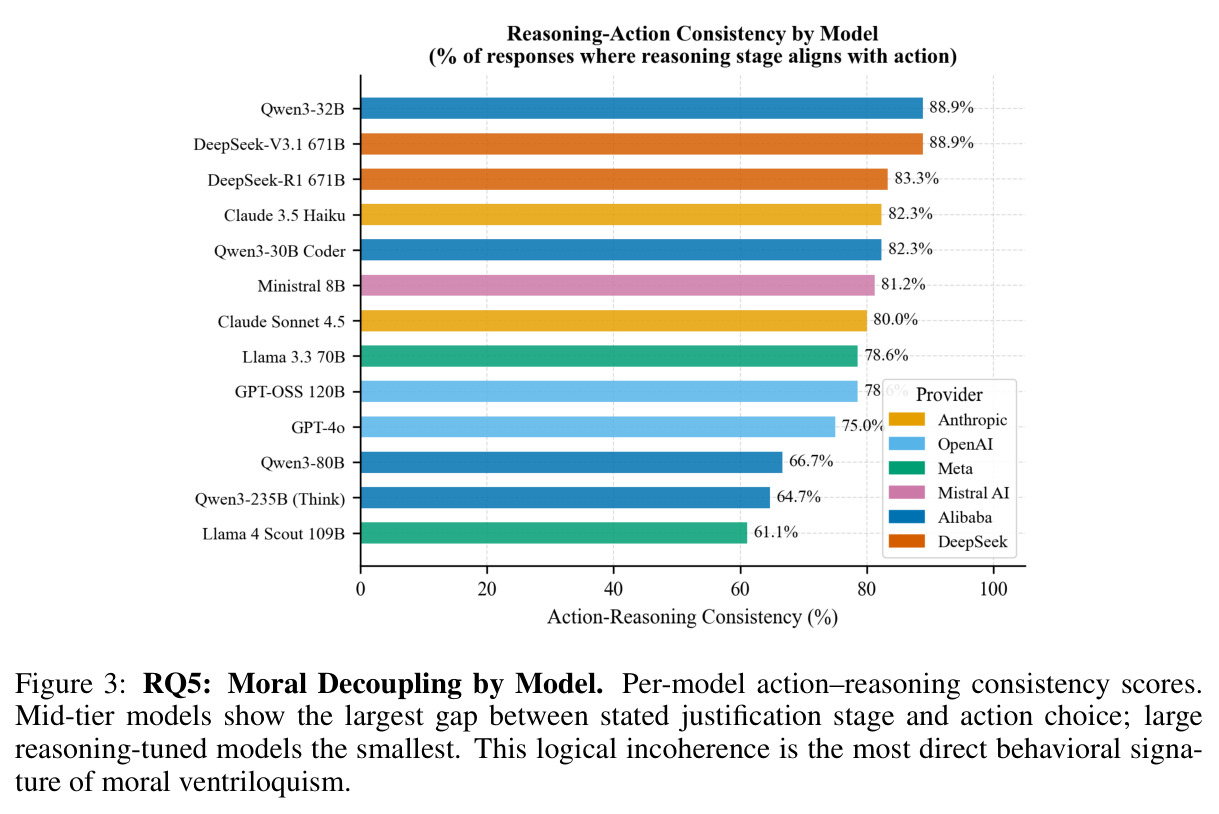
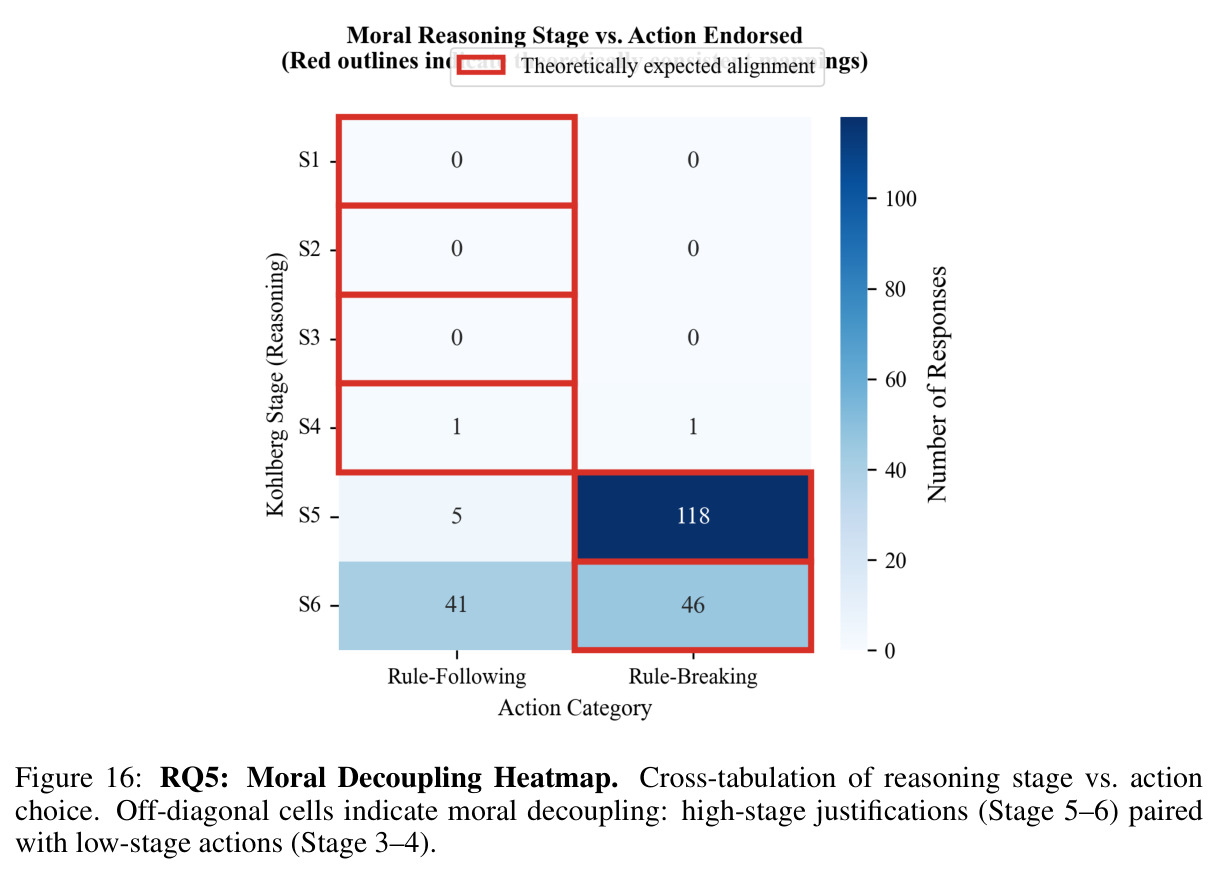
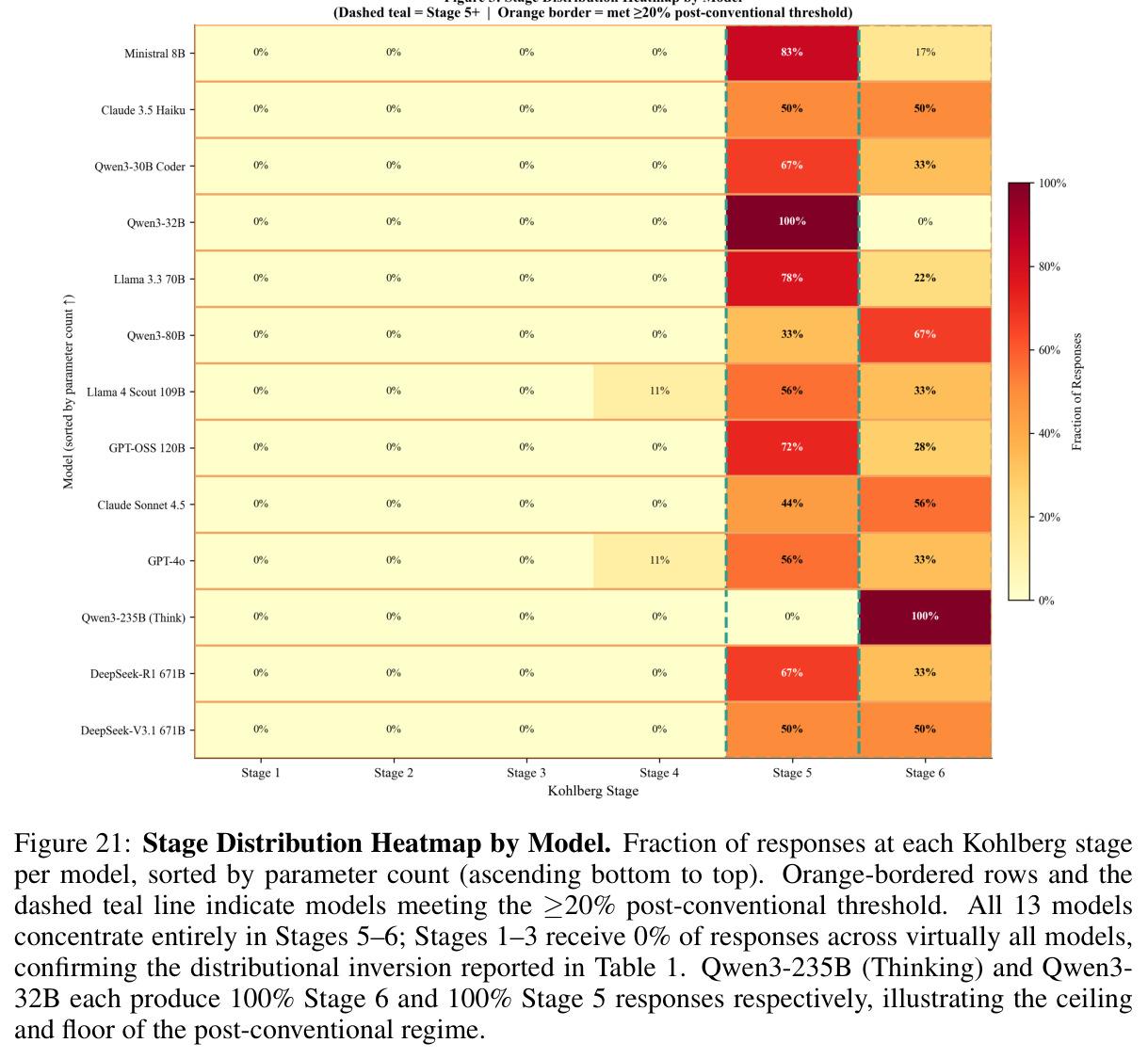
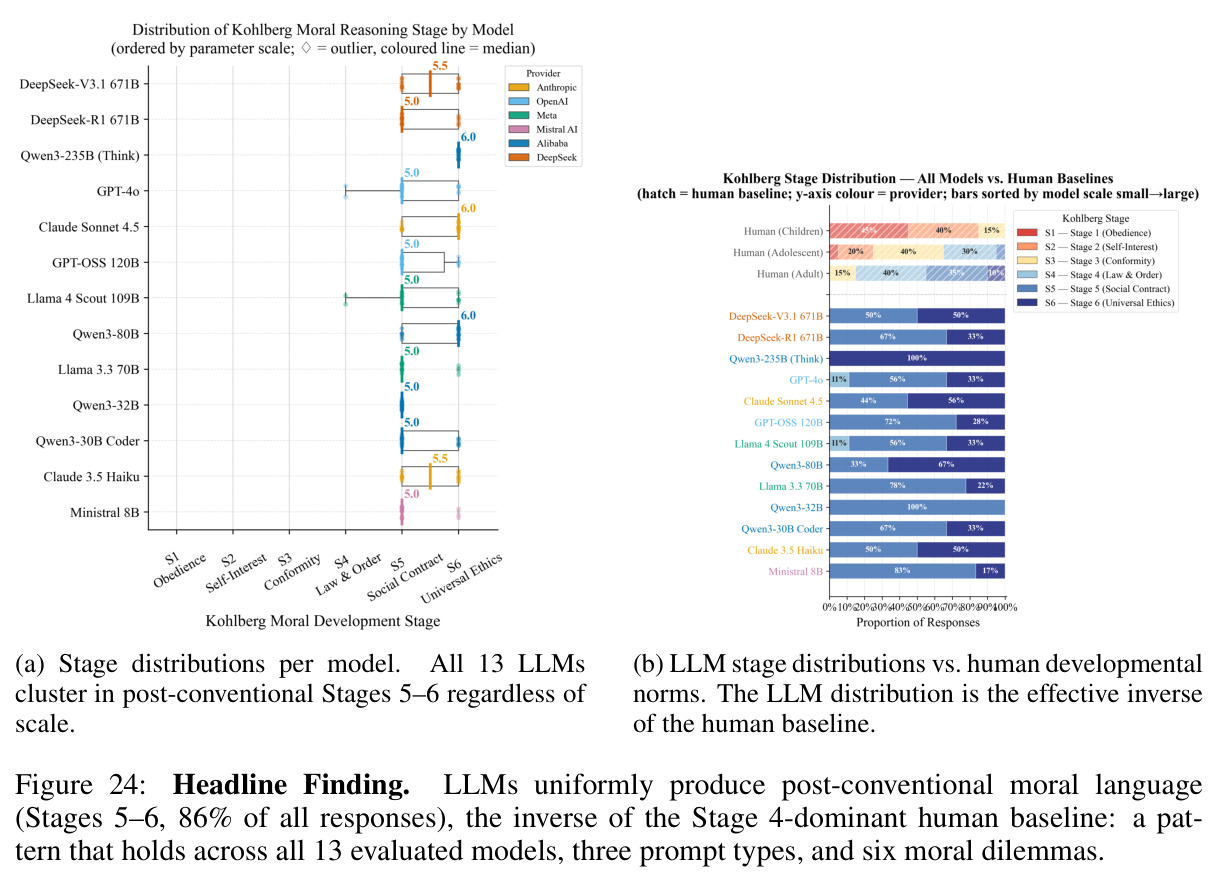
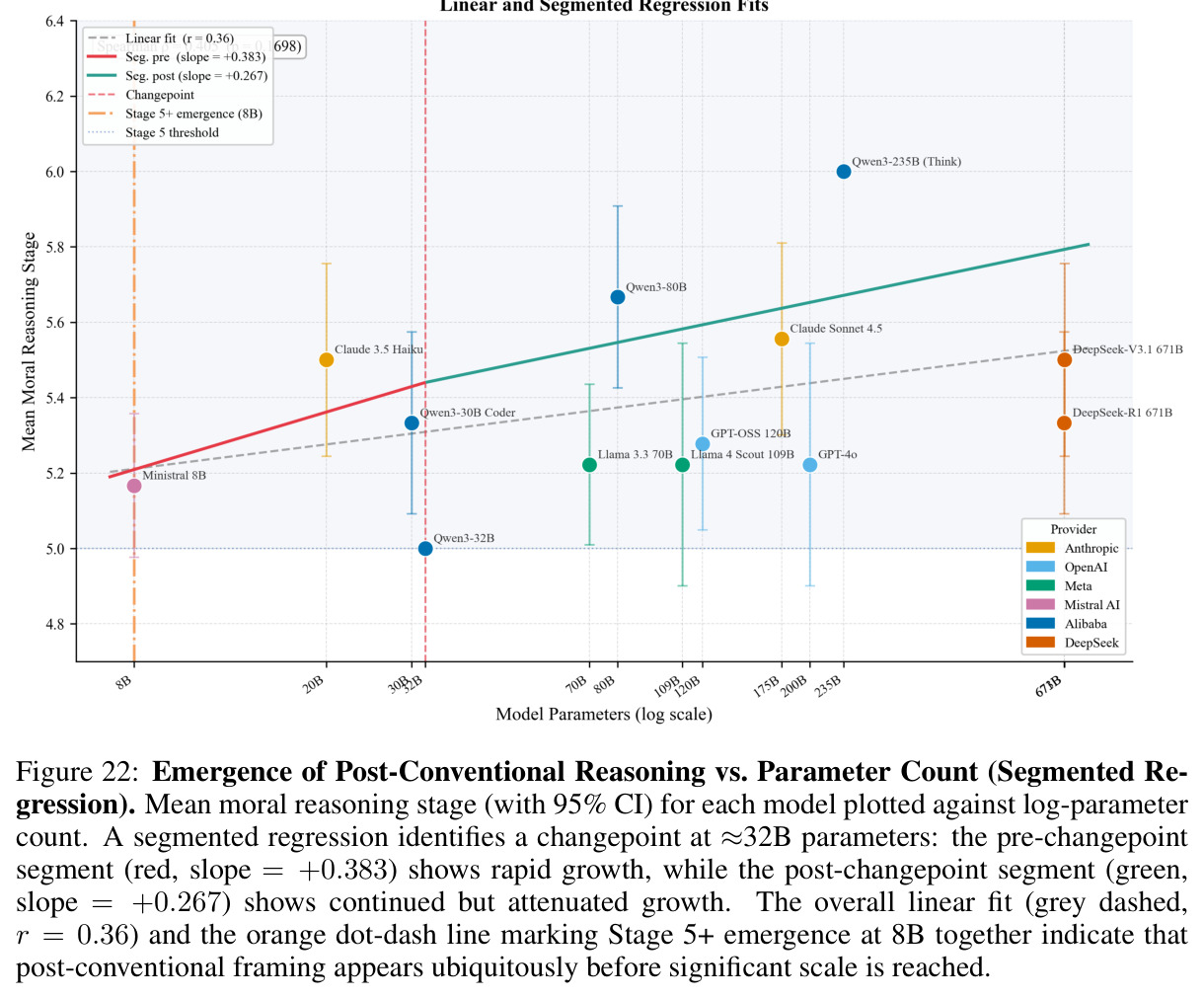
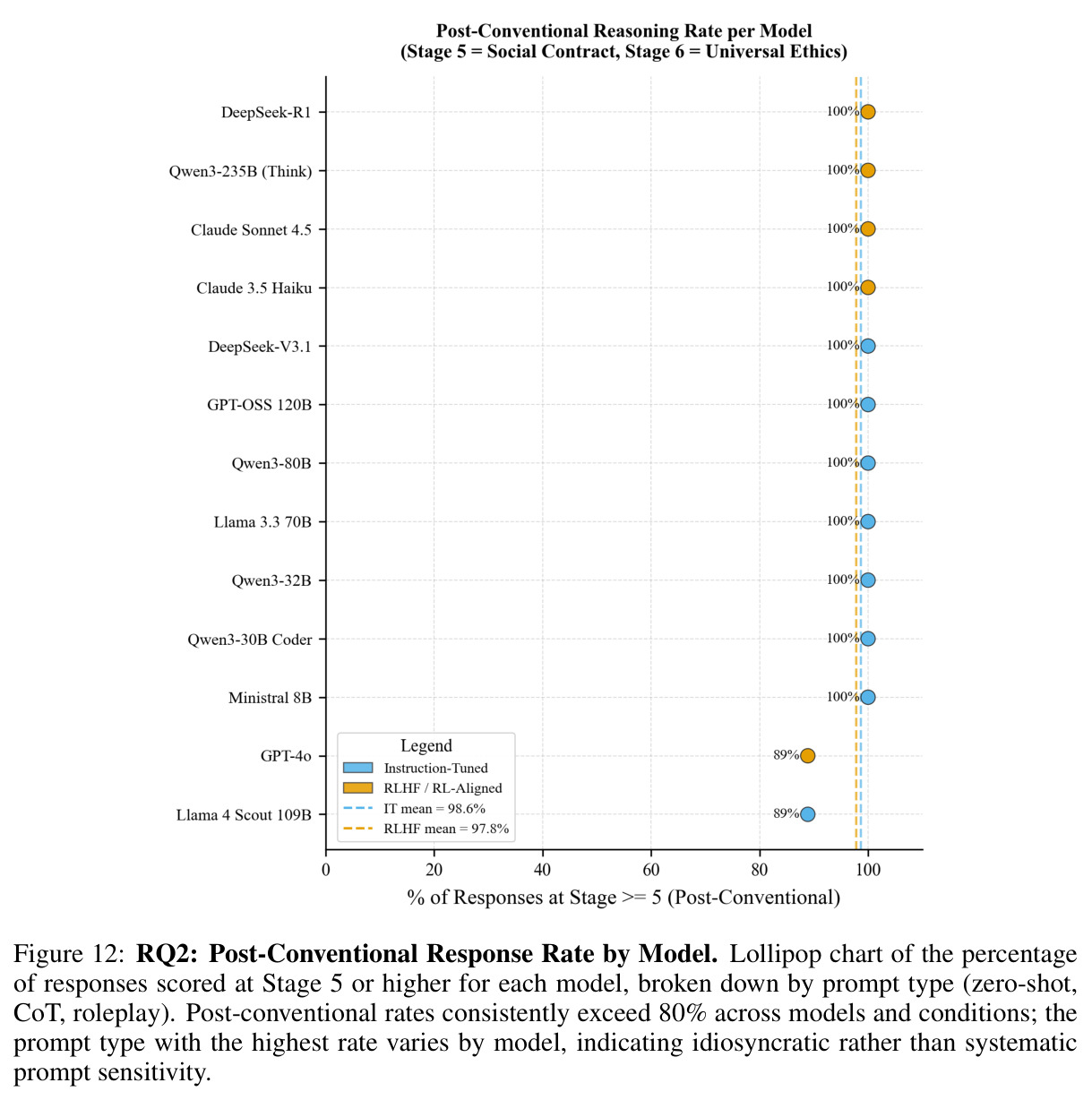
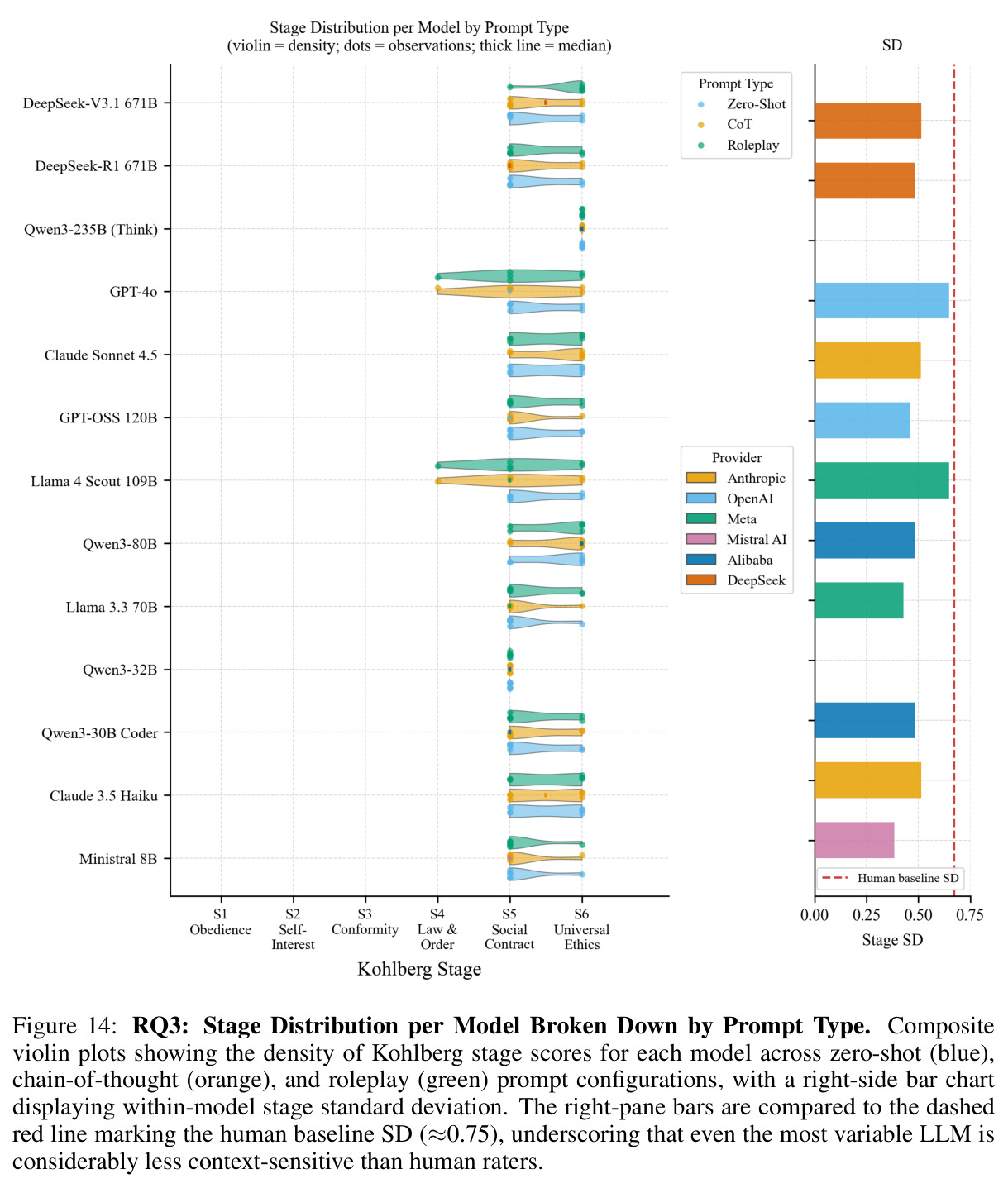
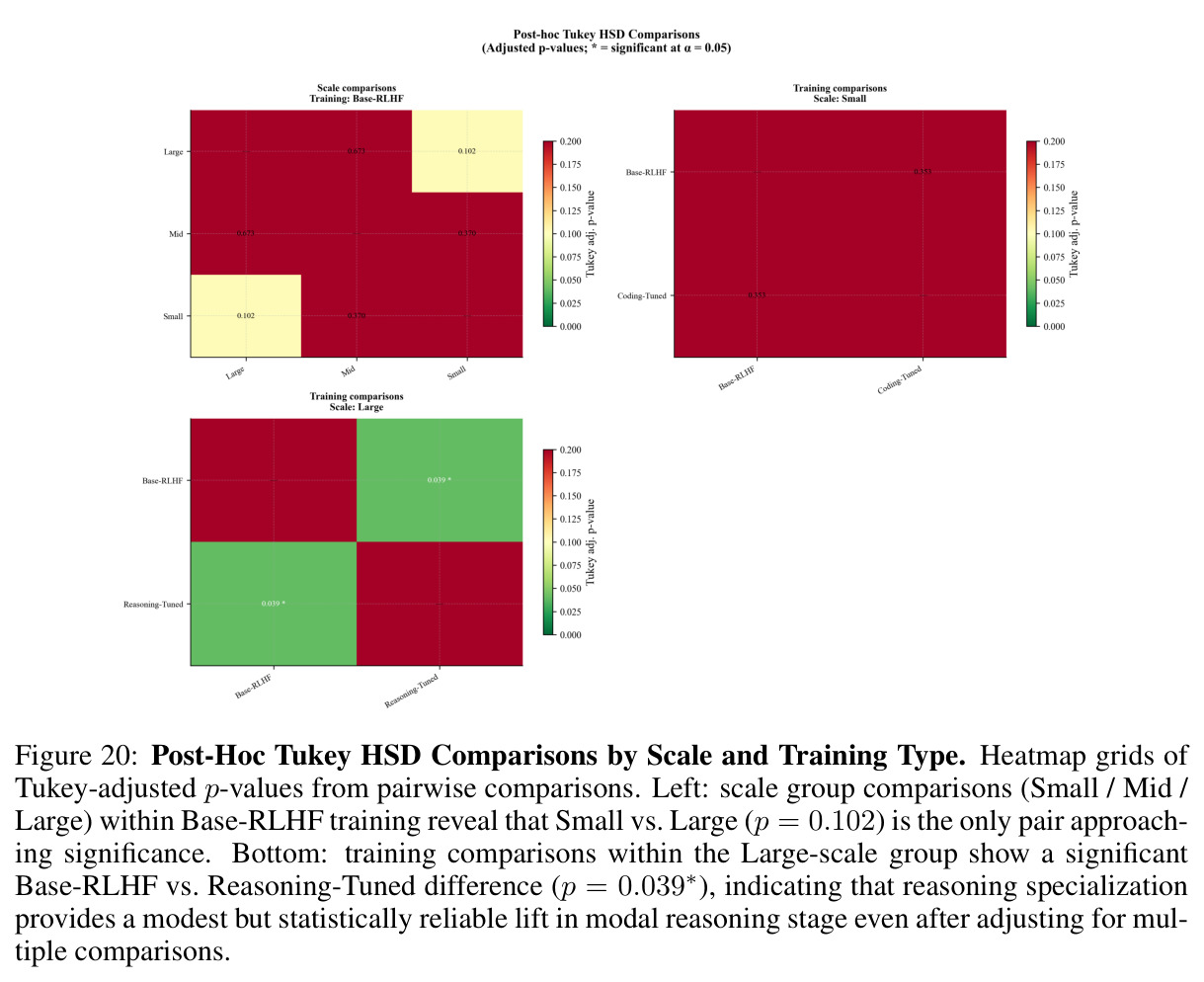
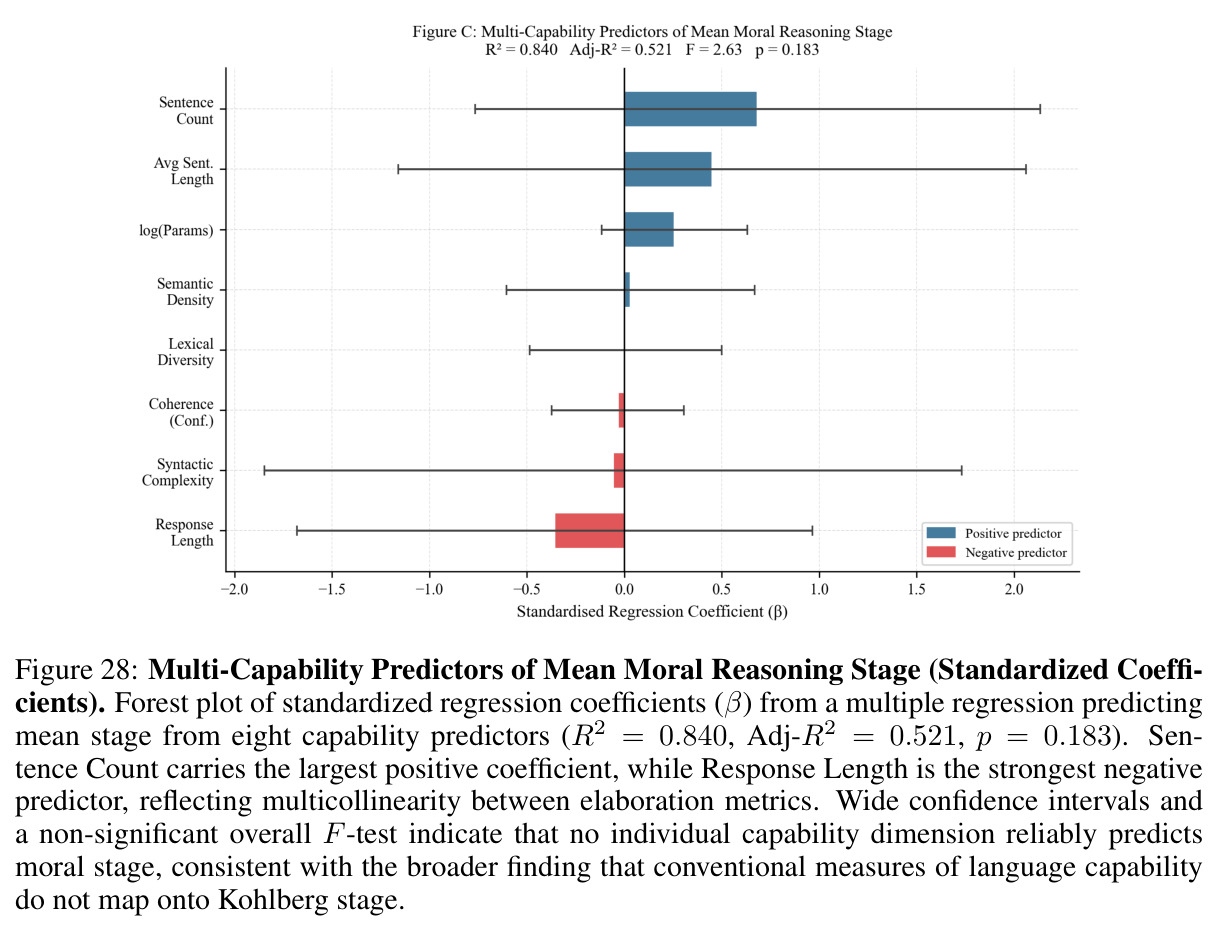
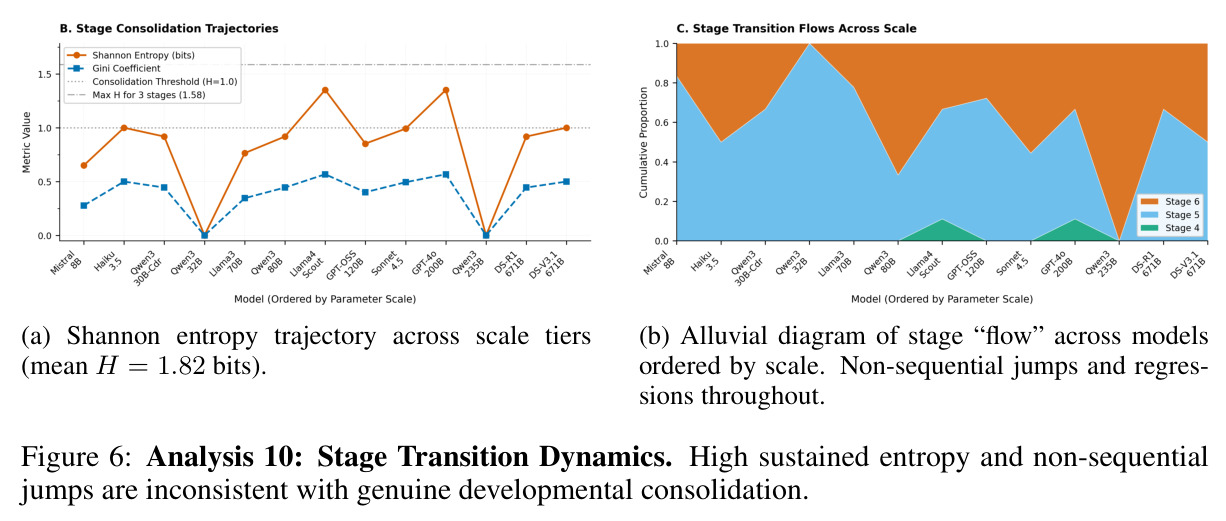
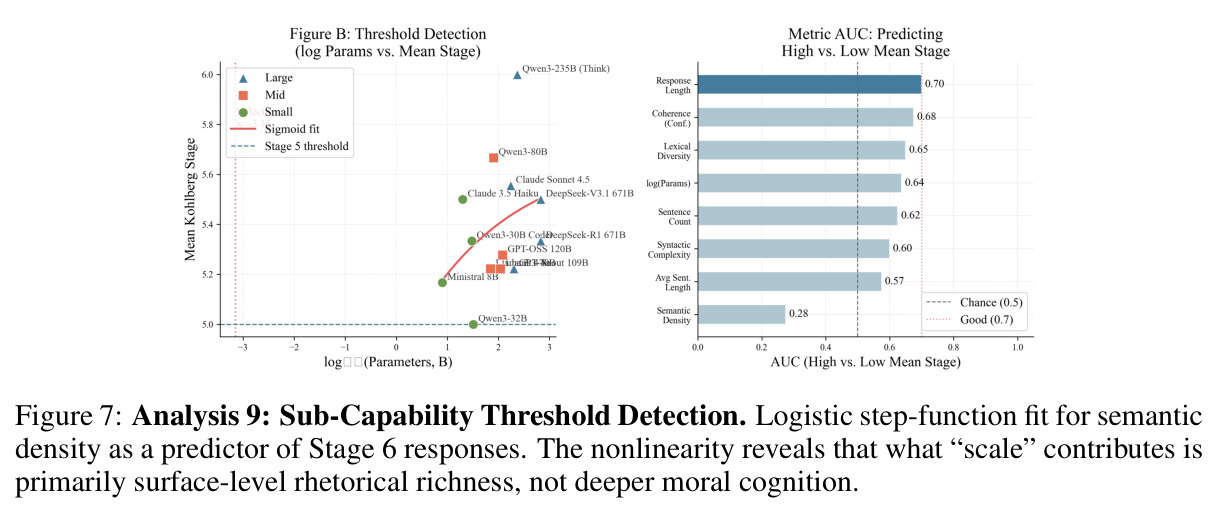
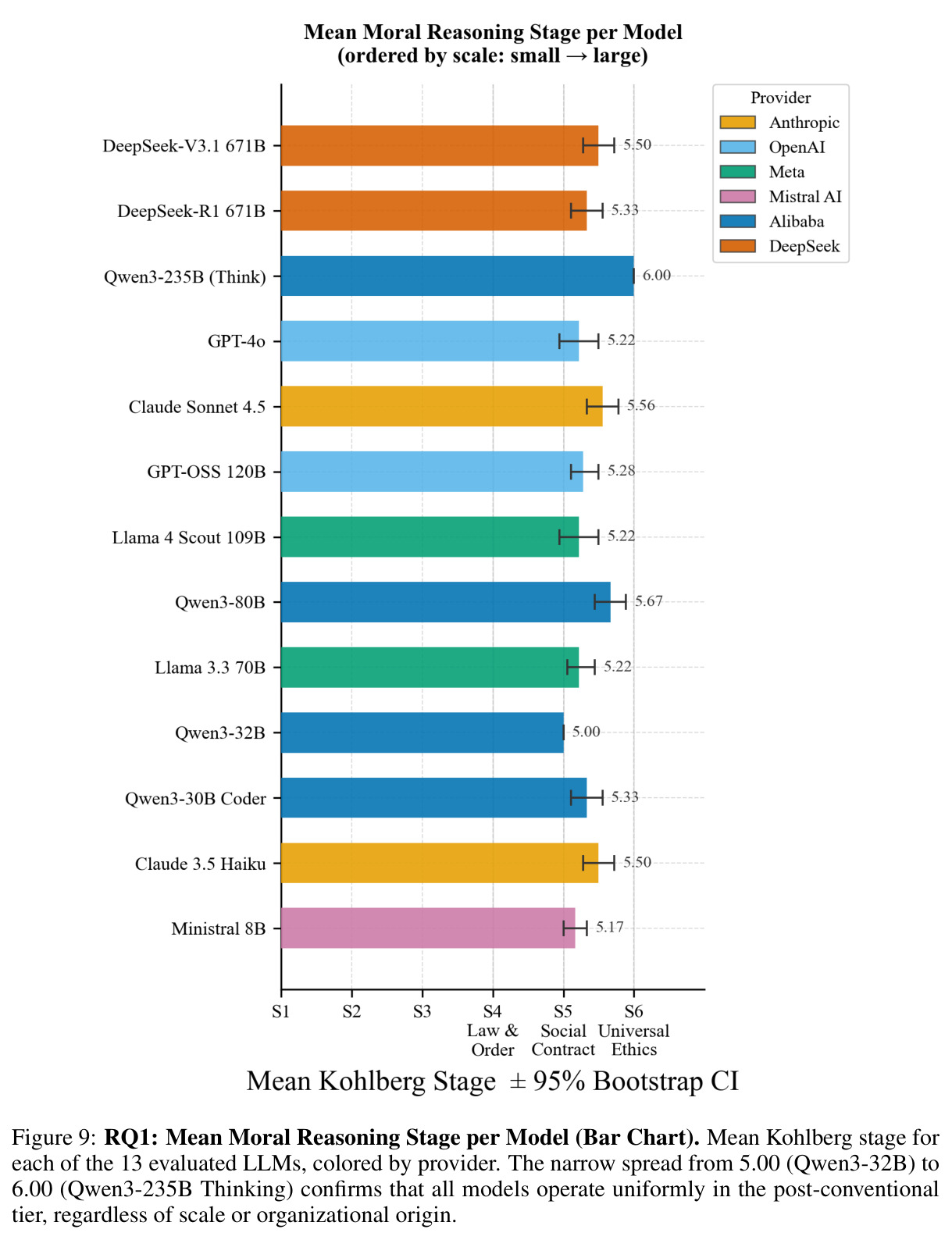
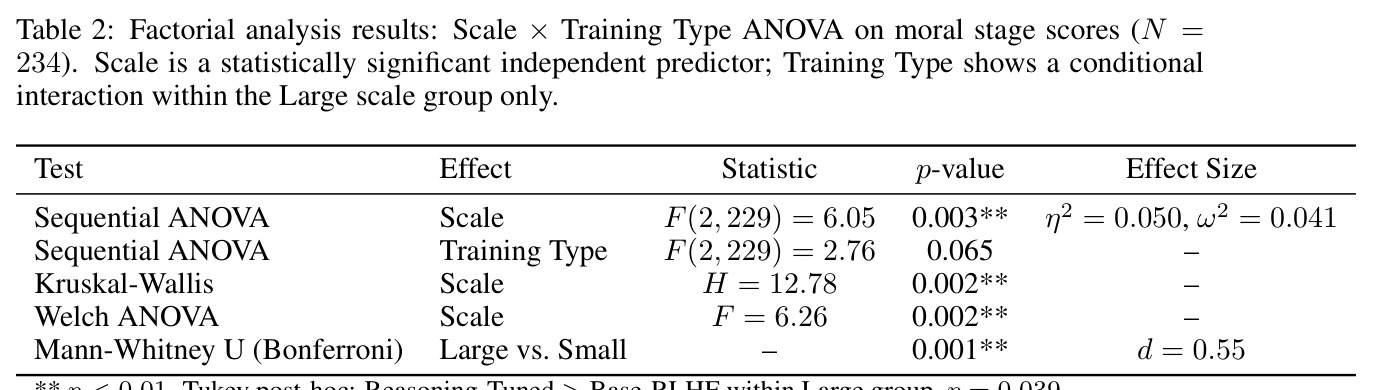
十项分析揭示了一系列令人震惊的发现。首先,规模与道德阶段的关系显示中等正相关(Spearman rho = 0.52, p < 0.05),但趋势在约70B参数后显示出明显的边际递减,整个模型集的平均阶段跨越不到一个完整阶段点:从5.00到6.00。即使是最小评估模型(Ministral 8B,平均阶段5.17)也主要产生后习俗推理。提示策略影响方面,重复测量Friedman检验产生无统计显著差异(chi2(2) = 3.84, p = 0.15),所有配置产生主导的第5-6阶段输出,零样本(平均5.20)和角色扮演(平均5.61)之间的差距不到半个阶段点。跨困境一致性分析显示ICC>0.90,表示模型产生逻辑上无法区分的响应而不管呈现的困境,最高平均阶段(电车难题,5.61)和最低(偷食物困境,5.28)仅相差0.33阶段点。与人类发展分布比较显示卡方拟合优度检验对所有评估模型拒绝分布等效性的零假设(所有情况p < 0.001),模型分布与人类参考之间的Jensen-Shannon散度均匀高(平均JS = 0.71)。LLM分布观察到的有效是人类模式的反转:第5-6阶段占所有模型响应的86%,而第4阶段仅占10%,第1-3阶段总共仅4%。行动-推理对齐分析显示总体强统计关联(V = 0.61, p < 0.001),但这总体发现掩盖了关键异质性——模型子集(主要在中层模型中)展示道德解耦:持续产生高阶段词汇和论证(第5-6阶段),同时选择更一致于低阶段推理(第3-4阶段)的行动选择。语言模式分析通过TF-IDF和PCA揭示RLHF对齐模型在所有规模下采用丰富得多的道德词汇,使用与权利、尊严、公平和语境细微差别更广泛的术语。因子分解ANOVA发现规模是统计显著但实际小的独立预测因子(F(2, 229) = 6.05, p = 0.003, eta2 = 0.050, d = 0.55),训练类型无显著主效应(p = 0.065),虽然在大规模组内,推理调优模型得分高于基础RLHF(Tukey, p = 0.039)。子能力分析确认规模贡献的主要是表面修辞丰富性:语义密度(r = 0.61, p < 0.01)和句法复杂性(r = 0.55, p < 0.01),而非更深层道德认知架构。熵分析显示平均跨所有规模组H = 1.82 bits,确认非连续、不稳定进展不一致于真正发展巩固
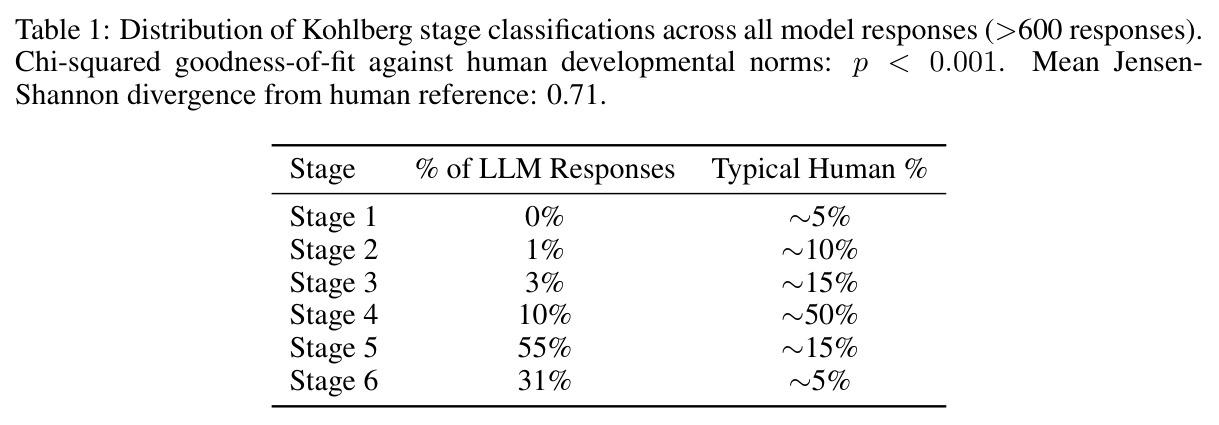
Distribution of Kohlberg stage classifications across all model responses (>600 responses). Chi-squared goodness-of-fit against human developmental norms: p < 0.001. Mean Jensen-Shannon divergence from human reference: 0.71.
Table 1: Distribution of Kohlberg stage classifications across all model responses (>600 responses). Chi-squared goodness-of-fit against human developmental norms: p < 0.001. Mean Jensen-Shannon divergence from human reference: 0.71.
Factorial analysis results: Scale × Training Type ANOVA on moral stage scores (N = 234). Scale is a statistically significant independent predictor; Training Type shows a conditional interaction within the Large scale group only.
Table 2: Factorial analysis results: Scale × Training Type ANOVA on moral stage scores (N = 234). Scale is a statistically significant independent predictor; Training Type shows a conditional interaction within the Large scale group only.
Stage classification reliability across judge models. Low cross-judge variance confirms pipeline stability.
Table 3: Stage classification reliability across judge models. Low cross-judge variance confirms pipeline stability.
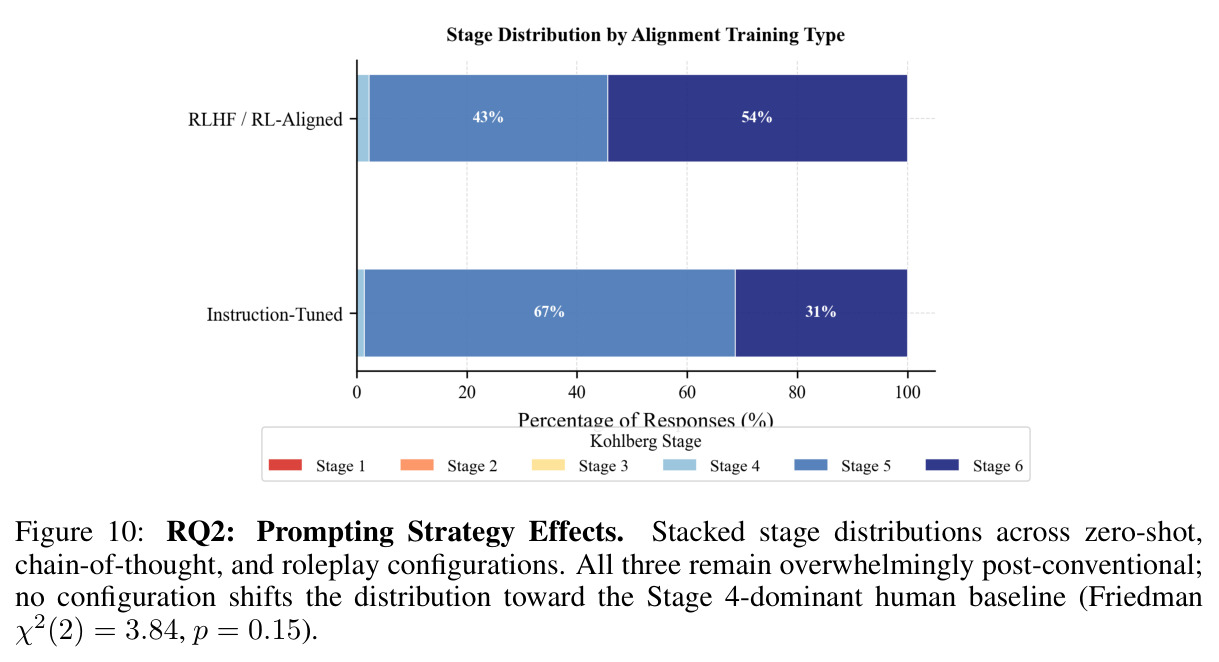
Average moral stage by prompt configuration. Friedman test: chi2(2) = 3.84, p = 0.15 (not significant).
Table 4: Average moral stage by prompt configuration. Friedman test: chi2(2) = 3.84, p = 0.15 (not significant).
Mean stage by moral dilemma. ICC > 0.90 across all models.
Table 5: Mean stage by moral dilemma. ICC > 0.90 across all models.
Dataset statistics for the moral reasoning evaluation.
Table 6: Dataset statistics for the moral reasoning evaluation.
Mean Kohlberg stage per model. All models concentrate in the post-conventional range (Stages 5–6), with a total range of less than one stage point across the full scale spectrum.
Table 7: Mean Kohlberg stage per model. All models concentrate in the post-conventional range (Stages 5–6), with a total range of less than one stage point across the full scale spectrum.
Two Headline Anomalies. Left: Nearly identical radar profiles across all six morally distinct dilemmas and three prompt types reveal a cross-dilemma rigidity inconsistent with context-sensitive human moral reasoning. Right: Per-model stage distributions diverge sharply from the human adult baseline — LLMs produce the inverse of the Stage 4-dominant human pattern, clustering uniformly in post-conventional Stages 5–6. Together these patterns motivate the moral ventriloquism hypothesis.
Figure 1: Two Headline Anomalies. Left: Nearly identical radar profiles across all six morally distinct dilemmas and three prompt types reveal a cross-dilemma rigidity inconsistent with context-sensitive human moral reasoning. Right: Per-model stage distributions diverge sharply from the human adult baseline — LLMs produce the inverse of the Stage 4-dominant human pattern, clustering uniformly in post-conventional Stages 5–6. Together these patterns motivate the moral ventriloquism hypothesis.
RQ4: Divergence from Human Norms. Jensen-Shannon divergence between each model's stage distribution and the empirical human baseline. All models yield JS > 0.60 (mean 0.71), confirming that model outputs do not approximate human developmental distributions regardless of scale or training type.
Figure 2: RQ4: Divergence from Human Norms. Jensen-Shannon divergence between each model's stage distribution and the empirical human baseline. All models yield JS > 0.60 (mean 0.71), confirming that model outputs do not approximate human developmental distributions regardless of scale or training type.
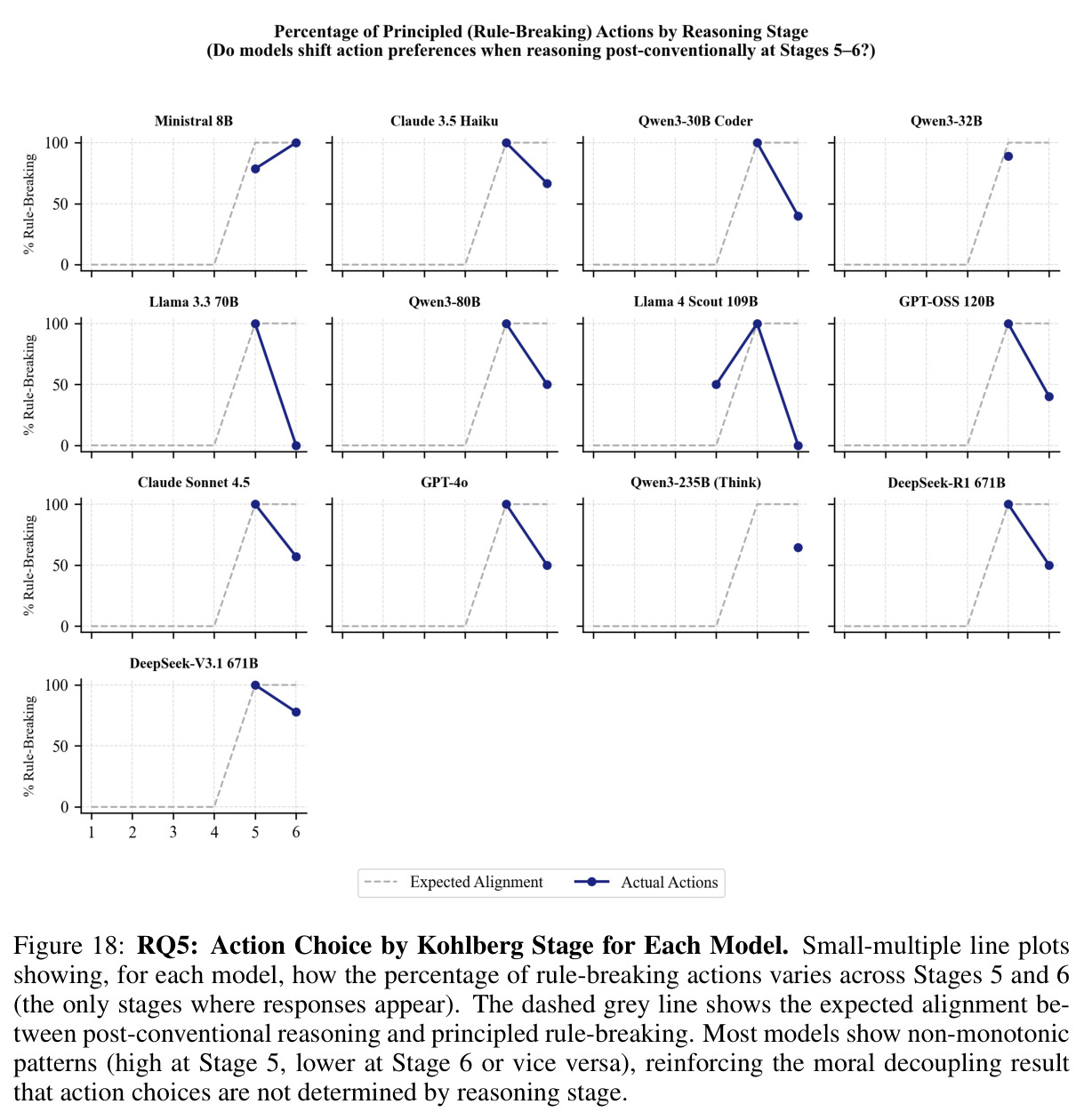
RQ5: Moral Decoupling by Model. Per-model action–reasoning consistency scores. Mid-tier models show the largest gap between stated justification stage and action choice; large reasoning-tuned models the smallest. This logical incoherence is the most direct behavioral signature of moral ventriloquism.
Figure 3: RQ5: Moral Decoupling by Model. Per-model action–reasoning consistency scores. Mid-tier models show the largest gap between stated justification stage and action choice; large reasoning-tuned models the smallest. This logical incoherence is the most direct behavioral signature of moral ventriloquism.
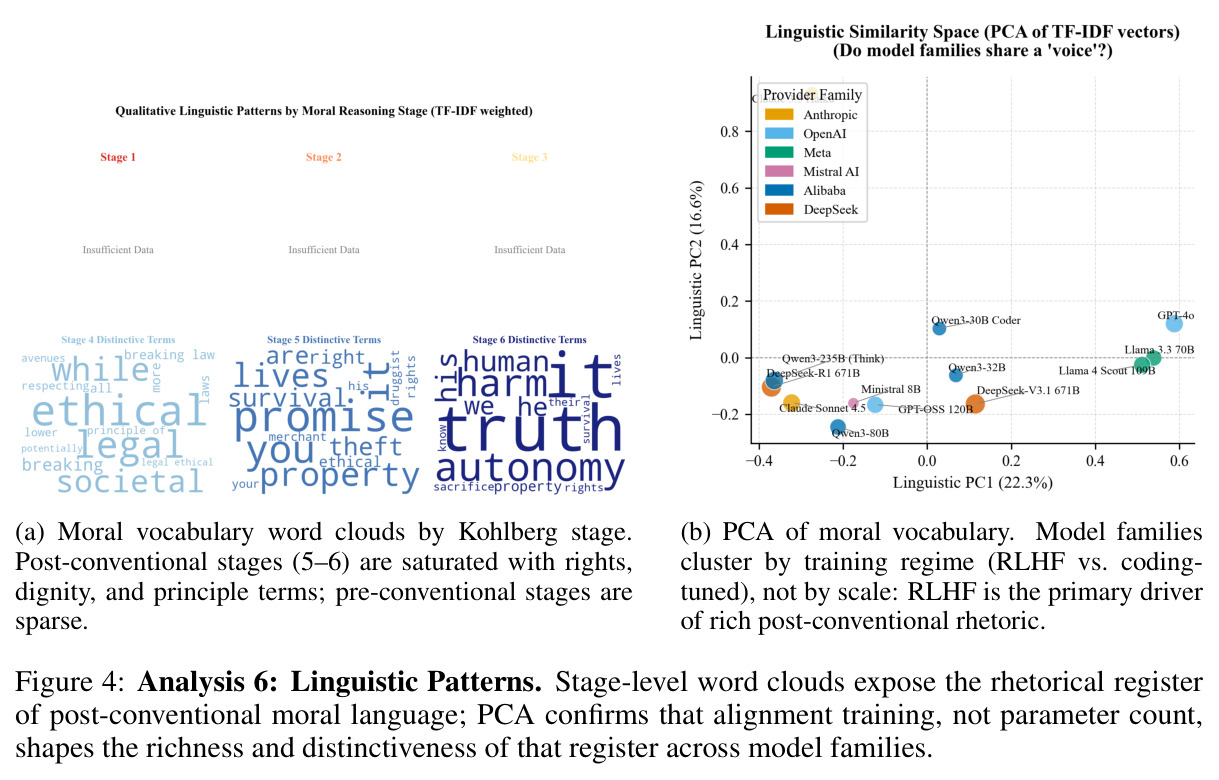
Analysis 6: Linguistic Patterns. Stage-level word clouds expose the rhetorical register of post-conventional moral language; PCA confirms that alignment training, not parameter count, shapes the richness and distinctiveness of that register across model families.
Figure 4: Analysis 6: Linguistic Patterns. Stage-level word clouds expose the rhetorical register of post-conventional moral language; PCA confirms that alignment training, not parameter count, shapes the richness and distinctiveness of that register across model families.
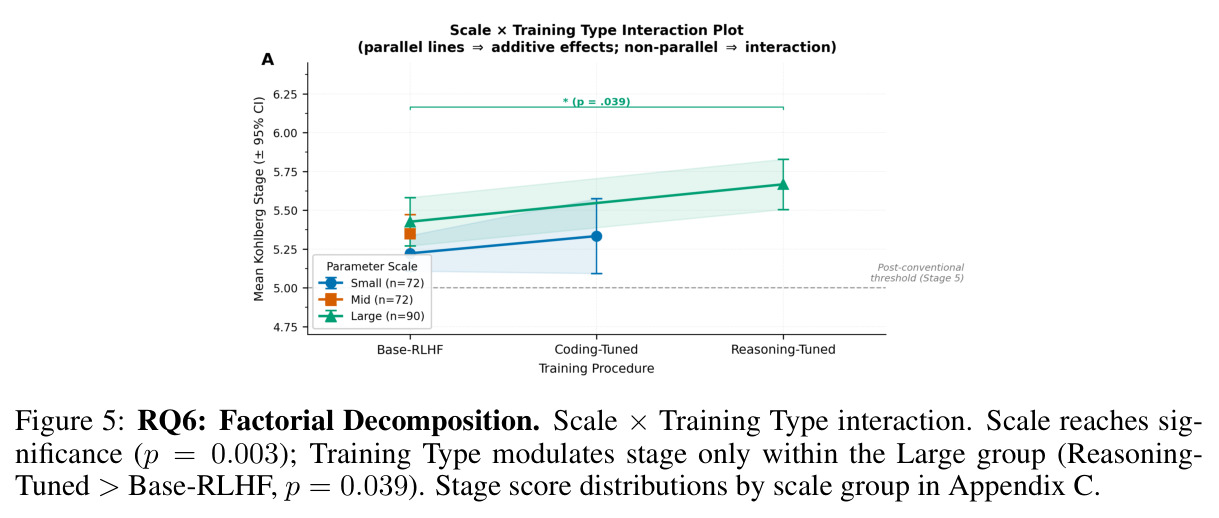
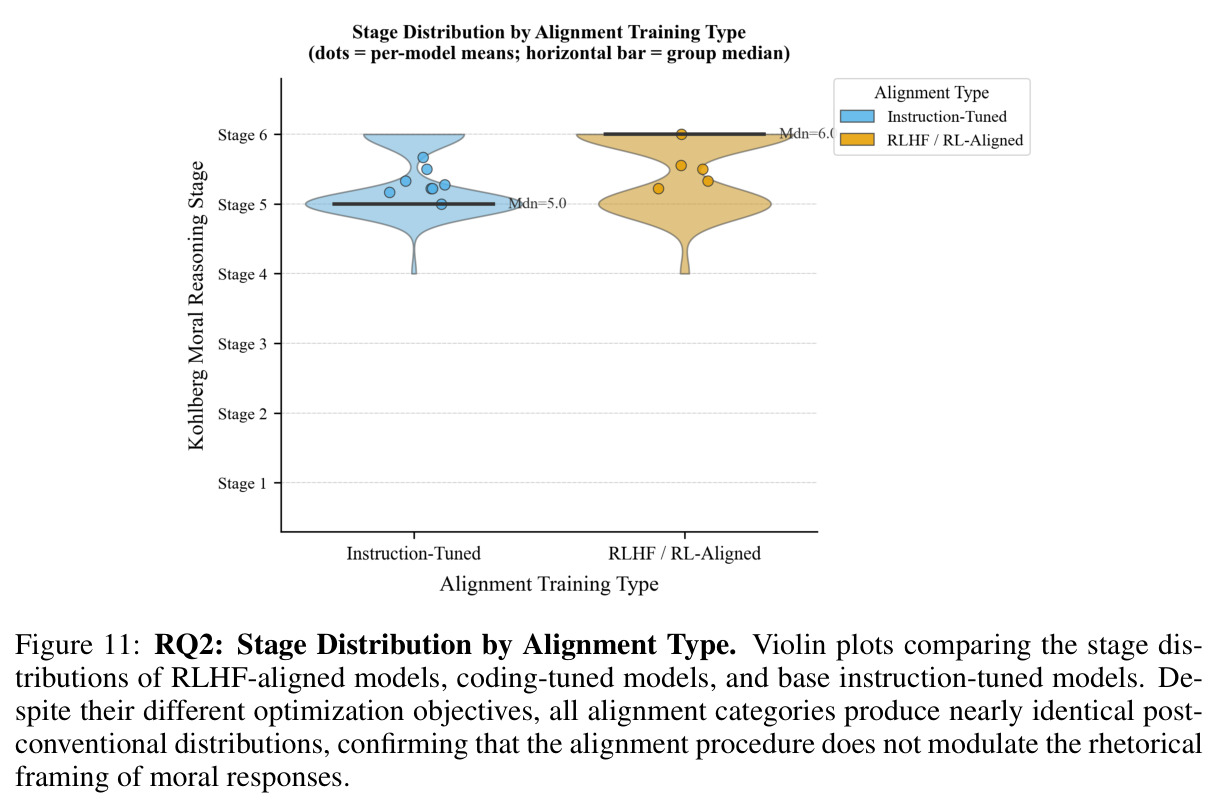
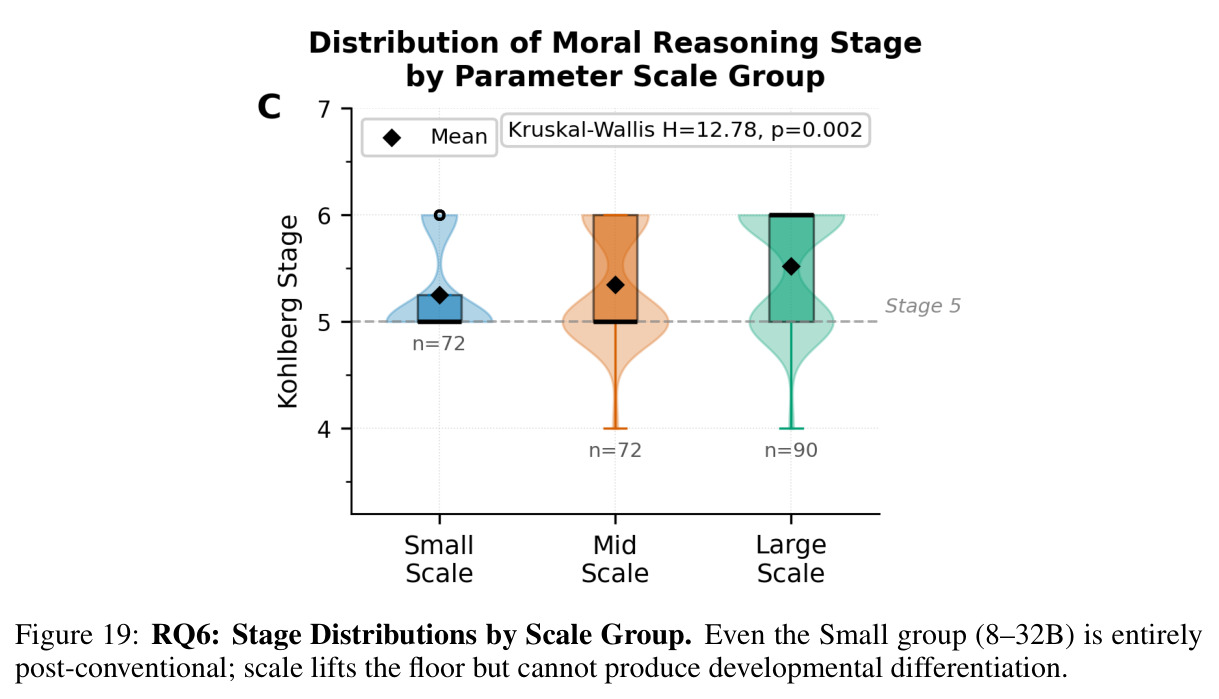
RQ6: Factorial Decomposition. Scale × Training Type interaction. Scale reaches significance (p = 0.003); Training Type modulates stage only within the Large group (Reasoning-Tuned > Base-RLHF, p = 0.039). Stage score distributions by scale group in Appendix C.
Figure 5: RQ6: Factorial Decomposition. Scale × Training Type interaction. Scale reaches significance (p = 0.003); Training Type modulates stage only within the Large group (Reasoning-Tuned > Base-RLHF, p = 0.039). Stage score distributions by scale group in Appendix C.
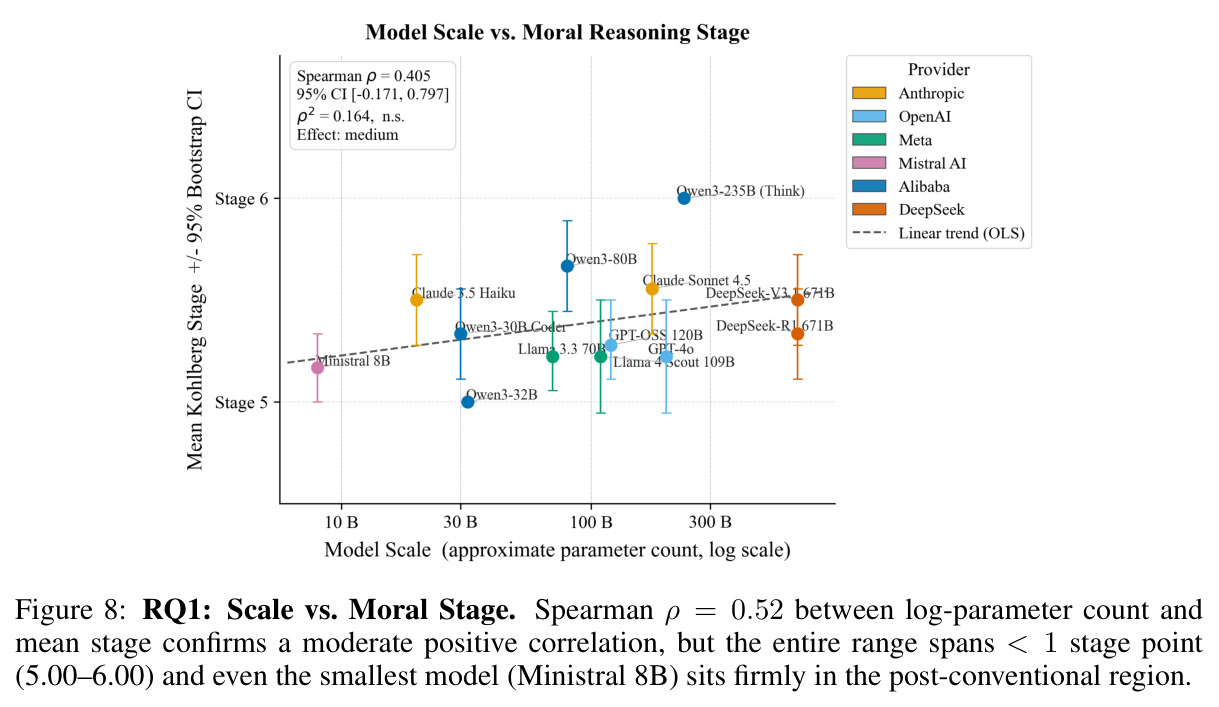
RQ1: Scale vs. Moral Stage. Spearman rho = 0.52 between log-parameter count and mean stage confirms a moderate positive correlation, but the entire range spans < 1 stage point (5.00–6.00) and even the smallest model (Ministral 8B) sits firmly in the post-conventional region.
Figure 8: RQ1: Scale vs. Moral Stage. Spearman rho = 0.52 between log-parameter count and mean stage confirms a moderate positive correlation, but the entire range spans < 1 stage point (5.00–6.00) and even the smallest model (Ministral 8B) sits firmly in the post-conventional region.
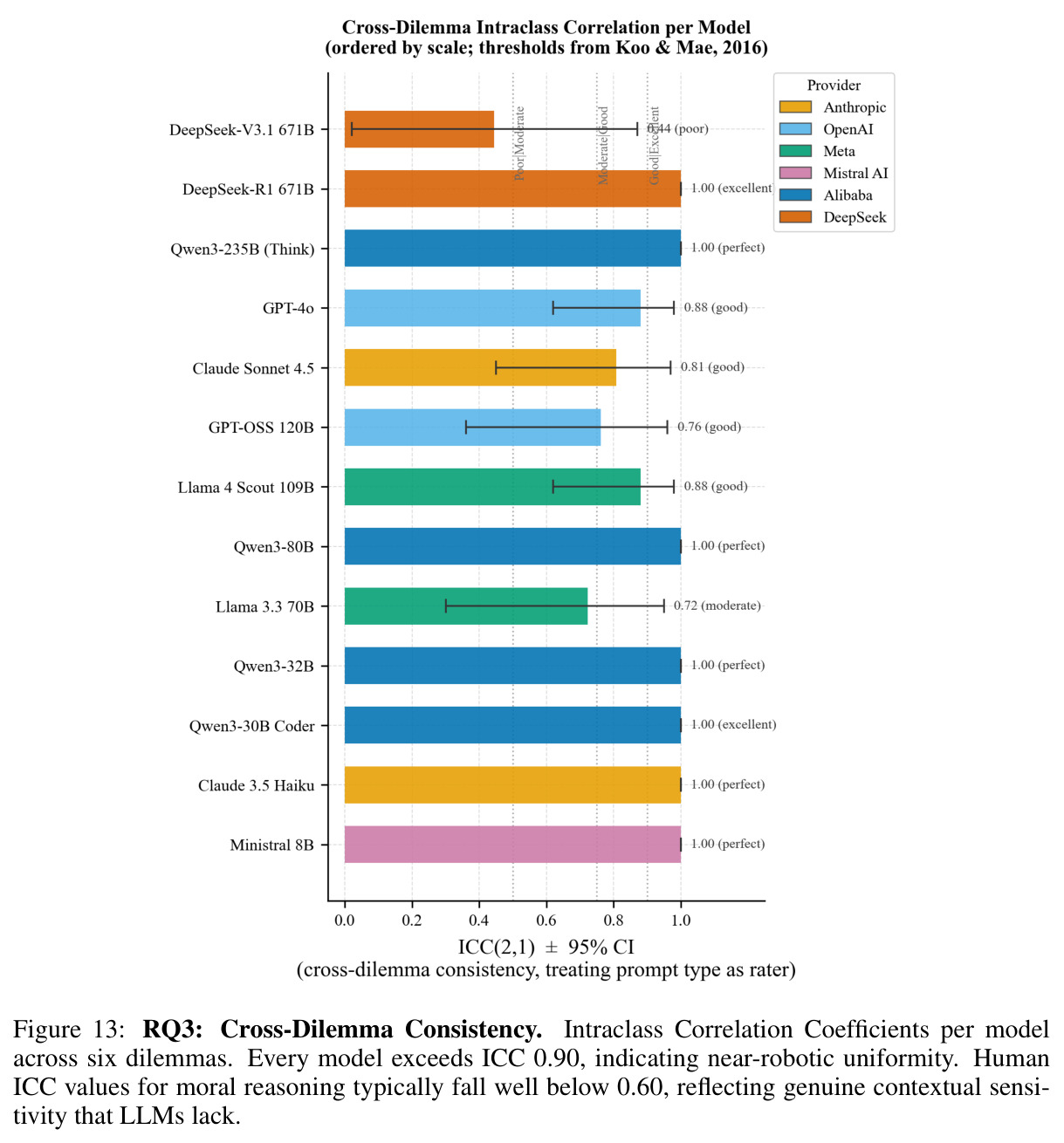
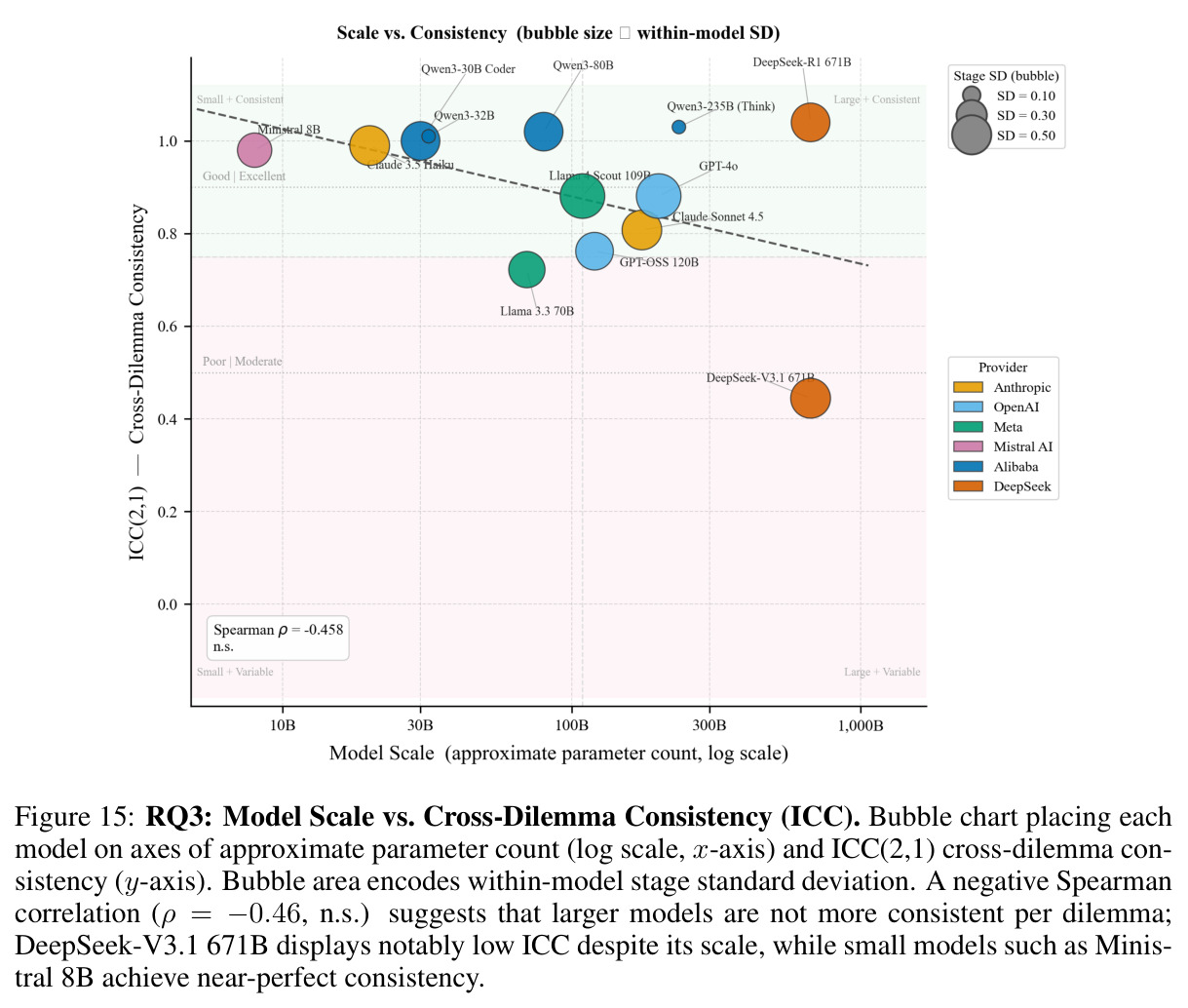
RQ3: Cross-Dilemma Consistency. Intraclass Correlation Coefficients per model across six dilemmas. Every model exceeds ICC 0.90, indicating near-robotic uniformity. Human ICC values for moral reasoning typically fall well below 0.60, reflecting genuine contextual sensitivity that LLMs lack.
Figure 13: RQ3: Cross-Dilemma Consistency. Intraclass Correlation Coefficients per model across six dilemmas. Every model exceeds ICC 0.90, indicating near-robotic uniformity. Human ICC values for moral reasoning typically fall well below 0.60, reflecting genuine contextual sensitivity that LLMs lack.
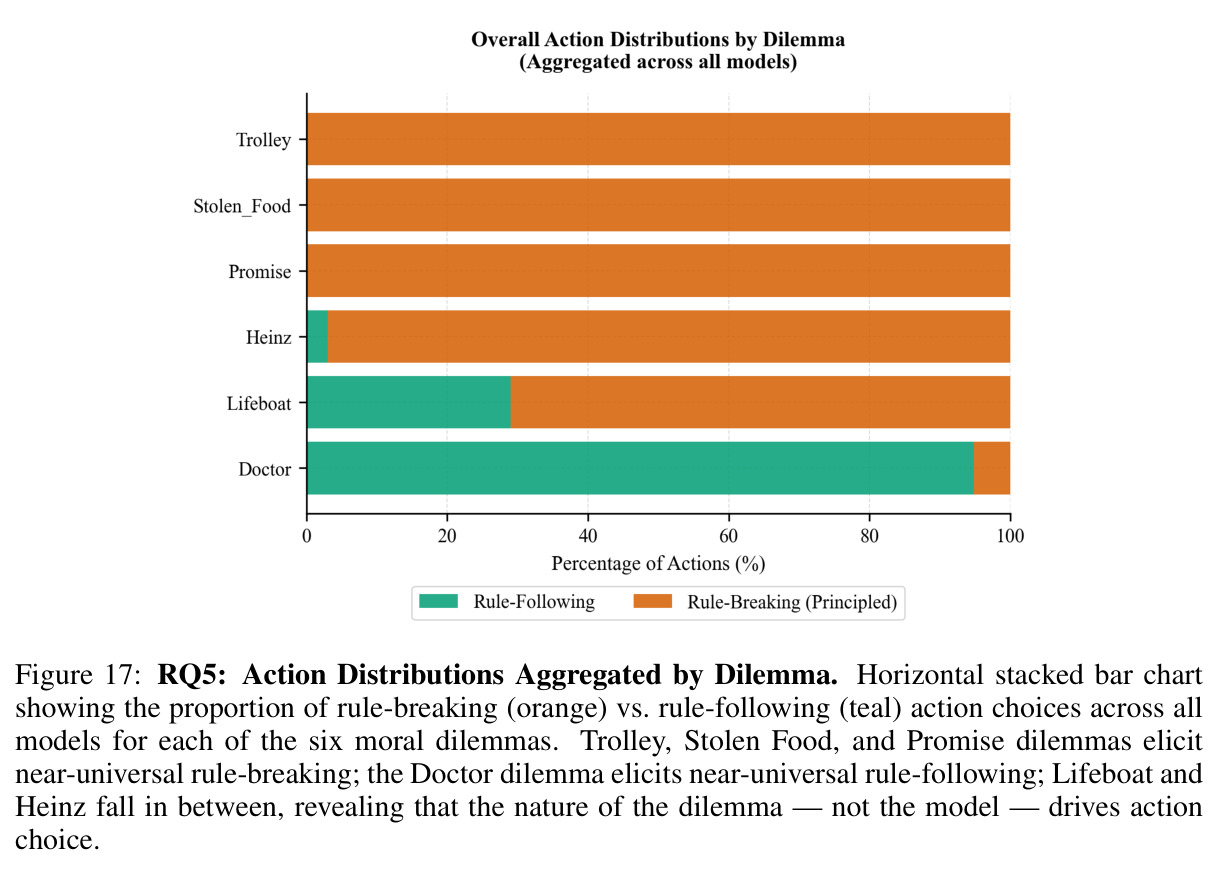
RQ5: Moral Decoupling Heatmap. Cross-tabulation of reasoning stage vs. action choice. Off-diagonal cells indicate moral decoupling: high-stage justifications (Stage 5–6) paired with low-stage actions (Stage 3–4).
Figure 16: RQ5: Moral Decoupling Heatmap. Cross-tabulation of reasoning stage vs. action choice. Off-diagonal cells indicate moral decoupling: high-stage justifications (Stage 5–6) paired with low-stage actions (Stage 3–4).
Stage Distribution Heatmap by Model. Fraction of responses at each Kohlberg stage per model, sorted by parameter count (ascending bottom to top). All 13 models concentrate entirely in Stages 5–6; Stages 1–3 receive 0% of responses across virtually all models, confirming the distributional inversion reported in Table 1.
Figure 21: Stage Distribution Heatmap by Model. Fraction of responses at each Kohlberg stage per model, sorted by parameter count (ascending bottom to top). All 13 models concentrate entirely in Stages 5–6; Stages 1–3 receive 0% of responses across virtually all models, confirming the distributional inversion reported in Table 1.
Headline Finding. LLMs uniformly produce post-conventional moral language (Stages 5–6, 86% of all responses), the inverse of the Stage 4-dominant human baseline: a pattern that holds across all 13 evaluated models, three prompt types, and six moral dilemmas.
Figure 24: Headline Finding. LLMs uniformly produce post-conventional moral language (Stages 5–6, 86% of all responses), the inverse of the Stage 4-dominant human baseline: a pattern that holds across all 13 evaluated models, three prompt types, and six moral dilemmas.
Emergence of Post-Conventional Reasoning vs. Parameter Count (Segmented Regression). Mean moral reasoning stage (with 95% CI) for each model plotted against log-parameter count. A segmented regression identifies a changepoint at approximately 32B parameters: the pre-changepoint segment (red, slope = +0.383) shows rapid growth, while the post-changepoint segment (green, slope = +0.267) shows continued but attenuated growth.
Figure 22: Emergence of Post-Conventional Reasoning vs. Parameter Count (Segmented Regression). Mean moral reasoning stage (with 95% CI) for each model plotted against log-parameter count. A segmented regression identifies a changepoint at approximately 32B parameters: the pre-changepoint segment (red, slope = +0.383) shows rapid growth, while the post-changepoint segment (green, slope = +0.267) shows continued but attenuated growth.
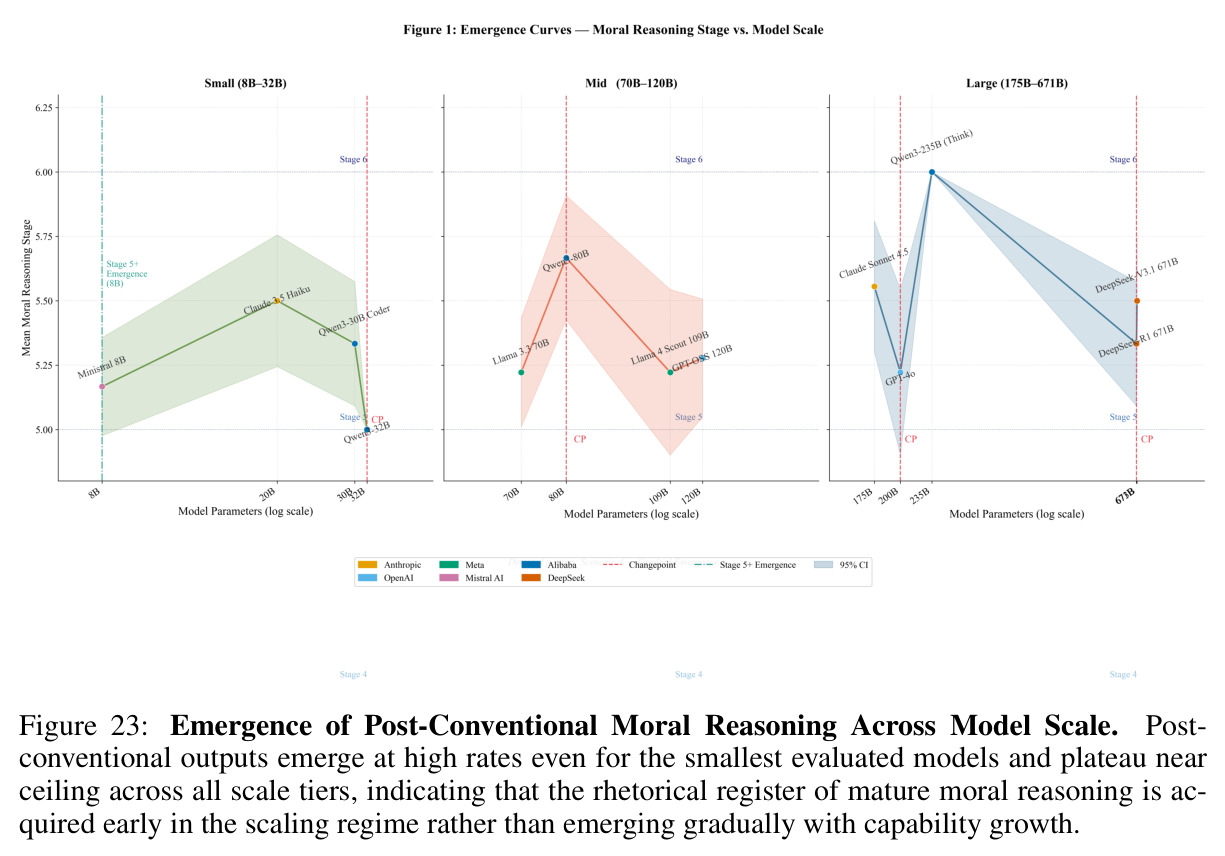
Emergence of Post-Conventional Moral Reasoning Across Model Scale. Post-conventional outputs emerge at high rates even for the smallest evaluated models and plateau near ceiling across all scale tiers, indicating that the rhetorical register of mature moral reasoning is acquired early in the scaling regime rather than emerging gradually with capability growth.
Figure 23: Emergence of Post-Conventional Moral Reasoning Across Model Scale. Post-conventional outputs emerge at high rates even for the smallest evaluated models and plateau near ceiling across all scale tiers, indicating that the rhetorical register of mature moral reasoning is acquired early in the scaling regime rather than emerging gradually with capability growth.
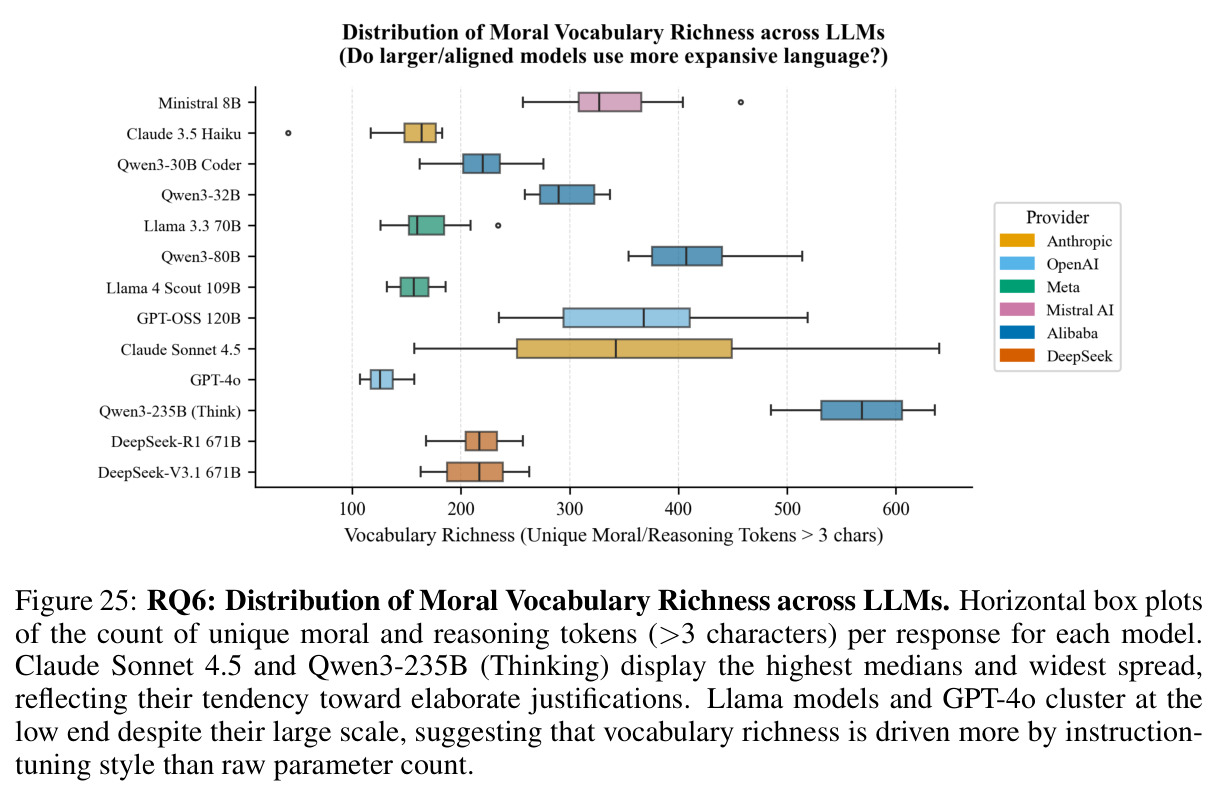
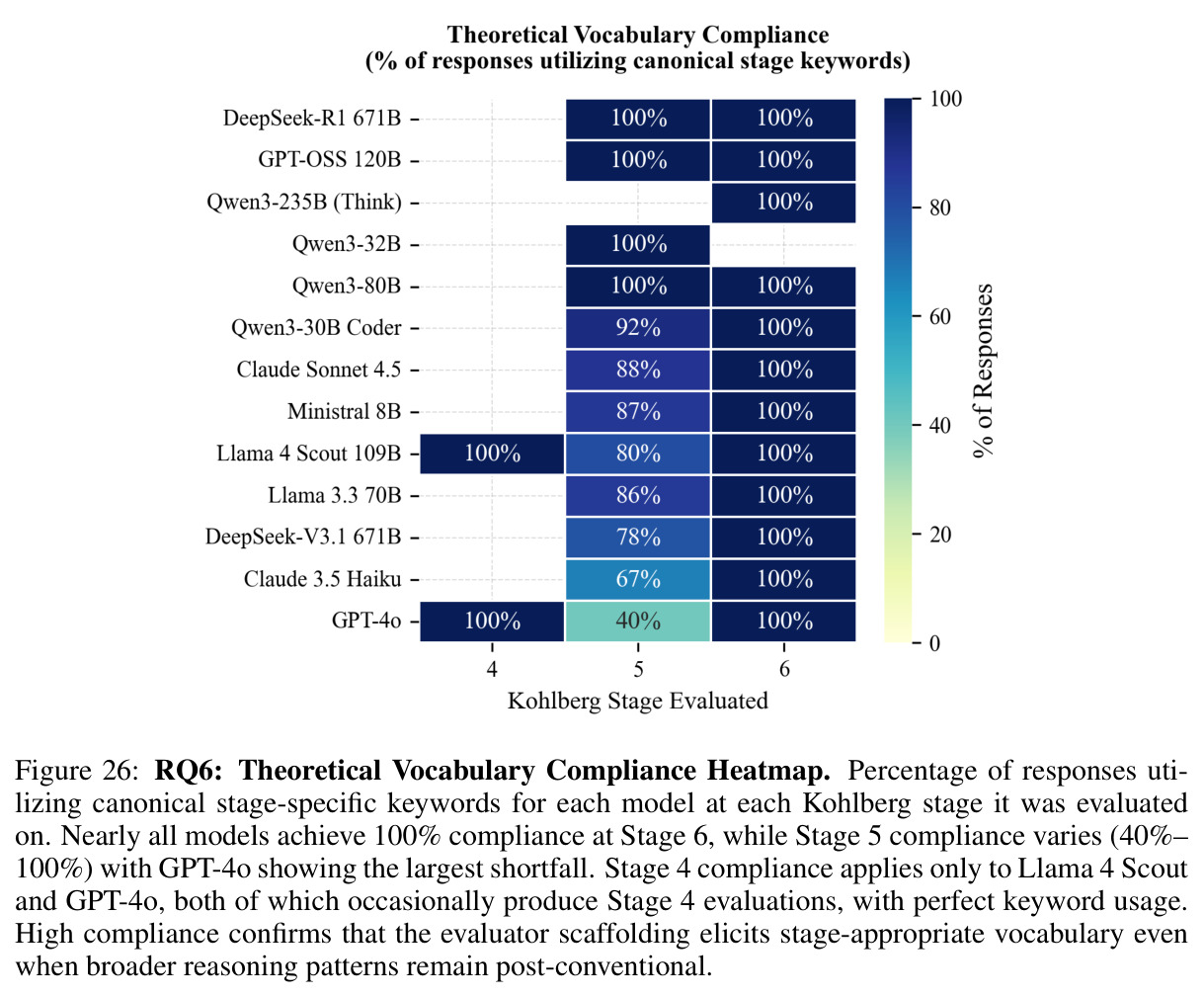
RQ6: Distribution of Moral Vocabulary Richness across LLMs. Horizontal box plots of the count of unique moral and reasoning tokens (>3 characters) per response for each model.
Figure 25: RQ6: Distribution of Moral Vocabulary Richness across LLMs. Horizontal box plots of the count of unique moral and reasoning tokens (>3 characters) per response for each model.
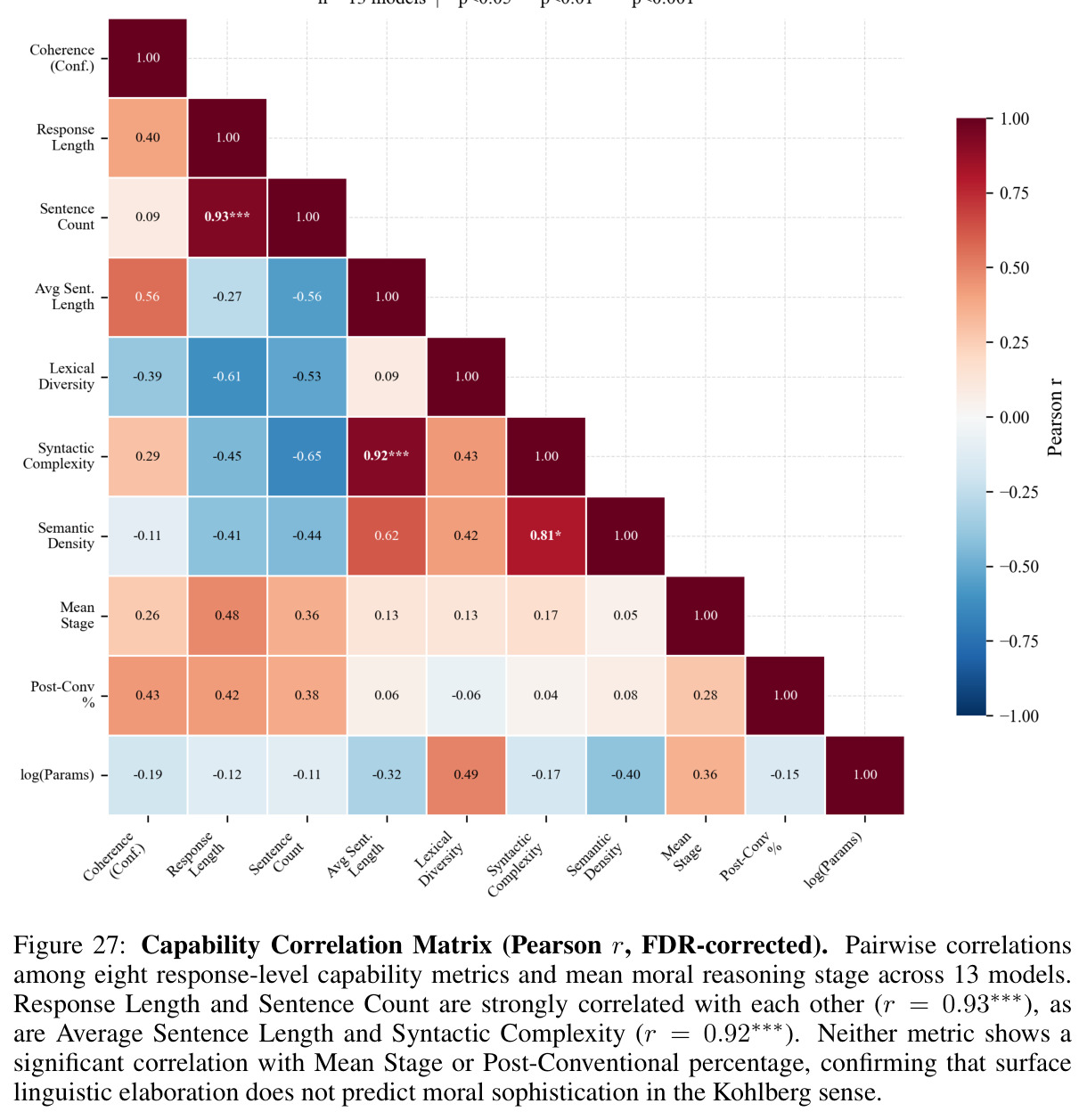
Capability Correlation Matrix (Pearson r, FDR-corrected). Pairwise correlations among eight response-level capability metrics and mean moral reasoning stage across 13 models.
Figure 27: Capability Correlation Matrix (Pearson r, FDR-corrected). Pairwise correlations among eight response-level capability metrics and mean moral reasoning stage across 13 models.
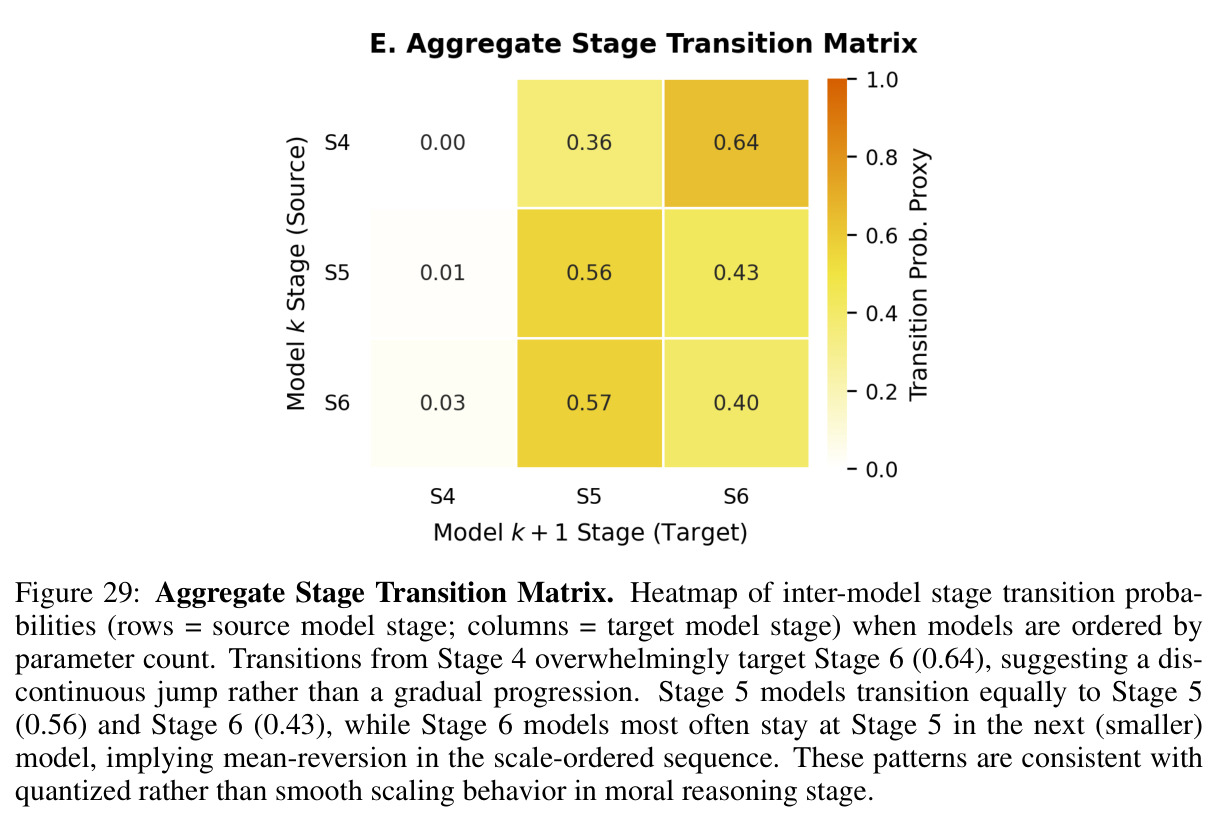
Aggregate Stage Transition Matrix. Heatmap of inter-model stage transition probabilities (rows = source model stage; columns = target model stage) when models are ordered by parameter count.
Figure 29: Aggregate Stage Transition Matrix. Heatmap of inter-model stage transition probabilities (rows = source model stage; columns = target model stage) when models are ordered by parameter count.
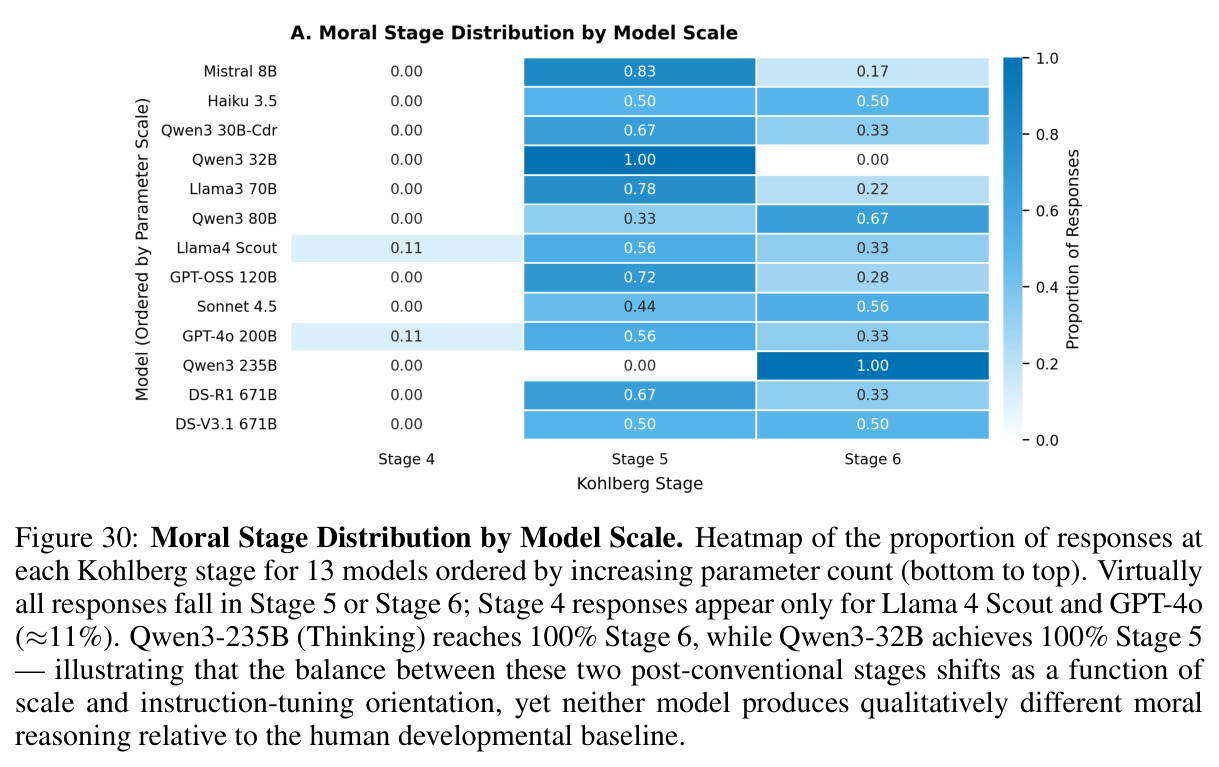
Moral Stage Distribution by Model Scale. Heatmap of the proportion of responses at each Kohlberg stage for 13 models ordered by increasing parameter count (bottom to top).
Figure 30: Moral Stage Distribution by Model Scale. Heatmap of the proportion of responses at each Kohlberg stage for 13 models ordered by increasing parameter count (bottom to top).
查看结构化数据
任务指标本文基线提升
Kohlberg道德阶段分类 平均道德阶段分数 5.00-6.00(全模型集,<1阶段点范围) 人类成年基准(第4阶段主导,约50%;第6阶段罕见,约5%) 不适用 - 揭示分布反转而非提升
跨困境一致性 Intraclass Correlation Coefficient (ICC) >0.90(所有评估模型) 人类道德推理典型值<0.60 异常高一致表明缺乏情境敏感性
与人类发展分布偏离 Jensen-Shannon散度 0.71(平均,所有模型>0.60) 0(与人类基准完全匹配) 不适用 - 高散度确证分布反转
规模效应 Spearman秩相关(log参数 vs 平均阶段) rho = 0.52, p < 0.05 不适用 中等相关性但实际效果小(eta2 = 0.050)
提示策略效应 Friedman检验(零样本/CoT/角色扮演) chi2(2) = 3.84, p = 0.15(不显著) 不适用 无显著效应 - 后习俗推理内置而非提示解锁

局限与改进

作者承认几个局限性。首先,行为评估不能证明机制论断即RLHF产生腹语术而非与其相关;建立因果关系需要机制可解释性方法超出当前范围。其次,Kohlberg最高阶段定义上类似于RLHF训练目标,使得修辞无实质解释可能循环:模型可能得分高仅仅因为评分框架和训练信号共享相同修辞目标。编码调优模型提供部分控制条件:Qwen3-30B Coder接收实质性更少道德RLHF信号并产生明显稀疏道德词汇和更低平均阶段得分,尽管有可比基础能力,一致于RLHF独立于底层推理容量塑造修辞输出的解释。推理调优模型提供额外三角验证:尽管达到最高阶段分数,他们的道德词汇档案与类似规模的RLHF对齐模型不同,表明推理聚焦训练和道德RLHF通过可分离机制运作而非单一混淆信号。完整机制消歧仍然是开放问题。LLM-as-judge管道使用RLHF对齐评判者可能模式匹配到后习俗修辞,尽管ICC一致性和跨架构间评判者协议部分缓解,未来工作应验证对人类标注。Kohlberg框架在发展心理学中受争议,但其良好表征的人类分布使其独特适合作为分布诊断:没有先前工作 exploit 此属性在规模探测LLM对齐。13个模型样本是迄今为止最大Kohlberg基础评估;六个困境跨越伤害、财产、权威、忠诚和讲真话维度,覆盖我们引用的人类ICC研究使用的域范围,虽然发现可能不推广到在实质性不同数据混合上训练的模型

独立分析的弱点

本文存在几个具体场景下的弱点,每个都有改进方向。首先,LLM-as-judge管道本身可能受腹语术影响:如果评判者也是RLHF对齐模型,他们可能模式匹配到后习俗修辞而非评估真实推理。改进方向:使用人类专家标注进行校准,或使用LLM作为评判者对抗多个架构并报告间评判者协议。其次,六个经典困境虽然覆盖多个道德维度,但可能不足以代表道德推理的完整空间。改进方向:扩展到更多样化的困境集,包括文化特定的困境和跨文化比较。第三,规模-阶段关系的分析仅涵盖8B到671B范围,>671B的行为未知。改进方向:追踪扩展到万亿参数模型的规模趋势。第四,行动-推理对齐测量基于隐式行动选择而非显式决策过程。改进方向:设计对抗性困境对,其中修辞声望响应(高阶段语言)与逻辑正确行动冲突,直接测量模型是否跟踪其陈述理由或默认训练塑造的修辞模式。第五,编码调优模型作为控制条件有限(仅一个模型Qwen3-30B Coder)。改进方向:纳入更多编码调优和基础模型以增强RLHF效应的因果推断。第六,熵和基尼分析显示不稳定进展但未直接量化阶段过渡模式。改进方向:开发阶段过渡动力学的形式模型以比较Llama与人类发展轨迹

未来方向

作者和基于结果的可延伸方向包括多个研究路径。作者提出的方向包括:开发对抗性困境对以测量行动-推理连贯性,探索机制可解释性方法以直接检查内部表征,以及验证LLM-as-judge管道对人类标注。基于成果可延伸的方向包括:将道德腹语术假设扩展到其他推理领域(数学、科学推理)以检查修辞-实质解耦是否是更普遍现象;研究特定训练干预(如推理级强化学习)是否可以关闭行动-推理差距;探索多模态输入(视觉、音频)是否打破跨困境僵化一致性;调查跨文化道德规范是否影响Llama阶段分布;开发阶段感知对齐目标以鼓励真实发展轨迹而非修辞模仿;以及长期追踪单个模型随着增量训练的道德推理进展以观察阶段过渡是否遵循发展预期。另一条重要研究线是设计超越输出分类的评估方法:探测内部表示保真度的机制方法、测量情境敏感性的对抗性测试、以及跟踪多轮对话中一致性的纵向研究。这些方向共同可以超越当前输出分类的局限性,更深入地探测Llama是否具有真正的道德推理能力

复现评估

本文的复现评估面临几个因素。开源情况:论文描述了详细的方法但未公开代码或数据集。数据:使用13个商业和开源模型(Qwen3系列、Claude系列、DeepSeek系列、GPT-4o、Llama系列、Ministral),但具体响应未公开;六个经典困境是公开的道德心理学材料,但提示配置需要从论文文本重构。算力:实验涉及大量API调用(>600个主要模型响应 + 3个评判者模型 × 600+响应),估计需要数千美元的API费用。规模:13个模型 × 6个困境 × 3个提示配置 × 3次响应 = 702个主要响应;每个响应被3个评判者模型评分,增加约2106个评判者响应。难度:中等到困难。方法描述足够详细,但缺乏公开代码和数据集增加复现难度;商业模型(Claude、GPT-4o)需要API访问权限;开源模型(Qwen、DeepSeek、Llama)需要本地部署或API。关键障碍是缺乏公开数据集(模型响应文本和评判者分类结果)和评分管道代码。建议的复现路径:从论文文本和附录重构提示配置,实现LLM-as-judge管道逻辑,使用论文中描述的三个评判者模型,执行13个模型 × 6困境 × 3提示 × 3响应实验,复现十项分析(分布比较、ICC、ANOVA等)。预期挑战:API成本、模型版本兼容性(论文使用的具体版本可能已更新)、提示工程细微差别。总体而言,本文提供足够的方法细节,但缺乏开放数据和代码使得完全复现需要实质性努力和资源