DreamPartGen:基于协作潜在去噪的语义部分级3D生成 DreamPartGen: Semantically Grounded Part-Level 3D Generation via Collaborative Latent Denoising
提出DPL和RSL协同去噪框架,实现语义驱动的部分级文本到3D生成
前置知识
扩散模型
扩散模型通过正向加噪和逆向去噪过程生成数据。在训练中,模型学习从纯噪声逐步恢复出真实数据;推理时,从随机噪声开始迭代去噪得到生成结果。Diffusion Transformer (DiT) 是一种将Transformer与扩散过程结合的架构,通过交叉注意力实现条件控制。本文采用两阶段训练:第一阶段优化部分潜在表示的扩散目标,第二阶段联合微调部分级和对象级同步模块。
本文核心创新是在扩散过程中引入语义协作,需要理解扩散的噪声调度、SNR加权课程等机制才能把握DPL-RSL如何协同去噪
文本到3D生成
文本到3D生成旨在根据自然语言描述创建3D模型。早期方法如DreamFusion使用分数蒸馏采样(SDS),将预训练的2D扩散模型作为3D优化的先验。近期改进包括可微渲染与显式3D表示结合(如Gaussian splatting在DreamGaussian中)、体素或网格参数化(如CLAY),以及混合自回归架构(如Trellis)。这些方法虽能生成单对象,但往往在保真度和多视角一致性上存在问题,且缺乏部分级建模。
本文要在文本到3D生成中加入部分级语义对齐,需要理解SDS等现有方法为何无法处理部分关系,以及DPL如何超越单对象整体生成范式
部分感知3D表示
部分感知方法将3D对象分解为语义上有意义的子部分(如椅子有座椅、靠背、扶手、腿)。PartNet提供分层部分标注,PartVerse扩展了更多类别。现有方法如Part123和Salad关注部分分割和组装,PartGen利用部分分解进行生成建模,CoPart引入部分级2D和3D潜在的双重先验,PartGS和Part2GS采用Gaussian splatting进行关节部分感知生成。但这些方法主要依赖几何信号(如边界框),语言指导未被充分探索。
本文的DPL设计建立在这些结构化潜在表示基础上,但关键区别在于引入持久化的语义关系,需要理解现有几何导向方法的局限性
潜在空间表示
潜在表示将高维数据(如图像、3D形状)压缩到低维空间以便神经网络处理。3D VAE将点云和法线编码为潜在序列 $L^{3D} \in \mathbb{R}^{T_{3D} \times d}$,图像VAE将渲染视图编码为 $L^{2D} \in \mathbb{R}^{T_{2D} \times d}$。这些潜在序列通过注意力机制交互,捕捉跨模态关系。本文的DPL创新在于为每个部分分配可学习的标识嵌入 $e_i \in \mathbb{R}^d$,确保部分在去噪时步间保持可追踪性。
本文核心是DPL的联合3D/2D潜在表示设计,需要理解潜在空间的编码、解码和注意力交互才能把握几何-外观协同的原理
研究动机
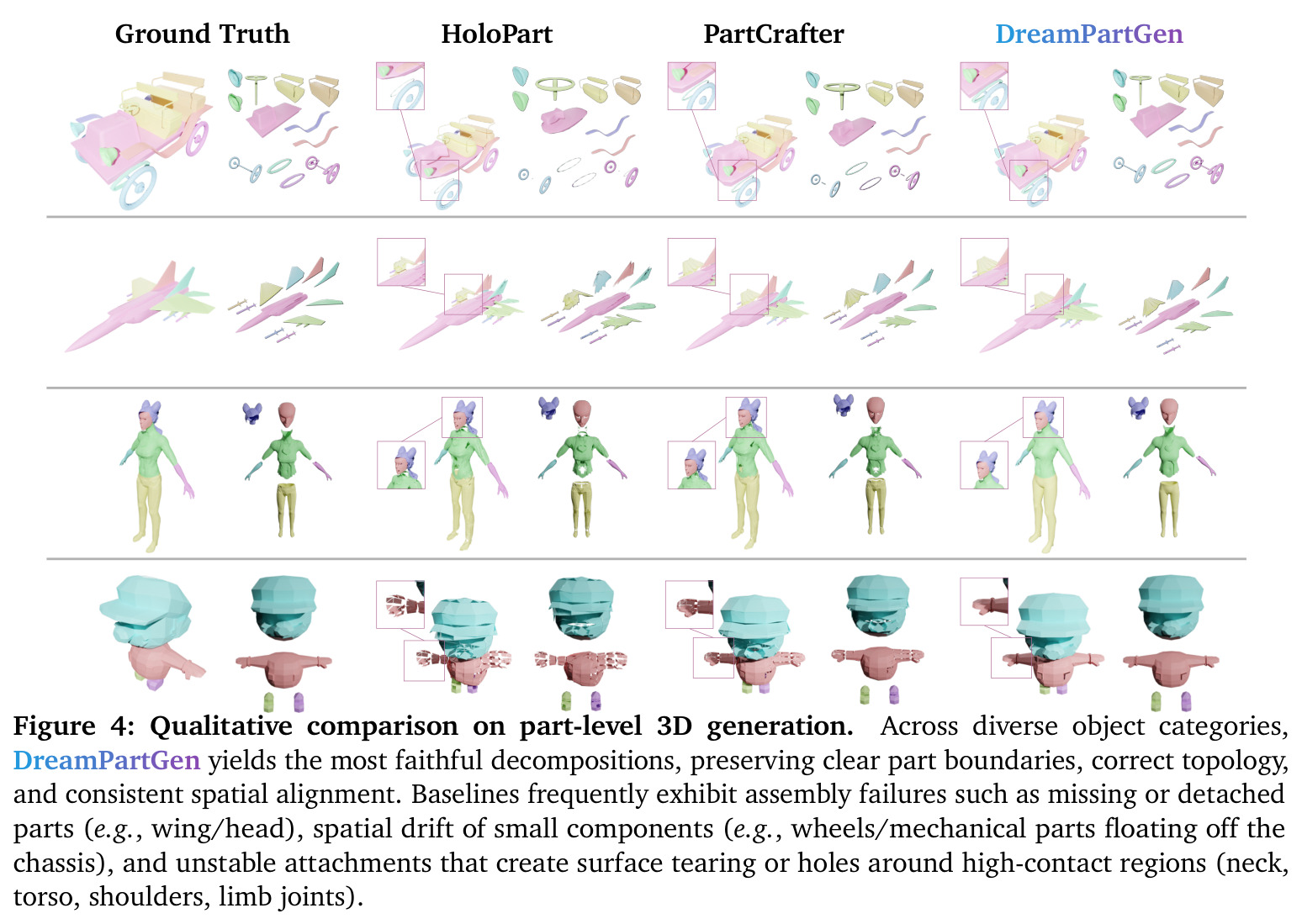
现有文本到3D方法主要操作整体潜在表示,将几何、外观和语义纠缠在一起,没有显式表示部分身份或部分间关系。例如,描述战斗机时用户可能指定"机翼下挂载多枚导弹",现有方法无法理解机翼和导弹之间的支撑或附着关系。近期部分感知方法虽然通过部分分割或边界框引导引入了分解,但它们对分割噪声脆弱,难以跨多样类别和提示扩展。更重要的是,许多基于部分的框架仍将部分视为几何上孤立的单元,不将部分间关系建模为显式变量,语言基本不可操作。这导致生成的3D对象经常出现部件分离、错位、功能失效等问题,如车轮悬浮在底盘外、机翼与机身断开连接、机械部件空间漂移等。
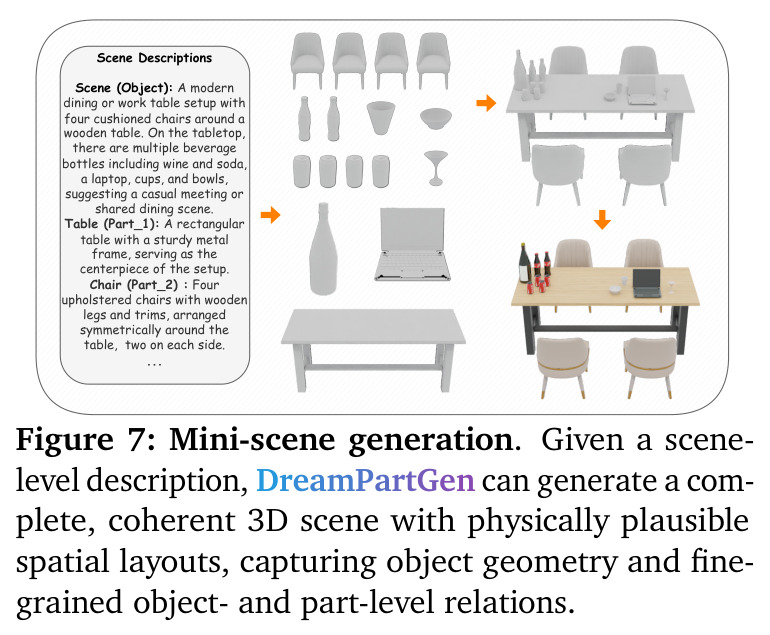
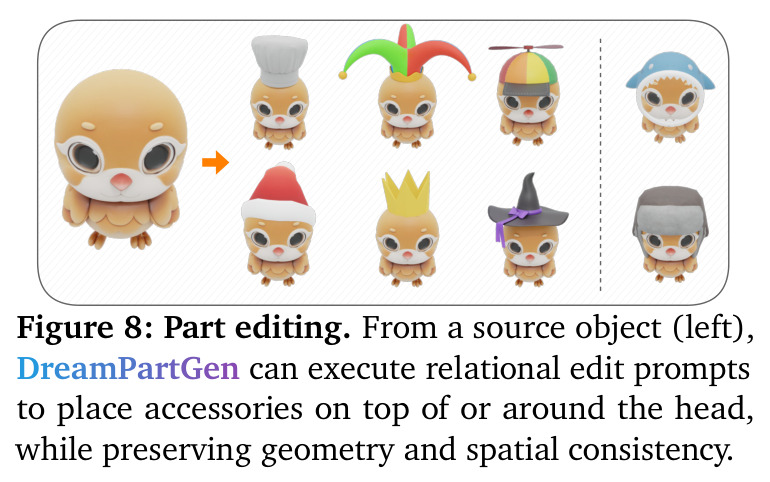
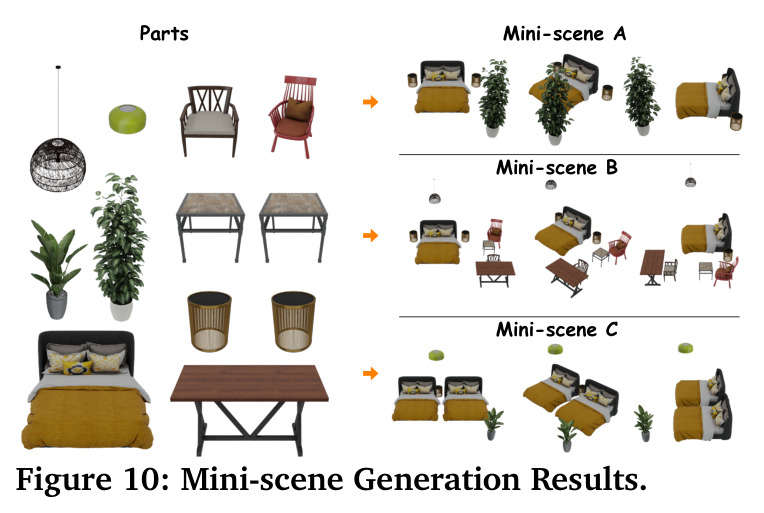
本文的目标是本文提出DreamPartGen框架,目标是实现语义驱动的、部分感知的文本到3D生成。具体而言,模型应该能够:(1)根据文本描述生成结构一致、功能合理的3D对象;(2)显式建模部分间的关系(如支撑、附着、对称、铰接等),这些关系源于自然语言;(3)保持部分身份在去噪过程中的一致性,避免槽位交换;(4)支持下游应用如部分编辑、关节对象生成和小场景合成。最终目标是让3D生成像人类理解对象一样——将对象视为有意义部分的组合,而不仅仅是一团纠缠的几何体。
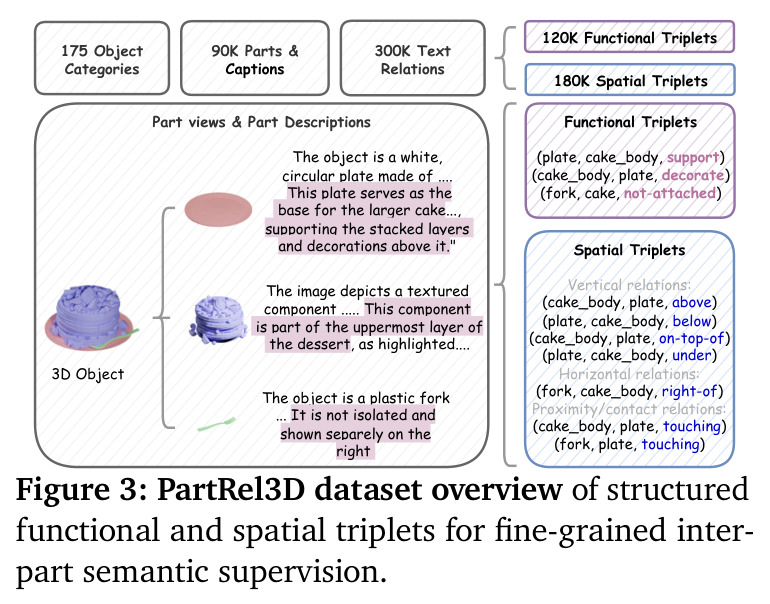
与已有工作不同的是,本文的独特切入角度是引入持久化的、语言衍生的关系语义潜在表示(RSLs),这些潜在表示在整个去噪过程中保持活跃,而不仅仅作为一次性条件。与现有方法不同,DreamPartGen将部分级几何/外观(DPLs)与关系语义(RSLs)通过同步去噪进行联合建模,强制执行相互的几何-语义一致性。RSLs分为全局关系令牌 $S^{glb}$(作为固定结构条件)和局部语义令牌 $S^{loc}$(被噪声化并与部分潜在表示一同去噪),这样在每一去噪步都能提供语义细化和全局规划信号。此外,本文构建了PartRel3D数据集,通过30万个规范化功能与空间三元组,为语言驱动的关系监督提供大规模显式信号。
核心方法
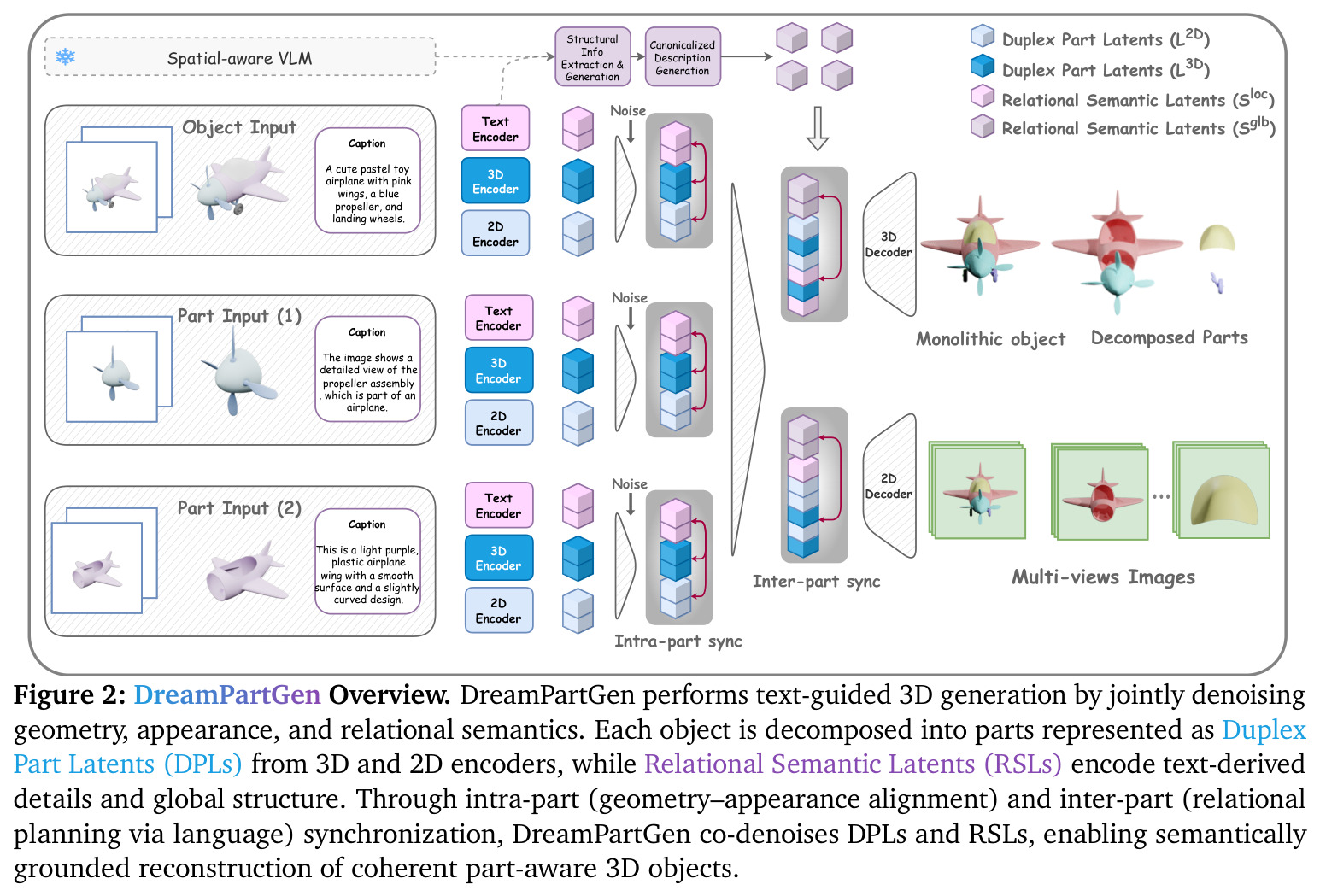
DreamPartGen的整体思路是将基于部分的3D生成建模为两种互补潜在表示之间的语义驱动协作扩散过程:Duplex Part Latents (DPLs)编码单个部分的几何和外观,Relational Semantic Latents (RSLs)提供语言衍生的细节和全局结构。在训练中,模型首先通过部分级扩散目标优化DPL,然后在SNR加权课程下联合微调完整模型,包括部分级和对象级同步。推理时,输入提示被编码为局部语义令牌 $S^{loc}$ 和全局规划器令牌 $S^{glb}$,通过部分级和对象级同步联合去噪DPLs和RSLs,最终解码为部分网格并组装成对象。整个框架的关键是在去噪过程中保持关系语义的持久性和一致性。
核心创新点是引入持久化的、语言衍生的关系语义潜在表示,这些表示在去噪过程中持续存在,而不仅仅作为一次性条件。具体而言,DPLs通过两个互补元素建模每个部分:3D令牌序列 $L^{3D}_i$(通过3D VAE编码表面点和法线得到)和2D令牌序列 $L^{2D}_i$(通过预训练图像VAE编码多视图渲染得到),加上可学习的部分标识嵌入 $e_i$。RSLs包括全局关系令牌 $S^{glb} = \{s^{glb}_{ij,\rho}\}_{(i,j,\rho) \in \mathcal{R}}$(从规范化三元组$(i,j,\rho)$投影得到)和局部语义令牌 $S^{loc} = \{s^{loc}_m\}_{m=1}^K$(从部分级属性短语编码得到)。在去噪过程中,通过部分内同步(几何-外观对齐)和部分间同步(跨部分上下文传播+关系指导)实现DPLs和RSLs的协同演化。
方法步骤详情
方法步骤完整描述如下:\n\n步骤1:DPL实例化。对于每个部分网格 $p_i$,采样表面点及其法线,通过3D VAE编码器得到几何潜在序列 $L^{3D}_i \in \mathbb{R}^{T_{3D} \times d}$。同时,从多个视角渲染该部分,通过预训练图像VAE得到外观潜在序列 $L^{2D}_i \in \mathbb{R}^{T_{2D} \times d}$。为每个部分分配可学习的标识嵌入 $e_i \in \mathbb{R}^d$,确保部分在去噪时步间的可追踪性。\n\n步骤2:RSL实例化。使用冻结的文本编码器 $\mathcal{E}_{text}$ 将提取的关系/属性短语编码,然后通过学习的投影 $\phi_{text}$ 得到全局关系令牌 $S^{glb}$ 和局部语义令牌 $S^{loc}$。全局关系令牌从规范化的功能三元组(如$\texttt{support, attach, hinge, symmetry}$)和空间三元组(如$\texttt{above, touching, symmetric-with}$)得到,每个令牌编码两个部分如何语义相关。局部语义令牌从细粒度属性短语(如"metallic blade", "wooden handle")编码,用于细化和外观。\n\n步骤3:训练阶段一。优化3D和2D DPLs的扩散目标,在RSLs的语义条件下。对于时间步 $t \sim \mathcal{U}\{1, \ldots, T\}$ 和噪声 $\epsilon \sim \mathcal{N}(0, I)$,每部分扩散损失为 $\mathcal{L}^{3D}_{diff} = \mathbb{E}_{t,\epsilon}[\|\epsilon - \hat{\epsilon}_\theta(L^{3D}_{i,t}, L^{2D}_{i,t}, S^{glb}, S^{loc,t}, t)\|^2]$,$\mathcal{L}^{2D}_{diff}$ 类似。\n\n步骤4:训练阶段二。联合微调3D和2D部分去噪器及同步模块,使用SNR加权课程 $w_{syn}(t) = \frac{\text{SNR}(t)}{1+\text{SNR}(t)}$,其中 $\text{SNR}(t) = \alpha_t^2/\sigma_t^2$,逐步将焦点从保真去噪转向关系对齐。\n\n步骤5:推理。编码输入提示得到 $S^{loc}$ 和 $S^{glb}$。当显式三元组可用时,将其编码为 $S^{glb}$;否则默认为仅提示条件。采样高斯噪声初始化几何和外观流 $\{L^{3D}_{T,i}, L^{2D}_{T,i}\}_{i=1}^N$,应用相同的前向噪声过程得到 $S^{loc,T}$。从时间步 $T$ 到 $1$,使用部分级和对象级同步模块联合去噪 $\{L^{3D}_{i,t}, L^{2D}_{i,t}\}_{i=1}^N$ 和 $S^{loc,t}$,同时在持久 $S^{glb}$ 条件下。去噪后,将最终几何潜在 $\{L^{3D}_{0,i}\}_{i=1}^N$ 通过3D VAE解码器解码得到部分网格,组装成对象。
技术新颖性
技术新颖性体现在三个方面:(1)持久化语义关系建模。与一次性文本条件不同,RSLs在每一步去噪时注入,实现迭代语义细化。全局关系令牌 $S^{glb}$ 作为固定结构条件持续存在,局部语义令牌 $S^{loc}$ 与部分潜在表示一同去噪,细化和外观在语义约束下。(2)协作扩散架构。DPLs和RSLs通过部分内同步(公式3)和部分间同步(公式4)协同演化,强制几何-外观对齐和全局关系一致性。部分内同步对齐几何和外观,部分间同步通过直接消息传递和关系指导传播上下文。(3)大规模关系监督。PartRel3D数据集提供300K规范化的功能和空间三元组,跨越175个对象类别,平均每个对象有8.2个部分和27个部分间关系,提供密集的结构监督。这是首个显式语言驱动的关系监督数据集。
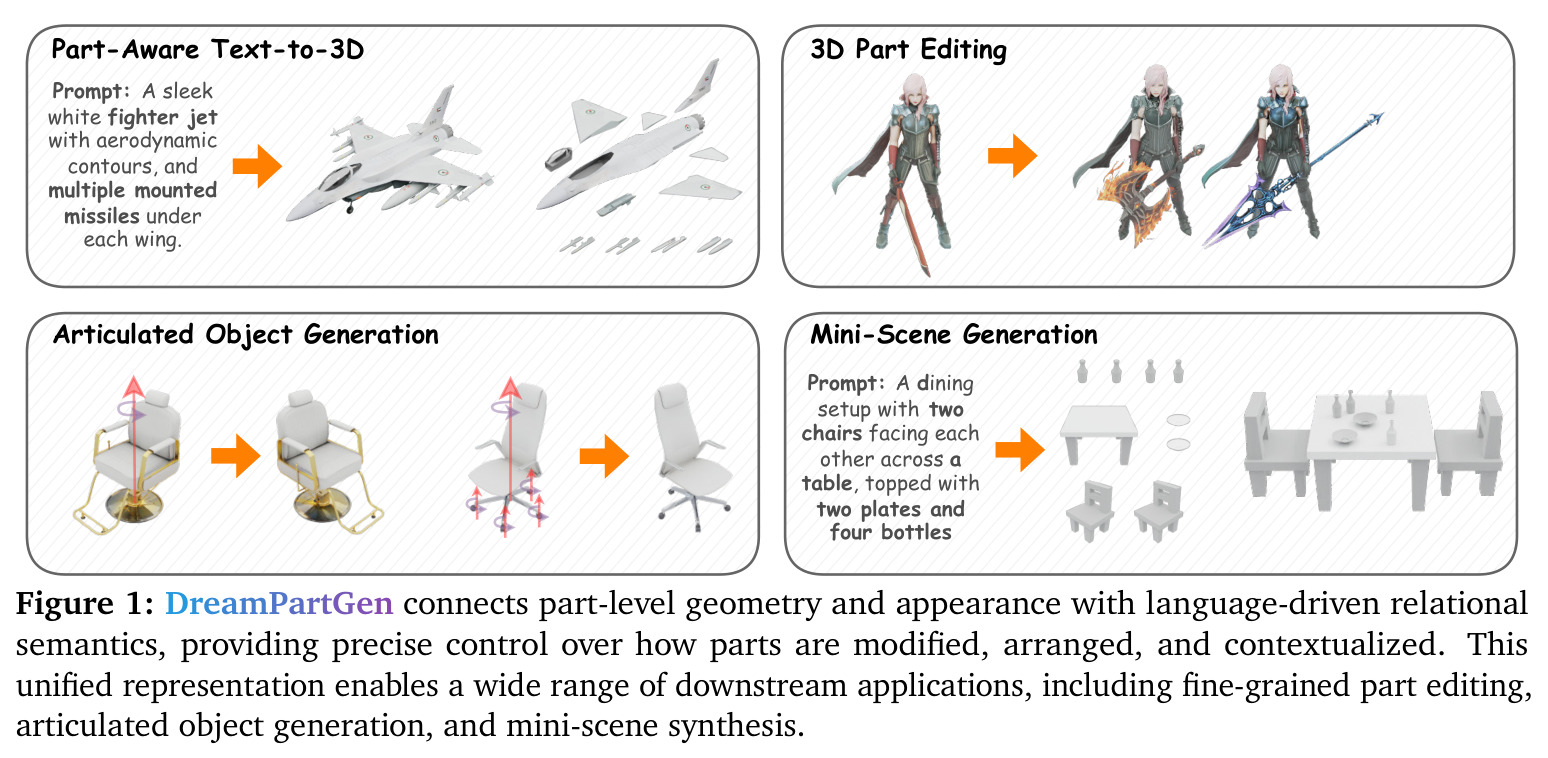
实验结果
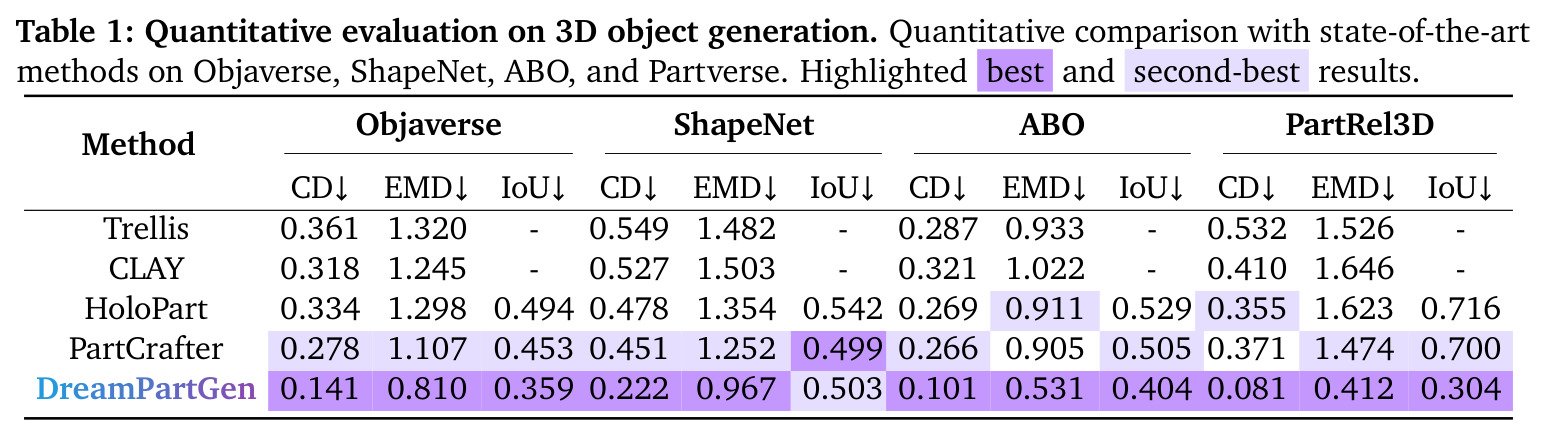
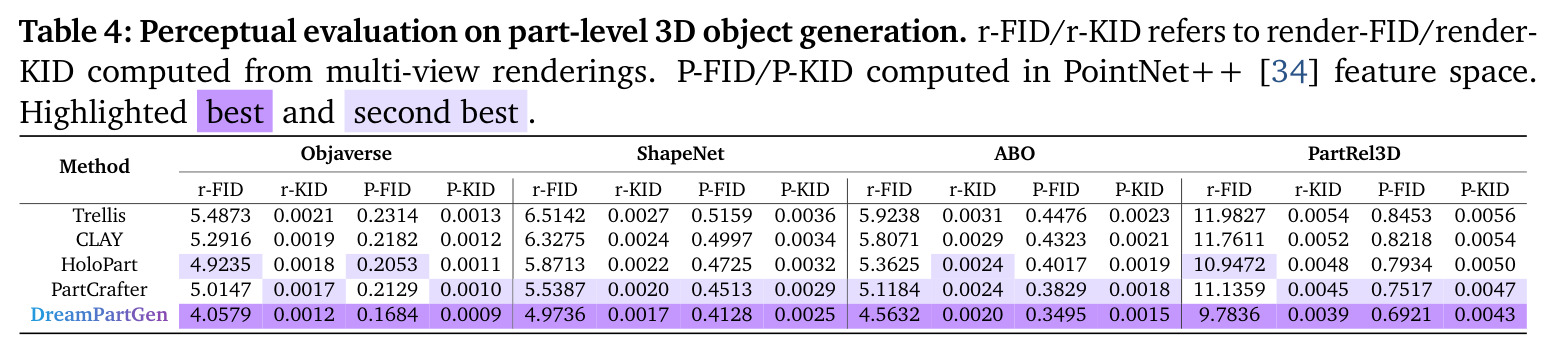
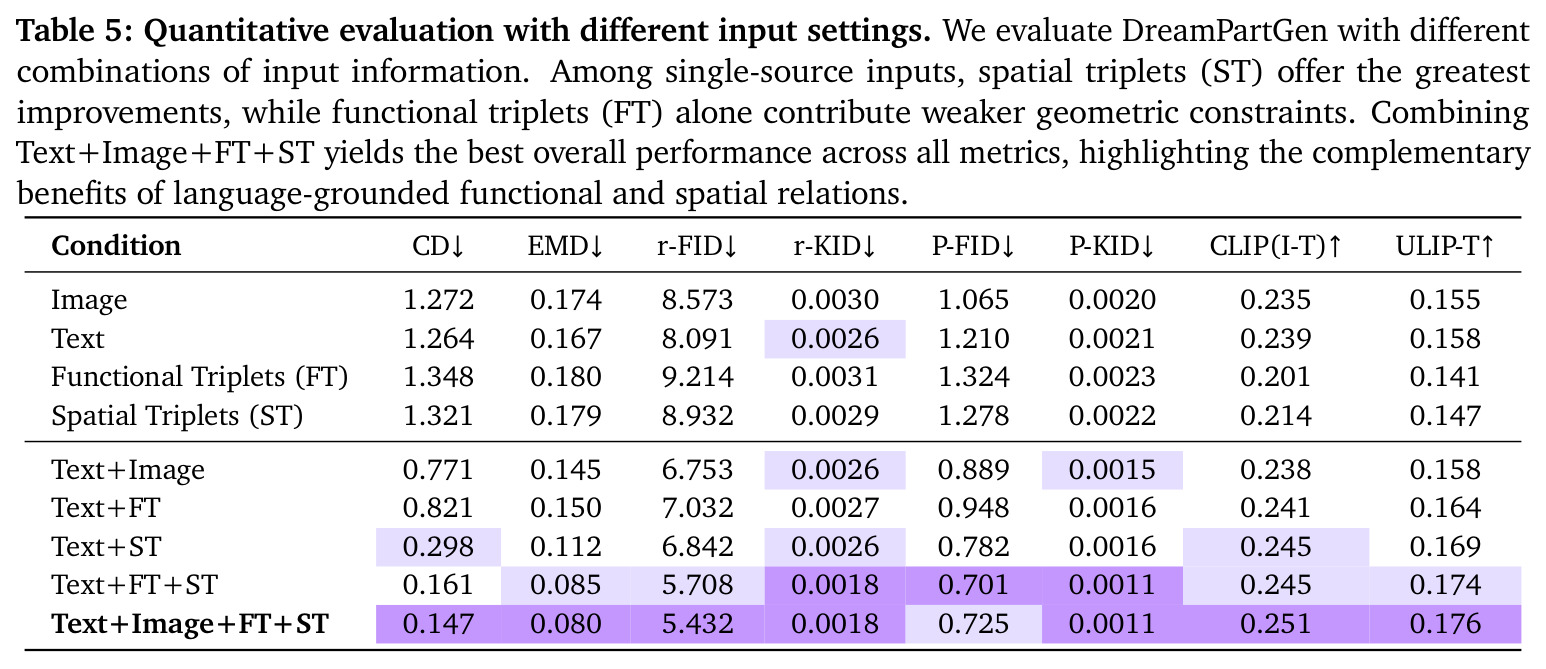
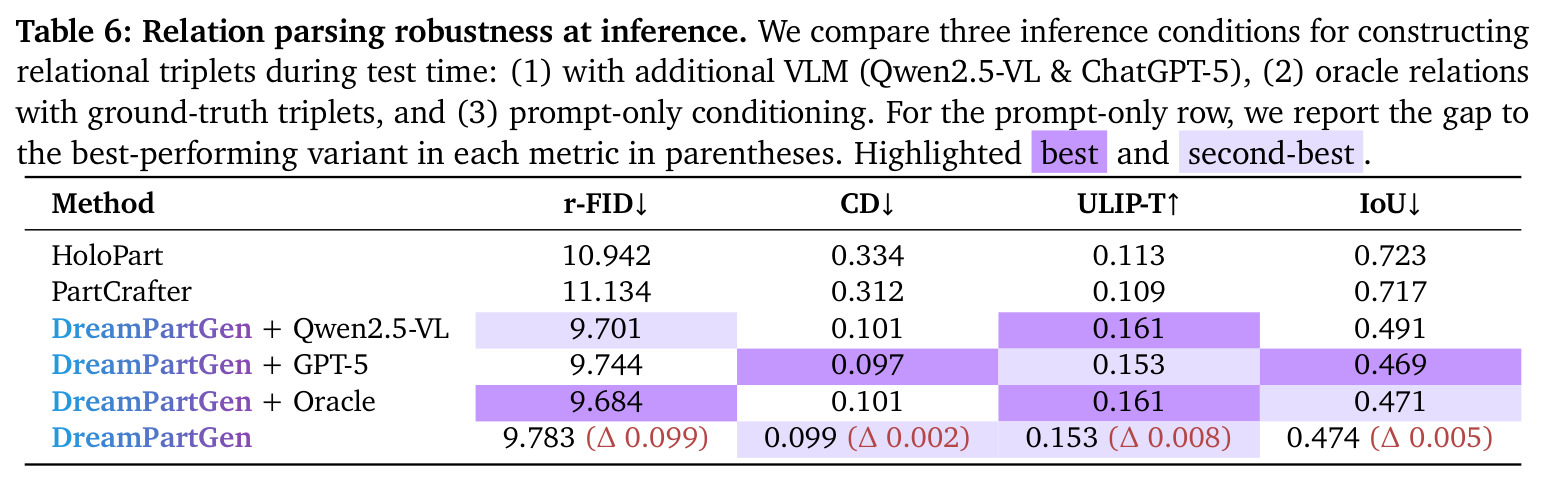
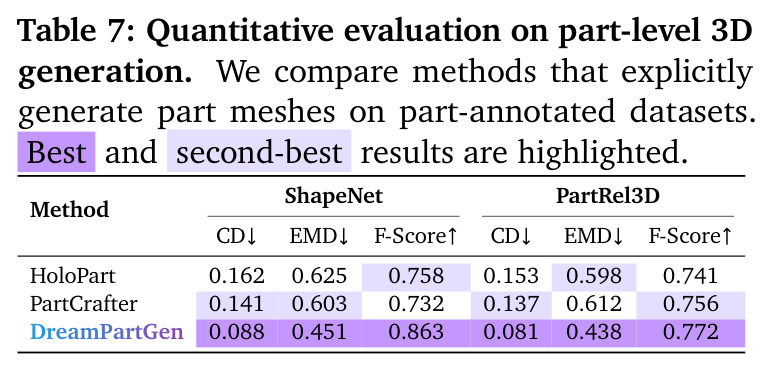
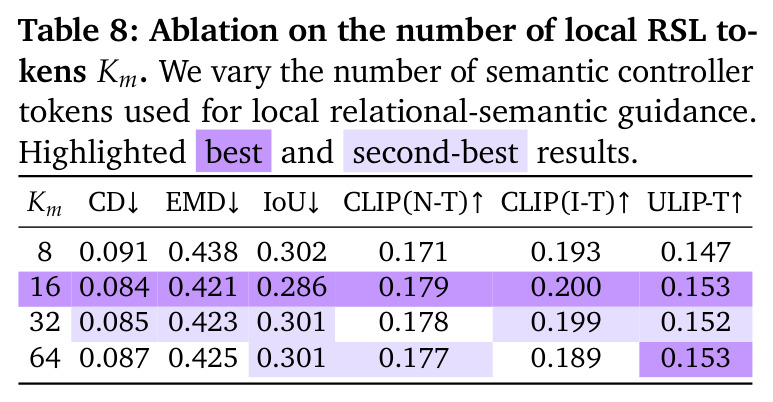
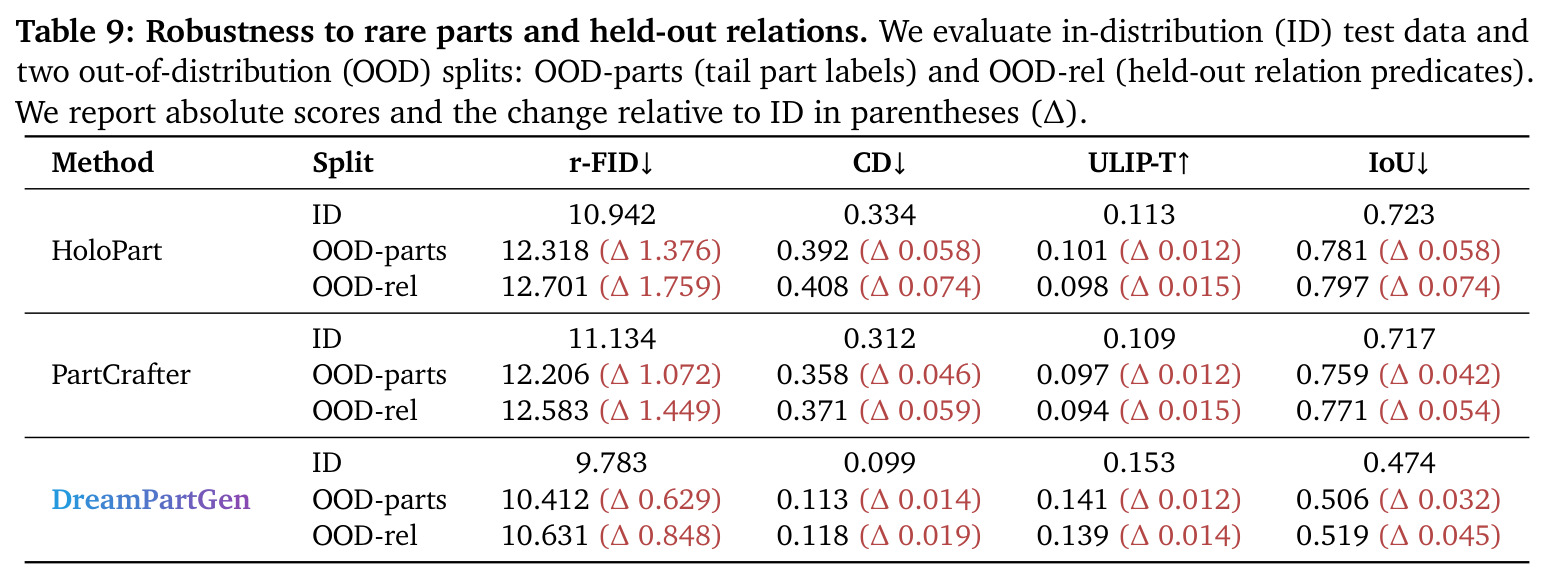
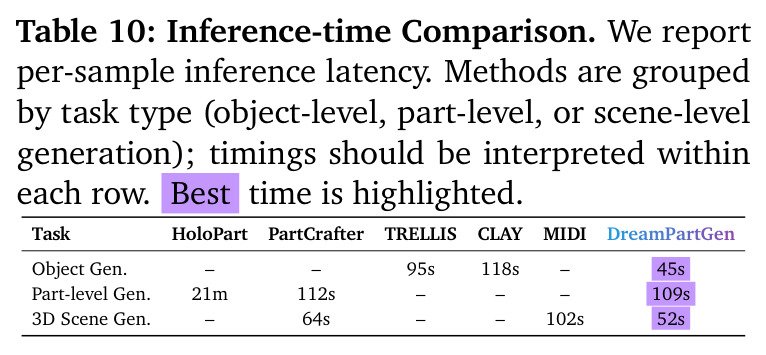
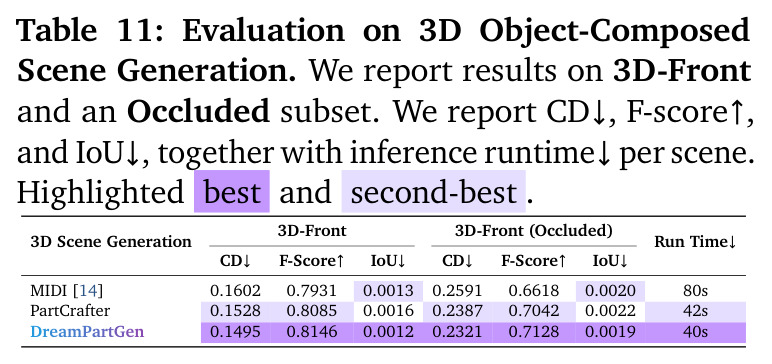
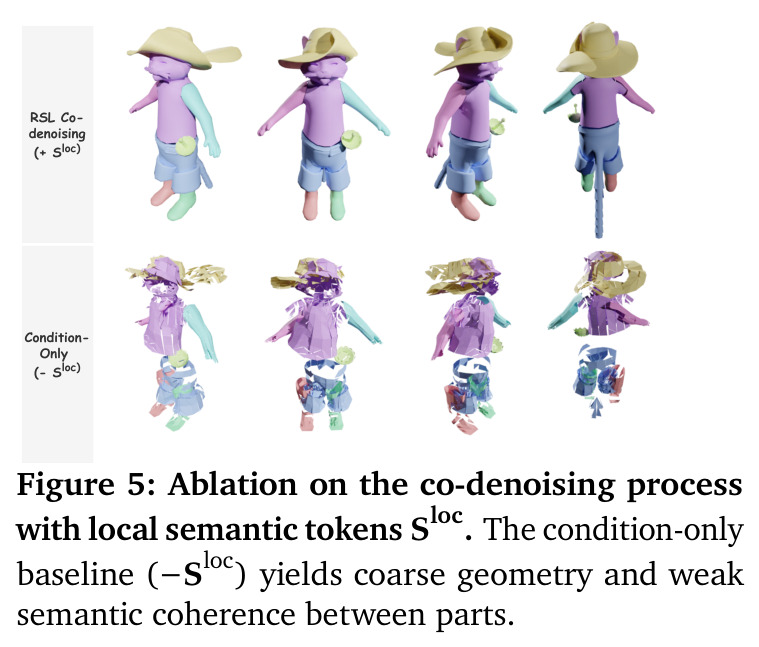
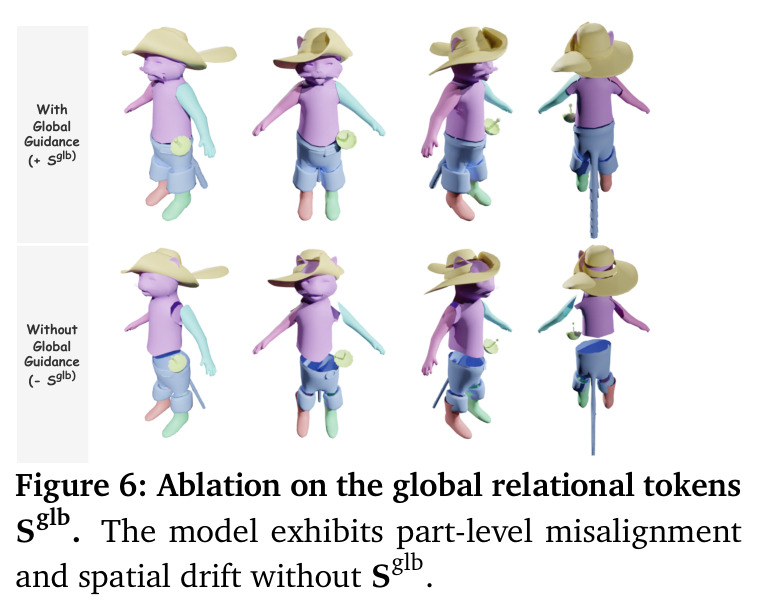
核心发现包括:在几何保真度方面,DreamPartGen在所有基准上实现最低的CD和EMD,平均比之前方法降低53%的CD和33%的EMD。例如在PartRel3D上,CD从0.371降至0.081(降低78.2%),EMD从1.474降至0.412(降低72.0%)。在文本-形状对齐方面,在对象级别提升≥20%(CLIP(I-T)从0.207增至0.264,提升27.5%;ULIP-T从0.162增至0.197,提升21.6%),在部分级别提升≥35%(CLIP(I-T)从0.145增至0.200,提升37.9%;ULIP-T从0.109增至0.153,提升40.4%)。在部分独立性方面,平均IoU降低27.2%(从0.518降至0.377),表明更强的非交叉部分生成能力。在感知质量方面,render-FID/KID和P-FID/P-KID在所有数据集上均最佳,例如在PartRel3D上,P-FID从0.7517降至0.6921。在消融实验中,移除全局关系令牌(✗Sglb)导致CD增加275.1%,EMD增加101.4%,部分重叠(IoU)增加176.9%,ULIP-T降低46.8%;移除局部语义令牌(✗Sloc)导致CD增加647.6%,EMD增加438.6%,IoU增加207.5%,ULIP-T降低43.7%;移除部分标识符导致IoU增加106.6%,CD/EMD增加121.7%/91.0%,ULIP-T降低42.4%。在少部分和未见关系泛化方面,OOD-parts设置下Render-FID增加∆0.629(相比PartCrafter的∆1.072),OOD-rel设置下增加∆0.848(相比PartCrafter的∆1.449),且ULIP-T仅下降∆0.012-0.014。在推理效率方面,对象级生成耗时109秒,部分级生成45秒,3D场景生成52秒,在保持竞争性能的同时保持效率。
查看结构化数据
| 任务 | 指标 | 本文 | 基线 | 提升 |
|---|---|---|---|---|
| 3D对象生成(几何保真度) | Chamfer Distance (CD) ↓ | 0.081 (PartRel3D) | PartCrafter: 0.371 | 降低78.2% |
| 3D对象生成(几何保真度) | Earth Mover's Distance (EMD) ↓ | 0.412 (PartRel3D) | PartCrafter: 1.474 | 降低72.0% |
| 3D对象生成(部分独立性) | 平均配对IoU ↓ | 0.212 (PartRel3D) | HoloPart: 0.716 | 降低70.4% |
| 3D对象生成(文本-形状对齐) | CLIP(I-T) ↑ | 0.264 (Partverse, 对象级) | PartCrafter: 0.207 | 提升27.5% |
| 3D对象生成(文本-形状对齐) | ULIP-T ↑ | 0.197 (Partverse, 对象级) | PartCrafter: 0.162 | 提升21.6% |
| 3D场景生成 | CD ↓ | 0.1495 (3D-Front) | MIDI: 0.1602 | 降低6.7% |
| 3D场景生成 | F-Score ↑ | 0.8146 (3D-Front) | MIDI: 0.7931 | 提升2.7% |
局限与改进
作者承认的局限性包括:(1)对关系解析器的依赖。虽然prompt-only推理保持竞争性,但使用VLM解析关系可以获得额外性能提升,这引入了对外部模型的依赖。(2)复杂场景的可扩展性。当前方法适用于小场景(几个对象),但扩展到大型复杂场景可能需要更高效的关系建模和注意力机制。(3)部分分解的一致性。虽然方法在OOD部分上表现良好,但仍然依赖于训练时的部分分解一致性,对于极不规范的分解可能仍然脆弱。\n\n自己观察到的局限性包括:(1)三元组规范的刚性。将自由形式的关系短语规范化为有限词汇表可能丢失细微差别,例如"slightly above"和"well above"都被映射为"above",这可能影响细粒度空间控制。(2)动态关系的处理缺失。当前RSLs建模静态关系,但某些应用可能需要动态关系(如"打开"门、"折叠"椅子),这需要更复杂的时序建模。(3)部分层次的缺失。PartNet提供分层部分标注,但DPLs是扁平的,无法显式建模部分-子部分关系,这可能限制对复杂层次结构的生成能力。(4)计算复杂度。虽然推理时间合理,但RSLs的双级同步增加了计算开销,对于实时应用可能需要优化。
独立分析的弱点
独立分析的弱点及改进方向:\n\n(1)三元组粒度粗的问题。当前关系谓词(如support、attach)是高层次的抽象,不直接约束几何。改进方向:引入细粒度几何约束,如接触点法向量对齐、关节轴参数等,将功能关系与具体几何参数关联。\n\n(2)VLM解析噪声的问题。使用VLM从文本或图像提取三元组可能引入错误或歧义。改进方向:训练端到端的关系解析模块,直接从原始文本或图像学习关系表示,避免显式三元组提取的误差传播。\n\n(3)缺乏物理仿真验证的问题。虽然生成的关系语义合理,但没有物理引擎验证功能正确性(如可移动关节)。改进方向:集成物理仿真器(如PyBullet、MuJoCo),在生成后验证和修正物理合理性,或训练时引入物理一致性损失。\n\n(4)部分层次建模缺失的问题。复杂对象(如人体、车辆)有层次结构(身体-手臂-手-手指),扁平的DPLs无法显式建模。改进方向:扩展DPLs为树状结构,引入部分-子部分注意力,分层同步几何-外观-语义。\n\n(5)时序关系和动态生成缺失的问题。当前只处理静态3D对象,无法生成可动画化的内容。改进方向:引入时序RSLs,建模动作和状态转移(如"打开"、"旋转"),支持生成可动画的3D资产。
未来方向
未来研究方向包括:\n\n作者提出的方向:(1)扩展到更复杂的具身或交互式设置,如机器人抓取场景中需要精确部分-部分交互推理;(2)探索结构化部分表示在更复杂语义任务中的作用,如问答、推理、规划。\n\n基于成果可延伸的方向:(1)多模态输入增强。当前主要使用文本,可以扩展到图像、草图、语音等多模态输入,实现更灵活的3D创作。(2)跨域迁移。将RSLs框架迁移到其他生成任务,如文本到4D视频、文本到场景图、文本到机器人技能等。(3)自监督学习。利用大规模无标注3D数据,通过自监督学习预训练部分级表示,减少对标注数据的依赖。(4)实时优化。开发更高效的注意力机制(如线性注意力、稀疏注意力),实现实时或近实时的3D生成。(5)用户交互设计。构建交互式编辑界面,用户可以实时修改部分关系、添加/删除部分、调整参数,所见即所得地创作3D内容。
复现评估
复现评估:\n\n开源情况:论文承诺提供开源实现,但需要检查代码仓库的完整性。\n\n数据可用性:PartRel3D数据集是新构建的,需要确认是否公开发布。该数据集包含约11K部分标注对象,跨越175个对象类别,超过90K个部分和300K规范化关系三元组。数据集验证采用两阶段协议:几何检查通过Open3D计算轴对齐边界框,对空间三元组应用谓词特定不等式过滤不一致三元组;人工审计均匀采样200个三元组,使用渲染的多视图图像和部分掩码手动验证正确性,重复20次得到稳定估计。空间三元组和功能三元组的平均正确率分别为92%和88%。\n\n算力需求:所有实验在4个NVIDIA L40 GPU上进行。训练使用AdamW,学习率 $1 \times 10^{-4}$,余弦衰减,梯度裁剪在1.0。这些是中等规模的资源需求,对于研究实验室是可及的。\n\n难度评估:总体难度中等。需要熟悉PyTorch、扩散模型、3D处理(Open3D、PointNet++)、以及注意力机制实现。依赖项包括3D VAE、图像VAE(如PixArt-α)、文本编码器(如Gemma 2)。数据处理需要解析三元组、渲染多视图图像、计算几何指标(CD、EMD、IoU)。评估需要多个基准数据集:Objaverse、ShapeNet、ABO、PartVerse、3D-Front。\n\n潜在障碍:部分数据集的获取和预处理可能耗时;VLM关系解析的配置需要额外步骤;3D渲染和几何计算的实现需要专业知识。但论文提供了详细的实现细节和评估协议,复现应该是可行的。
论文图表
该表展示了在Partverse数据集上的文本-形状对齐比较,使用CLIP(N-T)、CLIP(I-T)、ULIP-T指标。分为对象级和部分级两个Scope。在对象级,DreamPartGen的CLIP(I-T)为0.264(PartCrafter为0.207,提升27.5%),ULIP-T为0.197(PartCrafter为0.162,提升21.6%)。在部分级,DreamPartGen的CLIP(I-T)为0.200(PartCrafter为0.145,提升37.9%),ULIP-T为0.153(PartCrafter为0.109,提升40.4%)。表格清晰展示了RSLs在细粒度语义对齐上的有效性。
这个表格对理解论文很重要,因为它专门评估了文本-形状对齐性能,这是本文的核心目标之一。表格显示DreamPartGen不仅几何质量更好,语义对齐也显著改进,尤其是在部分级别的提升更加突出。
该表展示了模型组件的消融实验,在PartRel3D数据集上评估CD、EMD、IoU、ULIP-T。完整DreamPartGen的结果是CD=0.771, EMD=0.145, IoU=0.212, ULIP-T=0.158。移除Sglb后CD增至2.892(↑275.1%),EMD增至0.292(↑101.4%),IoU增至0.587(↑176.9%),ULIP-T降至0.084(↓46.8%)。移除Sloc后CD增至5.764(↑647.6%),EMD增至0.781(↑438.6%),IoU增至0.652(↑207.5%),ULIP-T降至0.089(↓43.7%)。移除Part Identifier后IoU增至0.438(↑106.6%),CD/EMD增至1.709/0.277(↑121.7%/↑91.0%),ULIP-T降至0.091(↓42.4%)。表格清晰地展示了每个组件的重要性。
这个表格对理解论文很重要,因为它通过消融实验量化了每个组件的贡献。表格显示Sglb、Sloc和Part Identifier都对性能至关重要,移除任何一个都会导致严重退化,验证了设计的必要性。
该图展示了定性结果,包括自行车、床、滑板、SUV、烛台、耳机等6个示例。每个示例显示Parts、Descriptions、FT & ST(功能与空间三元组)和最终Object。例如自行车有wheel、handlebar grip、gear等部分,FT包括(wheel, frame, attach)、(seat, frame, support),ST包括(gear, frame, touching)、(gear, frame, right-of)。图示展示了DreamPartGen可以在没有显式结构指导(如边界框)的情况下实现高质量的部分感知3D生成。
这张图对理解论文很重要,它展示了方法的多样性和质量,验证了框架不依赖显式几何指导。
该图展示了部分关节生成结果,显示具有运动能力的3D资产在不同姿态下保持结构一致性。通过估计部分变换对齐两个状态,重建关节运动。图示展示了RSLs如何支持关节对象的生成。
这张图对理解论文很重要,它展示了方法的另一个下游应用,验证了框架对关节对象的适用性。
该图展示了额外的部分编辑结果,显示多样化的部分编辑操作(如添加、修改、删除部分)同时保持结构一致性。图示进一步验证了DPLs的模块性和RSLs对编辑的指导作用。
这张图对理解论文很重要,它展示了部分编辑的多样性和一致性,增强了方法的实用性论证。