MACE-Dance:面向音乐驱动舞蹈视频生成的运动-外观级联专家框架 MACE-Dance: Motion-Appearance Cascaded Experts for Music-Driven Dance Video Generation
级联运动/外观专家+BiMamba-Transformer,3D中间表示刷新音乐驱动舞蹈视频SOTA
前置知识
扩散模型(Diffusion Model / DDPM)
通过正向加噪与反向去噪的马尔可夫过程学习数据分布的生成模型。在舞蹈任务中,模型以加噪的3D姿态为输入、以音乐为条件,逐步去噪得到SMPL参数序列。
Motion Expert的整个训练流程建立在DDPM之上,理解前向 $q(z_t|x)$ 与反向 $\hat{x}_\theta(z_t,t,c)$ 是阅读方法部分的前提。
SMPL人体参数化模型
一种用形状参数 $\beta\in\mathbb{R}^{10}$ 与姿态参数 $\theta\in\mathbb{R}^{24\times 3}$ 表示人体几何的可微模型,能通过线性混合蒙皮生成3D网格。
MACE-Dance把SMPL参数作为运动阶段的输出与外观阶段的中间桥梁,3D表示规避了2D关键点的视角歧义和遮挡问题。
Mamba / 双向Mamba (BiMamba)
基于选择性状态空间模型(SSM)的序列建模架构,输入依赖参数 $\bar{A}_t,\bar{B}_t,C_t$ 动态生成,可线性复杂度处理长序列;BiMamba同时做正向与反向扫描,捕获更丰富的上下文。
Motion Expert用BiMamba捕获音乐与舞蹈的局部时序依赖,是替代Transformer注意力机制、避免长序列位置外推失效的关键设计。
姿态驱动图像动画(Pose-driven Image Animation)
给定一张参考图像与一组姿态序列(2D关键点或3D骨架),合成与姿态驱动一致的动态视频,典型方法如Animate Anyone、MagicAnimate、Wan-Animate。
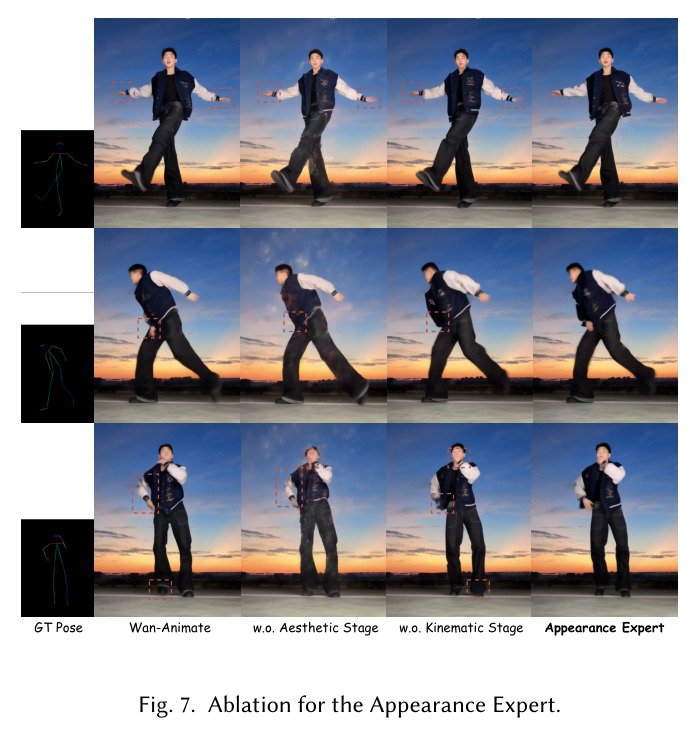
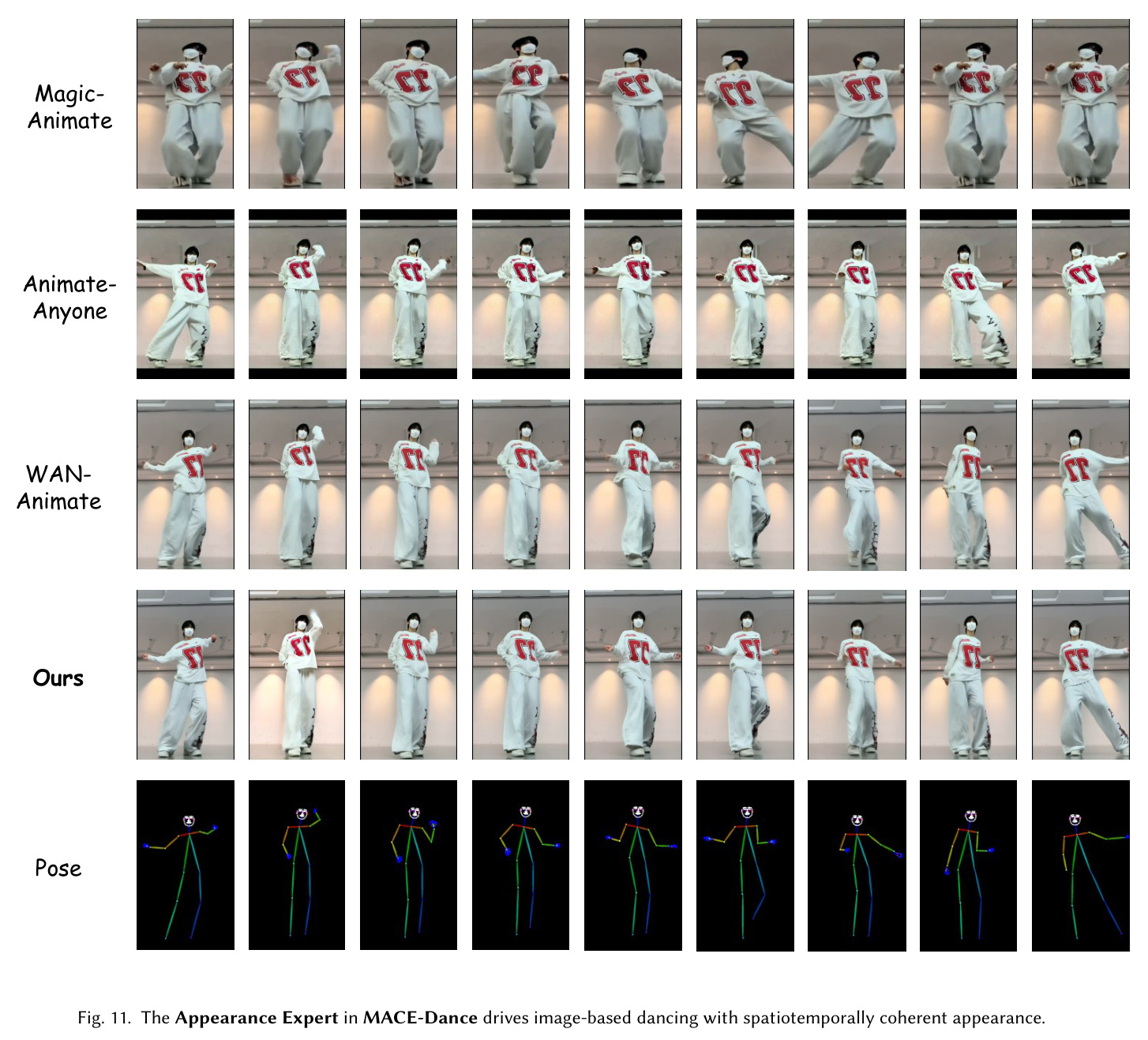
Appearance Expert建立在Wan-Animate之上,并通过两阶段微调把通用视频扩散模型适配到舞蹈领域,是论文第二个核心创新点。
Classifier-Free Guidance (CFG) 与 Guidance-Free Training (GFT)
CFG在推理时融合条件/无条件预测 $\hat{x}=\hat{x}_{cond}+w(\hat{x}_{cond}-\hat{x}_{uncond})$;GFT则在训练时直接学一个 $\beta$-索引的采样模型,单次前向就能控制保真度-多样性权衡。
GFT让推理仅需一次条件前向(而非CFG的两次),效率翻倍且缓解分布失配,是Motion Expert SOTA速度(770 FPS)的关键。
LoRA低秩适配
在原始权重 $W_0$ 旁并联低秩矩阵 $\Delta W=AB$($A\in\mathbb{R}^{m\times r}, B\in\mathbb{R}^{r\times n}$,$r\ll m,n$),仅微调A、B即可适配下游任务。
Aesthetic Stage使用rank=32的LoRA微调DiT块的Q/K/V/O与FFN,在保留预训练先验的同时精修舞蹈美学。
研究动机
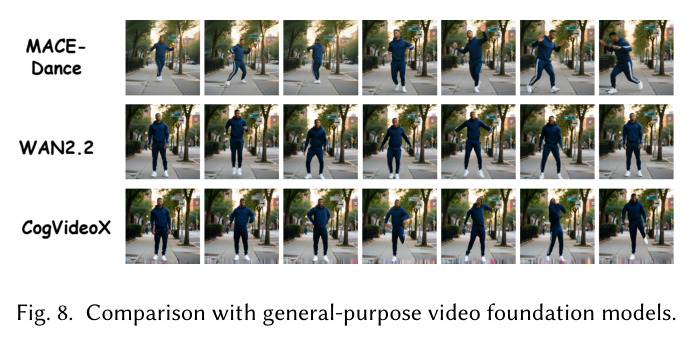
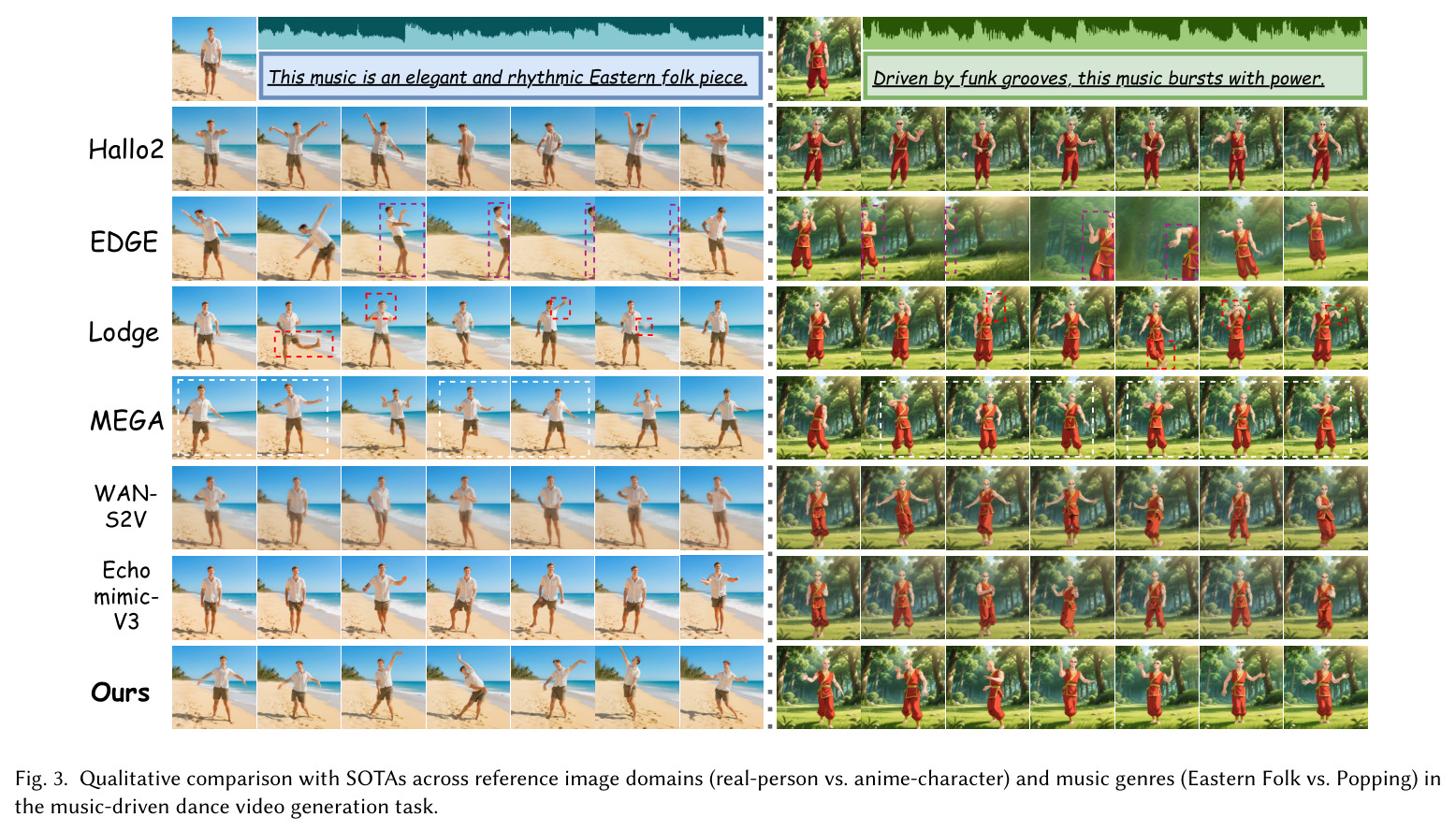
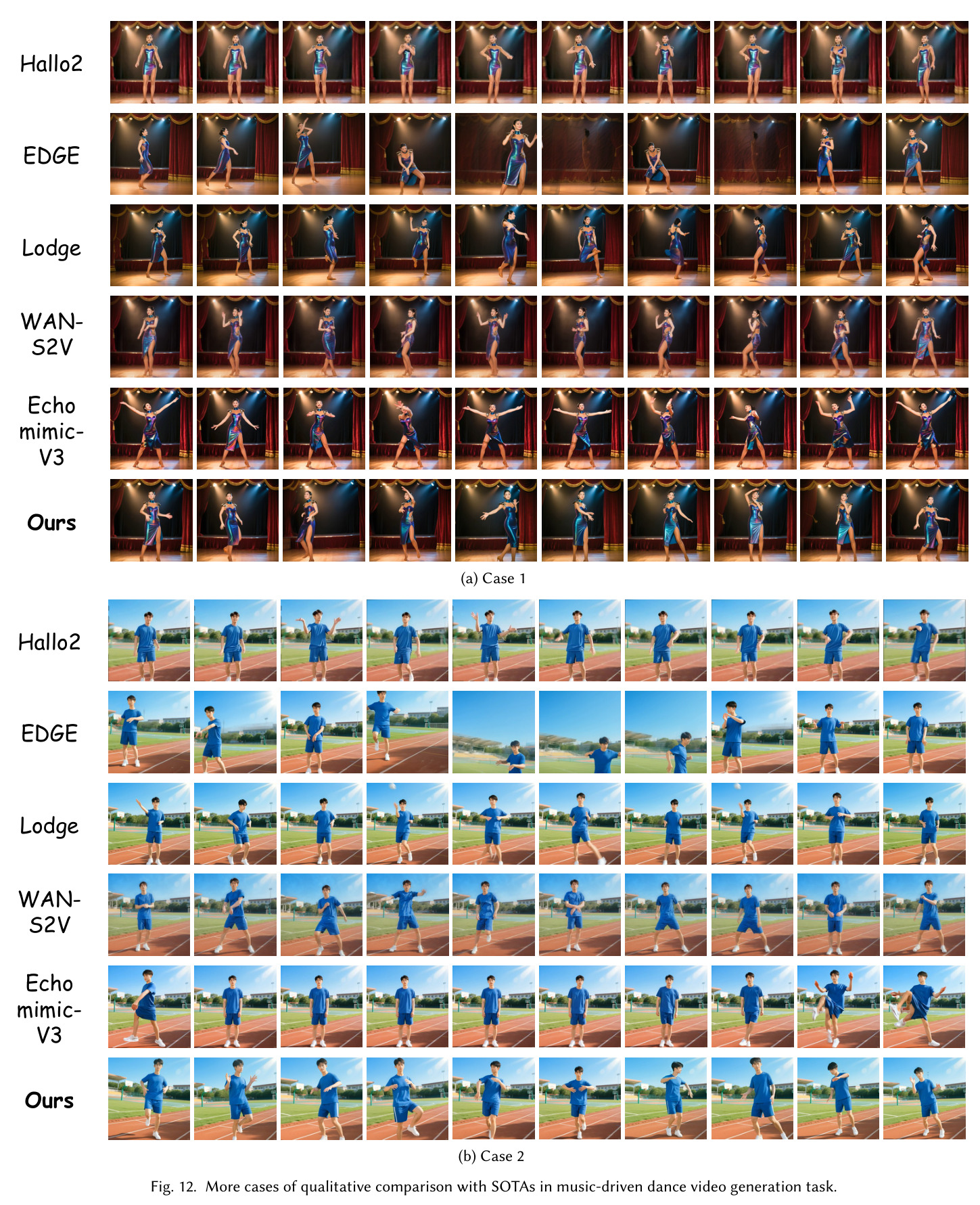
音乐驱动舞蹈视频生成是AIGC的高价值方向,但现有方法存在三重鸿沟:第一,3D舞蹈生成(如EDGE、Lodge++、MEGADance)只关注动作、忽视外观,从3D渲染得到的视频缺乏真实人-物交互与高保真纹理;第二,姿态驱动图像动画(如Animate Anyone、MagicAnimate)虽擅长视频合成,但姿态设计本身是最耗时的手工环节;第三,端到端音频驱动方案(DabFusion、X-Dancer)要么前景/背景模糊,要么无法捕捉舞蹈固有的3D全身运动特性。即使把3D姿态与图像动画拼接,也会出现匹配失真:在FineDance上EDGE的FID_k=94.34、Lodge的BAS仅0.226;在MA-Data自建基准上,Hallo2、WAN-S2V、EchoMimic-V3等通用方案均出现运动简单、重复、节奏感弱的问题。
本文的目标是构建一个端到端框架,使输入一段音乐和一张参考图,自动输出5–10秒(可外推到1024帧约34秒)运动学合理、艺术表达丰富、视觉高保真且时空一致的舞蹈视频,并在公开benchmark上同时刷新3D舞蹈生成与姿态驱动动画两个子任务的SOTA。
与已有工作不同的是,MACE-Dance的独特切入角度是"任务解耦 + 3D中间表示 + 级联MoE":把音乐→视频的复杂跨模态映射分解为"音乐→3D运动"与"3D运动+参考图→视频"两个受限子任务,让Motion Expert专精音乐到运动、Appearance Expert专精运动到像素;中间桥梁选择SMPL而非2D关键点,保留3D几何信息并通过Motion Projector兼容Wan-Animate的2D接口;同时引入BiMamba-Transformer混合骨干与GFT策略解决长序列外推与推理效率问题。
核心方法
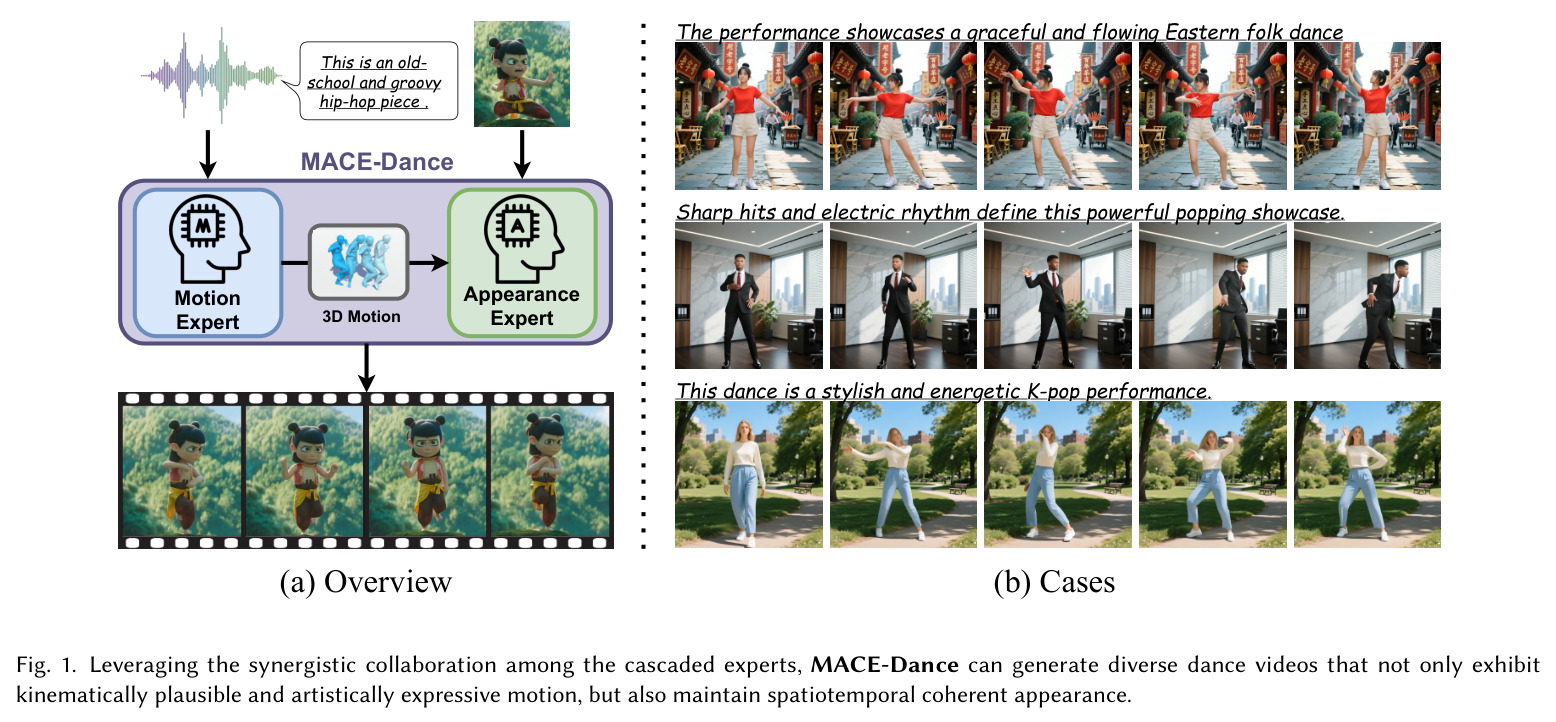
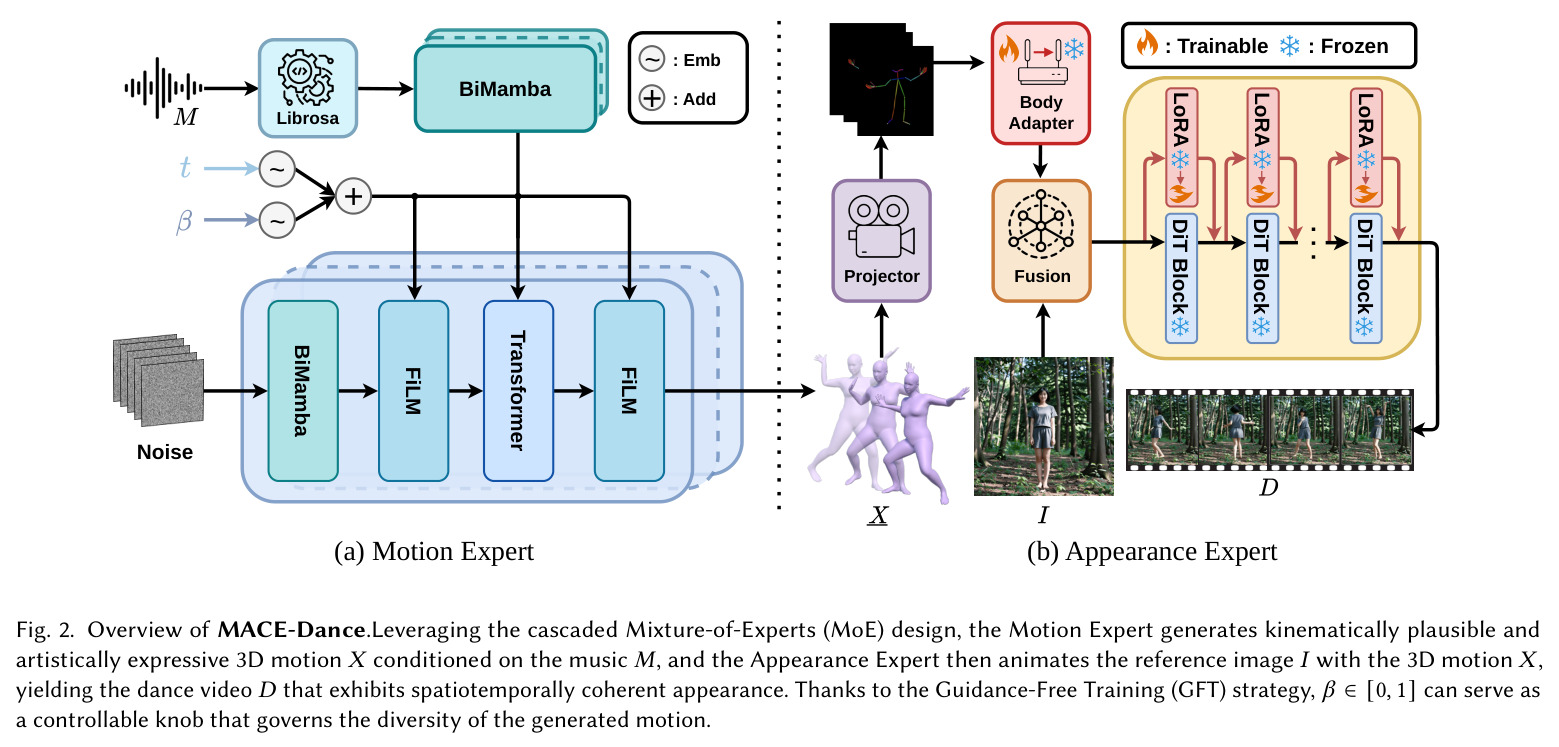
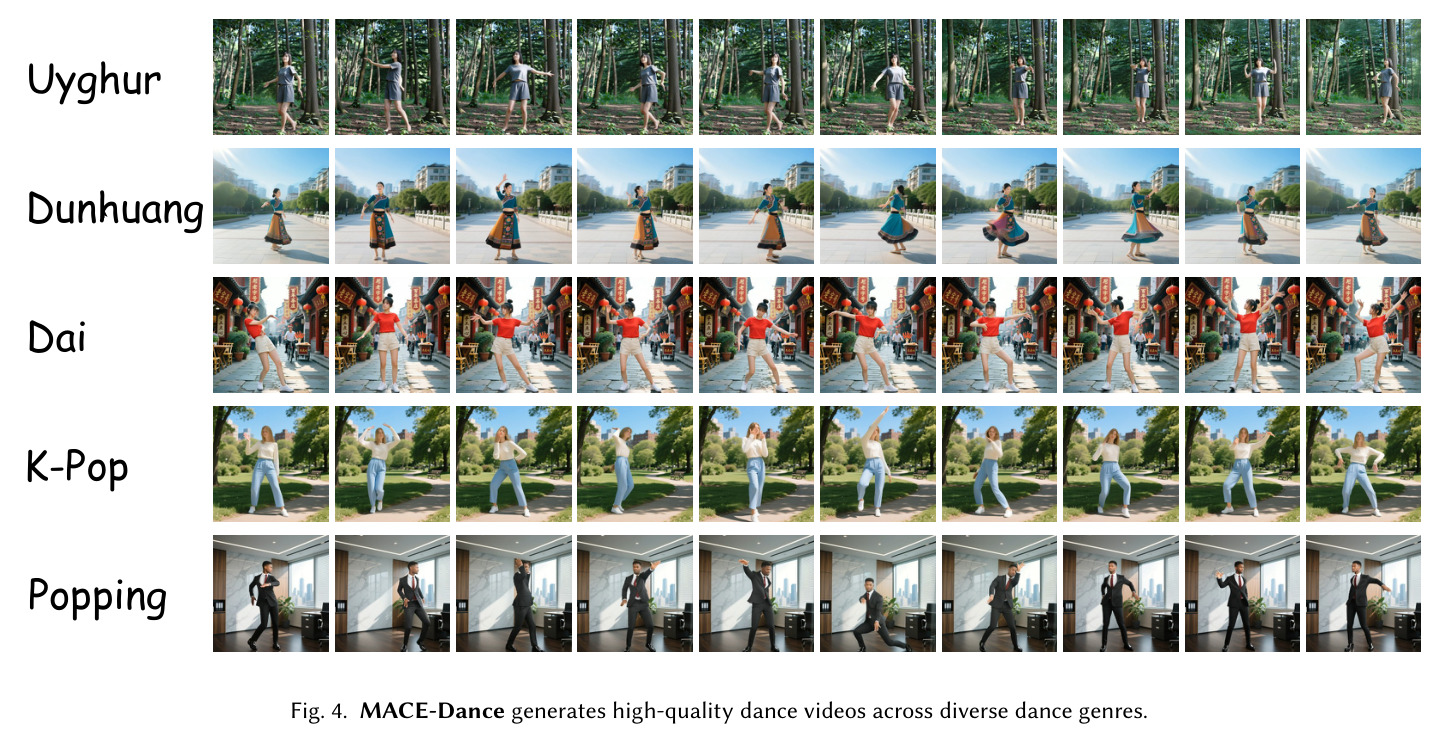
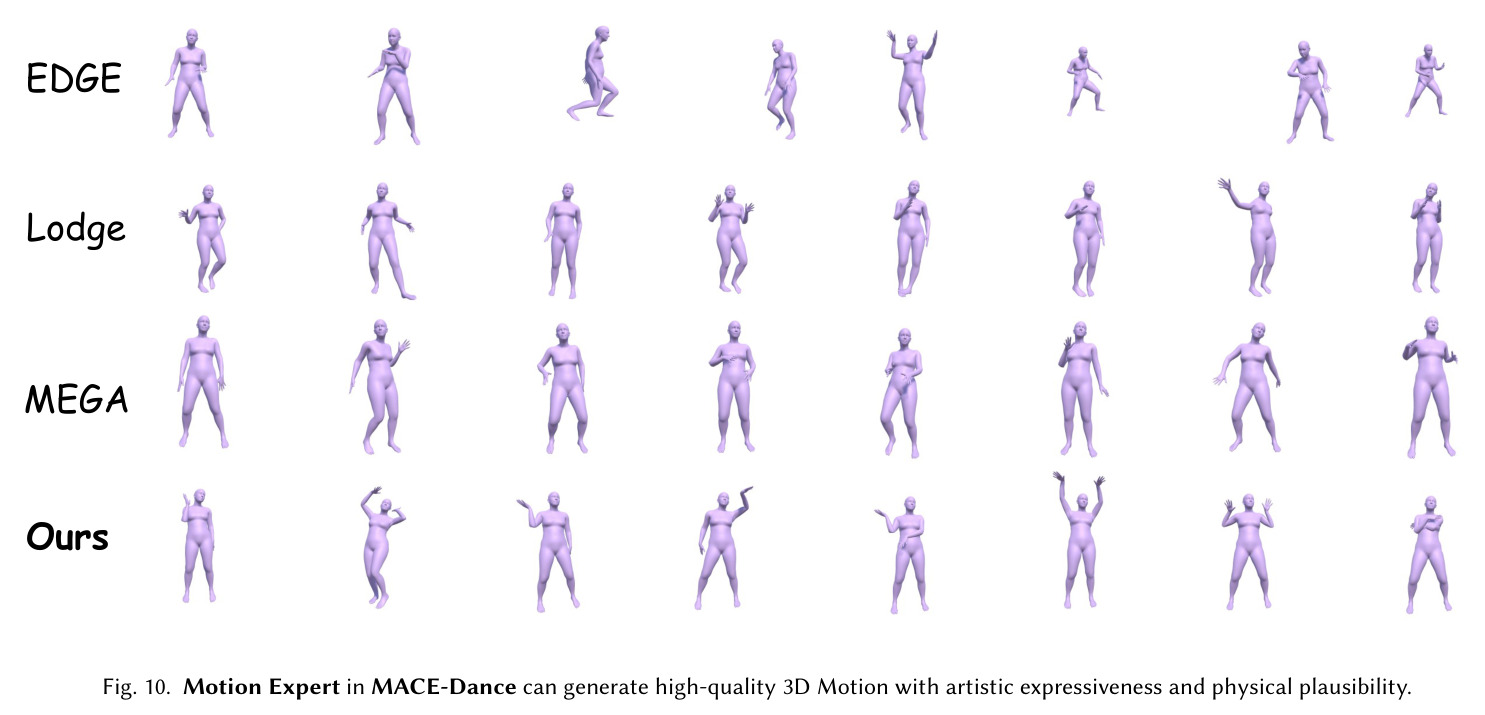
MACE-Dance采用级联MoE设计,第一阶段Motion Expert把音乐 $M\in\mathbb{R}^{T\times C_m}$ 映射为SMPL参数化的3D运动 $X\in\mathbb{R}^{T\times C_x}$,第二阶段Appearance Expert结合参考图 $I$ 与运动 $X$ 渲染舞蹈视频 $D\in\mathbb{R}^{T\times H\times W\times 3}$。Motion Expert的核心是基于DDPM的扩散模型,骨干由BiMamba层(局部/音乐内部时序)和Transformer层(跨模态全局对齐)堆叠而成,并配合Guidance-Free Training把温度参数 $\beta\in[0,1]$ 作为可调旋钮控制生成多样性与保真度;损失函数包含重建损失、3D关节位置损失、速度损失与脚接触损失 $\mathcal{L}=\lambda_{rec}\mathcal{L}_{rec}+\lambda_{joint}\mathcal{L}_{joint}+\lambda_{vel}\mathcal{L}_{vel}+\lambda_{foot}\mathcal{L}_{foot}$。Appearance Expert基于Wan-Animate(14B),先在Kinematic阶段仅微调Body Adapter强化身体姿态保真度,再在Aesthetic阶段冻结骨干仅训练LoRA(rank=32)精修纹理、光照与摄像机运动,从而把通用视频扩散模型无缝适配到舞蹈领域。
核心创新有二:(1) BiMamba-Transformer异构骨干——BiMamba(带Genre-Gate)对音乐编码做双向SSM扫描捕获局部依赖、Transformer通过跨注意力 $Q_dK_m^\top/\sqrt{C}$ 把全局节奏信息注入运动特征,二者互补解决了单一Transformer在长序列上位置外推失效、易陷入原地抖动的问题,同时保留非自回归并行生成的效率优势;(2) Kinematic-Aesthetic解耦微调——把Wan-Animate的Body Adapter单独训练以增强姿态保真,避免新增跨注意力分支带来的显存开销与特征纠缠,再用LoRA在每个DiT块上精修纹理、服饰、镜头运镜,使外观与运动正交优化。与已有方法相比,本质区别在于:EDGE等inpainting-based方法是自回归/补全式生成,会出现exposure bias;Bailando/MEGADance基于VQ-VAE+自回归存在码本离散化误差;DabFusion/X-Dancer端到端方案无法解耦运动与外观;本框架通过3D中间表示和显式级联,使两个子任务都能在各自benchmark上独立SOTA。
方法步骤详情
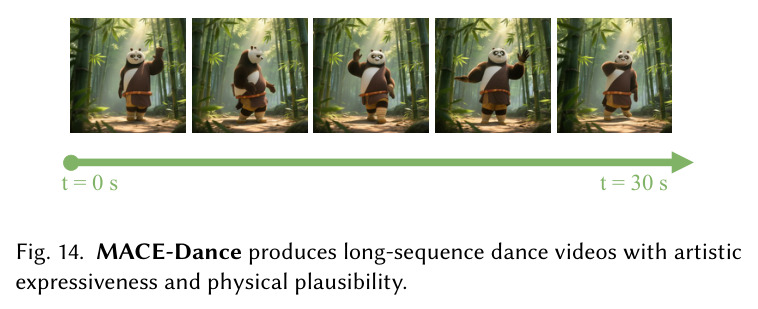
完整推理流程:(1) 音乐预处理:用Librosa提取与FineDance一致的音频特征,送入2层BiMamba+Genre-Gate编码器得到音乐上下文 $C_m$;(2) 噪声扩散:以随机噪声 $z_T\sim\mathcal{N}(0,I)$ 为起点,按DDIM迭代去噪,每一步输入当前 $z_t$、时间步 $t$、温度 $\beta$ 与音乐条件 $c$,骨干8层BiMamba-Transformer块交替进行局部SSM、FiLM调制、跨注意力全局注入、再FiLM,输出 $\hat{x}_\theta(z_t,t,c,\beta)$;(3) 目标重构:按GFT公式 $x_\beta=\beta\hat{x}_\theta(z_t,t,c,\beta)+(1-\beta)\mathrm{sg}[\hat{x}_\theta(z_t,t,\emptyset,1)]$ 联合优化重建、关节、速度、脚接触四项损失;(4) 3D→2D投影:Motion Projector把SMPL参数经pyrender正面渲染后用ViTPose提取2D关键点,兼容Wan-Animate输入接口;(5) Appearance Expert-Kinematic:冻结DiT与VAE,仅训练Body Adapter(lr=1e-5,50k iter)使身体姿态对齐SMPL预测;(6) Appearance Expert-Aesthetic:冻结上述模块,在每个DiT块的Q/K/V/O与FFN注入rank=32的LoRA(lr=5e-5,50k iter)优化纹理与镜头一致性;(7) 长序列生成:Motion Expert推理1024帧(约34秒),Appearance Expert以"上一段尾帧+全局参考图+连续2D pose"为锚点接力渲染,防止漂移与身份退化。
技术新颖性
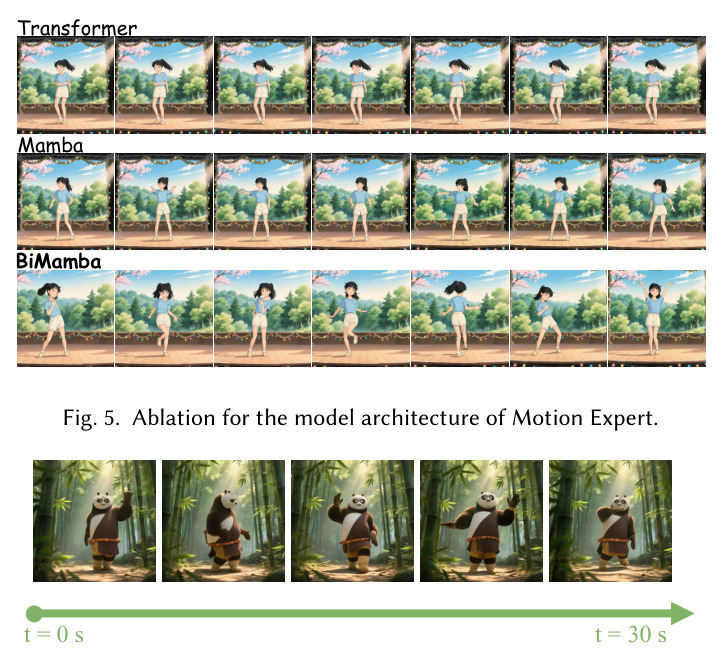
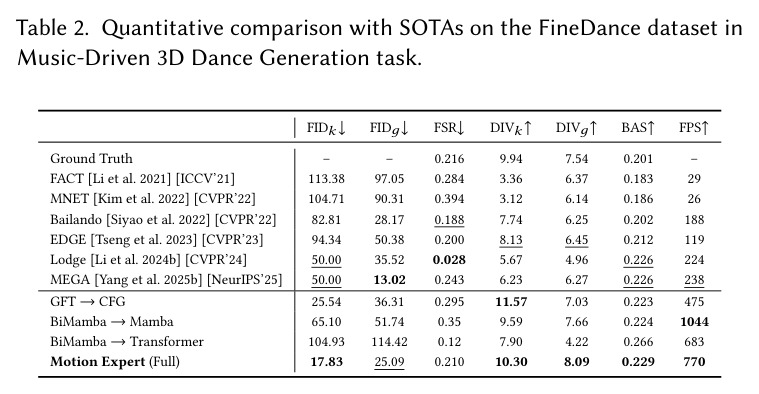
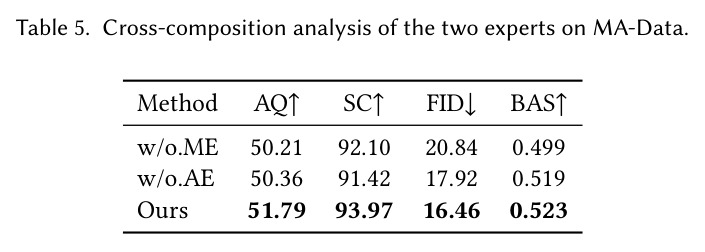
技术新颖性体现在三点:第一,BiMamba-Transformer是舞蹈生成的首次系统化结合,先前的Lodge++、MEGADance只用Transformer或自回归网络,无法处理长达34秒的运动序列;第二,GFT策略把温度参数内化为训练目标的一部分,使得推理只需一次条件前向,相比CFG单步计算量减半且无分布失配;第三,3D SMPL作为中间表示并通过Motion Projector自动转2D,既保留3D几何的鲁棒性又无缝对接2D视频扩散模型;第四,把Wan-Animate的两阶段微调细化为Kinematic(语义对齐)和Aesthetic(视觉精修),首次把通用视频模型高效迁移到舞蹈领域。消融实验证明:BiMamba→Mamba导致FID_k从17.83升至65.10、运动多样性塌陷;BiMamba→Transformer则FID_k飙至104.93、出现原地抖动;GFT→CFG使推理FPS从770降至475(≈1.62×加速)。
实验结果
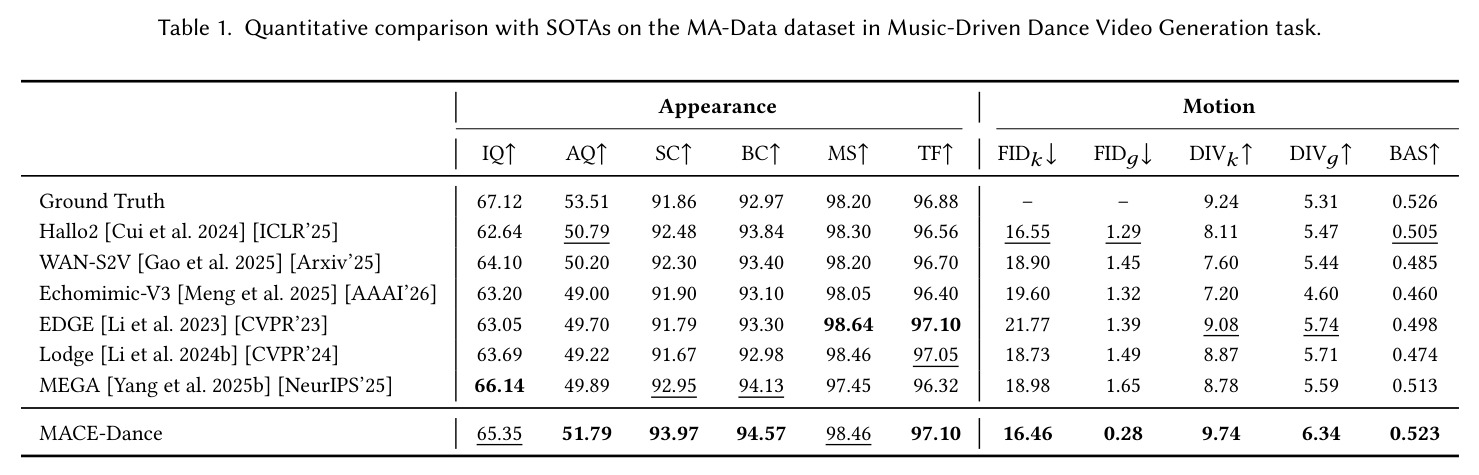
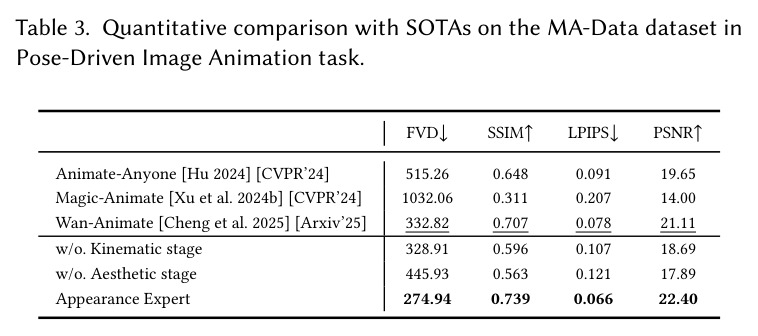
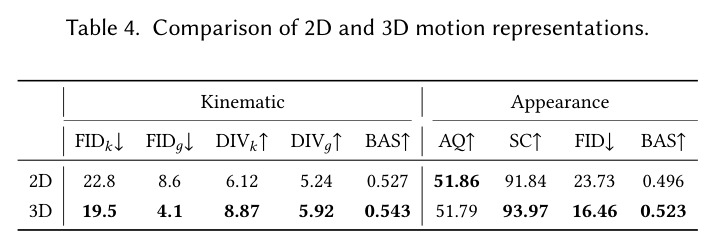
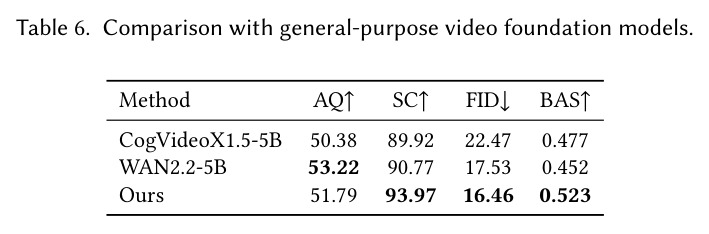
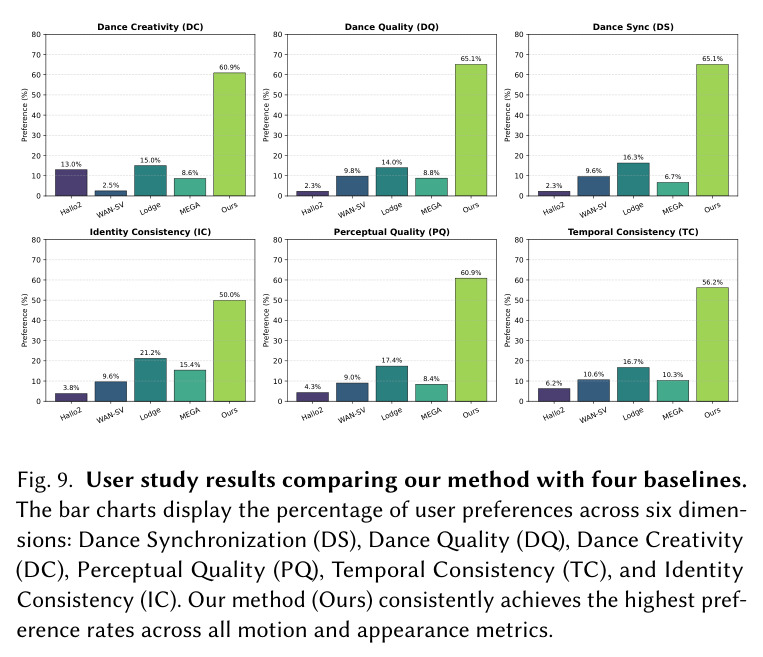
在3D舞蹈生成(FineDance,Tab. 2)上,Motion Expert同时刷新六项指标:FID_k=17.83(对比MEGA的50.00、Lodge的50.00、EDGE的94.34)、FID_g=25.09(仅次于MEGA的13.02但其余全部优于)、DIV_k=10.30、DIV_g=8.09、BAS=0.229、FSR=0.210;最关键的是FPS达到770,远超MEGA的238、EDGE的119、Fact的29,说明BiMamba-Transformer骨干配合GFT实现了"质量+效率"双SOTA。在舞蹈视频生成(MA-Data,Tab. 1)上,MACE-Dance的FID_k=16.46、FID_g=0.28(绝对领先,约为次优MEGA FID_g=1.65的1/6)、DIV_k=9.74、DIV_g=6.34、BAS=0.523,外观维度IQ=65.35、AQ=51.79、SC=93.97、BC=94.57、MS=98.46、TF=97.10,几乎全面领先。在姿态驱动图像动画子任务(Tab. 3)上,Appearance Expert把Wan-Animate的FVD从332.82降至274.94,SSIM从0.707提至0.739,LPIPS从0.078降至0.066,PSNR从21.11升至22.40;2D vs 3D对比(Tab. 4)显示3D在FineDance上FID_k降低3.3、FID_g降低4.5、BAS提升0.016,在MA-Data视频层面FID从23.73降至16.46、SC从91.84升至93.97。用户研究(40位舞蹈专业参与者、30段8秒音乐)进一步验证:在舞蹈同步(DS)65.1%、舞蹈质量(DQ)65.1%、舞蹈创意(DC)60.9%、感知质量(PQ)60.9%、时序一致性(TC)56.2%、身份一致性(IC)50.0%六个维度均居第一。
查看结构化数据
| 任务 | 指标 | 本文 | 基线 | 提升 |
|---|---|---|---|---|
| 音乐驱动3D舞蹈生成(FineDance) | FID_k(动力学FID) | 17.83 | 50.00(MEGA)/94.34(EDGE) | ↓ 64.4%(相比MEGA) |
| 音乐驱动3D舞蹈生成(FineDance) | BAS(节拍对齐) | 0.229 | 0.226(MEGA)/0.212(EDGE) | ↑ 1.3% |
| 音乐驱动3D舞蹈生成(FineDance) | FPS(推理速度) | 770 | 238(MEGA)/29(Fact) | ↑ 3.24×(相比MEGA) |
| 音乐驱动舞蹈视频生成(MA-Data) | FID_g(几何FID) | 0.28 | 1.29(Hallo2)/1.65(MEGA) | ↓ 78.3% |
| 音乐驱动舞蹈视频生成(MA-Data) | BAS(节拍对齐) | 0.523 | 0.513(MEGA)/0.498(EDGE) | ↑ 1.9% |
| 音乐驱动舞蹈视频生成(MA-Data) | SC(主体一致性) | 93.97 | 92.95(MEGA)/92.30(WAN-S2V) | ↑ 1.1 |
| 姿态驱动图像动画(MA-Data) | FVD | 274.94 | 332.82(Wan-Animate)/515.26(Animate Anyone) | ↓ 17.4% |
| 姿态驱动图像动画(MA-Data) | LPIPS | 0.066 | 0.078(Wan-Animate) | ↓ 15.4% |
局限与改进
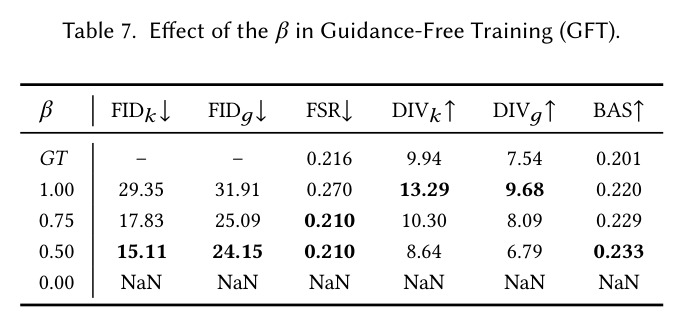
作者公开承认的局限有三:第一,控制模态单一,仅接受音乐输入,缺乏文本描述带来的层级化创作意图(如情绪、动作细节),难以表达"先旋转再举手"等序列指令;第二,Appearance Expert基于14B的Wan-Animate,计算开销大、暂不支持实时交互;第三,训练数据可能存在舞蹈风格、身形、服饰与文化表征的偏差,导致跨群体生成质量不均衡,模型也不应被用于身份篡改或合成欺骗性媒体。我自己的额外观察:(1) 评测数据集MA-Data虽含116小时、20+舞种,但测试集仅200段5秒片段,规模有限,可能对长尾舞种(如街舞细分风格)的泛化评估不足;(2) Motion Projector强制使用正面虚拟相机渲染SMPL再提取2D关键点,会丢失侧面/背面信息,未来可用多视角投影缓解;(3) GFT的 $\beta=0$ 时训练数值不稳定(Tab. 7全NaN),参数边界仍需进一步理论分析;(4) 缺乏对极端动作(如双人舞、托举、地面动作)的支持,SMPL对单人体外接触建模较弱。
独立分析的弱点
独立分析三个改进空间。第一,3D→2D投影是潜在瓶颈:当前pyrender正面渲染会丢失360°信息,对于Popping、K-Pop等含强烈侧面旋转或地面动作的舞蹈,可能在外观阶段引入姿态-图像错位;改进方向是采用多视角投影+视角条件编码,让Appearance Expert显式感知相机。第二,Motion Expert在GFT下 $\beta=0$ 出现NaN,意味着极端保真参数化存在数值不稳定;改进方向是引入数值更稳定的CFG-like权重调节或对 $x_\beta$ 加约束(如L2范数clip)。第三,Appearance Expert体量过大(14B)、仅靠LoRA难以做精细风格定制;改进方向是引入参考图驱动的Adapter或HyperNetwork,让用户能控制舞蹈风格、镜头感。第四,当前缺少多人/双人舞支持,SMPL-X结合多人体骨架碰撞约束是可行扩展。
未来方向
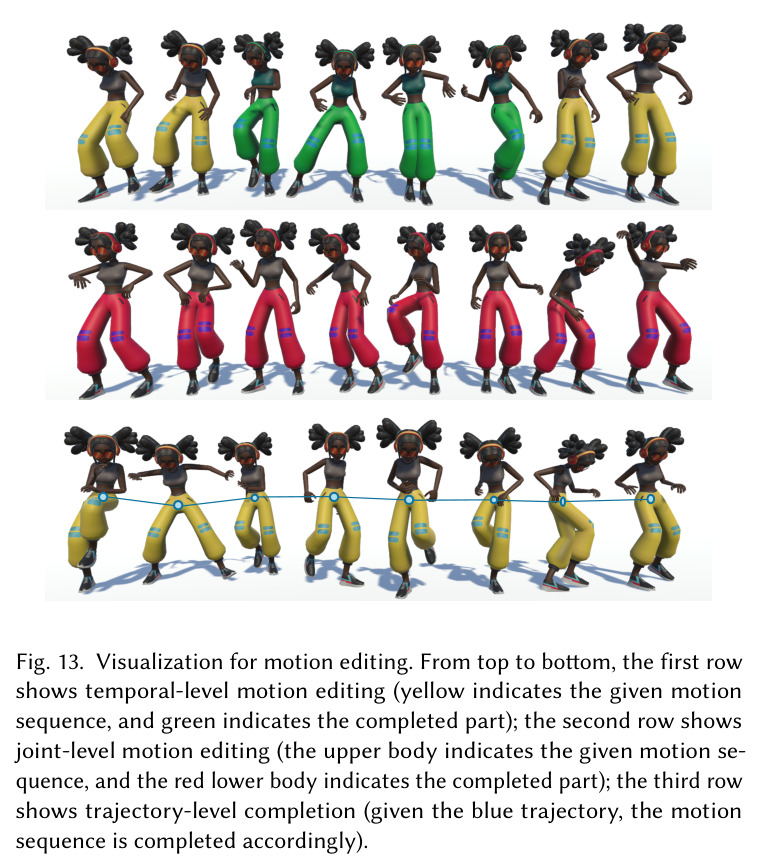
作者在结论与Limitations部分明确给出三方向:(1) 文本可控舞蹈生成——引入自由文本描述实现"优雅的东方民间舞 + 先旋转再举手"等层级控制,但当前主要瓶颈是缺乏大规模带文本标注的舞蹈数据;(2) 实时低延迟——通过知识蒸馏、量化剪枝乃至全新轻量Appearance Expert架构,把推理从14B压到消费级GPU实时;(3) 跨模态拓展到XR/具身AI——因Motion Expert输出是结构化3D motion,可直接重定向到CG角色、VR Avatar甚至人形机器人。基于成果可延伸的方向还有:跨舞种迁移(用LoRA在不同风格间快速切换)、交互式choreography authoring(结合Tab.7的 $\beta$ 与Masked Inpainting支持时空/关节级编辑)、与音乐生成联合训练形成"音乐↔舞蹈"闭环、以及为短视频平台(TikTok)做模型小型化与端侧部署。
复现评估
复现评估整体较好:代码已开源(https://github.com/AMAP-ML/MACE-Dance),使用主流PyTorch + Accelerate框架;MA-Data数据集脚本公开,作者也详细列出训练超参(Motion Expert: Adam, lr=4e-4, weight decay=0.02, batch=128, 4000 epochs, 8×H20 GPU;Appearance Expert Kinematic: lr=1e-5/50k iter, 128×H20 GPU;Aesthetic: lr=5e-5/50k iter, LoRA rank=32),损失权重 $\lambda_{rec}=\lambda_{joint}=0.636, \lambda_{vel}=2.964, \lambda_{foot}=10.942$ 给出。计算门槛较高:Appearance Expert两阶段合计需128张H20,相当于商用集群规模;Motion Expert相对轻量,8张H20可承担。数据方面FineDance是公开的,MA-Data虽需自行爬取TikTok/YouTube,但提供了完整四步清洗流程(TransNet V2切镜→光流阈值去静态→ViTPose单人检测→滑窗切分)。复现难度:Motion Expert中等(需自训扩散模型);Appearance Expert较高(依赖Wan-Animate权重 + 128 GPU天级训练 + 大规模舞蹈视频数据);总体对工业界友好、对学术小团队门槛偏高。
论文图表
完整长视频的两帧采样(t=0s与t=30s附近),与Fig. 6呼应但侧重整段舞蹈的连贯性与表达力,验证Motion Expert + Pose-anchored Relay在长序列下的稳定性。
长序列生成的关键证据,与"30秒-5分钟完整曲目"实际需求对应。